change wheel SAAB 9-5 2004 User Guide
[x] Cancel search | Manufacturer: SAAB, Model Year: 2004, Model line: 9-5, Model: SAAB 9-5 2004Pages: 288, PDF Size: 16.91 MB
Page 166 of 288
166 Starting and drivingSPORT and WINTER modes
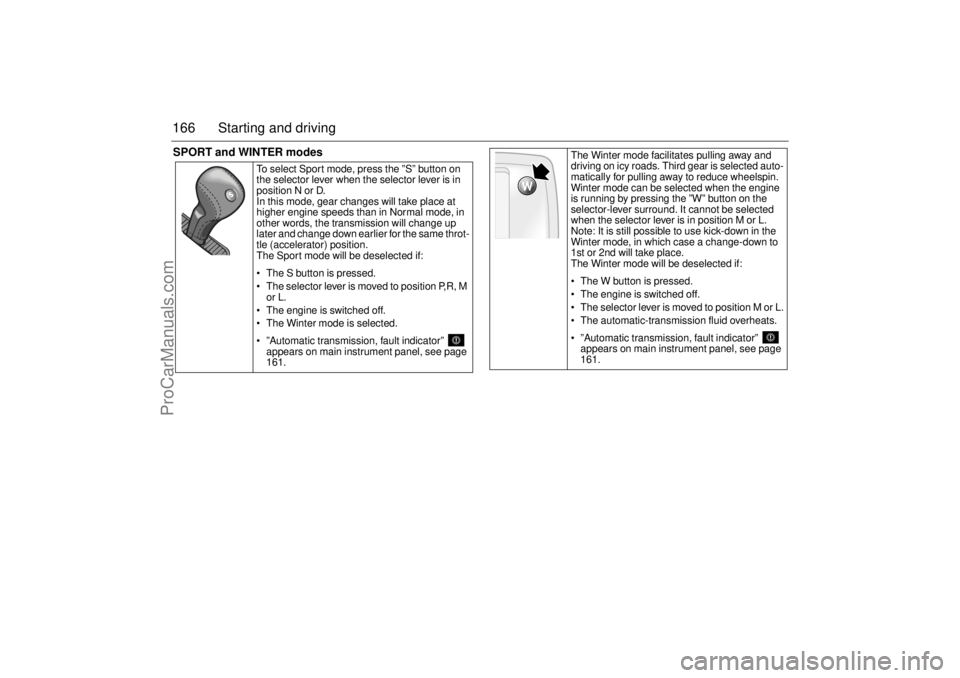
To select Sport mode, press the ”S” button on
the selector lever when the selector lever is in
position N or D.
In this mode, gear changes will take place at
higher engine speeds than in Normal mode, in
other words, the transmission will change up
later and change down earlier for the same throt-
tle (accelerator) position.
The Sport mode will be deselected if:
The S button is pressed.
The selector lever is moved to position P,R, M
or L.
The engine is switched off.
The Winter mode is selected.
”Automatic transmission, fault indicator”
appears on main instrument panel, see page
161.
The Winter mode facilitates pulling away and
driving on icy roads. Third gear is selected auto-
matically for pulling away to reduce wheelspin.
Winter mode can be selected when the engine
is running by pressing the ”W” button on the
selector-lever surround. It cannot be selected
when the selector lever is in position M or L.
Note: It is still possible to use kick-down in the
Winter mode, in which case a change-down to
1st or 2nd will take place.
The Winter mode will be deselected if:
The W button is pressed.
The engine is switched off.
The selector lever is moved to position M or L.
The automatic-transmission fluid overheats.
”Automatic transmission, fault indicator”
appears on main instrument panel, see page
161.
ProCarManuals.com
Page 177 of 288
177 Starting and driving
If winter tires are fitted, the same type must
be fitted on all wheels. Your Saab dealer will
be pleased to advise you on the best tires for
your car.
Remember that tires age. It may therefore
be necessary to change them before they
reach the legal wear limit, as they gradually
lose their friction properties.
The best response if the car gets into a
front-wheel skid is to freewheel (manual
gearbox only), i.e. disengage the clutch (so
that the wheels are neither driven or
retarded by the engine.
If the car has automatic transmission, ease
up on the accelerator and steer carefully in
the desired direction.
In a rear-wheel skid, steer in the same direc-
tion that the rear of the car is moving.
Tire chainsIf you want to fit tire chains (where legally
permitted) they should only be fitted to the
tires recommended under ”Specifications”
(see page 278).
Consult your Saab dealer for details of
approved tire chains.
Driving in hot weather Always check the coolant level before
starting a journey. The level should be just
below the MAX mark.
At the end of a journey, if the engine has
worked hard, allow it to idle for two or
three minutes before switching it off.
If the needle on the temperature gauge
enters the red zone:
1 Bring the car to a standstill but leave the
engine running. Do not remove the cap
on the expansion tank even if the tank is
empty. If the needle on the temperature
gauge continues to rise while the engine
is idling, switch off the engine.
WARNING
Do not exceed 30 mph (50 km/h)
when tire chains are fitted.
Tire chains can reduce the directional
stability of the car.
Tire chains must not be used on the
rear wheels. NOTICE Check the links frequently for wear.
Check that the chains do not contact
the wheel-arch liner at full lock.
See section ”Specifications”, page
278, for information on allowable
wheel dimensions for the fitting of tire
chains.
ProCarManuals.com
Page 181 of 288
181 Starting and driving
Recommendations for cars with manual
gearbox
Rises in coolant temperature are indicated
by the temperature gauge in the main instru-
ment panel.
The following steps are taken in order as the
temperature of the engine increases:
A/C compressor is switched off.
engine torque is reduced.
When continuing your journey, select a gear
in which the engine speed is about
3,000 rpm until the incline eases.
Driving considerations Always take extra care when towing a
trailer, as the car’s handling will be different
and its braking effect reduced. The trailer’s
braking system and suspension also have a
considerable effect on these characteris-
tics, see also ”Driving with a load” page 185.
If the car has automatic transmission, select
position D when ascending steep hills. This
ensures that the adaptive gear change pat-
terns are operational, see page 165. Use
position D or L for steep descents.
Checks before drivingMake sure that the car and caravan or trailer
are in good working order. This is essential
since towing a caravan increases the strain
on the car.
Check and if necessary adjust the tire
pressure of the car and caravan.
Make sure all wheel bolts are properly
tightened.
Make sure that the equipment joining the
car and caravan is properly secured and
adjusted.
Make sure the caravan’s electrical cable
is properly connected and is not so long
that it drags along the ground. Also, make
sure the cable is not too short and risks
breaking when turning a corner.
Check all bulbs.
Check the car and caravan brakes.
Make sure that all items on or in the cara-
van or trailer are properly secured.
Make sure that the caravan’s jockey
wheel is raised and locked.
Check the distribution of the load so that
the car and caravan are well balanced.
Check that the rearview mirrors provide
the best possible rearward vision.
Make sure the caravan’s safety cable is
correctly attached.
VARNING
Utilize the braking effect of the engine
(1st, 2nd or 3rd gear) when you are
descending long or steep hills to spare
the brakes.
Brake failure can result from overheated
brakes!
NOTICEIf the ”Automatic transmission, fault indi-
cator” indicator comes on, cease
towing until the problem has been recti-
fied.
ProCarManuals.com
Page 208 of 288
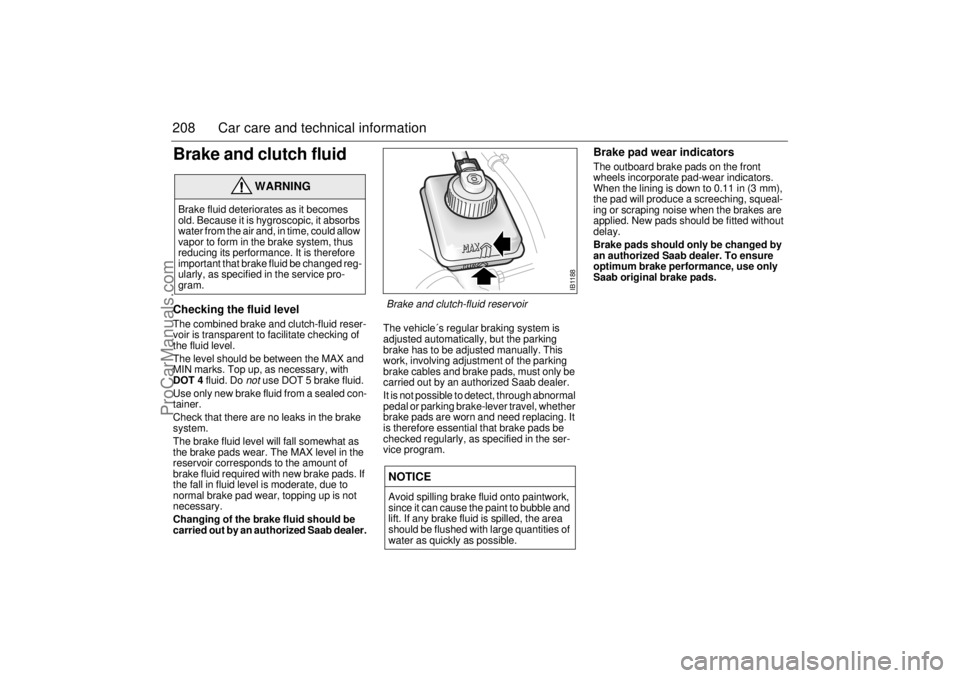
208 Car care and technical informationBrake and clutch fluid Checking the fluid level The combined brake and clutch-fluid reser-
voir is transparent to facilitate checking of
the fluid level.
The level should be between the MAX and
MIN marks. Top up, as necessary, with
DOT 4 fluid. Do
not
use DOT 5 brake fluid.
Use only new brake fluid from a sealed con-
tainer.
Check that there are no leaks in the brake
system.
The brake fluid level will fall somewhat as
the brake pads wear. The MAX level in the
reservoir corresponds to the amount of
brake fluid required with new brake pads. If
the fall in fluid level is moderate, due to
normal brake pad wear, topping up is not
necessary.
Changing of the brake fluid should be
carried out by an authorized Saab dealer.The vehicle´s regular braking system is
adjusted automatically, but the parking
brake has to be adjusted manually. This
work, involving adjustment of the parking
brake cables and brake pads, must only be
carried out by an authorized Saab dealer.
It is not possible to detect, through abnormal
pedal or parking brake-lever travel, whether
brake pads are worn and need replacing. It
is therefore essential that brake pads be
checked regularly, as specified in the ser-
vice program.
Brake pad wear indicators The outboard brake pads on the front
wheels incorporate pad-wear indicators.
When the lining is down to 0.11 in (3 mm),
the pad will produce a screeching, squeal-
ing or scraping noise when the brakes are
applied. New pads should be fitted without
delay.
Brake pads should only be changed by
an authorized Saab dealer. To ensure
optimum brake performance, use only
Saab original brake pads.
WARNING
Brake fluid deteriorates as it becomes
old. Because it is hygroscopic, it absorbs
water from the air and, in time, could allow
vapor to form in the brake system, thus
reducing its performance. It is therefore
important that brake fluid be changed reg-
ularly, as specified in the service pro-
gram.
NOTICEAvoid spilling brake fluid onto paintwork,
since it can cause the paint to bubble and
lift. If any brake fluid is spilled, the area
should be flushed with large quantities of
water as quickly as possible.
IB1188
Brake and clutch-fluid reservoir
ProCarManuals.com
Page 234 of 288

234 Car care and technical informationWhen to checkCheck your tires once a month or more.
Don’t forget your compact spare tire. It
should be at 60 psi (420 kPa).How to CheckUse a good quality pocket-type gage to
check tire pressure. You can’t tell if your
tires are properly inflated simply by looking
at them. Radial tires may look properly
inflated even when they’re underinflated.
Be sure to put the valve caps back on the
valve stems. They help prevent leaks by
keeping out dirt and moisture.Tire Inspection and RotationTires should be rotated every 7,500 miles
(12 500 km).
Any time you notice unusual wear, rotate
your tires as soon as possible and check
wheel alignment. Also check for damaged
tires or wheels. See “When It Is Time for
New Tires” on page 235 and “Wheel
Replacement” on page 238 for more infor-
mation.
The purpose of regular rotation is to achieve
more uniform wear for all tires on the vehi-
cle. The first rotation is the most important.
When rotating your tires, always use the
correct rotation pattern. Left front tire to left
rear. Left rear tire to right front. Right front to
right rear. Right rear to left front.
Don’t include the compact spare tire in your
tire rotation.After the tires have been rotated, adjust the
front and rear inflation pressures as shown
on the Tire-Loading Information label. Make
certain that all wheel nuts are properly tight-
ened. See page 250.
Flat spottingAll tires get hot, especially on long journeys
or when the car is driven hard. After the car
has been parked with hot tires and the tires
have cooled down, a flat spot can form in the
tire, where it is in contact with the ground.
The same can occur if the car has not been
moved for a long time.
Flat spots can cause vibration that can be
felt through the steering wheel, similar to
that experienced when the wheels need bal-
ancing.
Flat spots of this type disappear once the
tires get hot again, usually after 10–15 miles
(20–25 km) of driving at cruising speed.
WARNING
Rust or dirt on a wheel, or on the parts to
which it is fastened, can make wheel nuts
become loose after a time. The wheel
could come off and cause an accident.
When you change a wheel, remove any
rust or dirt from places where the wheel
attaches to the vehicle. In an emergency,
you can use a cloth or a paper towel to do
this; but be sure to use a scraper or wire
brush later, if you need to, to get all the
rust or dirt off. See “Changing a wheel” on
page 247.
ProCarManuals.com
Page 239 of 288

239 Car care and technical information
Tire Chains
Notice:
If your vehicle does not have
P225/45R17 size tires, use tire chains
only where legal and only when you
must. Use only SAE Class ²S² type
chains that are the proper size for your
tires. Install them on the front tires and
tighten them as tightly as possible with
the ends securely fastened. Drive slowly
and follow the chain manufacturer’s
instructions. If you can hear the chains
contacting your vehicle, stop and
retighten them. If the contact continues,
slow down until it stops. Driving too fast
or spinning the wheels with chains on
will damage your vehicle.If a Tire Goes Flat
It’s unusual for a tire to “blowout” while
you’re driving, especially if you maintain
your tires properly. If air goes out of a tire,
it’s much more likely to leak out slowly. But
if you should ever have a “blowout”, here are
a few tips about what to expect and what to
do:
If a front tire fails, the flat tire will create a
drag that pulls the vehicle toward that side.
Take your foot off the accelerator pedal and
grip the steering wheel firmly. Steer to main-
tain lane position, and then gently brake to
a stop well out of the traffic lane.
A rear blowout, particularly on a curve, acts
much like a skid and may require the same
correction you’d use in a skid. In any rear
blowout, remove your foot from the acceler-
ator pedal. Get the vehicle under control by
steering the way you want the vehicle to go.
It may be very bumpy and noisy, but you can
still steer. Gently brake to a stop – well off
the road if possible.
If a tire goes flat, the next part shows how to
use your jacking equipment to change a flat
tire safely.
WARNING
If your vehicle has P225/45 R17 size tires,
don’t use tire chains, there’s not enough
clearance.
Tire chains used on a vehicle without the
proper amount of clearance can cause
damage to the brakes, suspension or
other vehicle parts. The area damaged by
the tire chains could cause you to lose
control of your vehicle and you or others
may be injured in a crash.
Use another type of traction device only if
its manufacturer recommends it for use
on your vehicle and tire size combination
and road conditions. Follow that manu-
facturer’s instructions. To help avoid
damage to your vehicle, drive slowly,
readjust or remove the device if it’s con-
tacting your vehicle, and don’t spin your
wheels.
If you do find traction devices that will fit,
install them on the front tires.
ProCarManuals.com
Page 246 of 288
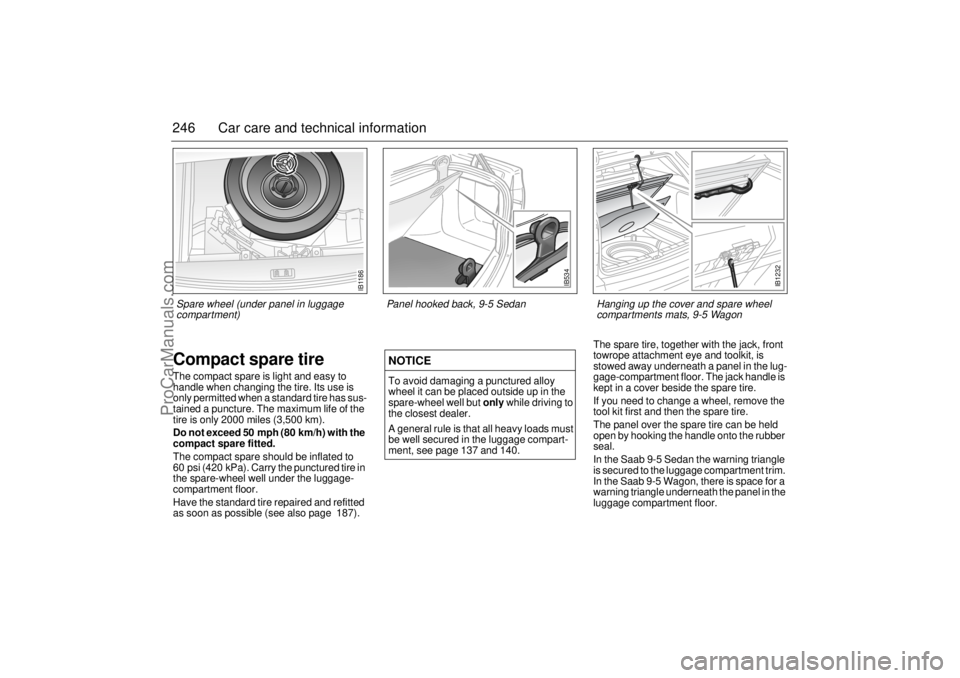
246 Car care and technical informationCompact spare tireThe compact spare is light and easy to
handle when changing the tire. Its use is
only permitted when a standard tire has sus-
tained a puncture. The maximum life of the
tire is only 2000 miles (3,500 km).
Do not exceed 50 mph (80 km/h) with the
compact spare fitted.
The compact spare should be inflated to
60 psi (420 kPa). Carry the punctured tire in
the spare-wheel well under the luggage-
compartment floor.
Have the standard tire repaired and refitted
as soon as possible (see also page 187).The spare tire, together with the jack, front
towrope attachment eye and toolkit, is
stowed away underneath a panel in the lug-
gage-compartment floor. The jack handle is
kept in a cover beside the spare tire.
If you need to change a wheel, remove the
tool kit first and then the spare tire.
The panel over the spare tire can be held
open by hooking the handle onto the rubber
seal.
In the Saab 9-5 Sedan the warning triangle
is secured to the luggage compartment trim.
In the Saab 9-5 Wagon, there is space for a
warning triangle underneath the panel in the
luggage compartment floor.
NOTICETo avoid damaging a punctured alloy
wheel it can be placed outside up in the
spare-wheel well but only while driving to
the closest dealer.
A general rule is that all heavy loads must
be well secured in the luggage compart-
ment, see page 137 and 140.
IB534
Panel hooked back, 9-5 Sedan
IB1232
Hanging up the cover and spare wheel
compartments mats, 9-5 Wagon
IB1186
Spare wheel (under panel in luggage
compartment)
ProCarManuals.com
Page 247 of 288

247 Car care and technical information
Changing a wheel
WARNING
The car jack is designed solely for use
in changing a wheel or fitting snow
chains. It must not be used to sup-
port the car during repair work or
servicing.
Never crawl under a car that is
supported only by a jack.
Special care must be taken if the car is
on a slope – use wheel chocks!
Position chocks, one ahead and one
behind, the wheel that is diagonally
opposite to the one to be changed.
Switch on the hazard warning lights if
the car is on a road.
Apply the parking brake and leave the
car in gear (1st or reverse). Automatic
transmission: move selector to the
P position.
Ensure that everybody is out of the car
before jacking it up.
Never start the engine while the car is
jacked up.
The jack must stand on a firm, level
surface.
Stow the jack in the place provided for
it under the panel in the floor of the
trunk. Secure it properly to avoid injury
to passengers in the event of a crash.
Do not use the jack for any purpose
other than for jacking up the car.
Grit, salt and rust can clog the inner
threads of the wheel bolts if the car has
been driven for several years exclu-
sively with alloy wheels.
If steel wheels are now fitted, the bolt
hole threads in the brake hubs should
be cleaned before the thinner steel
wheels are fitted. It may otherwise not
be possible to achieve the required
clamping force despite tightening the
bolts to the correct torque.
ProCarManuals.com
Page 283 of 288

283 Index
Index
AA/C system, fault diagnosis
_______ 252
A/C system, maintenance
_________ 252
ABS brakes
____________________ 168
ACC
__________________________ 75
ACC functions
___________________ 78
ACC, automatic climate control
_____ 75
ACC, calibration
_________________ 83
ACC, condensation _______________ 84
ACC, programming _______________ 81
ACC, useful tips
_________________ 83
Adjusting the steering wheel
_______ 120
Adjustment, seats
________________ 12
Air conditioning (A/C), fault diagnosis
and maintenance ______________ 252
Air distribution, ACC ______________ 80
Airbag
_________________________ 31
Alarm _________________________ 46
Alarm functions
__________________ 49
Alarm signals
________________ 46
, 49
Alternator
_____________________ 212
Alternator drive belt
__________ 212
, 275
Alternator rating
________________ 275
Anticorrosion treatment
___________ 256
Antidazzle rear-view mirror
________ 125
Ashtrays
______________________ 131
Audio System
___________________ 85
Audio System, quick guide
_________ 87
Autochecking of lights on starting
____ 60Automatic climate control (ACC)
_____ 75
Automatic transmission, technical
data
_________________________ 276
Aviod theft, tip
__________________ 197
BBattery
________________________ 210
Battery charging/replacing
________ 211
Battery, boost starting
____________ 191
Before a long journey ____________ 258
Before towing a camper or trailer
___ 181
Belt guide
______________________ 17
Boost starting using jump leads
____ 191
Brake and clutch fluid
____________ 208
Brake-fluid reservoir
_____________ 208
Brakes, technical data ____________ 277
Bulbs, changing
________________ 215
Bulbs, table of
__________________ 226
Buying new tires ________________ 235
CCD changer
_____________________ 97
CD player
______________________ 95
CHECK messages
_______________ 67
CHECKING
_____________________ 67
Calibration, ACC
_________________ 83
Cancelling the programmed settings
_81
Car alarm
______________________ 46
Car care
______________________ 199
Cargo net, 9-5 Wagon
____________ 142Carpeting, care of
_______________ 253
Cassette player
__________________ 92
Catalytic converter, important
considerations _________________ 152
Central locking ___________________ 40
Change language in SID
___________ 68
Change of address notification
_____ 266
Changing a wheel
_______________ 247
Changing bulbs
_________________ 215
Changing wiper blades
___________ 213
Charger/Jump starting ____________ 193
Charging the battery/Jump starting
__ 193
Chassis number
________________ 280
Chassis number, key to
___________ 281
Checks before towing a camper or
trailer
________________________ 181
Child safety
_____________________ 23
Child safety locks, rear doors
_______ 43
Cleaning, engine bay
_____________ 255
Clock
_______________________ 67
, 68
Color code, body
________________ 280
Color code, trim _________________ 280
Compact spare wheel
____________ 246
Compass
______________________ 126
Condensation, ACC
_______________ 84
Coolant
_______________________ 207
Courtesy Headlight Feature
________ 70
Cruise control
__________________ 167
Cup holder
_____________________ 134
ProCarManuals.com
Page 285 of 288

285 Index
JJack
_________________________ 249
KKey
___________________________ 40
Key to chassis number
___________ 281
Key, remove
___________________ 148
LLATCH (child safety)
______________ 24
Labeling, tire sidewall ____________ 240
Labels
__________________________ 7
Leather upholstery, care of
________ 253
Light horn
______________________ 69
Light switches ___________________ 69
Loading your vehicle
_____________ 242
Luggage-compartment lighting
_____ 130
MMain instrument panel
____________ 54
Main/dipped beam
_______________ 69
Maintenance schedule ___________ 264
Maintenance, A/C-system _________ 252
Manual gearbox, technical data
____ 276
Maxi fuses
_____________________ 228
Milometer ______________________ 60
Motoring abroad
________________ 258
NNew tires, buying
_______________ 235
Night Panel
_____________________ 67
OOil capacity, engine
______________ 272
Oil change, engine ______________ 204
Oil specification
_________________ 272
OnStar
________________________ 107
Outdoor temperature
______________ 63
Owner assistance
_______________ 265
PPaintwork, touching-in
____________ 255
Parking Assistance
______________ 194
Parking lights
___________________ 69
Plates and labels ________________ 280
Poly-V-belt
____________________ 212
Power steering _________________ 209
Power-steering fluid
_____________ 209
Pressure gauge
__________________ 62
Programming I, ACC
______________ 81
Programming II, ACC _____________ 82
Programming the ACC ____________ 81
QQuality grading, tires
_____________ 237
Questions on function of airbag
______ 37
Quick guide, Audio System
_________ 87
RRadiator fan
____________________ 212
Radio
__________________________ 90
Rain sensor
_____________________ 73
Rear fog light ____________________ 70
Rear seat, 9-5 Sedan, folding
______ 135
Rear seat, 9-5 Wagon, folding ______ 138
Rear-seat head restraints
__________ 16
Rear-view mirror, antidazzle _______ 125
Rearview mirrors
________________ 121
Reclamation
___________________ 258
Recommendations for cars with
automatic transmission, towing a
camper or trailer
_______________ 179
Refuelling
_____________________ 154
Relay panel ____________________ 230
Remote control __________________ 40
Remote-control battery, changing
____ 43
Remove the key
________________ 148
Replacement, wheel _____________ 238
Reporting safety defects __________ 266
Reprogramming of systems _______ 282
Reservoir, power-steering fluid _____ 209
Rev counter
_____________________ 60
Reversing lights
__________________ 72
ProCarManuals.com