power steering SAAB 9-5 2004 User Guide
[x] Cancel search | Manufacturer: SAAB, Model Year: 2004, Model line: 9-5, Model: SAAB 9-5 2004Pages: 288, PDF Size: 16.91 MB
Page 242 of 288
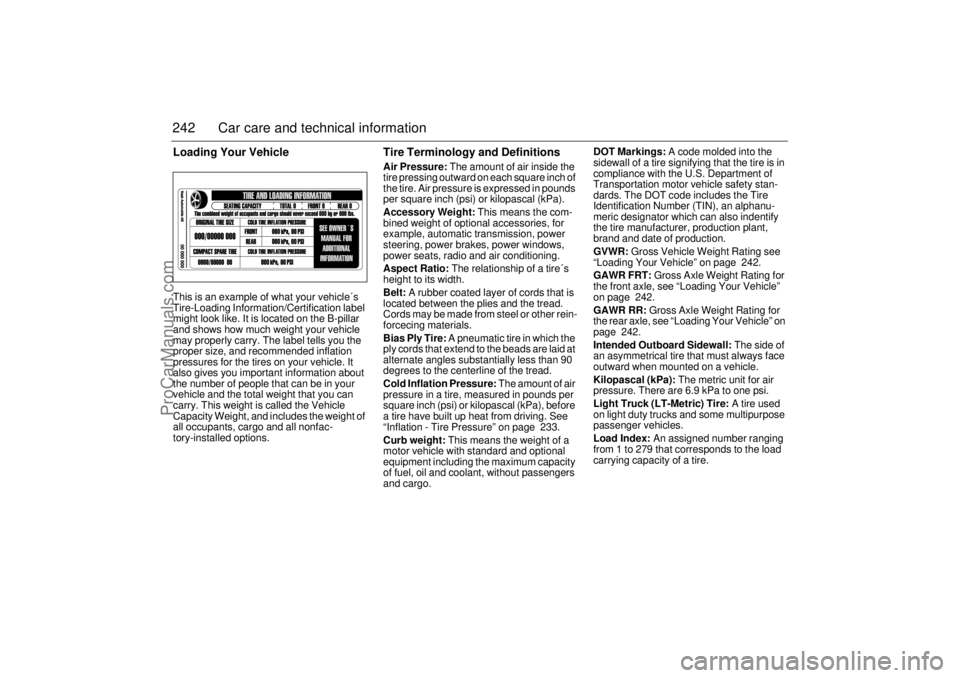
242 Car care and technical informationLoading Your VehicleThis is an example of what your vehicle´s
Tire-Loading Information/Certification label
might look like. It is located on the B-pillar
and shows how much weight your vehicle
may properly carry. The label tells you the
proper size, and recommended inflation
pressures for the tires on your vehicle. It
also gives you important information about
the number of people that can be in your
vehicle and the total weight that you can
carry. This weight is called the Vehicle
Capacity Weight, and includes the weight of
all occupants, cargo and all nonfac-
tory-installed options.
Tire Terminology and DefinitionsAir Pressure: The amount of air inside the
tire pressing outward on each square inch of
the tire. Air pressure is expressed in pounds
per square inch (psi) or kilopascal (kPa).
Accessory Weight: This means the com-
bined weight of optional accessories, for
example, automatic transmission, power
steering, power brakes, power windows,
power seats, radio and air conditioning.
Aspect Ratio: The relationship of a tire´s
height to its width.
Belt: A rubber coated layer of cords that is
located between the plies and the tread.
Cords may be made from steel or other rein-
forcecing materials.
Bias Ply Tire: A pneumatic tire in which the
ply cords that extend to the beads are laid at
alternate angles substantially less than 90
degrees to the centerline of the tread.
Cold Inflation Pressure: The amount of air
pressure in a tire, measured in pounds per
square inch (psi) or kilopascal (kPa), before
a tire have built up heat from driving. See
“Inflation - Tire Pressure” on page 233.
Curb weight: This means the weight of a
motor vehicle with standard and optional
equipment including the maximum capacity
of fuel, oil and coolant, without passengers
and cargo.DOT Markings: A code molded into the
sidewall of a tire signifying that the tire is in
compliance with the U.S. Department of
Transportation motor vehicle safety stan-
dards. The DOT code includes the Tire
Identification Number (TIN), an alphanu-
meric designator which can also indentify
the tire manufacturer, production plant,
brand and date of production.
GVWR: Gross Vehicle Weight Rating see
“Loading Your Vehicle” on page 242.
GAWR FRT: Gross Axle Weight Rating for
the front axle, see “Loading Your Vehicle”
on page 242.
GAWR RR: Gross Axle Weight Rating for
the rear axle, see “Loading Your Vehicle” on
page 242.
Intended Outboard Sidewall: The side of
an asymmetrical tire that must always face
outward when mounted on a vehicle.
Kilopascal (kPa): The metric unit for air
pressure. There are 6.9 kPa to one psi.
Light Truck (LT-Metric) Tire: A tire used
on light duty trucks and some multipurpose
passenger vehicles.
Load Index: An assigned number ranging
from 1 to 279 that corresponds to the load
carrying capacity of a tire.
ProCarManuals.com
Page 258 of 288

258 Car care and technical information4Inspect the undercoating and touch
up if necessary.
Pay particular atten-
tion to the fenders and wheel housings,
which are exposed to abrasion by flying
gravel, etc. If the composition has worn
or flaked off, the steel must be thor-
oughly cleaned and dried before a fresh
coat is applied. The cleaning is best
done with a scraper and a steel wire
brush, followed by washing with solvent.
Apply the new coating thinly, as other-
wise it may run off or fall off when dry.
For long tripsBefore setting off on a long journey, it is
advisable to have your car checked over by
your Saab dealer.
Obtain a few important items to take along
on your journey such as spare bulbs, wiper
blades, fuses, a Poly-V-belt and the like.
You can check some points yourself before-
hand:
Make sure that the engine is in good con-
dition.
Check that no oil or gasoline leaks out of
the engine or gearbox/transmission.
Check the coolant and power steering
fluid levels. Check also for leaks.
Inspect the Poly-V-belt and replace it if it
shows any signs of hard wear.
Check the battery charge.
Check the tires for tread pattern and air
pressure, including the compact spare
wheel.
Check the brakes.
Check all bulbs.
Check for the presence of the tool kit and
the jack in the car.
Recovery and/or
recycling of automotive
materialsA typical car consists of metals (65–75 %),
plastics (10–15 %), rubber (5 %) and small
quantities of glass, wood, paper and tex-
tiles. The recycling of metals has been com-
monplace for a long time now.
To facilitate sorting of other materials for
recycling, plastic parts, for instance, have
been marked to identify the precise nature
of the plastic.
The quantity of materials in the car that can
be recycled or recovered depends on the
scrapping facilities in different countries. EU
legislation that comes into force in 2006 will
require a minimum of 85 % of the total
weight of materials to be recycled. How-
ever, every major car salvage yard in each
market will receive details from Saab of how
the highest percentage of materials can be
reclaimed.
ProCarManuals.com
Page 277 of 288

277 Specifications
Suspension
Steering Brake system Spring type, front and rear ___________ Coil springs
Maximum deflection of springs:
Front __________________________ 7.09 in (180 mm)
Rear ___________________________ 7.87 in (200 mm)
Dampers, front and rear _____________ Gas-filled dampers
Steering _________________________ Power-assisted
steering of
rack-and-pinion
type; telescopic
steering-column
shaft with universal
joints
Number of turns, lock to lock __________ 2,9
Power-steering fluid ________________ Power-steering fluid
CHF 11S Footbrake (ABS) ____________________ Hydraulic, dual-cir-
cuit brake system.
Diagonally split cir-
cuit with vacuum
servo unit. Disc
brakes front and
rear. EBD, see page
168.
Handbrake ________________________ Acts on rear wheels
Brake fluid _________________________ DOT 4
Brake-fluid capacity _________________ 0.925 qts (900 ml)
Disc diameter:
Front, ventilated ___________________ 11.34 in (288 mm)
Front, ventilated, certain variants *) ____ 12.05 in (306 mm)
Rear, solid _______________________ 11.26 in (286 mm)
Rear, ventilated, certain variants *) ____ 11.81 in (300 mm)
*) 15” wheel must not be used on these
variants.
Total friction area of brake pads:
Front ___________________________ 36.3 in
2 (234 cm
2)
Rear ___________________________ 15.5 in
2 (100 cm
2)
ProCarManuals.com
Page 285 of 288

285 Index
JJack
_________________________ 249
KKey
___________________________ 40
Key to chassis number
___________ 281
Key, remove
___________________ 148
LLATCH (child safety)
______________ 24
Labeling, tire sidewall ____________ 240
Labels
__________________________ 7
Leather upholstery, care of
________ 253
Light horn
______________________ 69
Light switches ___________________ 69
Loading your vehicle
_____________ 242
Luggage-compartment lighting
_____ 130
MMain instrument panel
____________ 54
Main/dipped beam
_______________ 69
Maintenance schedule ___________ 264
Maintenance, A/C-system _________ 252
Manual gearbox, technical data
____ 276
Maxi fuses
_____________________ 228
Milometer ______________________ 60
Motoring abroad
________________ 258
NNew tires, buying
_______________ 235
Night Panel
_____________________ 67
OOil capacity, engine
______________ 272
Oil change, engine ______________ 204
Oil specification
_________________ 272
OnStar
________________________ 107
Outdoor temperature
______________ 63
Owner assistance
_______________ 265
PPaintwork, touching-in
____________ 255
Parking Assistance
______________ 194
Parking lights
___________________ 69
Plates and labels ________________ 280
Poly-V-belt
____________________ 212
Power steering _________________ 209
Power-steering fluid
_____________ 209
Pressure gauge
__________________ 62
Programming I, ACC
______________ 81
Programming II, ACC _____________ 82
Programming the ACC ____________ 81
QQuality grading, tires
_____________ 237
Questions on function of airbag
______ 37
Quick guide, Audio System
_________ 87
RRadiator fan
____________________ 212
Radio
__________________________ 90
Rain sensor
_____________________ 73
Rear fog light ____________________ 70
Rear seat, 9-5 Sedan, folding
______ 135
Rear seat, 9-5 Wagon, folding ______ 138
Rear-seat head restraints
__________ 16
Rear-view mirror, antidazzle _______ 125
Rearview mirrors
________________ 121
Reclamation
___________________ 258
Recommendations for cars with
automatic transmission, towing a
camper or trailer
_______________ 179
Refuelling
_____________________ 154
Relay panel ____________________ 230
Remote control __________________ 40
Remote-control battery, changing
____ 43
Remove the key
________________ 148
Replacement, wheel _____________ 238
Reporting safety defects __________ 266
Reprogramming of systems _______ 282
Reservoir, power-steering fluid _____ 209
Rev counter
_____________________ 60
Reversing lights
__________________ 72
ProCarManuals.com