spare wheel SAAB 9-5 2004 User Guide
[x] Cancel search | Manufacturer: SAAB, Model Year: 2004, Model line: 9-5, Model: SAAB 9-5 2004Pages: 288, PDF Size: 16.91 MB
Page 234 of 288

234 Car care and technical informationWhen to checkCheck your tires once a month or more.
Don’t forget your compact spare tire. It
should be at 60 psi (420 kPa).How to CheckUse a good quality pocket-type gage to
check tire pressure. You can’t tell if your
tires are properly inflated simply by looking
at them. Radial tires may look properly
inflated even when they’re underinflated.
Be sure to put the valve caps back on the
valve stems. They help prevent leaks by
keeping out dirt and moisture.Tire Inspection and RotationTires should be rotated every 7,500 miles
(12 500 km).
Any time you notice unusual wear, rotate
your tires as soon as possible and check
wheel alignment. Also check for damaged
tires or wheels. See “When It Is Time for
New Tires” on page 235 and “Wheel
Replacement” on page 238 for more infor-
mation.
The purpose of regular rotation is to achieve
more uniform wear for all tires on the vehi-
cle. The first rotation is the most important.
When rotating your tires, always use the
correct rotation pattern. Left front tire to left
rear. Left rear tire to right front. Right front to
right rear. Right rear to left front.
Don’t include the compact spare tire in your
tire rotation.After the tires have been rotated, adjust the
front and rear inflation pressures as shown
on the Tire-Loading Information label. Make
certain that all wheel nuts are properly tight-
ened. See page 250.
Flat spottingAll tires get hot, especially on long journeys
or when the car is driven hard. After the car
has been parked with hot tires and the tires
have cooled down, a flat spot can form in the
tire, where it is in contact with the ground.
The same can occur if the car has not been
moved for a long time.
Flat spots can cause vibration that can be
felt through the steering wheel, similar to
that experienced when the wheels need bal-
ancing.
Flat spots of this type disappear once the
tires get hot again, usually after 10–15 miles
(20–25 km) of driving at cruising speed.
WARNING
Rust or dirt on a wheel, or on the parts to
which it is fastened, can make wheel nuts
become loose after a time. The wheel
could come off and cause an accident.
When you change a wheel, remove any
rust or dirt from places where the wheel
attaches to the vehicle. In an emergency,
you can use a cloth or a paper towel to do
this; but be sure to use a scraper or wire
brush later, if you need to, to get all the
rust or dirt off. See “Changing a wheel” on
page 247.
ProCarManuals.com
Page 236 of 288

236 Car care and technical informationThe wheels and tires have been carefully
matched to the characteristics of the car and
play a key role in its outstanding roadhold-
ing and handling.
Do not take it for granted that a wheel/tire
combination will work in the best possible
way, just because it can be fitted to the car.
To ensure that the speedometer is as accu-
rate as possible it should be reprogrammed
if wheels of a different dimension are fitted.
Contact a Saab dealer.
Because of front wheel drive, the front tires
tend to wear faster than the rear ones. New
tires should always be fitted in pairs, so that
tires on the same axle have the same
amount of tread.
Store wheels lying flat or hanging – never
standing upright.
NOTICEAlways consult your Saab dealer before
changing the wheels and tires on your
Saab.
Wide wheels and tires with sidewalls that
are too low can:
be damaged in potholes etc.
cause springs, shock absorbers and
wheel bearings and body mountings
can be overloaded.
cause that the wheels can come into
contact with chassis and body compo-
nents.
can affect the function of the Elec-
tronic Stability Program (ESP).
The speed and load limits for the tires
must not be exceeded; see page 241.
Wheels larger than 17” must not be fitted.
The maximum permissible offset is
49 mm.
WARNING
Mixing tires could cause you to lose con-
trol while driving. If you mix tires of differ-
ent sizes or types (radial and bias-belted
tires), the vehicle may not handle prop-
erly, and you could have a crash. Using
tires of different sizes may also cause
damage to your vehicle. Be sure to use
the same size and type tires on all wheels.
It’s all right to drive with your compact
spare temporarily, it was developed for
use on your vehicle. See “Compact spare
tire” on page 246.
WARNING
If you use bias-ply tires on your vehicle,
the wheel rim flanges could develop
cracks after many miles of driving. A tire
and/or wheel could fail suddenly, causing
a crash. Use only radial-ply tires with the
wheels on your vehicle.
ProCarManuals.com
Page 237 of 288

237 Car care and technical information
Uniform Tire Quality GradingQuality grades can be found where applica-
ble on the tire sidewall between tread shoul-
der and maximum section width. For exam-
ple:
Treadwear 200 Traction AA Temperature
A
The following information relates to the
system developed by the United States
National Highway Traffic Safety Administra-
tion, which grades tires by treadwear, trac-
tion and temperature performance. (This
applies only to vehicles sold in the United
States.) The grades are molded on the side-
walls of most passenger car tires. The Uni-
form Tire Quality Grading system does not
apply to deep tread, winter-type snow tires,
space-saver or temporary use spare tires,
tires with nominal rim diameters of 10 to 12
inches (25 to 30 cm), or to some limited-pro-
duction tires.
While the tires available on General Motors
passenger cars and light trucks may vary
with respect to these grades, they must also
conform to federal safety requirements and
additional General Motors Tire Perfor-
mance Criteria (TPC) standards.Treadwear
The treadwear grade is a comparative
rating based on the wear rate of the tire
when tested under controlled conditions on
a specified government test course. For
example, a tire graded 150 would wear one
and a half (1.5) times as well on the govern-
ment course as a tire graded 100. The rela-
tive performance of tires depends upon the
actual conditions of their use, however, and
may depart significantly from the norm due
to variations in driving habits, service prac-
tices and differences in road characteristics
and climate.
Traction – AA, A, B, C
The traction grades, from highest to lowest,
are AA, A, B, and C. Those grades repre-
sent the tire’s ability to stop on wet pave-
ment as measured under controlled condi-
tions on specified government test surfaces
of asphalt and concrete. A tire marked C
may have poor traction performance. Warn-
ing: The traction grade assigned to this tire
is based on straight-ahead braking traction
tests, and does not include acceleration,
cornering, hydroplaning, or peak traction
characteristics.Temperature – A, B, C
The temperature grades are A (the highest),
B, and C, representing the tire’s resistance
to the generation of heat and its ability to dis-
sipate heat when tested under controlled
conditions on a specified indoor laboratory
test wheel. Sustained high temperature can
cause the material of the tire to degenerate
and reduce tire life, and excessive temper-
ature can lead to sudden tire failure. The
grade C corresponds to a level of perfor-
mance which all passenger car tires must
meet under the Federal Motor Vehicle
Safety Standard No. 109. Grades B and A
represent higher levels of performance on
the laboratory test wheel than the minimum
required by law.
Warning: The temperature grade for this tire
is established for a tire that is properly
inflated and not overloaded. Excessive
speed, underinflation, or excessive loading,
either separately or in combination, can
cause heat buildup and possible tire failure.
ProCarManuals.com
Page 246 of 288
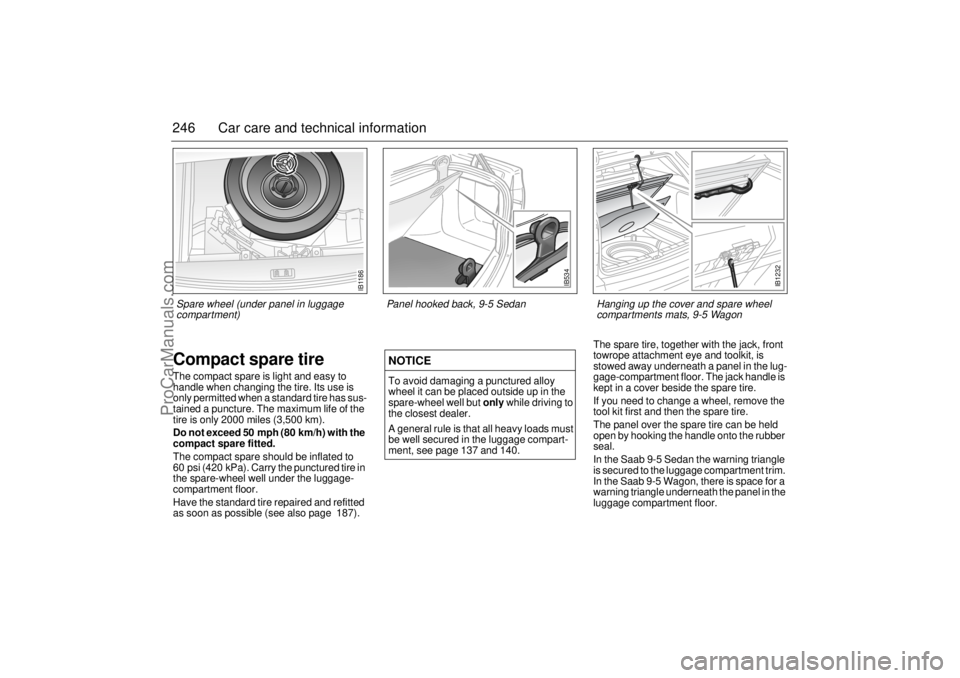
246 Car care and technical informationCompact spare tireThe compact spare is light and easy to
handle when changing the tire. Its use is
only permitted when a standard tire has sus-
tained a puncture. The maximum life of the
tire is only 2000 miles (3,500 km).
Do not exceed 50 mph (80 km/h) with the
compact spare fitted.
The compact spare should be inflated to
60 psi (420 kPa). Carry the punctured tire in
the spare-wheel well under the luggage-
compartment floor.
Have the standard tire repaired and refitted
as soon as possible (see also page 187).The spare tire, together with the jack, front
towrope attachment eye and toolkit, is
stowed away underneath a panel in the lug-
gage-compartment floor. The jack handle is
kept in a cover beside the spare tire.
If you need to change a wheel, remove the
tool kit first and then the spare tire.
The panel over the spare tire can be held
open by hooking the handle onto the rubber
seal.
In the Saab 9-5 Sedan the warning triangle
is secured to the luggage compartment trim.
In the Saab 9-5 Wagon, there is space for a
warning triangle underneath the panel in the
luggage compartment floor.
NOTICETo avoid damaging a punctured alloy
wheel it can be placed outside up in the
spare-wheel well but only while driving to
the closest dealer.
A general rule is that all heavy loads must
be well secured in the luggage compart-
ment, see page 137 and 140.
IB534
Panel hooked back, 9-5 Sedan
IB1232
Hanging up the cover and spare wheel
compartments mats, 9-5 Wagon
IB1186
Spare wheel (under panel in luggage
compartment)
ProCarManuals.com
Page 248 of 288
248 Car care and technical information
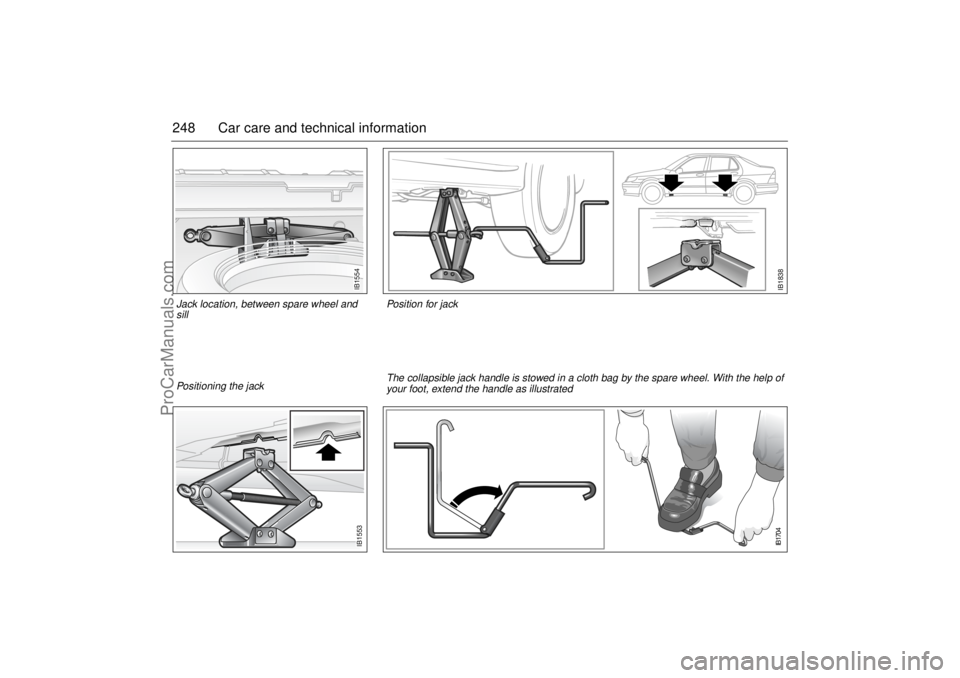
Position for jack
IB1838
IB1553
Positioning the jackThe collapsible jack handle is stowed in a cloth bag by the spare wheel. With the help of
your foot, extend the handle as illustrated
IB1554
Jack location, between spare wheel and
sill
IB1704
ProCarManuals.com
Page 258 of 288

258 Car care and technical information4Inspect the undercoating and touch
up if necessary.
Pay particular atten-
tion to the fenders and wheel housings,
which are exposed to abrasion by flying
gravel, etc. If the composition has worn
or flaked off, the steel must be thor-
oughly cleaned and dried before a fresh
coat is applied. The cleaning is best
done with a scraper and a steel wire
brush, followed by washing with solvent.
Apply the new coating thinly, as other-
wise it may run off or fall off when dry.
For long tripsBefore setting off on a long journey, it is
advisable to have your car checked over by
your Saab dealer.
Obtain a few important items to take along
on your journey such as spare bulbs, wiper
blades, fuses, a Poly-V-belt and the like.
You can check some points yourself before-
hand:
Make sure that the engine is in good con-
dition.
Check that no oil or gasoline leaks out of
the engine or gearbox/transmission.
Check the coolant and power steering
fluid levels. Check also for leaks.
Inspect the Poly-V-belt and replace it if it
shows any signs of hard wear.
Check the battery charge.
Check the tires for tread pattern and air
pressure, including the compact spare
wheel.
Check the brakes.
Check all bulbs.
Check for the presence of the tool kit and
the jack in the car.
Recovery and/or
recycling of automotive
materialsA typical car consists of metals (65–75 %),
plastics (10–15 %), rubber (5 %) and small
quantities of glass, wood, paper and tex-
tiles. The recycling of metals has been com-
monplace for a long time now.
To facilitate sorting of other materials for
recycling, plastic parts, for instance, have
been marked to identify the precise nature
of the plastic.
The quantity of materials in the car that can
be recycled or recovered depends on the
scrapping facilities in different countries. EU
legislation that comes into force in 2006 will
require a minimum of 85 % of the total
weight of materials to be recycled. How-
ever, every major car salvage yard in each
market will receive details from Saab of how
the highest percentage of materials can be
reclaimed.
ProCarManuals.com
Page 270 of 288

270 SpecificationsGeneral Overall length, including bumpers:
9-5 Sedan _______________________ 190.0 in (4827 mm)
9-5 Wagon ______________________ 190.1 in (4828 mm)
Overall width, including door mirrors ____ 80.4 in (2042 mm)
Maximum height:
9-5 Sedan _______________________ 58.1 in (1475 mm)
9-5 Wagon ______________________ 59.1 in (1501 mm)
Wheelbase _______________________ 106.4 in (2703 mm)
Ground clearance __________________ approx. 6.6 in
(167 mm)
Tr a c k :
Front __________________________ 59.9 in (1522 mm) *)
Rear ___________________________ 59.9 in (1522 mm) *)
Turning circle (curb to curb) ___________ 37,1 ft (11.3 m)
Turning circle (measured at vehicle extrem-
ities) ___________________________ 39,0 ft (11.9 m)
Number of seats (incl. driver) _________ 5
*) Specified track applies to wheel sizes:
6 x 15 & 6.5 x 16
Gross vehicle weight
(GVW)
Maximum train
weight
(GVW + max. trailer
weight)
Maximum axle load,
front
Maximum axle load,
rear Permissible load (in addition to driver) = GVW minus curb weight
The maximum permissible axle load, front or rear, must not be exceeded.
The maximum permissible axle load, front or rear, must not be exceeded. Chassis number in engine bay Weight ready for driving (i.e. with full fuel
tank, washer-fluid reservoir, standard
tools and spare wheel) ______________ 3460–3780 lbs.
(1570–1715 kg)
Gross vehicle weight (GVW) ___________ 4390–4710 lbs.
(1990–2135 kg)
Maximum axle load:
Front ___________________________ 2590 lbs. (1175 kg)
Rear, 9-5 Sedan ___________________ 2310 lbs. (1050 kg)
Rear, 9-5 Wagon __________________ 2480 lbs. (1125 kg)
Weight distribution:
Curb weight, front/rear ______________ 60/40 %
GVW, front/rear ___________________ 50/50 %
Maximum roof load __________________ 220 lbs (100 kg)
IB1917
ProCarManuals.com
Page 278 of 288

278 SpecificationsWheels and tires
(recommended dimensions)
2.3t 2.3 Turbo 2.3T
Summer tires205/65 R15 94 V X – –
215/55 R16 93 V X X X
225/45 R17 94 W XL/RF X X XWinter tires205/65 R15 94 Q X – –
205/55 R16 91 Q X X X
215/55 R16 93 Q X X X
225/45 R17 94 Q XL/RF X X XWheel sizes6 x 15” X – –
6,5 x 16” X X X
7 x 17” X X X15" wheels must not be fitted to the 2.3 Turbo and 2.3T since the size of
the brake discs prohibits this.
Speed ratings and load indices, see page 241.
Always contact an authorized Saab dealer if you wish to fit other wheels
or tires than those fitted as standard.
Compact spare:
Wheel ___________________________ 4 x 16
Tire _____________________________ T115/70 R16
Pressure_________________________ 60 psi (420 kPa)
Maximum life _____________________ 2,200 miles
(3500 km)
Maximum speed __________________ 50 mph (80 km/h)NOTICESnow chains:
Snow chains must not be fitted to the rear wheels, and may only
be used with the following wheel-tire combinations:
Wheels Tires
6 x 15*)_____ 205/65 R15
6.5 x 16_____205/55 R16 M+S or
215/55 R16
Snow chains must not be fitted to 17" wheels.
Max. permissible speed with snow chains fitted is 30 mph
(50 km/h).
Contact an authorized Saab dealer for advice on snow chains.NOTICEWheels larger than 17” must not be fitted.
Wheel offset must be 49 mm.
Vehicles with 12.05 in (306 mm) front brake discs must not use
15” rims.
ProCarManuals.com
Page 279 of 288

279 Specifications
Lowest recommended tire pressure, cold tiresTire size Load/speed
mph (km/h)
1)
Fr o nt
kPa/psiRear
kPa/psi
205/65 R15 94 V 1–3 pers./0–100 (0–160) 230/33 210/30
4–5 pers./0–100 (0–160) 230/33 210/30
1–5 pers./100– (160–) 280/41 260/38
215/55 R16 93 V 1–3 pers./0–100 (0–160) 240/35 220/32
4–5 pers./0–100 (0–160) 240/35 220/32
1–5 pers./100– (160–) 290/42 270/39
225/45 R17 94 W
XL/RF1–3 pers./0–120 (0–190) 250/36 240/35
4–5 pers./0–120 (0–190) 250/36 240/35
1–5 pers./120– (190–) 300/43 290/42
205/65 R15 94 Q 1–3 pers./0–100 (0–160) 240/35 240/35
Winter tire
for 2.3t4–5 pers./0–100 (0–160) 260/38 260/38
205/55 R16 91 Q
Winter tire.
All variants.1–3 pers./0–100 (0–160) 240/35 240/35
4–5 pers./0–100 (0–160) 260/38 260/38
215/55 R16 93 Q
Winter tire.
All variants.1–3 pers./0–100 (0–160) 240/35 240/35
4–5 pers./0–100 (0–160) 260/38 260/38
225/45 R17 94 Q
XL/RF
Winter tire.
All variants.1–3 pers./0–100 (0–160) 250/36 250/36
4–5 pers./0–100 (0–160) 270/39 270/39
T115/70 R16
Spare wheelMax 50 (80) 420/60 420/60
1) Do not exceed posted speed limits.
By cold tires is meant tires that are the same temperature as the surrounding
air temperature.
The values for tire pressure in the table above are for tires at 68°F (20°C).
The tire pressure will increase as the tires become warm (e.g. during motor-
way driving), and decrease as they cool.
When the temperature of the tires increase or decrease by 10 degrees the
tire pressure will correspondingly increase or decrease by 10 kPa/2 psi
(0.1 bar).
ProCarManuals.com
Page 283 of 288

283 Index
Index
AA/C system, fault diagnosis
_______ 252
A/C system, maintenance
_________ 252
ABS brakes
____________________ 168
ACC
__________________________ 75
ACC functions
___________________ 78
ACC, automatic climate control
_____ 75
ACC, calibration
_________________ 83
ACC, condensation _______________ 84
ACC, programming _______________ 81
ACC, useful tips
_________________ 83
Adjusting the steering wheel
_______ 120
Adjustment, seats
________________ 12
Air conditioning (A/C), fault diagnosis
and maintenance ______________ 252
Air distribution, ACC ______________ 80
Airbag
_________________________ 31
Alarm _________________________ 46
Alarm functions
__________________ 49
Alarm signals
________________ 46
, 49
Alternator
_____________________ 212
Alternator drive belt
__________ 212
, 275
Alternator rating
________________ 275
Anticorrosion treatment
___________ 256
Antidazzle rear-view mirror
________ 125
Ashtrays
______________________ 131
Audio System
___________________ 85
Audio System, quick guide
_________ 87
Autochecking of lights on starting
____ 60Automatic climate control (ACC)
_____ 75
Automatic transmission, technical
data
_________________________ 276
Aviod theft, tip
__________________ 197
BBattery
________________________ 210
Battery charging/replacing
________ 211
Battery, boost starting
____________ 191
Before a long journey ____________ 258
Before towing a camper or trailer
___ 181
Belt guide
______________________ 17
Boost starting using jump leads
____ 191
Brake and clutch fluid
____________ 208
Brake-fluid reservoir
_____________ 208
Brakes, technical data ____________ 277
Bulbs, changing
________________ 215
Bulbs, table of
__________________ 226
Buying new tires ________________ 235
CCD changer
_____________________ 97
CD player
______________________ 95
CHECK messages
_______________ 67
CHECKING
_____________________ 67
Calibration, ACC
_________________ 83
Cancelling the programmed settings
_81
Car alarm
______________________ 46
Car care
______________________ 199
Cargo net, 9-5 Wagon
____________ 142Carpeting, care of
_______________ 253
Cassette player
__________________ 92
Catalytic converter, important
considerations _________________ 152
Central locking ___________________ 40
Change language in SID
___________ 68
Change of address notification
_____ 266
Changing a wheel
_______________ 247
Changing bulbs
_________________ 215
Changing wiper blades
___________ 213
Charger/Jump starting ____________ 193
Charging the battery/Jump starting
__ 193
Chassis number
________________ 280
Chassis number, key to
___________ 281
Checks before towing a camper or
trailer
________________________ 181
Child safety
_____________________ 23
Child safety locks, rear doors
_______ 43
Cleaning, engine bay
_____________ 255
Clock
_______________________ 67
, 68
Color code, body
________________ 280
Color code, trim _________________ 280
Compact spare wheel
____________ 246
Compass
______________________ 126
Condensation, ACC
_______________ 84
Coolant
_______________________ 207
Courtesy Headlight Feature
________ 70
Cruise control
__________________ 167
Cup holder
_____________________ 134
ProCarManuals.com