tire pressure SAAB 9-5 2004 User Guide
[x] Cancel search | Manufacturer: SAAB, Model Year: 2004, Model line: 9-5, Model: SAAB 9-5 2004Pages: 288, PDF Size: 16.91 MB
Page 243 of 288

243 Car care and technical information
Maximum Load rating: The load rating for
a tire at the maximum permissible inflation
pressure for that tire.
Maximum Loaded Vehicle Weight: The
sum of curb weight; accessory weight; vehi-
cle capacity weight; and production options
weight.
Maximum Permissible Inflation Pres-
sure: The maximum cold inflation pressure
to which a tire may be inflated.
Normal occupant weight: The number of
occupants a vehicle is designed to seat mul-
tipled by 150 pounds (68 kg). See “Loading
Your Vehicle” on page 242.
Occupant Distribution: Designated seat-
ing positions.
Outward Facing Sidewall: The side of a
asymmetrical tire that has a particular side
that faces outward when mounted on a vehi-
cle. The side of the tire that contains a white-
wall bears white lettering or bears manufac-
turer, brand and or model name molding on
the other sidewall of the tire.
Passenger (P-Metric) Tire: A tire used on
passenger cars and some light duty trucks
and multipurpose vehicles.Recommended Inflation Pressure: Vehi-
cle manufacturer´s recommended tire infla-
tion pressure shown on the tire placard, see
“Inflation - Tire Pressure” on page 233 and
“Loading Your Vehicle” on page 242.
Radial Ply Tire: A pneumatic tire in which
the ply cords that extend to the beads are
laid at substantially 90 degrees to the cen-
terline of the tread.
Rim: A metal support for a tire or a tire and
tube assembly upon which the tire beads
are seated.
Sidewall: The portion of a tire between the
tread and the bead.
Speed rating: An alphanumeric code
assigned to a tire indicating the maximum
speed at which a tire can operate.
Traction: The friction between the tire and
the road surface. The amount of grip pro-
vided.
Treadwear Indicators: Narrow bands,
sometimes called “wear bars”, that show
across the tread of a tire when only
2/32 inch of tread remains. See “When It Is
Time for New Tires” on page 235.Tread Width: The width of the tire´s tread.
UTQGS: Uniform Tire Quality Grade Stan-
dards, a tire information system that pro-
vides consumers with ratings for a tire´s
traction, temperature and treadwear. Rat-
ings are determined by tire manufacturers
using government testing procedures. The
rating are molded into the sidewall of the
tire. See “Uniform Tire Quality Grading” on
page 237.
Vehicle Capacity Weight: Is the number of
designated seating positions multipled by
150 pounds (68 kg) plus the rated cargo
load. See “Loading Your Vehicle” on page
242.
Vehicle Maximum Load on the Tire: Load
on an individual tire due to curb weight,
accessory weight, occupant weight and
cargo weight.
Vehicle Placard: A label permanently
attached to a vehicle showing original
equipment tire size and the recommended
cold inflation pressure. See “Loading Your
Vehicle” on page 242.
ProCarManuals.com
Page 257 of 288

257 Car care and technical information
What causes rust?Steel body panels of automobiles are sub-
ject to rusting whenever air and moisture
manage to penetrate the protective finish,
and body panels may rust through if the pro-
cess is unchecked. Rusting can occur wher-
ever water is trapped or where the car’s
panels are continuously damp. Damage to
paint and undercoating by stones, gravel
and minor crashes immediately exposes
metal to air and moisture. Road salts used
for de-icing will collect on the bottom of the
car and promote rusting. Areas of the coun-
try with high humidity have great potential
for rust problems, especially where salt is
used on roads or there is moist sea air.
Industrial pollution (fallout) may also
damage paint and promote rusting.
Preventive maintenanceThe following procedures are necessary to
help protect against rusting. Refer also to
the terms and conditions of the Sheet Metal
Coverage described in the warranty book-
let.
1
Wash the car frequently, and wax at
least twice a year.
Under adverse con-
ditions, where there is a rapid buildup of
dirt, sand or road salt, wash your car at
least once a week. After extreme expo-
sure to salted snow or slush, evidenced
by a white film on the car, wash the car
immediately. Frequent washing will pre-
vent paint damage from acid rain and
other airborne contaminants such as
tree sap and bird droppings. If any of
these contaminants are noticed on the
car the finish should be washed immedi-
ately.
Begin washing by rinsing the entire car
with water to loosen and flush off heavy
concentrations of dirt (include the
underbody).
Sponge the car with a solution of either
a good quality car soap or mild general
purpose (dish washing) detergent and
water.
Rinse car thoroughly with clean water.
After washing, check and clear all
drains in doors and body panels.
Wipe the car dry, preferably using a
chamois.2
Clean the underside of the car during
the winter.
Use high pressure water to
clean the car’s underside (floor panels,
wheel wells) at least at mid- winter and
in the spring.
3
Inspect the car frequently for leaks or
damage, and arrange for needed
repairs promptly.
After washing or after
heavy rain, check for leaks. When wash-
ing the car inspect body surfaces for
paint damage. While checking for leaks,
lift the floor mats and check beneath
them. Water can collect in these areas
and remain for prolonged periods. Dry
any wet areas including the floor mats.
Have leaks repaired as soon as possi-
ble.
Use touch-up paint to repair small
scratches or minor finish damage. Areas
where metal is exposed will rust quickly
and MUST be repaired immediately by
touch-up or professional repainting.
Rust must be removed, the bare metal
primed and painted. Major body
damage should be repaired immediately
and new panels or exposed areas
should be undercoated with anti- corro-
sion material.
Repairs of this type are the owner’s
responsibility and are not covered under
warranty.
ProCarManuals.com
Page 258 of 288

258 Car care and technical information4Inspect the undercoating and touch
up if necessary.
Pay particular atten-
tion to the fenders and wheel housings,
which are exposed to abrasion by flying
gravel, etc. If the composition has worn
or flaked off, the steel must be thor-
oughly cleaned and dried before a fresh
coat is applied. The cleaning is best
done with a scraper and a steel wire
brush, followed by washing with solvent.
Apply the new coating thinly, as other-
wise it may run off or fall off when dry.
For long tripsBefore setting off on a long journey, it is
advisable to have your car checked over by
your Saab dealer.
Obtain a few important items to take along
on your journey such as spare bulbs, wiper
blades, fuses, a Poly-V-belt and the like.
You can check some points yourself before-
hand:
Make sure that the engine is in good con-
dition.
Check that no oil or gasoline leaks out of
the engine or gearbox/transmission.
Check the coolant and power steering
fluid levels. Check also for leaks.
Inspect the Poly-V-belt and replace it if it
shows any signs of hard wear.
Check the battery charge.
Check the tires for tread pattern and air
pressure, including the compact spare
wheel.
Check the brakes.
Check all bulbs.
Check for the presence of the tool kit and
the jack in the car.
Recovery and/or
recycling of automotive
materialsA typical car consists of metals (65–75 %),
plastics (10–15 %), rubber (5 %) and small
quantities of glass, wood, paper and tex-
tiles. The recycling of metals has been com-
monplace for a long time now.
To facilitate sorting of other materials for
recycling, plastic parts, for instance, have
been marked to identify the precise nature
of the plastic.
The quantity of materials in the car that can
be recycled or recovered depends on the
scrapping facilities in different countries. EU
legislation that comes into force in 2006 will
require a minimum of 85 % of the total
weight of materials to be recycled. How-
ever, every major car salvage yard in each
market will receive details from Saab of how
the highest percentage of materials can be
reclaimed.
ProCarManuals.com
Page 259 of 288

259 Car care and technical information
Headlight aiming The vehicle has a visual optical headlight
aiming system equipped with vertical
aiming device. The aim has been preset at
the factory and should normally not need
further adjustments.
If your headlights are damaged in a crash,
the headlight aim may be affected. If you
believe your headlights need to be
re-aimed, we recommend that you take it to
your Saab dealer for service, however, it is
possible for you to re-aim your headlights as
described in the following procedure.To check the aim, the vehicle should be
properly prepared as follows:
The vehicle shall be placed so that the
headlights are 25 ft (7.6 m) from a light
colored wall or other flat surface. The
aiming area should be darkened, this will
improve your ability to see the beam of the
low beam headlight being aimed.
The vehicle must have all four wheels on
a perfectly level surface which is level all
the way to the wall or other flat surface.
The vehicle should be placed so it is per-
pendicular to the wall or other flat surface.
The vehicle should be unloaded and fuel
tank full, and one person or 160 lbs.
(75 kg) on the drivers seat. The vehicle should be fully assembled
and all other work stopped while headlight
aiming is being done.
The vehicle should not have any snow, ice
or mud attached to it.
Tires should be inflated to the prescribed
pressure.
Close all doors.
Rock the vehicle to stabilize the suspen-
sion.
Headlight aiming is done with the vehicle
low beam lamps. The high beam lamps will
be correctly aimed if the low beam lamps
are aimed properly.
WARNING
Before checking/adjusting the headlight
aiming, switch off the engine to avoid
danger of fingers and hands being injured
by moving parts.
The radiator fan can start up even when
the engine is switched off.NOTICETo make sure that your headlights are
aimed properly read all instructions
before beginning. Failure to follow these
instructions could cause damage to
headlight parts or a not correctly aimed
headlight.
ProCarManuals.com
Page 278 of 288

278 SpecificationsWheels and tires
(recommended dimensions)
2.3t 2.3 Turbo 2.3T
Summer tires205/65 R15 94 V X – –
215/55 R16 93 V X X X
225/45 R17 94 W XL/RF X X XWinter tires205/65 R15 94 Q X – –
205/55 R16 91 Q X X X
215/55 R16 93 Q X X X
225/45 R17 94 Q XL/RF X X XWheel sizes6 x 15” X – –
6,5 x 16” X X X
7 x 17” X X X15" wheels must not be fitted to the 2.3 Turbo and 2.3T since the size of
the brake discs prohibits this.
Speed ratings and load indices, see page 241.
Always contact an authorized Saab dealer if you wish to fit other wheels
or tires than those fitted as standard.
Compact spare:
Wheel ___________________________ 4 x 16
Tire _____________________________ T115/70 R16
Pressure_________________________ 60 psi (420 kPa)
Maximum life _____________________ 2,200 miles
(3500 km)
Maximum speed __________________ 50 mph (80 km/h)NOTICESnow chains:
Snow chains must not be fitted to the rear wheels, and may only
be used with the following wheel-tire combinations:
Wheels Tires
6 x 15*)_____ 205/65 R15
6.5 x 16_____205/55 R16 M+S or
215/55 R16
Snow chains must not be fitted to 17" wheels.
Max. permissible speed with snow chains fitted is 30 mph
(50 km/h).
Contact an authorized Saab dealer for advice on snow chains.NOTICEWheels larger than 17” must not be fitted.
Wheel offset must be 49 mm.
Vehicles with 12.05 in (306 mm) front brake discs must not use
15” rims.
ProCarManuals.com
Page 279 of 288

279 Specifications
Lowest recommended tire pressure, cold tiresTire size Load/speed
mph (km/h)
1)
Fr o nt
kPa/psiRear
kPa/psi
205/65 R15 94 V 1–3 pers./0–100 (0–160) 230/33 210/30
4–5 pers./0–100 (0–160) 230/33 210/30
1–5 pers./100– (160–) 280/41 260/38
215/55 R16 93 V 1–3 pers./0–100 (0–160) 240/35 220/32
4–5 pers./0–100 (0–160) 240/35 220/32
1–5 pers./100– (160–) 290/42 270/39
225/45 R17 94 W
XL/RF1–3 pers./0–120 (0–190) 250/36 240/35
4–5 pers./0–120 (0–190) 250/36 240/35
1–5 pers./120– (190–) 300/43 290/42
205/65 R15 94 Q 1–3 pers./0–100 (0–160) 240/35 240/35
Winter tire
for 2.3t4–5 pers./0–100 (0–160) 260/38 260/38
205/55 R16 91 Q
Winter tire.
All variants.1–3 pers./0–100 (0–160) 240/35 240/35
4–5 pers./0–100 (0–160) 260/38 260/38
215/55 R16 93 Q
Winter tire.
All variants.1–3 pers./0–100 (0–160) 240/35 240/35
4–5 pers./0–100 (0–160) 260/38 260/38
225/45 R17 94 Q
XL/RF
Winter tire.
All variants.1–3 pers./0–100 (0–160) 250/36 250/36
4–5 pers./0–100 (0–160) 270/39 270/39
T115/70 R16
Spare wheelMax 50 (80) 420/60 420/60
1) Do not exceed posted speed limits.
By cold tires is meant tires that are the same temperature as the surrounding
air temperature.
The values for tire pressure in the table above are for tires at 68°F (20°C).
The tire pressure will increase as the tires become warm (e.g. during motor-
way driving), and decrease as they cool.
When the temperature of the tires increase or decrease by 10 degrees the
tire pressure will correspondingly increase or decrease by 10 kPa/2 psi
(0.1 bar).
ProCarManuals.com
Page 280 of 288
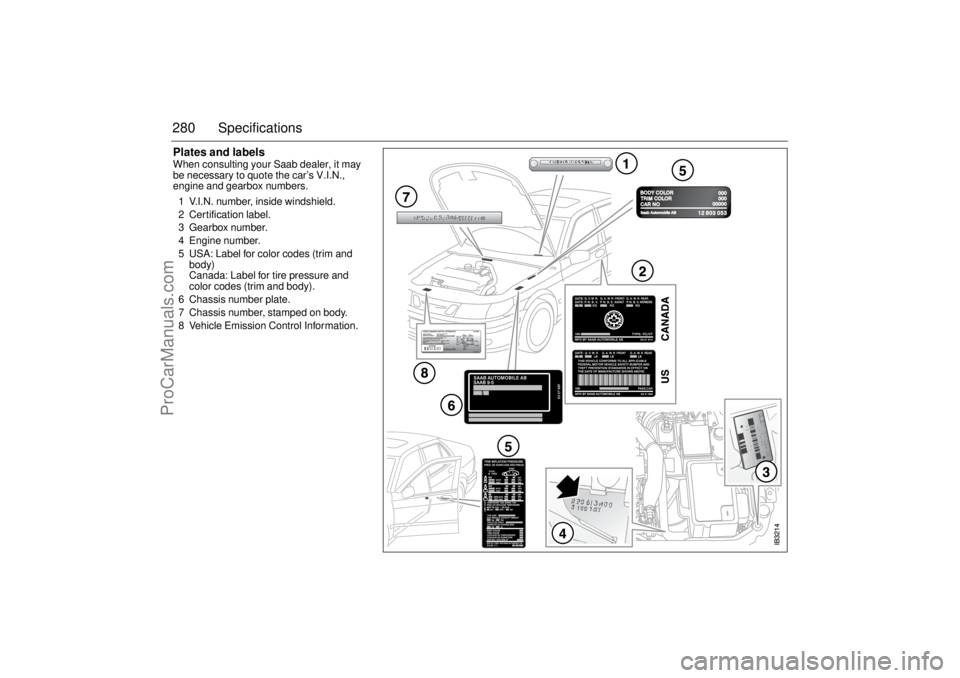
280 SpecificationsPlates and labels When consulting your Saab dealer, it may
be necessary to quote the car’s V.I.N.,
engine and gearbox numbers.
1 V.I.N. number, inside windshield.
2 Certification label.
3 Gearbox number.
4 Engine number.
5 USA: Label for color codes (trim and
body)
Canada: Label for tire pressure and
color codes (trim and body).
6 Chassis number plate.
7 Chassis number, stamped on body.
8 Vehicle Emission Control Information.
ProCarManuals.com
Page 285 of 288

285 Index
JJack
_________________________ 249
KKey
___________________________ 40
Key to chassis number
___________ 281
Key, remove
___________________ 148
LLATCH (child safety)
______________ 24
Labeling, tire sidewall ____________ 240
Labels
__________________________ 7
Leather upholstery, care of
________ 253
Light horn
______________________ 69
Light switches ___________________ 69
Loading your vehicle
_____________ 242
Luggage-compartment lighting
_____ 130
MMain instrument panel
____________ 54
Main/dipped beam
_______________ 69
Maintenance schedule ___________ 264
Maintenance, A/C-system _________ 252
Manual gearbox, technical data
____ 276
Maxi fuses
_____________________ 228
Milometer ______________________ 60
Motoring abroad
________________ 258
NNew tires, buying
_______________ 235
Night Panel
_____________________ 67
OOil capacity, engine
______________ 272
Oil change, engine ______________ 204
Oil specification
_________________ 272
OnStar
________________________ 107
Outdoor temperature
______________ 63
Owner assistance
_______________ 265
PPaintwork, touching-in
____________ 255
Parking Assistance
______________ 194
Parking lights
___________________ 69
Plates and labels ________________ 280
Poly-V-belt
____________________ 212
Power steering _________________ 209
Power-steering fluid
_____________ 209
Pressure gauge
__________________ 62
Programming I, ACC
______________ 81
Programming II, ACC _____________ 82
Programming the ACC ____________ 81
QQuality grading, tires
_____________ 237
Questions on function of airbag
______ 37
Quick guide, Audio System
_________ 87
RRadiator fan
____________________ 212
Radio
__________________________ 90
Rain sensor
_____________________ 73
Rear fog light ____________________ 70
Rear seat, 9-5 Sedan, folding
______ 135
Rear seat, 9-5 Wagon, folding ______ 138
Rear-seat head restraints
__________ 16
Rear-view mirror, antidazzle _______ 125
Rearview mirrors
________________ 121
Reclamation
___________________ 258
Recommendations for cars with
automatic transmission, towing a
camper or trailer
_______________ 179
Refuelling
_____________________ 154
Relay panel ____________________ 230
Remote control __________________ 40
Remote-control battery, changing
____ 43
Remove the key
________________ 148
Replacement, wheel _____________ 238
Reporting safety defects __________ 266
Reprogramming of systems _______ 282
Reservoir, power-steering fluid _____ 209
Rev counter
_____________________ 60
Reversing lights
__________________ 72
ProCarManuals.com
Page 286 of 288

286 IndexRoof load
_____________________ 183
Running-in ____________________ 174
SSDM
_________________________ 267
SID
___________________________ 63
Saab 9-5 Audio System
___________ 85
Saab Information Display (SID)
_____ 63
Saab Parking Assistance
_________ 194
Safety belts
_____________________ 17
Safety belts, care of
_____________ 253
Safety-belt pretensioners
__________ 18
Safety-belt reminder
______________ 17
Seats
__________________________ 12
Securing a load
__________________ 44
Selector lever indication, automatic
transmission
___________________ 63
Sentronic, manual mode
__________ 163
Service costs
__________________ 265
Service information
______________ 266
Service intervals
________________ 264
Service record retention
__________ 265
Settings, seats
__________________ 12
Side airbags
____________________ 35
Signalling, horn _________________ 120
Sliding floor, 9-5 Wagon
__________ 143
Snow chains
___________________ 176
Spare wheel ___________________ 246
Spare wheel and tools
___________ 145
Spark plugs
____________________ 275
Speedometer ________________ 60
, 61Starting in cold weather, ACC
_______ 81
Starting in hot weather, ACC _______ 81
Steering wheel adjustment
________ 120
Steering, technical data
__________ 277
Steps for determining correct load
limit
_________________________ 244
Stone-chip damage, repairing
______ 255
Storage compartments
___________ 132
Sun visors
_____________________ 131
Sunroof
_______________________ 128
Suspension ____________________ 277
Suspension, technical data
________ 277
Switches
_______________________ 69
Symboler ________________________ 9
Systems, adjustment
_____________ 282
TTCS OFF
_______________________ 59
Table of fuses
__________________ 229
Tachometer
_____________________ 60
Tailgate, opening
________________ 44
Tank gauge
_____________________ 61
Technical data __________________ 269
Telematics
_____________________ 107
Temperature control, ACC
_________ 77
Temperature gauge, engine ________ 61
Temperature zones, ACC
__________ 77
Textile carpeting
________________ 253
Through-load hatch ______________ 137
Tie Downs
_____________________ 137
Tightening torque, wheel studs
_____ 247Tip, driving at night
______________ 185
Tip, to avoid theft
________________ 197
Tire chains
_____________________ 239
Tire date code __________________ 245
Tire inspection and rotation
________ 234
Tire markings
___________________ 241
Tire pressure ___________________ 186
Tire sidewall labeling
_____________ 240
Tire terminology and definitions
____ 242
Tire, compact spare
______________ 246
Tires
_____________________ 233
, 278
Tires, winter
____________________ 278
Tools
_________________________ 145
Touching-in the paintwork
_________ 255
Towbar attachment
______________ 178
Towbar load
____________________ 182
Towing the car __________________ 188
Towing, automatics
______________ 188
Traction
_______________________ 171
Trailer weights
__________________ 271
Treadwear indicators
_____________ 235
Trionic
________________________ 202
Trip computer
___________________ 63
Trip meter
______________________ 60
Trunk
_________________________ 135
Trunk lid, opening
________________ 44
Turbo gauge
____________________ 62
Turbo, points to note
_____________ 151
ProCarManuals.com