fuel SAAB 9-5 2004 Owner's Manual
[x] Cancel search | Manufacturer: SAAB, Model Year: 2004, Model line: 9-5, Model: SAAB 9-5 2004Pages: 288, PDF Size: 16.91 MB
Page 154 of 288
154 Starting and drivingRefueling
Only fuel from well-known oil companies
should be used.
All Saab gasoline engines can be driven on
fuel of grade AON 87–93.
For optimum performance we recommend:
AO N 90 for 2.3t
AO N 93 for 2.3Turbo and 2.3T, (see page
272).
If fuel containing a mixture of alcohol is
used, the following restrictions apply:
Methanol: max. 5 % by volume.
Ethanol: max. 10 % by volume.
MTBE: max. 15 % by volume.
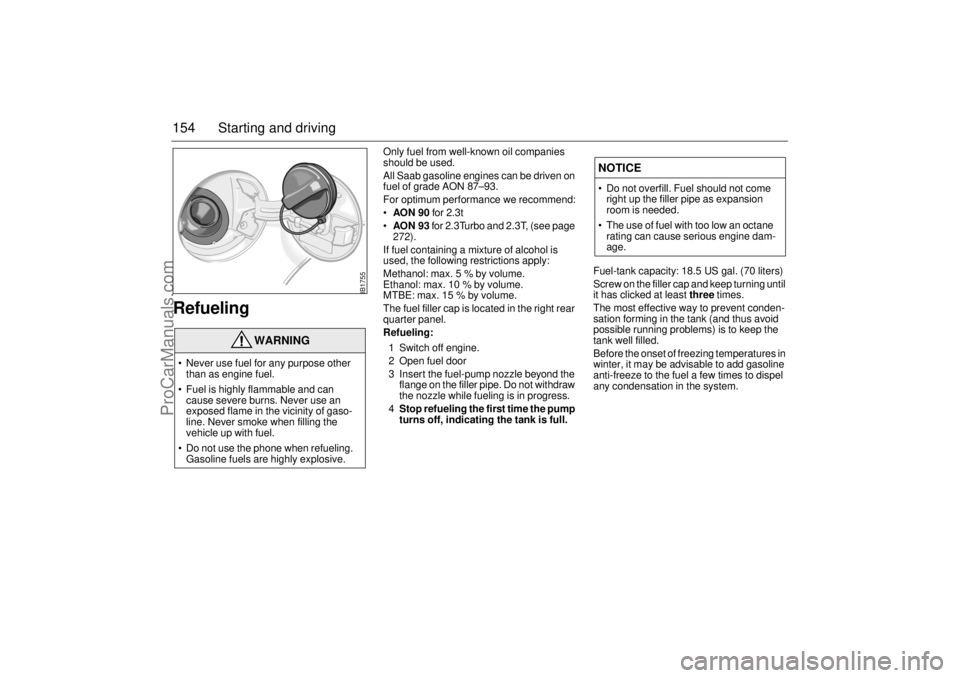
The fuel filler cap is located in the right rear
quarter panel.
Refueling:
1 Switch off engine.
2 Open fuel door
3 Insert the fuel-pump nozzle beyond the
flange on the filler pipe. Do not withdraw
the nozzle while fueling is in progress.
4Stop refueling the first time the pump
turns off, indicating the tank is full.
Fuel-tank capacity: 18.5 US gal. (70 liters)
Screw on the filler cap and keep turning until
it has clicked at least three times.
The most effective way to prevent conden-
sation forming in the tank (and thus avoid
possible running problems) is to keep the
tank well filled.
Before the onset of freezing temperatures in
winter, it may be advisable to add gasoline
anti-freeze to the fuel a few times to dispel
any condensation in the system.
WARNING
Never use fuel for any purpose other
than as engine fuel.
Fuel is highly flammable and can
cause severe burns. Never use an
exposed flame in the vicinity of gaso-
line. Never smoke when filling the
vehicle up with fuel.
Do not use the phone when refueling.
Gasoline fuels are highly explosive.
NOTICE Do not overfill. Fuel should not come
right up the filler pipe as expansion
room is needed.
The use of fuel with too low an octane
rating can cause serious engine dam-
age.
IB1755
ProCarManuals.com
Page 155 of 288

155 Starting and driving
Opening the fuel filler door in an emergency,
see page 146.
Recommended fuel:The engine in your Saab 9-5 is designed to
operate on unleaded gasoline that has an
octane rating of 87 or higher. Octane rating
is determined according to the formula:
where MON is the Motor Octane Number,
and RON is the Research Octane Number.
The average of these two values is the
octane rating of the gasoline as it appears
on the pump at a retail gas station. This
value is sometimes referred to as the
"Anti-Knock Index" (AKI) or the "Average
Octane Number" (AON).
To avoid deposit formation on the fuel injec-
tors which can cause poor driveability, use
only quality gasolines that contain deter-
gents and corrosion inhibitors. Because
gasolines sold at retail gas stations vary in
their composition and quality, you should
switch to a different brand if you begin expe-
riencing driveability and/or hard starting
problems shortly after refueling your car. In
recent years, a variety of fuel additives and
alcohols or oxygenates have been blended
with gasoline. These types of gasolines may
be found in all parts of the United States and
Canada, but particularly in geographic
areas and cities that have high carbon mon-
oxide levels. Saab approves the use of such
"reformulated" gasolines in its products,
which help in reducing pollution from all
motor vehicles, provided that the following blending percentages are met by such
fuels:
Up to 10 % ethanol by volume, with corro-
sion inhibitors.
Up to 15 % MTBE by volume (methyl ter-
tiary butyl ether).
Up to 5 % methanol by volume, with an
equal amount of a suitable co-solvent and
added corrosion inhibitors.
Other, less common, fuel additives used by
some gasoline dealers are also acceptable,
provided that the resultant gasoline is not
more than 2.7 % oxygen by weight.
Some Canadian and U.S. gasolines contain
an octane enhancing additive called meth-
lycyclopentadienyl manganese tricarbonyl
(MMT). If such fuel is used, your emission
control system performance may deterio-
rate and the malfunction indicator lamp on
your instrument panel may turn on. If this
occurs, return to your authorized Saab
dealer for service.
However, these blended gasolines are reg-
ulated and should never exceed these rec-
ommended blend percentages and service
station operators should know if their gaso-
lines contain detergents and oxygenates,
and have been reformulated to reduce vehi-
cle emissions. Nevertheless, if you begin to
notice a problem with the way your car starts
or runs shortly after it has been refueled, try
a different brand of gasoline.
NOTICE Fill to maximum filling capacity
Stop filling after the first time that the
nozzle trips to shut off the flow of fuel.
Filling capacity can differ between
different fuel stations and outside
temperature. Fuel tank volume when
nozzle trips to shut off, may vary by
0.5 gal. (2 liters).
Do not fill fuel all the way up the filler
pipe. The gasoline must be allowed
room for expansion especially during
hot weather.
MON + RON
2
ProCarManuals.com
Page 156 of 288
156 Starting and driving
Fuel (Gasoline Engine)Use regular unleaded gasoline rated at 87
octane or higher. Use of gasoline with an
octane rating lower than 87 can result in
severe engine damage. Damage caused by
incorrect fuel being used is not covered
under the terms of the New Car Warranty
and will be the responsibility of the owner. It
is recommended that the gasoline meet
specifications which were developed by the
American Automobile Manufacturers Asso-
ciation (AAMA) and endorsed by the Cana-
dian Motor Vehicle Manufacturers Associa-
tion for better vehicle performance and
engine protection. Gasolines meeting the
AAMA specification could provide improved
driveability and emission control system
performance compared to other gasolines.
Be sure the posted octane is at least 87. If
the octane is less than 87, you may get a
heavy knocking noise when you drive. If it’s
bad enough, it can damage your engine. If
you’re using fuel rated at 87 octane or
higher and you hear heavy knocking, your
engine needs service. But don’t worry if you
hear a little pinging noise when you’re accel-
erating or driving up a hill. That’s normal,
and you don’t have to buy a higher octane
fuel to get rid of pinging. It’s the heavy, con-
stant knock that means you have a problem.
NOTICEHigher concentrations of methanol than
listed above, or the use of methanol-
blended gasoline without suitable
co-solvents and corrosion inhibitors,
can damage your car’s fuel system,
leading to the need for repairs which are
not covered by Saab’s product warranty.
NOTICEThe engine control module (ECM) mon-
itoring the engine parameters also
stores fault codes.
Under certain circumstances, this may
cause constant illumination of the
”Engine malfunction (CHECK
ENGINE)” lamp , thus indicating a
fault that must be checked by your Saab
dealer, see page 57.
NOTE: always observe the following two
measures:
Make sure that the fuel filler cap is
screwed on correctly before the
engine is started. Screw on the fuel
filler cap until you hear 3 distinct
clicks.
Avoid driving with the fuel low level
indicator illuminated. The symbol
illuminates when less than approxi-
mately 2 gallons (8 litres) of fuel
remains in the tank.
In Canada, look for the
”Auto Makers’ Choice” label
on the fuel pump.
ProCarManuals.com
Page 157 of 288

157 Starting and driving
If your vehicle is certified to meet California
Emission Standards (indicated on the
underhood emission control label), it is
designed to operate on fuels that meet Cali-
fornia specifications. If such fuels are not
available in states adopting California emis-
sions standards, your vehicle will operate
satisfactorily on fuels meeting federal spec-
ifications, but emission control system per-
formance may be affected. The ”Engine
malfunction (CHECK ENGINE)” indicator
on your main instrument panel may turn on
and/or your vehicle may fail a smog-check
test. See ”Engine malfunction (CHECK
ENGINE)” indicator on page 57. If this
occurs, return to your authorized Saab
dealer for diagnosis to determine the cause
of failure. In the event it is determined that
the cause of the condition is the type of fuels
used, repairs may not be covered by your
warranty. Some gasolines that are not reformulated
for low emissions may contain an
octane-enhancing additive called methylcy-
clopentadienyl manganese tricarbonyl
(MMT); ask your service station operator
whether or not the fuel contains MMT. Saab
Automobile AB does not recommend the
use of such gasolines. If fuels containing
MMT are used, spark plug life may be
reduced and your emission control system
performance may be affected. The malfunc-
tion indicator lamp on your instrument panel
may turn on. If this occurs, return to your
authorized Saab dealer for service.
Engine Break-In PeriodPistons, bores and bearings need time to
obtain uniform, wear-resistant surfaces.
If a new engine is driven too hard, this grad-
ual process of bedding-in will not be possi-
ble and the life of the engine will be short-
ened.
During the first 1,200 miles (2,000 km), do
not exceed 5,000 rpm.
In addition, refrain from driving the car at full
throttle, other than for brief instances,
during the first 1,800 miles (3,000 km). Wearing in new brake padsNew brake pads take time to bed in, about
90 miles (150 km) if the car is driven largely
under stop-and-go conditions or about
300 miles (500 km) of highway driving.
To extend the useful life of the pads, avoid
hard braking as much as possible during
this period.
ProCarManuals.com
Page 160 of 288
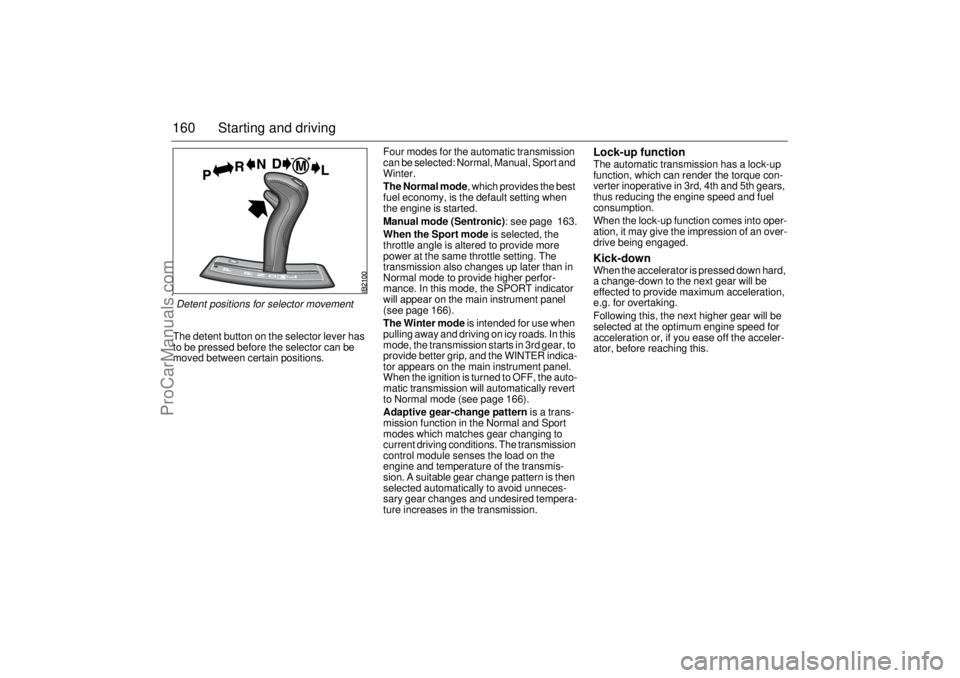
160 Starting and drivingThe detent button on the selector lever has
to be pressed before the selector can be
moved between certain positions. Four modes for the automatic transmission
can be selected: Normal, Manual, Sport and
Winter.
The Normal mode, which provides the best
fuel economy, is the default setting when
the engine is started.
Manual mode (Sentronic): see page 163.
When the Sport mode is selected, the
throttle angle is altered to provide more
power at the same throttle setting. The
transmission also changes up later than in
Normal mode to provide higher perfor-
mance. In this mode, the SPORT indicator
will appear on the main instrument panel
(see page 166).
The Winter mode is intended for use when
pulling away and driving on icy roads. In this
mode, the transmission starts in 3rd gear, to
provide better grip, and the WINTER indica-
tor appears on the main instrument panel.
When the ignition is turned to OFF, the auto-
matic transmission will automatically revert
to Normal mode (see page 166).
Adaptive gear-change pattern is a trans-
mission function in the Normal and Sport
modes which matches gear changing to
current driving conditions. The transmission
control module senses the load on the
engine and temperature of the transmis-
sion. A suitable gear change pattern is then
selected automatically to avoid unneces-
sary gear changes and undesired tempera-
ture increases in the transmission.
Lock-up function The automatic transmission has a lock-up
function, which can render the torque con-
verter inoperative in 3rd, 4th and 5th gears,
thus reducing the engine speed and fuel
consumption.
When the lock-up function comes into oper-
ation, it may give the impression of an over-
drive being engaged.Kick-downWhen the accelerator is pressed down hard,
a change-down to the next gear will be
effected to provide maximum acceleration,
e.g. for overtaking.
Following this, the next higher gear will be
selected at the optimum engine speed for
acceleration or, if you ease off the acceler-
ator, before reaching this.
Detent positions for selector movement
ProCarManuals.com
Page 174 of 288
174 Starting and driving
Economical motoringFactors affecting fuel consumption Fuel consumption is greatly affected by the
general driving conditions, the way in which
the car is driven and at what speeds, the
weather, the state of the road, the condition
of the car, etc. Breaking-in Fuel consumption may be somewhat higher
during the break-in period (the first 3,000–
4,000 miles (5,000–7,000 km) than stated.Weather conditions Fuel consumption can be as much as 10 %
lower in summer than in winter. The higher
consumption in cold weather is explained by
the longer time it takes for the engine to
reach normal operating temperature, and
for the transmission and wheel bearings to
warm up. Fuel economy is also affected by
the distance driven: short journeys of 3–
5 miles (5–8 km) do not give the engine
enough time to reach normal temperature.
Strong winds can also affect fuel consump-
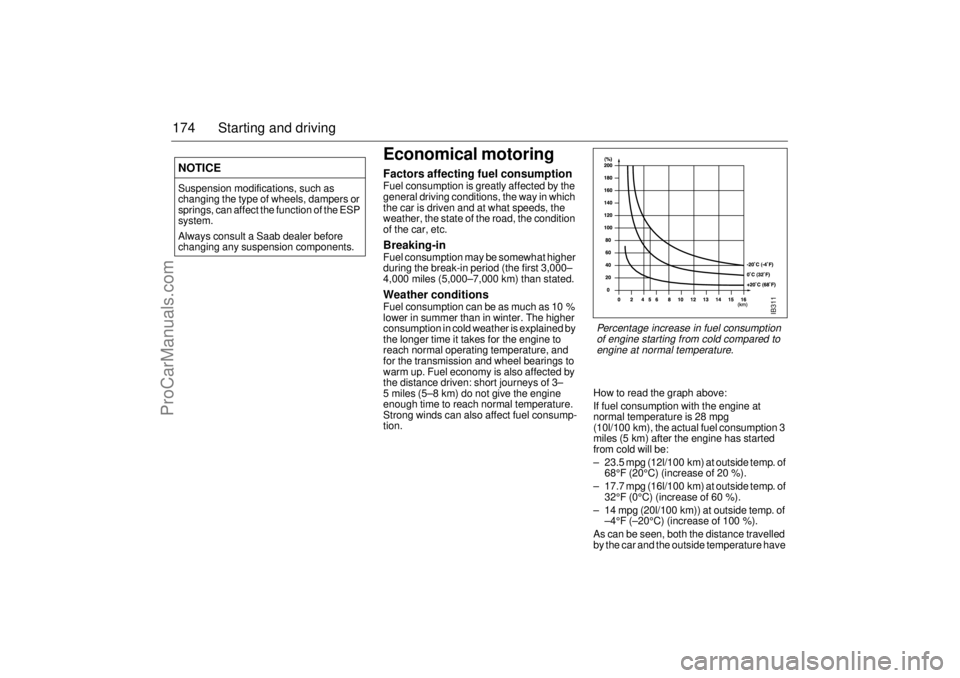
tion. How to read the graph above:
If fuel consumption with the engine at
normal temperature is 28 mpg
(10l/100 km), the actual fuel consumption 3
miles (5 km) after the engine has started
from cold will be:
– 23.5 mpg (12l/100 km) at outside temp. of
68°F (20°C) (increase of 20 %).
– 17.7 mpg (16l/100 km) at outside temp. of
32°F (0°C) (increase of 60 %).
– 14 mpg (20l/100 km)) at outside temp. of
–4°F (–20°C) (increase of 100 %).
As can be seen, both the distance travelled
by the car and the outside temperature have
NOTICESuspension modifications, such as
changing the type of wheels, dampers or
springs, can affect the function of the ESP
system.
Always consult a Saab dealer before
changing any suspension components.
IB311
Percentage increase in fuel consumption
of engine starting from cold compared to
engine at normal temperature.
ProCarManuals.com
Page 175 of 288
175 Starting and driving
a major impact on fuel consumption after
the engine has started from cold. Thus, if the
car is mainly used for short journeys of
3–5 miles (5–8 km), the fuel consumption
will be 60–80 % higher than normal.Driving technique To obtain the best running economy, not
only regarding fuel consumption but gen-
eral wear also, regular service is required.
High speed, unnecessary acceleration,
heavy braking and much low gear work all
gives rise to higher fuel consumption.
Frequent gear changing in traffic, starting
in cold weather, the use of studded tires
and roof racks, and towing a trailer all
increase fuel consumption.
Do not run the engine when the car is sta-
tionary.
If idling, it will take much longer before the
engine becomes hot. Engine wear is
greatest during this warming-up phase.
Therefore drive away as soon as possible
after the engine is started and avoid high
revving. Driving in a low gear results in higher fuel
consumption than in a high gear because
of the higher engine speed for a given
road speed. Always change up to a higher
gear as soon as traffic conditions allow
and use the highest gear as much as pos-
sible.
Check the air pressure in the tires once a
month. Incorrect pressures increase tire
wear. It is better to have slightly higher
pressure than lower.
Check fuel consumption regularly.
Increased consumption can indicate that
something is wrong and that the car
needs to be checked by an authorized
Saab dealer.
Practical trials on the roads have demon-
strated that substantial savings in fuel con-
sumption can be made if the above advice
is heeded.
Road conditions Wet roads increase fuel consumption, as do
unpaved roads and driving in hilly country
(the amount of fuel saved driving downhill is
less than the additional amount required to
climb the hill).
WARNING
Never switch the engine off while driving
as the effect of the brakes and power
steering will be greatly reduced.
ProCarManuals.com
Page 176 of 288

176 Starting and drivingEngine block heater (standard
equipment in Canada, accessory in
U.S.)The following are just some of the benefits
to the car and the environment of using an
engine block heater:
Lower fuel consumption.
Exhaust emissions substantially reduced
over short runs.
Reduced wear on the engine.
Inside of car warms up faster.
The engine heater is effective at outside
temperatures up to +15–20°C. The warmer
it is outside, the shorter the time the engine
heater needs to be connected. Longer than
1.5 hours is unnecessary.
If the car is equipped with a removable,
electrical cabin heater that is not in use, this
should be stored in the luggage compart-
ment.
Driving in cold weatherBefore starting a journey in cold weather
you should check the following:
That the wiper blades have not become
frozen to the windshield/glass.
Brush any snow away from the air intake
for the heater system (opening between
hood and windshield).
It may be advisable to lubricate the
door-lock cylinder (use molybdenum
disulphide, MoS
2) to prevent its freezing.
If the lock has frozen, take care not to
break the key (or use the remote control)
– heat it first or spray it with de-icer.
Periodically during the winter, add gaso-
line anti-freeze to the fuel to dispel any
condensation in the fuel tank which could
freeze and cause problems in the system.
Keep the tank well filled to reduce the risk
of condensation forming.
If the car is parked outside in freezing
weather, fuel additives (gasoline
anti-freeze) will not do any good as it
cannot remove water that has already fro-
zen. Park the car in a warm place so that
any ice that may have built up melts, then
add gasoline anti-freeze when filling up
the tank. Condensation is caused by
changes in the outdoor temperature or by
the car being parked alternately in a
garage and outside.
It is particularly important when the roads
are slippery that the brakes and tires be in
good condition. Check the anti-freeze in the engine cool-
ant, see page 207.
The car´s trip computer will warn you when
there is a risk of slippery conditions. For fur-
ther information on this function, see page
64.
The car is equipped with tires designed to
provide optimum grip on both wet and dry
roads, although this has been achieved at
the expense of somewhat reduced grip on
snow and ice. For regular driving on snow
and ice, we therefore recommend that
winter (snow) tires be fitted.
Winter (snow) tires, particularly studded
tires (where use is legally permitted), gener-
ally make driving safer on snow and ice.
Acquaint yourself with the legal provi-
sions governing the use of different
types of winter tires and snow chains.
Studded tires are not allowed in some
countries.
ProCarManuals.com
Page 180 of 288
180 Starting and drivingWhen negotiating long hills, bear the follow-
ing important considerations in mind:
Use Normal mode when driving with a cara-
van or trailer on hilly roads. The adaptive
gear change pattern function will prevent
the transmission overheating.
Rises in coolant temperature are indicated
by the temperature gauge in the main instru-
ment panel.Recommendations for cars with
automatic transmission
Rises in coolant temperature are indicated
by the temperature gauge in the main instru-
ment panel.
The following steps are taken in order as the
temperature of the engine increases:
Gear change pattern is altered.
A/C compressor is switched off.
Engine torque is reduced.
The following message will be displayed on
the SID if the transmission fluid becomes
too hot: “Gearbox too hot. Make a safe stop.
If this message appears, stop the car as
soon as it is safe to do so and allow the
engine to idle until the message has gone
out. The selector lever should be in
position P.When continuing your journey, select
manual mode and a gear in which the
engine speed is about 3,000 rpm until the
incline eases (see page 164).
Do not drive continuously with the WINTER
mode selected in hilly country when you are
towing a caravan, as this will increase fuel
consumption and risk overheating the trans-
mission.
VARNING
Remember to use the braking effect of the
engine (position D or L) when you are
descending long or steep hills to spare
the brakes.
Brake failure can result from overheated
brakes!
ProCarManuals.com
Page 183 of 288
183 Starting and driving
Driving with a roof rack
loadThe maximum permissible roof load is
220 lbs. (100 kg).
Note that the roof load is included in the
car’s maximum permissible load (see page
270).
Strong, sturdy roof carriers designed spe-
cially for the car are available from your
Saab dealer. Always secure the roof load
safely.
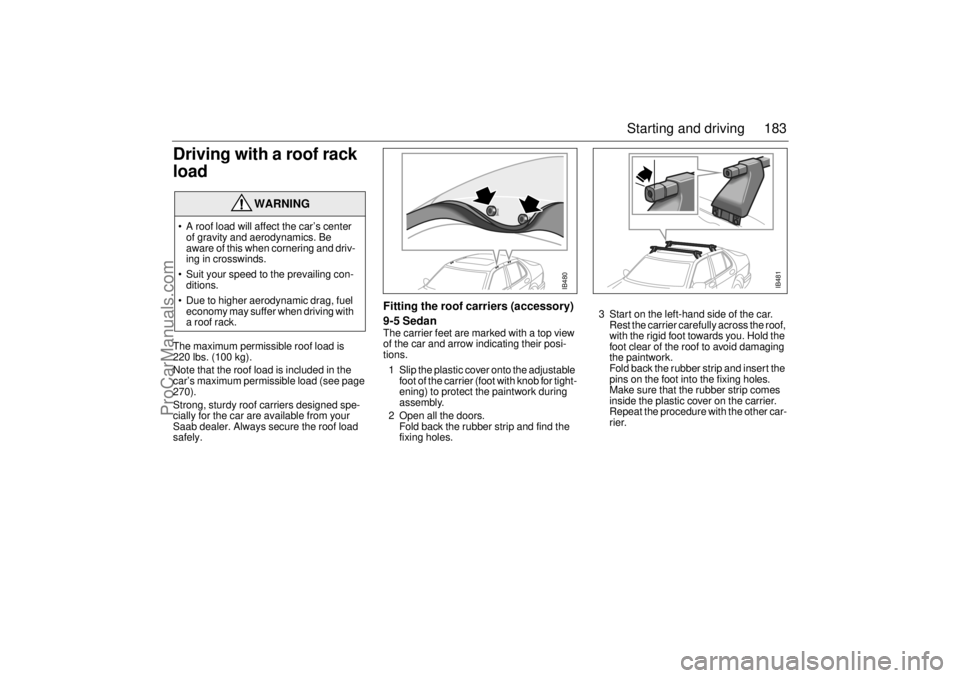
Fitting the roof carriers (accessory)
9-5 SedanThe carrier feet are marked with a top view
of the car and arrow indicating their posi-
tions.
1 Slip the plastic cover onto the adjustable
foot of the carrier (foot with knob for tight-
ening) to protect the paintwork during
assembly.
2 Open all the doors.
Fold back the rubber strip and find the
fixing holes. 3 Start on the left-hand side of the car.
Rest the carrier carefully across the roof,
with the rigid foot towards you. Hold the
foot clear of the roof to avoid damaging
the paintwork.
Fold back the rubber strip and insert the
pins on the foot into the fixing holes.
Make sure that the rubber strip comes
inside the plastic cover on the carrier.
Repeat the procedure with the other car-
rier.
WARNING
A roof load will affect the car’s center
of gravity and aerodynamics. Be
aware of this when cornering and driv-
ing in crosswinds.
Suit your speed to the prevailing con-
ditions.
Due to higher aerodynamic drag, fuel
economy may suffer when driving with
a roof rack.
IB480
IB481
ProCarManuals.com