tow SAAB 9-5 2004 Owner's Manual
[x] Cancel search | Manufacturer: SAAB, Model Year: 2004, Model line: 9-5, Model: SAAB 9-5 2004Pages: 288, PDF Size: 16.91 MB
Page 175 of 288

175 Starting and driving
a major impact on fuel consumption after
the engine has started from cold. Thus, if the
car is mainly used for short journeys of
3–5 miles (5–8 km), the fuel consumption
will be 60–80 % higher than normal.Driving technique To obtain the best running economy, not
only regarding fuel consumption but gen-
eral wear also, regular service is required.
High speed, unnecessary acceleration,
heavy braking and much low gear work all
gives rise to higher fuel consumption.
Frequent gear changing in traffic, starting
in cold weather, the use of studded tires
and roof racks, and towing a trailer all
increase fuel consumption.
Do not run the engine when the car is sta-
tionary.
If idling, it will take much longer before the
engine becomes hot. Engine wear is
greatest during this warming-up phase.
Therefore drive away as soon as possible
after the engine is started and avoid high
revving. Driving in a low gear results in higher fuel
consumption than in a high gear because
of the higher engine speed for a given
road speed. Always change up to a higher
gear as soon as traffic conditions allow
and use the highest gear as much as pos-
sible.
Check the air pressure in the tires once a
month. Incorrect pressures increase tire
wear. It is better to have slightly higher
pressure than lower.
Check fuel consumption regularly.
Increased consumption can indicate that
something is wrong and that the car
needs to be checked by an authorized
Saab dealer.
Practical trials on the roads have demon-
strated that substantial savings in fuel con-
sumption can be made if the above advice
is heeded.
Road conditions Wet roads increase fuel consumption, as do
unpaved roads and driving in hilly country
(the amount of fuel saved driving downhill is
less than the additional amount required to
climb the hill).
WARNING
Never switch the engine off while driving
as the effect of the brakes and power
steering will be greatly reduced.
ProCarManuals.com
Page 178 of 288
178 Starting and driving2 Wait until the needle has dropped back
to indicate normal temperature (roughly
midway, in the white zone) before stop-
ping the engine. If the coolant needs top-
ping up, unscrew the cap on expansion
tank carefully.
Top up, as necessary, ideally with a
50/50 mixture of Saab-approved coolant
and water. If only water is available, use
that, but remember to have the coolant
mixture checked as soon as possible. 3 As soon as possible, have the cooling
system checked by an authorized Saab
dealer.
Towing a trailer
Trailer hitch attachmentTrailer hitch attachments are available as
accessories. These are designed for a max-
imum trailer weight of 3500 lbs. (1588 kg),
see also page 271.
Use only the electrical trailer hitch socket
provided in the trailer hitch kit.
Saab recommends:
Use a Saab original hitch kit attachment
which is designed and tested by Saab.
Consult your Saab dealer regarding the
appropriate hitch kit for your car.
WARNING
Exercise care when opening the hood
if the engine is overheated. Never
remove the expansion tank cap com-
pletely when the engine is hot.
The cooling system is pressurized -
hot coolant and vapor can escape.
These can cause injury to your eyes
and burns. Open the cap slowly to
release the pressure before
removing it.
WARNING
When towing a trailer, do not attempt
to negotiate a hill having a gradient in
excess of 15 %. The weight distribu-
tion over the front wheels of the car will
be insufficient to prevent wheelspin,
making further progress impossible.
In addition, the parking brake may not
always be able to hold the car and
trailer securely, with the result that the
wheels can start to slide downhill.
Always apply the trailer’s handbrake
when unhitching it. There is otherwise
a risk of personal injury or damage to
the bumper should the trailer start to
roll.
NOTICEUse only a genuine Saab trailer hitch and
wiring, since other wiring methods can
cause expensive damage to the car’s
body and electrical system.
Consult an authorized Saab dealer for
guidance on how to connect the trailer
hitch electrical system.
ProCarManuals.com
Page 179 of 288
179 Starting and driving
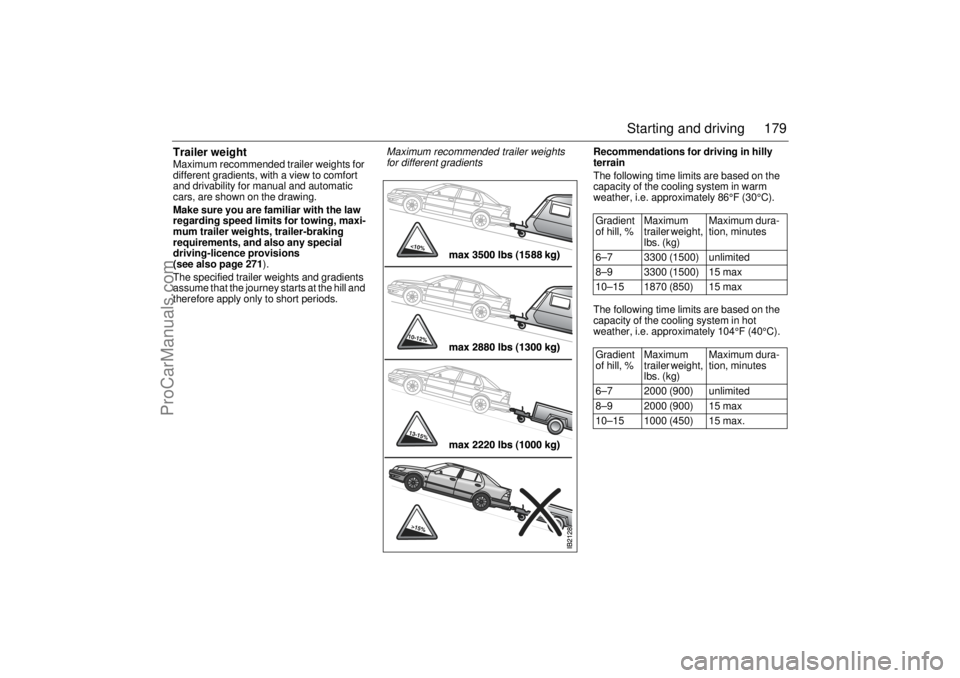
Trailer weightMaximum recommended trailer weights for
different gradients, with a view to comfort
and drivability for manual and automatic
cars, are shown on the drawing.
Make sure you are familiar with the law
regarding speed limits for towing, maxi-
mum trailer weights, trailer-braking
requirements, and also any special
driving-licence provisions
(see also page 271).
The specified trailer weights and gradients
assume that the journey starts at the hill and
therefore apply only to short periods. Recommendations for driving in hilly
terrain
The following time limits are based on the
capacity of the cooling system in warm
weather, i.e. approximately 86°F (30°C).
The following time limits are based on the
capacity of the cooling system in hot
weather, i.e. approximately 104°F (40°C).
Gradient
of hill, % Maximum
trailer weight,
lbs. (kg)Maximum dura-
tion, minutes
6–7 3300 (1500) unlimited
8–9 3300 (1500) 15 max
10–15 1870 (850) 15 max
Gradient
of hill, % Maximum
trailer weight,
lbs. (kg)Maximum dura-
tion, minutes
6–7 2000 (900) unlimited
8–9 2000 (900) 15 max
10–15 1000 (450) 15 max.
Maximum recommended trailer weights
for different gradients
ProCarManuals.com
Page 180 of 288

180 Starting and drivingWhen negotiating long hills, bear the follow-
ing important considerations in mind:
Use Normal mode when driving with a cara-
van or trailer on hilly roads. The adaptive
gear change pattern function will prevent
the transmission overheating.
Rises in coolant temperature are indicated
by the temperature gauge in the main instru-
ment panel.Recommendations for cars with
automatic transmission
Rises in coolant temperature are indicated
by the temperature gauge in the main instru-
ment panel.
The following steps are taken in order as the
temperature of the engine increases:
Gear change pattern is altered.
A/C compressor is switched off.
Engine torque is reduced.
The following message will be displayed on
the SID if the transmission fluid becomes
too hot: “Gearbox too hot. Make a safe stop.
If this message appears, stop the car as
soon as it is safe to do so and allow the
engine to idle until the message has gone
out. The selector lever should be in
position P.When continuing your journey, select
manual mode and a gear in which the
engine speed is about 3,000 rpm until the
incline eases (see page 164).
Do not drive continuously with the WINTER
mode selected in hilly country when you are
towing a caravan, as this will increase fuel
consumption and risk overheating the trans-
mission.
VARNING
Remember to use the braking effect of the
engine (position D or L) when you are
descending long or steep hills to spare
the brakes.
Brake failure can result from overheated
brakes!
ProCarManuals.com
Page 181 of 288
181 Starting and driving
Recommendations for cars with manual
gearbox
Rises in coolant temperature are indicated
by the temperature gauge in the main instru-
ment panel.
The following steps are taken in order as the
temperature of the engine increases:
A/C compressor is switched off.
engine torque is reduced.
When continuing your journey, select a gear
in which the engine speed is about
3,000 rpm until the incline eases.
Driving considerations Always take extra care when towing a
trailer, as the car’s handling will be different
and its braking effect reduced. The trailer’s
braking system and suspension also have a
considerable effect on these characteris-
tics, see also ”Driving with a load” page 185.
If the car has automatic transmission, select
position D when ascending steep hills. This
ensures that the adaptive gear change pat-
terns are operational, see page 165. Use
position D or L for steep descents.
Checks before drivingMake sure that the car and caravan or trailer
are in good working order. This is essential
since towing a caravan increases the strain
on the car.
Check and if necessary adjust the tire
pressure of the car and caravan.
Make sure all wheel bolts are properly
tightened.
Make sure that the equipment joining the
car and caravan is properly secured and
adjusted.
Make sure the caravan’s electrical cable
is properly connected and is not so long
that it drags along the ground. Also, make
sure the cable is not too short and risks
breaking when turning a corner.
Check all bulbs.
Check the car and caravan brakes.
Make sure that all items on or in the cara-
van or trailer are properly secured.
Make sure that the caravan’s jockey
wheel is raised and locked.
Check the distribution of the load so that
the car and caravan are well balanced.
Check that the rearview mirrors provide
the best possible rearward vision.
Make sure the caravan’s safety cable is
correctly attached.
VARNING
Utilize the braking effect of the engine
(1st, 2nd or 3rd gear) when you are
descending long or steep hills to spare
the brakes.
Brake failure can result from overheated
brakes!
NOTICEIf the ”Automatic transmission, fault indi-
cator” indicator comes on, cease
towing until the problem has been recti-
fied.
ProCarManuals.com
Page 182 of 288
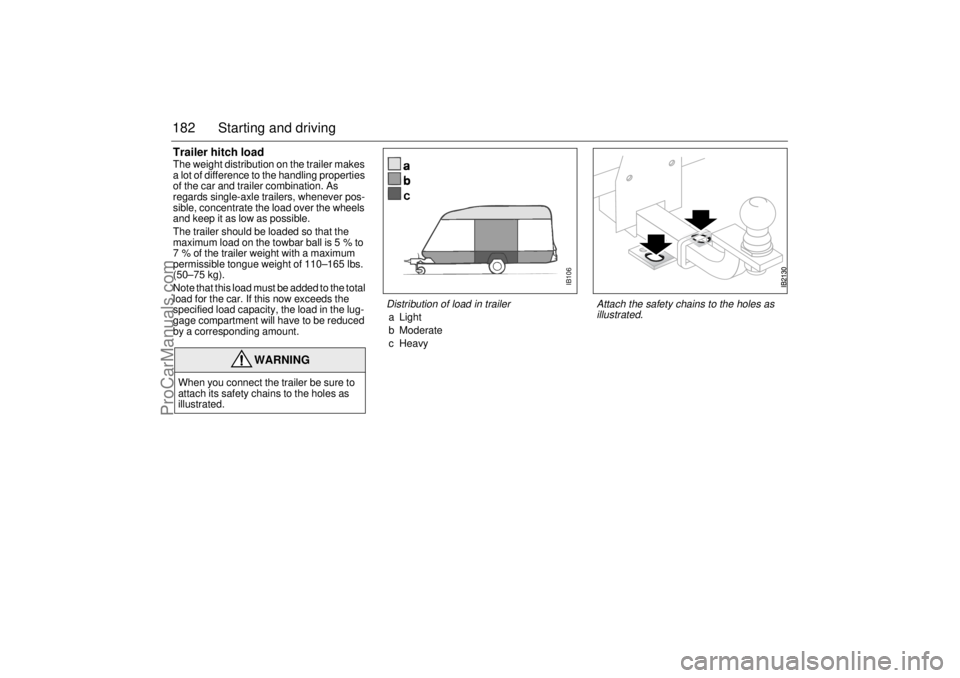
182 Starting and drivingTrailer hitch loadThe weight distribution on the trailer makes
a lot of difference to the handling properties
of the car and trailer combination. As
regards single-axle trailers, whenever pos-
sible, concentrate the load over the wheels
and keep it as low as possible.
The trailer should be loaded so that the
maximum load on the towbar ball is 5 % to
7 % of the trailer weight with a maximum
permissible tongue weight of 110–165 lbs.
(50–75 kg).
Note that this load must be added to the total
load for the car. If this now exceeds the
specified load capacity, the load in the lug-
gage compartment will have to be reduced
by a corresponding amount.
WARNING
When you connect the trailer be sure to
attach its safety chains to the holes as
illustrated.
IB106
Distribution of load in trailer aLight
b Moderate
cHeavy
Attach the safety chains to the holes as
illustrated.
ProCarManuals.com
Page 183 of 288
183 Starting and driving
Driving with a roof rack
loadThe maximum permissible roof load is
220 lbs. (100 kg).
Note that the roof load is included in the
car’s maximum permissible load (see page
270).
Strong, sturdy roof carriers designed spe-
cially for the car are available from your
Saab dealer. Always secure the roof load
safely.
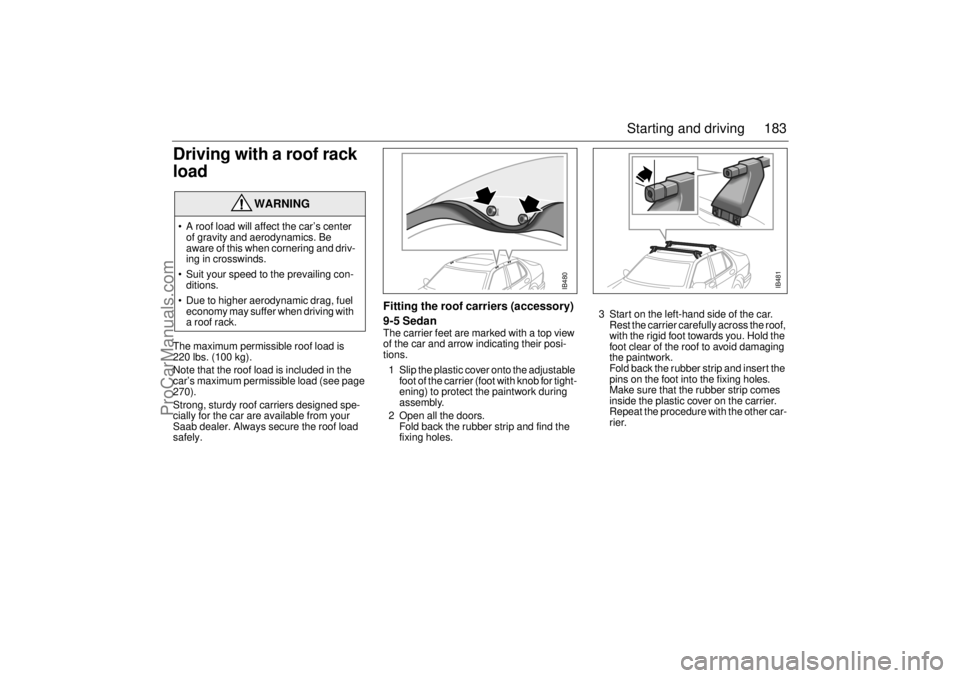
Fitting the roof carriers (accessory)
9-5 SedanThe carrier feet are marked with a top view
of the car and arrow indicating their posi-
tions.
1 Slip the plastic cover onto the adjustable
foot of the carrier (foot with knob for tight-
ening) to protect the paintwork during
assembly.
2 Open all the doors.
Fold back the rubber strip and find the
fixing holes. 3 Start on the left-hand side of the car.
Rest the carrier carefully across the roof,
with the rigid foot towards you. Hold the
foot clear of the roof to avoid damaging
the paintwork.
Fold back the rubber strip and insert the
pins on the foot into the fixing holes.
Make sure that the rubber strip comes
inside the plastic cover on the carrier.
Repeat the procedure with the other car-
rier.
WARNING
A roof load will affect the car’s center
of gravity and aerodynamics. Be
aware of this when cornering and driv-
ing in crosswinds.
Suit your speed to the prevailing con-
ditions.
Due to higher aerodynamic drag, fuel
economy may suffer when driving with
a roof rack.
IB480
IB481
ProCarManuals.com
Page 187 of 288
187 Starting and driving
Driving considerations
with compact spare
wheel/tire fitted
The following should be observed when the
compact spare wheel (T115/70 R16) is
fitted:
The compact spare is light and easy to
handle when changing the wheel.
Do not drive further than necessary with
the compact spare fitted – the maximum
life of the wheel is only just over
2000 miles (3,500 km).
Refit the standard tire as soon as possi-
ble.
Important considerations when driving with
a compact spare tire:
The car’s ground clearance is reduced.
The car must not be driven with more than
one compact tire at a time.
Avoid driving against a curb.
Do not use snow chains.
Do not fit the wheel cover - this would con-
ceal the warning text.
WARNING
Do not exceed 50 mph (80 km/h) as
the tire can overheat and adversely
affect the handling of the car.
Tire pressure: refer to page 279.
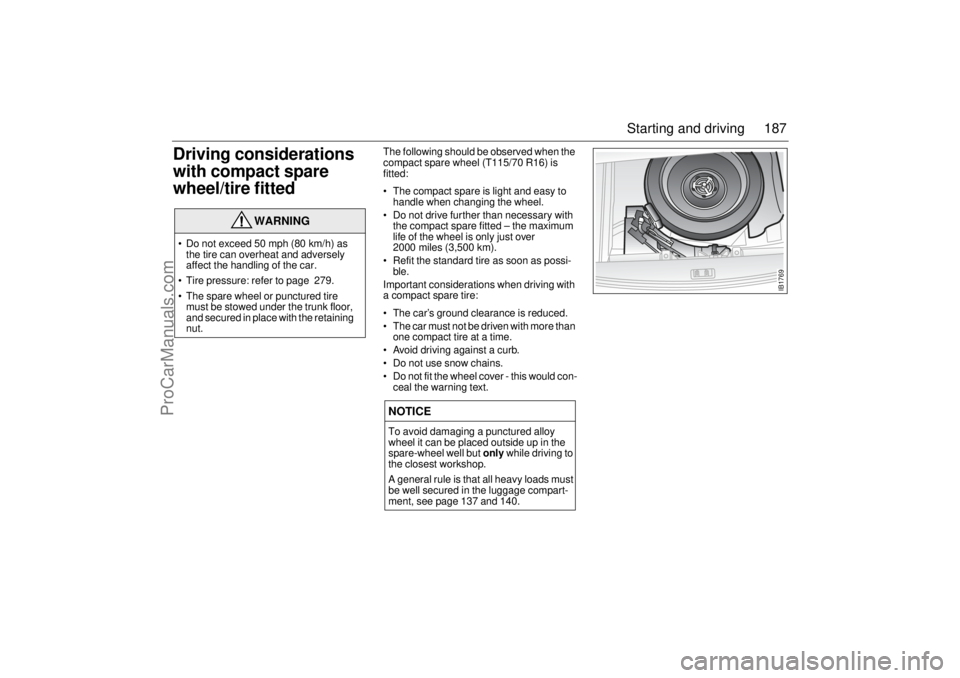
The spare wheel or punctured tire
must be stowed under the trunk floor,
and secured in place with the retaining
nut.
NOTICETo avoid damaging a punctured alloy
wheel it can be placed outside up in the
spare-wheel well but only while driving to
the closest workshop.
A general rule is that all heavy loads must
be well secured in the luggage compart-
ment, see page 137 and 140.
IB1769
ProCarManuals.com
Page 188 of 288

188 Starting and drivingDriving with the trunk
lid/tailgate openAvoid driving with the trunk lid/tailgate partly
or fully open, since exhaust fumes can be
drawn into the cabin.
If you must drive with the trunk lid/tailgate
open, all windows and the sunroof (if fitted)
must be closed and the cabin fan on at its
highest speed setting.
Driving in deep water Towing the carNOTICEDo not drive in water deeper than
12 inches (30 cm) and do not drive faster
than 3–4 mph. Water can otherwise be
sucked into the engine. The engine will be
seriously damaged if water enters the
intake system.
WARNING
Remember that the brake servo does
not operate when the engine is off.
Much greater pressure than normal
will therefore be required to operate
the brake pedal.
Nor does the steering servo operate
when the engine is off. The steering
will therefore be much heavier than
usual.
The towing vehicle should always be
heavier than the vehicle on tow.
Never allow passengers to ride in the
car being towed.
Always seek professional help if the
car needs to be towed.
ProCarManuals.com
Page 189 of 288
189 Starting and driving
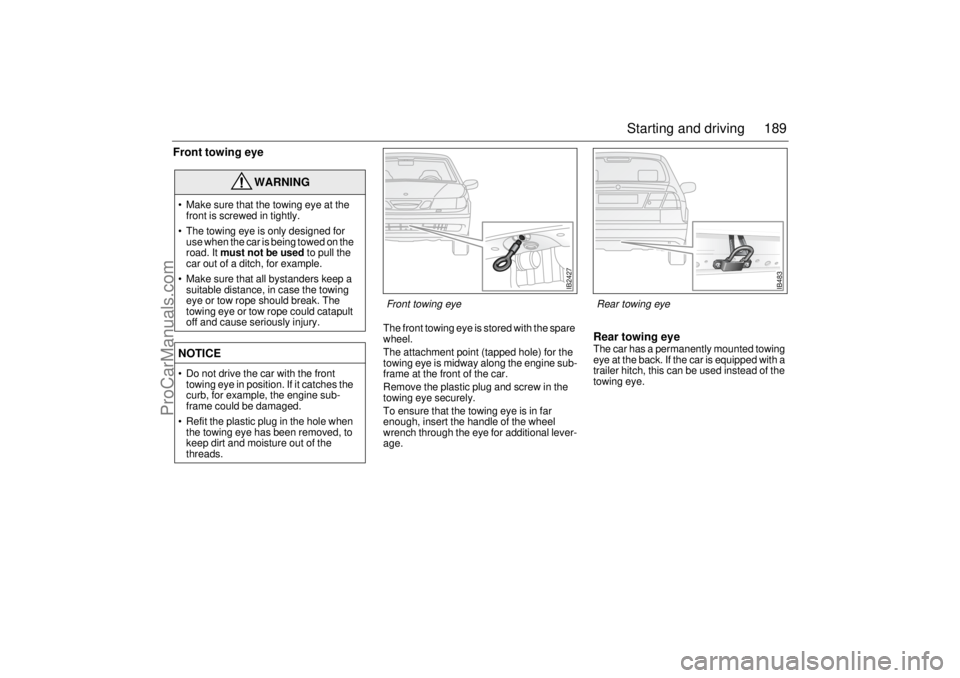
Front towing eye
The front towing eye is stored with the spare
wheel.
The attachment point (tapped hole) for the
towing eye is midway along the engine sub-
frame at the front of the car.
Remove the plastic plug and screw in the
towing eye securely.
To ensure that the towing eye is in far
enough, insert the handle of the wheel
wrench through the eye for additional lever-
age.
Rear towing eyeThe car has a permanently mounted towing
eye at the back. If the car is equipped with a
trailer hitch, this can be used instead of the
towing eye.
WARNING
Make sure that the towing eye at the
front is screwed in tightly.
The towing eye is only designed for
use when the car is being towed on the
road. It must not be used to pull the
car out of a ditch, for example.
Make sure that all bystanders keep a
suitable distance, in case the towing
eye or tow rope should break. The
towing eye or tow rope could catapult
off and cause seriously injury.NOTICE Do not drive the car with the front
towing eye in position. If it catches the
curb, for example, the engine sub-
frame could be damaged.
Refit the plastic plug in the hole when
the towing eye has been removed, to
keep dirt and moisture out of the
threads.
IB2427
Front towing eye
IB483
Rear towing eye
ProCarManuals.com