trunk SAAB 9-5 2004 Owner's Guide
[x] Cancel search | Manufacturer: SAAB, Model Year: 2004, Model line: 9-5, Model: SAAB 9-5 2004Pages: 288, PDF Size: 16.91 MB
Page 139 of 288
139 Interior equipment and trunk
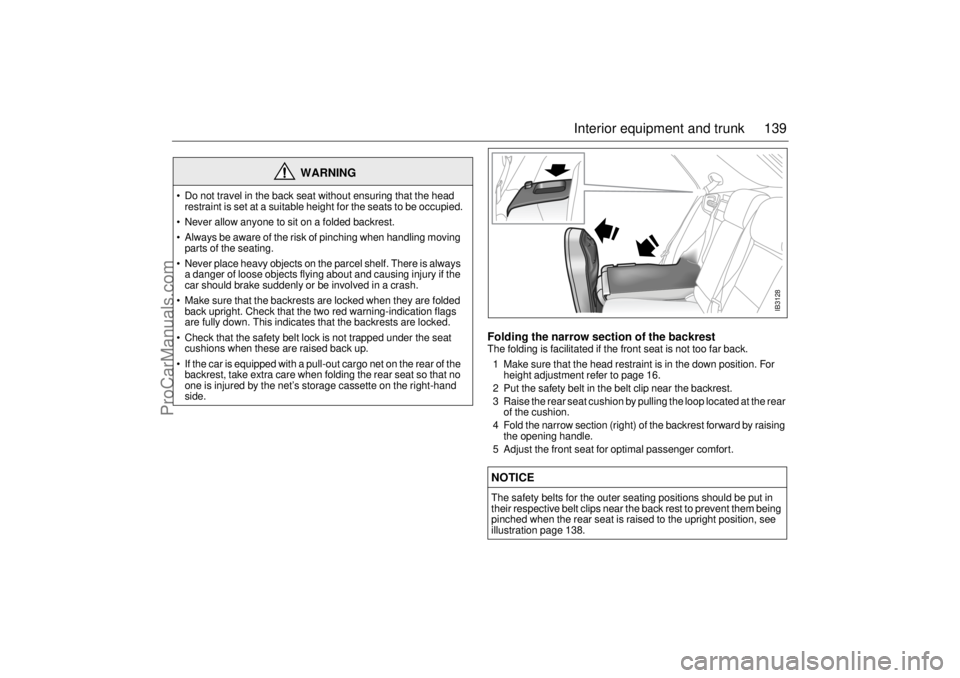
Folding the narrow section of the backrestThe folding is facilitated if the front seat is not too far back.
1 Make sure that the head restraint is in the down position. For
height adjustment refer to page 16.
2 Put the safety belt in the belt clip near the backrest.
3 Raise the rear seat cushion by pulling the loop located at the rear
of the cushion.
4 Fold the narrow section (right) of the backrest forward by raising
the opening handle.
5 Adjust the front seat for optimal passenger comfort.
WARNING
Do not travel in the back seat without ensuring that the head
restraint is set at a suitable height for the seats to be occupied.
Never allow anyone to sit on a folded backrest.
Always be aware of the risk of pinching when handling moving
parts of the seating.
Never place heavy objects on the parcel shelf. There is always
a danger of loose objects flying about and causing injury if the
car should brake suddenly or be involved in a crash.
Make sure that the backrests are locked when they are folded
back upright. Check that the two red warning-indication flags
are fully down. This indicates that the backrests are locked.
Check that the safety belt lock is not trapped under the seat
cushions when these are raised back up.
If the car is equipped with a pull-out cargo net on the rear of the
backrest, take extra care when folding the rear seat so that no
one is injured by the net’s storage cassette on the right-hand
side.
NOTICEThe safety belts for the outer seating positions should be put in
their respective belt clips near the back rest to prevent them being
pinched when the rear seat is raised to the upright position, see
illustration page 138.
IB3128
ProCarManuals.com
Page 140 of 288
140 Interior equipment and trunkLoad anchoring
Driving with the trunk lid/tailgate open, see
page 188.
WARNING
Put heavy loads as low down and as
far forward as possible in the luggage
compartment, i.e. against the back of
the rear seat.
Never overload the cargo net. If the
elastic breaks this may cause personal
injury. Do not use a cargo net that
shows signs of wear.
Never stack cargo so high that any part
of the cargo lies above the edge of the
backrest, if a cargo guard (accessory)
is not being used.
Always tie down the cargo so that it
cannot be thrown forward during
heavy braking or in the event of a
crash.
Unsecured and heavy cargo can
increase the risk of injury during hard
braking, sudden avoidance maneu-
vers and in the event of a crash.
For the best load anchoring, use the
special cargo bolts and load straps
(accessory).
Load the cargo bolts evenly. Never
attach more than one strap to each tie
down eye.
Provide protection on sharp edges to
prevent damage to the load straps.
Never use the elastic floor net and
elastic side net when the rear seat is
folded down. These nets are only
intended to keep light objects tidy, not
for the anchoring of loads.
If possible, avoid having the rear seat
folded down when driving with a heavy
load because the anchoring possibili-
ties are restricted when the rear seat is
in this position. That the rear seat is
in the upright position is a basic
requirement for protection against
cargo displacement in the event of
a crash.
Cargo can intrude into the passenger
compartment during a sudden stop or
front crash if the outer safety belts are
not fastened. Check that the two red
warning-indication flags are fully
down. This shows that the backrests
are locked.
WARNING
Match the speed and driving style
according to how the car is loaded.
The driving characteristics of the car
can be affected because the center of
gravity is altered when there is a cargo
in the luggage compartment.
An object weighing 55 lbs. (25 kg) cor-
responds to a weight of 2200 lbs.
(1000 kg) in a head on crash at
32 mph (50 km/h).
Adjust the car’s load (passengers and
luggage) so that the gross vehicle
weight or the axle weight is not
exceeded, see page 270.
ProCarManuals.com
Page 141 of 288
141 Interior equipment and trunk
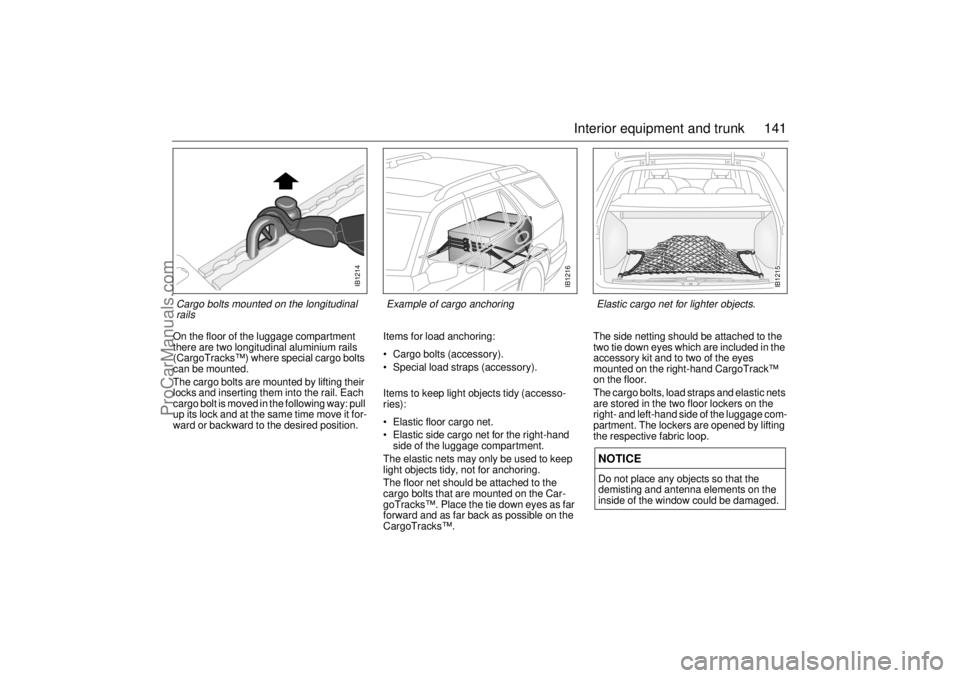
On the floor of the luggage compartment
there are two longitudinal aluminium rails
(CargoTracks™) where special cargo bolts
can be mounted.
The cargo bolts are mounted by lifting their
locks and inserting them into the rail. Each
cargo bolt is moved in the following way: pull
up its lock and at the same time move it for-
ward or backward to the desired position.Items for load anchoring:
Cargo bolts (accessory).
Special load straps (accessory).
Items to keep light objects tidy (accesso-
ries):
Elastic floor cargo net.
Elastic side cargo net for the right-hand
side of the luggage compartment.
The elastic nets may only be used to keep
light objects tidy, not for anchoring.
The floor net should be attached to the
cargo bolts that are mounted on the Car-
goTracks™. Place the tie down eyes as far
forward and as far back as possible on the
CargoTracks™.The side netting should be attached to the
two tie down eyes which are included in the
accessory kit and to two of the eyes
mounted on the right-hand CargoTrack™
on the floor.
The cargo bolts, load straps and elastic nets
are stored in the two floor lockers on the
right- and left-hand side of the luggage com-
partment. The lockers are opened by lifting
the respective fabric loop.
NOTICEDo not place any objects so that the
demisting and antenna elements on the
inside of the window could be damaged.
IB1214
Cargo bolts mounted on the longitudinal
rails
IB1216
Example of cargo anchoring
IB1215
Elastic cargo net for lighter objects.
ProCarManuals.com
Page 142 of 288
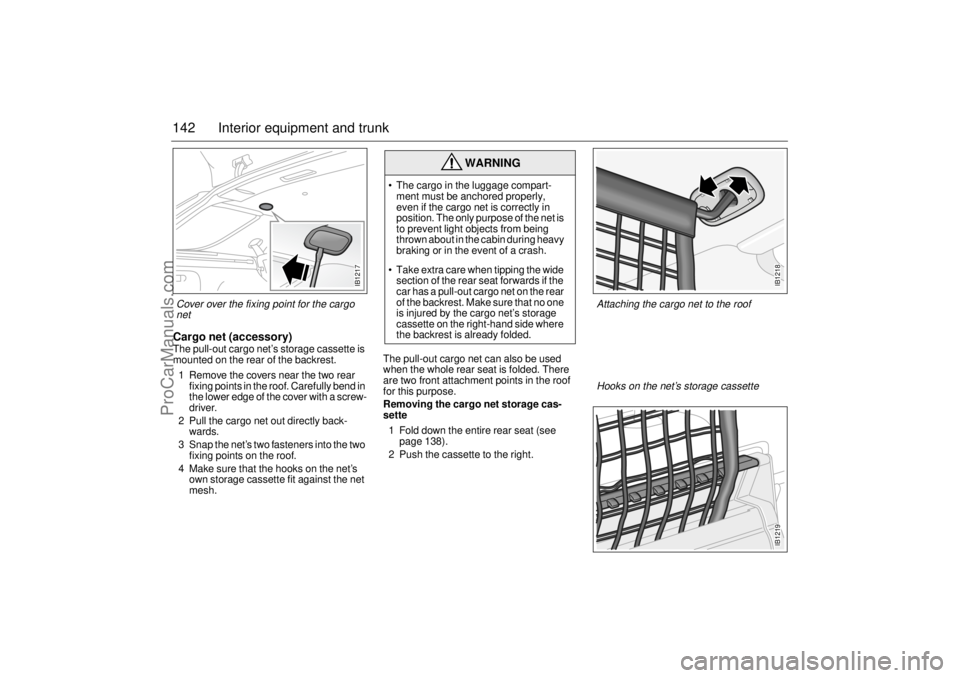
142 Interior equipment and trunkCargo net (accessory)The pull-out cargo net’s storage cassette is
mounted on the rear of the backrest.
1 Remove the covers near the two rear
fixing points in the roof. Carefully bend in
the lower edge of the cover with a screw-
driver.
2 Pull the cargo net out directly back-
wards.
3 Snap the net’s two fasteners into the two
fixing points on the roof.
4 Make sure that the hooks on the net’s
own storage cassette fit against the net
mesh.The pull-out cargo net can also be used
when the whole rear seat is folded. There
are two front attachment points in the roof
for this purpose.
Removing the cargo net storage cas-
sette
1 Fold down the entire rear seat (see
page 138).
2 Push the cassette to the right.
WARNING
The cargo in the luggage compart-
ment must be anchored properly,
even if the cargo net is correctly in
position. The only purpose of the net is
to prevent light objects from being
thrown about in the cabin during heavy
braking or in the event of a crash.
Take extra care when tipping the wide
section of the rear seat forwards if the
car has a pull-out cargo net on the rear
of the backrest. Make sure that no one
is injured by the cargo net’s storage
cassette on the right-hand side where
the backrest is already folded.
IB1217
Cover over the fixing point for the cargo
net
IB1218
Attaching the cargo net to the roof
IB1219
Hooks on the net’s storage cassette
ProCarManuals.com
Page 143 of 288
143 Interior equipment and trunk
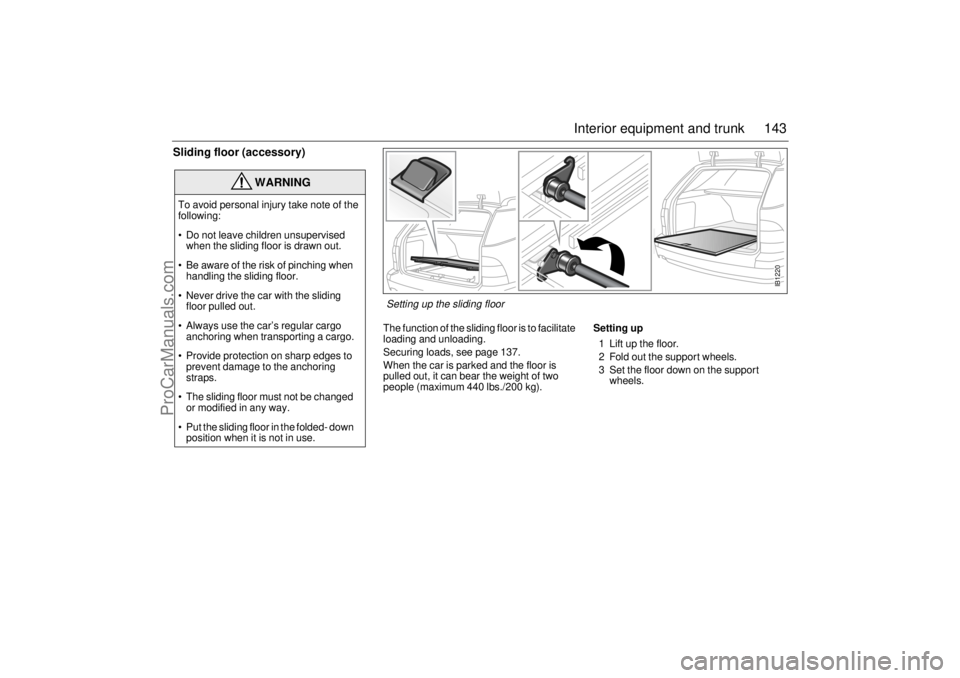
Sliding floor (accessory)
The function of the sliding floor is to facilitate
loading and unloading.
Securing loads, see page 137.
When the car is parked and the floor is
pulled out, it can bear the weight of two
people (maximum 440 lbs./200 kg).Setting up
1 Lift up the floor.
2 Fold out the support wheels.
3 Set the floor down on the support
wheels.
WARNING
To avoid personal injury take note of the
following:
Do not leave children unsupervised
when the sliding floor is drawn out.
Be aware of the risk of pinching when
handling the sliding floor.
Never drive the car with the sliding
floor pulled out.
Always use the car’s regular cargo
anchoring when transporting a cargo.
Provide protection on sharp edges to
prevent damage to the anchoring
straps.
The sliding floor must not be changed
or modified in any way.
Put the sliding floor in the folded- down
position when it is not in use.
IB1220
Setting up the sliding floor
ProCarManuals.com
Page 144 of 288
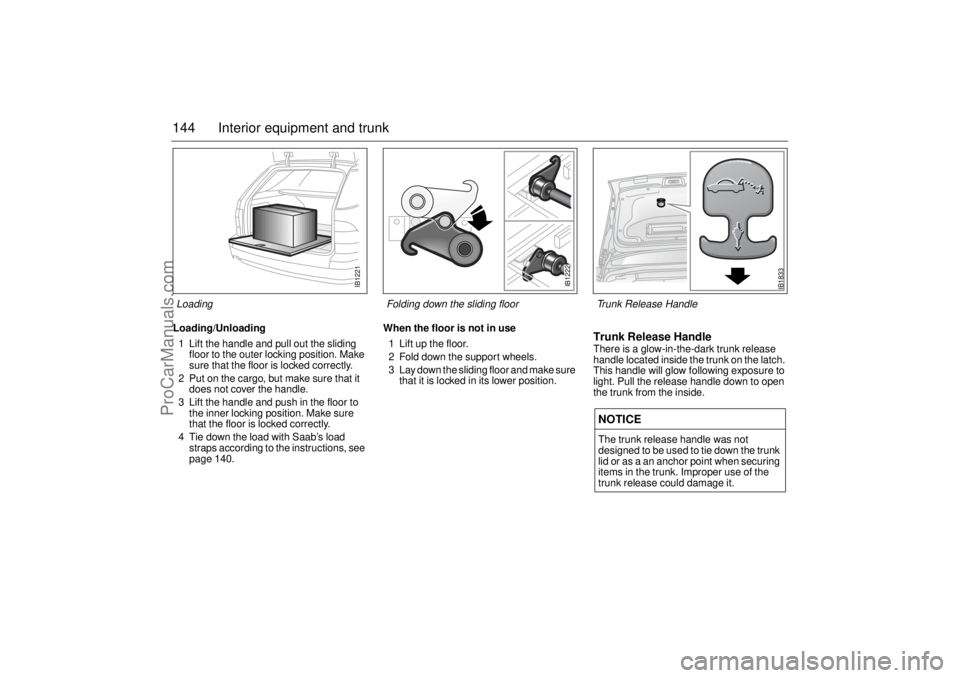
144 Interior equipment and trunkLoading/Unloading
1 Lift the handle and pull out the sliding
floor to the outer locking position. Make
sure that the floor is locked correctly.
2 Put on the cargo, but make sure that it
does not cover the handle.
3 Lift the handle and push in the floor to
the inner locking position. Make sure
that the floor is locked correctly.
4 Tie down the load with Saab’s load
straps according to the instructions, see
page 140.When the floor is not in use
1 Lift up the floor.
2 Fold down the support wheels.
3 Lay down the sliding floor and make sure
that it is locked in its lower position.
Trunk Release HandleThere is a glow-in-the-dark trunk release
handle located inside the trunk on the latch.
This handle will glow following exposure to
light. Pull the release handle down to open
the trunk from the inside.NOTICEThe trunk release handle was not
designed to be used to tie down the trunk
lid or as a an anchor point when securing
items in the trunk. Improper use of the
trunk release could damage it.
IB1221
Loading
IB1222
Folding down the sliding floor
IB1833
Trunk Release Handle
ProCarManuals.com
Page 145 of 288
145 Interior equipment and trunk
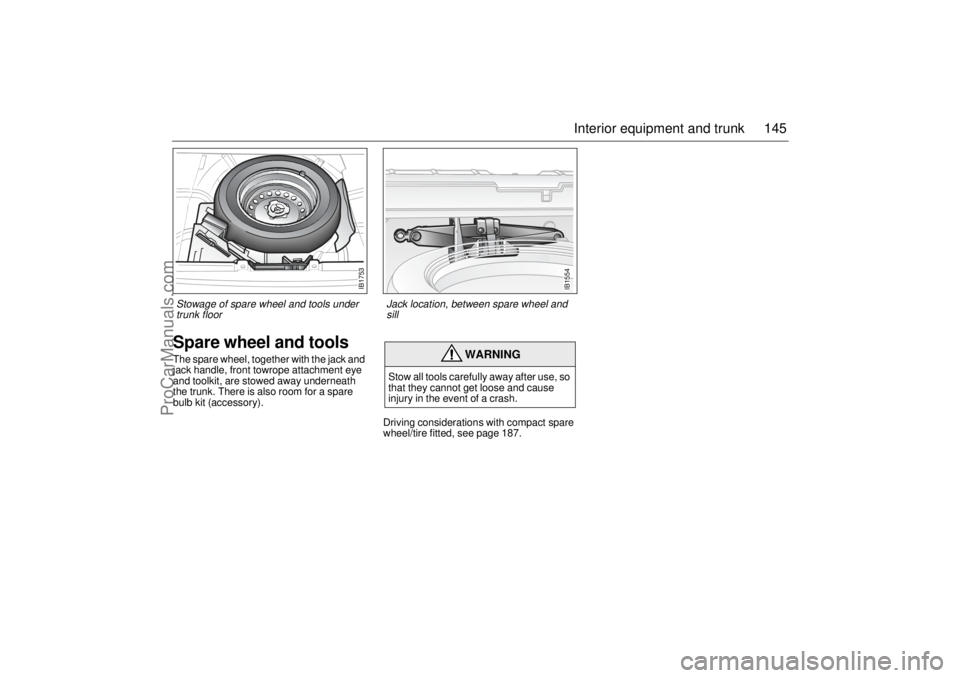
Spare wheel and toolsThe spare wheel, together with the jack and
jack handle, front towrope attachment eye
and toolkit, are stowed away underneath
the trunk. There is also room for a spare
bulb kit (accessory).
Driving considerations with compact spare
wheel/tire fitted, see page 187.
WARNING
Stow all tools carefully away after use, so
that they cannot get loose and cause
injury in the event of a crash.
IB1753
Stowage of spare wheel and tools under
trunk floor
IB1554
Jack location, between spare wheel and
sill
ProCarManuals.com
Page 146 of 288
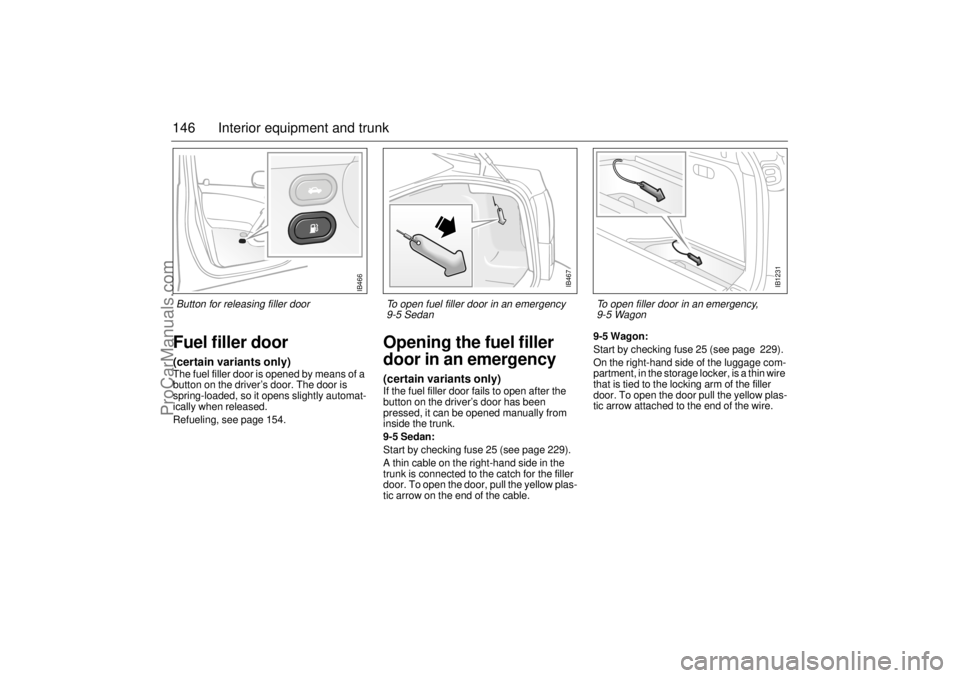
146 Interior equipment and trunkFuel filler door(certain variants only)The fuel filler door is opened by means of a
button on the driver’s door. The door is
spring-loaded, so it opens slightly automat-
ically when released.
Refueling, see page 154.
Opening the fuel filler
door in an emergency(certain variants only)If the fuel filler door fails to open after the
button on the driver’s door has been
pressed, it can be opened manually from
inside the trunk.
9-5 Sedan:
Start by checking fuse 25 (see page 229).
A thin cable on the right-hand side in the
trunk is connected to the catch for the filler
door. To open the door, pull the yellow plas-
tic arrow on the end of the cable. 9-5 Wagon:
Start by checking fuse 25 (see page 229).
On the right-hand side of the luggage com-
partment, in the storage locker, is a thin wire
that is tied to the locking arm of the filler
door. To open the door pull the yellow plas-
tic arrow attached to the end of the wire.
IB1231
To open filler door in an emergency,
9-5 Wagon
IB467
To open fuel filler door in an emergency
9-5 Sedan
IB466
Button for releasing filler door
ProCarManuals.com
Page 147 of 288
147 Starting and driving
Starting and driving
IB1754
Ignition switch ________ 148
Starting the engine ____ 149
Important considerations
for driving ___________ 151
Refueling ____________ 154
Engine Break-In Period _ 157
Gear changing ________ 158
Cruise control ________ 167
Braking ______________ 168
Traction Control System 171
Electronic Stability
Program (ESP) _______ 172 Economical motoring __ 174
Driving in cold weather_ 176
Driving in hot weather _ 177
Towing a trailer _______ 178
Driving with a roof rack
load ________________ 183
Driving at night _______ 185
Driving with a load ____ 185
Driving considerations
with compact spare
wheel/tire fitted ______ 187 Driving with the trunk
lid/tailgate open ______ 188
Driving in deep water __ 188
Towing the car________ 188
Jump starting ________ 191
Saab Parking Assistance 194
Parking brake ________ 196
Parking ______________ 196
ProCarManuals.com
Page 185 of 288
185 Starting and driving
Driving at nightBear in mind the following points when
driving at night:
Nighttime driving requires your full con-
centration.
Do not rush. Count on your journey taking
slightly longer.
The number of drivers under the influence
of drugs is likely to be greater at night than
during the day.
Do not stare at the headlights of oncom-
ing vehicles.
Avoid driving at night if you have poor eye-
sight. Night vision deteriorates with age.
Keep your car's headlights, windows and
mirrors clean. Also, if you wear glasses,
make sure they are clean.
Make sure you are well rested before
starting a long journey. Take a break every
other hour.
Only eat light meals. Heavy meals have a
tendency to induce tiredness.
Driving with a loadThe driving characteristics of the car are
affected by the way it is loaded.
Place heavy loads as far forward and as
low as possible in the trunk.
Secure the load to the tie downs, see
page 137.
The load should be such that the car´s
total weight or axle weight are not
exceeded, see page 270.
Heavy loads mean that the car’s center of
gravity is further back. As a result, the car
will sway more during evasive steering.
Never exceed the permissible load in the
roof box, even if there is room for more.
Ensure that the tire pressure is correct –
slight overinflation is preferable to under-
inflation.
The braking distance of a loaded car is
always greater. Keep your distance from
the vehicle in front.
Roof loads can negatively affect tele-
communication.
Tire pressure, see page 280 and back
cover.
IB1295
ProCarManuals.com