air condition SAAB 9-5 2004 Owners Manual
[x] Cancel search | Manufacturer: SAAB, Model Year: 2004, Model line: 9-5, Model: SAAB 9-5 2004Pages: 288, PDF Size: 16.91 MB
Page 3 of 288
3
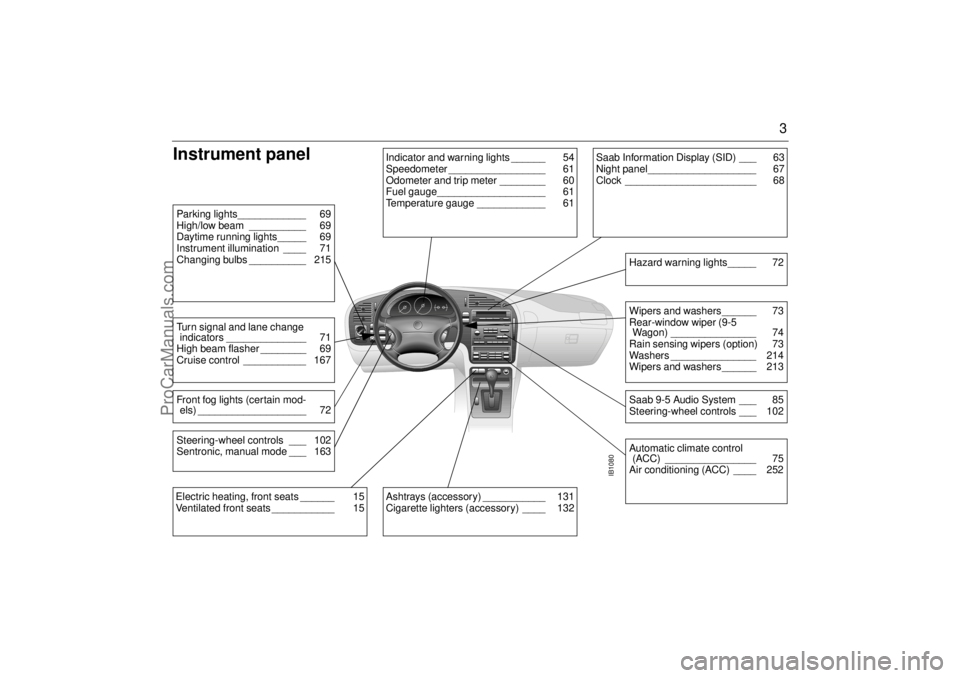
Instrument panel
IB1080
Indicator and warning lights ______ 54
Speedometer _________________ 61
Odometer and trip meter ________ 60
Fuel gauge___________________ 61
Temperature gauge ____________ 61
Parking lights____________ 69
High/low beam __________ 69
Daytime running lights_____ 69
Instrument illumination ____ 71
Changing bulbs __________ 215Turn signal and lane change
indicators ______________ 71
High beam flasher ________ 69
Cruise control ___________ 167Front fog lights (certain mod-
els) ___________________ 72
Ashtrays (accessory) ___________ 131
Cigarette lighters (accessory) ____ 132
Saab Information Display (SID) ___ 63
Night panel___________________ 67
Clock _______________________ 68
Wipers and washers ______ 73
Rear-window wiper (9-5
Wagon) _______________ 74
Rain sensing wipers (option) 73
Washers _______________ 214
Wipers and washers ______ 213Saab 9-5 Audio System ___ 85
Steering-wheel controls ___ 102Hazard warning lights_____ 72Automatic climate control
(ACC) ________________ 75
Air conditioning (ACC) ____ 252
Electric heating, front seats ______ 15
Ventilated front seats ___________ 15Steering-wheel controls ___ 102
Sentronic, manual mode ___ 163
ProCarManuals.com
Page 35 of 288
35 Safety
Side airbags
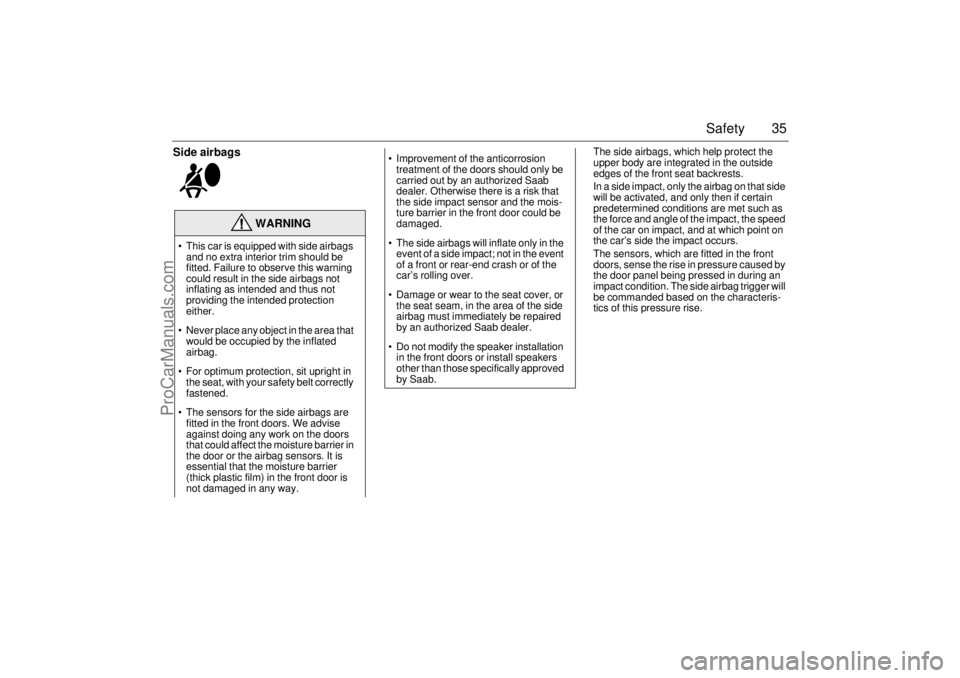
The side airbags, which help protect the
upper body are integrated in the outside
edges of the front seat backrests.
In a side impact, only the airbag on that side
will be activated, and only then if certain
predetermined conditions are met such as
the force and angle of the impact, the speed
of the car on impact, and at which point on
the car’s side the impact occurs.
The sensors, which are fitted in the front
doors, sense the rise in pressure caused by
the door panel being pressed in during an
impact condition. The side airbag trigger will
be commanded based on the characteris-
tics of this pressure rise.
WARNING
This car is equipped with side airbags
and no extra interior trim should be
fitted. Failure to observe this warning
could result in the side airbags not
inflating as intended and thus not
providing the intended protection
either.
Never place any object in the area that
would be occupied by the inflated
airbag.
For optimum protection, sit upright in
the seat, with your safety belt correctly
fastened.
The sensors for the side airbags are
fitted in the front doors. We advise
against doing any work on the doors
that could affect the moisture barrier in
the door or the airbag sensors. It is
essential that the moisture barrier
(thick plastic film) in the front door is
not damaged in any way.
Improvement of the anticorrosion
treatment of the doors should only be
carried out by an authorized Saab
dealer. Otherwise there is a risk that
the side impact sensor and the mois-
ture barrier in the front door could be
damaged.
The side airbags will inflate only in the
event of a side impact; not in the event
of a front or rear-end crash or of the
car’s rolling over.
Damage or wear to the seat cover, or
the seat seam, in the area of the side
airbag must immediately be repaired
by an authorized Saab dealer.
Do not modify the speaker installation
in the front doors or install speakers
other than those specifically approved
by Saab.
ProCarManuals.com
Page 37 of 288

37 Safety
Scrapping or working on airbags
and belt pretensioners Frequently asked questions on func-
tion of airbags
Do you still need to wear a
safety b
elt if
airbags are fitted?
Yes, always! The airbag merely supple-
ments the car’s normal safety system.
Moreover, the airbag will only be actuated in
a moderate to severe frontal, or near-frontal
crash, which means, of course, that it
provides no protection in minor frontal
crashes, major rear-end or side-on crashes
or if the car rolls over.
The safety belts help reduce the chance of
the car occupants from being thrown around
and injured or killed inside the car.
But they also ensure that, if a crash occurs
in which the airbags are inflated, the airbag
will make the optimum contact with the
occupant, i.e. square on from the front. If the
occupant meets the airbag in an offset posi-
tion, the protection afforded will be reduced.
In addition, airbags provide no protection
against a secondary impact occurring in the
same incident. So there is no doubt about
the benefit of wearing safety belts at all
times.
Do not sit too close to the airbag: it needs
room to inflate.
The airbag inflates very quickly and power-
fully in order to protect an adult person,
before they are thrown forward, in a serious
frontal crash.
How do I position the seat to leave room for
the airbag to inflate?Don’t have your seat too far forward.
Recline the seat back to increase the
distance between you and the airbag. For
short drivers, special accessory pedal
extensions are available through your Saab
dealer.
Airbags inflate extremely rapidly and with
great force – to be fast enough to protect an
adult in the seat. When do the front airbags inflate? The airbag will only be inflated under certain
predetermined conditions in a moderate to
severe frontal, or near-frontal crash,
depending on such factors as the force and
angle of the impact, the speed of the car on
impact, and the resistance to deformation of
the impacting object.
The airbag can only be activated once in the
same incident.
Do not attempt to drive the car after an
airbag has been inflated, even if it is possi-
ble.
WARNING
Under no circumstances should any
modifications be made that affect the
steering wheel or the airbag’s electri-
cal circuitry.
Before starting any welding work on
the car, always disconnect the nega-
tive (–) battery lead and cover the
conductor.
Airbags and belt pretensioners must
be deployed under controlled condi-
tions before the car is scrapped or any
of the system’s components are
removed. Airbags or belt pretension-
ers that have been deployed as a
result of a crash must be replaced by
new ones.
Airbag-system components must
never be transferred for use in another
vehicle.
All work involving the scrapping or
replacement of airbags or belt preten-
sioners must only be carried out by
knowledgeable personnel.
The headlining and roof pillar trim
must not be modified in any way. Work
on these areas must only be carried
out at a Saab dealer.
ProCarManuals.com
Page 56 of 288

56 Instruments and controls
Anti-lock brake warning
This light will come on if a fault has occurred
in the ABS system.
On certain variants and as well
as can light up to indicate a fault in the
electronic brake force distribution system
(distribution of the brake pressure between
the front and rear wheels).
Conventional braking without the ABS func-
tion will still be available.
For safety reasons, stop the car and check
the level of the brake fluid (see page 208).If the level is normal, depress the brake
pedal firmly two or three times. Now check
the level again. If the level is still normal, you
may drive the car, with considerable cau-
tion, to the nearest authorized Saab dealer
to have the brake system checked.
Airbag warning light
This light together with will come on if
a potentially serious fault has occurred in
the airbag system.
The light will come on for about three sec-
onds when the ignition switch is turned to
the Start or Drive position. It should go out
after the engine has started.
WARNING
If the ABS is inoperative, there is a
danger of the rear wheels locking up
on hard braking.
If the level of brake fluid in the reser-
voir is below the MIN mark, the car
should be towed to an authorized
Saab dealer.
WARNING
If the airbag readiness light stays on
after you start your vehicle, it means
the airbag system may not be working
properly. One or more of the following
conditions may occur:
- Non-deployment of the airbags in the
event of a crash.
- Deployment of the airbags without a
crash.
- Deployment of the airbags in
crashes less severe than intended.
To help avoid injury to yourself or
others, have your vehicle serviced
right away if the airbag readiness light
stays on after you start your vehicle.
ProCarManuals.com
Page 57 of 288
57 Instruments and controls
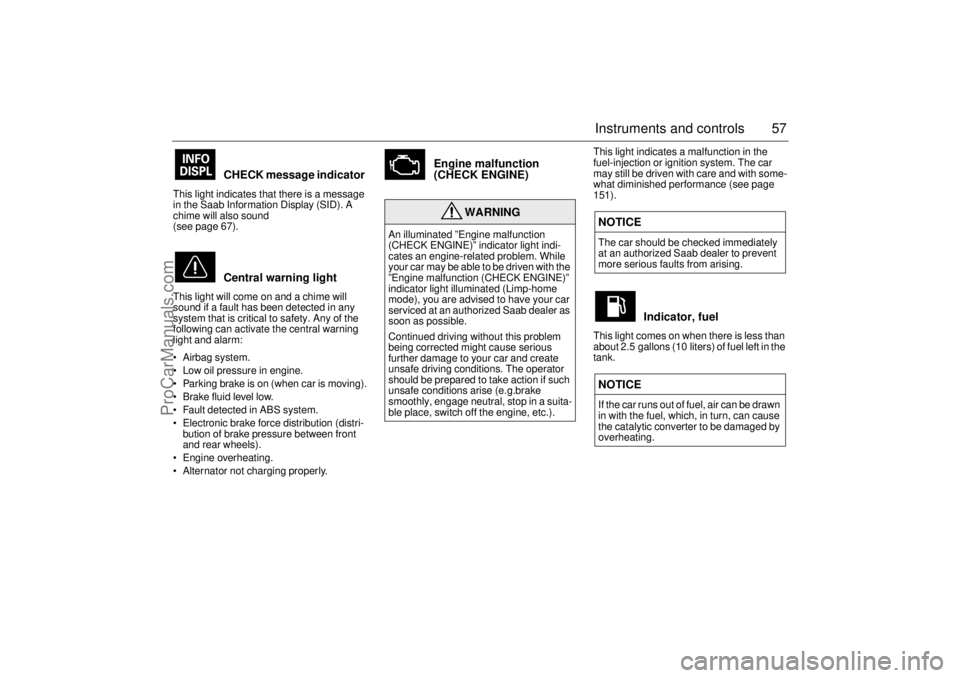
CHECK message indicator
This light indicates that there is a message
in the Saab Information Display (SID). A
chime will also sound
(see page 67).
Central warning light
This light will come on and a chime will
sound if a fault has been detected in any
system that is critical to safety. Any of the
following can activate the central warning
light and alarm:
Airbag system.
Low oil pressure in engine.
Parking brake is on (when car is moving).
Brake fluid level low.
Fault detected in ABS system.
Electronic brake force distribution (distri-
bution of brake pressure between front
and rear wheels).
Engine overheating.
Alternator not charging properly.
Engine malfunction
(CHECK ENGINE)
This light indicates a malfunction in the
fuel-injection or ignition system. The car
may still be driven with care and with some-
what diminished performance (see page
151).
Indicator, fuel
This light comes on when there is less than
about 2.5 gallons (10 liters) of fuel left in the
tank.
WARNING
An illuminated ”Engine malfunction
(CHECK ENGINE)” indicator light indi-
cates an engine-related problem. While
your car may be able to be driven with the
”Engine malfunction (CHECK ENGINE)”
indicator light illuminated (Limp-home
mode), you are advised to have your car
serviced at an authorized Saab dealer as
soon as possible.
Continued driving without this problem
being corrected might cause serious
further damage to your car and create
unsafe driving conditions. The operator
should be prepared to take action if such
unsafe conditions arise (e.g.brake
smoothly, engage neutral, stop in a suita-
ble place, switch off the engine, etc.).
NOTICEThe car should be checked immediately
at an authorized Saab dealer to prevent
more serious faults from arising.NOTICEIf the car runs out of fuel, air can be drawn
in with the fuel, which, in turn, can cause
the catalytic converter to be damaged by
overheating.
ProCarManuals.com
Page 62 of 288
62 Instruments and controls Check fuse 1 (radiator fan) in the fuse panel
under the hood, see page 231.
If the needle repeatedly enters the red zone,
stop the car as soon as it is safe to do so and
check the coolant level by looking at the
level visible through the plastic tank – do not
remove the cap.
If the coolant level falls below the MIN mark,
the Saab Information Display (SID) will dis-
play the message ”Coolant level low.
Refill.”.
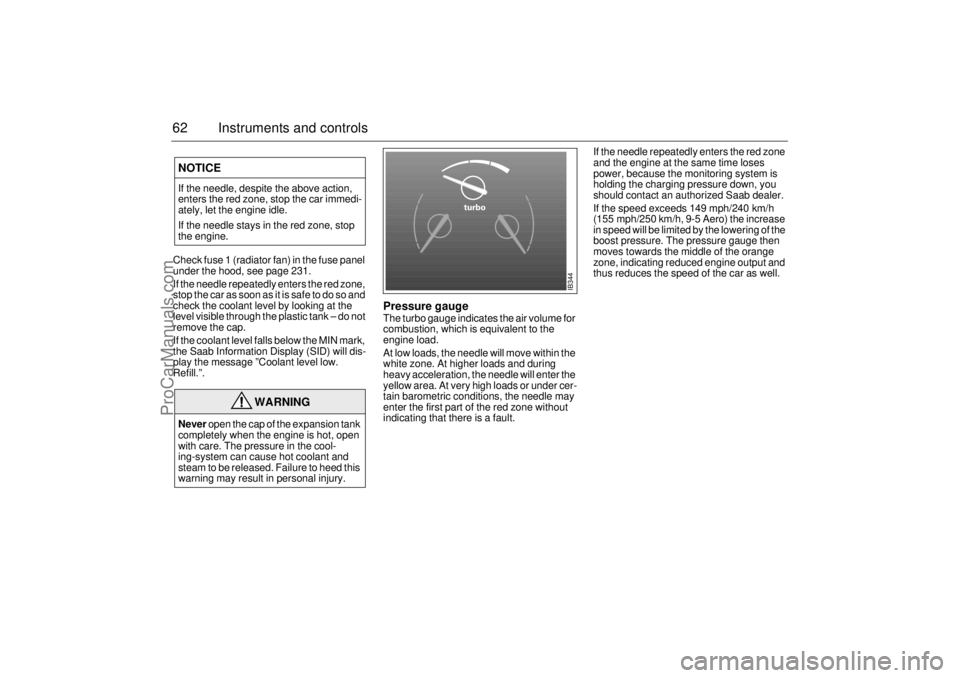
Pressure gaugeThe turbo gauge indicates the air volume for
combustion, which is equivalent to the
engine load.
At low loads, the needle will move within the
white zone. At higher loads and during
heavy acceleration, the needle will enter the
yellow area. At very high loads or under cer-
tain barometric conditions, the needle may
enter the first part of the red zone without
indicating that there is a fault.If the needle repeatedly enters the red zone
and the engine at the same time loses
power, because the monitoring system is
holding the charging pressure down, you
should contact an authorized Saab dealer.
If the speed exceeds 149 mph/240 km/h
(155 mph/250 km/h, 9-5 Aero) the increase
in speed will be limited by the lowering of the
boost pressure. The pressure gauge then
moves towards the middle of the orange
zone, indicating reduced engine output and
thus reduces the speed of the car as well.
NOTICEIf the needle, despite the above action,
enters the red zone, stop the car immedi-
ately, let the engine idle.
If the needle stays in the red zone, stop
the engine.
WARNING
Never open the cap of the expansion tank
completely when the engine is hot, open
with care. The pressure in the cool-
ing-system can cause hot coolant and
steam to be released. Failure to heed this
warning may result in personal injury.
IB344
ProCarManuals.com
Page 84 of 288

84 Instruments and controlsCondensation When the A/C system is running, the intake
air is dehumidified, and the resultant con-
densation is drained off through two outlets
underneath the floor of the car, in the vicinity
of the front doors.
It is therefore perfectly normal for water to
be seen dripping from these outlets when
the car is parked. Greater amounts of con-
densation will result in warmer, more humid
ambient air.
Formation of ice and mist in
extremes of weather It is only in the most extreme conditions that
icing and misting of window glass are likely
to be a problem, e.g. in torrential rain or
severe cold coupled with high relative
humidity, or when passengers are perspir-
ing heavily or wearing wet clothes.
The following measures are recommended
if such problems should occur:
1 Select AUTO and 70°
F (21°C) for both
temperature zones.
2 Select Defroster.
If this is not enough...
3 Increase the fan speed.
If this is not enough...
4 Select a higher temperature.
The following measures are recommended
if the occupants feel that it is cold and drafty
in the car:
1 Make sure that all the air vents are fully
open, including the center rear vent.
If this is not enough...
2 Direct the air flow away from the body
(but not towards the interior temperature
sensor).
If this is not enough...
3 Raise the temperature setting a degree
or two. If this is not enough...
4 Lower the fan speed.
Fault diagnosis and maintenance,
see page 252.
ProCarManuals.com
Page 132 of 288
132 Interior equipment and trunkCigarette lighters
(accessory/certain markets only)The car is provided with cigarette lighters
next to the front ashtray and in the rear end
of the center console.
The cigarette lighter socket can also be
used as power point, e.g. for a mobile
phone. The ignition should be in the ON
position.
The cigarette lighter sockets can also be
used for accessories (e.g. to charge a
mobile phone) when the ignition is ON.
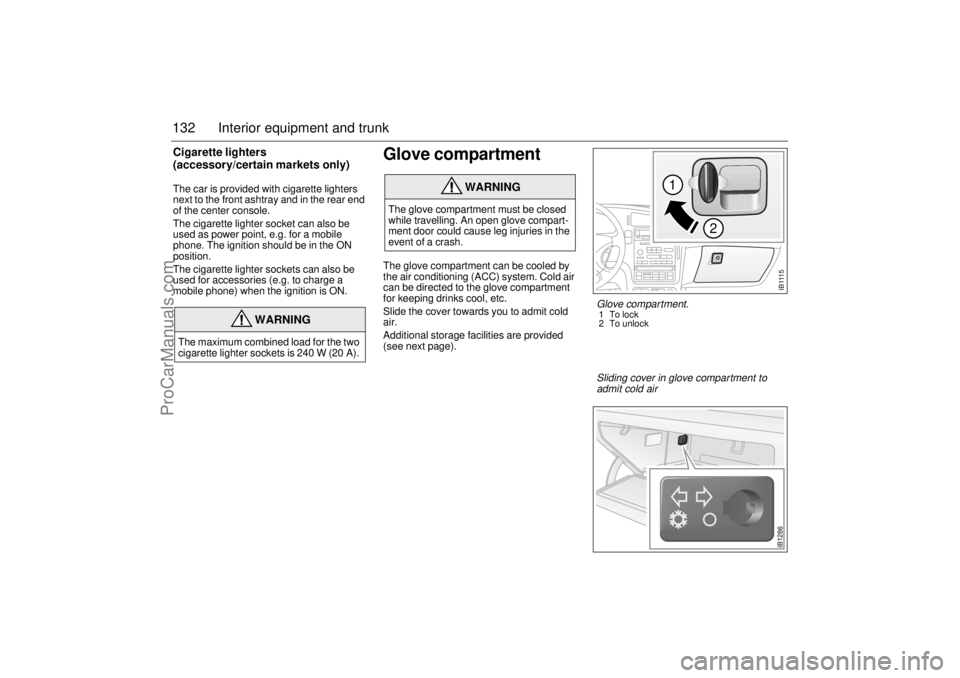
Glove compartment The glove compartment can be cooled by
the air conditioning (ACC) system. Cold air
can be directed to the glove compartment
for keeping drinks cool, etc.
Slide the cover towards you to admit cold
air.
Additional storage facilities are provided
(see next page).
WARNING
The maximum combined load for the two
cigarette lighter sockets is 240 W (20 A).
WARNING
The glove compartment must be closed
while travelling. An open glove compart-
ment door could cause leg injuries in the
event of a crash.
I B 111 5
1
2
Glove compartment.1To lock
2 To unlock
IB1286
Sliding cover in glove compartment to
admit cold air
ProCarManuals.com
Page 151 of 288

151 Starting and driving
Limp-home modeThe engine management system has a
diagnostic feature that continually checks a
number of internal functions. If, for example,
a fault is detected in the throttle valve, the
engine management system will go into
Limp-home mode.This limits idling control,
disables the cruise-control system and
limits the capacity of the A/C compressor.
If the limp-home mode is in operation
(”Engine malfunction (CHECK ENGINE)”
light on, see below) and the outside temper-
ature is close to or below freezing, you may
need to use some throttle on starting (some
pressure on the accelerator).
If the diagnostic system has detected a fault
in the engine-management system, the
”Engine malfunction (CHECK ENGINE)”
light on the main instrument panel will
come on (see page 57), indicating that you
should have the car checked as soon as
possible by an authorized Saab dealer.
Important
considerations for
drivingThe engine-management system in the
Saab 9-5 is called Saab Trionic T7. The
system manages the ignition, fuel injection
and turbo boost pressure.
The Trionic T7 system developed by Saab
is an intelligent engine-management
system designed to achieve optimum driv-
ability under differing driving conditions.
The system makes adjustments automati-
cally, for instance, if the car is being driven
at altitude (oxygen-deficient air), for differ-
ent grades of fuel (AON 87–93) and for dif-
ferent load conditions.
1 Starting and driving
Refrain from using full throttle before
the engine has warmed up (before
needle in mid-range on temperature
gauge).
A safety function prevents the engine
from revving faster than 6,000 rpm by
limiting the induction air.
2 Stopping the engine
Do not rev the engine immediately
before switching it off – stop the engine
when it is idling.
3 Regulating the boost pressure
The system is optimized for fuel with an
octane rating of AON 90. The 2.3 Turbo
and 2.3 T are optimized for AON 93.
NOTICEIf the CHECK ENGINE warning light
starts to flash, ease off the accelerator
slightly. If the light does not cease to flash
within 5 seconds, stop the car in a suit-
able place as soon as possible and turn
off the engine. The car must be towed to
an authorized Saab dealer.
If the CHECK ENGINE warning light
flashes, it indicates that the engine is mis-
firing which can result in damage to the
catalytic converter.
ProCarManuals.com
Page 153 of 288
153 Starting and driving
battery. However, as soon as you have
started the engine, it is important that it
runs on all cylinders. If it is misfiring, allow
i t t o i d l e f o r u p t o f i v e m i n u t e s t o g i v e i t t i m e
to settle and run smoothly. If, after this
time, the engine still fails to run properly,
turn off the engine and get in touch with
an authorized Saab dealer for advice. Never park the car on dry grass or other
combustible material. The catalytic con-
verter gets very hot and could therefore
start a fire.
Never drive off if the engine is misfiring.
If you jump start the car when the engine
is already up to normal temperature, the
engine must start to run on all cylinders.
Stop jump-starting if the engine fails to
start immediately.
Failure to follow these directions could
result in the catalytic converter and associ-
ated components being damaged, and
could represent a breach of the warranty
conditions.
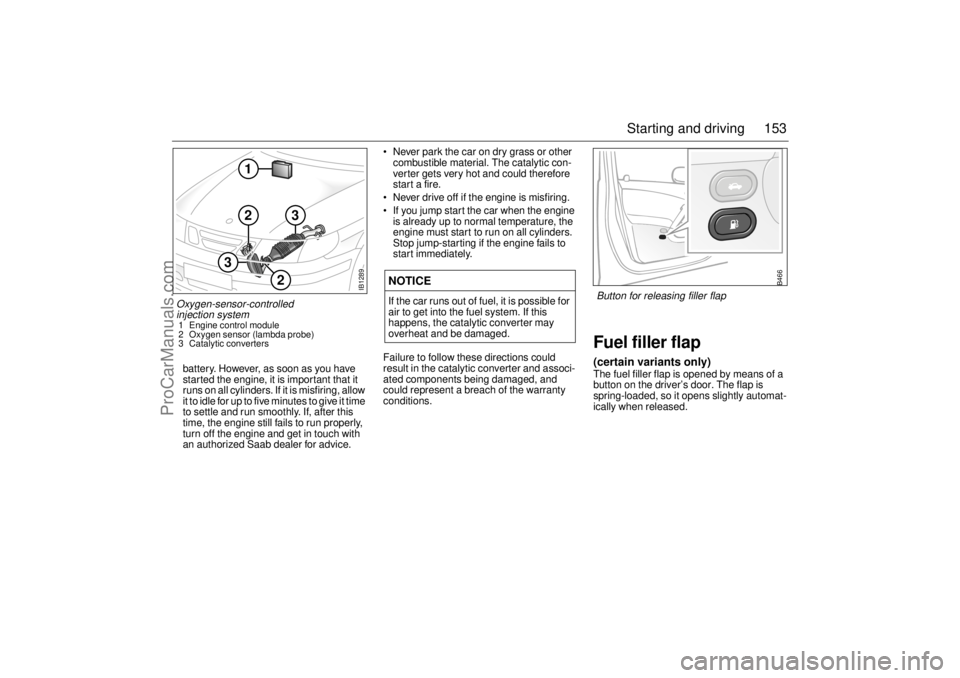
Fuel filler flap(certain variants only)The fuel filler flap is opened by means of a
button on the driver’s door. The flap is
spring-loaded, so it opens slightly automat-
ically when released.
NOTICEIf the car runs out of fuel, it is possible for
air to get into the fuel system. If this
happens, the catalytic converter may
overheat and be damaged.
IB1289
2
2
1
3
3
Oxygen-sensor-controlled
injection system 1 Engine control module
2 Oxygen sensor (lambda probe)
3 Catalytic converters
B466
Button for releasing filler flap
ProCarManuals.com