brake SAAB 9-5 2004 Owners Manual
[x] Cancel search | Manufacturer: SAAB, Model Year: 2004, Model line: 9-5, Model: SAAB 9-5 2004Pages: 288, PDF Size: 16.91 MB
Page 6 of 288
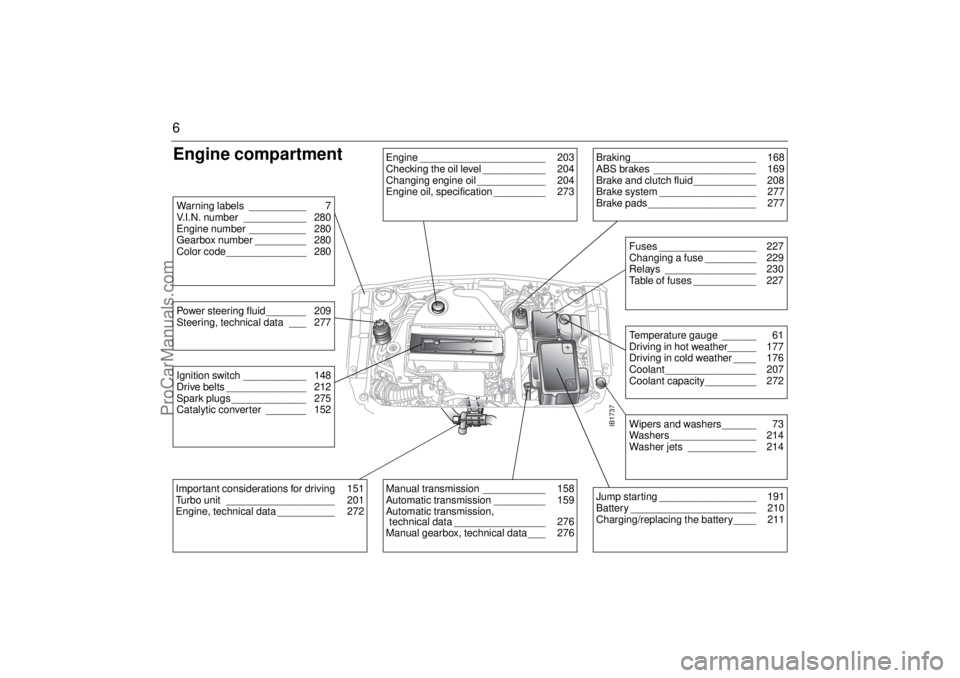
6Engine compartment
IB1737
Engine ______________________ 203
Checking the oil level ___________ 204
Changing engine oil ____________ 204
Engine oil, specification _________ 273
Braking______________________ 168
ABS brakes __________________ 169
Brake and clutch fluid ___________ 208
Brake system _________________ 277
Brake pads ___________________ 277
Fuses _________________ 227
Changing a fuse _________ 229
Relays ________________ 230
Table of fuses ___________ 227Temperature gauge ______ 61
Driving in hot weather_____ 177
Driving in cold weather ____ 176
Coolant________________ 207
Coolant capacity_________ 272
Power steering fluid _______ 209
Steering, technical data ___ 277
Wipers and washers ______ 73
Washers _______________ 214
Washer jets ____________ 214
Jump starting _________________ 191
Battery ______________________ 210
Charging/replacing the battery____ 211
Manual transmission ___________ 158
Automatic transmission _________ 159
Automatic transmission,
technical data ________________ 276
Manual gearbox, technical data ___ 276
Important considerations for driving 151
Turbo unit ___________________ 201
Engine, technical data __________ 272Ignition switch ___________ 148
Drive belts ______________ 212
Spark plugs _____________ 275
Catalytic converter _______ 152Warning labels __________ 7
V.I.N. number ___________ 280
Engine number __________ 280
Gearbox number _________ 280
Color code______________ 280
ProCarManuals.com
Page 7 of 288
7
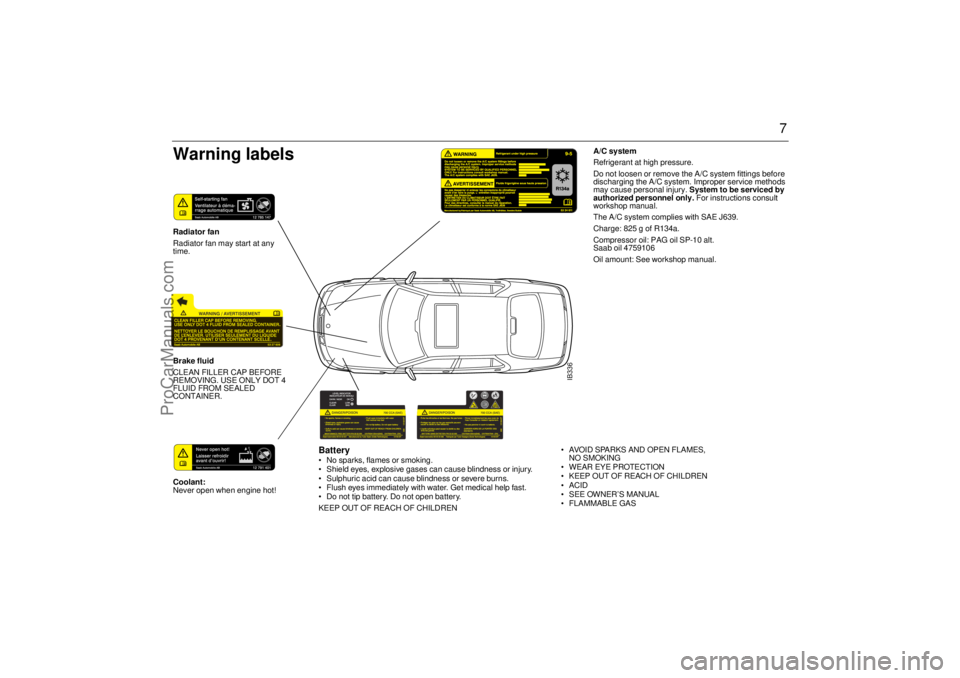
Battery No sparks, flames or smoking.
Shield eyes, explosive gases can cause blindness or injury.
Sulphuric acid can cause blindness or severe burns.
Flush eyes immediately with water. Get medical help fast.
Do not tip battery. Do not open battery.
KEEP OUT OF REACH OF CHILDREN Brake fluid
CLEAN FILLER CAP BEFORE
REMOVING. USE ONLY DOT 4
FLUID FROM SEALED
CONTAINER. Radiator fan
Radiator fan may start at any
time.
IB336
A/C system
Refrigerant at high pressure.
Do not loosen or remove the A/C system fittings before
discharging the A/C system. Improper service methods
may cause personal injury. System to be serviced by
authorized personnel only. For instructions consult
workshop manual.
The A/C system complies with SAE J639.
Charge: 825 g of R134a.
Compressor oil: PAG oil SP-10 alt.
Saab oil 4759106
Oil amount: See workshop manual.
Warning labels
AVOID SPARKS AND OPEN FLAMES,
NO SMOKING
WEAR EYE PROTECTION
KEEP OUT OF REACH OF CHILDREN
ACID
SEE OWNER’S MANUAL
FLAMMABLE GAS
Coolant:
Never open when engine hot!
ProCarManuals.com
Page 8 of 288
8
IB336
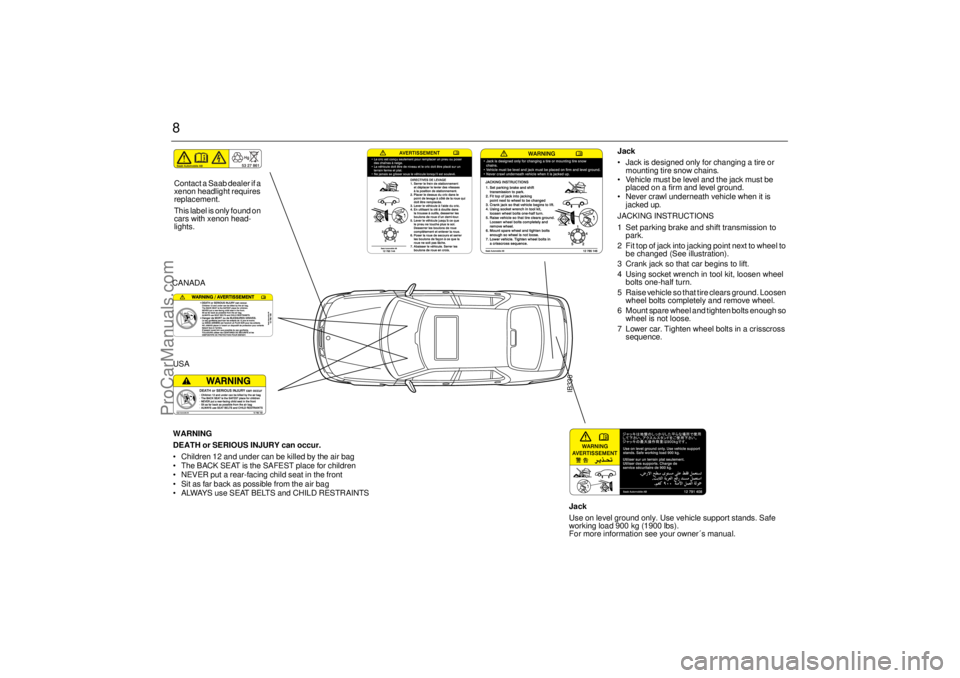
Jack
Jack is designed only for changing a tire or
mounting tire snow chains.
Vehicle must be level and the jack must be
placed on a firm and level ground.
Never crawl underneath vehicle when it is
jacked up.
JACKING INSTRUCTIONS
1 Set parking brake and shift transmission to
park.
2 Fit top of jack into jacking point next to wheel to
be changed (See illustration).
3 Crank jack so that car begins to lift.
4 Using socket wrench in tool kit, loosen wheel
bolts one-half turn.
5 Raise vehicle so that tire clears ground. Loosen
wheel bolts completely and remove wheel.
6 Mount spare wheel and tighten bolts enough so
wheel is not loose.
7 Lower car. Tighten wheel bolts in a crisscross
sequence.
CANADAUSA
WARNING
DEATH or SERIOUS INJURY can occur.
Children 12 and under can be killed by the air bag
The BACK SEAT is the SAFEST place for children
NEVER put a rear-facing child seat in the front
Sit as far back as possible from the air bag
ALWAYS use SEAT BELTS and CHILD RESTRAINTSContact a Saab dealer if a
xenon headlight requires
replacement.
This label is only found on
cars with xenon head-
lights.
Jack
Use on level ground only. Use vehicle support stands. Safe
working load 900 kg (1900 lbs).
For more information see your owner´s manual.
ProCarManuals.com
Page 9 of 288
9
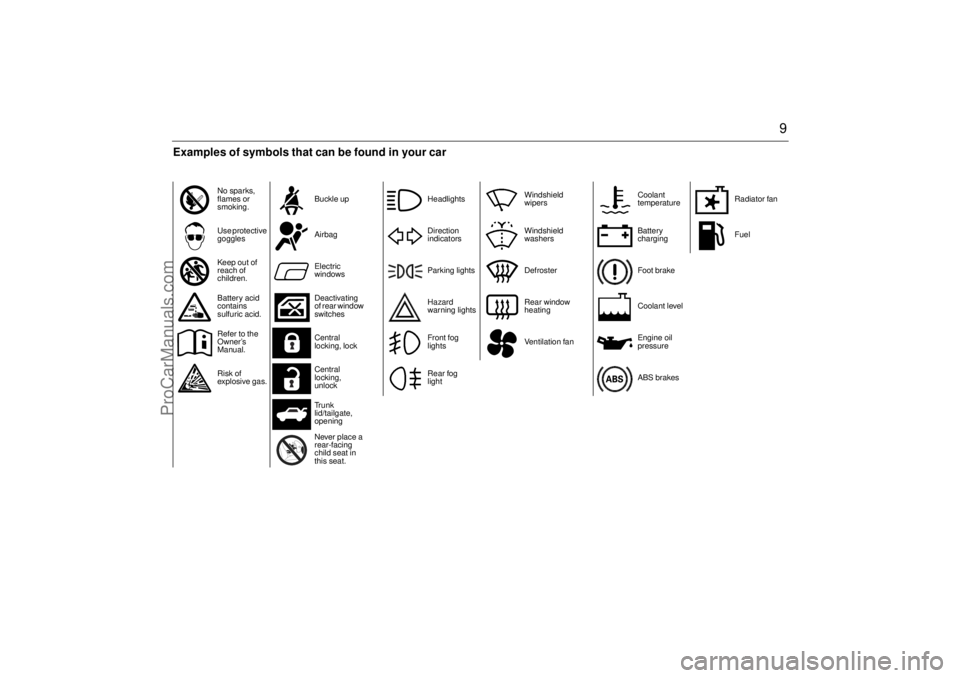
No sparks,
flames or
smoking.Buckle up
Use protective
gogglesAirbag
Keep out of
reach of
children.Electric
windows
Battery acid
contains
sulfuric acid.Deactivating
of rear window
switches
Refer to the
Owner’s
Manual.Central
locking, lock
Risk of
explosive gas.Central
locking,
unlock
Tr u n k
lid/tailgate,
opening
Never place a
rear-facing
child seat in
this seat.
HeadlightsWindshield
wipers
Direction
indicatorsWindshield
washers
Parking lights Defroster
Hazard
warning lightsRear window
heating
Front fog
lightsVentilation fan
Rear fog
light
Coolant
temperatureRadiator fan
Battery
chargingFuel
Foot brake
Coolant level
Engine oil
pressure
ABS brakes
Examples of symbols that can be found in your car
ProCarManuals.com
Page 18 of 288
18 SafetySafety belt pretensionersThe belts of the front seats are fitted with
automatic pretensioners and force limiters.
These are activated in the event of a severe
frontal or rear-end crash and a side-on colli-
sion, provided that the safety belts are being
worn.
The pretensioners serve to reduce the
forward movement of the body by tension-
ing the belt. The force limiters reduce belt
loads on the body by "loosening" the safety
belt to absorb the body’s kinetic energy as
gradually as possible.
The safety belt pretensioners are not acti-
vated by vehicle rollover.
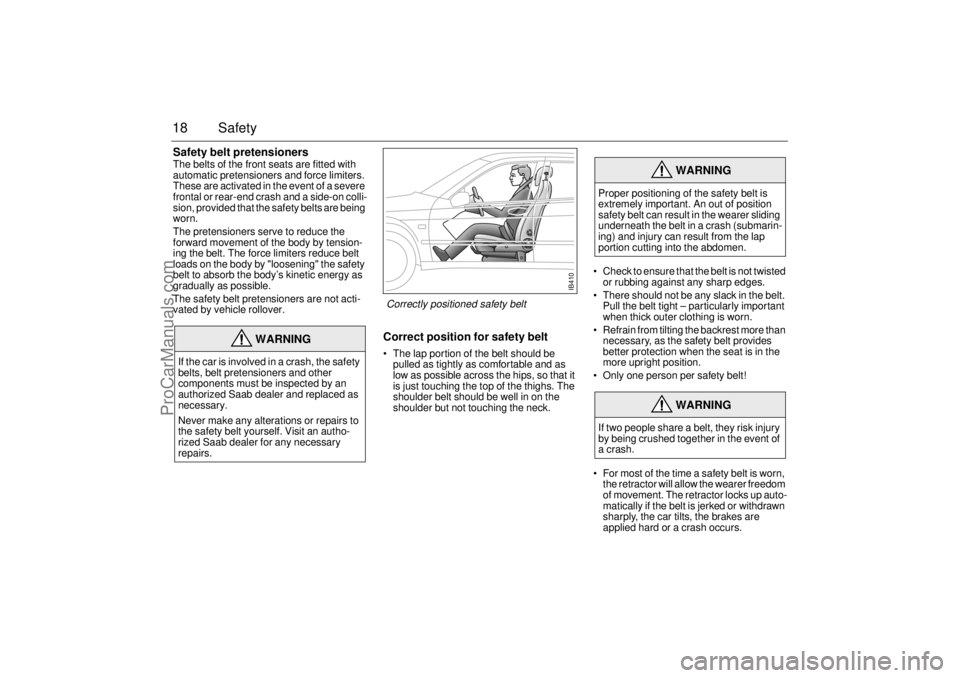
Correct position for safety belt The lap portion of the belt should be
pulled as tightly as comfortable and as
low as possible across the hips, so that it
is just touching the top of the thighs. The
shoulder belt should be well in on the
shoulder but not touching the neck.
Check to ensure that the belt is not twisted
or rubbing against any sharp edges.
There should not be any slack in the belt.
Pull the belt tight – particularly important
when thick outer clothing is worn.
Refrain from tilting the backrest more than
necessary, as the safety belt provides
better protection when the seat is in the
more upright position.
Only one person per safety belt!
For most of the time a safety belt is worn,
the retractor will allow the wearer freedom
of movement. The retractor locks up auto-
matically if the belt is jerked or withdrawn
sharply, the car tilts, the brakes are
applied hard or a crash occurs.
WARNING
If the car is involved in a crash, the safety
belts, belt pretensioners and other
components must be inspected by an
authorized Saab dealer and replaced as
necessary.
Never make any alterations or repairs to
the safety belt yourself. Visit an autho-
rized Saab dealer for any necessary
repairs.
WARNING
Proper positioning of the safety belt is
extremely important. An out of position
safety belt can result in the wearer sliding
underneath the belt in a crash (submarin-
ing) and injury can result from the lap
portion cutting into the abdomen.
WARNING
If two people share a belt, they risk injury
by being crushed together in the event of
a crash.
IB410
Correctly positioned safety belt
ProCarManuals.com
Page 55 of 288
55 Instruments and controls
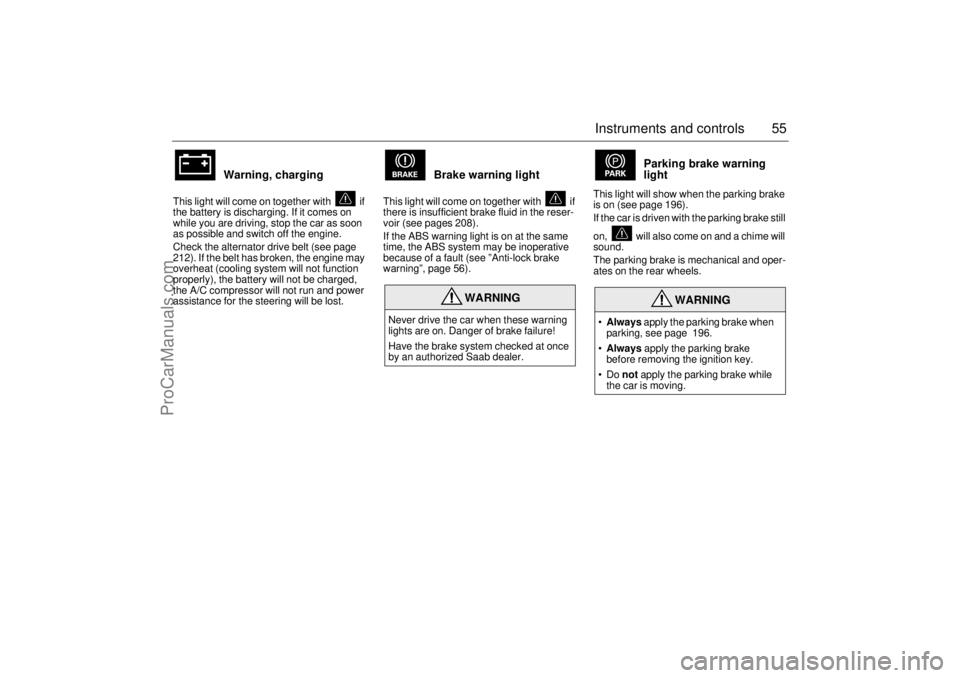
Warning, charging
This light will come on together with if
the battery is discharging. If it comes on
while you are driving, stop the car as soon
as possible and switch off the engine.
Check the alternator drive belt (see page
212). If the belt has broken, the engine may
overheat (cooling system will not function
properly), the battery will not be charged,
the A/C compressor will not run and power
assistance for the steering will be lost.
Brake warning light
This light will come on together with if
there is insufficient brake fluid in the reser-
voir (see pages 208).
If the ABS warning light is on at the same
time, the ABS system may be inoperative
because of a fault (see ”Anti-lock brake
warning”, page 56).
Parking brake warning
light
This light will show when the parking brake
is on (see page 196).
If the car is driven with the parking brake still
on, will also come on and a chime will
sound.
The parking brake is mechanical and oper-
ates on the rear wheels.
WARNING
Never drive the car when these warning
lights are on. Danger of brake failure!
Have the brake system checked at once
by an authorized Saab dealer.
WARNING
Always apply the parking brake when
parking, see page 196.
Always apply the parking brake
before removing the ignition key.
Do not apply the parking brake while
the car is moving.
ProCarManuals.com
Page 56 of 288

56 Instruments and controls
Anti-lock brake warning
This light will come on if a fault has occurred
in the ABS system.
On certain variants and as well
as can light up to indicate a fault in the
electronic brake force distribution system
(distribution of the brake pressure between
the front and rear wheels).
Conventional braking without the ABS func-
tion will still be available.
For safety reasons, stop the car and check
the level of the brake fluid (see page 208).If the level is normal, depress the brake
pedal firmly two or three times. Now check
the level again. If the level is still normal, you
may drive the car, with considerable cau-
tion, to the nearest authorized Saab dealer
to have the brake system checked.
Airbag warning light
This light together with will come on if
a potentially serious fault has occurred in
the airbag system.
The light will come on for about three sec-
onds when the ignition switch is turned to
the Start or Drive position. It should go out
after the engine has started.
WARNING
If the ABS is inoperative, there is a
danger of the rear wheels locking up
on hard braking.
If the level of brake fluid in the reser-
voir is below the MIN mark, the car
should be towed to an authorized
Saab dealer.
WARNING
If the airbag readiness light stays on
after you start your vehicle, it means
the airbag system may not be working
properly. One or more of the following
conditions may occur:
- Non-deployment of the airbags in the
event of a crash.
- Deployment of the airbags without a
crash.
- Deployment of the airbags in
crashes less severe than intended.
To help avoid injury to yourself or
others, have your vehicle serviced
right away if the airbag readiness light
stays on after you start your vehicle.
ProCarManuals.com
Page 57 of 288
57 Instruments and controls
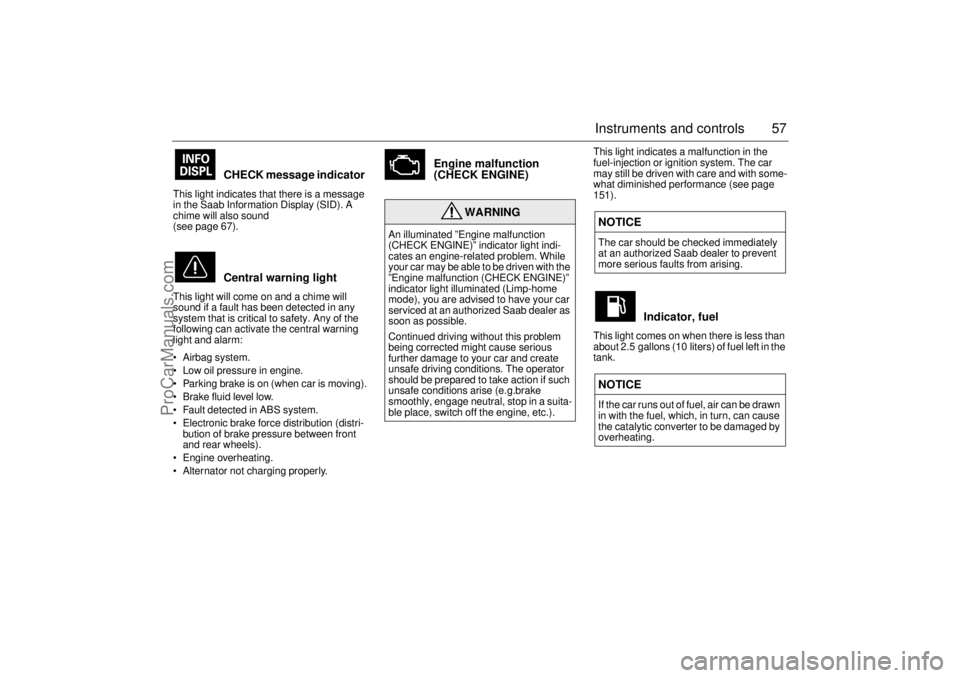
CHECK message indicator
This light indicates that there is a message
in the Saab Information Display (SID). A
chime will also sound
(see page 67).
Central warning light
This light will come on and a chime will
sound if a fault has been detected in any
system that is critical to safety. Any of the
following can activate the central warning
light and alarm:
Airbag system.
Low oil pressure in engine.
Parking brake is on (when car is moving).
Brake fluid level low.
Fault detected in ABS system.
Electronic brake force distribution (distri-
bution of brake pressure between front
and rear wheels).
Engine overheating.
Alternator not charging properly.
Engine malfunction
(CHECK ENGINE)
This light indicates a malfunction in the
fuel-injection or ignition system. The car
may still be driven with care and with some-
what diminished performance (see page
151).
Indicator, fuel
This light comes on when there is less than
about 2.5 gallons (10 liters) of fuel left in the
tank.
WARNING
An illuminated ”Engine malfunction
(CHECK ENGINE)” indicator light indi-
cates an engine-related problem. While
your car may be able to be driven with the
”Engine malfunction (CHECK ENGINE)”
indicator light illuminated (Limp-home
mode), you are advised to have your car
serviced at an authorized Saab dealer as
soon as possible.
Continued driving without this problem
being corrected might cause serious
further damage to your car and create
unsafe driving conditions. The operator
should be prepared to take action if such
unsafe conditions arise (e.g.brake
smoothly, engage neutral, stop in a suita-
ble place, switch off the engine, etc.).
NOTICEThe car should be checked immediately
at an authorized Saab dealer to prevent
more serious faults from arising.NOTICEIf the car runs out of fuel, air can be drawn
in with the fuel, which, in turn, can cause
the catalytic converter to be damaged by
overheating.
ProCarManuals.com
Page 58 of 288

58 Instruments and controls
Indicator, cruise control
This light shows when the cruise-control
system is active (see page 167).
Indicator, high beam
This light shows when the headlights are on
high beam (see page 69).
Indicator, rear fog light
This light shows when the rear fog light is on
(see page 70).
The rear fog light is switched off automat-
ically when the engine is switched off. When
the fog light is next needed, it will have to be
switched on manually again.
The rear fog light consists of one light so it
should not be mistaken for brake lights.
Xenon headlight fault
indicator
(certain variants only)
This light indicates that there is a fault in the
Xenon headlight system, which consists of
xenon headlights and an automatic levelling
system.
If a fault arises in the Xenon headlight sys-
tem, the headlights will be angled down to
avoid dazzling drivers in oncoming traffic.
Adjust your speed accordingly as visibility
will be reduced.
Indicator, open door
If a door has not been closed properly, the
pictogram will indicate the door concerned
(or tailgate).
Indicator, SPORT-mode
automatic transmission
This light will come on in cars with automatic
transmission when the S (SPORT) button
on the selector lever has been pressed
(position N or D) see page 166.
In this mode, the gear changes occur later,
at higher engine revs, giving the engine and
transmission a sportier feel.
To cancel the SPORT mode, press the S
button on the selector lever again. The
mode is also deselected automatically
w h e n t h e s e l e c t o r l e v e r i s m o v e d t o P , R , M
or L.
Indicator, WINTER-mode
automatic transmission
This light shows when the WINTER mode
has been selected in cars with automatic
transmission (see page 166).
In the WINTER mode, the car pulls away in
3rd gear, to help prevent wheelspin on an
icy road.
To cancel the WINTER mode, press the W
button.
NOTICEIf the Xenon headlight fault indicator lights
up, have your car checked as soon as
possible at an authorized Saab dealer.
If you do not rectify the problem, nighttime
visibility will be poor since the range of the
headlights is reduced.
ProCarManuals.com
Page 67 of 288

67 Instruments and controls
CHECK messages When the engine is started, CHECKING will
appear on the display for about four sec-
onds, while the SID checks are being per-
formed.
When a CHECK message is generated
while the car is being driven, a chime will
sound, INFO DISPL will illuminate on the
main instrument panel, and the message
will appear on the SID. The number of mes-
sages that can be displayed by the SID
varies with the specification of the car.
If more than one CHECK message has
been generated, the
+ symbol will appear to
the left of the text on the display. The mes-
sages appear in order of priority.
If a new fault occurs while another message
is being displayed, the message relating to
the new one will appear for 10 seconds,
after which the display will return to the ear-
lier one.
Press CLEAR once to acknowledge a mes-
sage, whereupon it will be cleared from the
display. It will not be displayed again before
the ignition has been switched off and then
on again. The following messages may be displayed:
1 This message will be displayed approximately
600 miles (1,000 km) before the next sched-
uled service is due, or when 365 days have
elapsed since the last service. The message
should be cleared at the time of that service
(see the Saab Warranties & Service Record
Booklet).
This message can also be deleted by first
briefly pressing the CLEAR button, then
depressing it a second time for at least eight
seconds until ”SERVICE” appears on the dis-
play and a chime sounds. The message can
only be deleted when it is shown on the SID.
Night panelTo improve night-driving conditions inside
the car, the Night Panel mode can be
selected. In this mode, the amount of infor-
mation displayed is reduced, and only the
most important instruments and displays
will be illuminated.
When the Night Panel button is pressed,
only the speedometer will be illuminated (up
to the 87-mph or 140-km/h graduation), all
the other instruments illumination being
extinguished and their needles moved to
zero. Both the SID and the ACC displays will
be extinguished and the backlighting for
switches and other controls will be dimmed.
Note: All indicator and warning lights,
together with the display of CHECK mes-
sages, will operate as normal, except ”Out-
door temperature (Frost warning)”, see
page 64. Message See
page
Fog light failure. 216
Rear light failure. 220
Brake light failure. 220
Washer fluid level low. Refill. 214
Coolant level low. Refill. 207
Remote control battery low.
Replace battery. 43
Key not accepted. Contact service. 50
Theft protection failure. Contact
service. 50
Gearbox too hot. Make a safe stop. 162
Tighten fuel filler cap. 154
Time for service.
1)
264
ProCarManuals.com