transmission fluid SAAB 9-5 2004 Owners Manual
[x] Cancel search | Manufacturer: SAAB, Model Year: 2004, Model line: 9-5, Model: SAAB 9-5 2004Pages: 288, PDF Size: 16.91 MB
Page 5 of 288
5
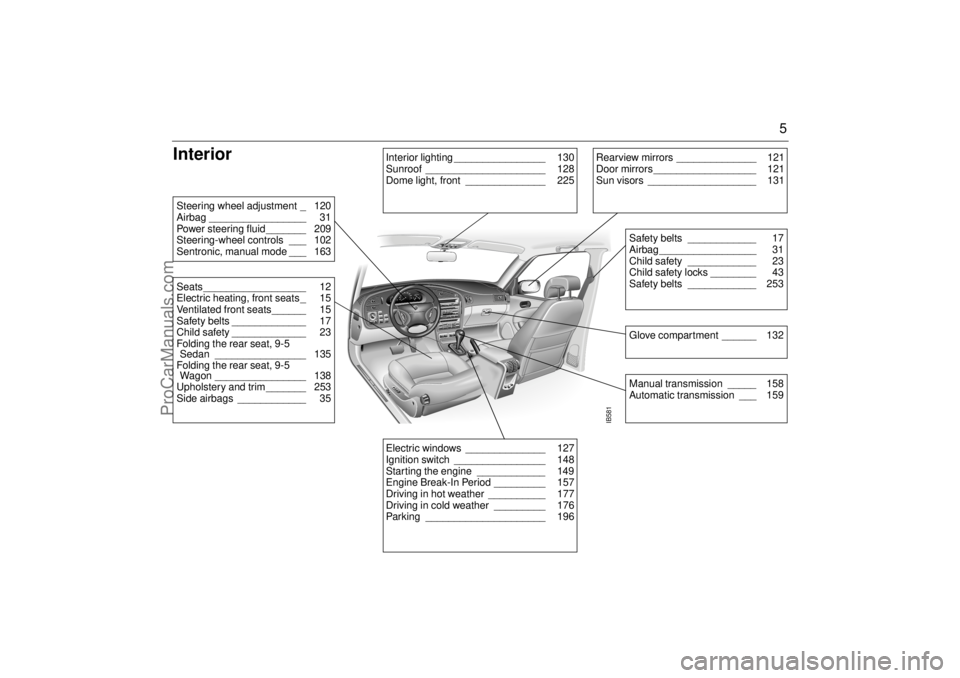
Interior
IB581
Rearview mirrors ______________ 121
Door mirrors __________________ 121
Sun visors ___________________ 131
Safety belts ____________ 17
Airbag _________________ 31
Child safety ____________ 23
Child safety locks ________ 43
Safety belts ____________ 253Glove compartment ______ 132Manual transmission _____ 158
Automatic transmission ___ 159
Electric windows ______________ 127
Ignition switch ________________ 148
Starting the engine ____________ 149
Engine Break-In Period _________ 157
Driving in hot weather __________ 177
Driving in cold weather _________ 176
Parking _____________________ 196
Steering wheel adjustment _ 120
Airbag _________________ 31
Power steering fluid _______ 209
Steering-wheel controls ___ 102
Sentronic, manual mode ___ 163Seats __________________ 12
Electric heating, front seats _ 15
Ventilated front seats______ 15
Safety belts _____________ 17
Child safety _____________ 23
Folding the rear seat, 9-5
Sedan ________________ 135
Folding the rear seat, 9-5
Wagon ________________ 138
Upholstery and trim _______ 253
Side airbags ____________ 35
Interior lighting ________________ 130
Sunroof _____________________ 128
Dome light, front ______________ 225
ProCarManuals.com
Page 6 of 288
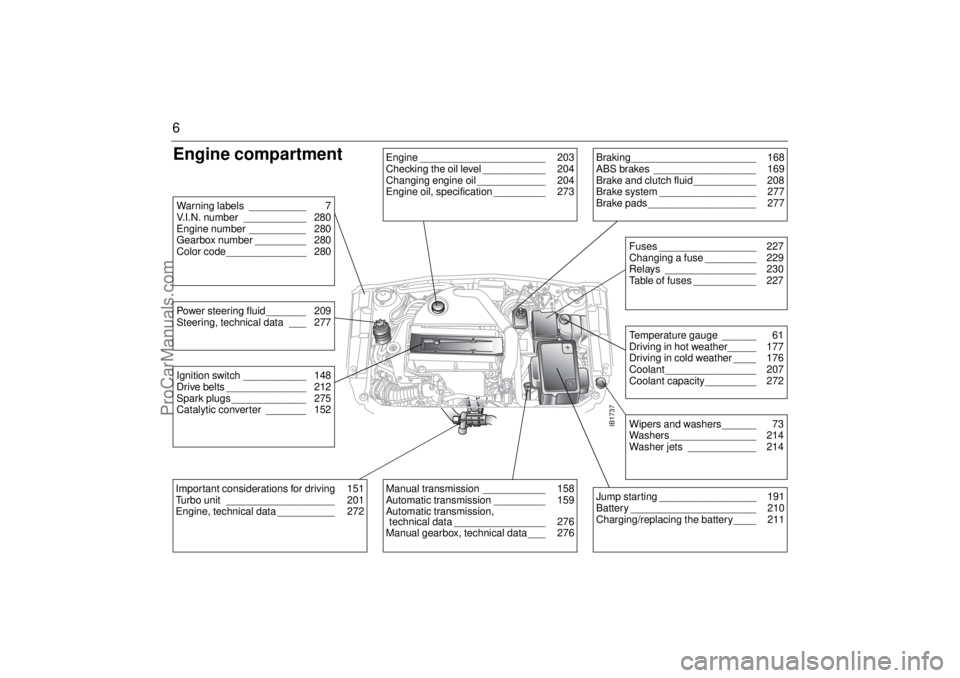
6Engine compartment
IB1737
Engine ______________________ 203
Checking the oil level ___________ 204
Changing engine oil ____________ 204
Engine oil, specification _________ 273
Braking______________________ 168
ABS brakes __________________ 169
Brake and clutch fluid ___________ 208
Brake system _________________ 277
Brake pads ___________________ 277
Fuses _________________ 227
Changing a fuse _________ 229
Relays ________________ 230
Table of fuses ___________ 227Temperature gauge ______ 61
Driving in hot weather_____ 177
Driving in cold weather ____ 176
Coolant________________ 207
Coolant capacity_________ 272
Power steering fluid _______ 209
Steering, technical data ___ 277
Wipers and washers ______ 73
Washers _______________ 214
Washer jets ____________ 214
Jump starting _________________ 191
Battery ______________________ 210
Charging/replacing the battery____ 211
Manual transmission ___________ 158
Automatic transmission _________ 159
Automatic transmission,
technical data ________________ 276
Manual gearbox, technical data ___ 276
Important considerations for driving 151
Turbo unit ___________________ 201
Engine, technical data __________ 272Ignition switch ___________ 148
Drive belts ______________ 212
Spark plugs _____________ 275
Catalytic converter _______ 152Warning labels __________ 7
V.I.N. number ___________ 280
Engine number __________ 280
Gearbox number _________ 280
Color code______________ 280
ProCarManuals.com
Page 162 of 288
162 Starting and driving
Overheated transmission fluid If the automatic-transmission fluid should
overheat, the following message will appear
on the SID:
”Gearbox too hot. Make a safe stop.”. In this
event, stop the car in a suitable place,
switch off the engine and open the hood.
Wait for several minutes then turn on the
ignition to check that the message has gone
out. When driving subsequent to the trans-
mission fluid overheating, select a gear in
which the engine speed is about 3,000 rpm.
Overheating of the automatic-transmission
fluid can occur when the car is towing a
heavy load, such as a camping trailer in hilly
country. High ambient temperatures can
also increase the temperature of the trans-
mission fluid or the oil cooler may be faulty.
Contact an authorized Saab dealer (see
also page 178).
Driving on hilly roads with a heavy
loadThe transmission fluid can overheat when
the gearbox is strained, for example, when
driving with a trailer on hilly roads. To avoid
the transmission fluid overheating, always
drive in Normal mode. The adaptive gear
change patterns are then active.
High air temperatures or a faulty oil cooler
can also cause the transmission fluid to
overheat. Overheating reduces the service
life of the fluid. Contact an authorized Saab
dealer (see also page 178). Towing Towing of cars with automatic transmission,
see page 188.
NOTICEIf the control module has actuated the
Limp-home function for the automatic
transmission, the car will remain in 5th
gear when D is selected, making it very
sluggish.
Select position L to prevent unnecessary
wear on the transmission. The transmis-
sion then starts in 2nd gear. Once the car
is moving you can select position D.
When the indicator light is on, the car
must not be driven with a caravan or
trailer attached.
WARNING
Remember to use engine-braking (selec-
tor position D or L) to spare the brakes
when you are driving on a long or steep
downhill slope.
Brake failure can result from overheated
brakes!
ProCarManuals.com
Page 166 of 288
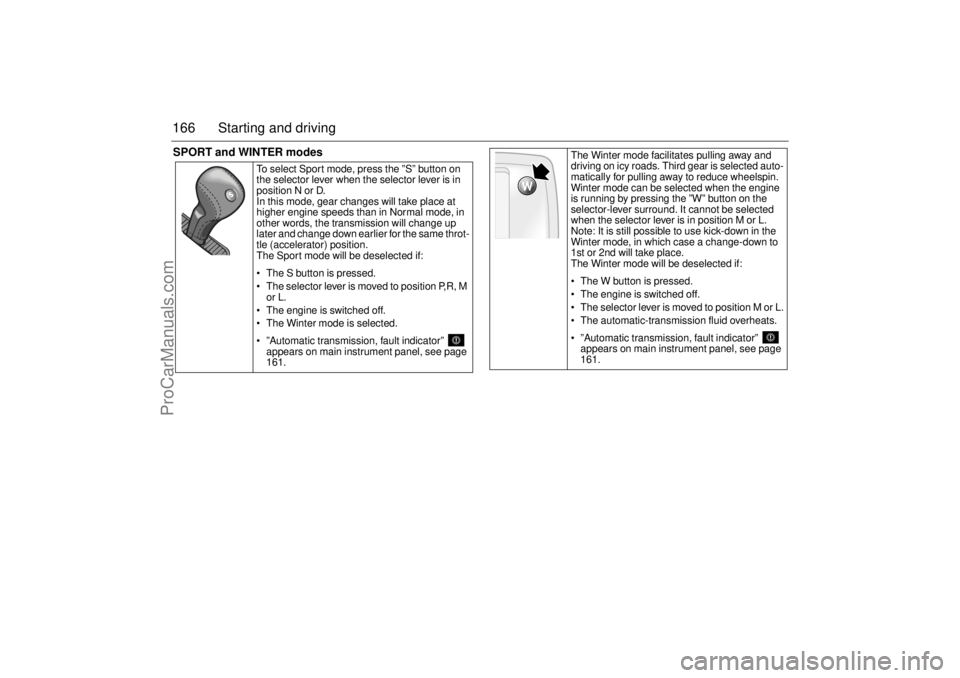
166 Starting and drivingSPORT and WINTER modes
To select Sport mode, press the ”S” button on
the selector lever when the selector lever is in
position N or D.
In this mode, gear changes will take place at
higher engine speeds than in Normal mode, in
other words, the transmission will change up
later and change down earlier for the same throt-
tle (accelerator) position.
The Sport mode will be deselected if:
The S button is pressed.
The selector lever is moved to position P,R, M
or L.
The engine is switched off.
The Winter mode is selected.
”Automatic transmission, fault indicator”
appears on main instrument panel, see page
161.
The Winter mode facilitates pulling away and
driving on icy roads. Third gear is selected auto-
matically for pulling away to reduce wheelspin.
Winter mode can be selected when the engine
is running by pressing the ”W” button on the
selector-lever surround. It cannot be selected
when the selector lever is in position M or L.
Note: It is still possible to use kick-down in the
Winter mode, in which case a change-down to
1st or 2nd will take place.
The Winter mode will be deselected if:
The W button is pressed.
The engine is switched off.
The selector lever is moved to position M or L.
The automatic-transmission fluid overheats.
”Automatic transmission, fault indicator”
appears on main instrument panel, see page
161.
ProCarManuals.com
Page 180 of 288
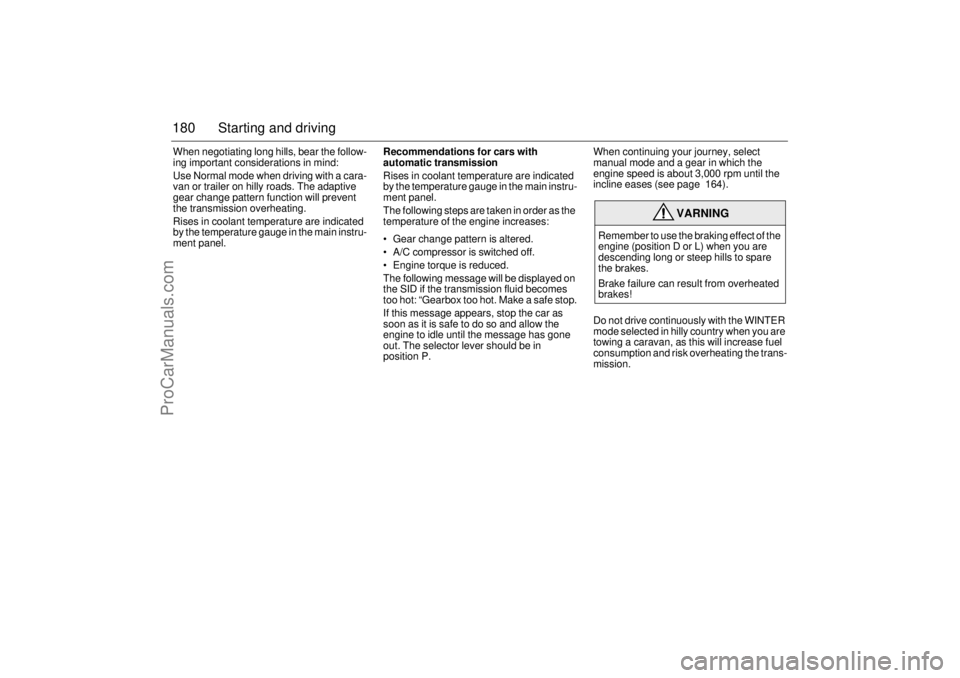
180 Starting and drivingWhen negotiating long hills, bear the follow-
ing important considerations in mind:
Use Normal mode when driving with a cara-
van or trailer on hilly roads. The adaptive
gear change pattern function will prevent
the transmission overheating.
Rises in coolant temperature are indicated
by the temperature gauge in the main instru-
ment panel.Recommendations for cars with
automatic transmission
Rises in coolant temperature are indicated
by the temperature gauge in the main instru-
ment panel.
The following steps are taken in order as the
temperature of the engine increases:
Gear change pattern is altered.
A/C compressor is switched off.
Engine torque is reduced.
The following message will be displayed on
the SID if the transmission fluid becomes
too hot: “Gearbox too hot. Make a safe stop.
If this message appears, stop the car as
soon as it is safe to do so and allow the
engine to idle until the message has gone
out. The selector lever should be in
position P.When continuing your journey, select
manual mode and a gear in which the
engine speed is about 3,000 rpm until the
incline eases (see page 164).
Do not drive continuously with the WINTER
mode selected in hilly country when you are
towing a caravan, as this will increase fuel
consumption and risk overheating the trans-
mission.
VARNING
Remember to use the braking effect of the
engine (position D or L) when you are
descending long or steep hills to spare
the brakes.
Brake failure can result from overheated
brakes!
ProCarManuals.com
Page 199 of 288
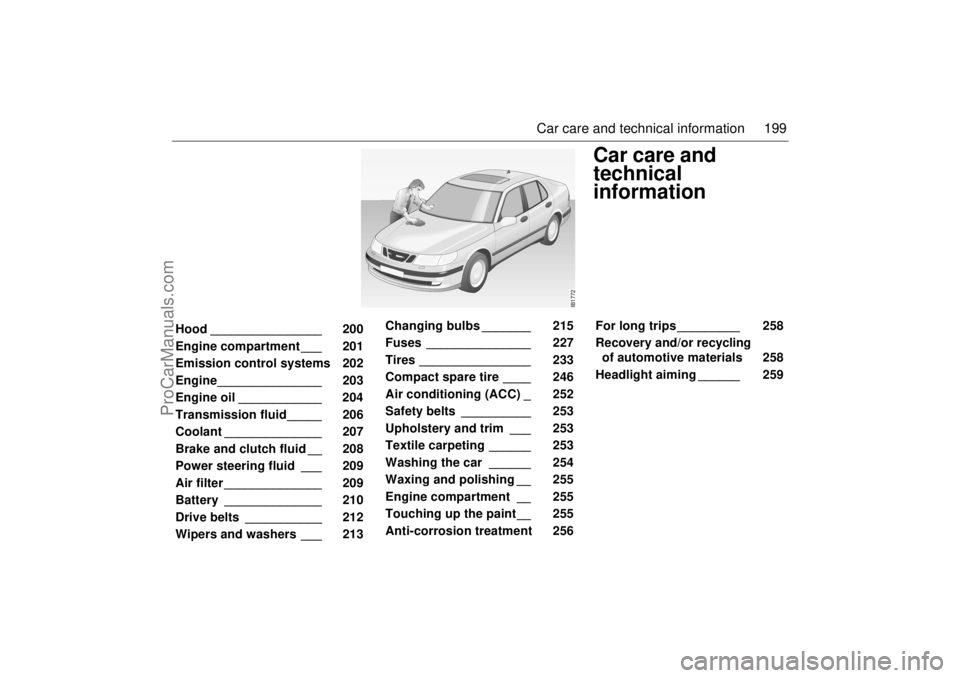
199 Car care and technical information
Car care and
technical
information
IB1772
Hood ________________ 200
Engine compartment ___ 201
Emission control systems 202
Engine_______________ 203
Engine oil ____________ 204
Transmission fluid_____ 206
Coolant ______________ 207
Brake and clutch fluid __ 208
Power steering fluid ___ 209
Air filter ______________ 209
Battery ______________ 210
Drive belts ___________ 212
Wipers and washers ___ 213 Changing bulbs _______ 215
Fuses _______________ 227
Tires ________________ 233
Compact spare tire ____ 246
Air conditioning (ACC) _ 252
Safety belts __________ 253
Upholstery and trim ___ 253
Textile carpeting ______ 253
Washing the car ______ 254
Waxing and polishing __ 255
Engine compartment __ 255
Touching up the paint__ 255
Anti-corrosion treatment 256 For long trips _________ 258
Recovery and/or recycling
of automotive materials 258
Headlight aiming ______ 259
ProCarManuals.com
Page 201 of 288
201 Car care and technical information
Engine compartment
10
9
6
7
8
1
2
4
3
5
IB1773
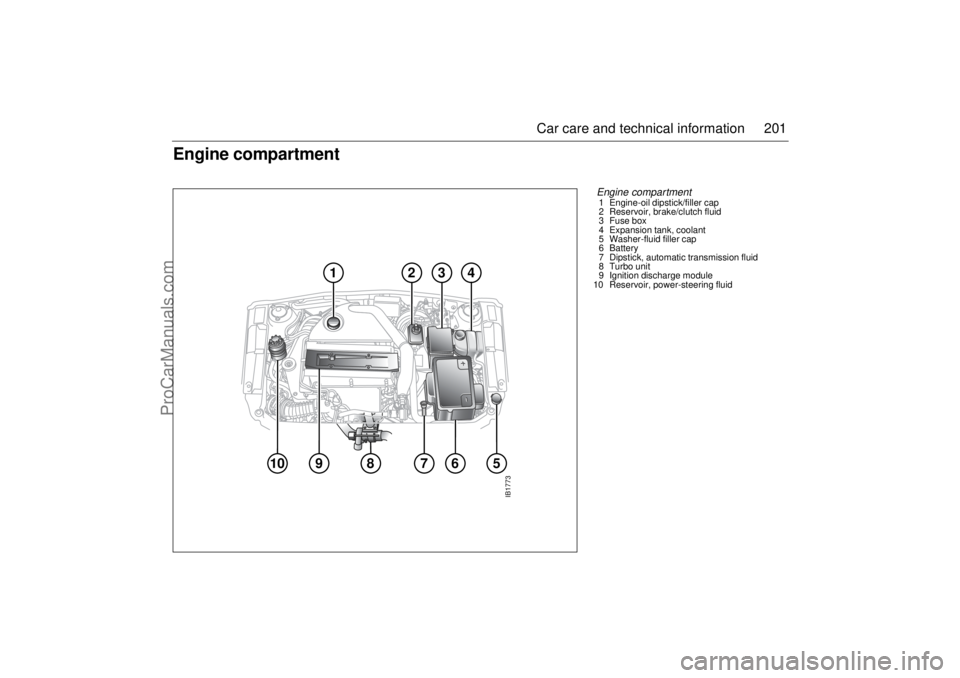
Engine compartment1 Engine-oil dipstick/filler cap
2 Reservoir, brake/clutch fluid
3 Fuse box
4 Expansion tank, coolant
5 Washer-fluid filler cap
6Battery
7 Dipstick, automatic transmission fluid
8 Turbo unit
9 Ignition discharge module
10 Reservoir, power-steering fluid
ProCarManuals.com
Page 206 of 288
206 Car care and technical informationTransmission fluidManual transmission Check and top up the fluid in accordance
with the service program.
If original fluid cannot be obtained for top-
ping up (see page 276), automatic trans-
mission fluid Dexron III (synthetic oil) can be
used. If so, the car should be taken to an
authorized Saab dealer immediately to
have the reason for low fluid level corrected
and original fluid installed.Automatic transmission Check the fluid level as follows:
1 Stand the car on level ground and apply
the parking brake. The automatic trans-
mission fluid must be at normal running
temperature, approximately 175°F
(80°C). This can be achieved by driving
the car for about 30 min on the open
road.
2 With the engine idling, move the selector
lever to D and wait for at least
15 seconds. Next, move the selector
lever to R and wait for 15 seconds again.
Finally, move the selector lever to P. Let
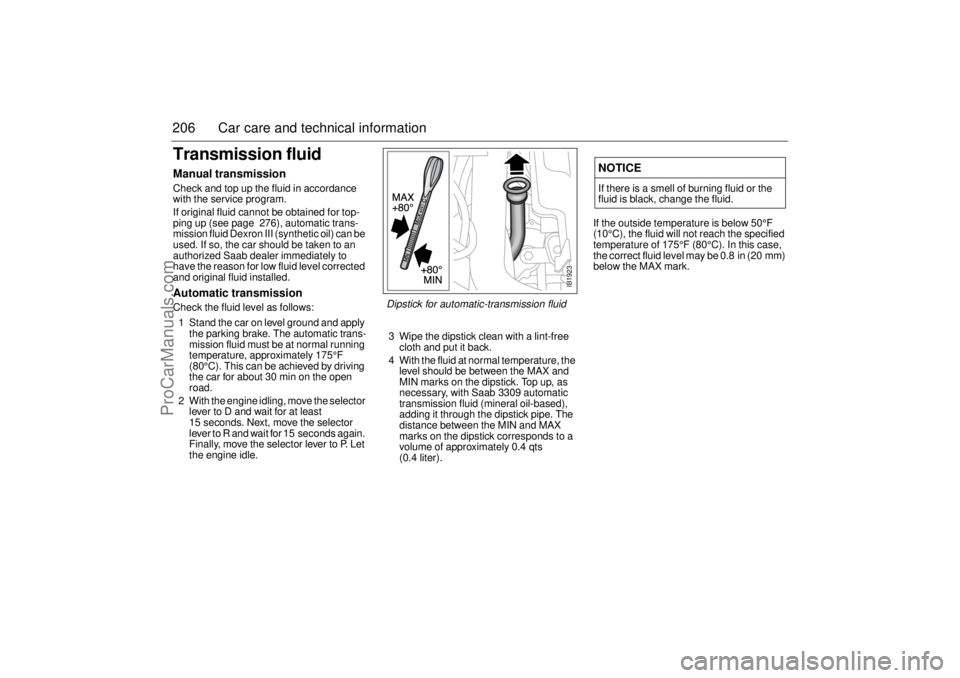
the engine idle.3 Wipe the dipstick clean with a lint-free
cloth and put it back.
4 With the fluid at normal temperature, the
level should be between the MAX and
MIN marks on the dipstick. Top up, as
necessary, with Saab 3309 automatic
transmission fluid (mineral oil-based),
adding it through the dipstick pipe. The
distance between the MIN and MAX
marks on the dipstick corresponds to a
volume of approximately 0.4 qts
(0.4 liter).
If the outside temperature is below 50°F
(10°C), the fluid will not reach the specified
temperature of 175°F (80°C). In this case,
the correct fluid level may be 0.8 in (20 mm)
below the MAX mark.NOTICEIf there is a smell of burning fluid or the
fluid is black, change the fluid.
IB1923
Dipstick for automatic-transmission fluid
ProCarManuals.com
Page 258 of 288

258 Car care and technical information4Inspect the undercoating and touch
up if necessary.
Pay particular atten-
tion to the fenders and wheel housings,
which are exposed to abrasion by flying
gravel, etc. If the composition has worn
or flaked off, the steel must be thor-
oughly cleaned and dried before a fresh
coat is applied. The cleaning is best
done with a scraper and a steel wire
brush, followed by washing with solvent.
Apply the new coating thinly, as other-
wise it may run off or fall off when dry.
For long tripsBefore setting off on a long journey, it is
advisable to have your car checked over by
your Saab dealer.
Obtain a few important items to take along
on your journey such as spare bulbs, wiper
blades, fuses, a Poly-V-belt and the like.
You can check some points yourself before-
hand:
Make sure that the engine is in good con-
dition.
Check that no oil or gasoline leaks out of
the engine or gearbox/transmission.
Check the coolant and power steering
fluid levels. Check also for leaks.
Inspect the Poly-V-belt and replace it if it
shows any signs of hard wear.
Check the battery charge.
Check the tires for tread pattern and air
pressure, including the compact spare
wheel.
Check the brakes.
Check all bulbs.
Check for the presence of the tool kit and
the jack in the car.
Recovery and/or
recycling of automotive
materialsA typical car consists of metals (65–75 %),
plastics (10–15 %), rubber (5 %) and small
quantities of glass, wood, paper and tex-
tiles. The recycling of metals has been com-
monplace for a long time now.
To facilitate sorting of other materials for
recycling, plastic parts, for instance, have
been marked to identify the precise nature
of the plastic.
The quantity of materials in the car that can
be recycled or recovered depends on the
scrapping facilities in different countries. EU
legislation that comes into force in 2006 will
require a minimum of 85 % of the total
weight of materials to be recycled. How-
ever, every major car salvage yard in each
market will receive details from Saab of how
the highest percentage of materials can be
reclaimed.
ProCarManuals.com
Page 265 of 288

265 Customer Assistance and Information
Service record retentionService instruction coupons and record
stubs are provided in the Saab Warranties
and Service Record Booklet which accom-
panies this Owner’s Manual. The coupons
are arranged in the order that normal ser-
vice should be performed. The edge of each
coupon is shaded to correspond to the type
of service point:
Striped – "Check Up"
Blue – Oil change/inspection service
Black – Major service
Note that in Canada a combined service
and warranty book is used, but not service
coupons.
When scheduled services are performed,
your dealer will tear out the applicable
coupon and use it to check off the opera-
tions performed and enter it into the service
file at the dealership. The servicing dealer’s
stamp, along with the date and mileage at
which the service was done, should be
entered on the corresponding stub which
remains in your booklet. The booklet is your
permanent record of the services per-
formed. It also includes a log sheet for
unscheduled repairs.
It is advisable to retain receipts and, if pos-
sible, copies of shop work orders for all ser-
vice and repair work, wherever performed.
Service costsDealer pricing practices and labor for ser-
vice work vary. Saab’s recommended ser-
vice times for each service point do not
include the labor required to replace wear
items, such as wiper blades, brake pads or
tires. Nor is labor to perform other service or
repairs found to be necessary as a result of
the inspections included in these times.
Additional labor and parts will be charged
for such work when necessary, except as
covered under an applicable Saab warranty
or any optional extended service contract.
Transmission fluid changes or suspension
alignment, when necessary, are also addi-
tional.
Dealer charges for general shop material,
regulated hazardous waste removal, recy-
cling expenses or other operation costs may
also be applied to service and repair
invoices and are apt to vary by dealer and
locality.
Owner assistanceWarranties and service problem
assistanceFor complete information about all applica-
ble warranties, including the New Car War-
ranty, Perforation Warranty, Vehicle Emis-
sion Warranty and Emission Perforation
Warranty, consult the Warranties and Ser-
vice Record Booklet which accompanies
this Owner’s Manual. It also contains owner
assistance information including Saab
Roadside Assistance. If the booklet is lost or
misplaced, a new one may be ordered
through a Saab dealer or by contacting
Saab.
In the U.S. there is a national Customer
Assistance Center at Saab Cars USA, Inc.
The toll-free number to call from all 50 states
is 1-800-955-9007.
In Canada, please call the Saab Customer
Assistance Centre at 1-800-263-1999.
A list of authorized Saab sales and service
dealers is available for those planning to
travel in the United States and Canada.
Canadian or U.S. travelers may call the
Customer Assistance Center in the country
in which they are traveling.
ProCarManuals.com