ABS SAAB 9-5 2005 User Guide
[x] Cancel search | Manufacturer: SAAB, Model Year: 2005, Model line: 9-5, Model: SAAB 9-5 2005Pages: 276, PDF Size: 16.72 MB
Page 155 of 276
153 Starting and driving
ABS brakes
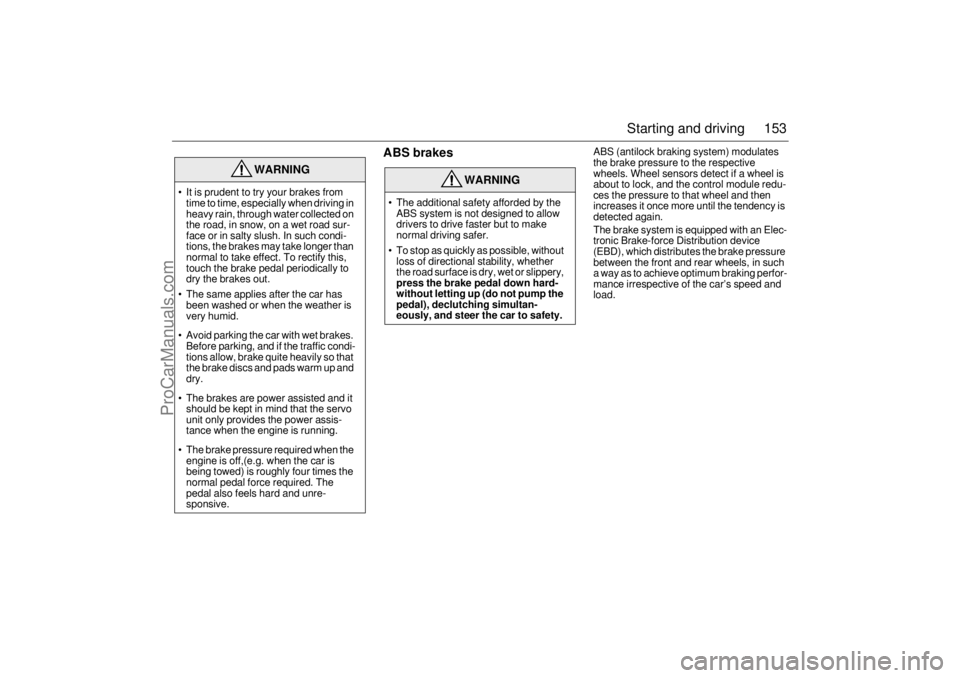
ABS (antilock braking system) modulates
the brake pressure to the respective
wheels. Wheel sensors detect if a wheel is
about to lock, and the control module redu-
ces the pressure to that wheel and then
increases it once more until the tendency is
detected again.
The brake system is equipped with an Elec-
tronic Brake-force Distribution device
(EBD), which distributes the brake pressure
between the front and rear wheels, in such
a way as to achieve optimum braking perfor-
mance irrespective of the car’s speed and
load.
WARNING
It is prudent to try your brakes from
time to time, especially when driving in
heavy rain, through water collected on
the road, in snow, on a wet road sur-
face or in salty slush. In such condi-
tions, the brakes may take longer than
normal to take effect. To rectify this,
touch the brake pedal periodically to
dry the brakes out.
The same applies after the car has
been washed or when the weather is
very humid.
Avoid parking the car with wet brakes.
Before parking, and if the traffic condi-
tions allow, brake quite heavily so that
the brake discs and pads warm up and
dry.
The brakes are power assisted and it
should be kept in mind that the servo
unit only provides the power assis-
tance when the engine is running.
The brake pressure required when the
engine is off,(e.g. when the car is
being towed) is roughly four times the
normal pedal force required. The
pedal also feels hard and unre-
sponsive.
WARNING
The additional safety afforded by the
ABS system is not designed to allow
drivers to drive faster but to make
normal driving safer.
To stop as quickly as possible, without
loss of directional stability, whether
the road surface is dry, wet or slippery, press the brake pedal down hard-
without letting up (do not pump the
pedal),
declutching simultan-
eously, and steer the car to safety.
ProCarManuals.com
Page 156 of 276
154 Starting and drivingThe ABS system has a built-in diagnostic
function which will switch on the Anti-lock
brake warning light if a fault is detected in
the system (see page 54).
The ABS system will not reduce the braking
distance on loose gravel or on snow or ice
but, because the wheels cannot lock up,
some steering control is retained.
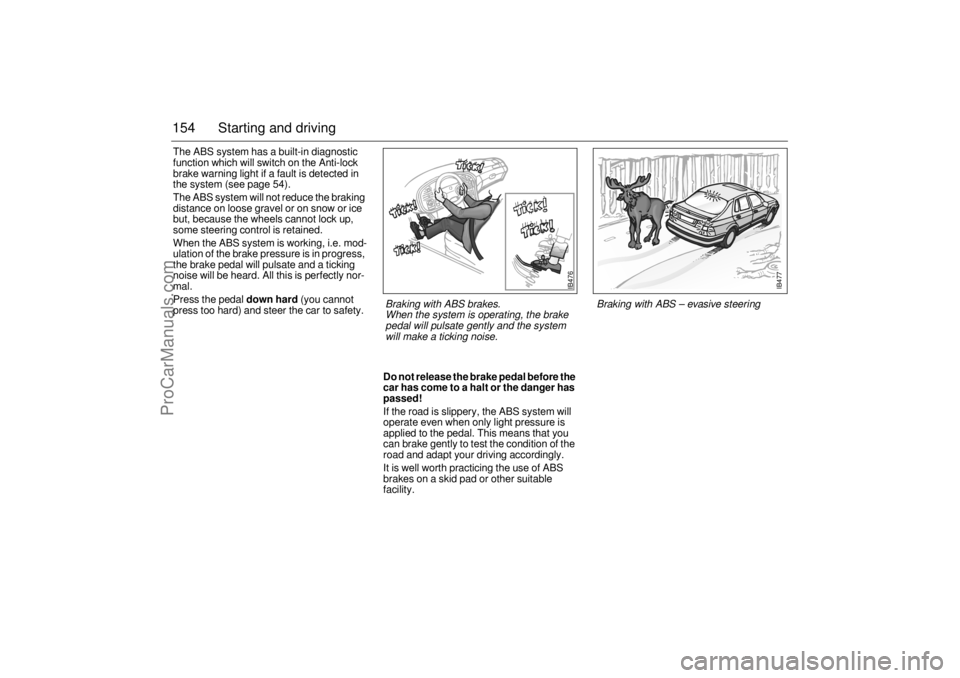
When the ABS system is working, i.e. mod-
ulation of the brake pressure is in progress,
the brake pedal will pulsate and a ticking
noise will be heard. All this is perfectly nor-
mal.
Press the pedal
down hard
(you cannot
press too hard) and steer the car to safety.
Do not release the brake pedal before the
car has come to a halt or the danger has
passed! If the road is slippery, the ABS system will
operate even when only light pressure is
applied to the pedal. This means that you
can brake gently to test the condition of the
road and adapt your driving accordingly.
It is well worth practicing the use of ABS
brakes on a skid pad or other suitable
facility.
IB476
Braking with ABS brakes.
When the system is operating, the brake
pedal will pulsate gently and the system
will make a ticking noise.
IB477
Braking with ABS – evasive steering
ProCarManuals.com
Page 157 of 276

155 Starting and driving
Electronic Stability
Program (ESP)The Electronic Stability Program employs
both the antilock braking system (ABS) and
the traction control system (TCS). It is a
system that helps the driver to stabilize the
car in unusual circumstances that can oth-
erwise be difficult to handle.
How the ESP system worksThe Electronic Stability Program can help to
prevent the car from skidding by braking
one or several wheels independently of the
driver. The engine output is then also
reduced to prevent the driving wheels from
spinning. The car has sensors that measure
wheel speed, yaw acceleration, lateral
acceleration, steering wheel position and
braking pressure. The values provided by
these sensors are used to calculate the
actual direction of the car. If this direction
does not agree with that intended by the
driver, calculated from the steering wheel
position, the ESP is engaged.
ESP improves the driver’s chances of
retaining control over the car in critical situ-
ations.
To ensure that the system works as
designed, the dimensions of all four tires
must be the same.
WARNING
When driving normally, ESP will help to
improve the stability of the car. This does
not mean that car can be driven faster.
The same care and prudence as normally
applied should be displayed on cornering
and when driving on slippery roads.
IB1841
Increased stability with ESP.
The system applies the brakes to the
wheels as shown to help prevent the car
from skidding
ProCarManuals.com
Page 187 of 276

185 Car care and technical information
Saab Trionic engine
management systemThe Saab Trionic engine management
system is a unique Saab development that
combines sequential multiport fuel injection,
electronic distributorless ignition and turbo-
charger boost pressure control into one sys-
tem.
The Trionic engine control module (ECM)
monitors many different engine parameters
such as:
Intake manifold pressure
Intake air temperature
Crankshaft position
Engine coolant temperature
Throttle position and
The oxygen content of the exhaust gases.
The ECM receives information regarding
engine knocking from a sophisticated feed-
back function in the ignition discharge unit.
By processing all of this information, the Tri-
onic system can control fuel injector ope-
ning duration, ignition timing and turbochar-
ger boost pressure to provide excellent
engine performance while maintaining low
emissions and fuel consumption.
ORVR (Onboard Refueling Vapor
Recovery)Hydrocarbon vapors formed when refueling
will be recovered by the car and not rele-
ased into the atmosphere. The hydrocar-
bons are absorbed in a evaporative emis-
sion canister. When the engine is
subsequently started, the evaporative emis-
sion canister is gradually purged as air is
sucked into it through a shut-off valve. The
hydrocarbon/air mixture passes through the
evap canister purge valve and into the
engine where it is burned.
When refueling, make sure you screw the
filler cap on and keep turning until it has
clicked at least 3 times. Otherwise, it is pos-
sible for the CHECK ENGINE light to illumi-
nate.
Refueling, see page 138.
NOTICEThe Trionic engine management system
continuously monitors the operation of
these systems and has on-board diag-
nostic capabilities (OBD II).
If the ”Engine malfunction (CHECK
ENGINE)” lamp in the main instru-
ment illuminates, this indicates that the
Trionic ECM has detected a problem. The
car will continue to operate, but perfor-
mance may be diminished. You should
have your car checked by a Saab dealer
as soon as possible.
ProCarManuals.com
Page 191 of 276

189 Car care and technical information
The cooling system is charged at the factory
with coolant containing a 45 % concentra-
tion of a combined antifreeze and corrosion
inhibitor. A weaker mixture will result in
reduced anticorrosion protection. For pro-
tection against freezing in very cold
weather, a stronger concentration will be
needed.
A 60 % concentration of antifreeze will pro-
vide protection at temperatures down to -
58 F (–50°C).
The coolant does not normally have to be
changed during the service life of the car.
The type of coolant used has a reddish color
and should not be mixed with other types of
coolant. Saab Original coolant should be
used all year round. Only use coolant appro-
ved by Saab.
Note:
If incorrect coolant is used or added, the life-
time properties will be affected. Even if the
coolant is flushed from the system and
replaced with life-time coolant, life-time pro-
perties are no longer retained and the coo-
lant must then be drained and replaced at
regular intervals.
Brake and clutch fluid Checking the fluid level The combined brake and clutch-fluid reser-
voir is transparent to facilitate checking of
the fluid level.
The level should be between the MAX and
MIN marks. Top up, as necessary, with DOT 4
fluid. Do
not
use DOT 5 brake fluid.
NOTICEAlways mix the antifreeze with the
appropriate volume of water before
adding it to the cooling system.
If pure antifreeze is added, the engine
could still freeze and be damaged. This is
because the antifreeze will not mix
properly with the coolant before the
thermostat has opened to allow full
circulation.
WARNING
Brake fluid deteriorates as it becomes
old. Because it is hygroscopic, it absorbs
water from the air and, in time, could allow
vapor to form in the brake system, thus
reducing its performance. It is therefore
important that brake fluid be changed
regularly, as specified in the service
program.
ProCarManuals.com
Page 216 of 276
214 Car care and technical information
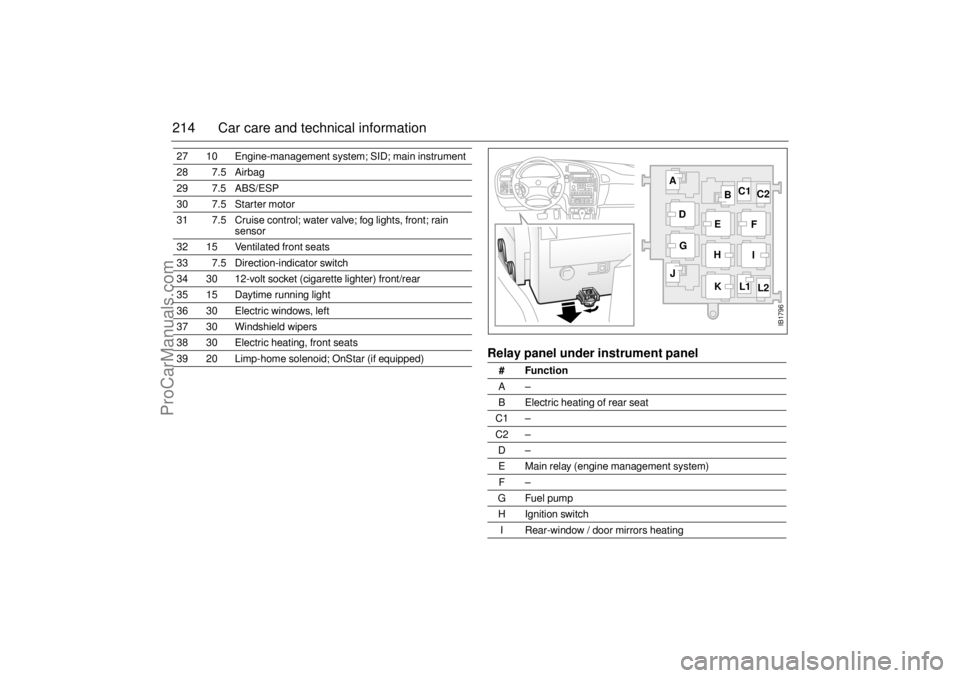
Relay panel under instrument panel
27 10 Engine-management system; SID; main instrument
28 7.5 Airbag
29 7.5 ABS/ESP
30 7.5 Starter motor
31 7.5 Cruise control; water valve; fog lights, front; rain
sensor
32 15 Ventilated front seats
33 7.5 Direction-indicator switch
34 30 12-volt socket (cigarette lighter) front/rear
35 15 Daytime running light
36 30 Electric windows, left
37 30 Windshield wipers
38 30 Electric heating, front seats
39 20 Limp-home solenoid; OnStar (if equipped)
# Function A –
B Electric heating of rear seat
C1 –
C2 –
D–
E Main relay (engine management system)
F–
G Fuel pump
H Ignition switch
I Rear-window / door mirrors heating
IB1796
A
BC1
C2
L2 L1 D
GE
F
H
I
K J
ProCarManuals.com
Page 217 of 276
215 Car care and technical information
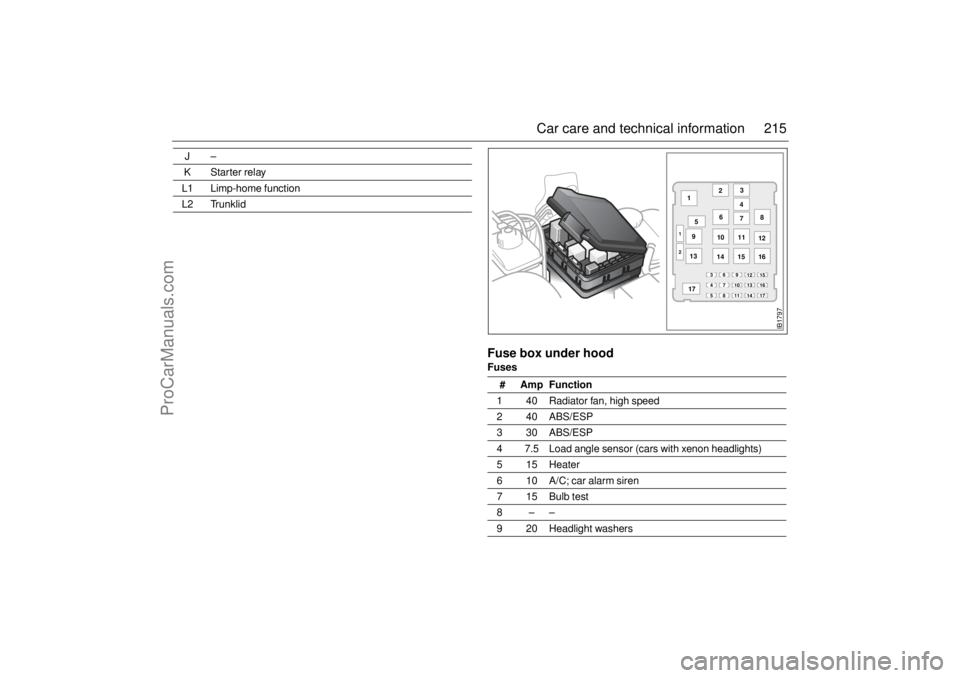
Fuse box under hoodFuses
J–
KStarter relay
L1 Limp-home function
L2 Trunklid
# Amp Function 1 40 Radiator fan, high speed
2 40 ABS/ESP
3 30 ABS/ESP
4 7.5 Load angle sensor (cars with xenon headlights)
515Heater
6 10 A/C; car alarm siren
715Bulb test
8––
9 20 Headlight washers
43
2
IB1797
2 1
14 1312 7 6
5 1
15 168
11
10 9
178 5
17 14 11 7 4
16 13 69
10 3
15 12
ProCarManuals.com
Page 222 of 276

220 Car care and technical informationThe wheels and tires have been carefully
matched to the characteristics of the car and
play a key role in its outstanding roadhol-
ding and handling.
Do not take it for granted that a wheel/tire
combination will work in the best possible
way, just because it can be fitted to the car.
To ensure that the speedometer is as accu-
rate as possible it should be reprogrammed
if wheels of a different dimension are fitted.
Contact a Saab dealer.
Because of front wheel drive, the front tires
tend to wear faster than the rear ones. New
tires should always be fitted in pairs, so that
tires on the same axle have the same
amount of tread.
Store wheels lying flat or hanging –
never
standing upright.
NOTICEAlways
consult your Saab dealer before
changing the wheels and tires on your
Saab.
Wide wheels and tires with sidewalls that
are too low can:
be damaged in potholes etc.
cause springs, shock absorbers and
wheel bearings and body mountings
can be overloaded.
cause the wheels to come into contact
with chassis and body components.
can affect the function of the Elec-
tronic Stability Program (ESP).
The speed and load limits for the tires
must not be exceeded; see page 225.
Wheels larger than 17” must not be fitted.
The maximum permissible offset is
49 mm.
WARNING
Mixing tires could cause you to lose
control while driving. If you mix tires of
different sizes or types (radial and bias-
belted tires), the vehicle may not handle
properly, and you could have a crash.
Using tires of different sizes may also
cause damage to your vehicle. Be sure to
use the same size and type tires on all
wheels. It’s all right to drive with your
compact spare temporarily, it was devel-
oped for use on your vehicle. See
“Compact spare tire” on page 230.
WARNING
If you use bias-ply tires on your vehicle,
the wheel rim flanges could develop
cracks after many miles of driving. A tire
and/or wheel could fail suddenly, causing
a crash. Use only radial-ply tires with the
wheels on your vehicle.
ProCarManuals.com
Page 238 of 276

236 Car care and technical informationUpholstery and trimTo remove lint or hairs from the seat uphol-
stery or headlining, use a moist, lint-free
cloth or a special lint remover (brush or rol-
ler). Remove any dirty marks using a cloth
moistened with lukewarm soapy water.
When using a stain remover, always work
from the outside towards the center to avoid
leaving a ring. If a soiled ring or spot should
remain, it can usually be removed using
lukewarm soapy water or water alone.
Wet patches left by spilled soft drinks or thin
oil must be wiped off immediately using an
absorbent material, such as a paper towel,
and treated with stain remover.
Alcohol is recommended for removing
grease or oil stains, and a semi-stiff brush
may also be used.
Cleaning and caring for leather
upholsteryThe principal reason for treating leather
upholstery is to maintain its elegant appea-
rance and to provide it with a protective film.
Discoloration caused by dust and wear
mainly affects the lighter shades, although
this is not detrimental to the leather –
indeed, the patina resulting from use is often
considered desirable in leather. But if the
leather is allowed to become too grubby, it
can start to look shabby.
It is a good idea to clean and recondition the
leather twice a year – in conjunction with a
general spring-cleaning of the car – after the
winter and in the autumn, for instance. In
hot, dry climates, the leather will need to be
treated more frequently. Recommended
conditioner – Saab Leather Care Lotion.
Do not use unknown harsh polishing
agents, cleaning agents, sprays, coarse
soap or hot water.
Textile carpetingVacuum clean the carpeting regularly. Car-
pets can also be cleaned using a brush, or
carpet shampoo applied with a sponge. Do
not use vacuum cleaners outdoors unless
they are properly grounded.
ProCarManuals.com
Page 261 of 276

259 Specifications
Suspension
Steering Brake system Spring type, front and rear ___________ Coil springs
Maximum deflection of springs:
Front __________________________ 7.09 in (180 mm)
Rear ___________________________ 7.87 in (200 mm)
Dampers, front and rear _____________ Gas-filled dampers
Steering _________________________ Power-assisted ste-
ering of
rack-and-pinion
type; telescopic ste-
ering-column shaft
with universal joints
Number of turns, lock to lock __________ 2.9
Power-steering fluid ________________ Power-steering fluid
CHF 11S Footbrake (ABS) ____________________ Hydraulic, dual-
circuit brake sys-
tem. Diagonally
split circuit with vac-
uum servo unit.
Disc brakes front
and rear. EBD, see
page 152.
Handbrake ________________________ Acts on rear wheels
Brake fluid _________________________ DOT 4
Brake-fluid capacity _________________ 0.951 qts (900 ml)
Disc diameter:
Front, ventilated ___________________ 11.34 in (288 mm)
Front, ventilated, certain variants * _____ 12.05 in (306 mm)
Rear, solid _______________________ 11.26 in (286 mm)
Rear, ventilated, certain variants * _____ 11.81 in (300 mm)
* 15” wheel must not be used on these
variants.
Total friction area of brake pads:
Front ___________________________ 36.3 in
2 (234 cm
2)
Rear ___________________________ 15.5 in
2 (100 cm
2)
ProCarManuals.com