engine oil SAAB 9-5 2005 User Guide
[x] Cancel search | Manufacturer: SAAB, Model Year: 2005, Model line: 9-5, Model: SAAB 9-5 2005Pages: 276, PDF Size: 16.72 MB
Page 149 of 276
147 Starting and driving
Driving on hilly roads with a
heavy loadThe transmission fluid can overheat when
the gearbox is strained, for example, when
driving with a trailer on hilly roads. To avoid
the transmission fluid overheating, always
drive in Normal mode. The adaptive gear
change patterns are then active.
High air temperatures or a faulty oil cooler
can also cause the transmission fluid to
overheat. Overheating reduces the service
life of the fluid. Contact an authorized Saab
dealer (see also page 161).
Towing Towing of cars with automatic transmission,
see page 171.
Descending hillsIf the speed of the car increases while
descending a steep hill, despite the acceler-
ator being released, the control module will
change down a gear when you brake. If you
desire more powerful engine braking, man-
ually select a lower gear.
WARNING
Remember to use engine-braking (selec-
tor position D or L) to spare the brakes
when you are driving on a long or steep
downhill slope.
Brake failure can result from overheated
brakes!
ProCarManuals.com
Page 152 of 276
150 Starting and drivingIf you move the selector lever from D to L, down shifts will follow a
set pattern to avoid damaging the engine or transmission.
Manual gear-changing is not recommended on slippery roads.
If one of the drive wheels spins excessively, the engine torque will
be reduced to avoid damaging the transmission.Adaptive gear-change patternsAdaptive gear-change patterns are selected automatically depend-
ing on the engine load and the present temperature of the transmis-
sion. The function is available in Normal and Sport modes.
The changes occur at a higher engine speed and the car remains in
the same gear for longer, if the transmission control module senses
that the load has not decreased. These gear-change patterns pre-
vent unnecessary changing up and down, when for example driving
up or down long slopes with a trailer or caravan, and to prevent over-
heating the transmission oil. The adaptive gear-change function is
also selected automatically when the transmission oil becomes too
hot, to protect the transmission itself from damage and to lower the
oil temperature.
The adaptive gear-change pattern function is deselected when:
The engine is switched off.
The load is reduced so much that the function is no longer requi-
red.
”Automatic transmission, fault indicator” appears on main
instrument panel, see page 146.
SPORT modes
To select Sport mode, press the ”S” button on
the selector lever when the selector lever is in
position N or D.
In this mode, gear changes will take place at hig-
her engine speeds than in Normal mode, in
other words, the transmission will change up
later and change down earlier for the same
throttle (accelerator) position.
The Sport mode will be deselected if:
The S button is pressed.
The selector lever is moved to position P,R, M
or L.
The engine is switched off.
”Automatic transmission, fault indicator”
appears on main instrument panel, see
page 146.
ProCarManuals.com
Page 175 of 276
173 Starting and driving
Towing the car Gear lever in neutral (in cars with automatic
transmission: selector lever at N (neutral))
Turn on the parking lights.Drive carefully and do not exceed the
speed limit for vehicles being towed. Always try to keep the towrope taut by
gently applying the brake, as necessary.
This will avoid the towrope being jerked
violently.
The local regulations on towing speeds
must be followed.
The highest permissible towing speed is
30 mph (50 km/h), unless the legal limit is
lower. The longest permissible towing dis-
tance is 30 miles (50 km). If the car has to
be transported farther than that, summon a
tow truck. A flat bed tow truck is the pre-
ferred method to tow.
Failure to follow these guidelines can result
in damage.
Cars with automatic transmissionThe car cannot be push started. In an emer-
gency, it is possible to start the engine using
jump leads (see the section, ”Jump starting”
on page 174).
Transporting the car
NOTICENever
use the towing eyes to pull the
car unstuck.
NOTICE The car must be towed front first.
If the car is to be towed with the front
wheels off the ground, make sure the
parking brake is off, as this acts on the
rear wheels.
NOTICEIf a car with a sport (lowered) chassis is
transported, for example on a flat bed
truck, take extra care not to damage the
spoiler and/or underbody.
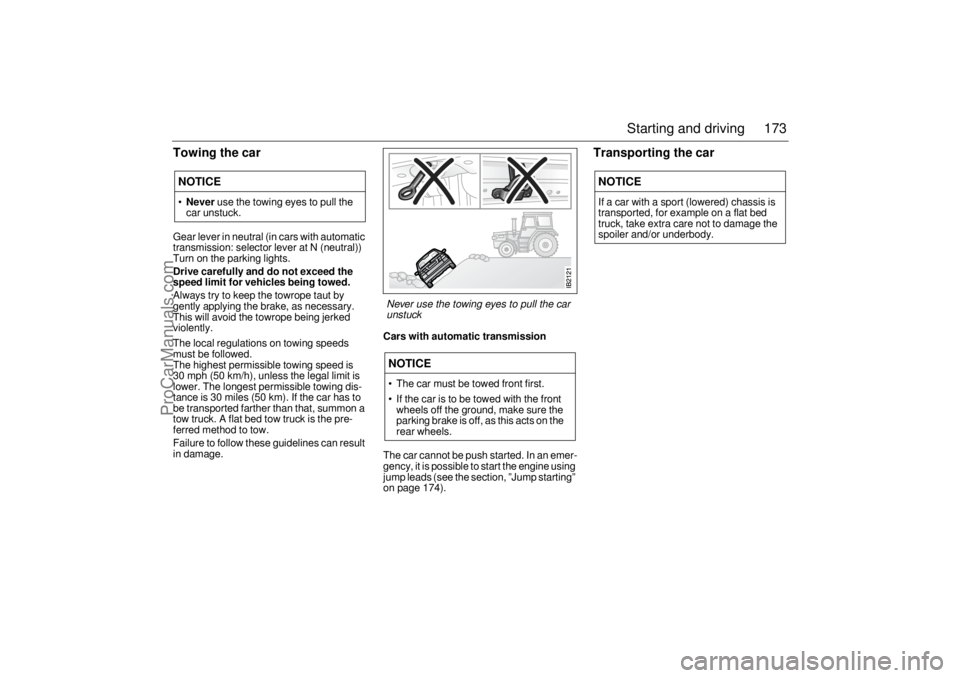
Never use the towing eyes to pull the car
unstuck
ProCarManuals.com
Page 177 of 276

175 Starting and driving
4 Open the hood and locate the battery.
Find the positive (+) and negative (–) termi-
nals on the battery.5 Check that the jumper cables do not
have loose or missing insulation. If they
do, you could get a shock and also the
vehicles could be damaged.
Before you connect the cables, here are
some basic things you should know.
Positive (+) will go to positive (+) and
negative (–) will go to a major metal
engine part with a good ground. Do not
connect (+) to (–) or you will get a short
that could injure you or would damage
the battery and maybe other parts as
well.
6 Connect the red positive (+) cable to the
positive (+) terminal of the vehicle with
the discharged battery.
7 Do not let the other end touch metal.
Connect it to the positive (+) terminal of
the good battery. Use a remote positive
(+) terminal if the vehicle has one.
8 Now connect the black negative (–)
cable to the good battery’s negative
terminal.NOTICEIf you leave your radio on, it could be
badly damaged. The repairs would not be
covered by your warranty.
WARNING
An electric fan can start up even when the
engine is not running and can injure you.
Keep hands, clothing and tools away from
any underhood electric fan.
WARNING
Using a match or flame of any kind near a
battery can cause battery gas to explode.
You can suffer burns or be blinded. Use a
flashlight if you need more light.
Be sure the battery has enough water.
The battery installed in your new Saab
has filler caps. Be sure the right amount
of water is there. Add distilled or boiled
water if the level is too low. If you don’t,
explosive gas could be present.
Be sure the electrolyte in the battery is not
frozen. Discharged batteries will freeze.
When connecting jumper cables to a
frozen battery, gas from the chemical
reaction inside the battery can build up
under the ice and cause an explosion.
Battery fluid contains acid that can burn
you. Do not get it on you. If you acciden-
tally get it in your eyes or on your skin,
flush the area with water and get medical
help immediately.
ProCarManuals.com
Page 183 of 276
181 Car care and technical information
IB1772
Hood ________________ 182
Engine compartment __ 183
Emission control systems 184
Engine ______________ 186
Engine oil ____________ 186
Transmission fluid ____ 188
Coolant ______________ 188
Brake and clutch fluid__ 189
Power steering fluid ___ 191
Air filter _____________ 191
Battery ______________ 192
Drive belts ___________ 194
Wipers and washers ___ 195
Changing bulbs _______ 197
Fuses _______________ 211 Tires _________________ 217
Compact spare tire _____ 230
Air conditioning (ACC) __ 234
Safety belts ___________ 235
Upholstery and trim ____ 236
Textile carpeting _______ 236
Washing the car _______ 237
Waxing and polishing ___ 238
Engine compartment ___ 238
Touching up the paint __ 238
Anti-corrosion treatment 240
For long trips __________ 241
Recovery and/or recycling
of automotive materials 242
Headlight aiming _______ 242
Car care and technical information
ProCarManuals.com
Page 185 of 276
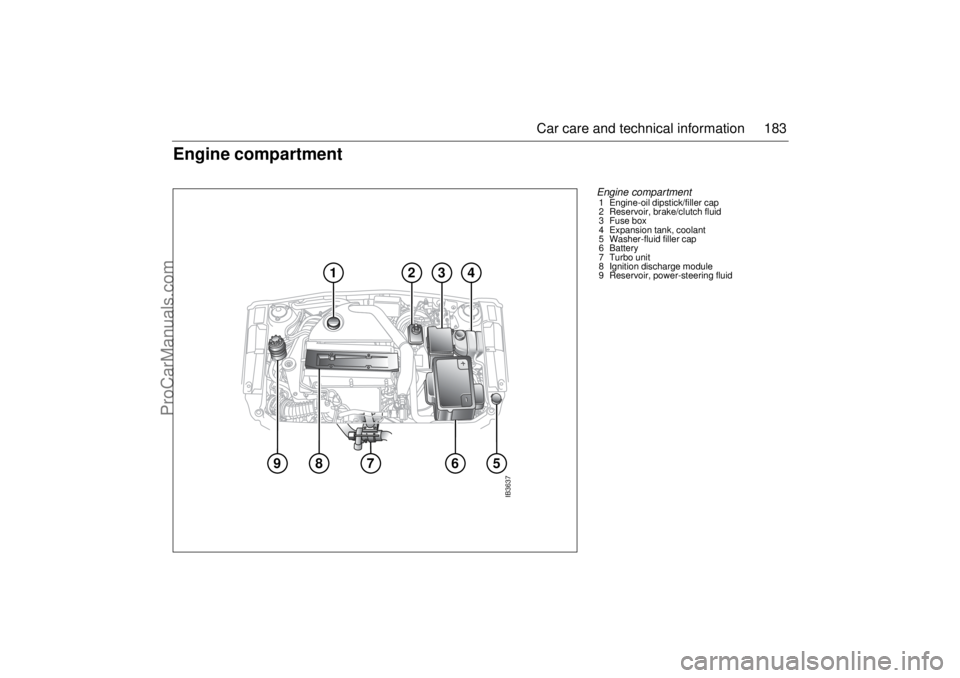
183 Car care and technical information
Engine compartment
9
6
8
1
2
4
3
5
7
IB3637
Engine compartment1 Engine-oil dipstick/filler cap
2 Reservoir, brake/clutch fluid
3 Fuse box
4 Expansion tank, coolant
5 Washer-fluid filler cap
6Battery
7 Turbo unit
8 Ignition discharge module
9 Reservoir, power-steering fluid
ProCarManuals.com
Page 188 of 276
186 Car care and technical informationEngineThe 2.3-liter model is a transverse, 4-cylin-
der in-line engine with twin overhead cams-
hafts and 4 valves per cylinder.
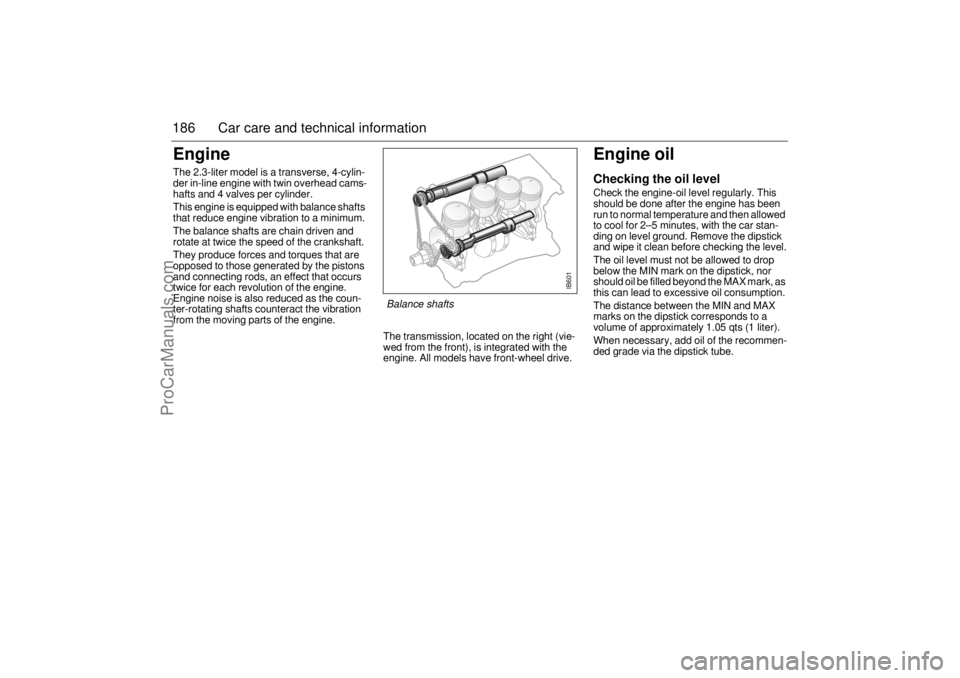
This engine is equipped with balance shafts
that reduce engine vibration to a minimum.
The balance shafts are chain driven and
rotate at twice the speed of the crankshaft.
They produce forces and torques that are
opposed to those generated by the pistons
and connecting rods, an effect that occurs
twice for each revolution of the engine.
Engine noise is also reduced as the coun-
ter-rotating shafts counteract the vibration
from the moving parts of the engine.
The transmission, located on the right (vie-
wed from the front), is integrated with the
engine. All models have front-wheel drive.
Engine oilChecking the oil level Check the engine-oil level regularly. This
should be done after the engine has been
run to normal temperature and then allowed
to cool for 2–5 minutes, with the car stan-
ding on level ground. Remove the dipstick
and wipe it clean before checking the level.
The oil level must not be allowed to drop
below the MIN mark on the dipstick, nor
should oil be filled beyond the MAX mark, as
this can lead to excessive oil consumption.
The distance between the MIN and MAX
marks on the dipstick corresponds to a
volume of approximately 1.05 qts (1 liter).
When necessary, add oil of the recommen-
ded grade via the dipstick tube.
IB601
Balance shafts
ProCarManuals.com
Page 189 of 276

187 Car care and technical information
Changing engine oil
The engine oil must be changed in accor-
dance with the service program, see
page 246.
Oil volume and grade, see page 255.
Oil changing should be carried out on a
warm engine.
1 Unscrew the drain plug in the bottom of
the sump and leave the oil to drain into
an oil tray or other suitable receptacle for
at least ten minutes. Take care, as the oil
may be hot.
2 After the oil has been drained, unscrew
and remove the oil filter.
3 Fit a new filter and tighten it by hand.
4 Refit the drain plug with a new washer.
5 Fill with new engine oil.
Run the engine to normal temperature and
check the oil level.
Change of engine oil and oil filter may be
required more frequently, see page 246.
WARNING
Prolonged and repeated exposure of
the skin to engine oil can cause seri-
ous skin disorders. Avoid prolonged
skin contact whenever possible.
Used engine oil contains chemicals
that have caused cancer in laboratory
animals. Always protect your skin by
washing thoroughly with soap and
water.
Keep oil out of reach of children.
Do not touch the turbocharger or
exhaust manifold. These get very hot
when the engine has been running.
Do not spill oil on hot parts of the
engine as this could cause a fire. Used
engine oil is particularly flammable.
Protect the environment. Do not
dispose of oil in the ground or down a
drain. Dispose of all used oil and oil
filters at an appropriate disposal facil-
ity.
IB491
Engine-oil filler cap and dipstick
IB493
Drain plug and oil filter
ProCarManuals.com
Page 190 of 276

188 Car care and technical informationTransmission fluidManual transmission Check and top up the fluid in accordance
with the service program.Automatic transmissionCheck and top up the fluid in accordance
with the service program.
Coolant The expansion tank is transparent to facili-
tate checking of the coolant level.
When the engine is cold, the coolant must
not lie over the KALT/COLD mark on the
expansion tank.If the message
”Coolant level low.
Refill.”
is displayed on the SID, check the level of
fluid in the expansion tank.
Top up, as necessary, with equal parts of
clean water and Saab-approved coolant.
If the expansion tank is empty when coolant
is added, run the engine to normal tempera-
ture and top up again, as necessary.
WARNING
Proceed with caution if the radiator is
boiling when you open the hood.
Never remove the expansion-tank
filler cap when the radiator is boiling.
The cooling system is pressurized –
hot coolant and vapor can escape
when the filler cap is released. These
can cause injury to your eyes and
burns. Loosen the cap carefully, and
let the engine cool before removing
the cap.
Exercise care when adding coolant.
Coolant on hot surfaces constitutes a
fire risk.
IB1338
Coolant expansion tank
ProCarManuals.com
Page 193 of 276

191 Car care and technical information
Power steering fluidCheck the level of the power steering fluid in
the reservoir regularly, in accordance with
the service program.
The wheels should point forward during the
check.
Clean around the cap before it is unscre-
wed. Clean the dipstick. Screw in the cap
completely again before checking the level.
The oil should lie between the MAX and MIN
marks when the oil temperature is about
70°F (+20°C). If the oil is colder the level can
be lower, and in higher temperatures the
level can be higher, both of which are
acceptable.
Top up with ”Power Steering Fluid
CHF 11S”.
Air filter
WARNING
Do not fill the power steering fluid to
above the MAX mark. Too much fluid
can result in leakage.
Power steering fluid on hot engine
components constitutes a fire risk.
WARNING
For Service and Repair, parts equiva-
lent to those used by Saab should be
used.
Be aware that some non standard
replacement parts may put you in an
unsafe condition, even if they might fit.
IB501
Power steering fluid reservoir
ProCarManuals.com