lights SAAB 9-5 2005 Service Manual
[x] Cancel search | Manufacturer: SAAB, Model Year: 2005, Model line: 9-5, Model: SAAB 9-5 2005Pages: 276, PDF Size: 16.72 MB
Page 216 of 276
214 Car care and technical information
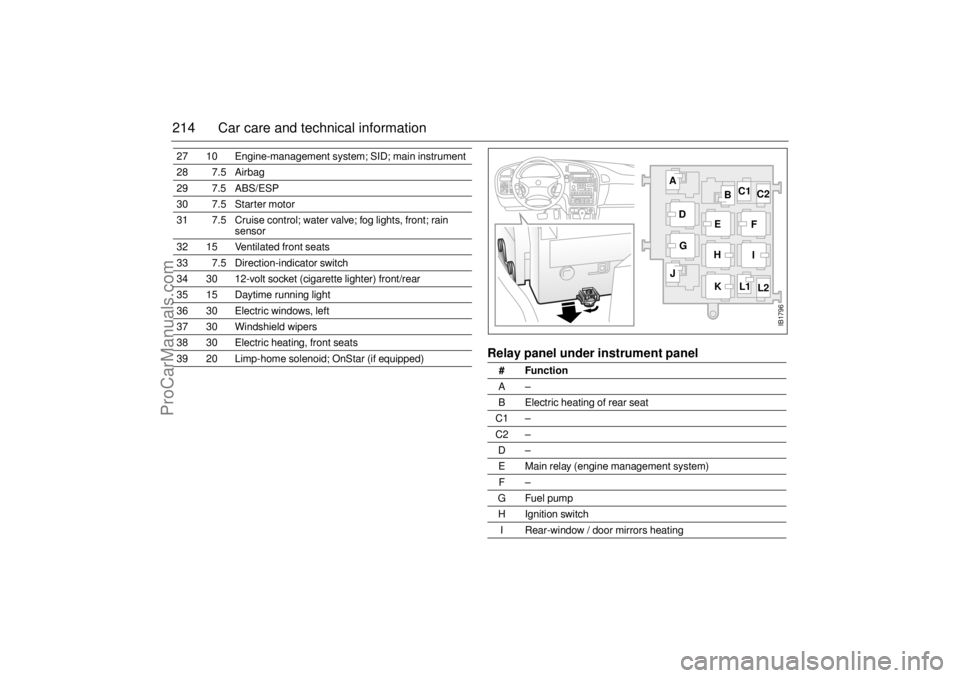
Relay panel under instrument panel
27 10 Engine-management system; SID; main instrument
28 7.5 Airbag
29 7.5 ABS/ESP
30 7.5 Starter motor
31 7.5 Cruise control; water valve; fog lights, front; rain
sensor
32 15 Ventilated front seats
33 7.5 Direction-indicator switch
34 30 12-volt socket (cigarette lighter) front/rear
35 15 Daytime running light
36 30 Electric windows, left
37 30 Windshield wipers
38 30 Electric heating, front seats
39 20 Limp-home solenoid; OnStar (if equipped)
# Function A –
B Electric heating of rear seat
C1 –
C2 –
D–
E Main relay (engine management system)
F–
G Fuel pump
H Ignition switch
I Rear-window / door mirrors heating
IB1796
A
BC1
C2
L2 L1 D
GE
F
H
I
K J
ProCarManuals.com
Page 217 of 276
215 Car care and technical information
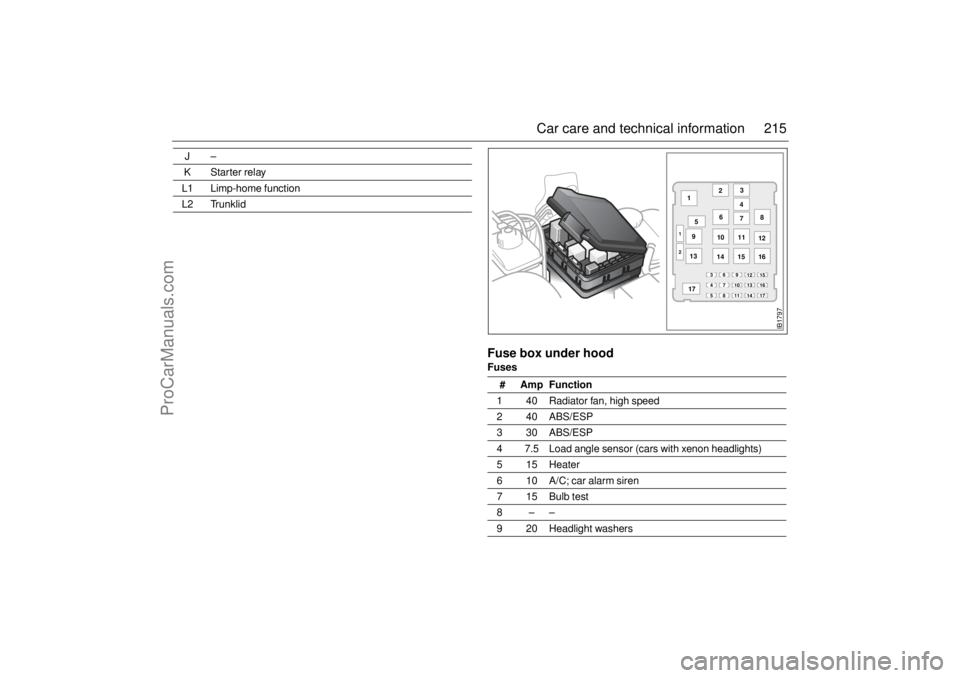
Fuse box under hoodFuses
J–
KStarter relay
L1 Limp-home function
L2 Trunklid
# Amp Function 1 40 Radiator fan, high speed
2 40 ABS/ESP
3 30 ABS/ESP
4 7.5 Load angle sensor (cars with xenon headlights)
515Heater
6 10 A/C; car alarm siren
715Bulb test
8––
9 20 Headlight washers
43
2
IB1797
2 1
14 1312 7 6
5 1
15 168
11
10 9
178 5
17 14 11 7 4
16 13 69
10 3
15 12
ProCarManuals.com
Page 218 of 276

216 Car care and technical information
Relays
10 15 High beam headlight, left
11 15 Low beam headlight left
12 15 High beam headlight, right
13 15 Low beam headlight, right
14 30 Radiator fan, high speed
15 15 Fog lights (front spoiler)
16 30 Wiper, rear
17 15 Horn
18 – –
# Function 1 Bulb test; head light; high beam flasher
2 Headlight washer
3 Front fog lights
4 Wiper, rear (9-5 SportWagon)
5–
6–
7 Rain sensor
8 Radiator fan, low speed
9 Radiator fan, high speed
10 A/C-compressor
11 Radiator fan, high speed, right fan
12 Horn
13 Extra lights (accessory)
14 High beam headlight
15 Low beam headlight
16 –
17 Windshield wipers
ProCarManuals.com
Page 233 of 276

231 Car care and technical information
Changing a wheel
WARNING
Lifting a vehicle and getting under it to do
maintenance or repairs is dangerous
without the appropriate safety equipment
and training. The jack provided with your
vehicle is designed only for changing a
flat tire. If it is used for anything else, you
or others could be badly injured or killed if
the vehicle slips off the jack. Use the jack
provided with your vehicle only for chang-
ing a flat tire.
Changing a tire can be dangerous. The
vehicle can slip off the jack and roll over
or fall on you or other people. You and
they could be badly injured or even killed.
Find a level place to change your tire. To
help prevent the vehicle from moving:
1 Set the parking brake firmly.
2 If you have an automatic transmis-
sion, put the shift lever in PARK (P).
For a manual transmission, leave the
car in gear (1st or REVERSE (R)).
3 Turn off the engine and do not restart
while the vehicle is raised.
4 Do not allow passengers to remain in
the vehicle.
To be even more certain the vehicle won't
move, you should put blocks at the front
and rear of the tire farthest away from the
one being changed. That would be the
tire, on the other side, at the opposite end
of the vehicle.
The car jack is designed solely for use
in changing a wheel or fitting snow
chains.
It must not be used to
support the car during repair work
or servicing.
Never
crawl under a car that is
supported only by a jack.
Raising your vehicle too high or with
the jack improperly positioned can
damage the vehicle and even make
the vehicle fall. To help avoid personal
injury and vehicle damage, be sure to
fit the jack lift head into the proper
location before raising the vehicle, and
raise the vehicle only far enough off
the ground so there is enough room for
the spare tire to fit (no more than 25
mm or 1 inch clearance between the
ground and the bottom of the tire).
Switch on the hazard warning lights if
the car is on a road.
The jack should be stored correctly
under the carpeting in the trunk. If it
lies loose in the car, it could thrown
forward and cause personal injury in
the event of a crash or if the car rolls
over.
Grit, salt and rust can clog the inner
threads of the wheel bolts if the car has
been driven for several years exclu-
sively with alloy wheels.
If steel wheels are being installed, the
bolt hole threads in the brake hubs
should be cleaned before the thinner
steel wheels are fitted. It may other-
wise not be possible to achieve the
correct clamping force, despite tight-
ening the wheel bolts to the correct
torque.
ProCarManuals.com
Page 240 of 276

238 Car care and technical informationWaxing and polishingOther than in exceptional cases, do not use
abrasive polishes containing a cutting agent
on a new car. Always wash the car tho-
roughly before waxing or polishing.Engine compartmentClean the engine compartment using an
engine detergent and rinse with hot water.
Cover the headlights. Do not use high-pres-
sure washer. Avoid spraying the hood liner,
as this can become heavy and hang down
and touch the engine when the hood is clo-
sed.
Do not use gasoline as a cleaning agent or
solvent when carrying out repairs or mainte-
nance. Saab recommends the use of envi-
ronmentally safe degreasing agents.
Touching up the paintDamaged paintwork should be treated as
soon as it is discovered: the longer it is left,
the greater the risk of corrosion. The anti-
perforation warranty does not cover corro-
sion resulting from untreated defects.
Paintwork damage sustained in a crash is
usually extensive and can only be properly
restored by professionals.
However, you can repair small scratches
and stone-chip damage yourself. The
necessary tools and materials, such as pri-
mer, touch-up paint and brushes, are avai-
lable from your Saab dealer.
In the case of minor flaws in the paintwork,
where the metal has not been exposed and
an undamaged layer of paint remains,
touch-up paint can usually be applied
directly, after any dirt has been scraped
away using a pointed knife.If corrosion has already set in, e.g. as a
result of stone-chip damage, use a pointed
knife to scrape off all surface rust. If pos-
sible, the damaged area should be taken
back to the bare metal. The metal should
then be primed with two thin coats of primer
applied by brush.
After the primer has dried, apply several thin
layers of topcoat enamel until the surface of
the repaired area is flush with the surroun-
ding paintwork.
Stir both primer and touch-up enamel tho-
roughly before use and allow each coat to
dry before applying the next.
ProCarManuals.com
Page 244 of 276

242 Car care and technical informationRecovery and/or
recycling of automotive
materialsA typical car consists of metals (65–75 %),
plastics (10–15 %), rubber (5 %) and small
quantities of glass, wood, paper and texti-
les. The recycling of metals has been com-
monplace for a long time now.
To facilitate sorting of other materials for
recycling, plastic parts, for instance, have
been marked to identify the precise nature
of the plastic.
The quantity of materials in the car that can
be recycled or recovered depends on the
scrapping facilities in different countries. EU
legislation that comes into force in 2006 will
require a minimum of 85 % of the total
weight of materials to be recycled. Howe-
ver, every major car salvage yard in each
market will receive details from Saab of how
the highest percentage of materials can be
reclaimed.
Headlight aimingThe vehicle has a visual optical headlight
aiming system equipped with vertical
aiming device. The aim has been preset at
the factory and should normally not need
further adjustments.
If your headlights are damaged in a crash,
the headlight aim may be affected. If you
believe your headlights need to be re-
aimed, we recommend that you take it to
your Saab dealer for service, however, it is
possible for you to re-aim your headlights as
described in the following procedure.To check the aim, the vehicle should be pro-
perly prepared as follows:
The vehicle shall be placed so that the
headlights are 25 ft (7.6 m) from a light
colored wall or other flat surface. The
aiming area should be darkened, this will
improve your ability to see the beam of the
low beam headlight being aimed.
The vehicle must have all four wheels on
a perfectly level surface which is level all
the way to the wall or other flat surface.
The vehicle should be placed so it is per-
pendicular to the wall or other flat surface.
The vehicle should be unloaded and fuel
tank full, and one person or 160 lbs.
(75 kg) on the drivers seat.
WARNING
Before checking/adjusting the headlight
aiming, switch off the engine to avoid
danger of fingers and hands being injured
by moving parts.
The radiator fan can start up even when
the engine is switched off.NOTICETo make sure that your headlights are
aimed properly read all instructions
before beginning. Failure to follow these
instructions could cause damage to
headlight parts or a not correctly aimed
headlight.
ProCarManuals.com
Page 246 of 276
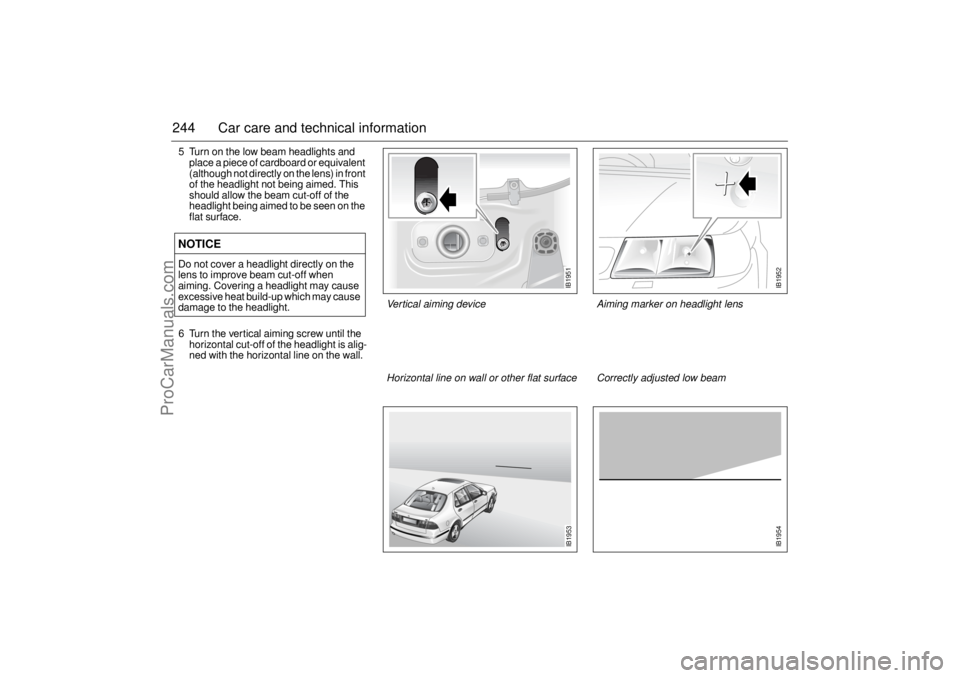
244 Car care and technical information5 Turn on the low beam headlights and
place a piece of cardboard or equivalent
(although not directly on the lens) in front
of the headlight not being aimed. This
should allow the beam cut-off of the
headlight being aimed to be seen on the
flat surface.
6 Turn the vertical aiming screw until the
horizontal cut-off of the headlight is alig-
ned with the horizontal line on the wall.NOTICEDo not cover a headlight directly on the
lens to improve beam cut-off when
aiming. Covering a headlight may cause
excessive heat build-up which may cause
damage to the headlight.
IB1951
Vertical aiming device
IB1952
Aiming marker on headlight lens
IB1953
Horizontal line on wall or other flat surface
IB1954
Correctly adjusted low beam
ProCarManuals.com
Page 266 of 276

264 SpecificationsSeveral of the systems in your
Saab car can be adjusted to
better fit your individual needsSome functions are governed by legal
requirements and cannot therefore be
reprogrammed.
Consult an authorized Saab dealer for
further information.Car alarm/central locking system: The number of blinks when locking/
unlocking.
Automatic locking of the trunk when the
car is driven, 1 to 8 mph (2–14 km/h), YES
or NO.
Preclude the unlocking of the trunk while
the car is driven, YES or NO.
Automatic locking of the trunk after
1 second–4 minutes if it has not been
opened, YES or NO.
Automatic locking of the trunk when it is
closed, YES or NO.
Automatic locking of all doors when the
car is driven above 7.5 mph (12 km/h),
YES or NO.
Saab Information Display: Outdoor temperature display can be
adjusted.Miscellaneous: Select the on-time for heated rear seat.
Additional sweep of the wipers after
windshield washer function (ON or OFF).
Courtesy Headlight Feature on-time can
vary from 20 to 50 seconds.
Night panel illumination deactivation
speed for the speedometer can be adjus-
ted.
Following adjustments can be
done by the driver:Automatic Climate Control (ACC):To alter the preprogrammed ”AUTO” start
up mode with your own preferences you can
manually select the desired settings for:
Temperature.
Fan speed.
Air distribution.
See ”Programming I” on page 79 and ”Pro-
gramming II” on page 80.Saab 9-5 Audio System (see page 99): Maximum starting volume (when the
radio is switched on).
Telephone volume (if the car is equipped
with a phone connected to the audio
system).
Speed dependent volume (volume
increases or decreases with vehicle
speed).
Loudness.Daytime Running Lights:To disable, turn off the ignition and pull out
fuse 35, see page 214.
ProCarManuals.com
Page 267 of 276

265 Index
IndexAA/C system, fault diagnosis
_______ 235
A/C system, maintenance
_________ 234
ABS brakes
____________________ 152
ACC
__________________________ 73
ACC functions
___________________ 76
ACC, automatic climate control
_____ 73
ACC, calibration
_________________ 81
ACC, condensation _______________ 82
ACC, programming _______________ 79
ACC, useful tips
_________________ 81
Adjusting the steering wheel
_______ 106
Adjustment, seats
________________ 12
Air conditioning (A/C), fault diagnosis
and maintenance ______________ 234
Air distribution, ACC ______________ 78
Airbag
_________________________ 28
Alarm _________________________ 44
Alarm functions
__________________ 47
Alarm signals
________________ 44
, 47
Alternator
_____________________ 194
Alternator drive belt
__________ 194
, 257
Alternator rating
________________ 257
Anticorrosion treatment
___________ 240
Antidazzle rear-view mirror
________ 111
Ashtrays
______________________ 117
Audio System
___________________ 83Audio System, quick guide
_________ 85
Autochecking of lights on starting
____ 58
Auto-dimming rear-view mirror with
garage door opener
____________ 108
Automatic climate control (ACC)
_____ 73
Automatic transmission, technical
data
_________________________ 258
Aviod theft, tip
__________________ 179
BBattery
________________________ 192
Battery charging/replacing
________ 193
Battery, boost starting
____________ 174
Before a long journey ____________ 241
Before towing a camper or trailer
___ 164
Belt guide
______________________ 16
Boost starting using jump leads
____ 174
Brake and clutch fluid
____________ 189
Brake-fluid reservoir
_____________ 189
Brakes, technical data ____________ 259
Bulbs, changing
________________ 197
Bulbs, table of
__________________ 210
Buying new tires ________________ 219
CCD changer
_____________________ 95
CD player
______________________ 93CHECK messages
_______________ 64
CHECKING
_____________________ 64
Calibration, ACC
_________________ 81
Cancelling the programmed settings
__ 79
Car alarm
_______________________ 44
Car care _______________________ 181
Cargo net, 9-5 SportWagon
_______ 128
Carpeting, care of
_______________ 236
Cassette player
__________________ 90
Catalytic converter, important
considerations _________________ 137
Central locking ___________________ 38
Change language in SID
___________ 66
Change of address notification
_____ 248
Changing a wheel
_______________ 231
Changing bulbs
_________________ 197
Changing wiper blades
___________ 195
Charger/Jump starting ____________ 176
Charging the battery/Jump starting
__ 176
Chassis number
________________ 262
Chassis number, key to
___________ 263
Checks before towing a camper or
trailer
________________________ 164
Child safety
_____________________ 21
Child safety locks, rear doors
_______ 41
Cleaning, engine bay
_____________ 238
Clock
_______________________ 65
, 66
Color code, body
________________ 262
Color code, trim _________________ 262
Compact spare wheel
____________ 230
Compass
______________________ 112
Condensation, ACC
_______________ 82
ProCarManuals.com
Page 268 of 276

266 IndexCoolant
_______________________ 188
Courtesy Headlight Feature
________ 68
Crash memory, see EDR
_________ 249
Cruise control
__________________ 151
Cup holder
____________________ 120
DDICE/TWICE
___________________ 212
Dampers
______________________ 259
Date code, tires
_________________ 229
Definitions and terminology, tire
____ 226
Determining correct load, tires
_____ 228
Dim-dipped beam
________________ 67
Direction indicators _______________ 69
Door handles
___________________ 38
Door mirrors
___________________ 107
Doors, locks & luggage compartment
_37
Drive belt
______________________ 257
Drive belt, alternator
_____________ 194
Drive belts, length
_______________ 257
Driver’s seat, programmable
________ 14
Driving at night
_________________ 168
Driving in hot weather
____________ 160
Driving with a load
______________ 168
EEDR (Event Data Recorders)
______ 249
ESP
__________________________ 155
Electric heating seat
______________ 15
Electric heating, front seats
_________ 15
Electric windows
________________ 113
Electrical system, technical data
____ 257
Electronic Stability Program, ESP ___ 155
Electronic starting interlock
_________ 43
Emergency operation of sunroof
____ 115
Emission control systems
_________ 184
Engine bay
____________________ 183
Engine bay, cleaning
_____________ 238
Engine number
_________________ 262
Engine oil, grade ________________ 255
Engine, description ______________ 186
Engine, technical data ____________ 254
Engine, temperature gauge
________ 59
Engine-oil level, checking
_________ 186
Event Data Recorders (EDR) ______ 249
Expansion tank, coolant
__________ 188
FFault codes, Audio System
________ 104
Flat spots, tires
_________________ 218
Fluid level, automatic transmission
__ 188
Folding the rear seat, 9-5 Sedan
___ 121
Folding the rear seat,
9-5 SportWagon
_______________ 124Frequently asked questions on airbag
35
Front fog lights
___________________ 70
Frost warning ____________________ 62
Fuel
__________________________ 138
Fuel consumption
________________ 61
Fuel gauge
_____________________ 59
Fuel grade _____________________ 254
Fuse box under hood
____________ 215
Fuse panel
_____________________ 211
Fuses
_________________________ 211
GGarage door opener
_____________ 108
Gearbox number
________________ 262
Gearbox oil, checking
____________ 188
Gearbox, technical data, __________ 258
Glove compartment
______________ 118
HHandbrake
_____________________ 179
Hazard warning lights
_____________ 70
Head restraint
___________________ 15
Headlight flasher _________________ 67
Headlights
______________________ 67
Hood
_________________________ 182
Horn __________________________ 106
ProCarManuals.com