remote start SAAB 9-5 2005 Owners Manual
[x] Cancel search | Manufacturer: SAAB, Model Year: 2005, Model line: 9-5, Model: SAAB 9-5 2005Pages: 276, PDF Size: 16.72 MB
Page 40 of 276

38 SecurityDoorsDoor handlesPull the handle to open the door.
If the door is stuck (e.g. if frozen), hold the
handle from above to secure a better grip.Central locking
Key / Remote control The key unit consists of a mechanical key
with integrated remote control.
The mechanical key is used for manual
locking and unlocking.
The remote control is used for remote lock-
ing and unlocking.
The key fits all the car’s locks.
The key supplied with the car has a code
number on a black plastic tag that needs to
be quoted for ordering additional keys. You
should therefore make a careful note of the
number.
The key contains a unique electronic code
for your car. When the key is inserted in the
ignition, the code is checked. If it matches,
the car can be started.
Your car is supplied with two keys. It is pos-
sible to have up to four keys for a car at one
time. If you loose one key you should have
this replaced as soon as possible by contac-
ting your Saab dealer. When the new key is
programmed into the system, the missing
key is automatically erased.
NOTE: For this reason, we strongly advise
you to take two keys with you on long jour-
neys and to keep them separate. If all keys
are lost, it will be necessary to replace costly
electronic components as well as the keys.
This loss and replacement cost is not cove-
red by the new car warranty.
If an additional key is to be added, all of the
original keys must be brought to the dealer
so that the control module can ”learn” to
recognize the new components.
WARNING
Leaving children or pets unattended in a
locked car is dangerous. It is also
dangerous to leave children in a vehicle
with the ignition key. A child or others
could be badly injured or even killed.
Key / Remote control1To lock
2 To unlock
3 Opening the trunk (9-5 Sedan)
Unlocking the tailgate (9-5 SportWagon)
IB3153
3
2 1
ProCarManuals.com
Page 41 of 276
39 Security
To check the number of keys that are pro-
grammed for the car; see page 48.
Locking/unlocking the carWhen the car is locked and unlocked the
theft alarm is also affected.
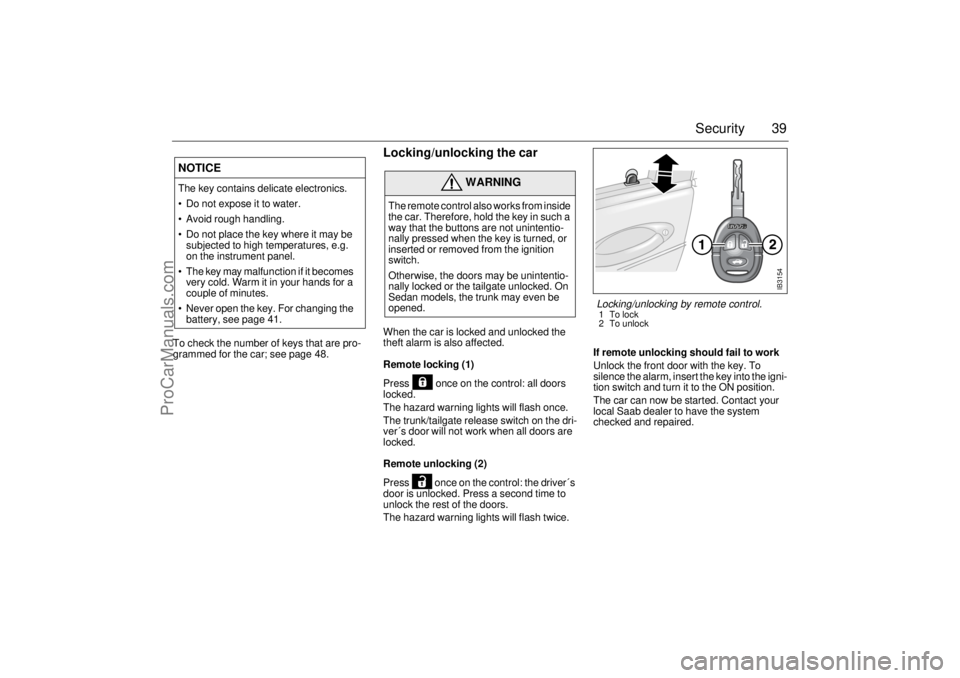
Remote locking (1)
Press once on the control: all doors
locked.
The hazard warning lights will flash once.
The trunk/tailgate release switch on the dri-
ver´s door will not work when all doors are
locked.
Remote unlocking (2)
Press once on the control: the driver´s
door is unlocked. Press a second time to
unlock the rest of the doors.
The hazard warning lights will flash twice.If remote unlocking should fail to work
Unlock the front door with the key. To
silence the alarm, insert the key into the igni-
tion switch and turn it to the ON position.
The car can now be started. Contact your
local Saab dealer to have the system
checked and repaired.
NOTICEThe key contains delicate electronics.
Do not expose it to water.
Avoid rough handling.
Do not place the key where it may be
subjected to high temperatures, e.g.
on the instrument panel.
The key may malfunction if it becomes
very cold. Warm it in your hands for a
couple of minutes.
Never open the key. For changing the
battery, see page 41.
WARNING
The remote control also works from inside
the car. Therefore, hold the key in such a
way that the buttons are not unintentio-
nally pressed when the key is turned, or
inserted or removed from the ignition
switch.
Otherwise, the doors may be unintentio-
nally locked or the tailgate unlocked. On
Sedan models, the trunk may even be
opened.
IB3154
Locking/unlocking by remote control.1To lock
2 To unlock
ProCarManuals.com
Page 45 of 276

43 Security
Tailgate, 9-5 SportWagonThe tailgate is not unlocked when the other
car doors are unlocked. The tailgate button
on the driver’s door is inoperative when the
car is locked or moving at a speed greater
than 2.7 mph (4 km/h).
Unlocking
The tailgate is unlocked using:
The button on the key
The tailgate switch on the inside of the dri-
ver’s door (if the car is unlocked and at a
standstill)
Remote unlocking is confirmed by the direc-
tion indicators flashing three times.
Locking
The tailgate is locked using:
The button on the key
The button on the centre console
The key in the driver’s door.
When vehicle speed exceeds 2 mph
(4 km/h).Electronic starting interlock
(immobilizer)Each time the key is removed from the igni-
tion, the electronic starting interlock is acti-
vated and the car is thus immobilized, see
also page 45.Reprogramming lock system
functionsCertain lock system functions can be repro-
grammed by your authorized Saab dealer;
see page 264.
NOTICEUse the grab handle to assist in closing
the tailgate.
Avoid the following, due to the risk of lock
mechanism damage when the tailgate is
closed.
Never grasp the lock mechanism as
this can lock the mechanism.
Never close the lock mechanism
manually.
IB3160
Grab handle
ProCarManuals.com
Page 46 of 276
44 SecurityCar alarm The car alarm (anti-theft system) is acti-
vated/deactivated when the car is
locked/unlocked by the remote control or by
the key, see page 39.
The antenna for the alarm system is located
in the center console.
All the doors plus trunk lid/tailgate and hood
are monitored by microswitches.
Your Saab 9-5 is equipped with an Electro-
nic starting interlock (immobilizer), see
page 45 for details.
The car alarm is armed 10 seconds after the
car has been locked by the remote control.
During this ten-second delay period, the
doors, trunk lid/tailgate and hood may still
be opened without the alarm being trigge-
red.
The LED indicator on the instrument panel
fascia will be on continuously during this
period, at the end of which it will start to flash
(once every other second). If a door or the trunk lid/tailgate or hood has
been left open when the car is locked, the
LED on the fascia will flash (three times per
second) for ten seconds to indicate this.
WARNING
Leaving children or pets unattended in a
locked car is dangerous. It is also
dangerous to leave children in a vehicle
with the ignition key. A child or others
could be badly injured or even killed.
IB3153
3
2 1
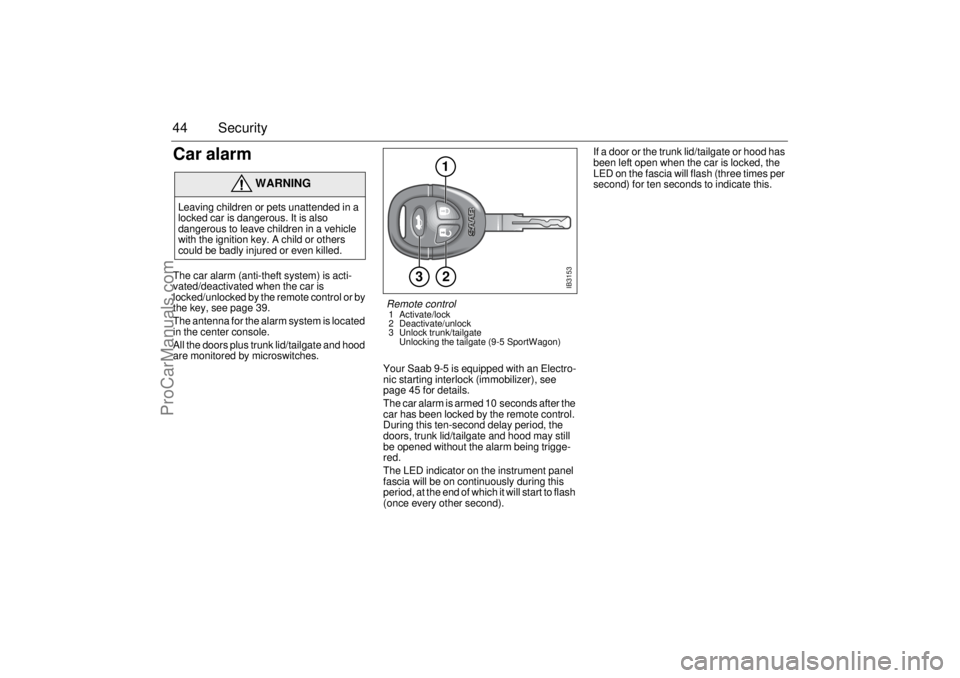
Remote control 1 Activate/lock
2 Deactivate/unlock
3 Unlock trunk/tailgate
Unlocking the tailgate (9-5 SportWagon)
ProCarManuals.com
Page 47 of 276

45 Security
Check to ensure that all the doors, plus
trunk lid/tailgate and hood, are closed pro-
perly.
If the fault persists (LED flashing when
another attempt is made to activate the car
alarm by remote control), lock the car using
the key instead. The car alarm will not have
been activated and you should contact an
authorized Saab dealer.
To avoid inconvenience caused by the
alarm being triggered inadvertently, make
sure that anyone else using the car is fami-
liar with how both the car alarm and the lock-
ing system work.
If the alarm is tripped (the direction indica-
tors are flashing and the horn is on) it can be
turned off by unlocking the car using the
button.
Activating the car alarm The car alarm cannot be activated if the dri-
ver’s door is open or if the ignition switch is
in ON position.
If one of the other doors or the trunk or hood
is open or opened and not closed again
during the 10-second delay period, it will be
excluded from the alarm function.
If it is then closed, a new delay period of ten
seconds will start, and the door (or trunk or
hood) will once again be secured by the
alarm system.
As usual, the LED will be on continuously
during the new delay period and will start to
flash once every other second after the
10-second period has elapsed.
Electronic starting interlock
(immobilizer) When the key is inserted in the ignition, a
signal is sent to the receiver. If the signal is
verified, the engine can be started.
Each time the key is removed from the igni-
tion, the electronic immobilizer is activated.
This means that the car cannot be started
without the correct key inserted in the igni-
tion and the immobilizer thus deactivated.
If a fault is detected (e.g. in the transmitter)
”Key not accepted.
Contact service.”
will appear on the Saab Information Display
(SID).
In this case, you can still start the car if you
turn the ignition key to ON and press one of
the buttons on the key (providing that the
receiver gets the right signal from the key).
Take the car to an authorized Saab dealer
to have the system checked.
The LED double-flashes when the car is
immobilized.
ProCarManuals.com
Page 50 of 276

48 SecurityOverview of LED signals and SID messagesSome signals may differ between model variants for different
countries. Status LED signal
Activation (during 10-second delay). Comes on for 10 seconds.
Alarm activated (after delay). Flashes once every other
second.
Deactivation. Comes on for 2 seconds.
Alarm not activated. Off.
Door, trunk lid/tailgate or hood open
or opened during delay period.Flashes three times per
second for 10 seconds.
Unlocking the trunk lid/tailgate. Flashes three times per
second for 10 seconds.
Closing of door, trunk lid/tailgate or
hood after delay period.Comes on for 10 seconds.
Car immobilized but not locked.
Car alarm not activated.Flashes twice at three
seconds intervals.
Fault in a switch serving doors, hood
or trunk lid.Flashing (instead of being
on continuously) during
delay period.
SID message Reason/action
Theft protection failure.
Contact service.Probably a fault in one of the sensors
or the horn.
Have the car checked by an authori-
zed Saab dealer.
Key not accepted.
Contact service.Fault in key transmitter or in igni-
tion-switch receiver.
Turn ignition switch to ON and press
the unlock button on the key. Start
the engine.
Have the car checked by an authori-
zed Saab dealer.
Remote control battery
low. Replace battery.Fit a new battery in the key, see
page 41.
REMOTE KEY
TRANSPONDRTurn the ignition key to position ON
and then press the button for ope-
ning the trunk lid. Saab Information
Display (SID) displays the number of
keys and transmitters (transponders)
coded to the car.
ProCarManuals.com
Page 102 of 276
100 Saab 9-5 Audio SystemLoudness ON/OFF To change the default setting:
The default setting for this function is ON.
– Press and hold the BAND button at the
same time as you switch on the Audio
System.
– After START VOL appears, release the
BAND button.
– Select LOUDNESS using
– Select ON or OFF using the VOL control.
– Wait 10 seconds or press one of the but-
tons on the bottom row of the Audio Sys-
tem, e.g. RADIO/BAND, to save the new
default setting.
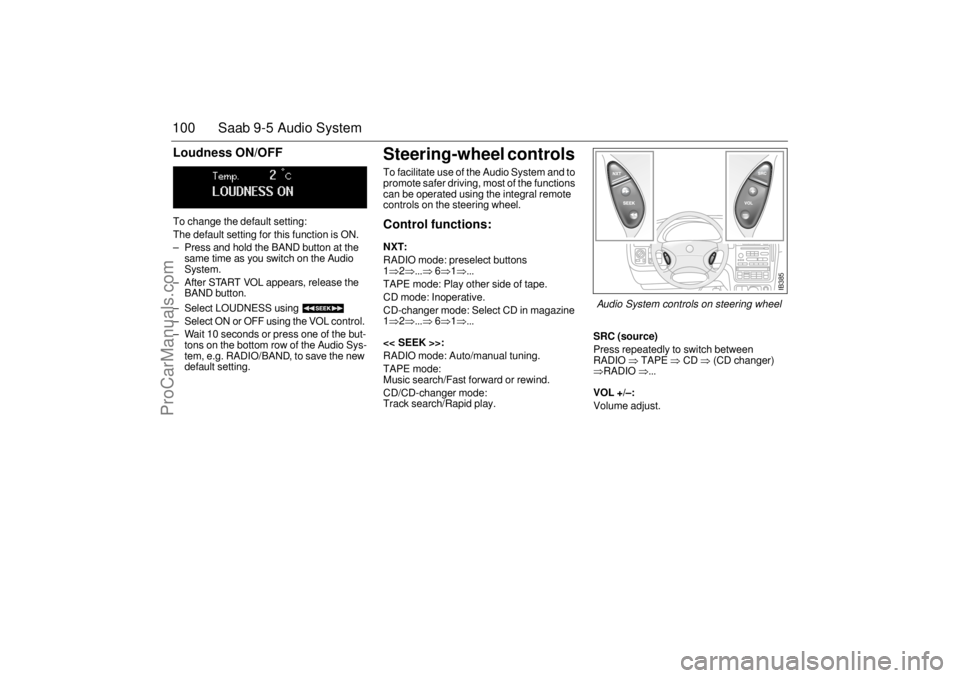
Steering-wheel controls To facilitate use of the Audio System and to
promote safer driving, most of the functions
can be operated using the integral remote
controls on the steering wheel. Control functions: NXT: RADIO mode: preselect buttons
1⇒2⇒...⇒
6⇒1⇒...
TAPE mode: Play other side of tape.
CD mode: Inoperative.
CD-changer mode: Select CD in magazine
1⇒2⇒...⇒
6⇒1⇒...
<< SEEK >>:
RADIO mode: Auto/manual tuning.
TAPE mode:
Music search/Fast forward or rewind.
CD/CD-changer mode:
Track search/Rapid play.
SRC (source)Press repeatedly to switch between
RADIO
⇒ TAPE
⇒ CD
⇒ (CD changer)
⇒RADIO
⇒...
VOL +/–: Volume adjust.
IB385
Audio System controls on steering wheel
ProCarManuals.com
Page 135 of 276

133 Starting and driving
If the car does not startIf the text
”Key not accepted.
Contact service.”
is shown on the SID, after a failed start
attempt, the cause could be a fault in the
transmitter in the key, or in the receiver in
the ignition lock. The following should be
done:
Turn the key back to the LOCK position.
Turn the key to ON.
Press one of the buttons on the remote
control (the LED stops blinking).
Start the engine.
Try another key. If this works, then the fault
is in the first key.
Contact an authorized Saab dealer for
checking and rectification.
Note:
Certain electronic items, such as cellular
phones, may affect the starting produce-
dure. Be sure that all devices are clear of the
key/ignition switch area.
Starting the engine
NOTICETake care not to spill drinks or to drop
crumbs over the ignition switch. If dirt or
liquid gets into it, the switch may not
operate properly.
WARNING
Always remove the key before leaving
the car.
Always apply the parking brake before
removing the ignition key.
WARNING
When starting the engine:
– Sit down in the driver’s seat.
– Depress the clutch pedal fully. If the
gear lever is not in the neutral position,
the clutch pedal must be fully depres-
sed or the car will jump forwards or
backwards, which may cause a crash.
– Never start the car from outside the
vehicle, e.g. through a wound down
window. This could lead to serious
personal injury.
Engage reverse (R) (position P for
automatic transmission) to remove the
ignition key. The key can only be
removed in this gear position.
Carbon monoxide (CO) is a colorless,
odorless, poisonous gas. Be alert to
the danger of CO – always open the
garage doors before starting the
engine in the garage.
There is also a danger of CO poiso-
ning if the exhaust system is leaking.
ProCarManuals.com
Page 161 of 276

159 Starting and driving
Engine block heater(standard equipment in Canada, acces-
sory in U.S.)The following are just some of the benefits
to the car and the environment of using an
engine block heater:
Lower fuel consumption.
Exhaust emissions substantially reduced
over short runs.
Reduced wear on the engine.
Inside of car warms up faster.
The engine heater is effective at outside
temperatures up to +15–20°C. The warmer
it is outside, the shorter the time the engine
heater needs to be connected. Longer than
1.5 hours is unnecessary.
If the car is equipped with a removable,
electrical cabin heater that is not in use, this
should be stored in the luggage compart-
ment.
Driving in cold weatherBefore starting a journey in cold weather
you should check the following:
That the wiper blades have not become
frozen to the windshield/glass.
Brush any snow away from the air intake
for the heater system (opening between
hood and windshield).
It may be advisable to lubricate the door-
lock cylinder (use molybdenum
disulphide, MoS
2) to prevent its freezing.
If the lock has frozen, take care not to
break the key (or use the remote control)
– heat it first or spray it with de-icer.
Periodically during the winter, add gaso-
line anti-freeze to the fuel to dispel any
condensation in the fuel tank which could
freeze and cause problems in the system.
Keep the tank well filled to reduce the risk
of condensation forming.
If the car is parked outside in freezing
weather, fuel additives (gasoline anti-
freeze) will not do any good as it cannot
remove water that has already frozen.
Park the car in a warm place so that any
ice that may have built up melts, then add
gasoline anti-freeze when filling up the
tank. Condensation is caused by changes
in the outdoor temperature or by the car
being parked alternately in a garage and
outside.
It is particularly important when the roads
are slippery that the brakes and tires be in
good condition. Check the anti-freeze in the engine coo-
lant, see page 188.
The car´s trip computer will warn you when
there is a risk of slippery conditions. For fur-
ther information on this function, see
page 62.
The car is equipped with tires designed to
provide optimum grip on both wet and dry
roads, although this has been achieved at
the expense of somewhat reduced grip on
snow and ice. For regular driving on snow
and ice, we therefore recommend that
winter (snow) tires be fitted.
Winter (snow) tires, particularly studded
tires (where use is legally permitted), gener-
ally make driving safer on snow and ice.
Acquaint yourself with the legal provi-
sions governing the use of different
types of winter tires and snow chains.
Studded tires are not allowed in some
countries
.
ProCarManuals.com
Page 177 of 276

175 Starting and driving
4 Open the hood and locate the battery.
Find the positive (+) and negative (–) termi-
nals on the battery.5 Check that the jumper cables do not
have loose or missing insulation. If they
do, you could get a shock and also the
vehicles could be damaged.
Before you connect the cables, here are
some basic things you should know.
Positive (+) will go to positive (+) and
negative (–) will go to a major metal
engine part with a good ground. Do not
connect (+) to (–) or you will get a short
that could injure you or would damage
the battery and maybe other parts as
well.
6 Connect the red positive (+) cable to the
positive (+) terminal of the vehicle with
the discharged battery.
7 Do not let the other end touch metal.
Connect it to the positive (+) terminal of
the good battery. Use a remote positive
(+) terminal if the vehicle has one.
8 Now connect the black negative (–)
cable to the good battery’s negative
terminal.NOTICEIf you leave your radio on, it could be
badly damaged. The repairs would not be
covered by your warranty.
WARNING
An electric fan can start up even when the
engine is not running and can injure you.
Keep hands, clothing and tools away from
any underhood electric fan.
WARNING
Using a match or flame of any kind near a
battery can cause battery gas to explode.
You can suffer burns or be blinded. Use a
flashlight if you need more light.
Be sure the battery has enough water.
The battery installed in your new Saab
has filler caps. Be sure the right amount
of water is there. Add distilled or boiled
water if the level is too low. If you don’t,
explosive gas could be present.
Be sure the electrolyte in the battery is not
frozen. Discharged batteries will freeze.
When connecting jumper cables to a
frozen battery, gas from the chemical
reaction inside the battery can build up
under the ice and cause an explosion.
Battery fluid contains acid that can burn
you. Do not get it on you. If you acciden-
tally get it in your eyes or on your skin,
flush the area with water and get medical
help immediately.
ProCarManuals.com