check oil SAAB 9-5 2006 User Guide
[x] Cancel search | Manufacturer: SAAB, Model Year: 2006, Model line: 9-5, Model: SAAB 9-5 2006Pages: 288, PDF Size: 19.71 MB
Page 242 of 288
242 Car care and technical information
Safety beltsRegularly check the function of the safety
belts as follows:
Hold the diagonal strap and pull it sharply.
The safety belt should lock and it should
not be possible to withdraw it further.
Check the anchorage points in the floor.
They must not have suffered rust damage.
There must be no frayed threads in the web-
bing.
Safety belts must not come into contact with
substances such as polishes, oils or other
chemicals. If the straps are dirty, wash them
with warm water and a detergent or have
them replaced.
WARNING
If the car is involved in a crash, the safety
belts, belt pretensioners and other com-
ponents must be inspected by a work-
shop. We recommend that you contact an
authorized Saab dealer.
Never make any alterations or repairs to
the safety belt yourself.
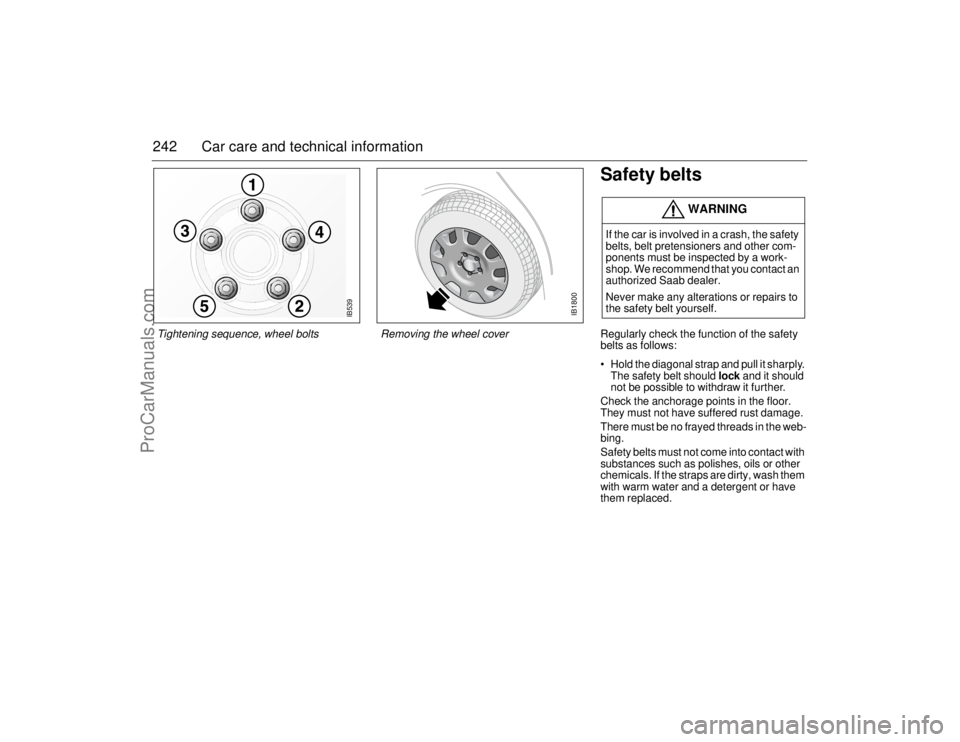
IB1800IB1800
Removing the wheel cover
IB539
Tightening sequence, wheel bolts 95usM06.book Page 242 Thursday, November 17, 2005 8:59 AM
ProCarManuals.com
Page 248 of 288

248 Car care and technical informationAnti-corrosion
treatmentThe entire car is corrosion-protected at the
factory in different stages by an electrolytic
immersion coating and a PVC-based pro-
tective coating to protect against corrosion
caused by stones flung up by the wheels. A
thin penetrating anti-rust oil is also applied
in cavities and body members.
In addition to conventional anti-corrosion
treatment like painting, underbody treat-
ment and cavity treatment, most of the body
panel surfaces are galvanized. These
include the hood, the doors and the under-
body.
The anti-corrosion treatment on the under-
side of the car and inside the wheel arches
is particularly exposed to constant wear and
possible damage, the degree of which will
obviously depend on driving conditions.
What causes rust?Steel body panels of automobiles are sub-
ject to rusting whenever air and moisture
manage to penetrate the protective finish,
and body panels may rust through if the pro-
cess is unchecked. Rusting can occur wher-
ever water is trapped or where the car’s
panels are continuously damp. Damage to
paint and undercoating by stones, gravel
and minor crashes immediately exposes
metal to air and moisture. Road salts used
for de-icing will collect on the bottom of the
car and promote rusting. Areas of the coun-
try with high humidity have great potential
for rust problems, especially where salt is
used on roads or there is moist sea air.
Industrial pollution (fallout) may also
damage paint and promote rusting.
Preventive maintenanceThe following procedures are necessary to
help protect against rusting. Refer also to
the terms and conditions of the Sheet Metal
Coverage described in the warranty book-
let.
1Wash the car frequently, and wax at
least twice a year. Under adverse con-
ditions, where there is a rapid buildup of
dirt, sand or road salt, wash your car at
least once a week. After extreme expo-
sure to salted snow or slush, evidenced
by a white film on the car, wash the car
immediately. Frequent washing will pre-
vent paint damage from acid rain and
other airborne contaminants such as
tree sap and bird droppings. If any of
these contaminants are noticed on the
car the finish should be washed immedi-
ately.
Begin washing by rinsing the entire car
with water to loosen and flush off heavy
concentrations of dirt (include the
underbody).
Sponge the car with a solution of either
a good quality car soap or mild general
purpose (dish washing) detergent and
water.
Rinse car thoroughly with clean water.
After washing, check and clear all
drains in doors and body panels.
Wipe the car dry, preferably using a
chamois.
95usM06.book Page 248 Thursday, November 17, 2005 8:59 AM
ProCarManuals.com
Page 249 of 288

249 Car care and technical information
2Clean the underside of the car during
the winter. Use high pressure water to
clean the car’s underside (floor panels,
wheel wells) at least at mid- winter and
in the spring.
3Inspect the car frequently for leaks or
damage, and arrange for needed
repairs promptly. After washing or after
heavy rain, check for leaks. When wash-
ing the car inspect body surfaces for
paint damage. While checking for leaks,
lift the floor mats and check beneath
them. Water can collect in these areas
and remain for prolonged periods. Dry
any wet areas including the floor mats.
Have leaks repaired as soon as possi-
ble.
Use touch-up paint to repair small
scratches or minor finish damage. Areas
where metal is exposed will rust quickly
and MUST be repaired immediately by
touch-up or professional repainting.
Rust must be removed, the bare metal
primed and painted. Major body
damage should be repaired immediately
and new panels or exposed areas
should be undercoated with anti- corro-
sion material.
Repairs of this type are the owner’s
responsibility and are not covered under
warranty.4Inspect the undercoating and touch
up if necessary. Pay particular atten-
tion to the fenders and wheel housings,
which are exposed to abrasion by flying
gravel, etc. If the composition has worn
or flaked off, the steel must be thor-
oughly cleaned and dried before a fresh
coat is applied. The cleaning is best
done with a scraper and a steel wire
brush, followed by washing with solvent.
Apply the new coating thinly, as other-
wise it may run off or fall off when dry.
For long tripsBefore setting off on a long journey, it is
advisable to have your car checked over by
your Saab dealer.
Obtain a few important items to take along
on your journey such as spare bulbs, wiper
blades, fuses, a Poly-V-belt and the like.
You can check some points yourself before-
hand:
Make sure that the engine is in good con-
dition.
Check that no oil or gasoline leaks out of
the engine or gearbox/transmission.
Check the coolant and power steering
fluid levels. Check also for leaks.
Inspect the Poly-V-belt and replace it if it
shows any signs of hard wear.
Check the battery charge.
Check the tires for tread pattern and air
pressure, including the compact spare
wheel.
Check the brakes.
Check all bulbs.
Check for the presence of the tool kit and
the jack in the car.
95usM06.book Page 249 Thursday, November 17, 2005 8:59 AM
ProCarManuals.com
Page 274 of 288

274 IndexDDICE/TWICE
___________________ 220
Dampers
______________________ 267
Date
_________________________ 105
Date code, tires
_________________ 237
Date display
___________________ 105
Definitions and terminology, tire
____ 234
Determining correct load, tires
_____ 236
Dim-dipped beam
________________ 73
Direction indicators _______________ 75
Diversity antenna
_______________ 109
Door handles
___________________ 44
Door mirrors
___________________ 116
Doors, locks & luggage compartment
_43
Drive belt
______________________ 265
Drive belt, alternator
_____________ 204
Drive belts, length
_______________ 265
Driver’s seat, programmable
________ 20
Driving at night
_________________ 183
Driving in hot weather
____________ 175
Driving with a load
______________ 183
EEDR (Event Data Recorders)
______ 257
ESP
__________________________ 165
Electric heating of rear seat
________ 87
Electric windows
________________ 115
Electrical system, technical data
____ 265
Electronic Stability Program, ESP __ 165Electronic starting interlock
_________ 49
Emergency operation of moonroof
__ 124
Emission control systems
_________ 194
Engine bay
____________________ 193
Engine bay, cleaning
_____________ 245
Engine number
_________________ 270
Engine oil, grade ________________ 263
Engine, description ______________ 196
Engine, technical data ____________ 262
Engine, temperature gauge
________ 65
Engine-oil level, checking
_________ 196
Error codes, Audio System ________ 112
Event Data Recorders (EDR) ______ 257
Expansion tank, coolant
__________ 198
FFilling a portable fuel container
_____ 150
Flat spots, tires
_________________ 227
Fluid level, automatic transmission
__ 198
Folding the parcel shelf,
9-5 SportCombi
________________ 134
Folding the rear seat, 9-5 Sedan
___ 130
Folding the rear seat, 9-5 SportCombi
133
Frequency band
_________________ 93
Frequently asked questions on airbag
40
Front fog lights
__________________ 76
Frost warning
___________________ 68
Fuel
__________________________ 148
Fuel consumption
________________ 68
Fuel container
__________________ 150Fuel gauge
_____________________ 65
Fuel grade _____________________ 262
Fuel information
_________________ 150
Fuse box under hood
____________ 223
Fuse panel
_____________________ 219
Fuses
_________________________ 219
GGarage door opener
_____________ 118
Gearbox number
________________ 270
Gearbox oil, checking
____________ 198
Gearbox, technical data, __________ 266
General functions
_______________ 105
Glove compartment ______________ 127
HHandbrake
_____________________ 167
Hazard warning lights
_____________ 76
Head restraint
___________________ 21
Headlight flasher _________________ 73
Headlights
______________________ 73
Heated front seats
________________ 87
Hood
_________________________ 192
Horn __________________________ 114
95usM06.book Page 274 Thursday, November 17, 2005 8:59 AM
ProCarManuals.com