child seat SAAB 9-5 2006 User Guide
[x] Cancel search | Manufacturer: SAAB, Model Year: 2006, Model line: 9-5, Model: SAAB 9-5 2006Pages: 288, PDF Size: 19.71 MB
Page 26 of 288
26 SafetySecuring a Child Restraint
Designed for the LATCH
System 9-5 Sedan:
Before installation, please read through
these instructions and the child restraint
installation instructions.
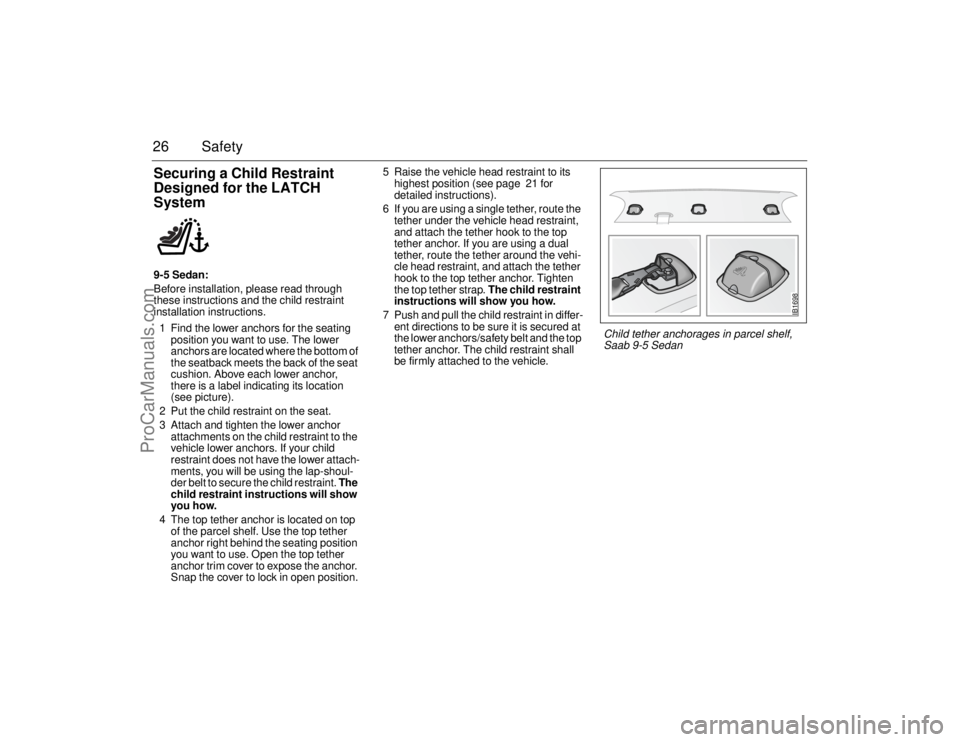
1 Find the lower anchors for the seating
position you want to use. The lower
anchors are located where the bottom of
the seatback meets the back of the seat
cushion. Above each lower anchor,
there is a label indicating its location
(see picture).
2 Put the child restraint on the seat.
3 Attach and tighten the lower anchor
attachments on the child restraint to the
vehicle lower anchors. If your child
restraint does not have the lower attach-
ments, you will be using the lap-shoul-
der belt to secure the child restraint. The
child restraint instructions will show
you how.
4 The top tether anchor is located on top
of the parcel shelf. Use the top tether
anchor right behind the seating position
you want to use. Open the top tether
anchor trim cover to expose the anchor.
Snap the cover to lock in open position.5 Raise the vehicle head restraint to its
highest position (see page 21 for
detailed instructions).
6 If you are using a single tether, route the
tether under the vehicle head restraint,
and attach the tether hook to the top
tether anchor. If you are using a dual
tether, route the tether around the vehi-
cle head restraint, and attach the tether
hook to the top tether anchor. Tighten
the top tether strap. The child restraint
instructions will show you how.
7 Push and pull the child restraint in differ-
ent directions to be sure it is secured at
the lower anchors/safety belt and the top
tether anchor. The child restraint shall
be firmly attached to the vehicle.
IB1698
Child tether anchorages in parcel shelf,
Saab 9-5 Sedan
95usM06.book Page 26 Thursday, November 17, 2005 8:59 AM
ProCarManuals.com
Page 27 of 288
27 Safety
Lockable latch plateIn fitting a child seat that is intended to be
secured in position by the lap portion of the
safety belt, make use of the locking function
of the latch plate. This function is available
on all seats in the second row.
Locking the lap portion of the belt lessens
the risk that the seat will work loose while
the car is in motion.
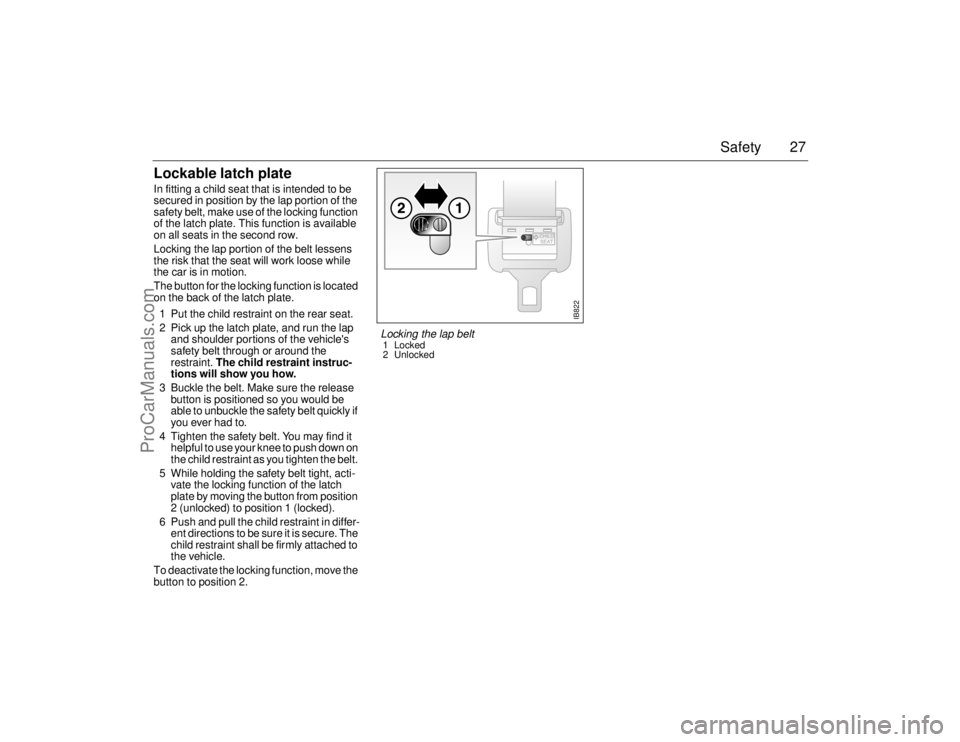
The button for the locking function is located
on the back of the latch plate.
1 Put the child restraint on the rear seat.
2 Pick up the latch plate, and run the lap
and shoulder portions of the vehicle's
safety belt through or around the
restraint. The child restraint instruc-
tions will show you how.
3 Buckle the belt. Make sure the release
button is positioned so you would be
able to unbuckle the safety belt quickly if
you ever had to.
4 Tighten the safety belt. You may find it
helpful to use your knee to push down on
the child restraint as you tighten the belt.
5 While holding the safety belt tight, acti-
vate the locking function of the latch
plate by moving the button from position
2 (unlocked) to position 1 (locked).
6 Push and pull the child restraint in differ-
ent directions to be sure it is secure. The
child restraint shall be firmly attached to
the vehicle.
To deactivate the locking function, move the
button to position 2.
IB822
Locking the lap belt1 Locked
2 Unlocked
95usM06.book Page 27 Thursday, November 17, 2005 8:59 AM
ProCarManuals.com
Page 28 of 288
28 SafetyInstallation of rear facing child restraints
Child restraints that are approved for rear
facing installation in the rear seat can be
positioned in any of the three rear seating
positions.
WARNING
Failure to follow all the manufacturer’s
instructions on the use of this child
restraint system can cause your child to
strike the vehicle´s interior during a
sudden stop or crash.
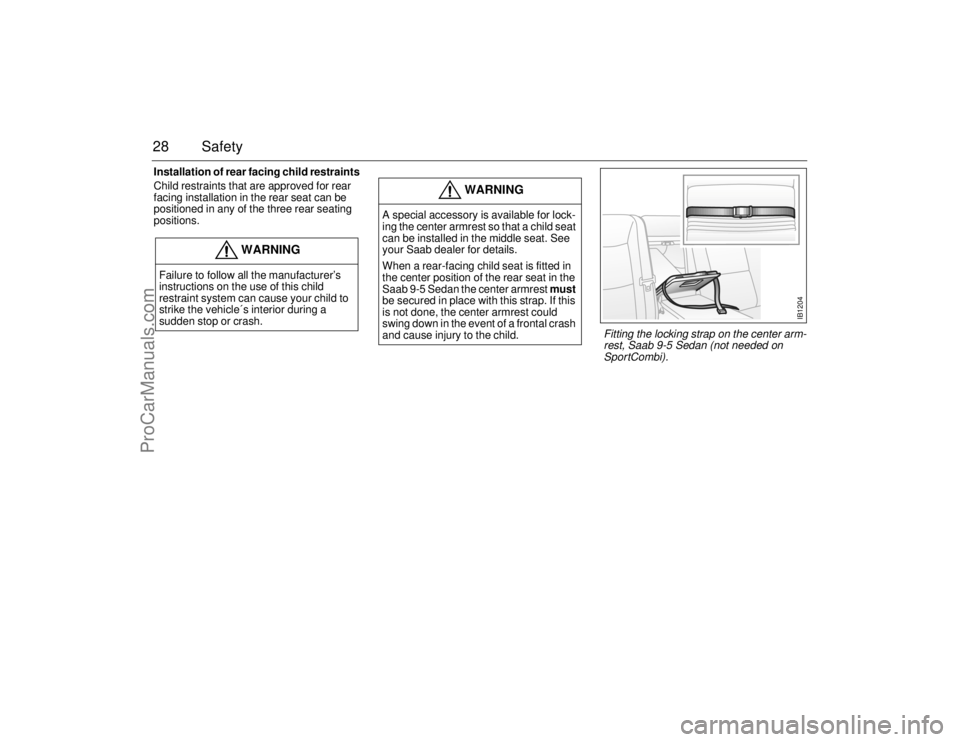
WARNING
A special accessory is available for lock-
ing the center armrest so that a child seat
can be installed in the middle seat. See
your Saab dealer for details.
When a rear-facing child seat is fitted in
the center position of the rear seat in the
Saab 9-5 Sedan the center armrest must
be secured in place with this strap. If this
is not done, the center armrest could
swing down in the event of a frontal crash
and cause injury to the child.
IB1204
Fitting the locking strap on the center arm-
rest, Saab 9-5 Sedan (not needed on
SportCombi).
95usM06.book Page 28 Thursday, November 17, 2005 8:59 AM
ProCarManuals.com
Page 29 of 288
29 Safety
Airbag The AIRBAG system comprises an airbag in
the steering wheel, a front passenger airbag
and side airbags in the front seats.
The system supplements the protection
provided by the safety belts to further
enhance the safety of the occupants.
If a fault is detected in the AIRBAG, the
AIR BAG warning light on the main instru-
ment panel will come on (see pages 61
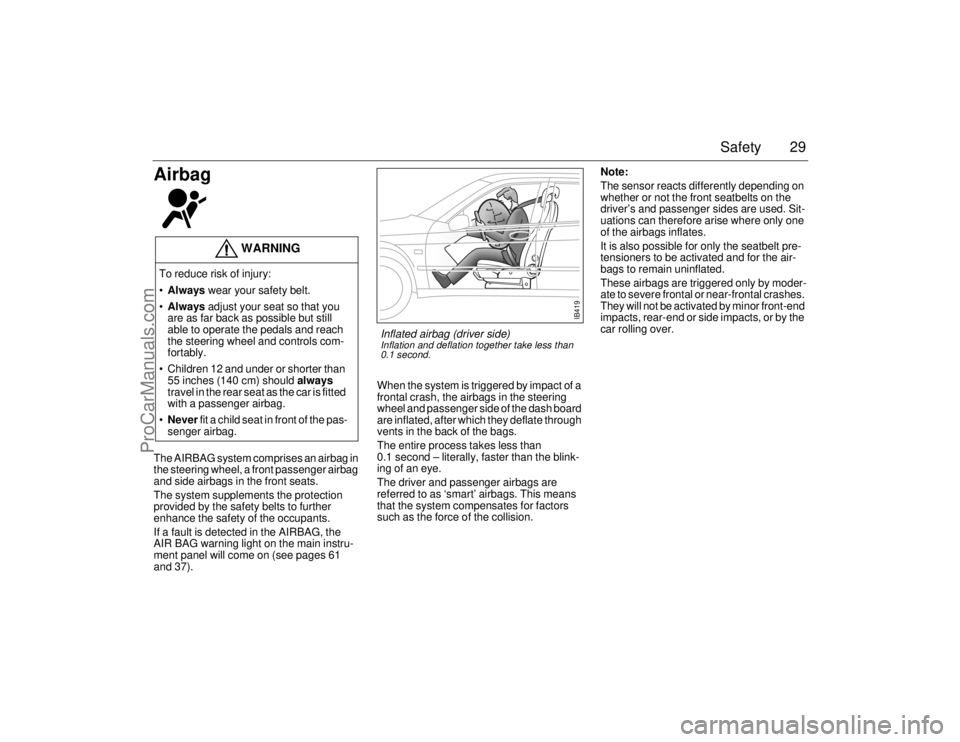
and 37). When the system is triggered by impact of a
frontal crash, the airbags in the steering
wheel and passenger side of the dash board
are inflated, after which they deflate through
vents in the back of the bags.
The entire process takes less than
0.1 second – literally, faster than the blink-
ing of an eye.
The driver and passenger airbags are
referred to as ‘smart’ airbags. This means
that the system compensates for factors
such as the force of the collision.Note:
The sensor reacts differently depending on
whether or not the front seatbelts on the
driver’s and passenger sides are used. Sit-
uations can therefore arise where only one
of the airbags inflates.
It is also possible for only the seatbelt pre-
tensioners to be activated and for the air-
bags to remain uninflated.
These airbags are triggered only by moder-
ate to severe frontal or near-frontal crashes.
They will not be activated by minor front-end
impacts, rear-end or side impacts, or by the
car rolling over.
WARNING
To reduce risk of injury:
Always wear your safety belt.
Always adjust your seat so that you
are as far back as possible but still
able to operate the pedals and reach
the steering wheel and controls com-
fortably.
Children 12 and under or shorter than
55 inches (140 cm) should always
travel in the rear seat as the car is fitted
with a passenger airbag.
Never fit a child seat in front of the pas-
senger airbag.
IB419
Inflated airbag (driver side) Inflation and deflation together take less than
0.1 second.
95usM06.book Page 29 Thursday, November 17, 2005 8:59 AM
ProCarManuals.com
Page 32 of 288
32 SafetyFront passenger seat The airbags are interconnected and have a
common warning light. The passenger
airbag module is housed in the fascia above
the glove compartment and is marked ”SRS
AIRBAG”. (SRS = Supplementary Restraint
System.)
Both airbags will be inflated in the event of a
moderate to severe frontal, or near-frontal
crash, even if the passenger seat is unoccu-
pied.
WARNING
Never secure a rear-facing child seat in
the right front seat of a car equipped with
a passenger airbag. Inflation of the airbag
in the event of a crash could seriously
injure or kill a child.
WARNING
DEATH or SERIOUS
INJURY can occur.
Children 12 and under or
shorter than 55 inches
(140 cm) can be killed by
the airbag.
The BACK SEAT is the SAFEST place
for children.
NEVER put a rear-facing child seat in
the front.
Sit as far back as possible from the air-
bag.
ALWAYS use SAFETY BELTS and
CHILD RESTRAINTS.
Never allow a child to stand in front of
the seat or to sit on the lap of a
front-seat passenger. Serious injury or
death could result if the airbag is
inflated in a crash.
The glove compartment must be
closed while travelling. An open glove
compartment door could cause leg
injuries in the event of a crash.
Never place anything on the dash or in
front of the seat as, in addition to being
a hazard to passengers, this could
interfere with the function of the airbag
in the event of a crash. The same
applies to the mounting of accessories
on the dash.
Keep feet on the floor – never put feet
up on the fascia, on the seat or out of
the window.
Do not carry anything in your lap.
95usM06.book Page 32 Thursday, November 17, 2005 8:59 AM
ProCarManuals.com
Page 33 of 288
33 Safety
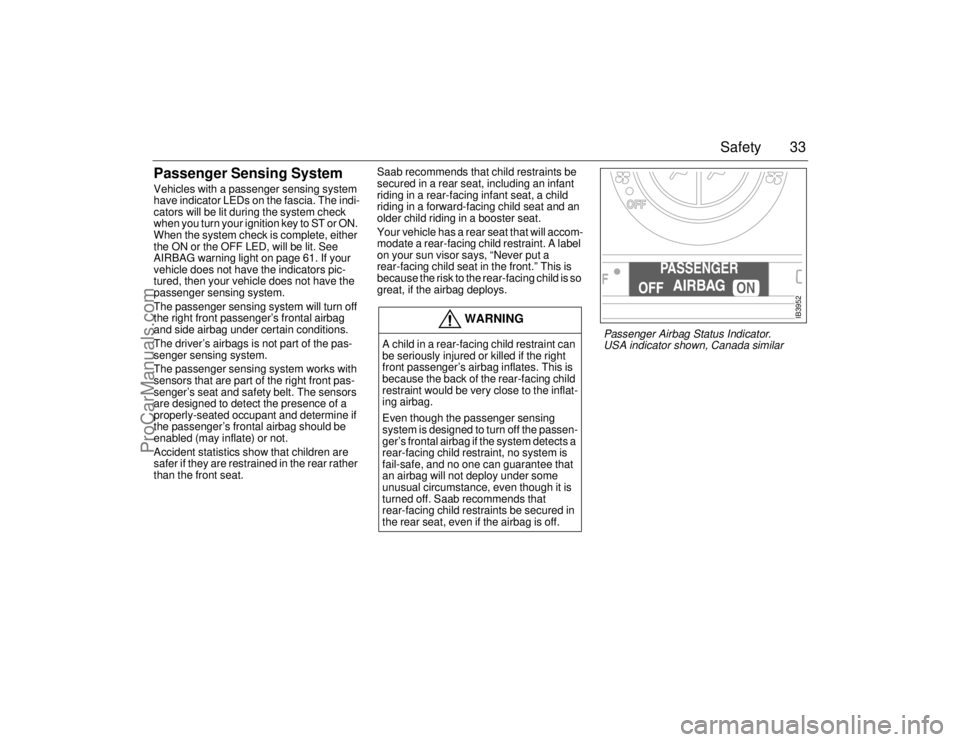
Passenger Sensing SystemVehicles with a passenger sensing system
have indicator LEDs on the fascia. The indi-
cators will be lit during the system check
when you turn your ignition key to ST or ON.
When the system check is complete, either
the ON or the OFF LED, will be lit. See
AIRBAG warning light on page 61. If your
vehicle does not have the indicators pic-
tured, then your vehicle does not have the
passenger sensing system.
The passenger sensing system will turn off
the right front passenger’s frontal airbag
and side airbag under certain conditions.
The driver’s airbags is not part of the pas-
senger sensing system.
The passenger sensing system works with
sensors that are part of the right front pas-
senger’s seat and safety belt. The sensors
are designed to detect the presence of a
properly-seated occupant and determine if
the passenger’s frontal airbag should be
enabled (may inflate) or not.
Accident statistics show that children are
safer if they are restrained in the rear rather
than the front seat.Saab recommends that child restraints be
secured in a rear seat, including an infant
riding in a rear-facing infant seat, a child
riding in a forward-facing child seat and an
older child riding in a booster seat.
Your vehicle has a rear seat that will accom-
modate a rear-facing child restraint. A label
on your sun visor says, “Never put a
rear-facing child seat in the front.” This is
because the risk to the rear-facing child is so
great, if the airbag deploys.
WARNING
A child in a rear-facing child restraint can
be seriously injured or killed if the right
front passenger’s airbag inflates. This is
because the back of the rear-facing child
restraint would be very close to the inflat-
ing airbag.
Even though the passenger sensing
system is designed to turn off the passen-
ger’s frontal airbag if the system detects a
rear-facing child restraint, no system is
fail-safe, and no one can guarantee that
an airbag will not deploy under some
unusual circumstance, even though it is
turned off. Saab recommends that
rear-facing child restraints be secured in
the rear seat, even if the airbag is off.
IB3952
Passenger Airbag Status Indicator.
USA indicator shown, Canada similar
95usM06.book Page 33 Thursday, November 17, 2005 8:59 AM
ProCarManuals.com
Page 34 of 288

34 SafetyThe passenger sensing system is designed
to turn off the right front passenger’s frontal
airbag if:
the right front passenger seat is unoccu-
pied
the system determines that an infant is
present in a rear-facing infant seat
the system determines that a small child
is present in a forward-facing child
restraint
the system determines that a small child
is present in a booster seat
a right front passenger takes his/her
weight off of the seat for a period of time
the right front passenger seat is occupied
by a smaller person, such as a child who
has outgrown child restraints
or if there is a critical problem with the
airbag system or the passenger sensing
system.When the passenger sensing system has
turned off the passenger’s frontal air bag,
the off indicator will light and stay lit to
remind you that the airbag is off.
If a child restraint has been installed (Saab
recommends that child restraints be
secured in the rear seat) and the on indica-
tor is lit, turn the vehicle off. Remove the
child restraint from the vehicle and reinstall
the child restraint following the child
restraint manufacturer’s directions and refer
to Installation of rear facing child restraints
on page 28.
If after reinstalling the child restraint and
restarting the vehicle, the on indicator is still
lit, check to make sure that the vehicle’s
seatback is not pressing the child restraint
into the seat cushion. If this happens,
slightly recline the vehicle’s seatback and
adjust the seat cushion if possible. Also
make sure the child restraint is not trapped
under the vehicle head restraint. If this hap-
pens, adjust the head restraint.
If the on indicator is still lit, secure the child
in the child restraint in a rear seat position in
the vehicle and check with your dealer.The passenger sensing system is designed
to enable (may inflate) the right front pas-
senger’s frontal airbag anytime the system
senses that a person of adult size is sitting
properly in the right front passenger’s seat.
When the passenger sensing system has
allowed the airbag to be enabled, the on
indicator will light and stay lit to remind you
that the airbag is active.
For some children who have outgrown child
restraints and for very small adults, the pas-
senger sensing system may or may not turn
off the right front passenger’s frontal airbag,
depending upon the person’s seating pos-
ture and body build. Everyone in your vehi-
cle who has outgrown child restraints
should wear a safety belt properly —
whether or not there is an airbag for that per-
son.95usM06.book Page 34 Thursday, November 17, 2005 8:59 AM
ProCarManuals.com
Page 40 of 288

40 SafetyFrequently asked questions
on function of airbagsDo you still need to wear a safety belt if air-
bags are fitted?
Yes, always! The airbag merely supple-
ments the car’s normal safety system.
Moreover, the airbag will only be actuated in
a moderate to severe frontal, or near-frontal
crash, which means, of course, that it pro-
vides no protection in minor frontal crashes,
major rear-end or side-on crashes or if the
car rolls over.
The safety belts help reduce the chance of
the car occupants from being thrown around
and injured or killed inside the car.
But they also ensure that, if a crash occurs
in which the airbags are inflated, the airbag
will make the optimum contact with the
occupant, i.e. square on from the front. If the
occupant meets the airbag in an offset posi-
tion, the protection afforded will be reduced.
In addition, airbags provide no protection
against a secondary impact occurring in the
same incident. So there is no doubt about
the benefit of wearing safety belts at all
times.
Do not sit too close to the airbag: it needs
room to inflate.
The airbag inflates very quickly and power-
fully in order to protect an adult person,
before they are thrown forward, in a serious
frontal crash.How do I position the seat to leave room for
the airbag to inflate?
Don’t have your seat too far forward.
Recline the seat back to increase the dis-
tance between you and the airbag. For short
drivers, special accessory pedal extensions
are available through your Saab dealer.
Airbags inflate extremely rapidly and with
great force – to be fast enough to protect an
adult in the seat.
When do the front airbags inflate?
The airbag will only be inflated under certain
predetermined conditions in a moderate to
severe frontal, or near-frontal crash,
depending on such factors as the force and
angle of the impact, the speed of the car on
impact, and the resistance to deformation of
the impacting object.
The airbag can only be activated once in the
same incident.
Do not attempt to drive the car after an
airbag has been inflated, even if it is
possible.What won’t trigger the front airbags?
The airbag will not be activated in all
front-end crashes. For instance, if the car
has hit something relatively soft and yielding
(e.g. a snow drift or a hedge) or a solid
object at a low impact speed, the airbag will
not necessarily be triggered.
How loud is the inflation?
The noise of the inflation is certainly loud,
but it is very short-lived and will not damage
your hearing. For a short time afterwards
you could experience a buzzing noise in
your ears.
Most people who have experienced it
cannot remember the noise of the inflation
at all – all they remember is the noise of the
crash.
Can you still use a child seat in the front if a
passenger airbag is installed?
Definitely not!
Children 12 and under or shorter than
55 inches (140 cm) can be killed by the
airbag.
The BACK SEAT is the SAFEST place for
children.
NEVER put a child seat in the front.
Sit as far back as possible from the airbag.
Always use safety belts and child
restraints.95usM06.book Page 40 Thursday, November 17, 2005 8:59 AM
ProCarManuals.com
Page 47 of 288
47 Security
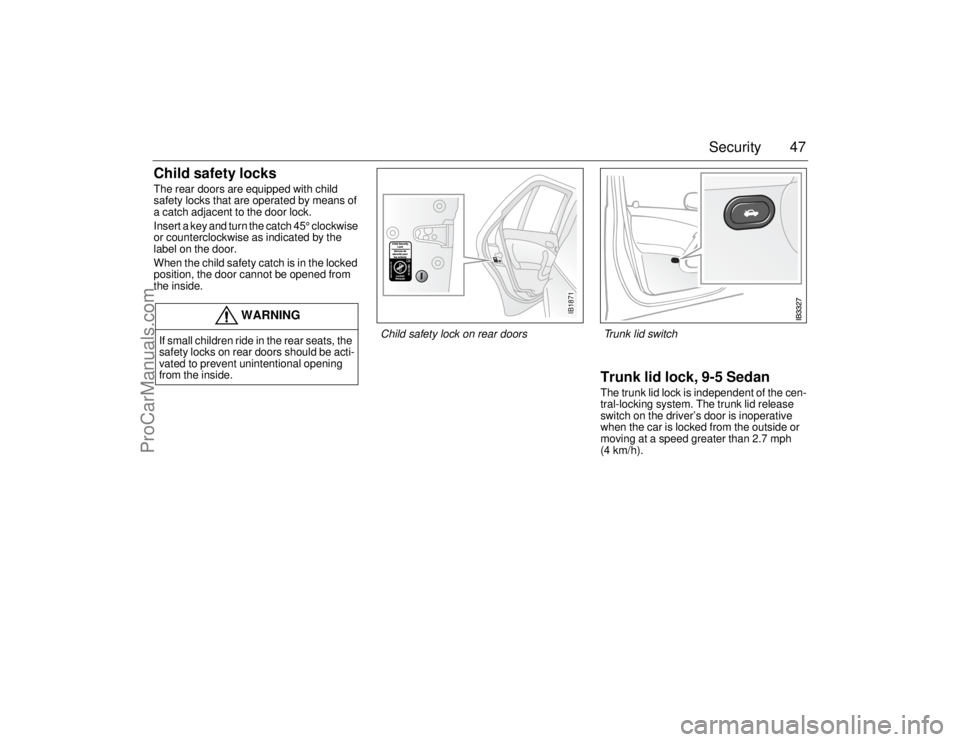
Child safety locksThe rear doors are equipped with child
safety locks that are operated by means of
a catch adjacent to the door lock.
Insert a key and turn the catch 45° clockwise
or counterclockwise as indicated by the
label on the door.
When the child safety catch is in the locked
position, the door cannot be opened from
the inside.
Trunk lid lock, 9-5 SedanThe trunk lid lock is independent of the cen-
tral-locking system. The trunk lid release
switch on the driver’s door is inoperative
when the car is locked from the outside or
moving at a speed greater than 2.7 mph
(4 km/h).
WARNING
If small children ride in the rear seats, the
safety locks on rear doors should be acti-
vated to prevent unintentional opening
from the inside.
IB1871
Child safety lock on rear doors
Trunk lid switch
95usM06.book Page 47 Thursday, November 17, 2005 8:59 AM
ProCarManuals.com
Page 130 of 288
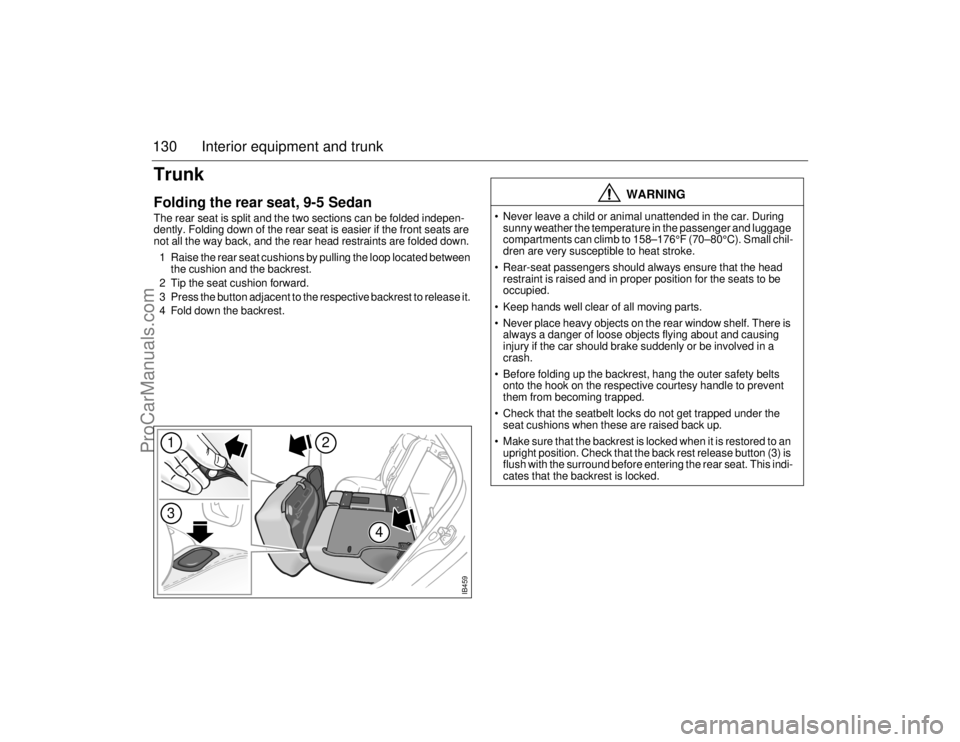
130 Interior equipment and trunkTrunkFolding the rear seat, 9-5 SedanThe rear seat is split and the two sections can be folded indepen-
dently. Folding down of the rear seat is easier if the front seats are
not all the way back, and the rear head restraints are folded down.
1 Raise the rear seat cushions by pulling the loop located between
the cushion and the backrest.
2 Tip the seat cushion forward.
3 Press the button adjacent to the respective backrest to release it.
4 Fold down the backrest.
WARNING
Never leave a child or animal unattended in the car. During
sunny weather the temperature in the passenger and luggage
compartments can climb to 158–176°F (70–80°C). Small chil-
dren are very susceptible to heat stroke.
Rear-seat passengers should always ensure that the head
restraint is raised and in proper position for the seats to be
occupied.
Keep hands well clear of all moving parts.
Never place heavy objects on the rear window shelf. There is
always a danger of loose objects flying about and causing
injury if the car should brake suddenly or be involved in a
crash.
Before folding up the backrest, hang the outer safety belts
onto the hook on the respective courtesy handle to prevent
them from becoming trapped.
Check that the seatbelt locks do not get trapped under the
seat cushions when these are raised back up.
Make sure that the backrest is locked when it is restored to an
upright position. Check that the back rest release button (3) is
flush with the surround before entering the rear seat. This indi-
cates that the backrest is locked.
IB459
1
2
4
3
95usM06.book Page 130 Thursday, November 17, 2005 8:59 AM
ProCarManuals.com