child lock SAAB 9-5 2006 Owners Manual
[x] Cancel search | Manufacturer: SAAB, Model Year: 2006, Model line: 9-5, Model: SAAB 9-5 2006Pages: 288, PDF Size: 19.71 MB
Page 9 of 288
9
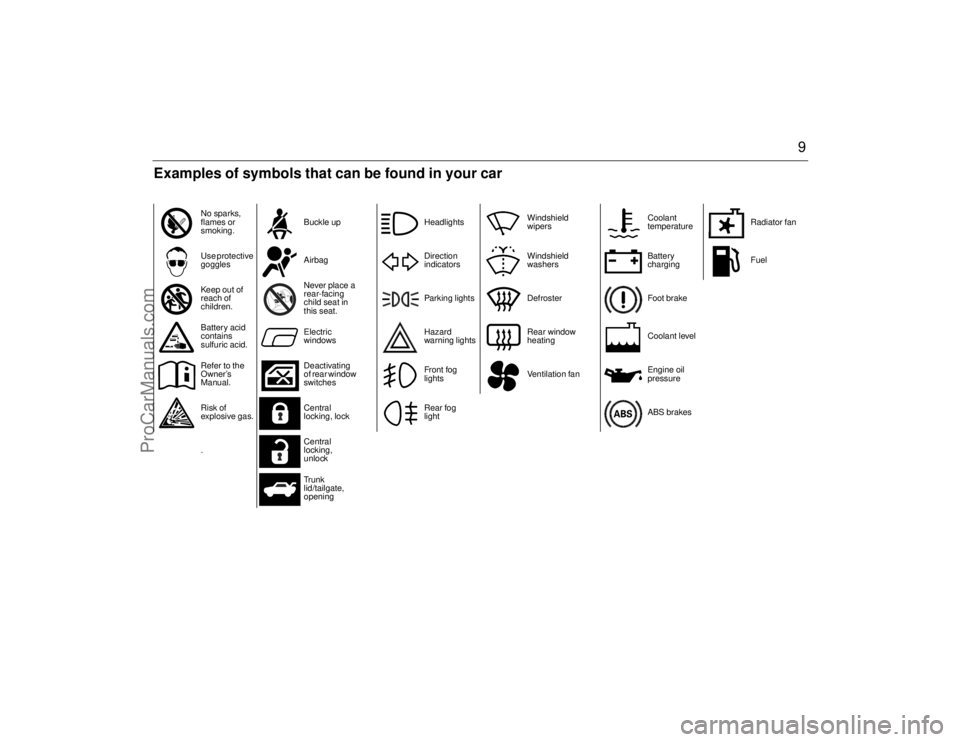
No sparks,
flames or
smoking.Buckle up
Use protective
gogglesAirbag
Keep out of
reach of
children.Never place a
rear-facing
child seat in
this seat.
Battery acid
contains
sulfuric acid.Electric
windows
Refer to the
Owner’s
Manual.Deactivating
of rear window
switches
Risk of
explosive gas.Central
locking, lock
.Central
locking,
unlock
Tr u n k
lid/tailgate,
opening
HeadlightsWindshield
wipers
Direction
indicatorsWindshield
washers
Parking lights Defroster
Hazard
warning lightsRear window
heating
Front fog
lightsVentilation fan
Rear fog
light
Coolant
temperatureRadiator fan
Battery
chargingFuel
Foot brake
Coolant level
Engine oil
pressure
ABS brakes
Examples of symbols that can be found in your car95usM06.book Page 9 Thursday, November 17, 2005 8:59 AM
ProCarManuals.com
Page 12 of 288
12 SafetySafety belts
Three-point inertia-reel safety belts are pro-
vided for all seats.
The results of studies show that it is equally
important to wear safety belts in the rear
seat as in the front seats.
Bear in mind that in certain states/provinces
it is a legal requirement for all occupants of
the car to wear a safety belt.
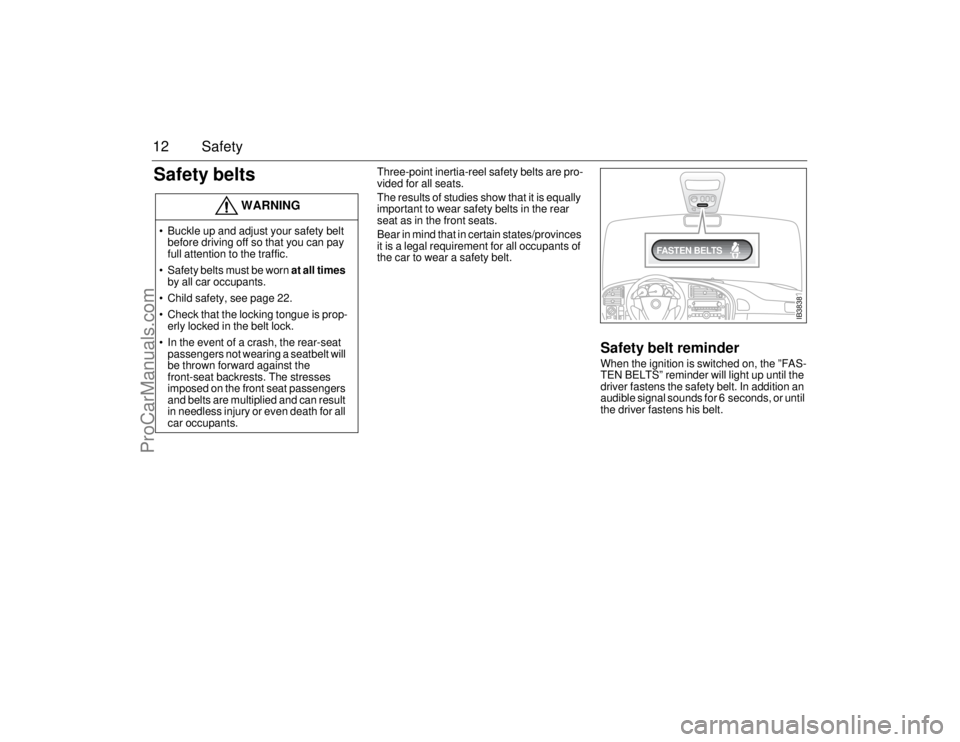
Safety belt reminderWhen the ignition is switched on, the ”FAS-
TEN BELTS” reminder will light up until the
driver fastens the safety belt. In addition an
audible signal sounds for 6 seconds, or until
the driver fastens his belt.
WARNING
Buckle up and adjust your safety belt
before driving off so that you can pay
full attention to the traffic.
Safety belts must be worn at all times
by all car occupants.
Child safety, see page 22.
Check that the locking tongue is prop-
erly locked in the belt lock.
In the event of a crash, the rear-seat
passengers not wearing a seatbelt will
be thrown forward against the
front-seat backrests. The stresses
imposed on the front seat passengers
and belts are multiplied and can result
in needless injury or even death for all
car occupants.
FASTEN BELTS
IB3838
95usM06.book Page 12 Thursday, November 17, 2005 8:59 AM
ProCarManuals.com
Page 13 of 288
13 Safety
Correct position for safety belt
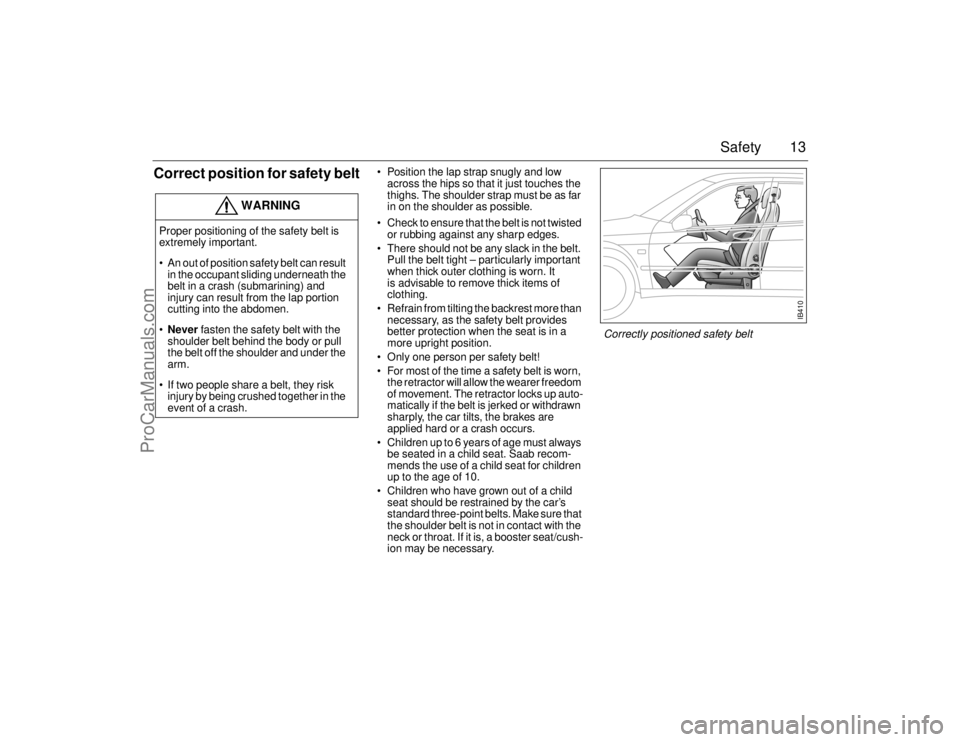
Position the lap strap snugly and low
across the hips so that it just touches the
thighs. The shoulder strap must be as far
in on the shoulder as possible.
Check to ensure that the belt is not twisted
or rubbing against any sharp edges.
There should not be any slack in the belt.
Pull the belt tight – particularly important
when thick outer clothing is worn. It
is advisable to remove thick items of
clothing.
Refrain from tilting the backrest more than
necessary, as the safety belt provides
better protection when the seat is in a
more upright position.
Only one person per safety belt!
For most of the time a safety belt is worn,
the retractor will allow the wearer freedom
of movement. The retractor locks up auto-
matically if the belt is jerked or withdrawn
sharply, the car tilts, the brakes are
applied hard or a crash occurs.
Children up to 6 years of age must always
be seated in a child seat. Saab recom-
mends the use of a child seat for children
up to the age of 10.
Children who have grown out of a child
seat should be restrained by the car’s
standard three-point belts. Make sure that
the shoulder belt is not in contact with the
neck or throat. If it is, a booster seat/cush-
ion may be necessary.
WARNING
Proper positioning of the safety belt is
extremely important.
An out of position safety belt can result
in the occupant sliding underneath the
belt in a crash (submarining) and
injury can result from the lap portion
cutting into the abdomen.
Never fasten the safety belt with the
shoulder belt behind the body or pull
the belt off the shoulder and under the
arm.
If two people share a belt, they risk
injury by being crushed together in the
event of a crash.
IB410
Correctly positioned safety belt
95usM06.book Page 13 Thursday, November 17, 2005 8:59 AM
ProCarManuals.com
Page 22 of 288
22 SafetyChild safety
Car safety tips
For Trunk Release Handle information see
page 48 and 139.
WARNING
Children must always be suitably
restrained in the car.
ALWAYS use SAFETY BELTS and
CHILD RESTRAINTS.
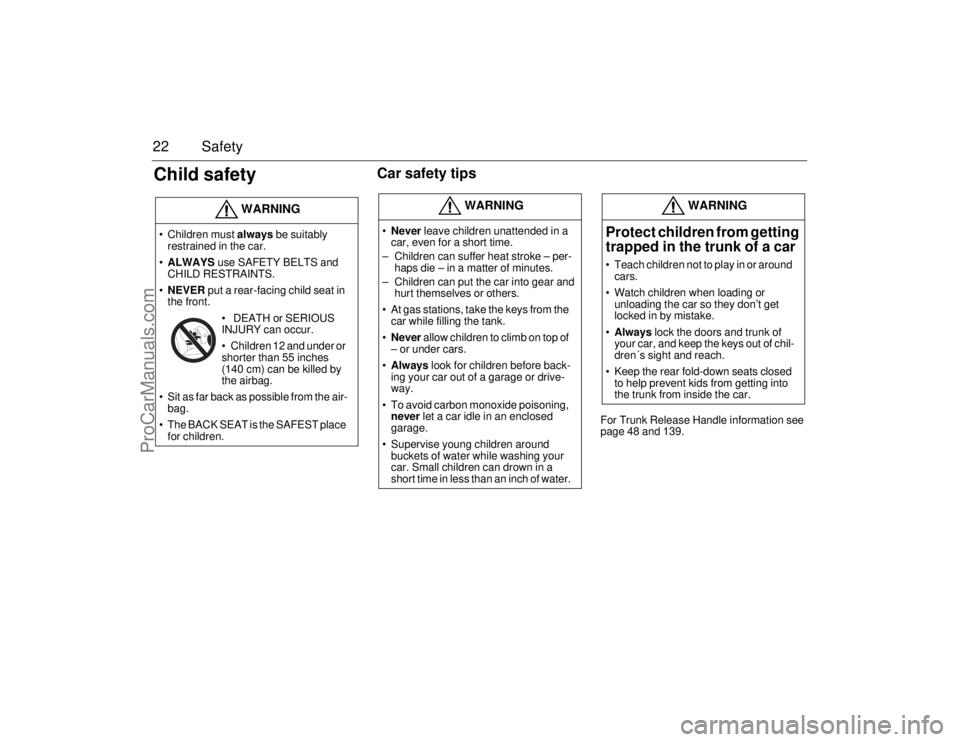
NEVER put a rear-facing child seat in
the front.
DEATH or SERIOUS
INJURY can occur.
Children 12 and under or
shorter than 55 inches
(140 cm) can be killed by
the airbag.
Sit as far back as possible from the air-
bag.
The BACK SEAT is the SAFEST place
for children.
WARNING
Never leave children unattended in a
car, even for a short time.
– Children can suffer heat stroke – per-
haps die – in a matter of minutes.
– Children can put the car into gear and
hurt themselves or others.
At gas stations, take the keys from the
car while filling the tank.
Never allow children to climb on top of
– or under cars.
Always look for children before back-
ing your car out of a garage or drive-
way.
To avoid carbon monoxide poisoning,
never let a car idle in an enclosed
garage.
Supervise young children around
buckets of water while washing your
car. Small children can drown in a
short time in less than an inch of water.
WARNING
Protect children from getting
trapped in the trunk of a car Teach children not to play in or around
cars.
Watch children when loading or
unloading the car so they don’t get
locked in by mistake.
Always lock the doors and trunk of
your car, and keep the keys out of chil-
dren´s sight and reach.
Keep the rear fold-down seats closed
to help prevent kids from getting into
the trunk from inside the car.
95usM06.book Page 22 Thursday, November 17, 2005 8:59 AM
ProCarManuals.com
Page 25 of 288
25 Safety
Securing a Child Restraint
Designed for the LATCH
System9-5 SportCombi:
Before installation, please read through
these instructions and the child restraint
installation instructions.
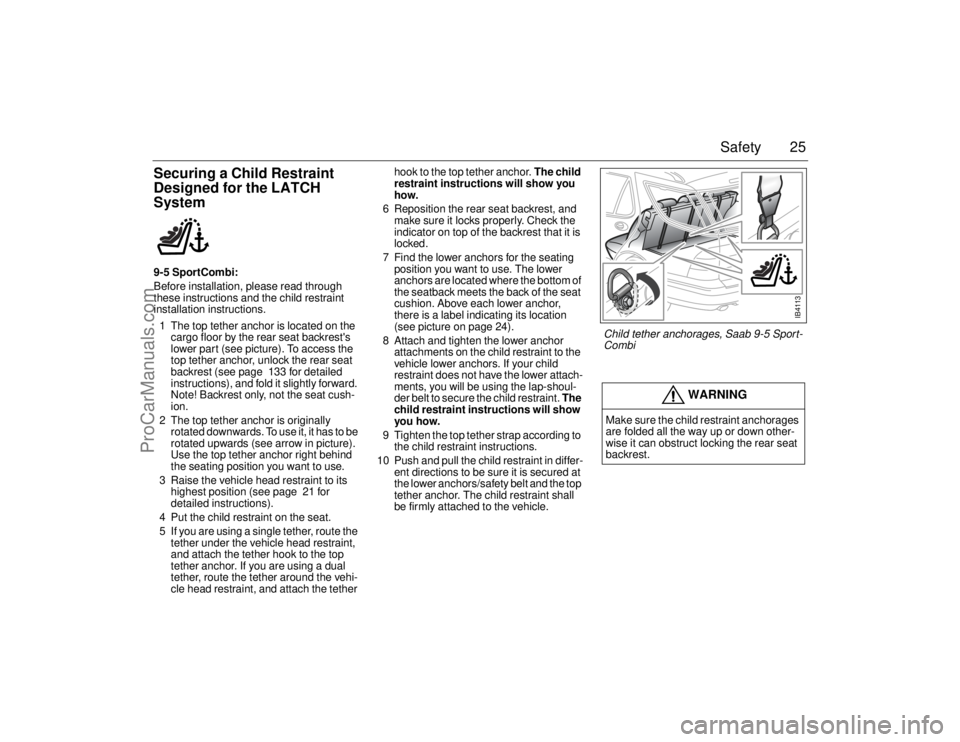
1 The top tether anchor is located on the
cargo floor by the rear seat backrest's
lower part (see picture). To access the
top tether anchor, unlock the rear seat
backrest (see page 133 for detailed
instructions), and fold it slightly forward.
Note! Backrest only, not the seat cush-
ion.
2 The top tether anchor is originally
rotated downwards. To use it, it has to be
rotated upwards (see arrow in picture).
Use the top tether anchor right behind
the seating position you want to use.
3 Raise the vehicle head restraint to its
highest position (see page 21 for
detailed instructions).
4 Put the child restraint on the seat.
5 If you are using a single tether, route the
tether under the vehicle head restraint,
and attach the tether hook to the top
tether anchor. If you are using a dual
tether, route the tether around the vehi-
cle head restraint, and attach the tether hook to the top tether anchor. The child
restraint instructions will show you
how.
6 Reposition the rear seat backrest, and
make sure it locks properly. Check the
indicator on top of the backrest that it is
locked.
7 Find the lower anchors for the seating
position you want to use. The lower
anchors are located where the bottom of
the seatback meets the back of the seat
cushion. Above each lower anchor,
there is a label indicating its location
(see picture on page 24).
8 Attach and tighten the lower anchor
attachments on the child restraint to the
vehicle lower anchors. If your child
restraint does not have the lower attach-
ments, you will be using the lap-shoul-
der belt to secure the child restraint. The
child restraint instructions will show
you how.
9 Tighten the top tether strap according to
the child restraint instructions.
10 Push and pull the child restraint in differ-
ent directions to be sure it is secured at
the lower anchors/safety belt and the top
tether anchor. The child restraint shall
be firmly attached to the vehicle.
WARNING
Make sure the child restraint anchorages
are folded all the way up or down other-
wise it can obstruct locking the rear seat
backrest.
IB4113
Child tether anchorages, Saab 9-5 Sport-
Combi
95usM06.book Page 25 Thursday, November 17, 2005 8:59 AM
ProCarManuals.com
Page 26 of 288
26 SafetySecuring a Child Restraint
Designed for the LATCH
System 9-5 Sedan:
Before installation, please read through
these instructions and the child restraint
installation instructions.
1 Find the lower anchors for the seating
position you want to use. The lower
anchors are located where the bottom of
the seatback meets the back of the seat
cushion. Above each lower anchor,
there is a label indicating its location
(see picture).
2 Put the child restraint on the seat.
3 Attach and tighten the lower anchor
attachments on the child restraint to the
vehicle lower anchors. If your child
restraint does not have the lower attach-
ments, you will be using the lap-shoul-
der belt to secure the child restraint. The
child restraint instructions will show
you how.
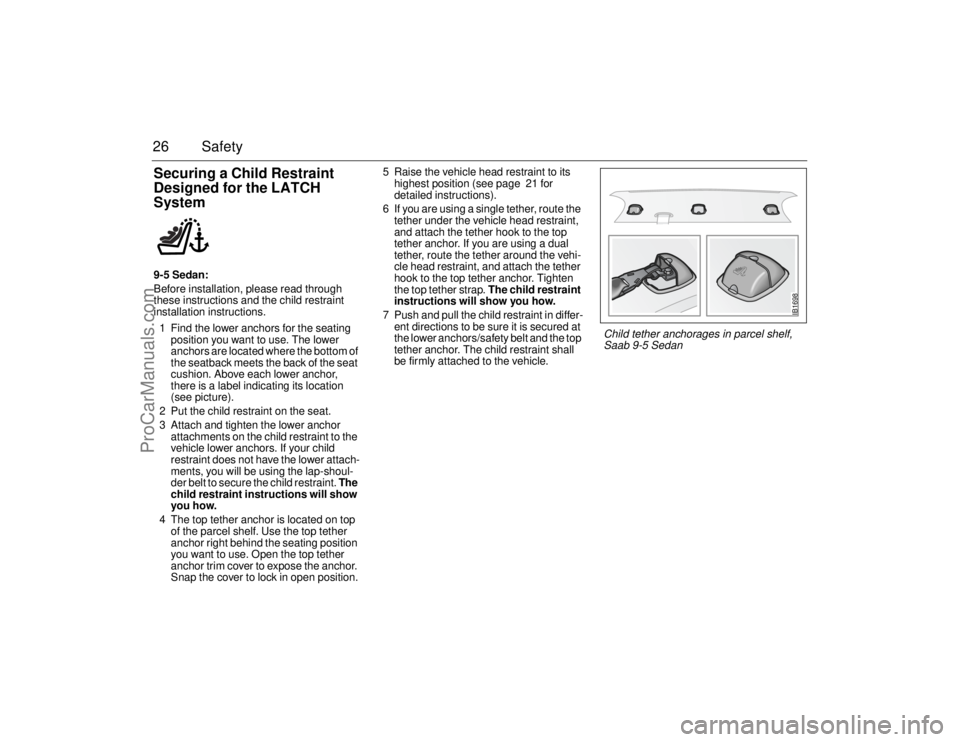
4 The top tether anchor is located on top
of the parcel shelf. Use the top tether
anchor right behind the seating position
you want to use. Open the top tether
anchor trim cover to expose the anchor.
Snap the cover to lock in open position.5 Raise the vehicle head restraint to its
highest position (see page 21 for
detailed instructions).
6 If you are using a single tether, route the
tether under the vehicle head restraint,
and attach the tether hook to the top
tether anchor. If you are using a dual
tether, route the tether around the vehi-
cle head restraint, and attach the tether
hook to the top tether anchor. Tighten
the top tether strap. The child restraint
instructions will show you how.
7 Push and pull the child restraint in differ-
ent directions to be sure it is secured at
the lower anchors/safety belt and the top
tether anchor. The child restraint shall
be firmly attached to the vehicle.
IB1698
Child tether anchorages in parcel shelf,
Saab 9-5 Sedan
95usM06.book Page 26 Thursday, November 17, 2005 8:59 AM
ProCarManuals.com
Page 27 of 288
27 Safety
Lockable latch plateIn fitting a child seat that is intended to be
secured in position by the lap portion of the
safety belt, make use of the locking function
of the latch plate. This function is available
on all seats in the second row.
Locking the lap portion of the belt lessens
the risk that the seat will work loose while
the car is in motion.
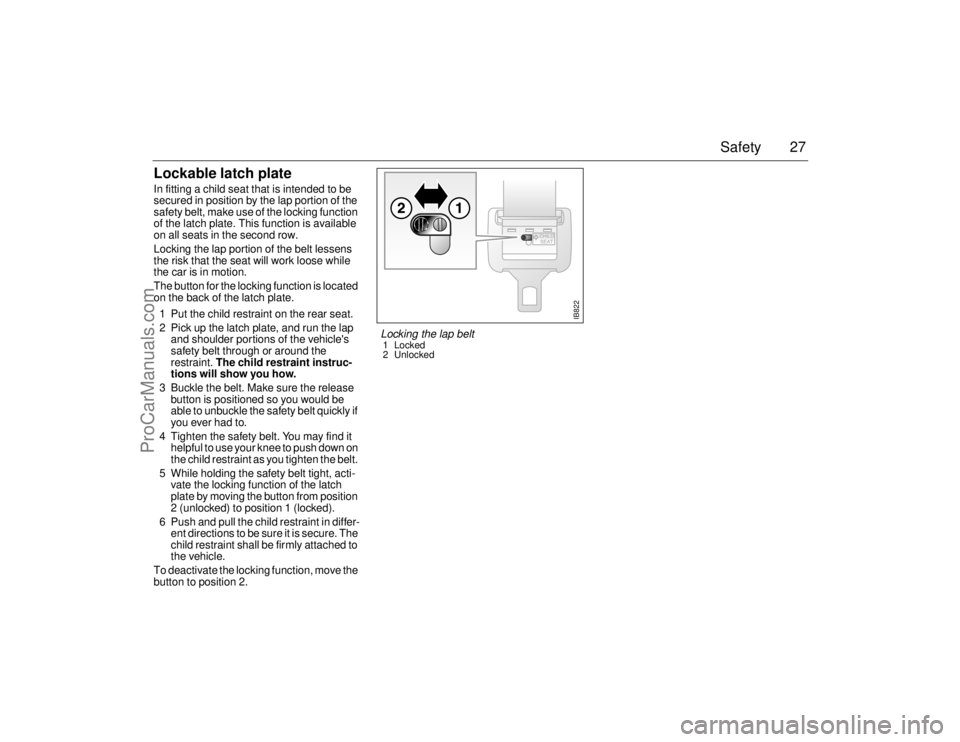
The button for the locking function is located
on the back of the latch plate.
1 Put the child restraint on the rear seat.
2 Pick up the latch plate, and run the lap
and shoulder portions of the vehicle's
safety belt through or around the
restraint. The child restraint instruc-
tions will show you how.
3 Buckle the belt. Make sure the release
button is positioned so you would be
able to unbuckle the safety belt quickly if
you ever had to.
4 Tighten the safety belt. You may find it
helpful to use your knee to push down on
the child restraint as you tighten the belt.
5 While holding the safety belt tight, acti-
vate the locking function of the latch
plate by moving the button from position
2 (unlocked) to position 1 (locked).
6 Push and pull the child restraint in differ-
ent directions to be sure it is secure. The
child restraint shall be firmly attached to
the vehicle.
To deactivate the locking function, move the
button to position 2.
IB822
Locking the lap belt1 Locked
2 Unlocked
95usM06.book Page 27 Thursday, November 17, 2005 8:59 AM
ProCarManuals.com
Page 28 of 288
28 SafetyInstallation of rear facing child restraints
Child restraints that are approved for rear
facing installation in the rear seat can be
positioned in any of the three rear seating
positions.
WARNING
Failure to follow all the manufacturer’s
instructions on the use of this child
restraint system can cause your child to
strike the vehicle´s interior during a
sudden stop or crash.
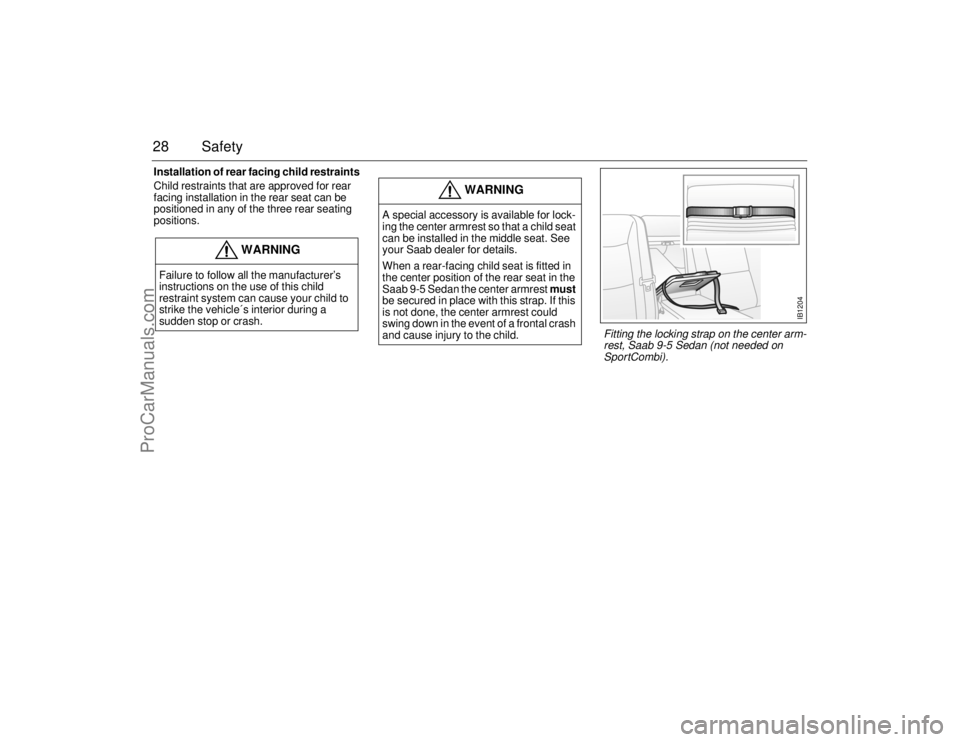
WARNING
A special accessory is available for lock-
ing the center armrest so that a child seat
can be installed in the middle seat. See
your Saab dealer for details.
When a rear-facing child seat is fitted in
the center position of the rear seat in the
Saab 9-5 Sedan the center armrest must
be secured in place with this strap. If this
is not done, the center armrest could
swing down in the event of a frontal crash
and cause injury to the child.
IB1204
Fitting the locking strap on the center arm-
rest, Saab 9-5 Sedan (not needed on
SportCombi).
95usM06.book Page 28 Thursday, November 17, 2005 8:59 AM
ProCarManuals.com
Page 44 of 288
44 SecurityDoorsDoor handlesPull the handle to open the door.
If the door is stuck (e.g. if frozen), hold the
handle from above to secure a better grip.Central locking
Key / Remote control The key unit consists of a mechanical key
with integrated remote control.
The mechanical key is used for manual
locking and unlocking.
The remote control is used for remote lock-
ing and unlocking.
The key fits all the car’s locks.
The key supplied with the car has a code
number on a black plastic tag that needs to
be quoted for ordering additional keys. You
should therefore make a careful note of the
number.
The key contains a unique electronic code
for your car. When the key is inserted in the
ignition, the code is checked. If it matches,
the car can be started.
Your car is supplied with two keys. It is pos-
sible to have up to four keys for a car at one
time. If you loose one key you should have
this replaced as soon as possible by con-
tacting your Saab dealer. When the new key
is programmed into the system, the missing
key is automatically erased.
NOTE: For this reason, we strongly advise
you to take two keys with you on long jour-
neys and to keep them separate. If all keys
are lost, it will be necessary to replace costly
electronic components as well as the keys.
This loss and replacement cost is not cov-
ered by the new car warranty.
If an additional key is to be added, all of the
original keys must be brought to the dealer
so that the control module can ”learn” to rec-
ognize the new components.To check the number of keys that are pro-
grammed for the car; see page 54.
WARNING
Leaving children or pets unattended in a
locked car is dangerous. It is also danger-
ous to leave children in a vehicle with the
ignition key. A child or others could be
badly injured or even killed.
NOTICEThe key contains delicate electronics.
Do not expose it to water.
Avoid rough handling.
Do not place the key where it may be
subjected to high temperatures, e.g.
on the instrument panel.
The key may malfunction if it becomes
very cold. Warm it in your hands for a
couple of minutes.
Never open the key. For changing the
battery, see page 49.
95usM06.book Page 44 Thursday, November 17, 2005 8:59 AM
ProCarManuals.com
Page 46 of 288
46 Security
If remote unlocking should fail to work
Unlock the front door with the key. To
silence the alarm, insert the key into the igni-
tion switch and turn it to the ON position.
The car can now be started. Contact a work-
shop to have the system checked and
repaired. We recommend that you contact
an authorized Saab dealer.
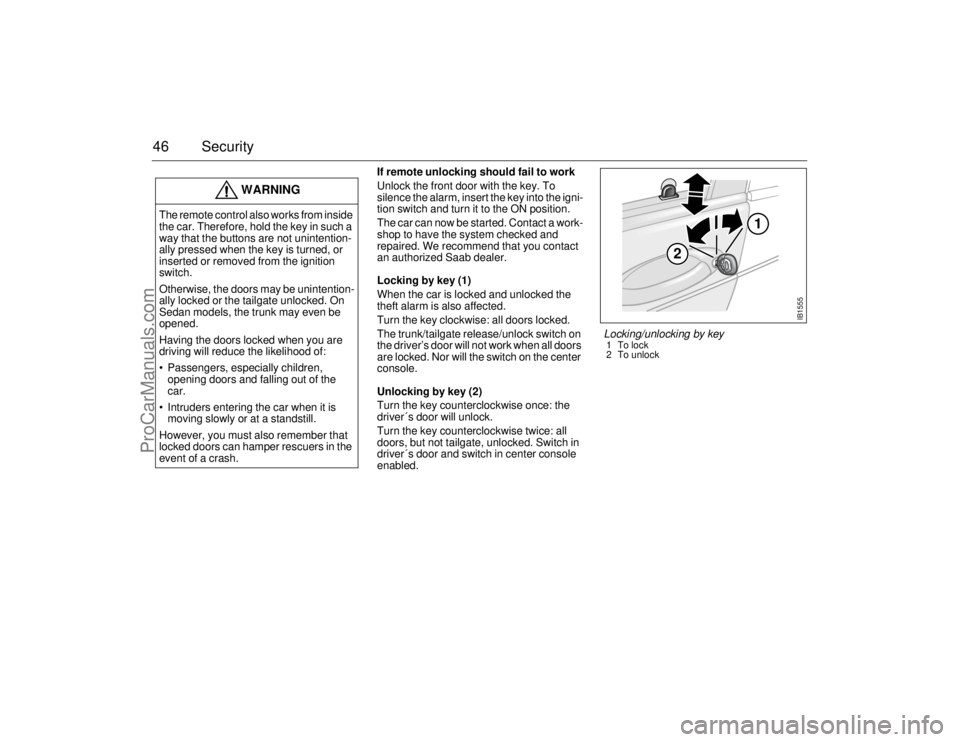
Locking by key (1)
When the car is locked and unlocked the
theft alarm is also affected.
Turn the key clockwise: all doors locked.
The trunk/tailgate release/unlock switch on
the driver’s door will not work when all doors
are locked. Nor will the switch on the center
console.
Unlocking by key (2)
Turn the key counterclockwise once: the
driver´s door will unlock.
Turn the key counterclockwise twice: all
doors, but not tailgate, unlocked. Switch in
driver´s door and switch in center console
enabled.
WARNING
The remote control also works from inside
the car. Therefore, hold the key in such a
way that the buttons are not unintention-
ally pressed when the key is turned, or
inserted or removed from the ignition
switch.
Otherwise, the doors may be unintention-
ally locked or the tailgate unlocked. On
Sedan models, the trunk may even be
opened.
Having the doors locked when you are
driving will reduce the likelihood of:
Passengers, especially children,
opening doors and falling out of the
car.
Intruders entering the car when it is
moving slowly or at a standstill.
However, you must also remember that
locked doors can hamper rescuers in the
event of a crash.
IB1555
2
1
Locking/unlocking by key1To lock
2 To unlock
95usM06.book Page 46 Thursday, November 17, 2005 8:59 AM
ProCarManuals.com