air condition SAAB 9-5 2008 User Guide
[x] Cancel search | Manufacturer: SAAB, Model Year: 2008, Model line: 9-5, Model: SAAB 9-5 2008Pages: 288, PDF Size: 27.54 MB
Page 149 of 288
149 Starting and driving
occurs, return to your authorized Saab
dealer for diagnosis. If it is determined that
the condition is caused by the type of fuel
used, repairs may not be covered by your
warranty.
Additives
To provide cleaner air, all gasolines in the
United States are now required to contain
additives that will help prevent engine and
fuel system deposits from forming, allowing
your emission control system to work prop-
erly. You should not have to add anything to
your fuel. However, some gasolines contain
only the minimum amount of additive
required to meet U.S. Environmental Pro-
tection Agency regulations. Saab recom-
mends that you buy gasolines that are
advertised to help keep fuel injectors and
intake valves clean. If your vehicle experi-
ences problems due to dirty injectors or
valves, try a different brand of gasoline.
Gasolines containing oxygenates, such as
ethers and ethanol, and reformulated gaso-
lines may be available in your area to con-
tribute to clean air. Saab recommends that
you use these gasolines, particularly if they
comply with the specifications described
earlier.Notice: Your vehicle was not designed
for fuel that contains methanol. Do not
use fuel containing methanol. It can
corrode metal parts in your fuel system
and also damage the plastic and rubber
parts. That damage would not be
covered under your warranty.
Some gasolines that are not reformulated
for low emissions may contain an
octane-enhancing additive called methylcy-
clopentadienyl manganese tricarbonyl
(MMT); ask the attendant where you buy
gasoline whether the fuel contains MMT.
Saab does not recommend the use of such
gasolines.
Fuels containing MMT can reduce the life of
spark plugs and the performance of the
emission control system may be affected.
The malfunction indicator lamp may turn on.
If this occurs, return to your authorized Saab
dealer for service.Fuels in Foreign Countries
If you plan on driving in another country out-
side the United States or Canada, the
proper fuel may be hard to find. Never use
leaded gasoline or any other fuel not recom-
mended in the previous text on fuel. Costly
repairs caused by use of improper fuel
would not be covered by your warranty.
To check the fuel availability, ask an auto
club, or contact a major oil company that
does business in the country where you will
be driving.95_US_M08.book Page 149 Friday, May 11, 2007 1:06 PM
ProCarManuals.com
Page 171 of 288
171 Starting and driving
Driving techniqueTo obtain the best running economy, not
only regarding fuel consumption but
general wear also, regular service is
required.
High speed, unnecessary acceleration,
heavy braking and much low gear work all
gives rise to higher fuel consumption.
Frequent gear changing in traffic, starting
in cold weather, the use of studded tires
and roof racks, and towing a trailer all
increase fuel consumption.
Do not run the engine when the car is
stationary.
If idling, it will take much longer before the
engine becomes hot. Engine wear is
greatest during this warming-up phase.
Therefore drive away as soon as possible
after the engine is started and avoid high
revving.Driving in a low gear results in higher fuel
consumption than in a high gear because
of the higher engine speed for a given
road speed. Always change up to a higher
gear as soon as traffic conditions allow
and use the highest gear as much as
possible.
Check the air pressure in the tires once a
month. Incorrect pressures increase tire
wear. It is better to have slightly higher
pressure than lower.
Check fuel consumption regularly.
Increased consumption can indicate that
something is wrong and that the car
needs to be checked by a workshop. We
recommend that you contact an autho-
rized Saab dealer.
Practical trials on the roads have demon-
strated that substantial savings in fuel con-
sumption can be made if the above advice
is heeded.
Road conditionsWet roads increase fuel consumption, as do
unpaved roads and driving in hilly country
(the amount of fuel saved driving downhill is
less than the additional amount required to
climb the hill).
WARNING
Never switch the engine off while driving
as the effect of the brakes and power
steering will be greatly reduced.
95_US_M08.book Page 171 Friday, May 11, 2007 1:06 PM
ProCarManuals.com
Page 172 of 288
172 Starting and drivingEngine block heater3
33 3The following are just some of the benefits
to the car and the environment of using an
engine block heater:
Lower fuel consumption.
Exhaust emissions substantially reduced
over short runs.
Reduced wear on the engine.
Inside of car warms up faster.
The engine heater is effective at outside
temperatures up to 58–68°F (+15–20°C).
The warmer it is outside, the shorter the time
the engine heater needs to be connected.
Longer than 1.5 hours is unnecessary.
If the car is equipped with a removable,
electrical cabin heater that is not in use, this
should be stored in the luggage compart-
ment.
Driving in cold weatherBefore starting a journey in cold weather
you should check the following:
That the wiper blades have not become
frozen to the windshield/glass.
Brush any snow away from the air intake
for the heater system (opening between
hood and windshield).
It may be advisable to lubricate the
door-lock cylinder (use molybdenum
disulphide, MoS
2) to prevent its freezing.
If the lock has frozen, take care not to
break the key (or use the remote control)
– heat it first or spray it with de-icer.
Periodically during the winter, add gaso-
line anti-freeze to the fuel to dispel any
condensation in the fuel tank which could
freeze and cause problems in the system.
Keep the tank well filled to reduce the risk
of condensation forming.
If the car is parked outside in freezing
weather, fuel additives (gasoline
anti-freeze) will not do any good as it
cannot remove water that has already
frozen. Park the car in a warm place so
that any ice that may have built up melts,
then add gasoline anti-freeze when filling
up the tank. Condensation is caused by
changes in the outdoor temperature or by
the car being parked alternately in a
garage and outside. It is particularly important when the roads
are slippery that the brakes and tires be in
good condition.
Check the anti-freeze in the engine cool-
ant, see page 195.
The car´s trip computer will warn you when
there is a risk of slippery conditions. For fur-
ther information on this function, see
page 68.
The car is equipped with tires designed to
provide optimum grip on both wet and dry
roads, although this has been achieved at
the expense of somewhat reduced grip on
snow and ice. For regular driving on snow
and ice, we therefore recommend that
winter (snow) tires be fitted.
Winter (snow) tires, particularly studded
tires (where use is legally permitted), gener-
ally make driving safer on snow and ice.
Acquaint yourself with the legal provi-
sions governing the use of different
types of winter tires and snow chains.
Studded tires are not allowed in some
countries.
95_US_M08.book Page 172 Friday, May 11, 2007 1:06 PM
ProCarManuals.com
Page 189 of 288
189 Car care and technical information
IB3888
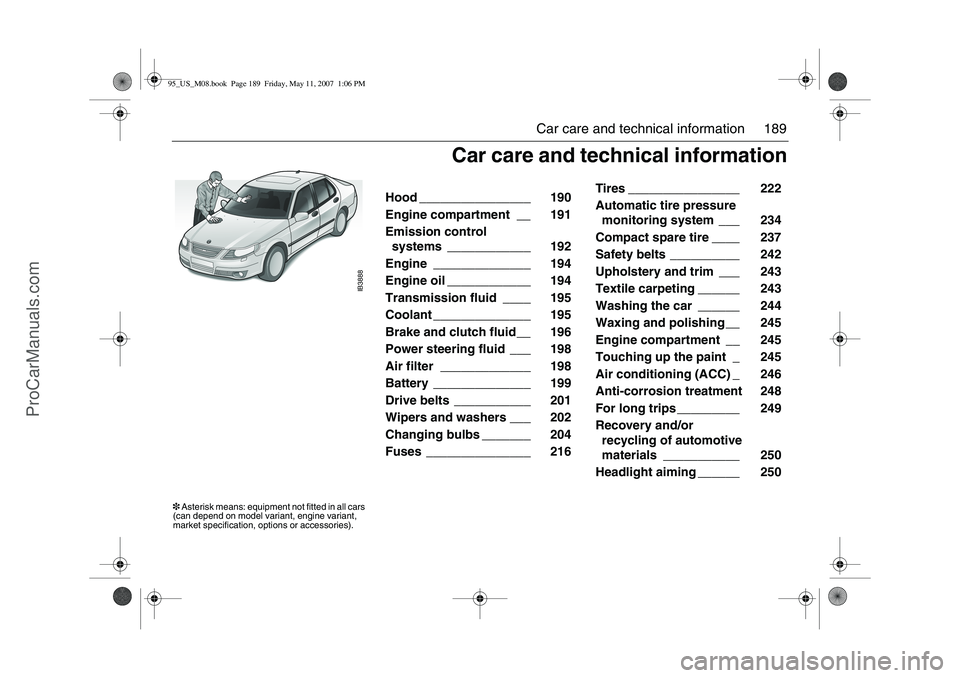
Hood ________________ 190
Engine compartment __ 191
Emission control
systems ____________ 192
Engine ______________ 194
Engine oil ____________ 194
Transmission fluid ____ 195
Coolant ______________ 195
Brake and clutch fluid__ 196
Power steering fluid ___ 198
Air filter _____________ 198
Battery ______________ 199
Drive belts ___________ 201
Wipers and washers ___ 202
Changing bulbs _______ 204
Fuses _______________ 216 Tires ________________ 222
Automatic tire pressure
monitoring system ___ 234
Compact spare tire ____ 237
Safety belts __________ 242
Upholstery and trim ___ 243
Textile carpeting ______ 243
Washing the car ______ 244
Waxing and polishing __ 245
Engine compartment __ 245
Touching up the paint _ 245
Air conditioning (ACC) _ 246
Anti-corrosion treatment 248
For long trips _________ 249
Recovery and/or
recycling of automotive
materials ___________ 250
Headlight aiming ______ 250
Car care and technical information
3 Asterisk means: equipment not fitted in all cars
(can depend on model variant, engine variant,
market specification, options or accessories).95_US_M08.book Page 189 Friday, May 11, 2007 1:06 PM
ProCarManuals.com
Page 198 of 288
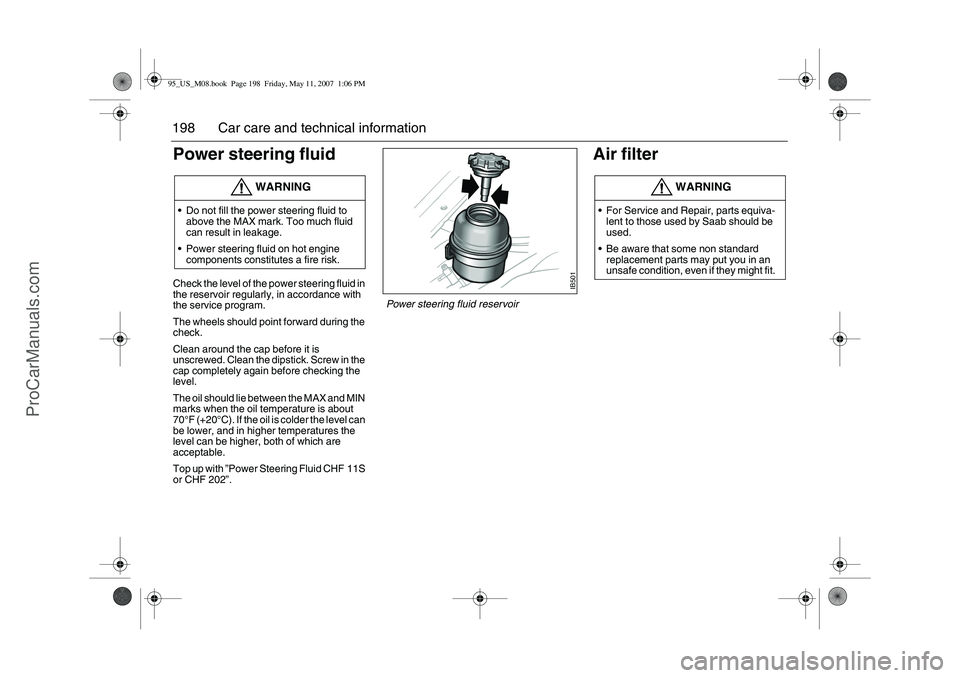
198 Car care and technical informationPower steering fluidCheck the level of the power steering fluid in
the reservoir regularly, in accordance with
the service program.
The wheels should point forward during the
check.
Clean around the cap before it is
unscrewed. Clean the dipstick. Screw in the
cap completely again before checking the
level.
The oil should lie between the MAX and MIN
marks when the oil temperature is about
70°F (+20°C). If the oil is colder the level can
be lower, and in higher temperatures the
level can be higher, both of which are
acceptable.
Top up with ”Power Steering Fluid CHF 11S
or CHF 202”.
Air filter
WARNING
Do not fill the power steering fluid to
above the MAX mark. Too much fluid
can result in leakage.
Power steering fluid on hot engine
components constitutes a fire risk.
WARNING
For Service and Repair, parts equiva-
lent to those used by Saab should be
used.
Be aware that some non standard
replacement parts may put you in an
unsafe condition, even if they might fit.
IB501
Power steering fluid reservoir
95_US_M08.book Page 198 Friday, May 11, 2007 1:06 PM
ProCarManuals.com
Page 225 of 288

225 Car care and technical information
Buying New TiresTo find out what kind and size of tires you
need, look at the Tire-Loading Information
label.
Before changing to wheels/tires of another
size, we recommend that you contact an
authorized Saab workshop regarding
acceptable options. See also page 268
Wheels/tires combinations that are not
approved by the vehicle manufacturer can
negatively affect the car’s directional stabil-
ity, steering and braking in both wet and dry
conditions.
The wheels and tires have been carefully
matched to the characteristics of the car and
play a key role in its outstanding roadhold-
ing and handling.
Do not take it for granted that a wheel/tire
combination will work in the best possible
way, just because it can be fitted to the car.
To ensure that the speedometer is as accu-
rate as possible it should be reprogrammed
if wheels of a different dimension are fitted.
Contact a Saab dealer.
Because of front wheel drive, the front tires
tend to wear faster than the rear ones. New
tires should always be fitted in pairs, so that
tires on the same axle have the same
amount of tread.
Store wheels lying flat or hanging – never
standing upright.
NOTEWide wheels and tires with sidewalls that
are too low can:
be damaged in potholes etc.
cause springs, shock absorbers and
wheel bearings and body mountings
can be overloaded.
cause the wheels to come into contact
with chassis and body components.
can affect the function of the Elec-
tronic Stability Program (ESP
®).
The speed and load limits for the tires
must not be exceeded; see page 230.
Wheels larger than 17” must not be fitted.
The maximum permissible offset is
49 mm.
WARNING
Mixing tires could cause you to lose con-
trol while driving. If you mix tires of differ-
ent sizes or types (radial and bias-belted
tires), the vehicle may not handle prop-
erly, and you could have a crash. Using
tires of different sizes may also cause
damage to your vehicle. Be sure to use
the same size and type tires on all wheels.
It’s all right to drive with your compact
spare temporarily, it was developed for
use on your vehicle. See “Compact spare
tire” on page 237.
WARNING
If you use bias-ply tires on your vehicle,
the wheel rim flanges could develop
cracks after many miles of driving. A tire
and/or wheel could fail suddenly, causing
a crash. Use only radial-ply tires with the
wheels on your vehicle.
95_US_M08.book Page 225 Friday, May 11, 2007 1:06 PM
ProCarManuals.com
Page 227 of 288
227 Car care and technical information
Wheel Alignment and Tire Balance
The wheels on your vehicle were aligned
and balanced carefully at the factory to give
you the longest tire life and best overall per-
formance.
Scheduled wheel alignment and wheel bal-
ancing are not needed. However, if you
notice unusual tire wear or your vehicle pull-
ing one way or the other, the alignment may
need to be reset. If you notice your vehicle
vibrating when driving on a smooth road,
your wheels may need to be rebalanced.
Wheel Replacement
Replace any wheel that is bent, cracked or
badly rusted or corroded. If wheel nuts keep
coming loose, the wheel, wheel bolts and
wheel nuts should be replaced. If the wheel
leaks air, replace it (except some aluminum
wheels, which can sometimes be repaired).
See your dealer if any of these conditions
exist.
Your dealer will know the kind of wheel you
need.
Each new wheel should have the same
load-carrying capacity, diameter, width,
offset and be mounted the same way as the
one it replaces.
If you need to replace any of your wheels,
wheel bolts or wheel nuts, replace them only
with new Saab original equipment parts.
This way, you will be sure to have the right
wheel, wheel bolts and wheel nuts for your
vehicle.Notice: The wrong wheel can also cause
problems with bearing life, brake cool-
ing, speedometer or odometer calibra-
tion, headlamp aim, bumper height, vehi-
cle ground clearance and tire or tire
chain clearance to the body and chassis.
See “Changing a wheel” on page 239.Used Replacement Wheels
WARNING
Using the wrong replacement wheels,
wheel bolts or wheel nuts on your vehicle
can be dangerous. It could affect the
braking and handling of your vehicle,
make your tires lose air and make you
lose control. You could have a collision in
which you or others could be injured.
Always use the correct wheel, wheel bolts
and wheel nuts for replacement.
WARNING
When fitting just one new pair of tires,
these should be fitted to the rear wheels,
as these are more critical to the direc-
tional stability of the car (e.g. on braking
or in a skid). The existing rear wheels
should therefore be moved to the front.
WARNING
Putting a used wheel on your vehicle is
dangerous. You can’t know how it’s been
used or how far it’s been driven. It could
fail suddenly and cause a crash. If you
have to replace a wheel, use a new GM
original equipment wheel.
95_US_M08.book Page 227 Friday, May 11, 2007 1:06 PM
ProCarManuals.com
Page 228 of 288

228 Car care and technical informationTire Chains
Notice: If your vehicle does not have
225/45R17 alt. 235/45 R17 size tires, use
tire chains only where legal and only
when you must. Contact your Saab
dealer regarding suitable snow chains.
Install them on the front tires and tighten
them as tightly as possible with the ends
securely fastened. Drive slowly and
follow the chain manufacturer’s instruc-
tions. If you can hear the chains contact-
ing your vehicle, stop and retighten
them. If the contact continues, slow
down until it stops. Driving too fast or
spinning the wheels with chains on will
damage your vehicle.If a Tire Goes Flat
It’s unusual for a tire to “blow-out” while
you’re driving, especially if you maintain
your tires properly. If air goes out of a tire,
it’s much more likely to leak out slowly. But
if you should ever have a “blow-out”, here
are a few tips about what to expect and what
to do:
If a front tire fails, the flat tire will create a
drag that pulls the vehicle toward that side.
Take your foot off the accelerator pedal and
grip the steering wheel firmly. Steer to main-
tain lane position, and then gently brake to
a stop well out of the traffic lane.
A rear blow-out, particularly on a curve, acts
much like a skid and may require the same
correction you’d use in a skid. In any rear
blowout, remove your foot from the acceler-
ator pedal. Get the vehicle under control by
steering the way you want the vehicle to go.
It may be very bumpy and noisy, but you can
still steer. Gently brake to a stop – well off
the road if possible.
If a tire goes flat, the next part shows how to
use your jacking equipment to change a flat
tire safely.
WARNING
If your vehicle has 225/45 R17 alt. 235/45
R17 size tires, don’t use tire chains,
there’s not enough clearance.
Tire chains used on a vehicle without the
proper amount of clearance can cause
damage to the brakes, suspension or
other vehicle parts. The area damaged by
the tire chains could cause you to lose
control of your vehicle and you or others
may be injured in a crash.
Use another type of traction device only if
its manufacturer recommends it for use
on your vehicle and tire size combination
and road conditions. Follow that manu-
facturer’s instructions. To help avoid
damage to your vehicle, drive slowly,
readjust or remove the device if it’s con-
tacting your vehicle, and don’t spin your
wheels.
If you do find traction devices that will fit,
install them on the front tires.95_US_M08.book Page 228 Friday, May 11, 2007 1:06 PM
ProCarManuals.com
Page 231 of 288
231 Car care and technical information
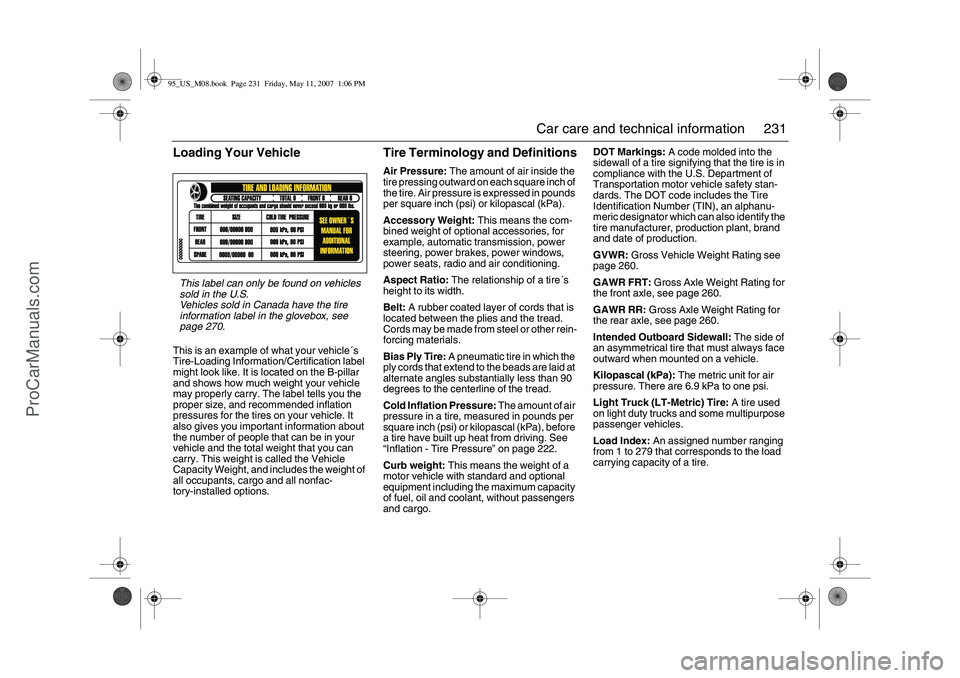
Loading Your VehicleThis is an example of what your vehicle´s
Tire-Loading Information/Certification label
might look like. It is located on the B-pillar
and shows how much weight your vehicle
may properly carry. The label tells you the
proper size, and recommended inflation
pressures for the tires on your vehicle. It
also gives you important information about
the number of people that can be in your
vehicle and the total weight that you can
carry. This weight is called the Vehicle
Capacity Weight, and includes the weight of
all occupants, cargo and all nonfac-
tory-installed options.
Tire Terminology and DefinitionsAir Pressure: The amount of air inside the
tire pressing outward on each square inch of
the tire. Air pressure is expressed in pounds
per square inch (psi) or kilopascal (kPa).
Accessory Weight: This means the com-
bined weight of optional accessories, for
example, automatic transmission, power
steering, power brakes, power windows,
power seats, radio and air conditioning.
Aspect Ratio: The relationship of a tire´s
height to its width.
Belt: A rubber coated layer of cords that is
located between the plies and the tread.
Cords may be made from steel or other rein-
forcing materials.
Bias Ply Tire: A pneumatic tire in which the
ply cords that extend to the beads are laid at
alternate angles substantially less than 90
degrees to the centerline of the tread.
Cold Inflation Pressure: The amount of air
pressure in a tire, measured in pounds per
square inch (psi) or kilopascal (kPa), before
a tire have built up heat from driving. See
“Inflation - Tire Pressure” on page 222.
Curb weight: This means the weight of a
motor vehicle with standard and optional
equipment including the maximum capacity
of fuel, oil and coolant, without passengers
and cargo.DOT Markings: A code molded into the
sidewall of a tire signifying that the tire is in
compliance with the U.S. Department of
Transportation motor vehicle safety stan-
dards. The DOT code includes the Tire
Identification Number (TIN), an alphanu-
meric designator which can also identify the
tire manufacturer, production plant, brand
and date of production.
GVWR: Gross Vehicle Weight Rating see
page 260.
GAWR FRT: Gross Axle Weight Rating for
the front axle, see page 260.
GAWR RR: Gross Axle Weight Rating for
the rear axle, see page 260.
Intended Outboard Sidewall: The side of
an asymmetrical tire that must always face
outward when mounted on a vehicle.
Kilopascal (kPa): The metric unit for air
pressure. There are 6.9 kPa to one psi.
Light Truck (LT-Metric) Tire: A tire used
on light duty trucks and some multipurpose
passenger vehicles.
Load Index: An assigned number ranging
from 1 to 279 that corresponds to the load
carrying capacity of a tire. This label can only be found on vehicles
sold in the U.S.
Vehicles sold in Canada have the tire
information label in the glovebox, see
page 270.
95_US_M08.book Page 231 Friday, May 11, 2007 1:06 PM
ProCarManuals.com
Page 243 of 288
243 Car care and technical information
Upholstery and trimTo remove lint or hairs from the seat uphol-
stery or headlining, use a moist, lint-free
cloth or a special lint remover (brush or
roller). Remove any dirty marks using a
cloth moistened with lukewarm soapy
water.
When using a stain remover, always work
from the outside towards the center to avoid
leaving a ring. If a soiled ring or spot should
remain, it can usually be removed using
lukewarm soapy water or water alone.
Wet patches left by spilled soft drinks or thin
oil must be wiped off immediately using an
absorbent material, such as a paper towel,
and treated with stain remover.
Alcohol is recommended for removing
grease or oil stains, and a semi-stiff brush
may also be used.
Cleaning and caring for leather
upholsteryThe principal reason for treating leather
upholstery is to maintain its elegant appear-
ance and to provide it with a protective film.
Discoloration caused by dust and wear
mainly affects the lighter shades, although
this is not detrimental to the leather –
indeed, the patina resulting from use is often
considered desirable in leather. But if the
leather is allowed to become too grubby, it
can start to look shabby. Regularly vacuum
the leather with a soft brush to remove loose
dirt and dust.
It is a good idea to clean and recondition the
leather twice a year – in conjunction with a
general spring-cleaning of the car – after the
winter and in the autumn, for instance. In
hot, dry climates, the leather will need to be
treated more frequently. Use conventional
leather care products. Follow the instruc-
tions on the packaging.
Do not use harsh polishing agents, cleaning
agents, sprays, coarse soap or hot water.
Semi-aniline leather only has a thin protec-
tive finish and is therefore more sensitive
than other leathers and therefore need
more care to keep the protection and ageing
properties.
Textile carpetingVacuum clean the carpeting regularly. Car-
pets can also be cleaned using a brush, or
carpet shampoo applied with a sponge. Do
not use vacuum cleaners outdoors unless
they are properly grounded.
95_US_M08.book Page 243 Friday, May 11, 2007 1:06 PM
ProCarManuals.com