alarm SAAB 9-5 2008 User Guide
[x] Cancel search | Manufacturer: SAAB, Model Year: 2008, Model line: 9-5, Model: SAAB 9-5 2008Pages: 288, PDF Size: 27.54 MB
Page 69 of 288
69 Instruments and controls
Entering values for the functions Dist.
1Select Dist. using the i/SET button.
2 Hold i/SET depressed until a chime
sounds and the selected function is
marked.
3 Set the distance using or .
4 End with a brief press on the i/SET
button.
The calculated arrival time will then
appear next to the distance.
SID calculates arrival time using the set dis-
tance and average vehicle speed.
The values are updated during the trip. If
you take a break, this time is added to the
previously calculated arrival time.
After the distance to destination has
decreased to zero, Dist. will function as a
trip meter (see "Using Dist. as a trip meter").
The starting value for the trip meter will be
the last distance set for the Dist. function.
Example: 100 miles is set for the Dist. func-
tion. Once the countdown has reached
0 mile, the Dist. function will act as a trip
meter, beginning at 100 miles.Alarm
1Select Alarm with the i/SET button.
2 Hold i/SET depressed until a chime
sounds. Briefly press the i/SET button if
you do not wish to change the alarm
time.
If you wish to change the alarm time,
press or .
End with a brief press on the i/SET
button.
ON appears to the right of the alarm time to
indicate that the alarm will go off at the set
time.
When the alarm sounds, it can be deacti-
vated with CLR.Activating speed warning
1Select Speed W. with the i/SET button.
2 Hold i/SET depressed until a chime
sounds. Briefly press the i/SET button if
you do not wish to change speed.
If you wish to change speed, press or
.
End with a brief press on the i/SET
button.
ON appears to the right of the speed if a
warning will sound when vehicle speed
exceeds the set speed.
Disengaging speed warning
1Select Speed W. with the i/SETbutton.
2 Briefly press the CLR button.95_US_M08.book Page 69 Friday, May 11, 2007 1:06 PM
ProCarManuals.com
Page 70 of 288
70 Instruments and controlsUsing Dist. as a trip meter
If no value is programmed in Dist., it func-
tions as a trip meter. This is indicated by an
arrow to the right in the display.
Reset the trip meter by briefly pressing the
CLR button.
Calculating the arrival time if a specified
average speed is maintained:
1Select Dist.
2 Set the distance.
3Select SpeedØ.
4 Set the average speed you intend to
drive at.
5 SID switches to Dist. automatically. The
calculated arrival time is now displayed
to the right.
The SpeedØ function will show actual
values once you start driving.Average fuel consumption, FuelØ
The average fuel consumption is calculated
using the values for fuel consumed and dis-
tance driven since last reset. This value is
stored in the car’s trip computer even when
the engine is switched off.
To reset the value, hold CLR depressed
until a chime sounds. The text Cleared is
displayed.
Resetting valuesTo reset the value, hold CLR depressed
until a chime sounds. The text Cleared is
displayed.
The following functions will be reset simulta-
neously:
D.T.E. (the value is reset to the distance
that can be reached with the amount of
remaining fuel)
FuelØ
SpeedØ (average speed)
Values programmed in Dist., Alarm and
Speed W. are not reset. See respective
function
95_US_M08.book Page 70 Friday, May 11, 2007 1:06 PM
ProCarManuals.com
Page 217 of 288
217 Car care and technical information
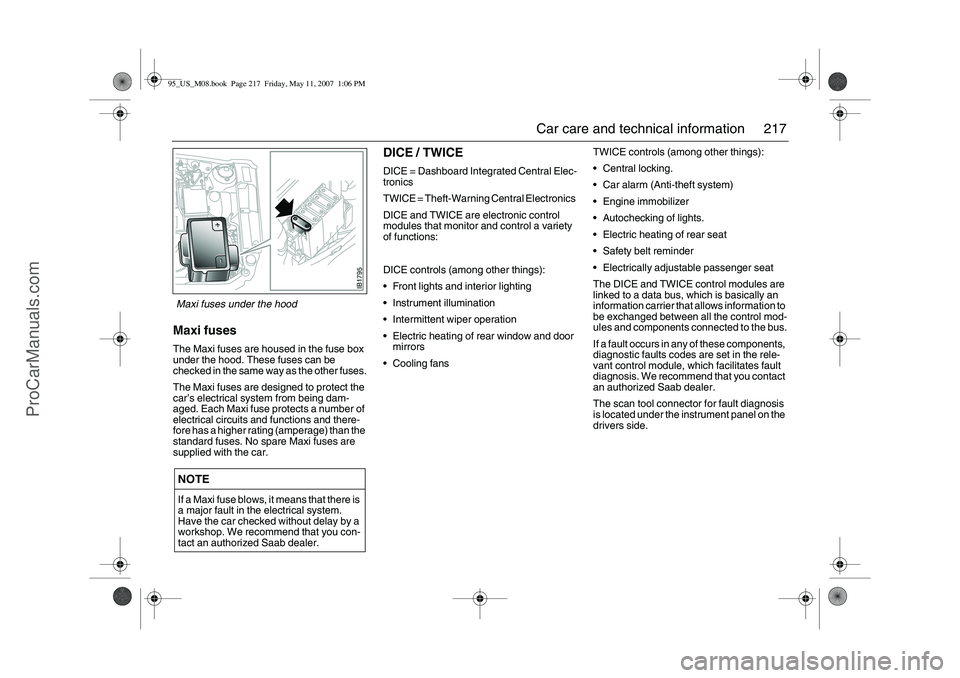
Maxi fusesThe Maxi fuses are housed in the fuse box
under the hood. These fuses can be
checked in the same way as the other fuses.
The Maxi fuses are designed to protect the
car’s electrical system from being dam-
aged. Each Maxi fuse protects a number of
electrical circuits and functions and there-
fore has a higher rating (amperage) than the
standard fuses. No spare Maxi fuses are
supplied with the car.
DICE / TWICEDICE = Dashboard Integrated Central Elec-
tronics
TWICE = Theft-Warning Central Electronics
DICE and TWICE are electronic control
modules that monitor and control a variety
of functions:
DICE controls (among other things):
Front lights and interior lighting
Instrument illumination
Intermittent wiper operation
Electric heating of rear window and door
mirrors
Cooling fansTWICE controls (among other things):
Central locking.
Car alarm (Anti-theft system)
Engine immobilizer
Autochecking of lights.
Electric heating of rear seat
Safety belt reminder
Electrically adjustable passenger seat
The DICE and TWICE control modules are
linked to a data bus, which is basically an
information carrier that allows information to
be exchanged between all the control mod-
ules and components connected to the bus.
If a fault occurs in any of these components,
diagnostic faults codes are set in the rele-
vant control module, which facilitates fault
diagnosis. We recommend that you contact
an authorized Saab dealer.
The scan tool connector for fault diagnosis
is located under the instrument panel on the
drivers side.
NOTEIf a Maxi fuse blows, it means that there is
a major fault in the electrical system.
Have the car checked without delay by a
workshop. We recommend that you con-
tact an authorized Saab dealer.
IB1795
Maxi fuses under the hood 95_US_M08.book Page 217 Friday, May 11, 2007 1:06 PM
ProCarManuals.com
Page 220 of 288
220 Car care and technical information
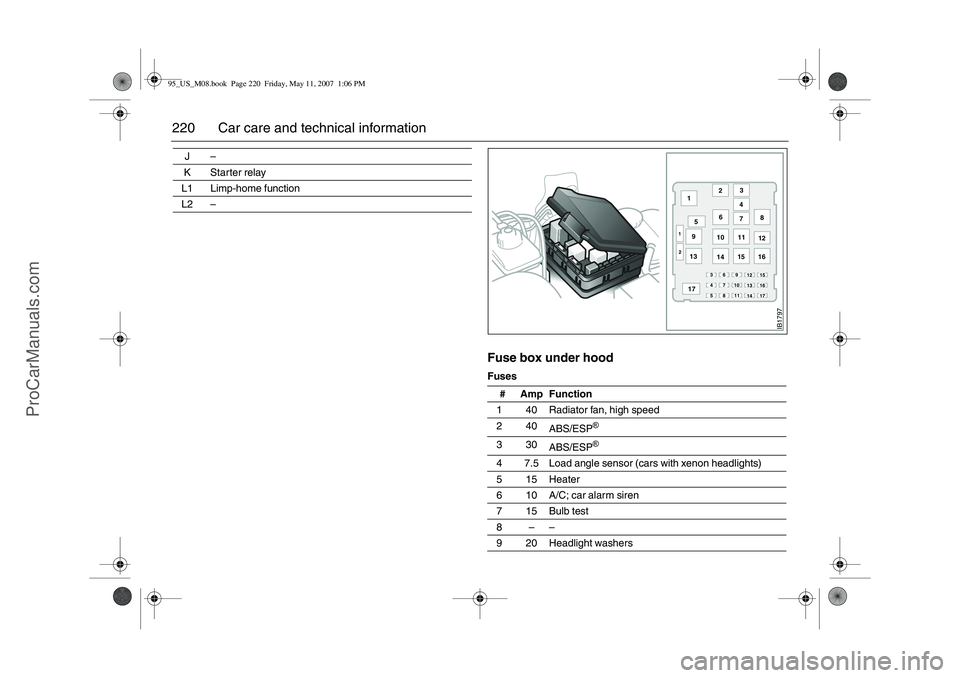
Fuse box under hoodFuses J–
KStarter relay
L1 Limp-home function
L2–
# Amp Function
1 40 Radiator fan, high speed
240
ABS/ESP
®
330
ABS/ESP
®
4 7.5 Load angle sensor (cars with xenon headlights)
515Heater
6 10 A/C; car alarm siren
715Bulb test
8––
9 20 Headlight washers
43
2
IB1797
2 1
14 1312 7 6
5 1
15 168
11
10 9
178 5
17 14 11 7 4
16 13 69
10 3
15 12
95_US_M08.book Page 220 Friday, May 11, 2007 1:06 PM
ProCarManuals.com
Page 234 of 288
234 Car care and technical informationAutomatic tire pressure
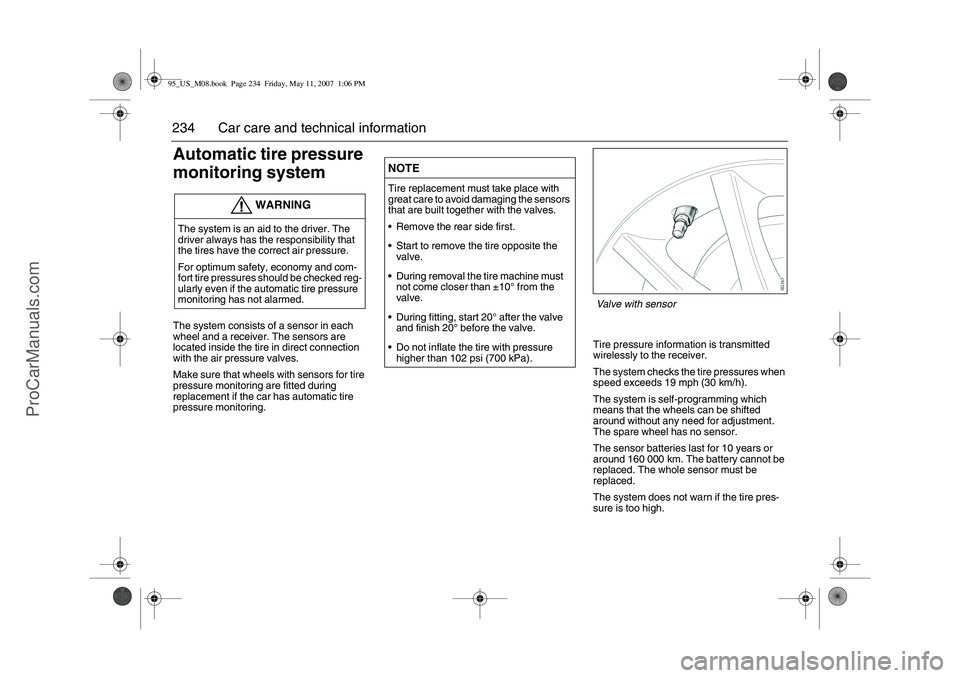
monitoring systemThe system consists of a sensor in each
wheel and a receiver. The sensors are
located inside the tire in direct connection
with the air pressure valves.
Make sure that wheels with sensors for tire
pressure monitoring are fitted during
replacement if the car has automatic tire
pressure monitoring.Tire pressure information is transmitted
wirelessly to the receiver.
The system checks the tire pressures when
speed exceeds 19 mph (30 km/h).
The system is self-programming which
means that the wheels can be shifted
around without any need for adjustment.
The spare wheel has no sensor.
The sensor batteries last for 10 years or
around 160 000 km. The battery cannot be
replaced. The whole sensor must be
replaced.
The system does not warn if the tire pres-
sure is too high.
WARNING
The system is an aid to the driver. The
driver always has the responsibility that
the tires have the correct air pressure.
For optimum safety, economy and com-
fort tire pressures should be checked reg-
ularly even if the automatic tire pressure
monitoring has not alarmed.
NOTETire replacement must take place with
great care to avoid damaging the sensors
that are built together with the valves.
Remove the rear side first.
Start to remove the tire opposite the
valve.
During removal the tire machine must
not come closer than ±10° from the
valve.
During fitting, start 20° after the valve
and finish 20° before the valve.
Do not inflate the tire with pressure
higher than 102 psi (700 kPa).
Valve with sensor
95_US_M08.book Page 234 Friday, May 11, 2007 1:06 PM
ProCarManuals.com
Page 235 of 288
235 Car care and technical information
If the tire pressure decreasesIf the tire pressure decreases to 0.4 bar
(6 psi) below the recommended pressure
then a warning is shown on the SID as to
which tires are affected.
Adjust the pressure as soon as possible.If the tire pressure continues to decrease
then an alarm is shown on the SID when the
pressure has decreased to 23 psi (159 kPa)
which is the lowest permitted pressure for
the tire.
An alarm is also received when leakage is
greater than 3 psi/min. (20 kPa/min.).
Reduce speed (avoid heavy braking and
significant steering wheel movement) and
stop the car as soon as possible at a suita-
ble location. Replace the defective wheel.
The fault message can remain for up to
10 minutes after restarting the car. Then it
disappears if the tire pressure is correct.
Check/adjust the pressure in the other tires
when a fault message is shown.Note that the tire pressure can decrease
without a puncture. The pressure could
decrease around 3 psi (20 kPa) during a
three month period. The outside tempera-
ture could also affect tire pressure.
If the system has triggerd a low pressure
warning or alarm then the tire pressure must
be adjusted to the recommended pressure
in order to put out the warning or alarm.
For further information on tire air pres-
sure, see page 222.
Allow 10 minutes for the system to recogn-
ise the wheel/sensors positions after fitting
a new set of tires. During this period no low
pressure warning or alarm can be triggered.
Tire pressure low,
rear left. Check tires.
Low tire pressure front
right. Make a safe stop.
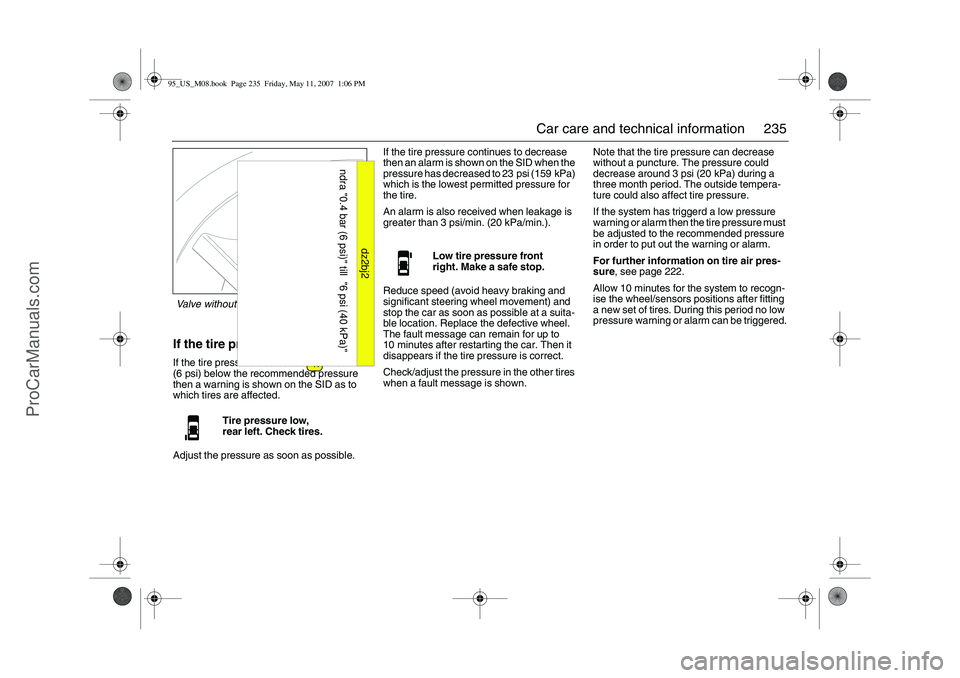
Valve without sensor95_US_M08.book Page 235 Friday, May 11, 2007 1:06 PM
ProCarManuals.com
Page 272 of 288
272 SpecificationsAdjustable systemsSeveral of the systems in your Saab car can
be adjusted to better fit your individual
needs
Some functions are governed by legal
requirements and cannot therefore be
reprogrammed.
We recommend that you contact an autho-
rized Saab dealer for further information.
Car alarm/central locking system:
The number of blinks when locking/
unlocking.
Automatic locking of the trunk when the
car (SportCombi) is driven, 1 to 8 mph
(2–14 km/h), YES or NO.
Preclude the unlocking of the trunk while
the car (SportCombi) is driven, YES or
NO.
Automatic locking of the trunk (Sport-
Combi) after 1 second–4 minutes if it has
not been opened, YES or NO.
Automatic locking of the trunk (Sport-
Combi) when it is closed, YES or NO.
Automatic locking of all doors when the
car is driven above 7.5 mph (12 km/h),
YES or NO.Saab Information Display:
Outdoor temperature display can be
adjusted.
Miscellaneous:
Select the on-time for heated rear seat3.
Additional sweep of the wipers after wind-
shield washer function (ON or OFF).
Courtesy Headlight Feature on-time can
vary from 20 to 50 seconds.
Night panel illumination deactivation
speed for the speedometer can be
adjusted.
Following adjustments can be
done by the driver:Automatic Climate Control (ACC):
You can choose whether front seat and rear
window heating is to be activated manually
or automatically; see "Adaptation of ACC"
on page 85.
Saab 9-5 Audio System (see page 106):
Speed dependent volume.
Daytime Running Lights:
To disable, turn off the ignition and pull out
fuse 35, see page 219.
95_US_M08.book Page 272 Friday, May 11, 2007 1:06 PM
ProCarManuals.com
Page 273 of 288
273 Index
Index
AA/C system, fault diagnosis
_______ 247
A/C system, maintenance
_________ 246
ABS brakes
____________________ 160
ACC
__________________________ 79
ACC functions
___________________ 82
ACC, automatic climate control
_____ 79
ACC, calibration
_________________ 86
ACC, condensation water
__________ 86
ACC, useful tips
_________________ 86
AUX input
_____________________ 104
Adjusting the steering wheel
_______ 114
Adjustment, seats
________________ 18
Air conditioning (A/C), fault diagnosis
and maintenance ______________ 246
Airbag
_________________________ 29
Alarm _________________________ 50
Alarm functions
__________________ 53
Alarm signals
________________ 50
, 53
Album information
_______________ 104
Alternator
_____________________ 201
Alternator drive belt
__________ 201
, 267
Alternator rating
________________ 267
Antennas
______________________ 109
Anticorrosion treatment
___________ 248
Antidazzle rear-view mirror
________ 121
Anti-skid
______________________ 163
Autochecking of lights on starting
____ 64Auto-dimming rear-view mirror with
garage door opener
____________ 118
Automatic climate control (ACC)
_____ 79
Automatic transmission, technical
data
_________________________ 268
Aviod theft, tip
__________________ 166
Battery
________________________ 199
BBattery
________________________ 199
Battery charging/replacing
________ 200
Battery, boost starting
____________ 186
Before a long journey ____________ 249
Before towing a camper or trailer
___ 177
Belt guide
______________________ 12
Boost starting using jump leads
____ 186
Brake and clutch fluid
____________ 196
Brake-fluid reservoir
_____________ 196
Brakes, technical data ____________ 269
Bulbs, changing
________________ 204
Bulbs, table of
__________________ 215
Buying new tires ________________ 225
Car alarm
______________________ 50
CCar care
______________________ 189
Cargo net, 9-5 SportCombi
________ 137
Carpeting, care of
_______________ 243Catalytic converter, important
considerations
_________________ 145
CD changer
____________________ 100
CHECK messages
_______________ 71
CHECKING
_____________________ 71
Central locking ___________________ 44
Change language in SID
___________ 72
Change of address notification
_____ 258
Changing a wheel
_______________ 239
Changing bulbs
_________________ 204
Changing wiper blades
___________ 202
Charge mobile phone
____________ 126
Charger/Jump starting ____________ 188
Charging the battery/Jump starting
__ 188
Chassis number
________________ 272
Chassis number, key to
___________ 273
Checks before towing a camper or
trailer
________________________ 177
Child safety
_____________________ 22
Child safety locks, rear doors
_______ 47
Cleaning, engine bay
_____________ 245
Clock
_________________________ 105
Color code, body
________________ 272
Color code, trim _________________ 272
Compact spare wheel
____________ 237
Compass
______________________ 122
Condensation water, ACC
__________ 86
Connecting a portable player ______ 104
Coolant
_______________________ 195
Courtesy Headlight Feature
________ 74
Crash memory, see EDR
_________ 259
Cross modulation
_______________ 110
95_US_M08.book Page 273 Friday, May 11, 2007 1:06 PM
ProCarManuals.com
Page 275 of 288
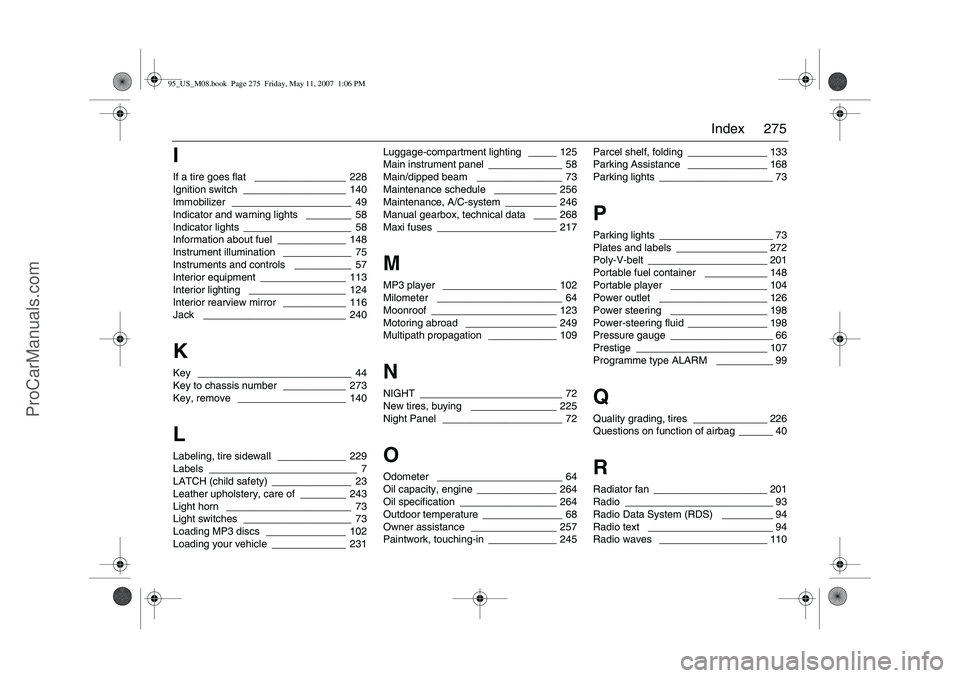
275 Index
IIf a tire goes flat
________________ 228
Ignition switch
__________________ 140
Immobilizer
_____________________ 49
Indicator and warning lights
________ 58
Indicator lights
___________________ 58
Information about fuel
____________ 148
Instrument illumination ____________ 75
Instruments and controls __________ 57
Interior equipment
_______________ 113
Interior lighting
_________________ 124
Interior rearview mirror
___________ 116
Jack
_________________________ 240
KKey
___________________________ 44
Key to chassis number
___________ 273
Key, remove
___________________ 140
LLabeling, tire sidewall
____________ 229
Labels
__________________________ 7
LATCH (child safety)
______________ 23
Leather upholstery, care of
________ 243
Light horn
______________________ 73
Light switches ___________________ 73
Loading MP3 discs
______________ 102
Loading your vehicle _____________ 231Luggage-compartment lighting
_____ 125
Main instrument panel
_____________ 58
Main/dipped beam
_______________ 73
Maintenance schedule ___________ 256
Maintenance, A/C-system _________ 246
Manual gearbox, technical data
____ 268
Maxi fuses
_____________________ 217
MMP3 player
____________________ 102
Milometer
______________________ 64
Moonroof ______________________ 123
Motoring abroad
________________ 249
Multipath propagation
____________ 109
NNIGHT
_________________________ 72
New tires, buying
_______________ 225
Night Panel
_____________________ 72
OOdometer
______________________ 64
Oil capacity, engine
______________ 264
Oil specification
_________________ 264
Outdoor temperature
______________ 68
Owner assistance
_______________ 257
Paintwork, touching-in
____________ 245Parcel shelf, folding
______________ 133
Parking Assistance ______________ 168
Parking lights
____________________ 73
PParking lights
____________________ 73
Plates and labels
________________ 272
Poly-V-belt
_____________________ 201
Portable fuel container
___________ 148
Portable player
_________________ 104
Power outlet
___________________ 126
Power steering _________________ 198
Power-steering fluid
______________ 198
Pressure gauge
__________________ 66
Prestige
_______________________ 107
Programme type ALARM
__________ 99
QQuality grading, tires
_____________ 226
Questions on function of airbag
______ 40
RRadiator fan
____________________ 201
Radio
__________________________ 93
Radio Data System (RDS)
_________ 94
Radio text
______________________ 94
Radio waves ___________________ 110
95_US_M08.book Page 275 Friday, May 11, 2007 1:06 PM
ProCarManuals.com