automatic transmission SAAB 9-5 2008 User Guide
[x] Cancel search | Manufacturer: SAAB, Model Year: 2008, Model line: 9-5, Model: SAAB 9-5 2008Pages: 288, PDF Size: 27.54 MB
Page 153 of 288
153 Starting and driving
Lock-up function The automatic transmission has a lock-up
function, which can render the torque con-
verter inoperative in 3rd, 4th and 5th gears,
thus reducing the engine speed and fuel
consumption.
When the lock-up function comes into oper-
ation, it may give the impression of an over-
drive being engaged.Kick-downWhen the accelerator is pressed down hard,
a change-down to the next gear will be
effected to provide maximum acceleration,
e.g. for overtaking.
Following this, the next higher gear will be
selected at the optimum engine speed for
acceleration or, if you ease off the acceler-
ator, before reaching this.
Park Brake Shift LockThe transmission has a security function
known as Park Brake Shift Lock. To move
the gear selector out of the P position, the
brake pedal must be depressed at the same
time as the gear selector catch (detent) is
pressed in.
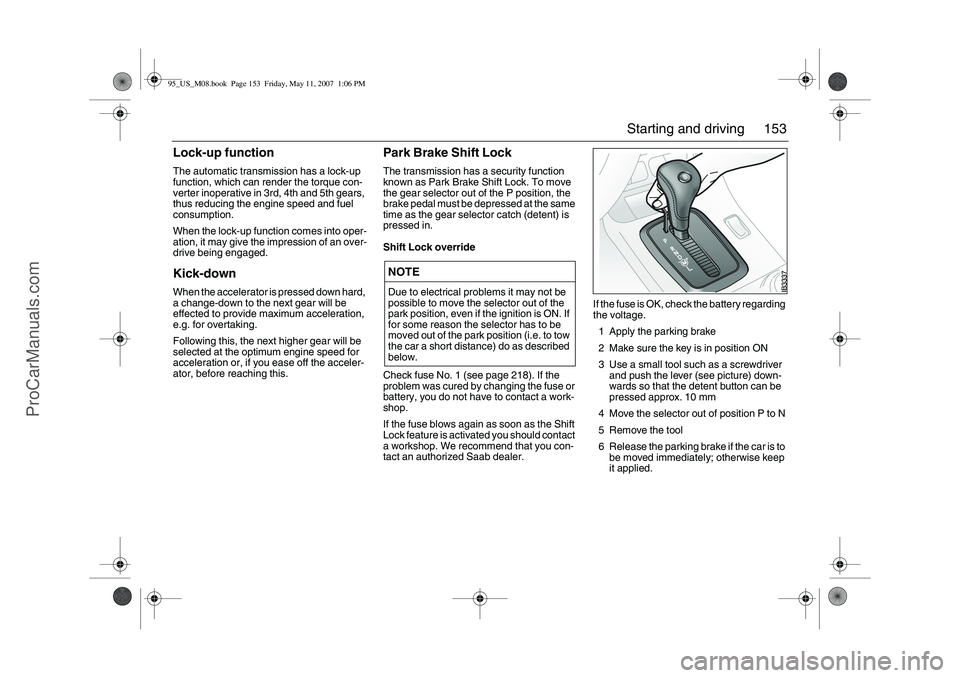
Shift Lock override
Check fuse No. 1 (see page 218). If the
problem was cured by changing the fuse or
battery, you do not have to contact a work-
shop.
If the fuse blows again as soon as the Shift
Lock feature is activated you should contact
a workshop. We recommend that you con-
tact an authorized Saab dealer.If the fuse is OK, check the battery regarding
the voltage.
1 Apply the parking brake
2 Make sure the key is in position ON
3 Use a small tool such as a screwdriver
and push the lever (see picture) down-
wards so that the detent button can be
pressed approx. 10 mm
4 Move the selector out of position P to N
5 Remove the tool
6 Release the parking brake if the car is to
be moved immediately; otherwise keep
it applied.NOTEDue to electrical problems it may not be
possible to move the selector out of the
park position, even if the ignition is ON. If
for some reason the selector has to be
moved out of the park position (i.e. to tow
the car a short distance) do as described
below.
95_US_M08.book Page 153 Friday, May 11, 2007 1:06 PM
ProCarManuals.com
Page 154 of 288
154 Starting and drivingIf ”Automatic transmission3, fault indicator”
light appears on the main instrument panel,
the system has detected a fault in the auto-
matic transmission or its control module
(see page 62).
This also means that the Limp-home mode
has been selected, to guard against further
damage being done to the transmission. In
this mode, the automatic transmission
starts in 5th gear, and gear changes (if nec-
essary) will have to be made manually.
Stop the car in a safe place. Switch off then
restart the engine. If the fault is intermittent,
the transmission will operate as normal
despite the fault indicator being on. Have
the car checked at a workshop. We recom-
mend that you contact an authorized Saab
dealer.
It is not possible to select the SPORT or
Sentronic mode when the Limp-home mode
is active.
Gear changes must be made manually.
The following gears will be engaged in the
respective selector positions when the auto-
matic transmission is in Limp-home mode:
Overheated transmission fluid If the automatic-transmission fluid should
overheat, the following message will appear
on the SID:
”Gearbox too hot.
Make a safe stop.”
In this event, stop the car in a suitable place,
switch off the engine and open the hood.
Wait for several minutes then turn on the
ignition to check that the message has gone
out. When driving subsequent to the trans-
mission fluid overheating, select a gear in
which the engine speed is about 3,000 rpm.
Overheating of the automatic-transmission
fluid can occur when the car is towing a
heavy load, such as a camping trailer in hilly
country. High ambient temperatures can
also increase the temperature of the trans-
mission fluid or the oil cooler may be faulty.
Contact a workshop. We recommend that
you contact an authorized Saab dealer (see
also page 174).
Automatic transmission3
33 3,
fault indicator
Position R D M L
Gear Reverse 5th 5th 2nd
NOTEIf the control module has actuated the
Limp-home function for the automatic
transmission, the car will remain in 5th
gear when D is selected, making it very
sluggish.
Select position L to prevent unnecessary
wear on the transmission. The transmis-
sion then starts in 2nd gear. Once the car
is moving you can select position D.
When the indicator light is on, the car
must not be driven with a caravan or
trailer attached.
95_US_M08.book Page 154 Friday, May 11, 2007 1:06 PM
ProCarManuals.com
Page 155 of 288
155 Starting and driving
Driving on hilly roads with a
heavy loadThe transmission fluid can overheat when
the gearbox is strained, for example, when
driving with a trailer on hilly roads. To avoid
the transmission fluid overheating, always
drive in Normal mode. The adaptive gear
change patterns are then active.
High air temperatures or a faulty oil cooler
can also cause the transmission fluid to
overheat. Overheating reduces the service
life of the fluid. Contact an authorized Saab
dealer (see also page 174).
Towing Towing of cars with automatic transmission,
see page 183.
Descending hillsIf the speed of the car increases while
descending a steep hill, despite the acceler-
ator being released, the control module will
change down a gear when you brake. If you
desire more powerful engine braking, man-
ually select a lower gear.
WARNING
Remember to use engine-braking (selec-
tor position D or L) to spare the brakes
when you are driving on a long or steep
downhill slope.
Brake failure can result from overheated
brakes!
95_US_M08.book Page 155 Friday, May 11, 2007 1:06 PM
ProCarManuals.com
Page 157 of 288
157 Starting and driving
Selector positions
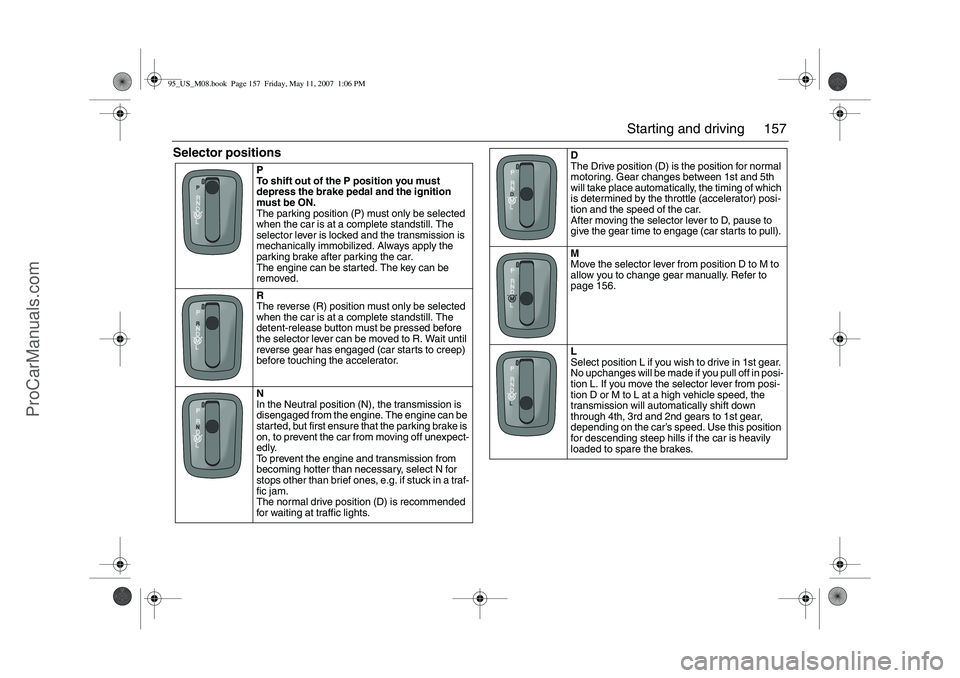
P
To shift out of the P position you must
depress the brake pedal and the ignition
must be ON.
The parking position (P) must only be selected
when the car is at a complete standstill. The
selector lever is locked and the transmission is
mechanically immobilized. Always apply the
parking brake after parking the car.
The engine can be started. The key can be
removed.
R
The reverse (R) position must only be selected
when the car is at a complete standstill. The
detent-release button must be pressed before
the selector lever can be moved to R. Wait until
reverse gear has engaged (car starts to creep)
before touching the accelerator.
N
In the Neutral position (N), the transmission is
disengaged from the engine. The engine can be
started, but first ensure that the parking brake is
on, to prevent the car from moving off unexpect-
edly.
To prevent the engine and transmission from
becoming hotter than necessary, select N for
stops other than brief ones, e.g. if stuck in a traf-
fic jam.
The normal drive position (D) is recommended
for waiting at traffic lights.
D
The Drive position (D) is the position for normal
motoring. Gear changes between 1st and 5th
will take place automatically, the timing of which
is determined by the throttle (accelerator) posi-
tion and the speed of the car.
After moving the selector lever to D, pause to
give the gear time to engage (car starts to pull).
M
Move the selector lever from position D to M to
allow you to change gear manually. Refer to
page 156.
L
Select position L if you wish to drive in 1st gear.
No upchanges will be made if you pull off in posi-
tion L. If you move the selector lever from posi-
tion D or M to L at a high vehicle speed, the
transmission will automatically shift down
through 4th, 3rd and 2nd gears to 1st gear,
depending on the car’s speed. Use this position
for descending steep hills if the car is heavily
loaded to spare the brakes.
95_US_M08.book Page 157 Friday, May 11, 2007 1:06 PM
ProCarManuals.com
Page 158 of 288
158 Starting and drivingIf you move the selector lever from D to L, down shifts will follow a
set pattern to avoid damaging the engine or transmission.
Manual gear-changing is not recommended on slippery roads.
If one of the drive wheels spins excessively, the engine torque will
be reduced to avoid damaging the transmission.Adaptive gear-change patternsAdaptive gear-change patterns are selected automatically depend-
ing on the engine load and the present temperature of the transmis-
sion. The function is available in Normal and Sport modes.
The changes occur at a higher engine speed and the car remains in
the same gear for longer, if the transmission control module senses
that the load has not decreased. These gear-change patterns pre-
vent unnecessary changing up and down, when for example driving
up or down long slopes with a trailer or caravan, and to prevent over-
heating the transmission oil. The adaptive gear-change function is
also selected automatically when the transmission oil becomes too
hot, to protect the transmission itself from damage and to lower the
oil temperature.
The adaptive gear-change pattern function is deselected when:
The engine is switched off.
The load is reduced so much that the function is no longer
required.
”Automatic transmission3, fault indicator” appears on main
instrument panel, see page 154.
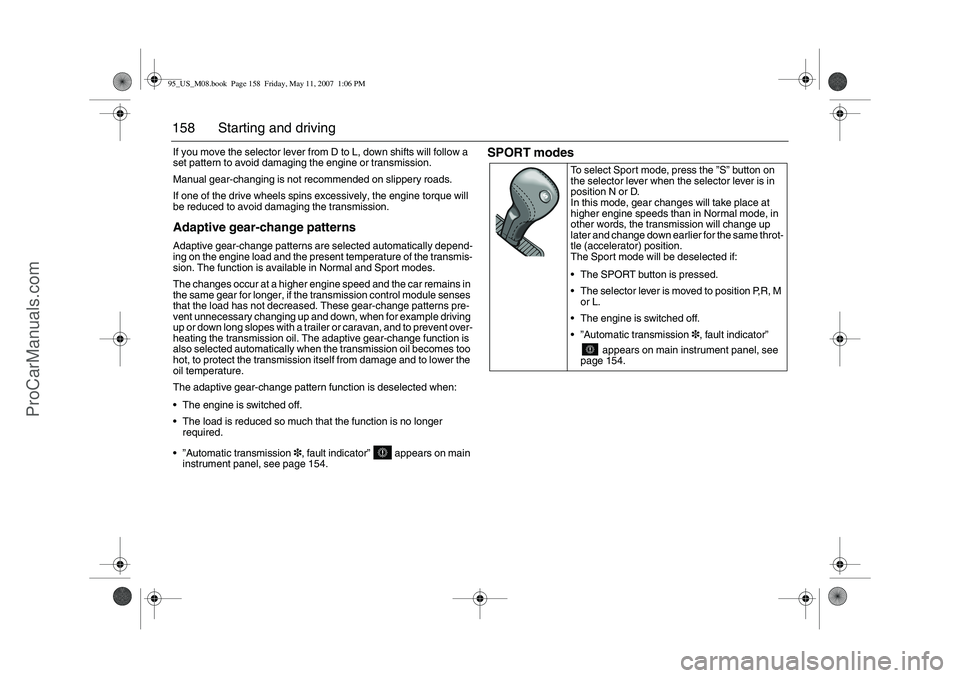
SPORT modes
To select Sport mode, press the ”S” button on
the selector lever when the selector lever is in
position N or D.
In this mode, gear changes will take place at
higher engine speeds than in Normal mode, in
other words, the transmission will change up
later and change down earlier for the same throt-
tle (accelerator) position.
The Sport mode will be deselected if:
The SPORT button is pressed.
The selector lever is moved to position P,R, M
or L.
The engine is switched off.
”Automatic transmission3, fault indicator”
appears on main instrument panel, see
page 154.
95_US_M08.book Page 158 Friday, May 11, 2007 1:06 PM
ProCarManuals.com
Page 160 of 288

160 Starting and drivingTo reduce the preset speedThe cruise control system will always disen-
gage automatically the moment that either
the brake pedal or the clutch pedal is
depressed.
It is also possible to reduce the speed by
means of the RESUME/– button.
Sliding the button to RESUME/– once will
reduce the speed by 1 mph (1.6 km/h).
Holding the button in the RESUME/– posi-
tion will effect a gradual reduction in speed
until the button is released.
Disengaging the system The system will be disengaged:
When the brake or clutch pedal is
depressed.
When the switch is moved to CANCEL.
When the switch is moved to OFF.
When the engine is switched off.
When the selector lever is moved to posi-
tion N (cars with automatic transmission).
When the ESP
® system is operative for
more than 1 second.
BrakingTo avoid the brakes becoming overheated,
(e.g. when negotiating long descents with a
drop of several hundred feet), select a low
gear to use the braking effect of the engine.
If the car has automatic transmission, move
the selector lever to position D or L.
When driving fast, you can help to prolong
the life of the brakes by thinking ahead and
braking harder for short periods, rather than
braking more moderately over long
stretches. Brake pad wear indicatorsThe outboard brake pads on the front
wheels incorporate pad-wear indicators.
When the lining is down to 3 mm, the pad
will produce a screeching, squealing or
scraping noise when the brakes are applied.
New pads should be fitted without delay.
Brake pads should only be replaced by a
workshop. We recommend that you con-
tact an authorized Saab dealer.
95_US_M08.book Page 160 Friday, May 11, 2007 1:06 PM
ProCarManuals.com
Page 165 of 288
165 Starting and driving
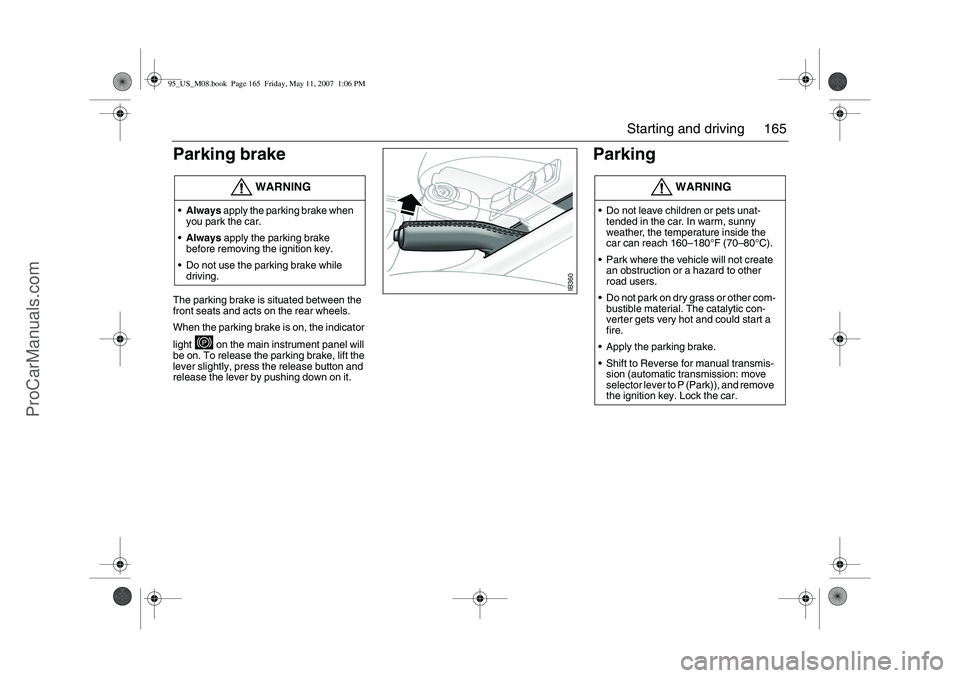
Parking brake
The parking brake is situated between the
front seats and acts on the rear wheels.
When the parking brake is on, the indicator
light on the main instrument panel will
be on. To release the parking brake, lift the
lever slightly, press the release button and
release the lever by pushing down on it.
Parking
WARNING
Always apply the parking brake when
you park the car.
Always apply the parking brake
before removing the ignition key.
Do not use the parking brake while
driving.
WARNING
Do not leave children or pets unat-
tended in the car. In warm, sunny
weather, the temperature inside the
car can reach 160–180°F (70–80°C).
Park where the vehicle will not create
an obstruction or a hazard to other
road users.
Do not park on dry grass or other com-
bustible material. The catalytic con-
verter gets very hot and could start a
fire.
Apply the parking brake.
Shift to Reverse for manual transmis-
sion (automatic transmission: move
selector lever to P (Park)), and remove
the ignition key. Lock the car.
IB360
95_US_M08.book Page 165 Friday, May 11, 2007 1:06 PM
ProCarManuals.com
Page 173 of 288
173 Starting and driving
If winter tires are fitted, the same type must
be fitted on all wheels. Your Saab dealer will
be pleased to advise you on the best tires for
your car.
Remember that tires age. It may therefore
be necessary to change them before they
reach the legal wear limit, as they gradually
lose their friction properties.
The best response if the car gets into a
front-wheel skid is to freewheel (manual
gearbox only), i.e. disengage the clutch (so
that the wheels are neither driven or
retarded by the engine.
If the car has automatic transmission, ease
up on the accelerator and steer carefully in
the desired direction.
In a rear-wheel skid, steer in the same direc-
tion that the rear of the car is moving.
Tire chains3
33 3If you want to fit tire chains (where legally
permitted) they should only be fitted to the
tires recommended under ”Specifications”
(see page 268).
Consult your Saab dealer for details of
approved tire chains.
Driving in hot weatherAlways check the coolant level before start-
ing a journey. When the engine is cold, the
coolant shall lie on or just above the
KALT/COLD mark on the expansion tank..
At the end of a journey, if the engine has
worked hard, allow it to idle for two or three
minutes before switching it off.
If the needle on the temperature gauge
enters the red zone:
1 Bring the car to a standstill but leave the
engine running. Do not remove the cap
on the expansion tank even if the tank is
empty. If the needle on the temperature
gauge continues to rise while the engine
is idling, switch off the engine.
WARNING
Do not exceed 30 mph (50 km/h)
when tire chains are fitted.
Tire chains can reduce the directional
stability of the car.
Tire chains must not be used on the
rear wheels. NOTECheck the links frequently for wear.
Check that the chains do not contact
the wheel-arch liner at full lock.
See section ”Specifications”,
page 268, for information on allowable
wheel dimensions for the fitting of tire
chains.
95_US_M08.book Page 173 Friday, May 11, 2007 1:06 PM
ProCarManuals.com
Page 176 of 288
176 Starting and drivingWhen negotiating long hills, bear the follow-
ing important considerations in mind:
Use Normal mode when driving with a
caravan or trailer on hilly roads. The adap-
tive gear change pattern function will
prevent the transmission overheating.
Rises in coolant temperature are indi-
cated by the temperature gauge in the
main instrument panel.Recommendations for cars with
automatic transmission
Rises in coolant temperature are indicated
by the temperature gauge in the main instru-
ment panel.
The following steps are taken in order as the
temperature of the engine increases:
Gear change pattern is altered.
A/C compressor is switched off.
Engine torque is reduced.
The following message will be displayed on
the SID if the transmission fluid becomes
too hot:
“Gearbox too hot.
Make a safe stop.
If this message appears, stop the car as
soon as it is safe to do so and allow the
engine to idle until the message has gone
out. The selector lever should be in
position P.When continuing your journey, select
manual mode and a gear in which the
engine speed is about 3,000 rpm until the
incline eases (see page 157).
WARNING
Remember to use the braking effect of the
engine (position D or L) when you are
descending long or steep hills to spare
the brakes.
Brake failure can result from overheated
brakes!
95_US_M08.book Page 176 Friday, May 11, 2007 1:06 PM
ProCarManuals.com
Page 177 of 288
177 Starting and driving
Recommendations for cars with manual
gearbox
Rises in coolant temperature are indicated
by the temperature gauge in the main instru-
ment panel.
The following steps are taken in order as the
temperature of the engine increases:
A/C compressor is switched off.
engine torque is reduced.
When continuing your journey, select a gear
in which the engine speed is about
3,000 rpm until the incline eases.
Driving considerations Always take extra care when towing a
trailer, as the car’s handling will be different
and its braking effect reduced. The trailer’s
braking system and suspension also have a
considerable effect on these characteris-
tics, see also ”Driving with a load” page 181.
If the car has automatic transmission, select
position D when ascending steep hills. This
ensures that the adaptive gear change pat-
terns are operational, see page 158. Use
position D or L for steep descents.Checks before drivingMake sure that the car and camper or trailer
are in good working order. This is essential
since towing a camper or trailer increases
the strain on the car.
Check and if necessary adjust the tire
pressure of the car and camper or trailer.
Make sure all wheel bolts are properly
tightened.
Make sure that the equipment joining the
car and camper or trailer is properly
secured and adjusted.Make sure the camper or trailer’s electri-
cal cable is properly connected and is not
so long that it drags along the ground.
Also, make sure the cable is not too short
and risks breaking when turning a corner.
Check all bulbs.
Check the car and camper or trailer
brakes.
Make sure that all items on or in the cara-
van or trailer are properly secured.
Make sure that the camper or trailer’s
jockey wheel is raised and locked.
Check the distribution of the load so that
the car and camper or trailer are well
balanced.
Check that the rearview mirrors provide
the best possible rearward vision.
Make sure the camper or trailer’s safety
cable is correctly attached.
WARNING
Utilize the braking effect of the engine
(1st, 2nd or 3rd gear) when you are
descending long or steep hills to spare
the brakes.
Brake failure can result from overheated
brakes!
NOTEIf the ”Automatic transmission3, fault
indicator” indicator comes on, cease
towing until the problem has been recti-
fied.
95_US_M08.book Page 177 Friday, May 11, 2007 1:06 PM
ProCarManuals.com