fuel pressure SAAB 9-5 2008 User Guide
[x] Cancel search | Manufacturer: SAAB, Model Year: 2008, Model line: 9-5, Model: SAAB 9-5 2008Pages: 288, PDF Size: 27.54 MB
Page 222 of 288

222 Car care and technical informationTires Your new vehicle comes with high-quality
tires made by a leading tire manufacturer. If
you ever have questions about your tire
warranty and where to obtain service, see
your Saab Warranty and Service Record
Booklet for details.
Inflation - Tire PressureThe Tire-Loading Information label shows
the correct inflation pressures for your tires
when they’re cold. “Cold” means your vehi-
cle has been sitting for at least three hours
or driven no more than 1 mile (1.6 km).
Notice: Don’t let anyone tell you that
underinflation or overinflation is all
right. It’s not. If your tires don’t have
enough air (underinflation), you can get
the following:
Too much flexing
Too much heat
Tire overloading
Bad wear
Bad handling
Bad fuel economy
If your tires have too much air (overinfla-
tion), you can get the following:
Unusual wear
Bad handling
Rough ride
Needless damage from road hazardsAdjust the tire pressure to match the current
load and speed of the car (see page 269).
The stated tire pressures apply to cold tires,
i.e. tires that are the same temperature as
the outside air temperature. Tire pressure
increases as the tires become warm (e.g.
during highway driving) by approximately
0.3 bar (4 psi). When the temperature of the
tires changes by 50°F (10°C), the tire pres-
sure will change 0.1 bar (2 psi).
Never reduce the pressure of a hot tire. If the
tires are hot when you check them, only
increase the pressure, if necessary.
WARNING
Poorly maintained and improperly used
tires are dangerous.
Overloading your tires can cause
overheating as a result of too much
friction. You could have an blow-out
and a serious accident. See “Loading
Your Vehicle” on page 231.
Underinflated tires pose the same
danger as overloaded tires. The
resulting accident could cause serious
injury. Check all tires frequently to
maintain the recommended pressure.
Tire pressure should be checked
when your tires are cold.
Overinflated tires are more likely to be
cut, punctured or broken by a sudden
impact – such as when you hit a pot-
hole. Keep tires at the recommended
pressure.
Worn, old tires can cause accidents. If
your tread is badly worn, or if your tires
have been damaged, replace them.95_US_M08.book Page 222 Friday, May 11, 2007 1:06 PM
ProCarManuals.com
Page 231 of 288
231 Car care and technical information
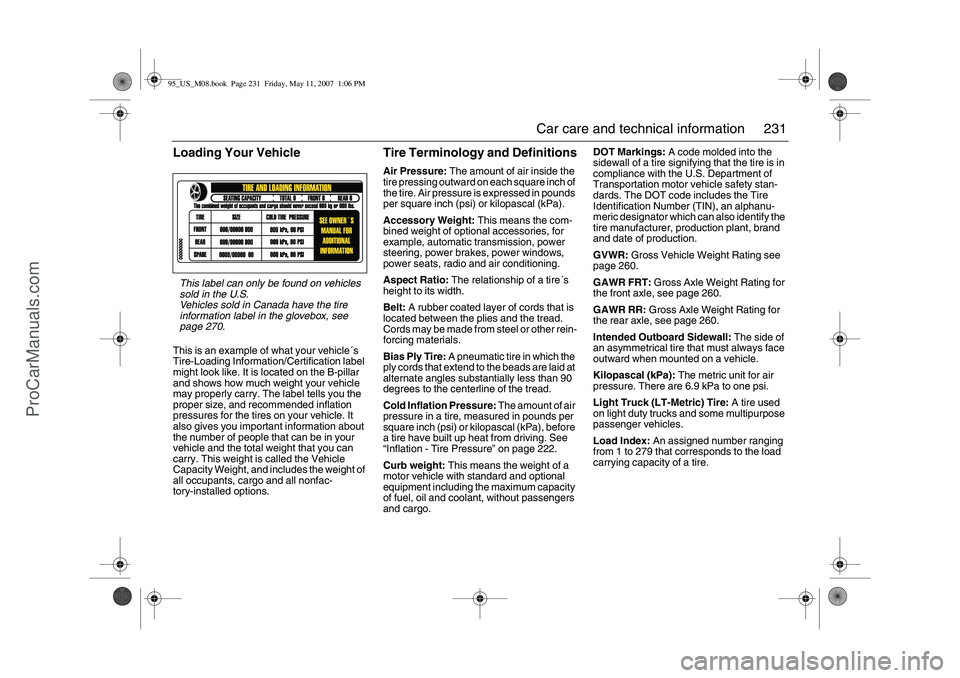
Loading Your VehicleThis is an example of what your vehicle´s
Tire-Loading Information/Certification label
might look like. It is located on the B-pillar
and shows how much weight your vehicle
may properly carry. The label tells you the
proper size, and recommended inflation
pressures for the tires on your vehicle. It
also gives you important information about
the number of people that can be in your
vehicle and the total weight that you can
carry. This weight is called the Vehicle
Capacity Weight, and includes the weight of
all occupants, cargo and all nonfac-
tory-installed options.
Tire Terminology and DefinitionsAir Pressure: The amount of air inside the
tire pressing outward on each square inch of
the tire. Air pressure is expressed in pounds
per square inch (psi) or kilopascal (kPa).
Accessory Weight: This means the com-
bined weight of optional accessories, for
example, automatic transmission, power
steering, power brakes, power windows,
power seats, radio and air conditioning.
Aspect Ratio: The relationship of a tire´s
height to its width.
Belt: A rubber coated layer of cords that is
located between the plies and the tread.
Cords may be made from steel or other rein-
forcing materials.
Bias Ply Tire: A pneumatic tire in which the
ply cords that extend to the beads are laid at
alternate angles substantially less than 90
degrees to the centerline of the tread.
Cold Inflation Pressure: The amount of air
pressure in a tire, measured in pounds per
square inch (psi) or kilopascal (kPa), before
a tire have built up heat from driving. See
“Inflation - Tire Pressure” on page 222.
Curb weight: This means the weight of a
motor vehicle with standard and optional
equipment including the maximum capacity
of fuel, oil and coolant, without passengers
and cargo.DOT Markings: A code molded into the
sidewall of a tire signifying that the tire is in
compliance with the U.S. Department of
Transportation motor vehicle safety stan-
dards. The DOT code includes the Tire
Identification Number (TIN), an alphanu-
meric designator which can also identify the
tire manufacturer, production plant, brand
and date of production.
GVWR: Gross Vehicle Weight Rating see
page 260.
GAWR FRT: Gross Axle Weight Rating for
the front axle, see page 260.
GAWR RR: Gross Axle Weight Rating for
the rear axle, see page 260.
Intended Outboard Sidewall: The side of
an asymmetrical tire that must always face
outward when mounted on a vehicle.
Kilopascal (kPa): The metric unit for air
pressure. There are 6.9 kPa to one psi.
Light Truck (LT-Metric) Tire: A tire used
on light duty trucks and some multipurpose
passenger vehicles.
Load Index: An assigned number ranging
from 1 to 279 that corresponds to the load
carrying capacity of a tire. This label can only be found on vehicles
sold in the U.S.
Vehicles sold in Canada have the tire
information label in the glovebox, see
page 270.
95_US_M08.book Page 231 Friday, May 11, 2007 1:06 PM
ProCarManuals.com
Page 275 of 288
275 Index
IIf a tire goes flat
________________ 228
Ignition switch
__________________ 140
Immobilizer
_____________________ 49
Indicator and warning lights
________ 58
Indicator lights
___________________ 58
Information about fuel
____________ 148
Instrument illumination ____________ 75
Instruments and controls __________ 57
Interior equipment
_______________ 113
Interior lighting
_________________ 124
Interior rearview mirror
___________ 116
Jack
_________________________ 240
KKey
___________________________ 44
Key to chassis number
___________ 273
Key, remove
___________________ 140
LLabeling, tire sidewall
____________ 229
Labels
__________________________ 7
LATCH (child safety)
______________ 23
Leather upholstery, care of
________ 243
Light horn
______________________ 73
Light switches ___________________ 73
Loading MP3 discs
______________ 102
Loading your vehicle _____________ 231Luggage-compartment lighting
_____ 125
Main instrument panel
_____________ 58
Main/dipped beam
_______________ 73
Maintenance schedule ___________ 256
Maintenance, A/C-system _________ 246
Manual gearbox, technical data
____ 268
Maxi fuses
_____________________ 217
MMP3 player
____________________ 102
Milometer
______________________ 64
Moonroof ______________________ 123
Motoring abroad
________________ 249
Multipath propagation
____________ 109
NNIGHT
_________________________ 72
New tires, buying
_______________ 225
Night Panel
_____________________ 72
OOdometer
______________________ 64
Oil capacity, engine
______________ 264
Oil specification
_________________ 264
Outdoor temperature
______________ 68
Owner assistance
_______________ 257
Paintwork, touching-in
____________ 245Parcel shelf, folding
______________ 133
Parking Assistance ______________ 168
Parking lights
____________________ 73
PParking lights
____________________ 73
Plates and labels
________________ 272
Poly-V-belt
_____________________ 201
Portable fuel container
___________ 148
Portable player
_________________ 104
Power outlet
___________________ 126
Power steering _________________ 198
Power-steering fluid
______________ 198
Pressure gauge
__________________ 66
Prestige
_______________________ 107
Programme type ALARM
__________ 99
QQuality grading, tires
_____________ 226
Questions on function of airbag
______ 40
RRadiator fan
____________________ 201
Radio
__________________________ 93
Radio Data System (RDS)
_________ 94
Radio text
______________________ 94
Radio waves ___________________ 110
95_US_M08.book Page 275 Friday, May 11, 2007 1:06 PM
ProCarManuals.com