radio SAAB 9-5 2008 User Guide
[x] Cancel search | Manufacturer: SAAB, Model Year: 2008, Model line: 9-5, Model: SAAB 9-5 2008Pages: 288, PDF Size: 27.54 MB
Page 110 of 288
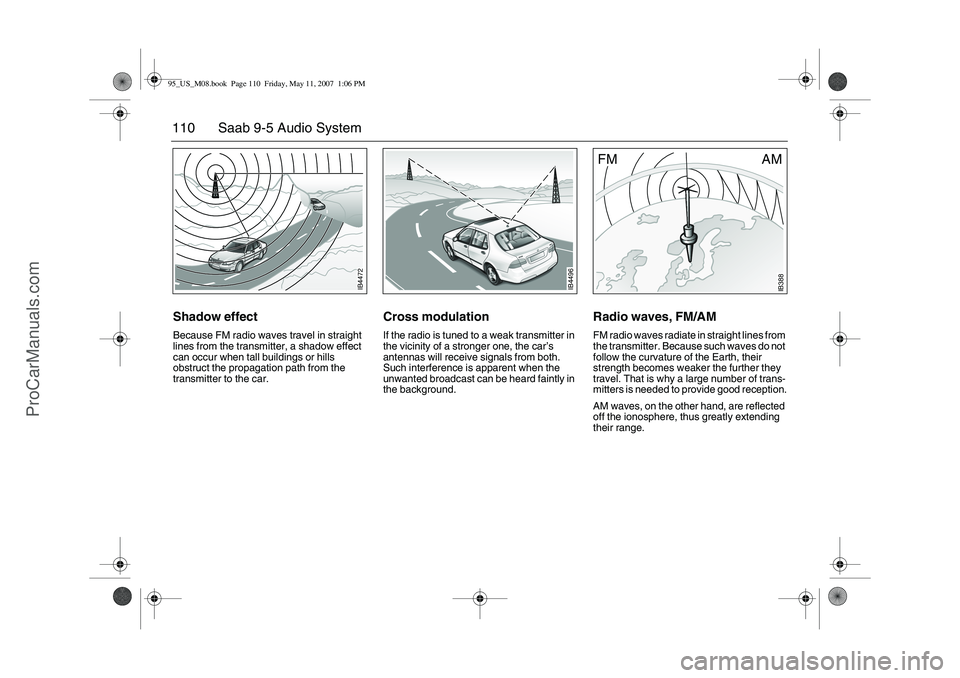
110 Saab 9-5 Audio SystemShadow effectBecause FM radio waves travel in straight
lines from the transmitter, a shadow effect
can occur when tall buildings or hills
obstruct the propagation path from the
transmitter to the car.
Cross modulationIf the radio is tuned to a weak transmitter in
the vicinity of a stronger one, the car’s
antennas will receive signals from both.
Such interference is apparent when the
unwanted broadcast can be heard faintly in
the background.
Radio waves, FM/AMFM radio waves radiate in straight lines from
the transmitter. Because such waves do not
follow the curvature of the Earth, their
strength becomes weaker the further they
travel. That is why a large number of trans-
mitters is needed to provide good reception.
AM waves, on the other hand, are reflected
off the ionosphere, thus greatly extending
their range.
IB4472
IB4496
IB388
AM
FM
95_US_M08.book Page 110 Friday, May 11, 2007 1:06 PM
ProCarManuals.com
Page 120 of 288
120 Interior equipment and trunkGate Operator / Canadian Programming
Canadian radio-frequency laws require
transmitter signals to "time-out" (or quit)
after several seconds of transmission -
which may not be long enough for the
garage opener to pick up the signal during
programming. Similar to this Canadian law,
some U.S. gate operators are designed to
"time-out" in the same manner.
If you live in Canada or you are having diffi-
culties programming a gate operator by
using the "Programming" procedures
(regardless of where you live), replace
"Programming " step 4 with the following:
Note: If programming a garage door opener
or gate operator, it is advised to unplug the
device during the "cycling" process to pre-
vent possible overheating.
Continue to press and hold the button while
you press and release - every two sec-
onds ("cycle") your hand-held transmitter
until the frequency signal has successfully
been accepted by the garage opener. (The
indicator light will flash slowly and then rap-
idly.)
Proceed with "Programming" step five to
complete.Reprogramming a single button
To program a device to the garage opener
using a button previously trained, follow
these steps:
1 Press and hold the desired button. DO
NOT release the button.
2 The indicator light will begin to flash after
20 seconds. Without releasing the
button, proceed with "Programming" -
step 3.Erasing the three buttons
To erase programming from the three but-
tons (individual buttons cannot be erased
but can be "reprogrammed" as outlined
below), follow the step noted:
Press and hold the two outer buttons until
the indicator light begins to flash-after
20 seconds. Release both buttons. Do
not hold for longer that 30 seconds. The
garage opener is now in the train (or
learning) mode and can be programmed
at any time beginning with "Programming"
- step 3.
NOTESwitch off the power supply to the garage
door or gate (or park the car beyond the
range of the remote control) while pro-
gramming using the "cycling" method to
prevent damaging the electrical motor.
95_US_M08.book Page 120 Friday, May 11, 2007 1:06 PM
ProCarManuals.com
Page 186 of 288
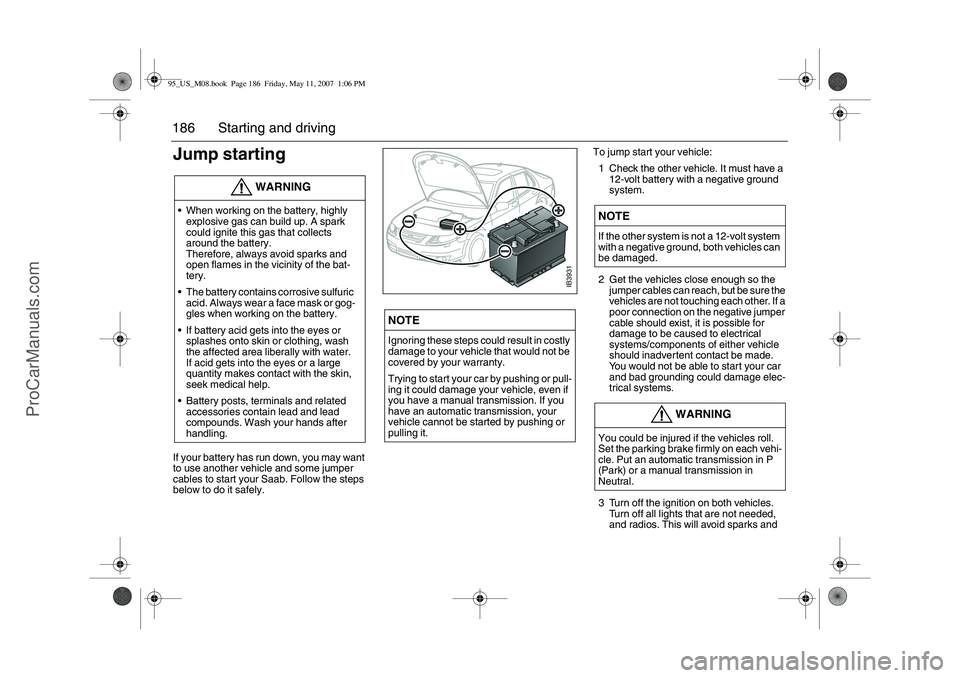
186 Starting and drivingJump startingIf your battery has run down, you may want
to use another vehicle and some jumper
cables to start your Saab. Follow the steps
below to do it safely.To jump start your vehicle:
1 Check the other vehicle. It must have a
12-volt battery with a negative ground
system.
2 Get the vehicles close enough so the
jumper cables can reach, but be sure the
vehicles are not touching each other. If a
poor connection on the negative jumper
cable should exist, it is possible for
damage to be caused to electrical
systems/components of either vehicle
should inadvertent contact be made.
You would not be able to start your car
and bad grounding could damage elec-
trical systems.
3 Turn off the ignition on both vehicles.
Turn off all lights that are not needed,
and radios. This will avoid sparks and
WARNING
When working on the battery, highly
explosive gas can build up. A spark
could ignite this gas that collects
around the battery.
Therefore, always avoid sparks and
open flames in the vicinity of the bat-
tery.
The battery contains corrosive sulfuric
acid. Always wear a face mask or gog-
gles when working on the battery.
If battery acid gets into the eyes or
splashes onto skin or clothing, wash
the affected area liberally with water.
If acid gets into the eyes or a large
quantity makes contact with the skin,
seek medical help.
Battery posts, terminals and related
accessories contain lead and lead
compounds. Wash your hands after
handling.
NOTEIgnoring these steps could result in costly
damage to your vehicle that would not be
covered by your warranty.
Trying to start your car by pushing or pull-
ing it could damage your vehicle, even if
you have a manual transmission. If you
have an automatic transmission, your
vehicle cannot be started by pushing or
pulling it.
NOTEIf the other system is not a 12-volt system
with a negative ground, both vehicles can
be damaged.
WARNING
You could be injured if the vehicles roll.
Set the parking brake firmly on each vehi-
cle. Put an automatic transmission in P
(Park) or a manual transmission in
Neutral.
IB3931
95_US_M08.book Page 186 Friday, May 11, 2007 1:06 PM
ProCarManuals.com
Page 187 of 288
187 Starting and driving
help save both batteries and it could
save your radio.
4 Open the hood and locate the battery.
Find the positive (+) and negative (–) termi-
nals on the battery.5 Check that the jumper cables do not
have loose or missing insulation. If they
do, you could get a shock and also the
vehicles could be damaged.
Before you connect the cables, here are
some basic things you should know.
Positive (+) will go to positive (+) and
negative (–) will go to a major metal
engine part with a good ground. Do not
connect (+) to (–) or you will get a short
that could injure you or would damage
the battery and maybe other parts as
well.
6 Connect the red positive (+) cable to the
positive (+) terminal of the vehicle with
the discharged battery.
7 Do not let the other end touch metal.
Connect it to the positive (+) terminal of
the good battery. Use a remote positive
(+) terminal if the vehicle has one.
8 Now connect the black negative (–)
cable to the good battery’s negative
terminal.NOTEIf you leave your radio on, it could be
badly damaged. The repairs would not be
covered by your warranty.
WARNING
An electric fan can start up even when the
engine is not running and can injure you.
Keep hands, clothing and tools away from
any underhood electric fan.
WARNING
Using a match or flame of any kind near a
battery can cause battery gas to explode.
You can suffer burns or be blinded. Use a
flashlight if you need more light.
Be sure the battery has enough water.
The battery installed in your new Saab
has filler caps. Be sure the right amount
of water is there. Add distilled or boiled
water if the level is too low. If you don’t,
explosive gas could be present.
Be sure the electrolyte in the battery is not
frozen. Discharged batteries will freeze.
When connecting jumper cables to a
frozen battery, gas from the chemical
reaction inside the battery can build up
under the ice and cause an explosion.
Battery fluid contains acid that can burn
you. Do not get it on you. If you acciden-
tally get it in your eyes or on your skin,
flush the area with water and get medical
help immediately.
95_US_M08.book Page 187 Friday, May 11, 2007 1:06 PM
ProCarManuals.com
Page 231 of 288
231 Car care and technical information
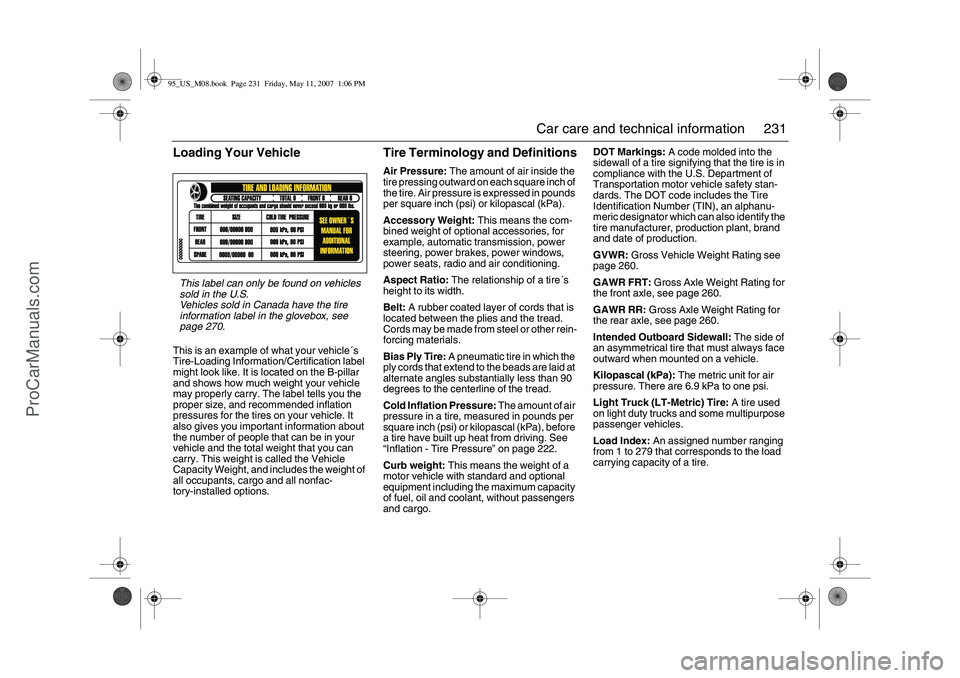
Loading Your VehicleThis is an example of what your vehicle´s
Tire-Loading Information/Certification label
might look like. It is located on the B-pillar
and shows how much weight your vehicle
may properly carry. The label tells you the
proper size, and recommended inflation
pressures for the tires on your vehicle. It
also gives you important information about
the number of people that can be in your
vehicle and the total weight that you can
carry. This weight is called the Vehicle
Capacity Weight, and includes the weight of
all occupants, cargo and all nonfac-
tory-installed options.
Tire Terminology and DefinitionsAir Pressure: The amount of air inside the
tire pressing outward on each square inch of
the tire. Air pressure is expressed in pounds
per square inch (psi) or kilopascal (kPa).
Accessory Weight: This means the com-
bined weight of optional accessories, for
example, automatic transmission, power
steering, power brakes, power windows,
power seats, radio and air conditioning.
Aspect Ratio: The relationship of a tire´s
height to its width.
Belt: A rubber coated layer of cords that is
located between the plies and the tread.
Cords may be made from steel or other rein-
forcing materials.
Bias Ply Tire: A pneumatic tire in which the
ply cords that extend to the beads are laid at
alternate angles substantially less than 90
degrees to the centerline of the tread.
Cold Inflation Pressure: The amount of air
pressure in a tire, measured in pounds per
square inch (psi) or kilopascal (kPa), before
a tire have built up heat from driving. See
“Inflation - Tire Pressure” on page 222.
Curb weight: This means the weight of a
motor vehicle with standard and optional
equipment including the maximum capacity
of fuel, oil and coolant, without passengers
and cargo.DOT Markings: A code molded into the
sidewall of a tire signifying that the tire is in
compliance with the U.S. Department of
Transportation motor vehicle safety stan-
dards. The DOT code includes the Tire
Identification Number (TIN), an alphanu-
meric designator which can also identify the
tire manufacturer, production plant, brand
and date of production.
GVWR: Gross Vehicle Weight Rating see
page 260.
GAWR FRT: Gross Axle Weight Rating for
the front axle, see page 260.
GAWR RR: Gross Axle Weight Rating for
the rear axle, see page 260.
Intended Outboard Sidewall: The side of
an asymmetrical tire that must always face
outward when mounted on a vehicle.
Kilopascal (kPa): The metric unit for air
pressure. There are 6.9 kPa to one psi.
Light Truck (LT-Metric) Tire: A tire used
on light duty trucks and some multipurpose
passenger vehicles.
Load Index: An assigned number ranging
from 1 to 279 that corresponds to the load
carrying capacity of a tire. This label can only be found on vehicles
sold in the U.S.
Vehicles sold in Canada have the tire
information label in the glovebox, see
page 270.
95_US_M08.book Page 231 Friday, May 11, 2007 1:06 PM
ProCarManuals.com
Page 275 of 288
275 Index
IIf a tire goes flat
________________ 228
Ignition switch
__________________ 140
Immobilizer
_____________________ 49
Indicator and warning lights
________ 58
Indicator lights
___________________ 58
Information about fuel
____________ 148
Instrument illumination ____________ 75
Instruments and controls __________ 57
Interior equipment
_______________ 113
Interior lighting
_________________ 124
Interior rearview mirror
___________ 116
Jack
_________________________ 240
KKey
___________________________ 44
Key to chassis number
___________ 273
Key, remove
___________________ 140
LLabeling, tire sidewall
____________ 229
Labels
__________________________ 7
LATCH (child safety)
______________ 23
Leather upholstery, care of
________ 243
Light horn
______________________ 73
Light switches ___________________ 73
Loading MP3 discs
______________ 102
Loading your vehicle _____________ 231Luggage-compartment lighting
_____ 125
Main instrument panel
_____________ 58
Main/dipped beam
_______________ 73
Maintenance schedule ___________ 256
Maintenance, A/C-system _________ 246
Manual gearbox, technical data
____ 268
Maxi fuses
_____________________ 217
MMP3 player
____________________ 102
Milometer
______________________ 64
Moonroof ______________________ 123
Motoring abroad
________________ 249
Multipath propagation
____________ 109
NNIGHT
_________________________ 72
New tires, buying
_______________ 225
Night Panel
_____________________ 72
OOdometer
______________________ 64
Oil capacity, engine
______________ 264
Oil specification
_________________ 264
Outdoor temperature
______________ 68
Owner assistance
_______________ 257
Paintwork, touching-in
____________ 245Parcel shelf, folding
______________ 133
Parking Assistance ______________ 168
Parking lights
____________________ 73
PParking lights
____________________ 73
Plates and labels
________________ 272
Poly-V-belt
_____________________ 201
Portable fuel container
___________ 148
Portable player
_________________ 104
Power outlet
___________________ 126
Power steering _________________ 198
Power-steering fluid
______________ 198
Pressure gauge
__________________ 66
Prestige
_______________________ 107
Programme type ALARM
__________ 99
QQuality grading, tires
_____________ 226
Questions on function of airbag
______ 40
RRadiator fan
____________________ 201
Radio
__________________________ 93
Radio Data System (RDS)
_________ 94
Radio text
______________________ 94
Radio waves ___________________ 110
95_US_M08.book Page 275 Friday, May 11, 2007 1:06 PM
ProCarManuals.com
Page 276 of 288

276 IndexRain sensor
_____________________ 77
Random playback of MP3 files, CD
_103
Random playback, CD
____________ 99
Random playback, CD changer
____ 101
Rapid playing an MP3 file
_________ 103
RDS time
_____________________ 106
Rear fog light ___________________ 74
Rear seat, 9-5 Sedan, folding
______ 129
Rear seat, 9-5 SportCombi, folding
_132
Rear window heating
_____________ 82
Rear-seat head restraints __________ 21
Rear-view mirror, auto-dimming
____ 121
Rearview mirrors
________________ 116
Reclamation
___________________ 250
Recommendations for cars with
automatic transmission, towing a
camper or trailer
_______________ 175
Refuelling
_____________________ 146
Relay panel ____________________ 219
Remote control __________________ 44
Remote-control battery, changing
____ 49
Remove the key
________________ 140
Removing CDs
__________________ 99
Removing CDs, CD-changer
______ 100
Removing MP3 discs
____________ 102
Replacement, wheel
_____________ 227
Reporting safety defects
__________ 258
Reprogramming of systems _______ 274
Reservoir, power-steering fluid _____ 198
Rev counter
____________________ 64
Reversing lights _________________ 76
Rolling advertisements
____________ 94Roof load
______________________ 179
Running-in _____________________ 170
Saab Information Display (SID)
_____ 68
SSaab Parking Assistance
_________ 168
Safety belts
_____________________ 12
Safety belts, care of
_____________ 242
Safety-belt pretensioners
__________ 15
Safety-belt reminder
______________ 12
SDM
_________________________ 259
SID
___________________________ 68
Seats __________________________ 18
Securing a load
__________________ 47
Selecting and changing tracks, CD
___ 99
Selecting a radio station
___________ 93
Selecting/changing MP3 file _______ 103
Selector lever indication, automatic
transmission
___________________ 67
Sentronic, manual mode
__________ 156
Service costs
___________________ 257
Service information
______________ 258
Service intervals
________________ 256
Service record retention
__________ 257
Setting the clock
________________ 105
Setting the date _________________ 105
Settings, seats __________________ 18
Shadow effect
__________________ 110
Side airbags
____________________ 36
Signalling, horn _________________ 114Snow chains
___________________ 172
Sorting music ___________________ 103
Sound system __________________ 107
Sources of AM interference
________ 111
Sources of FM interference ________ 111
Spare wheel
___________________ 237
Spare wheel and tools
____________ 183
Spark plugs
____________________ 267
Speed dependent volume
compensation _________________ 106
Speedometer
_________________ 64
, 65
Starting in cold weather, ACC
_______ 84
Starting in hot weather, ACC ________ 84
Steering wheel adjustment
________ 114
Steering wheel controls
____________ 91
Steering, technical data ___________ 269
Steps for determining correct load
limit
_________________________ 233
Stone-chip damage, repairing
______ 245
Storage compartments
___________ 126
Storing radio stations
______________ 93
Sun visors
_____________________ 125
Suspension ____________________ 269
Suspension, technical data
________ 269
Switches
_______________________ 73
Symboler ________________________ 9
Systems, adjustment
_____________ 274
95_US_M08.book Page 276 Friday, May 11, 2007 1:06 PM
ProCarManuals.com
Page 277 of 288
277 Index
TTable of fuses
__________________ 218
Tachometer
_____________________ 64
Tailgate, opening
________________ 47
Tank gauge
_____________________ 65
TCS OFF
______________________ 63
TP
____________________________ 99
Technical data
_________________ 261
Technical data, radio/audio
________ 108
Temperature control, ACC _________ 81
Temperature gauge, engine ________ 65
Temperature zones, ACC
__________ 81
Textile carpeting
________________ 243
Through-load hatch ______________ 131
Tie Downs
_____________________ 131
Tightening torque, wheel studs
_____ 239
Time display
___________________ 105
Tip, driving at night
______________ 181
Tip, to avoid theft
_______________ 166
Tips, ACC
______________________ 86
Tire chains ____________________ 228
Tire date code __________________ 233
Tire inspection and rotation
_______ 223
Tire markings
__________________ 230
Tire pressure ___________________ 182
Tire sidewall labeling
____________ 229
Tire terminology and definitions
____ 231
Tire, compact spare
_____________ 237
Tires
_____________________ 222
, 270
Tires, winter
___________________ 270
Tools
_________________________ 183Touching-in the paintwork
_________ 245
Towbar attachment
______________ 174
Towbar load
___________________ 178
Towing the car _________________ 183
Towing, automatics
______________ 183
Traffic programme ________________ 99
Trailer weights
__________________ 263
Treadwear indicators
____________ 224
Trionic
________________________ 192
Trip computer
___________________ 68
Trip meter
______________________ 64
Trunk
_________________________ 129
Trunk lid, opening
________________ 47
Tuning
_________________________ 93
Turbo gauge
____________________ 66
Turbo, points to note
_____________ 144
UUnder the hood
_________________ 191
Uniform tire quality grading
________ 226
Upholstery and trim
______________ 243
Upholstery and trim, care of
_______ 243
Vanity mirrors
__________________ 125
VVehicle Data Collection
___________ 259
Ventilated front seats
_____________ 87
Viscosity, engine oil
_____________ 264
WWarning labels
____________________ 7
Warning light, AIR BAG
____________ 37
Warning lights
___________________ 58
Washers
______________________ 202
Washers, windshield
_____________ 203
Washing the car
________________ 244
Waxing and polishing
____________ 245
Wear indicators, tires _____________ 224
What Will You See After an Airbag
Inflates?
______________________ 38
Wheel replacement
______________ 227
Wheel, change
_________________ 239
Wheels and tires ________________ 270
Wheels and tires, sizes
___________ 270
When it is time for new tires
_______ 224
Windshield washers
______________ 77
Windshield wipers
________________ 77
Winter tires
________________ 233
, 270
Wiper blades, replacing
___________ 202
Wipers and washers
__________ 77
, 202
XXenon headlight
________________ 204
95_US_M08.book Page 277 Friday, May 11, 2007 1:06 PM
ProCarManuals.com