steering wheel SAAB 9-5 2008 Owner's Manual
[x] Cancel search | Manufacturer: SAAB, Model Year: 2008, Model line: 9-5, Model: SAAB 9-5 2008Pages: 288, PDF Size: 27.54 MB
Page 156 of 288
156 Starting and drivingSentronic, manual mode 3
33 3Move the selector lever to the M position.
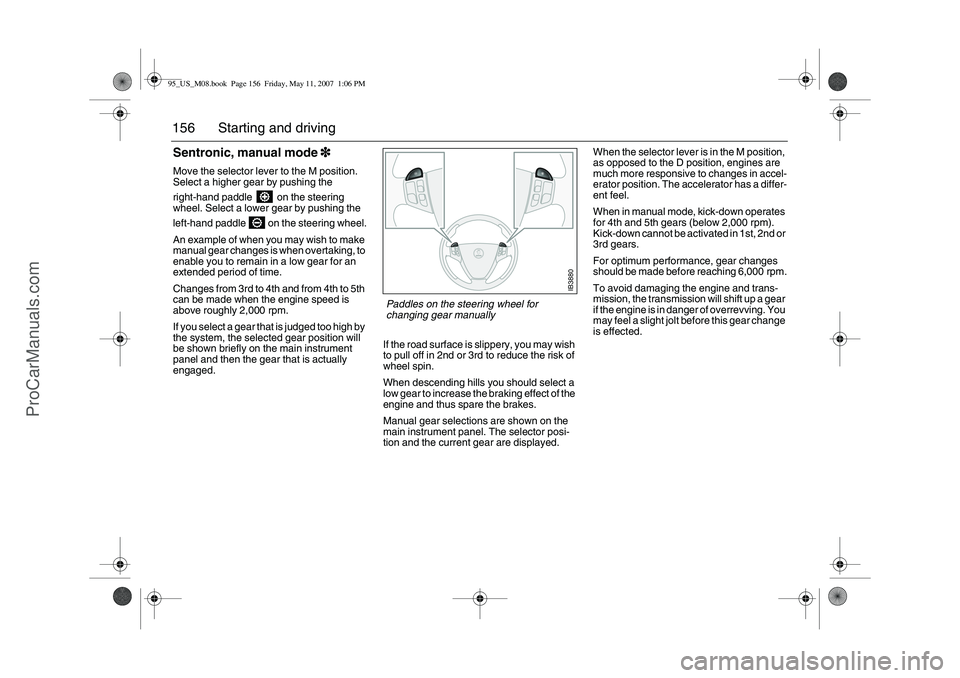
Select a higher gear by pushing the
right-hand paddle on the steering
wheel. Select a lower gear by pushing the
left-hand paddle on the steering wheel.
An example of when you may wish to make
manual gear changes is when overtaking, to
enable you to remain in a low gear for an
extended period of time.
Changes from 3rd to 4th and from 4th to 5th
can be made when the engine speed is
above roughly 2,000 rpm.
If you select a gear that is judged too high by
the system, the selected gear position will
be shown briefly on the main instrument
panel and then the gear that is actually
engaged.If the road surface is slippery, you may wish
to pull off in 2nd or 3rd to reduce the risk of
wheel spin.
When descending hills you should select a
low gear to increase the braking effect of the
engine and thus spare the brakes.
Manual gear selections are shown on the
main instrument panel. The selector posi-
tion and the current gear are displayed.When the selector lever is in the M position,
as opposed to the D position, engines are
much more responsive to changes in accel-
erator position. The accelerator has a differ-
ent feel.
When in manual mode, kick-down operates
for 4th and 5th gears (below 2,000 rpm).
Kick-down cannot be activated in 1st, 2nd or
3rd gears.
For optimum performance, gear changes
should be made before reaching 6,000 rpm.
To avoid damaging the engine and trans-
mission, the transmission will shift up a gear
if the engine is in danger of overrevving. You
may feel a slight jolt before this gear change
is effected.
IB3880
Paddles on the steering wheel for
changing gear manually
95_US_M08.book Page 156 Friday, May 11, 2007 1:06 PM
ProCarManuals.com
Page 162 of 288
162 Starting and drivingThe ABS system has a built-in diagnostic
function which will switch on the Anti-lock
brake warning light if a fault is detected in
the system (see page 60).
The ABS system will not reduce the braking
distance on loose gravel or on snow or ice
but, because the wheels cannot lock up,
some steering control is retained.
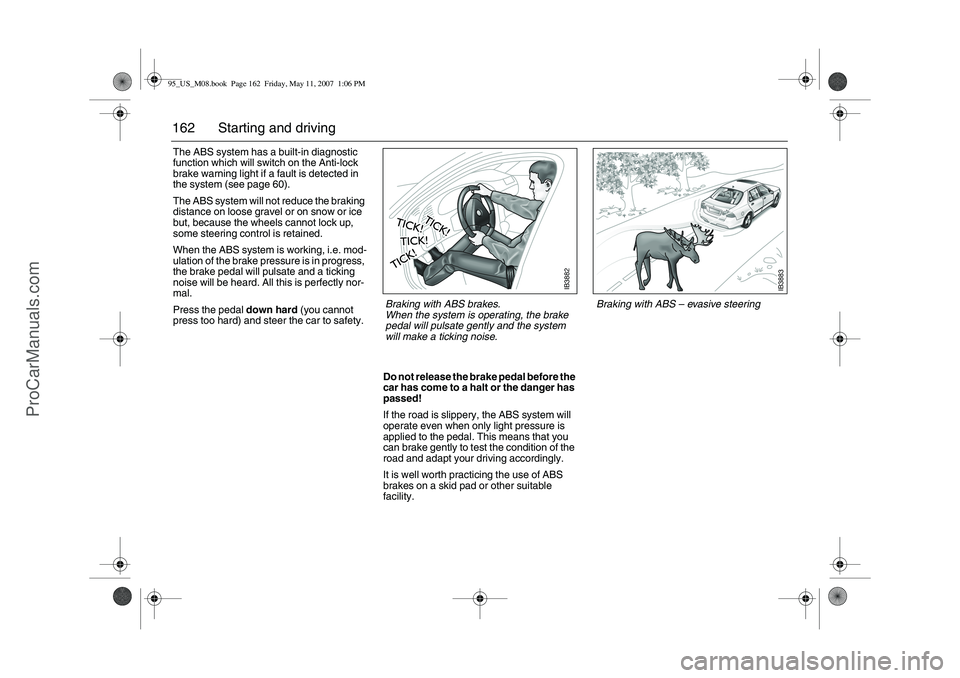
When the ABS system is working, i.e. mod-
ulation of the brake pressure is in progress,
the brake pedal will pulsate and a ticking
noise will be heard. All this is perfectly nor-
mal.
Press the pedal down hard (you cannot
press too hard) and steer the car to safety.
Do not release the brake pedal before the
car has come to a halt or the danger has
passed!
If the road is slippery, the ABS system will
operate even when only light pressure is
applied to the pedal. This means that you
can brake gently to test the condition of the
road and adapt your driving accordingly.
It is well worth practicing the use of ABS
brakes on a skid pad or other suitable
facility.
IB3882
Braking with ABS brakes.
When the system is operating, the brake
pedal will pulsate gently and the system
will make a ticking noise.
IB3883
Braking with ABS – evasive steering
95_US_M08.book Page 162 Friday, May 11, 2007 1:06 PM
ProCarManuals.com
Page 163 of 288
163 Starting and driving
Electronic Stability
Program (ESP
®)
The system employs both the antilock brak-
ing system (ABS) and the traction control
system (TCS). It is a system that helps the
driver to stabilize the car in unusual circum-
stances that would otherwise be more diffi-
cult to handle.
How the ESP
® system works
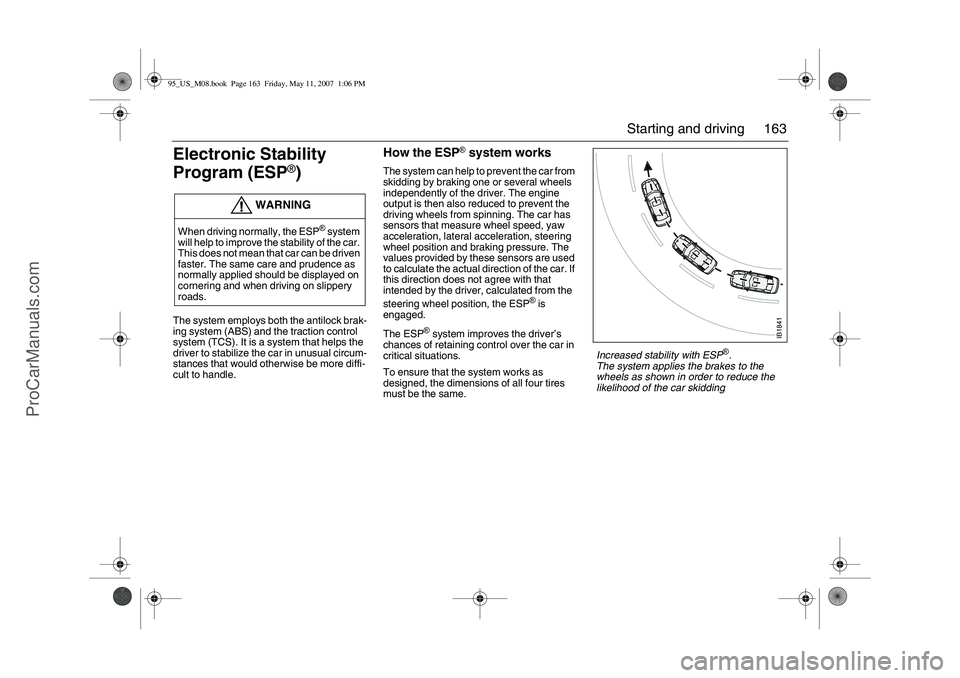
The system can help to prevent the car from
skidding by braking one or several wheels
independently of the driver. The engine
output is then also reduced to prevent the
driving wheels from spinning. The car has
sensors that measure wheel speed, yaw
acceleration, lateral acceleration, steering
wheel position and braking pressure. The
values provided by these sensors are used
to calculate the actual direction of the car. If
this direction does not agree with that
intended by the driver, calculated from the
steering wheel position, the ESP
® is
engaged.
The ESP
® system improves the driver’s
chances of retaining control over the car in
critical situations.
To ensure that the system works as
designed, the dimensions of all four tires
must be the same.
WARNING
When driving normally, the ESP
® system
will help to improve the stability of the car.
This does not mean that car can be driven
faster. The same care and prudence as
normally applied should be displayed on
cornering and when driving on slippery
roads.
IB1841
Increased stability with ESP
®.
The system applies the brakes to the
wheels as shown in order to reduce the
likelihood of the car skidding
95_US_M08.book Page 163 Friday, May 11, 2007 1:06 PM
ProCarManuals.com
Page 169 of 288
169 Starting and driving
When an object is approximately 3 feet
(90 cm) from the car, the sound pulses
change character markedly. A distance of
about 3 feet (90 cm) is suitable if you wish
to load or unload the luggage compartment.
If the distance between an object and the
corner sensors does not change for three
seconds, e.g. if you are reversing alongside
a wall, the system will switch to monitoring
straight back. The system indicates if the
distance to the wall decreases again.
The system can be disengaged for when
driving with a trailer. Press and hold the CLR
button on the steering wheel when the dis-
play shows "PARK ASSIST", until the dis-
play shows "PARK ASSIST OFF". The
system is re-engaged in the same way. The
system is also always activated when the
ignition key is turned to ON. Pressing a steering wheel button briefly will
not disengage the system, the display will
simply show the previously selected func-
tion.
Ice, snow and dirt can affect the sensitivity
of the sensors. In such cases a continuous
tone will sound warning the driver that the
system cannot measure the distance to an
object. You can turn the system off by press-
ing and holding the CLR button for
1.5 seconds.
If the text "PARK ASSIST FAILURE" is dis-
played on the SID, have the system
checked by a workshop. We recommend
that you contact an authorized Saab dealer.NOTEReverse slowly so that you have time to
stop the car when the continuous tone is
heard at approx. 12 in. (30 cm).
NOTETo function well, the sensors must be kept
clean. Ice snow and dirt can affect their
sensitivity.
Do not spray the sensors or closer than
8 in. (20 cm) to the sensors with a pres-
sure washer, as this could damage them.
95_US_M08.book Page 169 Friday, May 11, 2007 1:06 PM
ProCarManuals.com
Page 183 of 288
183 Starting and driving
Driving with a spare
wheel fittedSee page 238.Driving with the trunk
lid/tailgate openAvoid driving with the trunk lid/tailgate partly
or fully open, since exhaust fumes can be
drawn into the cabin.
If you must drive with the trunk lid/tailgate
open, all windows and the moonroof3 must
be closed and the cabin fan on at its highest
speed setting.
Driving in deep water Towing the carNOTEDo not drive in water deeper than
12 inches (30 cm) and do not drive faster
than 3–4 mph. Water can otherwise be
sucked into the engine. The engine will be
seriously damaged if water enters the
intake system.
WARNING
Remember that the brake servo does
not operate when the engine is off.
Much greater pressure than normal
will therefore be required to operate
the brake pedal.
Nor does the steering servo operate
when the engine is off. The steering
will therefore be much heavier than
usual.
The towing vehicle should always be
heavier than the vehicle on tow.
Never allow passengers to ride in the
car being towed.
Always seek professional help if the
car needs to be towed.
95_US_M08.book Page 183 Friday, May 11, 2007 1:06 PM
ProCarManuals.com
Page 198 of 288
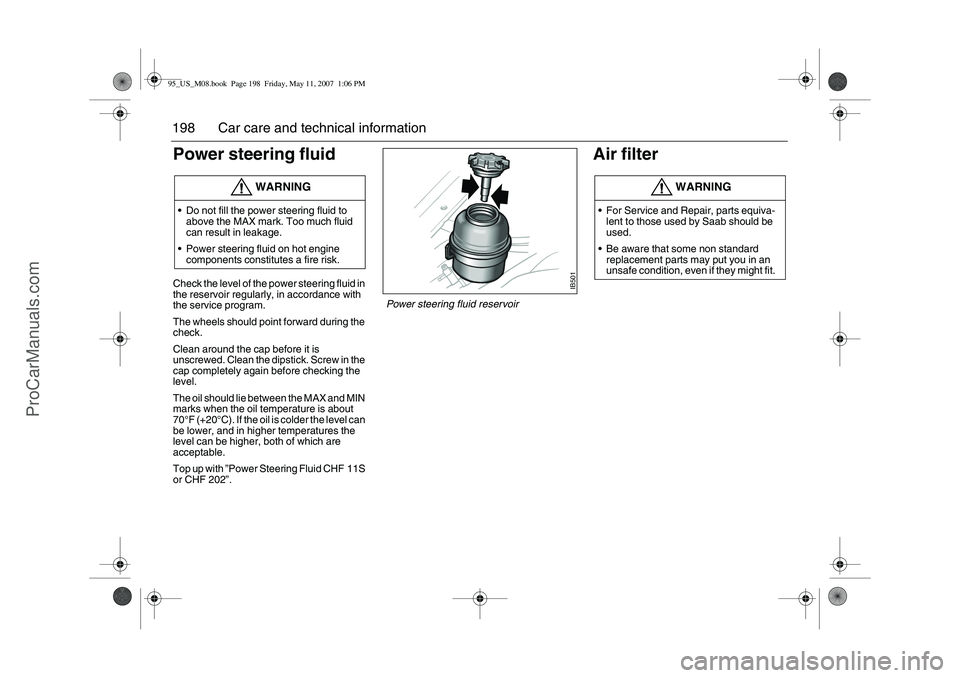
198 Car care and technical informationPower steering fluidCheck the level of the power steering fluid in
the reservoir regularly, in accordance with
the service program.
The wheels should point forward during the
check.
Clean around the cap before it is
unscrewed. Clean the dipstick. Screw in the
cap completely again before checking the
level.
The oil should lie between the MAX and MIN
marks when the oil temperature is about
70°F (+20°C). If the oil is colder the level can
be lower, and in higher temperatures the
level can be higher, both of which are
acceptable.
Top up with ”Power Steering Fluid CHF 11S
or CHF 202”.
Air filter
WARNING
Do not fill the power steering fluid to
above the MAX mark. Too much fluid
can result in leakage.
Power steering fluid on hot engine
components constitutes a fire risk.
WARNING
For Service and Repair, parts equiva-
lent to those used by Saab should be
used.
Be aware that some non standard
replacement parts may put you in an
unsafe condition, even if they might fit.
IB501
Power steering fluid reservoir
95_US_M08.book Page 198 Friday, May 11, 2007 1:06 PM
ProCarManuals.com
Page 224 of 288

224 Car care and technical informationFlat spottingAll tires get hot, especially on long journeys
or when the car is driven hard. After the car
has been parked with hot tires and the tires
have cooled down, a flat spot can form in the
tire, where it is in contact with the ground.
The same can occur if the car has not been
moved for a long time.
Flat spots can cause vibration that can be
felt through the steering wheel, similar to
that experienced when the wheels need bal-
ancing.
Flat spots of this type disappear once the
tires get hot again, usually after 10–15 miles
(20–25 km) of driving at cruising speed.
When It Is Time for New TiresOne way to tell when it’s time for new tires is
to check the treadwear indicators, which will
appear when your tires have only 1/16 inch
(1.6 mm) or less of tread remaining.
You need a new tire if any of the following
statements are true:
You can see the indicators at three or
more places around the tire.
You can see cord or fabric showing
through the tire’s rubber.
The tread or sidewall is cracked, cut or
snagged deep enough to show cord or
fabric.
The tire has a bump, bulge or split.
The tire has a puncture, cut or other
damage that can’t be repaired well
because of the size or location of the
damage.
Treadwear indicatorsThe tires incorporate wear indicators in the
form of smooth, treadless strips across the
width, which become visible when only
2/32" (1.6 mm) of tread remains. As soon as
the indicators become visible, new tires
should be fitted without delay.
Make sure you are familiar with the legal
limit for minimum tread depth in your
country and also any regulations gov-
erning the use of winter (snow) tires.
SG840
Wear indicators
95_US_M08.book Page 224 Friday, May 11, 2007 1:06 PM
ProCarManuals.com
Page 225 of 288

225 Car care and technical information
Buying New TiresTo find out what kind and size of tires you
need, look at the Tire-Loading Information
label.
Before changing to wheels/tires of another
size, we recommend that you contact an
authorized Saab workshop regarding
acceptable options. See also page 268
Wheels/tires combinations that are not
approved by the vehicle manufacturer can
negatively affect the car’s directional stabil-
ity, steering and braking in both wet and dry
conditions.
The wheels and tires have been carefully
matched to the characteristics of the car and
play a key role in its outstanding roadhold-
ing and handling.
Do not take it for granted that a wheel/tire
combination will work in the best possible
way, just because it can be fitted to the car.
To ensure that the speedometer is as accu-
rate as possible it should be reprogrammed
if wheels of a different dimension are fitted.
Contact a Saab dealer.
Because of front wheel drive, the front tires
tend to wear faster than the rear ones. New
tires should always be fitted in pairs, so that
tires on the same axle have the same
amount of tread.
Store wheels lying flat or hanging – never
standing upright.
NOTEWide wheels and tires with sidewalls that
are too low can:
be damaged in potholes etc.
cause springs, shock absorbers and
wheel bearings and body mountings
can be overloaded.
cause the wheels to come into contact
with chassis and body components.
can affect the function of the Elec-
tronic Stability Program (ESP
®).
The speed and load limits for the tires
must not be exceeded; see page 230.
Wheels larger than 17” must not be fitted.
The maximum permissible offset is
49 mm.
WARNING
Mixing tires could cause you to lose con-
trol while driving. If you mix tires of differ-
ent sizes or types (radial and bias-belted
tires), the vehicle may not handle prop-
erly, and you could have a crash. Using
tires of different sizes may also cause
damage to your vehicle. Be sure to use
the same size and type tires on all wheels.
It’s all right to drive with your compact
spare temporarily, it was developed for
use on your vehicle. See “Compact spare
tire” on page 237.
WARNING
If you use bias-ply tires on your vehicle,
the wheel rim flanges could develop
cracks after many miles of driving. A tire
and/or wheel could fail suddenly, causing
a crash. Use only radial-ply tires with the
wheels on your vehicle.
95_US_M08.book Page 225 Friday, May 11, 2007 1:06 PM
ProCarManuals.com
Page 228 of 288

228 Car care and technical informationTire Chains
Notice: If your vehicle does not have
225/45R17 alt. 235/45 R17 size tires, use
tire chains only where legal and only
when you must. Contact your Saab
dealer regarding suitable snow chains.
Install them on the front tires and tighten
them as tightly as possible with the ends
securely fastened. Drive slowly and
follow the chain manufacturer’s instruc-
tions. If you can hear the chains contact-
ing your vehicle, stop and retighten
them. If the contact continues, slow
down until it stops. Driving too fast or
spinning the wheels with chains on will
damage your vehicle.If a Tire Goes Flat
It’s unusual for a tire to “blow-out” while
you’re driving, especially if you maintain
your tires properly. If air goes out of a tire,
it’s much more likely to leak out slowly. But
if you should ever have a “blow-out”, here
are a few tips about what to expect and what
to do:
If a front tire fails, the flat tire will create a
drag that pulls the vehicle toward that side.
Take your foot off the accelerator pedal and
grip the steering wheel firmly. Steer to main-
tain lane position, and then gently brake to
a stop well out of the traffic lane.
A rear blow-out, particularly on a curve, acts
much like a skid and may require the same
correction you’d use in a skid. In any rear
blowout, remove your foot from the acceler-
ator pedal. Get the vehicle under control by
steering the way you want the vehicle to go.
It may be very bumpy and noisy, but you can
still steer. Gently brake to a stop – well off
the road if possible.
If a tire goes flat, the next part shows how to
use your jacking equipment to change a flat
tire safely.
WARNING
If your vehicle has 225/45 R17 alt. 235/45
R17 size tires, don’t use tire chains,
there’s not enough clearance.
Tire chains used on a vehicle without the
proper amount of clearance can cause
damage to the brakes, suspension or
other vehicle parts. The area damaged by
the tire chains could cause you to lose
control of your vehicle and you or others
may be injured in a crash.
Use another type of traction device only if
its manufacturer recommends it for use
on your vehicle and tire size combination
and road conditions. Follow that manu-
facturer’s instructions. To help avoid
damage to your vehicle, drive slowly,
readjust or remove the device if it’s con-
tacting your vehicle, and don’t spin your
wheels.
If you do find traction devices that will fit,
install them on the front tires.95_US_M08.book Page 228 Friday, May 11, 2007 1:06 PM
ProCarManuals.com
Page 235 of 288
235 Car care and technical information
If the tire pressure decreasesIf the tire pressure decreases to 0.4 bar
(6 psi) below the recommended pressure
then a warning is shown on the SID as to
which tires are affected.
Adjust the pressure as soon as possible.If the tire pressure continues to decrease
then an alarm is shown on the SID when the
pressure has decreased to 23 psi (159 kPa)
which is the lowest permitted pressure for
the tire.
An alarm is also received when leakage is
greater than 3 psi/min. (20 kPa/min.).
Reduce speed (avoid heavy braking and
significant steering wheel movement) and
stop the car as soon as possible at a suita-
ble location. Replace the defective wheel.
The fault message can remain for up to
10 minutes after restarting the car. Then it
disappears if the tire pressure is correct.
Check/adjust the pressure in the other tires
when a fault message is shown.Note that the tire pressure can decrease
without a puncture. The pressure could
decrease around 3 psi (20 kPa) during a
three month period. The outside tempera-
ture could also affect tire pressure.
If the system has triggerd a low pressure
warning or alarm then the tire pressure must
be adjusted to the recommended pressure
in order to put out the warning or alarm.
For further information on tire air pres-
sure, see page 222.
Allow 10 minutes for the system to recogn-
ise the wheel/sensors positions after fitting
a new set of tires. During this period no low
pressure warning or alarm can be triggered.
Tire pressure low,
rear left. Check tires.
Low tire pressure front
right. Make a safe stop.
Valve without sensor95_US_M08.book Page 235 Friday, May 11, 2007 1:06 PM
ProCarManuals.com