transmission SAAB 9-5 2008 Owner's Manual
[x] Cancel search | Manufacturer: SAAB, Model Year: 2008, Model line: 9-5, Model: SAAB 9-5 2008Pages: 288, PDF Size: 27.54 MB
Page 170 of 288
170 Starting and drivingEconomical motoringFactors affecting fuel
consumptionFuel consumption is greatly affected by the
general driving conditions, the way in which
the car is driven and at what speeds, the
weather, the state of the road, the condition
of the car, etc. Breaking-inFuel consumption may be somewhat higher
during the break-in period (the first 3,000–
4,000 miles (5,000–7,000 km) than stated.Weather conditionsFuel consumption can be as much as 10 %
lower in summer than in winter. The higher
consumption in cold weather is explained by
the longer time it takes for the engine to
reach normal operating temperature, and
for the transmission and wheel bearings to
warm up. Fuel economy is also affected by
the distance driven: short journeys of
3–5miles (5–8 km) do not give the engine
enough time to reach normal temperature.
Strong winds can also affect fuel con-
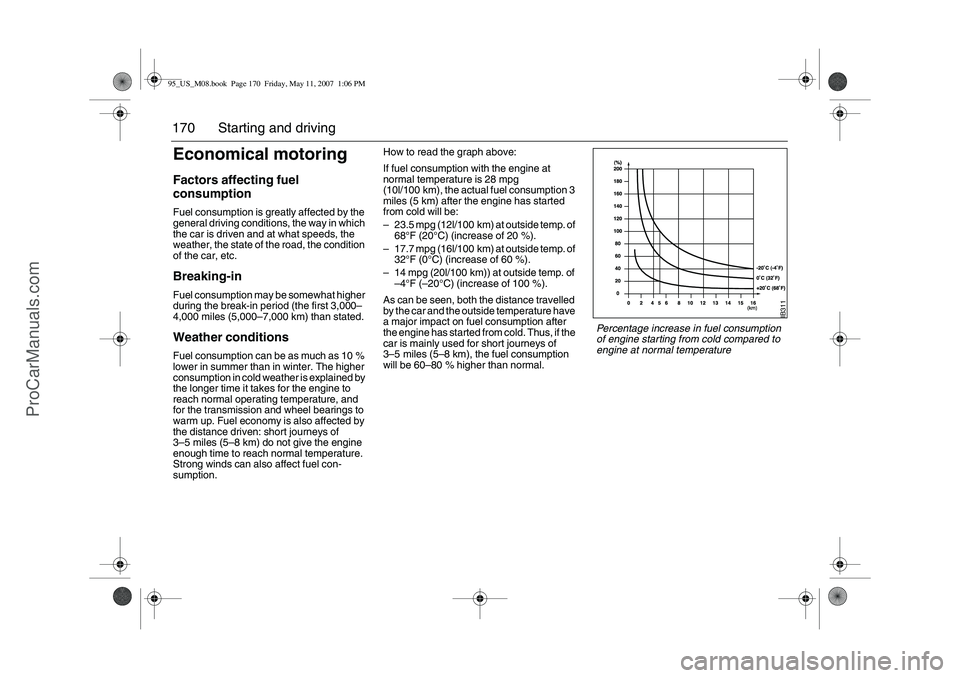
sumption. How to read the graph above:
If fuel consumption with the engine at
normal temperature is 28 mpg
(10l/100 km), the actual fuel consumption 3
miles (5 km) after the engine has started
from cold will be:
–23.5 mpg (12l/100 km) at outside temp. of
68°F (20°C) (increase of 20 %).
–17.7 mpg (16l/100 km) at outside temp. of
32°F (0°C) (increase of 60 %).
–14 mpg (20l/100 km)) at outside temp. of
–4°F (–20°C) (increase of 100 %).
As can be seen, both the distance travelled
by the car and the outside temperature have
a major impact on fuel consumption after
the engine has started from cold. Thus, if the
car is mainly used for short journeys of
3–5miles (5–8 km), the fuel consumption
will be 60–80 % higher than normal.
IB311
Percentage increase in fuel consumption
of engine starting from cold compared to
engine at normal temperature
95_US_M08.book Page 170 Friday, May 11, 2007 1:06 PM
ProCarManuals.com
Page 173 of 288
173 Starting and driving
If winter tires are fitted, the same type must
be fitted on all wheels. Your Saab dealer will
be pleased to advise you on the best tires for
your car.
Remember that tires age. It may therefore
be necessary to change them before they
reach the legal wear limit, as they gradually
lose their friction properties.
The best response if the car gets into a
front-wheel skid is to freewheel (manual
gearbox only), i.e. disengage the clutch (so
that the wheels are neither driven or
retarded by the engine.
If the car has automatic transmission, ease
up on the accelerator and steer carefully in
the desired direction.
In a rear-wheel skid, steer in the same direc-
tion that the rear of the car is moving.
Tire chains3
33 3If you want to fit tire chains (where legally
permitted) they should only be fitted to the
tires recommended under ”Specifications”
(see page 268).
Consult your Saab dealer for details of
approved tire chains.
Driving in hot weatherAlways check the coolant level before start-
ing a journey. When the engine is cold, the
coolant shall lie on or just above the
KALT/COLD mark on the expansion tank..
At the end of a journey, if the engine has
worked hard, allow it to idle for two or three
minutes before switching it off.
If the needle on the temperature gauge
enters the red zone:
1 Bring the car to a standstill but leave the
engine running. Do not remove the cap
on the expansion tank even if the tank is
empty. If the needle on the temperature
gauge continues to rise while the engine
is idling, switch off the engine.
WARNING
Do not exceed 30 mph (50 km/h)
when tire chains are fitted.
Tire chains can reduce the directional
stability of the car.
Tire chains must not be used on the
rear wheels. NOTECheck the links frequently for wear.
Check that the chains do not contact
the wheel-arch liner at full lock.
See section ”Specifications”,
page 268, for information on allowable
wheel dimensions for the fitting of tire
chains.
95_US_M08.book Page 173 Friday, May 11, 2007 1:06 PM
ProCarManuals.com
Page 176 of 288
176 Starting and drivingWhen negotiating long hills, bear the follow-
ing important considerations in mind:
Use Normal mode when driving with a
caravan or trailer on hilly roads. The adap-
tive gear change pattern function will
prevent the transmission overheating.
Rises in coolant temperature are indi-
cated by the temperature gauge in the
main instrument panel.Recommendations for cars with
automatic transmission
Rises in coolant temperature are indicated
by the temperature gauge in the main instru-
ment panel.
The following steps are taken in order as the
temperature of the engine increases:
Gear change pattern is altered.
A/C compressor is switched off.
Engine torque is reduced.
The following message will be displayed on
the SID if the transmission fluid becomes
too hot:
“Gearbox too hot.
Make a safe stop.
If this message appears, stop the car as
soon as it is safe to do so and allow the
engine to idle until the message has gone
out. The selector lever should be in
position P.When continuing your journey, select
manual mode and a gear in which the
engine speed is about 3,000 rpm until the
incline eases (see page 157).
WARNING
Remember to use the braking effect of the
engine (position D or L) when you are
descending long or steep hills to spare
the brakes.
Brake failure can result from overheated
brakes!
95_US_M08.book Page 176 Friday, May 11, 2007 1:06 PM
ProCarManuals.com
Page 177 of 288
177 Starting and driving
Recommendations for cars with manual
gearbox
Rises in coolant temperature are indicated
by the temperature gauge in the main instru-
ment panel.
The following steps are taken in order as the
temperature of the engine increases:
A/C compressor is switched off.
engine torque is reduced.
When continuing your journey, select a gear
in which the engine speed is about
3,000 rpm until the incline eases.
Driving considerations Always take extra care when towing a
trailer, as the car’s handling will be different
and its braking effect reduced. The trailer’s
braking system and suspension also have a
considerable effect on these characteris-
tics, see also ”Driving with a load” page 181.
If the car has automatic transmission, select
position D when ascending steep hills. This
ensures that the adaptive gear change pat-
terns are operational, see page 158. Use
position D or L for steep descents.Checks before drivingMake sure that the car and camper or trailer
are in good working order. This is essential
since towing a camper or trailer increases
the strain on the car.
Check and if necessary adjust the tire
pressure of the car and camper or trailer.
Make sure all wheel bolts are properly
tightened.
Make sure that the equipment joining the
car and camper or trailer is properly
secured and adjusted.Make sure the camper or trailer’s electri-
cal cable is properly connected and is not
so long that it drags along the ground.
Also, make sure the cable is not too short
and risks breaking when turning a corner.
Check all bulbs.
Check the car and camper or trailer
brakes.
Make sure that all items on or in the cara-
van or trailer are properly secured.
Make sure that the camper or trailer’s
jockey wheel is raised and locked.
Check the distribution of the load so that
the car and camper or trailer are well
balanced.
Check that the rearview mirrors provide
the best possible rearward vision.
Make sure the camper or trailer’s safety
cable is correctly attached.
WARNING
Utilize the braking effect of the engine
(1st, 2nd or 3rd gear) when you are
descending long or steep hills to spare
the brakes.
Brake failure can result from overheated
brakes!
NOTEIf the ”Automatic transmission3, fault
indicator” indicator comes on, cease
towing until the problem has been recti-
fied.
95_US_M08.book Page 177 Friday, May 11, 2007 1:06 PM
ProCarManuals.com
Page 185 of 288
185 Starting and driving
Towing the car Gear lever in neutral (in cars with automatic
transmission: selector lever at N (neutral))
Turn on the parking lights.
Drive carefully and do not exceed the
speed limit for vehicles being towed.
Always try to keep the towrope taut by
gently applying the brake, as necessary.
This will avoid the towrope being jerked
violently.
The local regulations on towing speeds
must be followed.
The highest permissible towing speed is
30 mph (50 km/h), unless the legal limit is
lower. The longest permissible towing dis-
tance is 30 miles (50 km). If the car has to
be transported farther than that, summon a
tow truck. A flat bed tow truck is the pre-
ferred method to tow.
Failure to follow these guidelines can result
in damage.Cars with automatic transmission
The car cannot be push started. In an emer-
gency, it is possible to start the engine using
jump leads (see the section, ”Jump starting”
on page 186).
Transporting the car
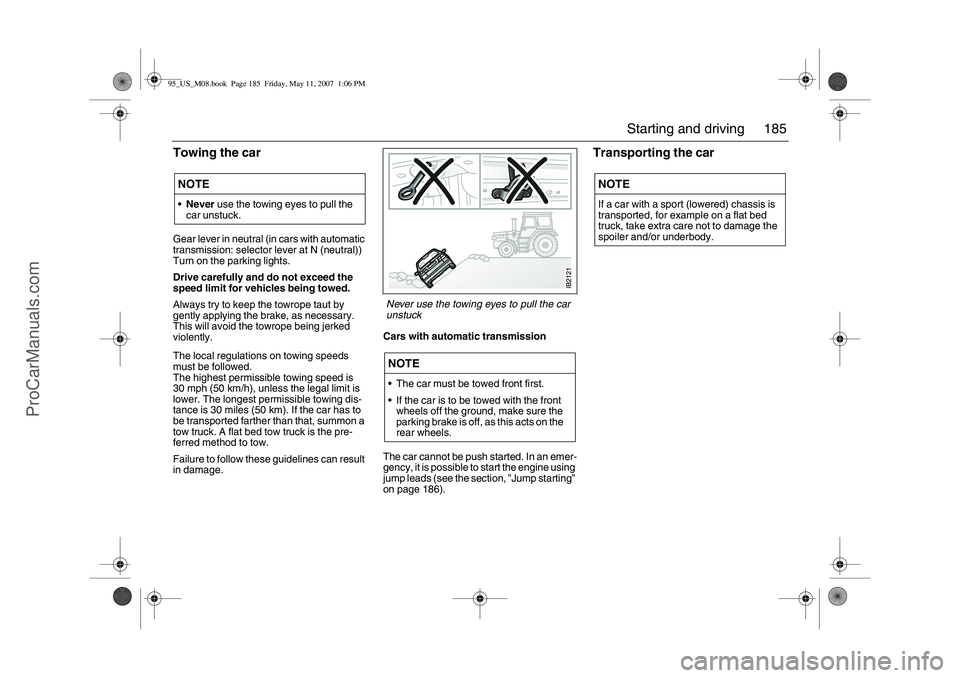
NOTENever use the towing eyes to pull the
car unstuck.
NOTEThe car must be towed front first.
If the car is to be towed with the front
wheels off the ground, make sure the
parking brake is off, as this acts on the
rear wheels.
NOTEIf a car with a sport (lowered) chassis is
transported, for example on a flat bed
truck, take extra care not to damage the
spoiler and/or underbody.
Never use the towing eyes to pull the car
unstuck
95_US_M08.book Page 185 Friday, May 11, 2007 1:06 PM
ProCarManuals.com
Page 186 of 288
186 Starting and drivingJump startingIf your battery has run down, you may want
to use another vehicle and some jumper
cables to start your Saab. Follow the steps
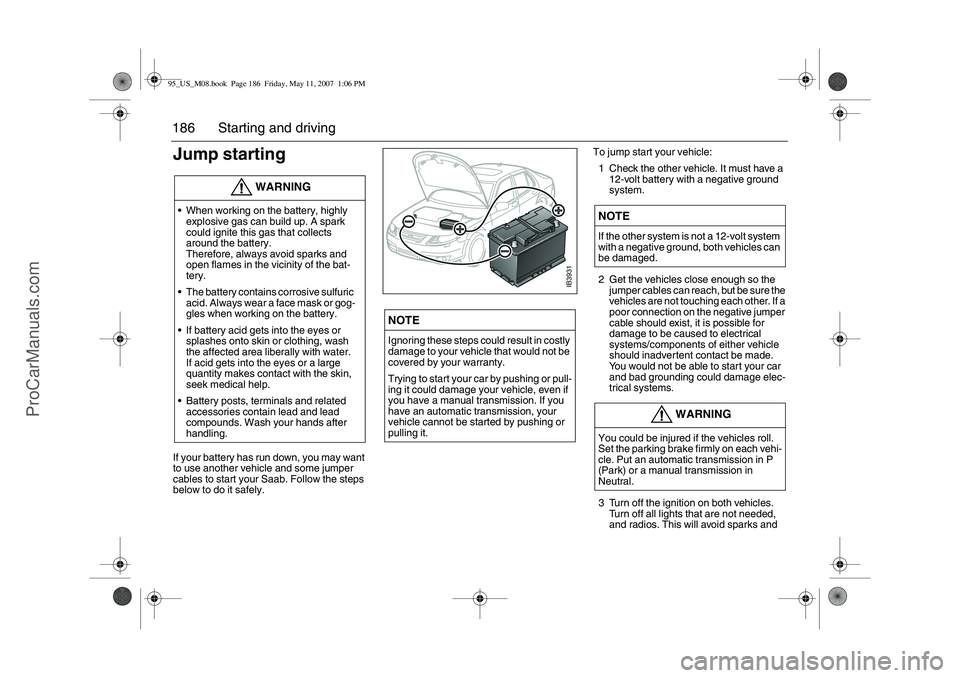
below to do it safely.To jump start your vehicle:
1 Check the other vehicle. It must have a
12-volt battery with a negative ground
system.
2 Get the vehicles close enough so the
jumper cables can reach, but be sure the
vehicles are not touching each other. If a
poor connection on the negative jumper
cable should exist, it is possible for
damage to be caused to electrical
systems/components of either vehicle
should inadvertent contact be made.
You would not be able to start your car
and bad grounding could damage elec-
trical systems.
3 Turn off the ignition on both vehicles.
Turn off all lights that are not needed,
and radios. This will avoid sparks and
WARNING
When working on the battery, highly
explosive gas can build up. A spark
could ignite this gas that collects
around the battery.
Therefore, always avoid sparks and
open flames in the vicinity of the bat-
tery.
The battery contains corrosive sulfuric
acid. Always wear a face mask or gog-
gles when working on the battery.
If battery acid gets into the eyes or
splashes onto skin or clothing, wash
the affected area liberally with water.
If acid gets into the eyes or a large
quantity makes contact with the skin,
seek medical help.
Battery posts, terminals and related
accessories contain lead and lead
compounds. Wash your hands after
handling.
NOTEIgnoring these steps could result in costly
damage to your vehicle that would not be
covered by your warranty.
Trying to start your car by pushing or pull-
ing it could damage your vehicle, even if
you have a manual transmission. If you
have an automatic transmission, your
vehicle cannot be started by pushing or
pulling it.
NOTEIf the other system is not a 12-volt system
with a negative ground, both vehicles can
be damaged.
WARNING
You could be injured if the vehicles roll.
Set the parking brake firmly on each vehi-
cle. Put an automatic transmission in P
(Park) or a manual transmission in
Neutral.
IB3931
95_US_M08.book Page 186 Friday, May 11, 2007 1:06 PM
ProCarManuals.com
Page 189 of 288
189 Car care and technical information
IB3888
Hood ________________ 190
Engine compartment __ 191
Emission control
systems ____________ 192
Engine ______________ 194
Engine oil ____________ 194
Transmission fluid ____ 195
Coolant ______________ 195
Brake and clutch fluid__ 196
Power steering fluid ___ 198
Air filter _____________ 198
Battery ______________ 199
Drive belts ___________ 201
Wipers and washers ___ 202
Changing bulbs _______ 204
Fuses _______________ 216 Tires ________________ 222
Automatic tire pressure
monitoring system ___ 234
Compact spare tire ____ 237
Safety belts __________ 242
Upholstery and trim ___ 243
Textile carpeting ______ 243
Washing the car ______ 244
Waxing and polishing __ 245
Engine compartment __ 245
Touching up the paint _ 245
Air conditioning (ACC) _ 246
Anti-corrosion treatment 248
For long trips _________ 249
Recovery and/or
recycling of automotive
materials ___________ 250
Headlight aiming ______ 250
Car care and technical information
3 Asterisk means: equipment not fitted in all cars
(can depend on model variant, engine variant,
market specification, options or accessories).95_US_M08.book Page 189 Friday, May 11, 2007 1:06 PM
ProCarManuals.com
Page 194 of 288
194 Car care and technical informationEngineThe 2.3-liter model is a transverse, 4-cylin-
der in-line engine with twin overhead cam-
shafts and 4 valves per cylinder.
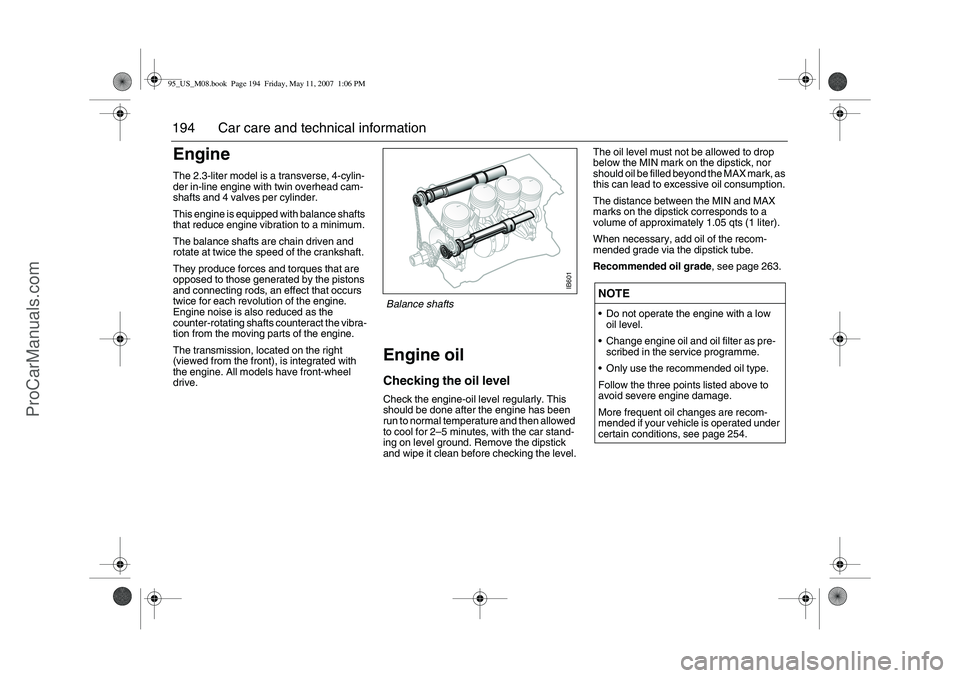
This engine is equipped with balance shafts
that reduce engine vibration to a minimum.
The balance shafts are chain driven and
rotate at twice the speed of the crankshaft.
They produce forces and torques that are
opposed to those generated by the pistons
and connecting rods, an effect that occurs
twice for each revolution of the engine.
Engine noise is also reduced as the
counter-rotating shafts counteract the vibra-
tion from the moving parts of the engine.
The transmission, located on the right
(viewed from the front), is integrated with
the engine. All models have front-wheel
drive.
Engine oilChecking the oil level Check the engine-oil level regularly. This
should be done after the engine has been
run to normal temperature and then allowed
to cool for 2–5 minutes, with the car stand-
ing on level ground. Remove the dipstick
and wipe it clean before checking the level.The oil level must not be allowed to drop
below the MIN mark on the dipstick, nor
should oil be filled beyond the MAX mark, as
this can lead to excessive oil consumption.
The distance between the MIN and MAX
marks on the dipstick corresponds to a
volume of approximately 1.05 qts (1 liter).
When necessary, add oil of the recom-
mended grade via the dipstick tube.
Recommended oil grade, see page 263.
NOTEDo not operate the engine with a low
oil level.
Change engine oil and oil filter as pre-
scribed in the service programme.
Only use the recommended oil type.
Follow the three points listed above to
avoid severe engine damage.
More frequent oil changes are recom-
mended if your vehicle is operated under
certain conditions, see page 254.
IB601
Balance shafts
95_US_M08.book Page 194 Friday, May 11, 2007 1:06 PM
ProCarManuals.com
Page 195 of 288
195 Car care and technical information
Transmission fluidManual transmission Check and top up the fluid in accordance
with the service program.Automatic transmissionCheck and top up the fluid in accordance
with the service program.
Coolant There is an overpressure in the cooling sys-
tem. Coolant temperatures can sometimes
exceed 212°F (100 °C).
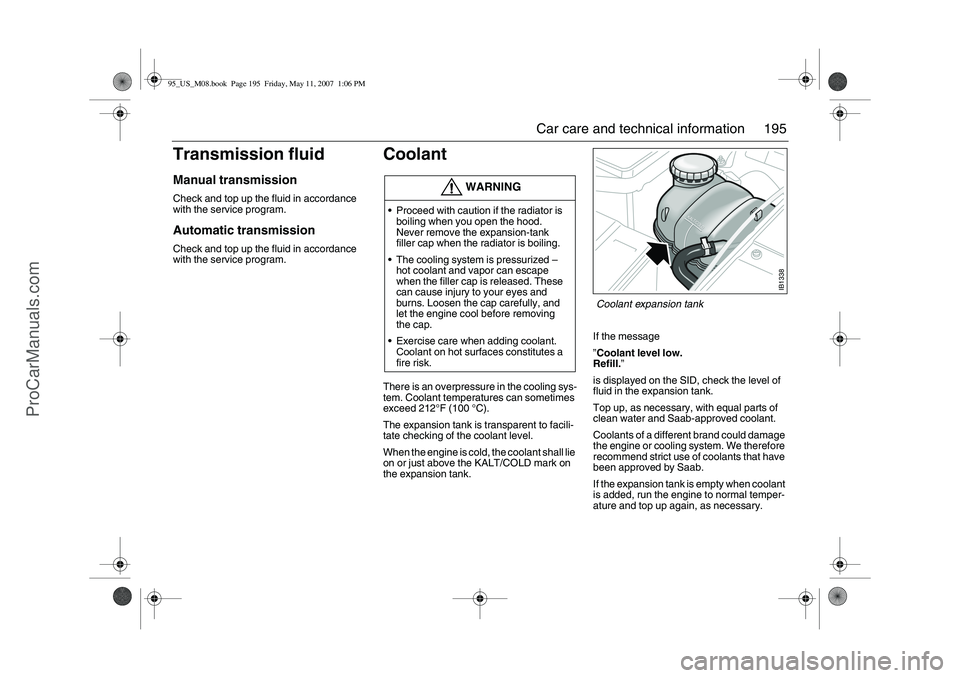
The expansion tank is transparent to facili-
tate checking of the coolant level.
When the engine is cold, the coolant shall lie
on or just above the KALT/COLD mark on
the expansion tank.If the message
”Coolant level low.
Refill.”
is displayed on the SID, check the level of
fluid in the expansion tank.
Top up, as necessary, with equal parts of
clean water and Saab-approved coolant.
Coolants of a different brand could damage
the engine or cooling system. We therefore
recommend strict use of coolants that have
been approved by Saab.
If the expansion tank is empty when coolant
is added, run the engine to normal temper-
ature and top up again, as necessary.
WARNING
Proceed with caution if the radiator is
boiling when you open the hood.
Never remove the expansion-tank
filler cap when the radiator is boiling.
The cooling system is pressurized –
hot coolant and vapor can escape
when the filler cap is released. These
can cause injury to your eyes and
burns. Loosen the cap carefully, and
let the engine cool before removing
the cap.
Exercise care when adding coolant.
Coolant on hot surfaces constitutes a
fire risk.
IB1338
Coolant expansion tank
95_US_M08.book Page 195 Friday, May 11, 2007 1:06 PM
ProCarManuals.com
Page 218 of 288
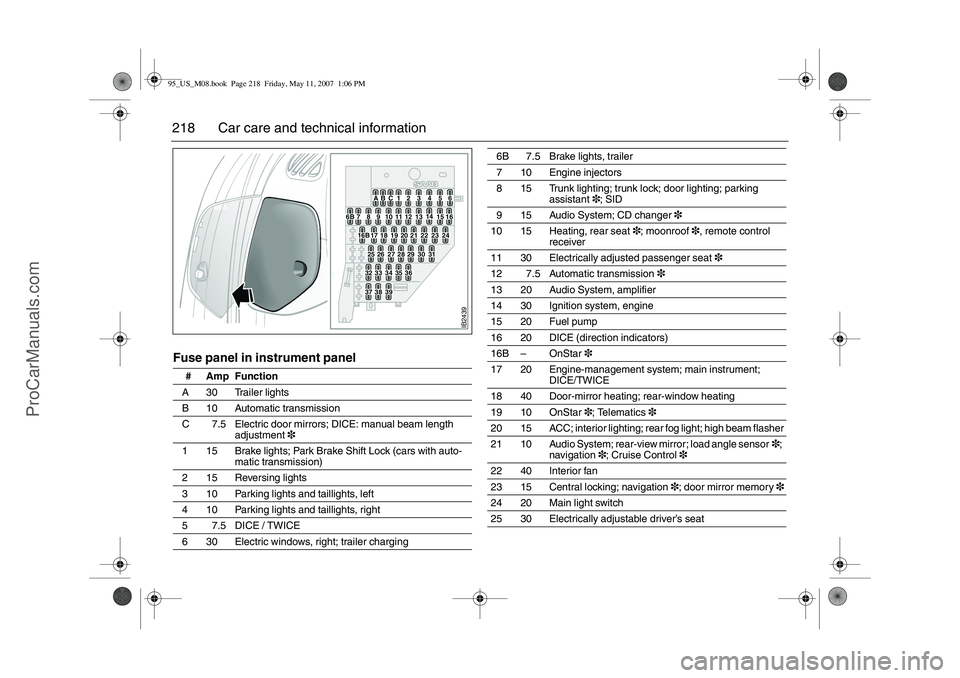
218 Car care and technical informationFuse panel in instrument panel
# Amp Function
A 30 Trailer lights
B 10 Automatic transmission
C 7.5 Electric door mirrors; DICE: manual beam length
adjustment3
1 15 Brake lights; Park Brake Shift Lock (cars with auto-
matic transmission)
2 15 Reversing lights
3 10 Parking lights and taillights, left
4 10 Parking lights and taillights, right
5 7.5 DICE / TWICE
6 30 Electric windows, right; trailer charging
6B 7.5 Brake lights, trailer
7 10 Engine injectors
8 15 Trunk lighting; trunk lock; door lighting; parking
assistant3; SID
9 15 Audio System; CD changer3
10 15 Heating, rear seat3; moonroof3, remote control
receiver
11 30 Electrically adjusted passenger seat3
12 7.5 Automatic transmission3
13 20 Audio System, amplifier
14 30 Ignition system, engine
15 20 Fuel pump
16 20 DICE (direction indicators)
16B –OnStar3
17 20 Engine-management system; main instrument;
DICE/TWICE
18 40 Door-mirror heating; rear-window heating
19 10 OnStar3; Telematics3
20 15 ACC; interior lighting; rear fog light; high beam flasher
21 10 Audio System; rear-view mirror; load angle sensor3;
navigation3; Cruise Control3
22 40 Interior fan
23 15 Central locking; navigation3; door mirror memory3
24 20 Main light switch
25 30 Electrically adjustable driver’s seat
IB2439
BC123456 A
14
121110987
13
6B
1516
2324
222120191817
16B25262728293031
3635343332
393837
95_US_M08.book Page 218 Friday, May 11, 2007 1:06 PM
ProCarManuals.com