warning light SAAB 9-5 2008 Owner's Manual
[x] Cancel search | Manufacturer: SAAB, Model Year: 2008, Model line: 9-5, Model: SAAB 9-5 2008Pages: 288, PDF Size: 27.54 MB
Page 61 of 288
61 Instruments and controls
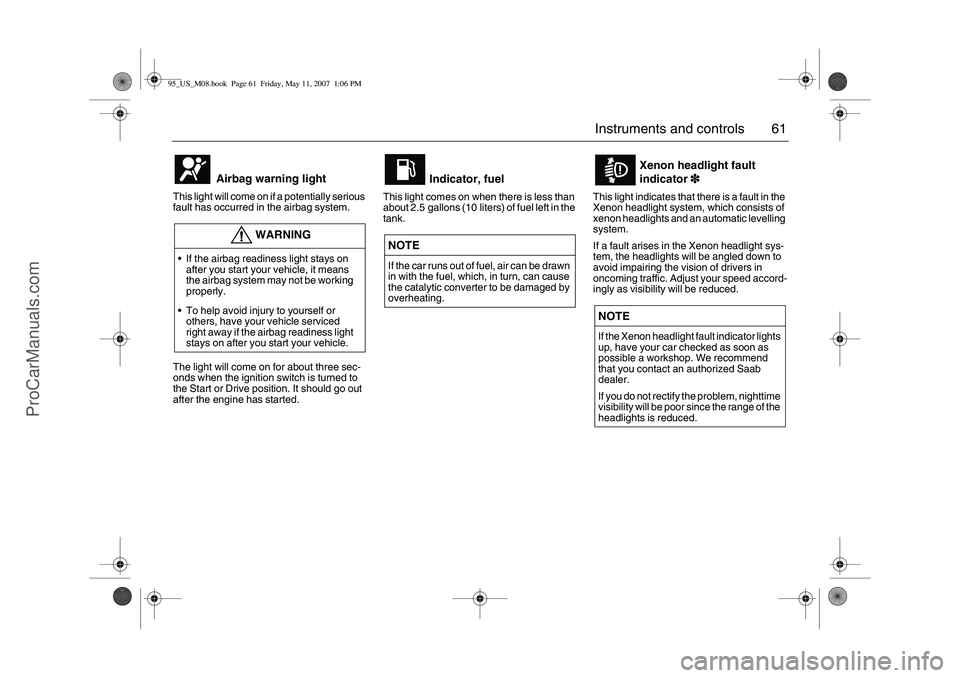
This light will come on if a potentially serious
fault has occurred in the airbag system. The light will come on for about three sec-
onds when the ignition switch is turned to
the Start or Drive position. It should go out
after the engine has started.This light comes on when there is less than
about 2.5 gallons (10 liters) of fuel left in the
tank. This light indicates that there is a fault in the
Xenon headlight system, which consists of
xenon headlights and an automatic levelling
system.
If a fault arises in the Xenon headlight sys-
tem, the headlights will be angled down to
avoid impairing the vision of drivers in
oncoming traffic. Adjust your speed accord-
ingly as visibility will be reduced.
Airbag warning light
WARNING
If the airbag readiness light stays on
after you start your vehicle, it means
the airbag system may not be working
properly.
To help avoid injury to yourself or
others, have your vehicle serviced
right away if the airbag readiness light
stays on after you start your vehicle.
Indicator, fuel
NOTE
If the car runs out of fuel, air can be drawn
in with the fuel, which, in turn, can cause
the catalytic converter to be damaged by
overheating.
Xenon headlight fault
indicator3
33 3
NOTE
If the Xenon headlight fault indicator lights
up, have your car checked as soon as
possible a workshop. We recommend
that you contact an authorized Saab
dealer.
If you do not rectify the problem, nighttime
visibility will be poor since the range of the
headlights is reduced.
95_US_M08.book Page 61 Friday, May 11, 2007 1:06 PM
ProCarManuals.com
Page 62 of 288
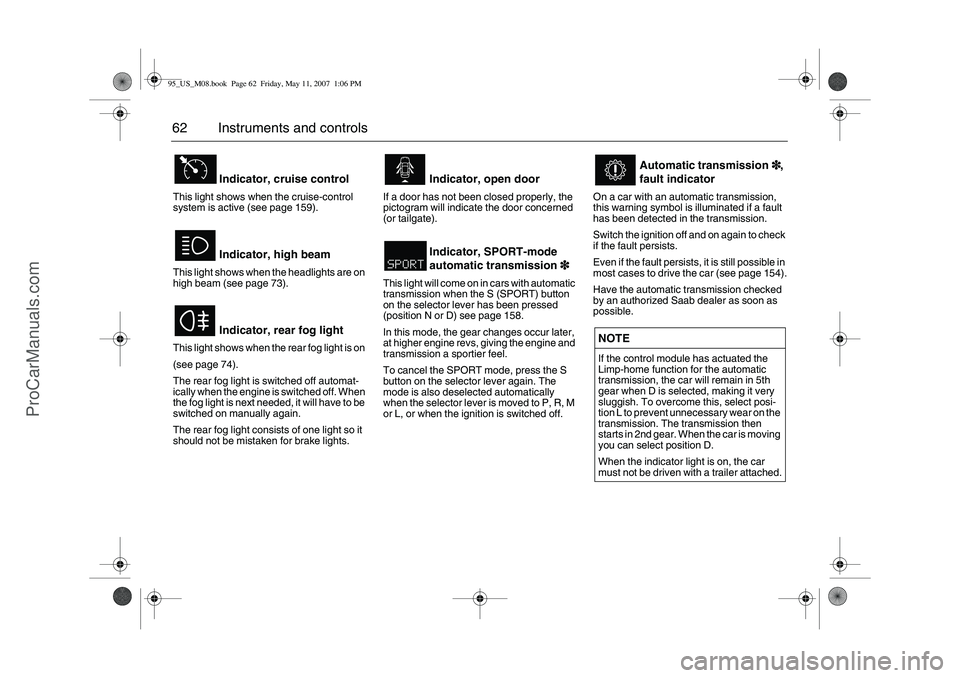
62 Instruments and controlsThis light shows when the cruise-control
system is active (see page 159).
This light shows when the headlights are on
high beam (see page 73).
This light shows when the rear fog light is on
(see page 74).
The rear fog light is switched off automat-
ically when the engine is switched off. When
the fog light is next needed, it will have to be
switched on manually again.
The rear fog light consists of one light so it
should not be mistaken for brake lights.If a door has not been closed properly, the
pictogram will indicate the door concerned
(or tailgate).
This light will come on in cars with automatic
transmission when the S (SPORT) button
on the selector lever has been pressed
(position N or D) see page 158.
In this mode, the gear changes occur later,
at higher engine revs, giving the engine and
transmission a sportier feel.
To cancel the SPORT mode, press the S
button on the selector lever again. The
mode is also deselected automatically
when the selector lever is moved to P, R, M
or L, or when the ignition is switched off.On a car with an automatic transmission,
this warning symbol is illuminated if a fault
has been detected in the transmission.
Switch the ignition off and on again to check
if the fault persists.
Even if the fault persists, it is still possible in
most cases to drive the car (see page 154).
Have the automatic transmission checked
by an authorized Saab dealer as soon as
possible.
Indicator, cruise control
Indicator, high beam
Indicator, rear fog light
Indicator, open door
Indicator, SPORT-mode
automatic transmission3
33 3
Automatic transmission3
33 3,
fault indicator
NOTE
If the control module has actuated the
Limp-home function for the automatic
transmission, the car will remain in 5th
gear when D is selected, making it very
sluggish. To overcome this, select posi-
tion L to prevent unnecessary wear on the
transmission. The transmission then
starts in 2nd gear. When the car is moving
you can select position D.
When the indicator light is on, the car
must not be driven with a trailer attached.
95_US_M08.book Page 62 Friday, May 11, 2007 1:06 PM
ProCarManuals.com
Page 63 of 288
63 Instruments and controls
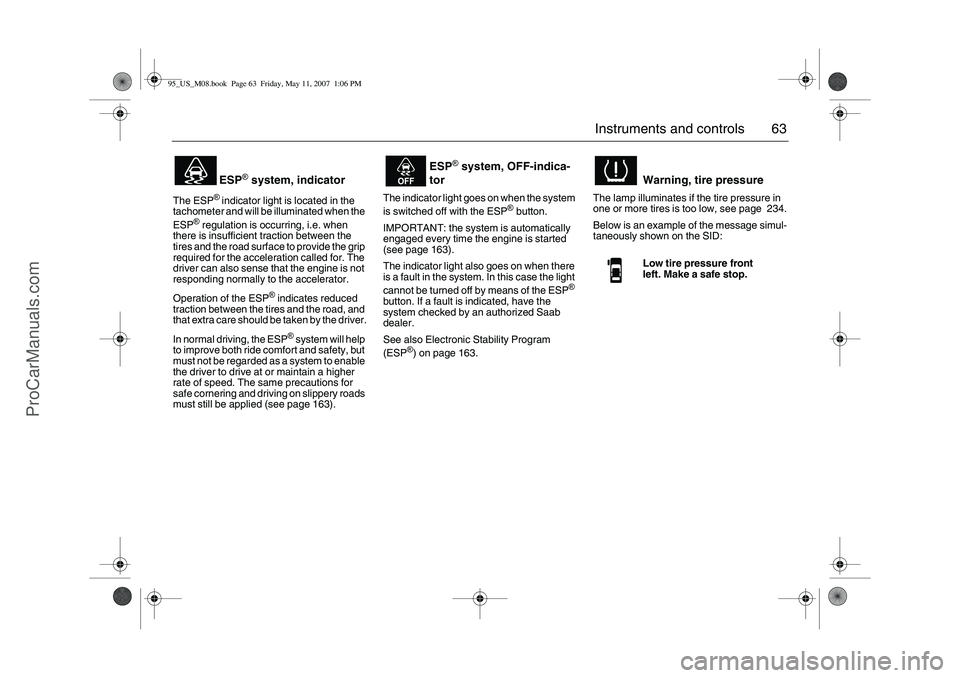
The ESP
® indicator light is located in the
tachometer and will be illuminated when the
ESP
® regulation is occurring, i.e. when
there is insufficient traction between the
tires and the road surface to provide the grip
required for the acceleration called for. The
driver can also sense that the engine is not
responding normally to the accelerator.
Operation of the ESP
® indicates reduced
traction between the tires and the road, and
that extra care should be taken by the driver.
In normal driving, the ESP
® system will help
to improve both ride comfort and safety, but
must not be regarded as a system to enable
the driver to drive at or maintain a higher
rate of speed. The same precautions for
safe cornering and driving on slippery roads
must still be applied (see page 163).The indicator light goes on when the system
is switched off with the ESP
® button.
IMPORTANT: the system is automatically
engaged every time the engine is started
(see page 163).
The indicator light also goes on when there
is a fault in the system. In this case the light
cannot be turned off by means of the ESP
®
button. If a fault is indicated, have the
system checked by an authorized Saab
dealer.
See also Electronic Stability Program
(ESP
®) on page 163.The lamp illuminates if the tire pressure in
one or more tires is too low, see page 234.
Below is an example of the message simul-
taneously shown on the SID:
ESP
® system, indicator
ESP
® system, OFF-indica-
tor
Warning, tire pressureLow tire pressure front
left. Make a safe stop.
95_US_M08.book Page 63 Friday, May 11, 2007 1:06 PM
ProCarManuals.com
Page 64 of 288
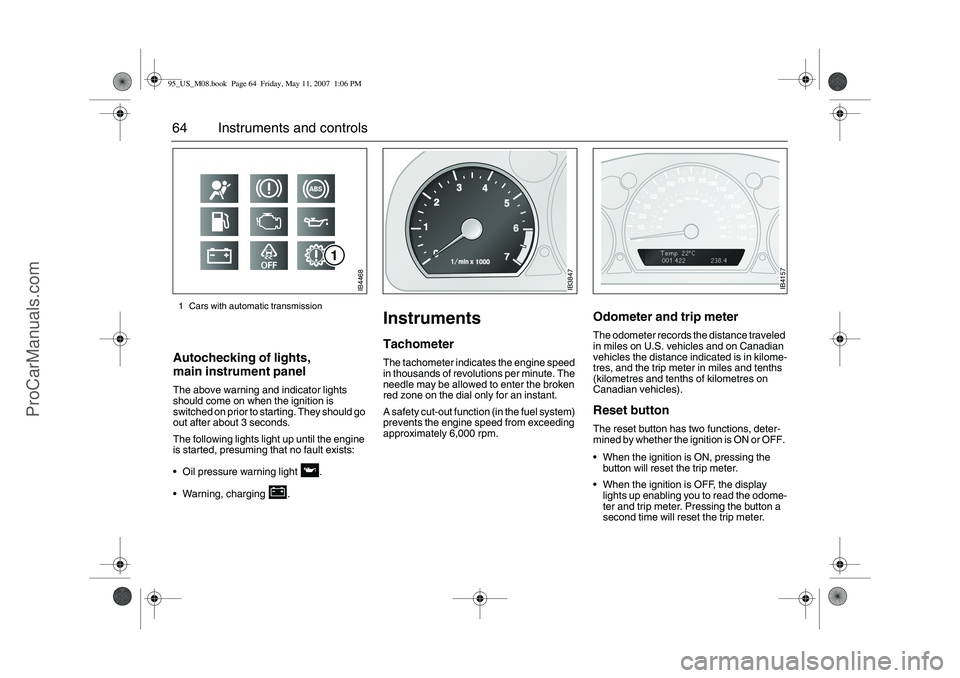
64 Instruments and controlsAutochecking of lights,
main instrument panel The above warning and indicator lights
should come on when the ignition is
switched on prior to starting. They should go
out after about 3 seconds.
The following lights light up until the engine
is started, presuming that no fault exists:
Oil pressure warning light .
Warning, charging .
InstrumentsTachometerThe tachometer indicates the engine speed
in thousands of revolutions per minute. The
needle may be allowed to enter the broken
red zone on the dial only for an instant.
A safety cut-out function (in the fuel system)
prevents the engine speed from exceeding
approximately 6,000 rpm.
Odometer and trip meter The odometer records the distance traveled
in miles on U.S. vehicles and on Canadian
vehicles the distance indicated is in kilome-
tres, and the trip meter in miles and tenths
(kilometres and tenths of kilometres on
Canadian vehicles). Reset button The reset button has two functions, deter-
mined by whether the ignition is ON or OFF.
When the ignition is ON, pressing the
button will reset the trip meter.
When the ignition is OFF, the display
lights up enabling you to read the odome-
ter and trip meter. Pressing the button a
second time will reset the trip meter.
IB4468
1 Cars with automatic transmission
IB3847
IB4157
95_US_M08.book Page 64 Friday, May 11, 2007 1:06 PM
ProCarManuals.com
Page 65 of 288
65 Instruments and controls
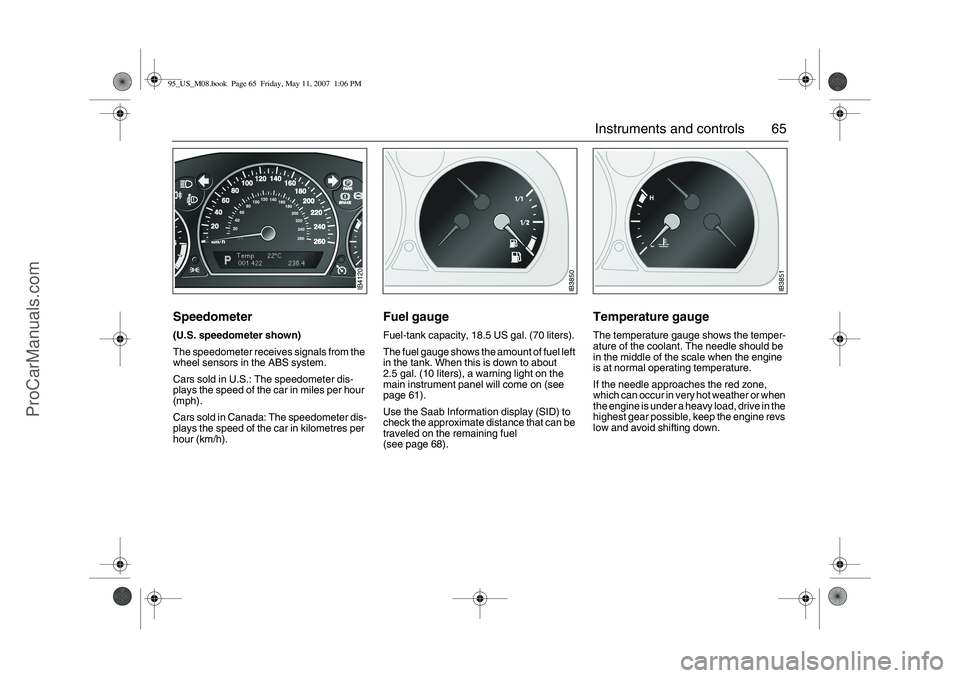
Speedometer(U.S. speedometer shown)
The speedometer receives signals from the
wheel sensors in the ABS system.
Cars sold in U.S.: The speedometer dis-
plays the speed of the car in miles per hour
(mph).
Cars sold in Canada: The speedometer dis-
plays the speed of the car in kilometres per
hour (km/h).
Fuel gauge Fuel-tank capacity, 18.5 US gal. (70 liters).
The fuel gauge shows the amount of fuel left
in the tank. When this is down to about
2.5 gal. (10 liters), a warning light on the
main instrument panel will come on (see
page 61).
Use the Saab Information display (SID) to
check the approximate distance that can be
traveled on the remaining fuel
(see page 68).
Temperature gauge The temperature gauge shows the temper-
ature of the coolant. The needle should be
in the middle of the scale when the engine
is at normal operating temperature.
If the needle approaches the red zone,
which can occur in very hot weather or when
the engine is under a heavy load, drive in the
highest gear possible, keep the engine revs
low and avoid shifting down.
IB4120
IB3850
IB3851
95_US_M08.book Page 65 Friday, May 11, 2007 1:06 PM
ProCarManuals.com
Page 72 of 288
72 Instruments and controlsNIGHT PANELTo improve night-driving conditions inside
the car, the Night Panel mode can be
selected. In this mode, the amount of infor-
mation displayed is reduced, and only the
most important instruments and displays
will be illuminated.
When the NIGHT PANEL button is pressed,
only the speedometer will be illuminated, all
the other instruments illumination being
extinguished and their needles moved to
zero. The SID display will be extinguished
and the backlighting for switches and other
controls will be dimmed. Note: All indicator
and warning lights, together with the display
of CHECK messages, will operate as nor-
mal, except ”Outdoor temperature”, see
page 68.The following conditions will wake up the
respective displays in the Night-Panel
mode:
Setting of the Audio system or, SID
(display comes on for ten seconds).
CHECK message generated in the SID.
High engine revs cause the rev counter to
be illuminated until the engine speed has
fallen again.
If the quantity of fuel remaining falls below
4 gallons (15 liters), the fuel gauge will be
illuminated.
If the engine temperature rises above
normal, the temperature gauge will be illu-
minated.
In cars with automatic transmission, if the
selector lever is moved from D to position
M or L, the selector indication on the main
instrument panel will be illuminated.
To restore the displays and lighting to the
normal mode, press the NIGHT PANEL but-
ton.
Units and language versionsThe SID has four sets of units: CHECK messages can be displayed in six
language options: English, Swedish,
German, French, Italian and Spanish. Selecting units and language 1 Switch off the engine.
2 Briefly press i/SETbutton. Repeat this
until LANGUAGE/UNITS is displayed.
3 Hold i/SET depressed until a chime
sounds. Then select language using
or .
4 Briefly press the i/SET button. Then
select the units using or .
5 Briefly press the i/SET button. METRIC US GB IMPERIAL
km miles miles miles
km/h mph mph mph
liters US gal gallon gallon
°C °F °C °F
24-hour 12-hour 12-hour 12-hour
95_US_M08.book Page 72 Friday, May 11, 2007 1:06 PM
ProCarManuals.com
Page 74 of 288
74 Instruments and controlsCourtesy Headlight FeatureA delay function allows the headlights to
remain on low beam for about 30 seconds
after the driver’s door has been closed.
To activate this function,
Switch off the ignition and remove the key
Open the driver’s door
Pull the high/low beam control stalk
towards the steering wheel like you are
flashing the high beam, see page 73. The
low beam headlights will now come on
immediately after the driver’s door has
been closed (within 30 seconds) and will
remain on for about 30 seconds.
The length of time for this function can be
adjusted by your authorized Saab dealer.
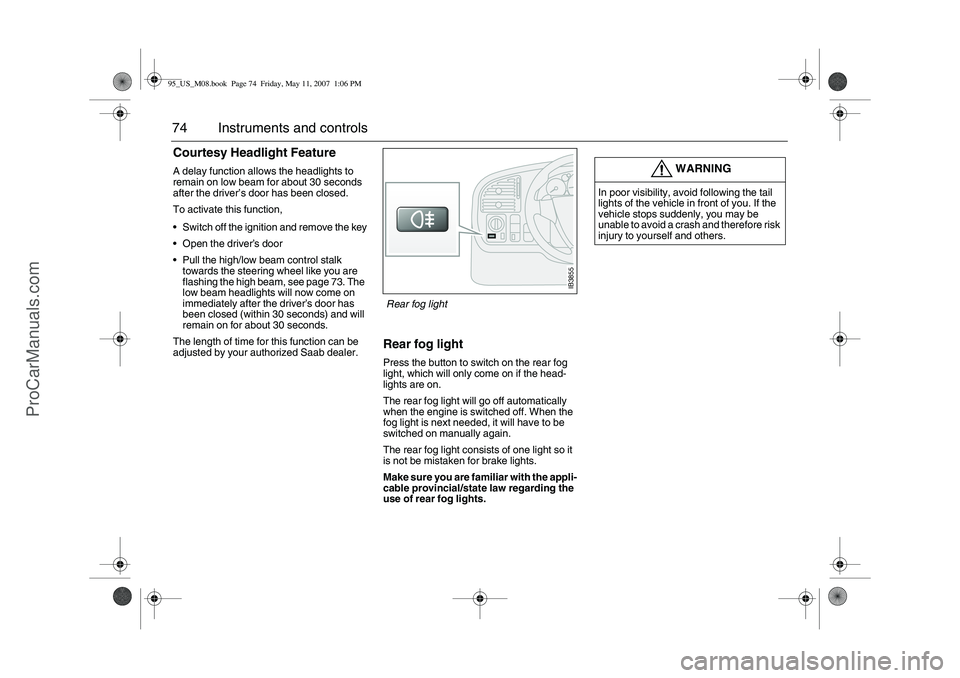
Rear fog lightPress the button to switch on the rear fog
light, which will only come on if the head-
lights are on.
The rear fog light will go off automatically
when the engine is switched off. When the
fog light is next needed, it will have to be
switched on manually again.
The rear fog light consists of one light so it
is not be mistaken for brake lights.
Make sure you are familiar with the appli-
cable provincial/state law regarding the
use of rear fog lights.
WARNING
In poor visibility, avoid following the tail
lights of the vehicle in front of you. If the
vehicle stops suddenly, you may be
unable to avoid a crash and therefore risk
injury to yourself and others.
IB3855
Rear fog light
95_US_M08.book Page 74 Friday, May 11, 2007 1:06 PM
ProCarManuals.com
Page 76 of 288
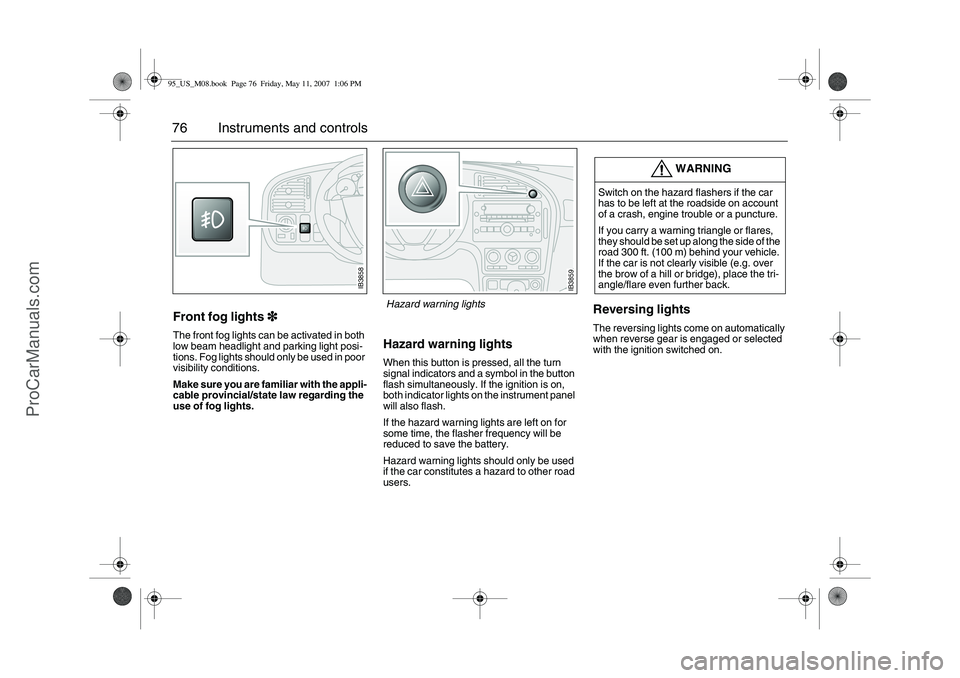
76 Instruments and controlsFront fog lights3
33 3The front fog lights can be activated in both
low beam headlight and parking light posi-
tions. Fog lights should only be used in poor
visibility conditions.
Make sure you are familiar with the appli-
cable provincial/state law regarding the
use of fog lights.
Hazard warning lightsWhen this button is pressed, all the turn
signal indicators and a symbol in the button
flash simultaneously. If the ignition is on,
both indicator lights on the instrument panel
will also flash.
If the hazard warning lights are left on for
some time, the flasher frequency will be
reduced to save the battery.
Hazard warning lights should only be used
if the car constitutes a hazard to other road
users.
Reversing lightsThe reversing lights come on automatically
when reverse gear is engaged or selected
with the ignition switched on.
WARNING
Switch on the hazard flashers if the car
has to be left at the roadside on account
of a crash, engine trouble or a puncture.
If you carry a warning triangle or flares,
they should be set up along the side of the
road 300 ft. (100 m) behind your vehicle.
If the car is not clearly visible (e.g. over
the brow of a hill or bridge), place the tri-
angle/flare even further back.
IB3858
IB3859
Hazard warning lights
95_US_M08.book Page 76 Friday, May 11, 2007 1:06 PM
ProCarManuals.com
Page 77 of 288
77 Instruments and controls
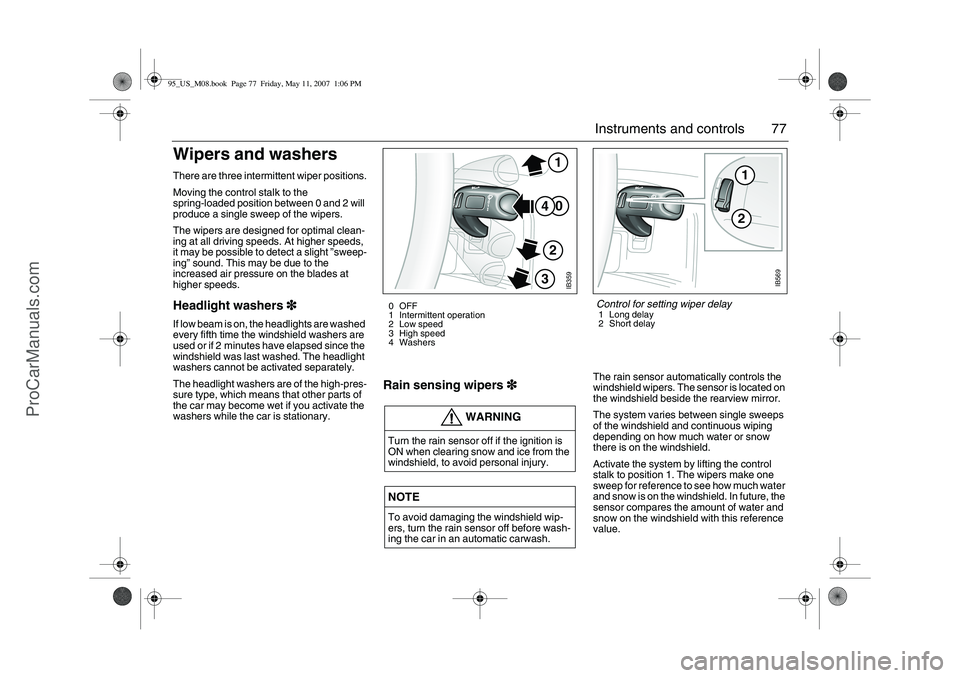
Wipers and washers There are three intermittent wiper positions.
Moving the control stalk to the
spring-loaded position between 0 and 2 will
produce a single sweep of the wipers.
The wipers are designed for optimal clean-
ing at all driving speeds. At higher speeds,
it may be possible to detect a slight ”sweep-
ing” sound. This may be due to the
increased air pressure on the blades at
higher speeds.Headlight washers3
33 3If low beam is on, the headlights are washed
every fifth time the windshield washers are
used or if 2 minutes have elapsed since the
windshield was last washed. The headlight
washers cannot be activated separately.
The headlight washers are of the high-pres-
sure type, which means that other parts of
the car may become wet if you activate the
washers while the car is stationary.
Rain sensing wipers3
33 3
The rain sensor automatically controls the
windshield wipers. The sensor is located on
the windshield beside the rearview mirror.
The system varies between single sweeps
of the windshield and continuous wiping
depending on how much water or snow
there is on the windshield.
Activate the system by lifting the control
stalk to position 1. The wipers make one
sweep for reference to see how much water
and snow is on the windshield. In future, the
sensor compares the amount of water and
snow on the windshield with this reference
value.
WARNING
Turn the rain sensor off if the ignition is
ON when clearing snow and ice from the
windshield, to avoid personal injury.NOTETo avoid damaging the windshield wip-
ers, turn the rain sensor off before wash-
ing the car in an automatic carwash.
IB359
0
41
2
3
0OFF
1 Intermittent operation
2 Low speed
3 High speed
4 Washers
12
IB569
Control for setting wiper delay1 Long delay
2 Short delay
95_US_M08.book Page 77 Friday, May 11, 2007 1:06 PM
ProCarManuals.com
Page 130 of 288
130 Interior equipment and trunk
WARNING
Place heavy items closest to the backrest and stow smaller
and lighter items on top.
Never overload the cargo net3. If the elastic breaks this may
cause personal injury. Do not use a cargo net that shows signs
of wear.
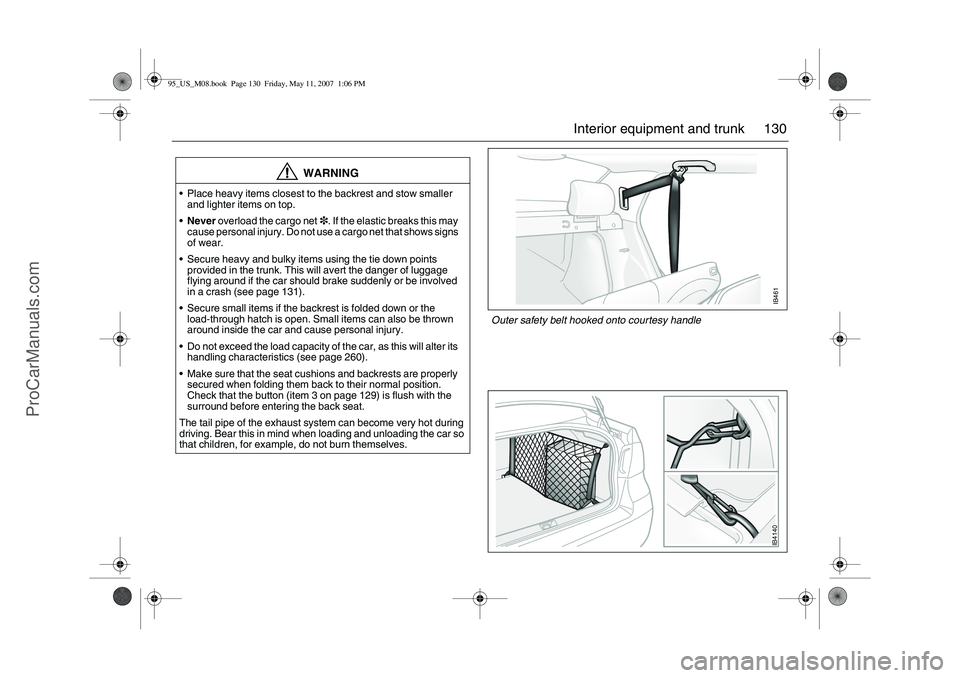
Secure heavy and bulky items using the tie down points
provided in the trunk. This will avert the danger of luggage
flying around if the car should brake suddenly or be involved
in a crash (see page 131).
Secure small items if the backrest is folded down or the
load-through hatch is open. Small items can also be thrown
around inside the car and cause personal injury.
Do not exceed the load capacity of the car, as this will alter its
handling characteristics (see page 260).
Make sure that the seat cushions and backrests are properly
secured when folding them back to their normal position.
Check that the button (item 3 on page 129) is flush with the
surround before entering the back seat.
The tail pipe of the exhaust system can become very hot during
driving. Bear this in mind when loading and unloading the car so
that children, for example, do not burn themselves.
IB4140IB461
Outer safety belt hooked onto courtesy handle
95_US_M08.book Page 130 Friday, May 11, 2007 1:06 PM
ProCarManuals.com