belt SAAB 9-5 2008 Owner's Guide
[x] Cancel search | Manufacturer: SAAB, Model Year: 2008, Model line: 9-5, Model: SAAB 9-5 2008Pages: 288, PDF Size: 27.54 MB
Page 131 of 288
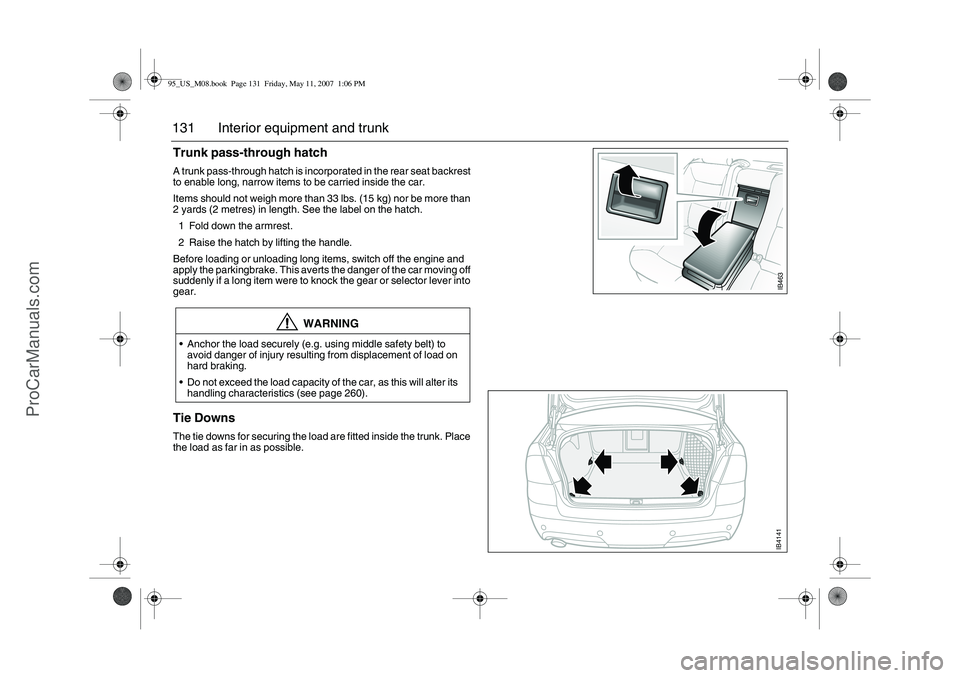
131 Interior equipment and trunkTrunk pass-through hatch A trunk pass-through hatch is incorporated in the rear seat backrest
to enable long, narrow items to be carried inside the car.
Items should not weigh more than 33 lbs. (15 kg) nor be more than
2 yards (2 metres) in length. See the label on the hatch.
1 Fold down the armrest.
2 Raise the hatch by lifting the handle.
Before loading or unloading long items, switch off the engine and
apply the parkingbrake. This averts the danger of the car moving off
suddenly if a long item were to knock the gear or selector lever into
gear. Tie DownsThe tie downs for securing the load are fitted inside the trunk. Place
the load as far in as possible.
WARNING
Anchor the load securely (e.g. using middle safety belt) to
avoid danger of injury resulting from displacement of load on
hard braking.
Do not exceed the load capacity of the car, as this will alter its
handling characteristics (see page 260).
IB463IB4141
95_US_M08.book Page 131 Friday, May 11, 2007 1:06 PM
ProCarManuals.com
Page 132 of 288
132 Interior equipment and trunk
Folding the rear seat, 9-5 SportCombiBoth the narrow and wide sections of the rear seat can be folded
separately. Folding is facilitated if the front seats are not located too
far back. The wide section cannot be folded separately if a cargo net
(accessory) is mounted on the rear of the backrest.
1 Make sure that the head restraint is in the down position. For
height adjustment refer to page 21.
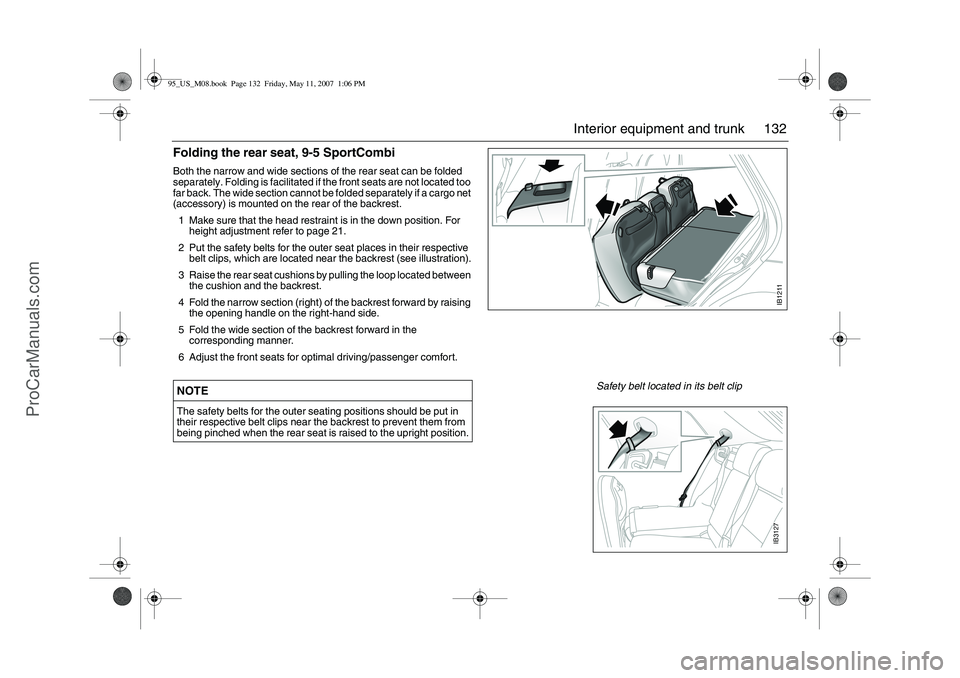
2 Put the safety belts for the outer seat places in their respective
belt clips, which are located near the backrest (see illustration).
3 Raise the rear seat cushions by pulling the loop located between
the cushion and the backrest.
4 Fold the narrow section (right) of the backrest forward by raising
the opening handle on the right-hand side.
5 Fold the wide section of the backrest forward in the
corresponding manner.
6 Adjust the front seats for optimal driving/passenger comfort. NOTEThe safety belts for the outer seating positions should be put in
their respective belt clips near the backrest to prevent them from
being pinched when the rear seat is raised to the upright position.
IB1211IB3127
Safety belt located in its belt clip
95_US_M08.book Page 132 Friday, May 11, 2007 1:06 PM
ProCarManuals.com
Page 133 of 288
133 Interior equipment and trunk
Parcel shelf, 9-5 SportCombiFold the parcel shelf as follows:
1 Press the rear edge of the shelf downwards and forwards.
2 Continue pressing the folded section forward until it is folded over
the front section.
Extend the parcel shelf as follows:
1 Hold the rear edge of the shelf and pull it back.
2 The shelf rests on a track located beneath the rear side windows.
Make sure that the rear corner fits in the recess. Otherwise it will
not lie flat.
Alternative location of the parcel shelf if this is removed:
Folded up on the floor at the rear of the luggage compartment.
On its end on the floor behind the front seat backrest.
WARNING
Do not travel in the back seat without ensuring that the head
restraint is set at a suitable height for the seats to be occupied.
Never allow anyone to sit on a folded backrest.
Always be aware of the risk of pinching when handling moving
parts of the seating.
Never place heavy objects on the parcel shelf. There is always
a danger of loose objects flying about and causing injury if the
car should brake suddenly or be involved in a crash.
Make sure that the backrests are locked when they are folded
back upright. Check that the two red warning-indication flags
are fully down. This indicates that the backrests are locked.
Check that the safety belt lock is not trapped under the seat
cushions when these are raised back up.
Never leave a child or animal unattended in the car. During
sunny weather the temperature in the passenger and luggage
compartments can climb to 158–176°F (70–80°C). Small chil-
dren are very susceptible to heat stroke.95_US_M08.book Page 133 Friday, May 11, 2007 1:06 PM
ProCarManuals.com
Page 134 of 288
134 Interior equipment and trunk
Folding the narrow section of the backrestThe folding is facilitated if the front seat is not too far back.
1 Make sure that the head restraint is in the down position. For
height adjustment refer to page 21.
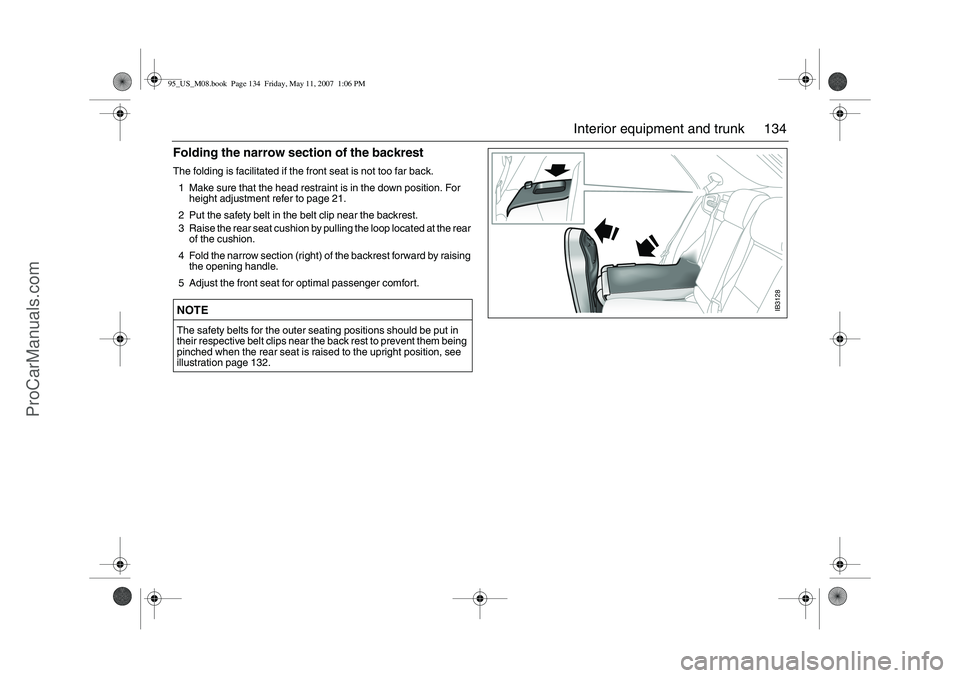
2 Put the safety belt in the belt clip near the backrest.
3 Raise the rear seat cushion by pulling the loop located at the rear
of the cushion.
4 Fold the narrow section (right) of the backrest forward by raising
the opening handle.
5 Adjust the front seat for optimal passenger comfort.NOTEThe safety belts for the outer seating positions should be put in
their respective belt clips near the back rest to prevent them being
pinched when the rear seat is raised to the upright position, see
illustration page 132.
IB3128
95_US_M08.book Page 134 Friday, May 11, 2007 1:06 PM
ProCarManuals.com
Page 135 of 288
135 Interior equipment and trunk
Load anchoring
Driving with the trunk lid/tailgate open,
see page 183.
WARNING
Put heavy loads as low down and as
far forward as possible in the luggage
compartment, i.e. against the back of
the rear seat.
Never overload the cargo net3. If the
elastic breaks this may cause personal
injury. Do not use a cargo net that
shows signs of wear.
Never stack cargo so high that any part
of the cargo lies above the edge of the
backrest, if a cargo guard3 is not
being used.
Always tie down the cargo so that it
cannot be thrown forward during
heavy braking or in the event of a
crash.
Unsecured and heavy cargo can
increase the risk of injury during hard
braking, sudden avoidance maneu-
vers and in the event of a crash.
For the best load anchoring, use the
special cargo tie down eye and load
straps3.
Load the cargo tie down eyes evenly.
Never attach more than one strap to
each tie down eye.
Provide protection on sharp edges to
prevent damage to the load straps.
Never use the elastic floor net3 and
elastic side net (accessory) when the
rear seat is folded down. These nets
are only intended to keep light objects
tidy, not for the anchoring of loads.
If possible, avoid having the rear seat
folded down when driving with a heavy
load because the anchoring possibili-
ties are restricted when the rear seat is
in this position. That the rear seat is
in the upright position is a basic
requirement for protection against
cargo displacement in the event of
a crash.
Cargo can intrude into the passenger
compartment during a sudden stop or
front crash if the outer safety belts are
not fastened. Check that the two red
warning-indication flags are fully
down. This shows that the backrests
are locked.
WARNING
Match the speed and driving style
according to how the car is loaded.
The driving characteristics of the car
can be affected because the center of
gravity is altered when there is a cargo
in the luggage compartment.
An object weighing 55 lbs. (25 kg) cor-
responds to a weight of 2200 lbs.
(1000 kg) in a head on crash at
32 mph (50 km/h).
Adjust the car’s load (passengers and
luggage) so that the gross vehicle
weight or the axle weight is not
exceeded, see page 260.
95_US_M08.book Page 135 Friday, May 11, 2007 1:06 PM
ProCarManuals.com
Page 189 of 288
189 Car care and technical information
IB3888
Hood ________________ 190
Engine compartment __ 191
Emission control
systems ____________ 192
Engine ______________ 194
Engine oil ____________ 194
Transmission fluid ____ 195
Coolant ______________ 195
Brake and clutch fluid__ 196
Power steering fluid ___ 198
Air filter _____________ 198
Battery ______________ 199
Drive belts ___________ 201
Wipers and washers ___ 202
Changing bulbs _______ 204
Fuses _______________ 216 Tires ________________ 222
Automatic tire pressure
monitoring system ___ 234
Compact spare tire ____ 237
Safety belts __________ 242
Upholstery and trim ___ 243
Textile carpeting ______ 243
Washing the car ______ 244
Waxing and polishing __ 245
Engine compartment __ 245
Touching up the paint _ 245
Air conditioning (ACC) _ 246
Anti-corrosion treatment 248
For long trips _________ 249
Recovery and/or
recycling of automotive
materials ___________ 250
Headlight aiming ______ 250
Car care and technical information
3 Asterisk means: equipment not fitted in all cars
(can depend on model variant, engine variant,
market specification, options or accessories).95_US_M08.book Page 189 Friday, May 11, 2007 1:06 PM
ProCarManuals.com
Page 201 of 288
201 Car care and technical information
Drive belts
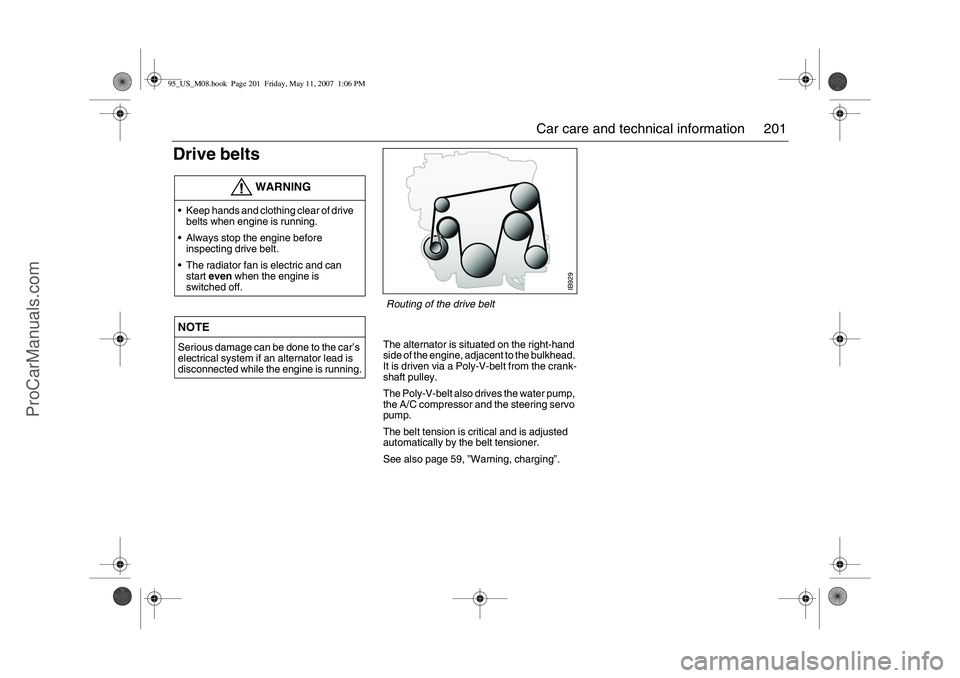
The alternator is situated on the right-hand
side of the engine, adjacent to the bulkhead.
It is driven via a Poly-V-belt from the crank-
shaft pulley.
The Poly-V-belt also drives the water pump,
the A/C compressor and the steering servo
pump.
The belt tension is critical and is adjusted
automatically by the belt tensioner.
See also page 59, ”Warning, charging”.
WARNING
Keep hands and clothing clear of drive
belts when engine is running.
Always stop the engine before
inspecting drive belt.
The radiator fan is electric and can
start even when the engine is
switched off.NOTESerious damage can be done to the car’s
electrical system if an alternator lead is
disconnected while the engine is running.
IB929
Routing of the drive belt
95_US_M08.book Page 201 Friday, May 11, 2007 1:06 PM
ProCarManuals.com
Page 215 of 288
215 Car care and technical information
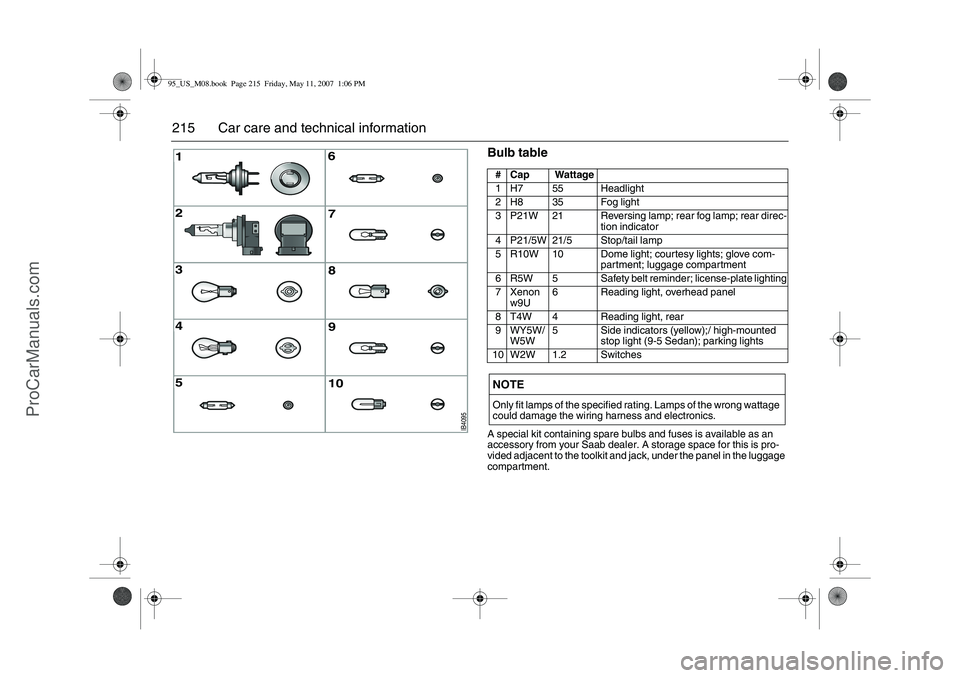
Bulb tableA special kit containing spare bulbs and fuses is available as an
accessory from your Saab dealer. A storage space for this is pro-
vided adjacent to the toolkit and jack, under the panel in the luggage
compartment.# Cap Wattage
1 H7 55 Headlight
2 H8 35 Fog light
3 P21W 21 Reversing lamp; rear fog lamp; rear direc-
tion indicator
4 P21/5W 21/5 Stop/tail lamp
5 R10W 10 Dome light; courtesy lights; glove com-
partment; luggage compartment
6 R5W 5 Safety belt reminder; license-plate lighting
7 Xenon
w9U6 Reading light, overhead panel
8 T4W 4 Reading light, rear
9WY5W/
W5W5 Side indicators (yellow);/ high-mounted
stop light (9-5 Sedan); parking lights
10 W2W 1.2 SwitchesNOTEOnly fit lamps of the specified rating. Lamps of the wrong wattage
could damage the wiring harness and electronics.
12345
678910
IB4095
95_US_M08.book Page 215 Friday, May 11, 2007 1:06 PM
ProCarManuals.com
Page 217 of 288
217 Car care and technical information
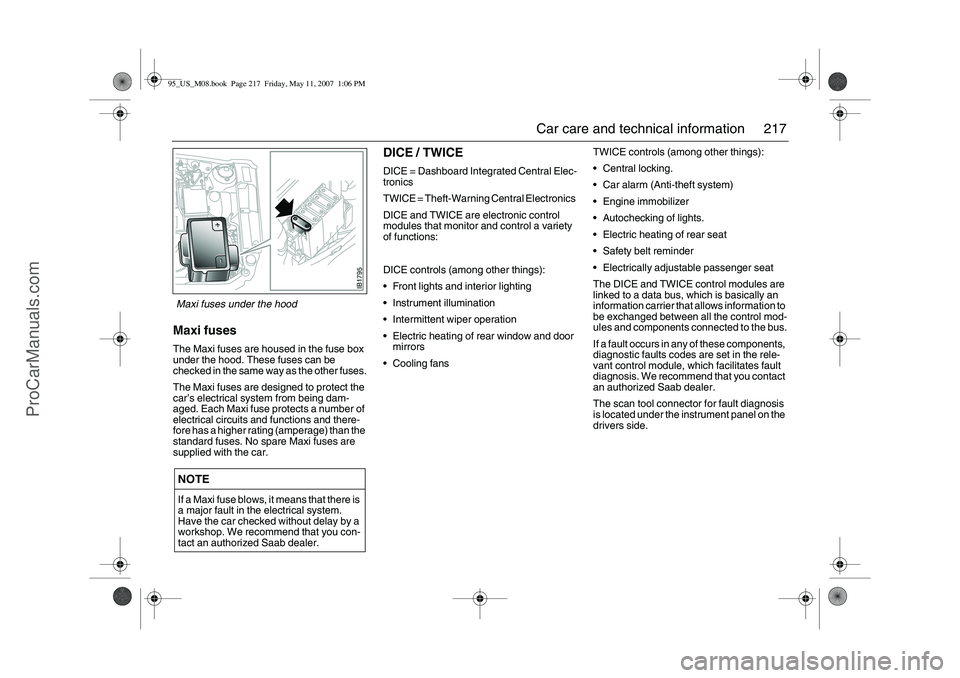
Maxi fusesThe Maxi fuses are housed in the fuse box
under the hood. These fuses can be
checked in the same way as the other fuses.
The Maxi fuses are designed to protect the
car’s electrical system from being dam-
aged. Each Maxi fuse protects a number of
electrical circuits and functions and there-
fore has a higher rating (amperage) than the
standard fuses. No spare Maxi fuses are
supplied with the car.
DICE / TWICEDICE = Dashboard Integrated Central Elec-
tronics
TWICE = Theft-Warning Central Electronics
DICE and TWICE are electronic control
modules that monitor and control a variety
of functions:
DICE controls (among other things):
Front lights and interior lighting
Instrument illumination
Intermittent wiper operation
Electric heating of rear window and door
mirrors
Cooling fansTWICE controls (among other things):
Central locking.
Car alarm (Anti-theft system)
Engine immobilizer
Autochecking of lights.
Electric heating of rear seat
Safety belt reminder
Electrically adjustable passenger seat
The DICE and TWICE control modules are
linked to a data bus, which is basically an
information carrier that allows information to
be exchanged between all the control mod-
ules and components connected to the bus.
If a fault occurs in any of these components,
diagnostic faults codes are set in the rele-
vant control module, which facilitates fault
diagnosis. We recommend that you contact
an authorized Saab dealer.
The scan tool connector for fault diagnosis
is located under the instrument panel on the
drivers side.
NOTEIf a Maxi fuse blows, it means that there is
a major fault in the electrical system.
Have the car checked without delay by a
workshop. We recommend that you con-
tact an authorized Saab dealer.
IB1795
Maxi fuses under the hood 95_US_M08.book Page 217 Friday, May 11, 2007 1:06 PM
ProCarManuals.com
Page 219 of 288
219 Car care and technical information
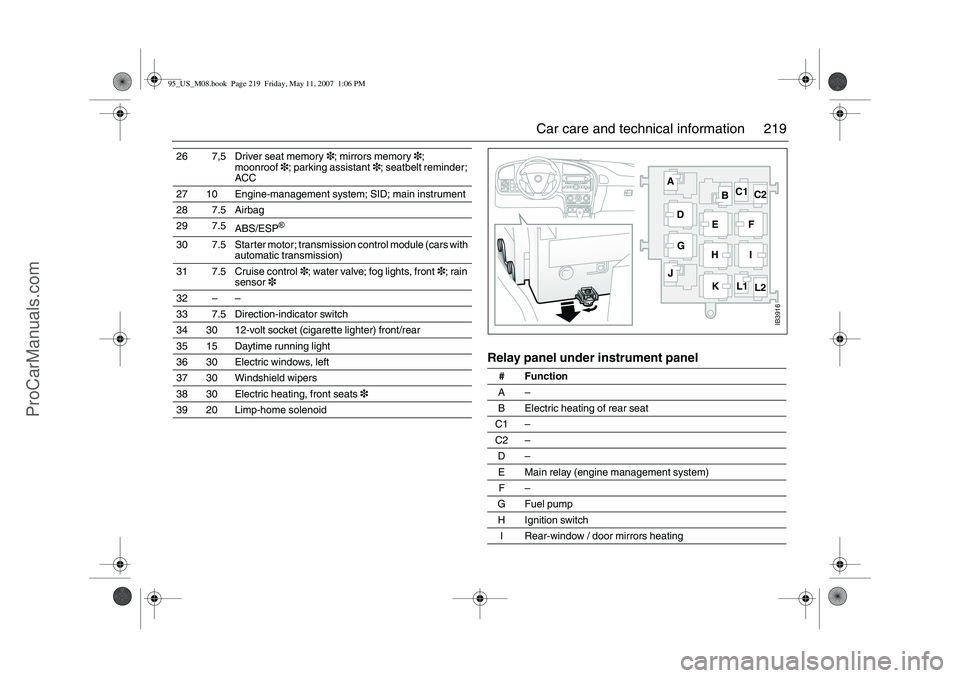
Relay panel under instrument panel
26 7,5 Driver seat memory3; mirrors memory3;
moonroof3; parking assistant3; seatbelt reminder;
ACC
27 10 Engine-management system; SID; main instrument
28 7.5 Airbag
29 7.5
ABS/ESP
®
30 7.5 Starter motor; transmission control module (cars with
automatic transmission)
31 7.5 Cruise control3; water valve; fog lights, front3; rain
sensor3
32––
33 7.5 Direction-indicator switch
34 30 12-volt socket (cigarette lighter) front/rear
35 15 Daytime running light
36 30 Electric windows, left
37 30 Windshield wipers
38 30 Electric heating, front seats3
39 20 Limp-home solenoid
# Function
A –
B Electric heating of rear seat
C1 –
C2–
D–
E Main relay (engine management system)
F–
GFuel pump
H Ignition switch
I Rear-window / door mirrors heating
IB3916
A
BC1
C2
L2 L1 D
GE
F
H
I
K J
95_US_M08.book Page 219 Friday, May 11, 2007 1:06 PM
ProCarManuals.com