service SAAB 9-5 2008 Owner's Guide
[x] Cancel search | Manufacturer: SAAB, Model Year: 2008, Model line: 9-5, Model: SAAB 9-5 2008Pages: 288, PDF Size: 27.54 MB
Page 204 of 288
204 Car care and technical informationChanging bulbs
Check that the new bulb is working when
finished.
Use only "Long Life" bulbs.
Headlight aiming, see page 250.
Xenon headlight3
33 3Xenon headlights produce roughly twice as
much light as halogen bulbs and have a sig-
nificantly longer service life.
The lamp units consist of a gas discharge
lamp containing xenon. When the lights are
switched on a very high voltage activates
the xenon gas. The lamps soon reach full
intensity.
Cars with xenon headlights have automatic
levelling. The levelling system comprises
two sensors, one on the front axle, one on
the rear axle and a control unit under each
of the two headlight housings. Headlight
alignment is regulated automatically to pre-
vent dazzling oncoming traffic. Alignment is
also adjusted during braking.
WARNING
Before changing a bulb in the engine bay,
switch off the engine to avoid danger of
fingers and hands being injured by
moving parts.
The radiator fan can start up even when
the engine is switched off.
Xenon headlights3
33 3 are high voltage
and must therefore be changed at a
workshop. We recommend that you
contact an authorized Saab work-
shop. Work involving high-voltage
components is potentially lethal.NOTESince the headlight lenses are made
of plastic, rinse dried-on dirt with
water and allow it time to soften up
before cleaning the lenses. Avoid
rubbing the lenses when dry and
never use solvents.
Use de-icer spray instead of scraping
the ice off.
NOTEDo not fit bulbs with a higher rating
than 55 W, since the headlight reflec-
tor and the wiring of the car are not
designed for a higher wattage.
Switch off the ignition before chang-
ing a bulb, to avoid possible short-cir-
cuiting.
Do not touch the glass of the bulbs
with your fingers. The oil on your skin
can shorten the life of the bulb.
95_US_M08.book Page 204 Friday, May 11, 2007 1:06 PM
ProCarManuals.com
Page 222 of 288

222 Car care and technical informationTires Your new vehicle comes with high-quality
tires made by a leading tire manufacturer. If
you ever have questions about your tire
warranty and where to obtain service, see
your Saab Warranty and Service Record
Booklet for details.
Inflation - Tire PressureThe Tire-Loading Information label shows
the correct inflation pressures for your tires
when they’re cold. “Cold” means your vehi-
cle has been sitting for at least three hours
or driven no more than 1 mile (1.6 km).
Notice: Don’t let anyone tell you that
underinflation or overinflation is all
right. It’s not. If your tires don’t have
enough air (underinflation), you can get
the following:
Too much flexing
Too much heat
Tire overloading
Bad wear
Bad handling
Bad fuel economy
If your tires have too much air (overinfla-
tion), you can get the following:
Unusual wear
Bad handling
Rough ride
Needless damage from road hazardsAdjust the tire pressure to match the current
load and speed of the car (see page 269).
The stated tire pressures apply to cold tires,
i.e. tires that are the same temperature as
the outside air temperature. Tire pressure
increases as the tires become warm (e.g.
during highway driving) by approximately
0.3 bar (4 psi). When the temperature of the
tires changes by 50°F (10°C), the tire pres-
sure will change 0.1 bar (2 psi).
Never reduce the pressure of a hot tire. If the
tires are hot when you check them, only
increase the pressure, if necessary.
WARNING
Poorly maintained and improperly used
tires are dangerous.
Overloading your tires can cause
overheating as a result of too much
friction. You could have an blow-out
and a serious accident. See “Loading
Your Vehicle” on page 231.
Underinflated tires pose the same
danger as overloaded tires. The
resulting accident could cause serious
injury. Check all tires frequently to
maintain the recommended pressure.
Tire pressure should be checked
when your tires are cold.
Overinflated tires are more likely to be
cut, punctured or broken by a sudden
impact – such as when you hit a pot-
hole. Keep tires at the recommended
pressure.
Worn, old tires can cause accidents. If
your tread is badly worn, or if your tires
have been damaged, replace them.95_US_M08.book Page 222 Friday, May 11, 2007 1:06 PM
ProCarManuals.com
Page 226 of 288

226 Car care and technical informationUniform Tire Quality GradingQuality grades can be found where applica-
ble on the tire sidewall between tread shoul-
der and maximum section width. For exam-
ple:
Treadwear 200 Traction AA
Temperature A
The following information relates to the
system developed by the United States
National Highway Traffic Safety Administra-
tion, which grades tires by treadwear, trac-
tion and temperature performance. (This
applies only to vehicles sold in the United
States.) The grades are molded on the side-
walls of most passenger car tires. The Uni-
form Tire Quality Grading system does not
apply to deep tread, winter-type snow tires,
space-saver or temporary use spare tires,
tires with nominal rim diameters of 10 to 12
inches (25 to 30 cm), or to some limited-pro-
duction tires.
While the tires available on General Motors
passenger cars and light trucks may vary
with respect to these grades, they must also
conform to federal safety requirements and
additional General Motors Tire Perfor-
mance Criteria (TPC) standards.Treadwear
The treadwear grade is a comparative
rating based on the wear rate of the tire
when tested under controlled conditions on
a specified government test course. For
example, a tire graded 150 would wear one
and a half (1.5) times as well on the govern-
ment course as a tire graded 100. The rela-
tive performance of tires depends upon the
actual conditions of their use, however, and
may depart significantly from the norm due
to variations in driving habits, service prac-
tices and differences in road characteristics
and climate.
Traction – AA, A, B, C
The traction grades, from highest to lowest,
are AA, A, B, and C. Those grades repre-
sent the tire’s ability to stop on wet pave-
ment as measured under controlled condi-
tions on specified government test surfaces
of asphalt and concrete. A tire marked C
may have poor traction performance. Warn-
ing: The traction grade assigned to this tire
is based on straight-ahead braking traction
tests, and does not include acceleration,
cornering, hydroplaning, or peak traction
characteristics.Temperature – A, B, C
The temperature grades are A (the highest),
B, and C, representing the tire’s resistance
to the generation of heat and its ability to dis-
sipate heat when tested under controlled
conditions on a specified indoor laboratory
test wheel. Sustained high temperature can
cause the material of the tire to degenerate
and reduce tire life, and excessive temper-
ature can lead to sudden tire failure. The
grade C corresponds to a level of perfor-
mance which all passenger car tires must
meet under the Federal Motor Vehicle
Safety Standard No. 109. Grades B and A
represent higher levels of performance on
the laboratory test wheel than the minimum
required by law.
Warning: The temperature grade for this tire
is established for a tire that is properly
inflated and not overloaded. Excessive
speed, underinflation, or excessive loading,
either separately or in combination, can
cause heat buildup and possible tire failure.95_US_M08.book Page 226 Friday, May 11, 2007 1:06 PM
ProCarManuals.com
Page 229 of 288
229 Car care and technical information
Tire Sidewall LabelingUseful information about a tire is molded
into it´s sidewall.
Tire size: The tire size ia a combination of
letters and numbers used to define a partic-
ular tire´s width, height, aspect ratio, con-
struction type and service description.
Department of Transportation (DOT):
The Department of Transportation (DOT)
code indicates that the tire is in compliance
with the U.S. Department of Transportation
Motor Vehicle Safety standards.
Tire Identification Number (TIN): The let-
ters and numbers following DOT code are
the Tire Identification Number (TIN). The
TIN shows the manufacturer and plant
code, tire size, and date the tire was manu-
factured. The TIN is molded onto both sides
of the tire.
Tire Ply Material: The type of cord and
number of plies in the sidewall and under
the tread.Uniform Tire Quality Grading (UTQG):
Tire manufacturers are required to grade
tires based on performance factors: tread-
wear, traction and temperature resistance.
For more information see “Uniform Tire
Quality Grading” on page 226.
Maximum Cold Inflation Load Limit: Max-
imum load that can be carried and the max-
imum pressure needed to support that load.
For information on recommended tire pres-
sure see “Lowest recommended tire pres-
sure, cold tires” on page 269and “Loading
Your Vehicle” on page 231.
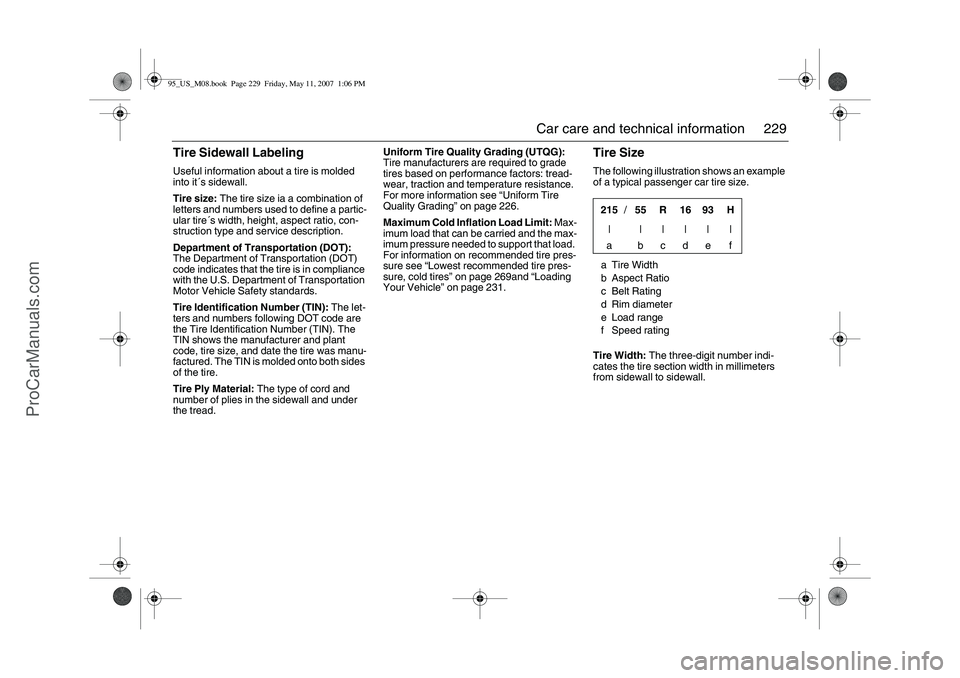
Tire SizeThe following illustration shows an example
of a typical passenger car tire size.
Tire Width: The three-digit number indi-
cates the tire section width in millimeters
from sidewall to sidewall.215/55 R 16 93 H
| |||||
abcdef
aTire Width
b Aspect Ratio
c Belt Rating
d Rim diameter
e Load range
f Speed rating
95_US_M08.book Page 229 Friday, May 11, 2007 1:06 PM
ProCarManuals.com
Page 233 of 288
233 Car care and technical information
Steps for Determining Correct
Load Limit1 Locate the statement “The
combined weight of occupants and
cargo should never exceed
XXX pounds” on your vehicle´s
label.
2 Determine the combined weight of
the driver and passengers that will
be riding in your vehicle.
3 Subtract the combined weight of the
driver and passengers from
XXX kilograms or XXX pounds.
4 The resulting figure equals the avail-
able amount of cargo and luggage
load capacity. For example, if the
“XXX” amount equals 1400 lbs. and
there will be five 150 lb. passengers
in your vehicle, the amount of avail-
able cargo and luggage load capac-
ity is 650 lbs. (1400–750 (5x150) =
650 lbs.).5 Determine the combined weight of
luggage and cargo being loaded on
the vehicle. That weight may not
safely exceed the available cargo
and luggage load capacity calcu-
lated in Step 4.
6 If your vehicle will be towing a trailer,
load from your trailer will be trans-
ferred to your vehicle. Consult this
manual to determine how this
reduces the available cargo and
luggage load capacity of your vehi-
cle.
Winter tiresWinter (snow) tires are recommended for
winter climates where the majority of your
driving will be done on snow and ice. Winter
tires should be fitted to all four wheels to
maintain a proper balance. Your Saab
dealer can advise you of to the correct size
tire for your car (if different from the original
size) and also supply Saab approved winter
tires pre-mounted on steel or alloy rims.
Winter tires normally use a different speed
rating compared to summer/all season tires.
Make sure not to exceed the stated speed
rating on the tires you use.
Make sure that wheels with sensors for tire
pressure monitoring are fitted during
replacement if the car has automatic tire
pressure monitoring.
Tire date codeTires should be regarded as perishable
goods. As the tires age, the rubber becomes
progressively harder, and the roadholding
ability of the tires diminishes. This is partic-
ularly true on winter tires.
Tires now have a date-code marking for the
year of manufacture. The first two digits
denote the week number and the two last
digits the year followed by a filled triangle.Tire direction of rotationThe direction of rotation is important for the
majority of tires. These tires have a marking
on the side of the tire. The marking may
state "Tire rotation" together with an arrow
or the text "Facing out". The tire must rotate
in the same direction for its entire service
life.
95_US_M08.book Page 233 Friday, May 11, 2007 1:06 PM
ProCarManuals.com
Page 236 of 288
236 Car care and technical informationMalfunctionsThe above message is shown on the SID if:
a wheel without pressure sensor has
been fitted (e.g. spare wheel)
one or more pressure sensors are broken
or missing
a fault has arisen in the receiver
a system error has arisen.
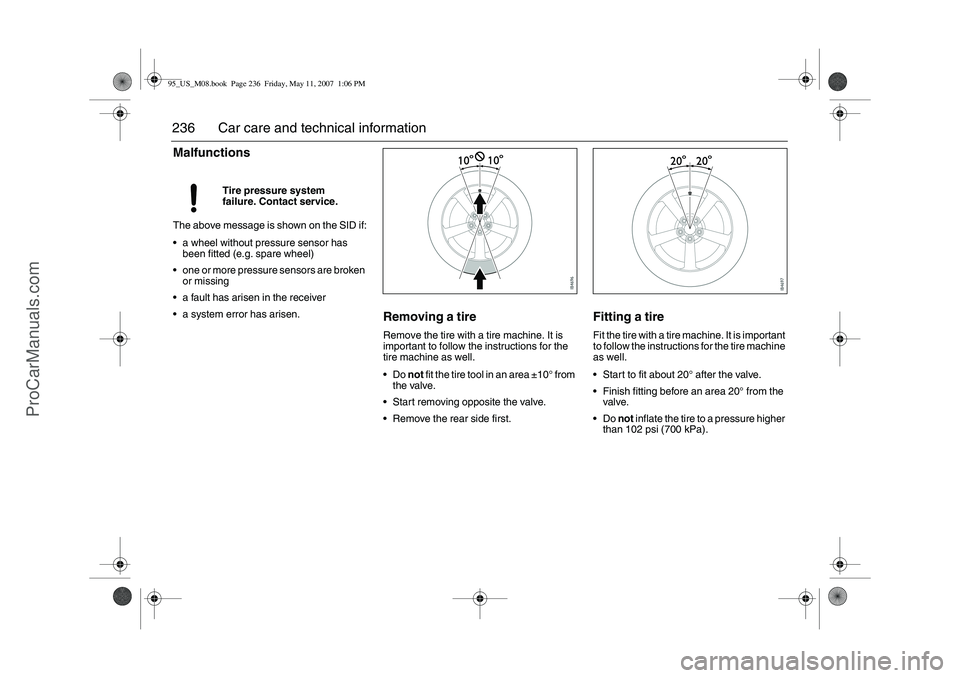
Removing a tireRemove the tire with a tire machine. It is
important to follow the instructions for the
tire machine as well.
Do not fit the tire tool in an area ±10° from
the valve.
Start removing opposite the valve.
Remove the rear side first.
Fitting a tireFit the tire with a tire machine. It is important
to follow the instructions for the tire machine
as well.
Start to fit about 20° after the valve.
Finish fitting before an area 20° from the
valve.
Do not inflate the tire to a pressure higher
than 102 psi (700 kPa). Tire pressure system
failure. Contact service.
95_US_M08.book Page 236 Friday, May 11, 2007 1:06 PM
ProCarManuals.com
Page 247 of 288
247 Car care and technical information
Fault diagnosisIf a fault occurs in the A/C system, there are
a number of checks you can perform your-
self. If the fault persists, however, have the
system checked by a workshop. We recom-
mend that you contact an authorized Saab
dealer.
Important!
When the A/C system is running, the intake
air is dehumidified, and the resultant con-
densation is drained off through two outlets
underneath the floor of the car in the vicinity
of the front doors. It is therefore perfectly
normal for water to be seen dripping from
these outlets when the car is parked. The
warmer the ambient air and the higher the
humidity, the greater will be the amount of
condensation formed.Inadequate cooling:
a Check that the condenser (forward of
the radiator) has not become clogged
with dirt and insects.
b Make sure that the drive belt for the com-
pressor is not slipping.
c Check the fuses for the ventilation fans
and compressor.
MaintenanceThe drive belt for the compressor should
be inspected under the regular service
program.
Clean dirt and insects away from the
condenser and radiator to prevent clog-
ging. When washing the car, use the hose
to spray the radiator and condenser
(located forward of the radiator) from both
sides (both from the front of the car and
from inside the engine bay). Do not use a
pressure washer.
Caution: Do not use the hose when the
engine is hot.
Other than in extremely cold weather, do not
screen the radiator, e.g. with netting, as this
will greatly diminish its cooling capacity.
Note: The A/C system will only operate
when the outdoor temperature is above the
freezing point (0°C, 32°F).
95_US_M08.book Page 247 Friday, May 11, 2007 1:06 PM
ProCarManuals.com
Page 250 of 288
250 Car care and technical informationRecovery and/or
recycling of automotive
materialsInformation on the scrapping and recycling
of car materials is available on
www.saab.com.
Headlight aimingThe vehicle has a visual optical headlight
aiming system equipped with vertical
aiming device. The aim has been preset at
the factory and should normally not need
further adjustments.
If your headlights are damaged in a crash,
the headlight aim may be affected. If you
believe your headlights need to be
re-aimed, we recommend that you take it to
your Saab dealer for service, however, it is
possible for you to re-aim your headlights as
described in the following procedure.To check the aim, the vehicle should be
properly prepared as follows:
The vehicle shall be placed so that the
headlights are 25 ft (7.6 m) from a light
colored wall or other flat surface. The
aiming area should be darkened, this will
improve your ability to see the beam of the
low beam headlight being aimed.
The vehicle must have all four wheels on
a perfectly level surface which is level all
the way to the wall or other flat surface.
The vehicle should be placed so it is
perpendicular to the wall or other flat
surface.
The vehicle should be unloaded and fuel
tank full, and one person or 160 lbs.
(75 kg) on the drivers seat.
WARNING
Before checking/adjusting the headlight
aiming, switch off the engine to avoid
danger of fingers and hands being injured
by moving parts.
The radiator fan can start up even when
the engine is switched off.NOTETo make sure that your headlights are
aimed properly read all instructions
before beginning. Failure to follow these
instructions could cause damage to
headlight parts or a not correctly aimed
headlight.
95_US_M08.book Page 250 Friday, May 11, 2007 1:06 PM
ProCarManuals.com
Page 254 of 288
254 Customer Assistance and InformationMaintenance scheduleThe Maintenance Schedule prescribes a
service program to the purchaser/operator
of a Saab that is reasonable and necessary
to ensure the proper emission control sys-
tems function, safety and reliability of the
Saab automobile in normal use. Additional
maintenance is recommended for specific
components when the car is operated under
certain severe conditions. Proper mainte-
nance is always good advice!
Authorized Saab dealers are equipped and
trained to meet your Saab’s service needs.
They regularly receive up-to-date Saab
service manuals and parts and technical
service bulletins from Saab and are able,
through their franchise agreement, to attend
Saab service schools, obtain Saab special
tools and technical assistance and pur-
chase original equipment service and
replacement parts.
Today’s complex automobiles should only
be entrusted to the most knowledgeable
service professionals. A Saab dealer is your
best choice.
Service intervalsA time for service message will illuminate on
the Saab Instrument Display (SID) when the
car is due for regular maintenance.
Engine oil and filter changesChanging the engine oil and filter is required
at every service point. Use only a Saab
approved long-life oil filter and engine oils
stated in the Specification section of this
Owner’s Manual. The use of extra additives
in the oil is not necessary and is not recom-
mended, and may be harmful to turbo-
chargers.
More frequent oil changes are recom-
mended if your vehicle is operated under
the following conditions:
Most trips are less than 5 to 10 miles (8 to
16 km). This is particularly important
when outside temperatures are below
freezing.
Most trips include extensive idling (such
as frequent stop-and-go driving).
Most trips are through dusty areas.
You frequently tow a trailer or use a carrier
on top of your vehicle.
If the vehicle is used for delivery service,
police, taxi or other commercial applica-
tions.
If your driving habits match this description,
have the engine oil and filter changed in-
between normal services at 5,000 mile
(8,000 km) intervals. The Saab Warranty
and Service Record Booklet has provisions
to record extra oil changes.
95_US_M08.book Page 254 Friday, May 11, 2007 1:06 PM
ProCarManuals.com
Page 255 of 288
255 Customer Assistance and Information
Service record retentionIt is the owner´s responsibility to retain ser-
vice records. If possible, you should keep
copies of all shop work orders for all service
and repairs, whenever performed. As indi-
cated in the new car and emission control
system warranties, it is important to docu-
ment that all necessary maintenance has
been done.HOW THE SERVICE RECORD IS
ORGANIZEDThe service record is comprised of a series
of coupons on which to record services as
they are performed. There are additional
coupons for documenting extra engine oil
and filter changes, extra automatic trans-
mission fluid services necessary for severe
service conditions, and brake fluid changes.HOW TO USE THE SERVICE
RECORD COUPONSWhen the car is brought to a Saab dealer for
scheduled maintenance, present the Saab
Warranty and Service Record Booklet to the
service manager. When the technician has
completed the service, the technician will
sign the maintenance record. The person
responsible for quality assurance at the
dealership will also sign and stamp the
record with the dealer identification stamp.
Service costsDealer pricing practices and labor for ser-
vice work vary. Saab’s recommended ser-
vice times for each service point do not
include the labor required to replace wear
items, such as wiper blades, brake pads or
tires. Nor is labor to perform other service or
repairs found to be necessary as a result of
the inspections included in these times.
Additional labor and parts will be charged
for such work when necessary, except as
covered under an applicable Saab warranty
or any optional extended service contract.
Transmission fluid changes or suspension
alignment, when necessary, are also addi-
tional.
Dealer charges for general shop material,
regulated hazardous waste removal, recy-
cling expenses or other operation costs may
also be applied to service and repair
invoices and are apt to vary by dealer and
location.
Owner assistanceWarranties and service problem
assistanceFor complete information about all applica-
ble warranties, including the New Car War-
ranty, Perforation Warranty, Vehicle Emis-
sion Warranty and Emission Perforation
Warranty, consult the Warranties and Ser-
vice Record Booklet which accompanies
this Owner’s Manual. It also contains owner
assistance information including Saab
Roadside Assistance. If the booklet is lost or
misplaced, a new one may be ordered
through a Saab dealer or by contacting
Saab.
In the U.S. there is a national Customer
Assistance Center at Saab Automobile
USA, Inc. The toll-free number to call from
all 50 states is 1-800-955-9007.
In Canada, please call the Saab Customer
Assistance Center at 1-800-263-1999.
A list of authorized Saab sales and service
dealers is available for those planning to
travel in the United States and Canada.
Canadian or U.S. travelers may call the
Customer Assistance Center in the country
in which they are traveling.
95_US_M08.book Page 255 Friday, May 11, 2007 1:06 PM
ProCarManuals.com