light SAAB 9-5 2009 Owners Manual
[x] Cancel search | Manufacturer: SAAB, Model Year: 2009, Model line: 9-5, Model: SAAB 9-5 2009Pages: 272, PDF Size: 21.53 MB
Page 239 of 272

239 Car care and technical information
5 Clean any rust or dirt from the contact
surfaces between the wheel and brake
disc. Do not wipe away the grease in the
hub.
6 Fit the wheel and screw in the bolts in the
sequence shown (opposite pairs) - see
page 240.
Tighten the bolts enough for the bolts
and wheel to be seated correctly.7 Lower the car and tighten the wheel
bolts to the correct torque in the
sequence shown (opposite
pairs).Replace the wheel bolt caps.
Tightening torque
Light-alloy wheels: 80 ft.lbs. (110 Nm)
Steel wheels: 80 ft.lbs. (110 Nm).
Lubricate the wheel stud head with a
small amount of petroleum jelly or simi-
lar and reinstall the plastic covers on the
wheel studs. The petroleum jelly facilita-
tes removal.
NOTICE When refitting wheel covers (where
applicable), make sure that the valve
protrudes through the marked hole in
the wheel cover.
Do not overtighten the bolts using an
impact wrench: not only can this
damage the wheels but it can also
make it impossible to undo the bolts
using the wheel wrench in the car’s
toolkit.
Clean any rust or dirt from the contact sur-
faces between the wheel and brake disc
IB2428
Do not wipe away the grease in the hub.
IB4529
Removing the plastic wheel bolt caps95_US_MY09.book Page 239 Tuesday, April 15, 2008 11:03 AM
ProCarManuals.com
Page 240 of 272

240 Car care and technical information8 Check-tighten the wheel bolts after a few
miles.
Tightening torque
Light-alloy wheels: 80 ft.lbs. (110 Nm)
Steel wheels: 80 ft.lbs. (110 Nm)
Safety beltsRegularly check the function of the safety
belts as follows:
Hold the diagonal strap and pull it sharply.
The safety belt should lock and it should
not be possible to withdraw it further.
Check the anchorage points in the floor.
They must not have suffered rust damage.
There must be no frayed threads in the web-
bing.
Safety belts must not come into contact with
substances such as polishes, oils or other
chemicals. If the straps are dirty, wash them
with warm water and a detergent or have
them replaced.
WARNING
If the car is involved in a crash, the safety
belts, belt pretensioners and other com-
ponents must be inspected by a work-
shop. We recommend that you contact an
authorized Saab dealer.
Never make any alterations or repairs to
the safety belt yourself.
IB1800IB1800
Removing the wheel cover
IB539
Tightening sequence, wheel bolts
95_US_MY09.book Page 240 Tuesday, April 15, 2008 11:03 AM
ProCarManuals.com
Page 241 of 272
241 Car care and technical information
Upholstery and trimTo remove lint or hairs from the seat uphol-
stery or headlining, use a moist, lint-free
cloth or a special lint remover (brush or
roller). Remove any dirty marks using a
cloth moistened with lukewarm soapy
water.
When using a stain remover, always work
from the outside towards the center to avoid
leaving a ring. If a soiled ring or spot should
remain, it can usually be removed using
lukewarm soapy water or water alone.
Wet patches left by spilled soft drinks or thin
oil must be wiped off immediately using an
absorbent material, such as a paper towel,
and treated with stain remover.
Alcohol is recommended for removing
grease or oil stains, and a semi-stiff brush
may also be used.
Cleaning and caring for leather
upholsteryThe principal reason for treating leather
upholstery is to maintain its elegant appear-
ance and to provide it with a protective film.
Discoloration caused by dust and wear
mainly affects the lighter shades, although
this is not detrimental to the leather –
indeed, the patina resulting from use is often
considered desirable in leather. But if the
leather is allowed to become too grubby, it
can start to look shabby. Regularly vacuum
the leather with a soft brush to remove loose
dirt and dust.
It is a good idea to clean and recondition the
leather twice a year – in conjunction with a
general spring-cleaning of the car – after the
winter and in the autumn, for instance. In
hot, dry climates, the leather will need to be
treated more frequently. Use conventional
leather care products. Follow the instruc-
tions on the packaging.
Do not use harsh polishing agents, cleaning
agents, sprays, coarse soap or hot water.
Semi-aniline leather only has a thin protec-
tive finish and is therefore more sensitive
than other leathers and therefore need
more care to keep the protection and ageing
properties.
Textile carpetingVacuum clean the carpeting regularly. Car-
pets can also be cleaned using a brush, or
carpet shampoo applied with a sponge. Do
not use vacuum cleaners outdoors unless
they are properly grounded.
95_US_MY09.book Page 241 Tuesday, April 15, 2008 11:03 AM
ProCarManuals.com
Page 242 of 272
242 Car care and technical informationWashing the carWash your car frequently. To facilitate
cleaning, a suitable detergent can be added
to the water, which should be lukewarm.
Saab offers a full line of car care products,
including car wash, for the care of your vehi-
cle. See your dealer for available products
or visit www.saabcatalog.com (U.S. resi-
dents only).
Do not use a pressure washer at close
range on stone chip damage, scratches or
other damage to the paintwork. The paint
can otherwise start to flake.
Remove any bird droppings without delay,
as these can discolor the paintwork and
prove difficult to polish out.
Use a soft cloth moistened with methyl alco-
hol to remove splashes of tar or asphalt. Do
not use strong cleaners, as these can dry
out the paintwork.
The underside of the car also needs wash-
ing regularly, and this should be done extra
thoroughly at the end of winter. Clean the
underside of the car by hand if the car is
usually washed in an automatic car wash
without special facilities for underbody
cleaning.
Never wash or leave the car to dry in the
sun, but wipe it dry with a chamois leather
immediately after washing to avoid smears
and streaks.
Clean the window glass inside and out using
a high quality window cleaner. This is partic-
ularly important when the car is new, as
upholstery and trim have a tendency to
sweat a little at first.
Keep the glass well cleaned, as this helps to
prevent misting.
NOTICEOnly use liquid detergent when cleaning
the plastic lenses of the front and rear
lights. Do not use mechanical cleaning.
Rinse off the detergent immediately, oth-
erwise cracks may form in the plastic
lenses.
NOTICE The door mirrors must be fully
retracted before the car enters an
automatic car wash.
Remove fixed antennas, e.g. for
mobile phone, before putting car
through an automatic car wash.
Try your brakes on leaving a car wash.
Wet brake discs may reduce the per-
formance of the brakes.
Cars with Saab Parking Assistance:
Do not spray the sensors or closer
than 8 in. (20 cm) to the sensors with
a pressure washer, as this can
damage them.
95_US_MY09.book Page 242 Tuesday, April 15, 2008 11:03 AM
ProCarManuals.com
Page 243 of 272
243 Car care and technical information
Waxing and polishingOther than in exceptional cases, do not use
abrasive polishes containing a cutting agent
on a new car. Always wash the car thor-
oughly before waxing or polishing.Engine compartmentClean the engine compartment using an
engine detergent and rinse with hot water.
Cover the headlights. Do not use high-pres-
sure washer. Avoid spraying the hood liner,
as this can become heavy and hang down
and touch the engine when the hood is
closed.
Do not use gasoline as a cleaning agent or
solvent when carrying out repairs or mainte-
nance. Saab recommends the use of envi-
ronmentally safe degreasing agents.
Touching up the paintDamaged paintwork should be treated as
soon as it is discovered: the longer it is left,
the greater the risk of corrosion. The
anti-perforation warranty does not cover
corrosion resulting from untreated defects.
Paintwork damage sustained in a crash is
usually extensive and can only be properly
restored by professionals.
However, you can repair small scratches
and stone-chip damage yourself. The nec-
essary tools and materials, such as primer,
touch-up paint and brushes, are available
from your Saab dealer.
In the case of minor flaws in the paintwork,
where the metal has not been exposed and
an undamaged layer of paint remains,
touch-up paint can usually be applied
directly, after any dirt has been scraped
away using a pointed knife.If corrosion has already set in, e.g. as a
result of stone-chip damage, use a pointed
knife to scrape off all surface rust. If possi-
ble, the damaged area should be taken
back to the bare metal. The metal should
then be primed with two thin coats of primer
applied by brush.
After the primer has dried, apply several thin
layers of topcoat enamel until the surface of
the repaired area is flush with the surround-
ing paintwork.
Stir both primer and touch-up enamel thor-
oughly before use and allow each coat to
dry before applying the next.
95_US_MY09.book Page 243 Tuesday, April 15, 2008 11:03 AM
ProCarManuals.com
Page 248 of 272
248 Car care and technical informationRecovery and/or
recycling of automotive
materialsInformation on the scrapping and recycling
of car materials is available on
www.saab.com.
Headlight aimingThe vehicle has a visual optical headlight
aiming system equipped with vertical
aiming device. The aim has been preset at
the factory and should normally not need
further adjustments.
If your headlights are damaged in a crash,
the headlight aim may be affected. If you
believe your headlights need to be
re-aimed, we recommend that you take it to
your Saab dealer for service, however, it is
possible for you to re-aim your headlights as
described in the following procedure.To check the aim, the vehicle should be
properly prepared as follows:
The vehicle shall be placed so that the
headlights are 25 ft (7.6 m) from a light
colored wall or other flat surface. The
aiming area should be darkened, this will
improve your ability to see the beam of the
low beam headlight being aimed.
The vehicle must have all four wheels on
a perfectly level surface which is level all
the way to the wall or other flat surface.
The vehicle should be placed so it is
perpendicular to the wall or other flat
surface.
The vehicle should be unloaded and fuel
tank full, and one person or 160 lbs.
(75 kg) on the drivers seat.
WARNING
Before checking/adjusting the headlight
aiming, switch off the engine to avoid
danger of fingers and hands being injured
by moving parts.
The radiator fan can start up even when
the engine is switched off.NOTICETo make sure that your headlights are
aimed properly read all instructions
before beginning. Failure to follow these
instructions could cause damage to
headlight parts or a not correctly aimed
headlight.
95_US_MY09.book Page 248 Tuesday, April 15, 2008 11:03 AM
ProCarManuals.com
Page 249 of 272
249 Car care and technical information
The vehicle should be fully assembled
and all other work stopped while headlight
aiming is being done.
The vehicle should not have any snow, ice
or mud attached to it.
Tires should be inflated to the prescribed
pressure.
Close all doors.
Rock the vehicle to stabilize the suspen-
sion.
Headlight aiming is done with the vehicle
low beam lamps. The high beam lamps will
be correctly aimed if the low beam lamps
are aimed properly.
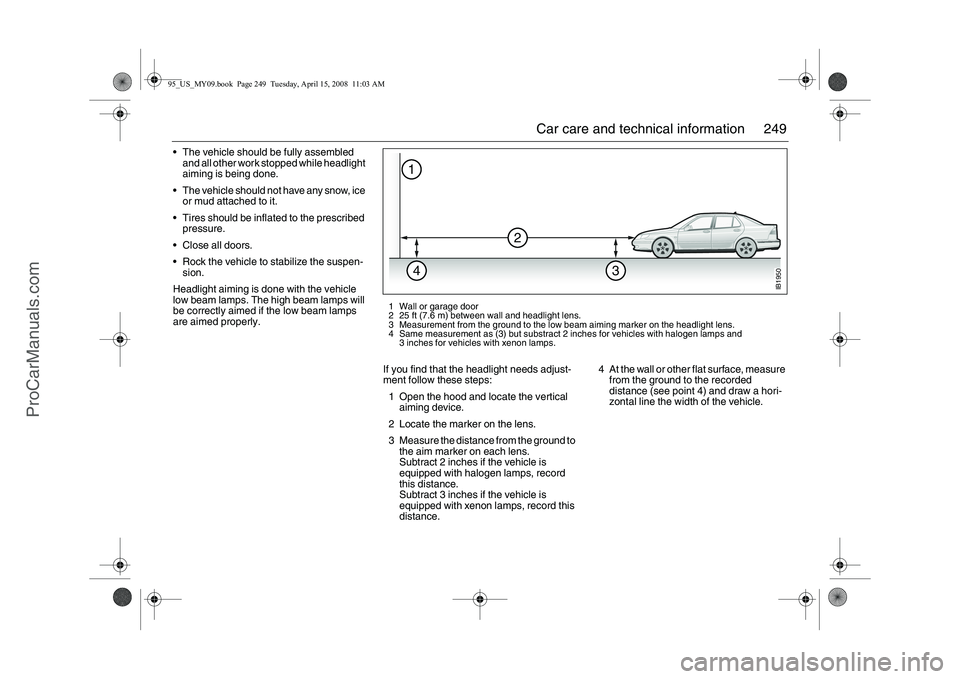
If you find that the headlight needs adjust-
ment follow these steps:
1 Open the hood and locate the vertical
aiming device.
2 Locate the marker on the lens.
3 Measure the distance from the ground to
the aim marker on each lens.
Subtract 2 inches if the vehicle is
equipped with halogen lamps, record
this distance.
Subtract 3 inches if the vehicle is
equipped with xenon lamps, record this
distance.4 At the wall or other flat surface, measure
from the ground to the recorded
distance (see point 4) and draw a hori-
zontal line the width of the vehicle.
IB1950
2
14
3
1 Wall or garage door
2 25 ft (7.6 m) between wall and headlight lens.
3 Measurement from the ground to the low beam aiming marker on the headlight lens.
4 Same measurement as (3) but substract 2 inches for vehicles with halogen lamps and
3 inches for vehicles with xenon lamps.
95_US_MY09.book Page 249 Tuesday, April 15, 2008 11:03 AM
ProCarManuals.com
Page 250 of 272
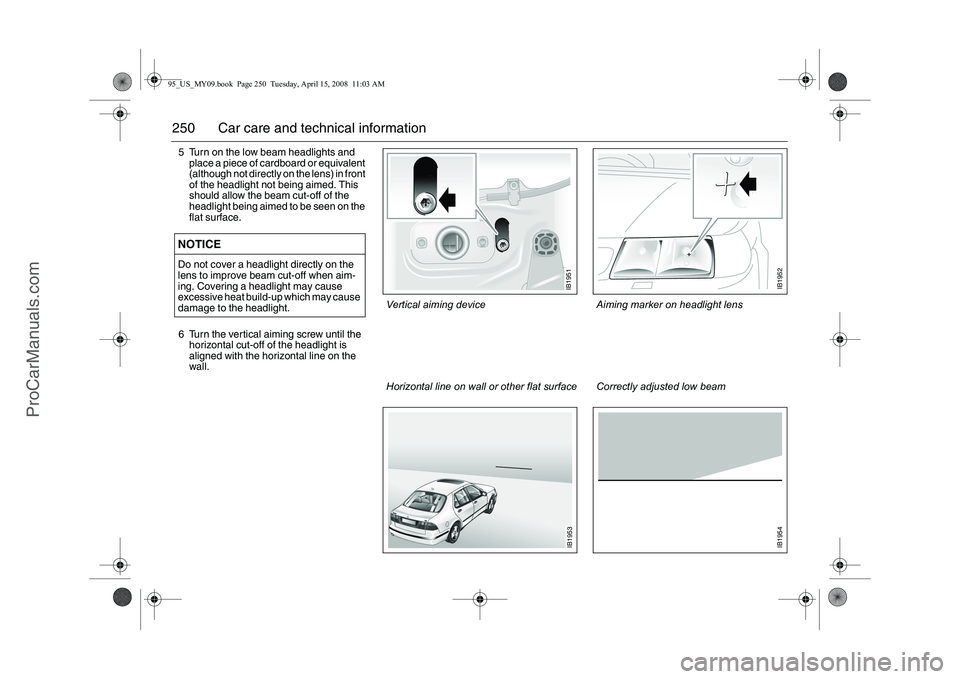
250 Car care and technical information5 Turn on the low beam headlights and
place a piece of cardboard or equivalent
(although not directly on the lens) in front
of the headlight not being aimed. This
should allow the beam cut-off of the
headlight being aimed to be seen on the
flat surface.
6 Turn the vertical aiming screw until the
horizontal cut-off of the headlight is
aligned with the horizontal line on the
wall.NOTICEDo not cover a headlight directly on the
lens to improve beam cut-off when aim-
ing. Covering a headlight may cause
excessive heat build-up which may cause
damage to the headlight.
IB1951
Vertical aiming device
IB1952
Aiming marker on headlight lens
IB1953
Horizontal line on wall or other flat surface
IB1954
Correctly adjusted low beam
95_US_MY09.book Page 250 Tuesday, April 15, 2008 11:03 AM
ProCarManuals.com
Page 260 of 272
260 SpecificationsEngine Fuel Engine oil
Engine variants
Electrical system
Brake system
4-cylinder ________________________ Four cylinders, twin
overhead cam-
shafts, 16 valves
and two balancer
shafts.
Cylinder bores _____________________ 3.54 in (90 mm)
Stroke ___________________________ 3.54 in (90 mm)
Swept volume _____________________ 139.7 cu.in
(2.290 litres)
Idling speed _______________________ 825 rpm (man.)
860 rpm (aut.)
Antifreeze_________________________ Saab-approved
antifreeze
Coolant capacity ___________________ 7.8 qts (7.4 litres)
Fuel-tank capacity __________________ 18.0 gal. (68 litres)
Gasoline Octane
Use regular unleaded gasoline with a posted octane of 87 or
higher.
Although not required, use higher octane fuel for optimum perfor-
mance - 93 octane.
Gasoline with a lower octane rating can be used, although not
lower than 87 octane. However, engine performance will fall
slightly and heavy loading and laboring should be avoided.
For further information on fuel, see page 148.Oil capacity incl. filter (on changing) _____ 4.1 qts (4.0 litres)
2.3 Turbo
Rating, SAE at 5000 rpm ____________ 260 hp (191 kW)
Maximum torque, SAE at 1900 rpm ____ 258.0 ft.lb.
(350 Nm)
Voltage ___________________________ 12 V
Battery capacity ____________________ 70 Ah
Footbrake (ABS) ____________________ Hydraulic, dual-
circuit brake sys-
tem. Diagonally
split circuit with vac-
uum servo unit.
Disc brakes front
and rear. EBD, see
page 160.
Parkingbrake _______________________ Acts on rear wheels
Brake fluid _________________________ DOT 4 95_US_MY09.book Page 260 Tuesday, April 15, 2008 11:03 AM
ProCarManuals.com
Page 265 of 272
265 Specifications
Adjustable systemsSeveral of the systems in your Saab car can
be adjusted to better fit your individual
needs
Some functions are governed by legal
requirements and cannot therefore be
reprogrammed.
We recommend that you contact an autho-
rized Saab dealer for further information.
Car alarm/central locking system:
The number of blinks when locking/
unlocking.
Automatic locking of the trunk when the
car (SportCombi) is driven, 1 to 8 mph
(2–14 km/h), YES or NO.
Automatic locking of the trunk (Sport-
Combi) when it is closed, YES or NO.
Automatic locking of all doors when the
car is driven above 7.5 mph (12 km/h),
YES or NO.Saab Information Display:
Outdoor temperature display can be
adjusted.
Miscellaneous:
Select the on-time for heated rear seat3.
Additional sweep of the wipers after wind-
shield washer function (ON or OFF).
Courtesy Headlight Feature on-time can
vary from 20 to 50 seconds.
Night panel illumination deactivation
speed for the speedometer can be
adjusted.
Following adjustments can be
done by the driver:Automatic Climate Control (ACC):
You can choose whether front seat and rear
window heating is to be activated manually
or automatically; see "Adaptation of ACC"
on page 85.
Saab 9-5 Audio System (see page 106):
Speed dependent volume.
Daytime Running Lights:
To disable, turn off the ignition and pull out
fuse 35, see page 217.
95_US_MY09.book Page 265 Tuesday, April 15, 2008 11:03 AM
ProCarManuals.com