ABS SAAB 9-5 2009 User Guide
[x] Cancel search | Manufacturer: SAAB, Model Year: 2009, Model line: 9-5, Model: SAAB 9-5 2009Pages: 272, PDF Size: 21.53 MB
Page 163 of 272
163 Starting and driving
Electronic Stability
Program (ESP
®)
The system employs both the antilock brak-
ing system (ABS) and the traction control
system (TCS). It is a system that helps the
driver to stabilize the car in unusual circum-
stances that would otherwise be more diffi-
cult to handle.
How the ESP
® system works
The system can help to prevent the car from
skidding by braking one or several wheels
independently of the driver. The engine
output is then also reduced to prevent the
driving wheels from spinning. The car has
sensors that measure wheel speed, yaw
acceleration, lateral acceleration, steering
wheel position and braking pressure. The
values provided by these sensors are used
to calculate the actual direction of the car. If
this direction does not agree with that
intended by the driver, calculated from the
steering wheel position, the ESP
® is
engaged.
The ESP
® system improves the driver’s
chances of retaining control over the car in
critical situations.
To ensure that the system works as
designed, the dimensions of all four tires
must be the same.
WARNING
When driving normally, the ESP
® system
will help to improve the stability of the car.
This does not mean that car can be driven
faster. The same care and prudence as
normally applied should be displayed on
cornering and when driving on slippery
roads.
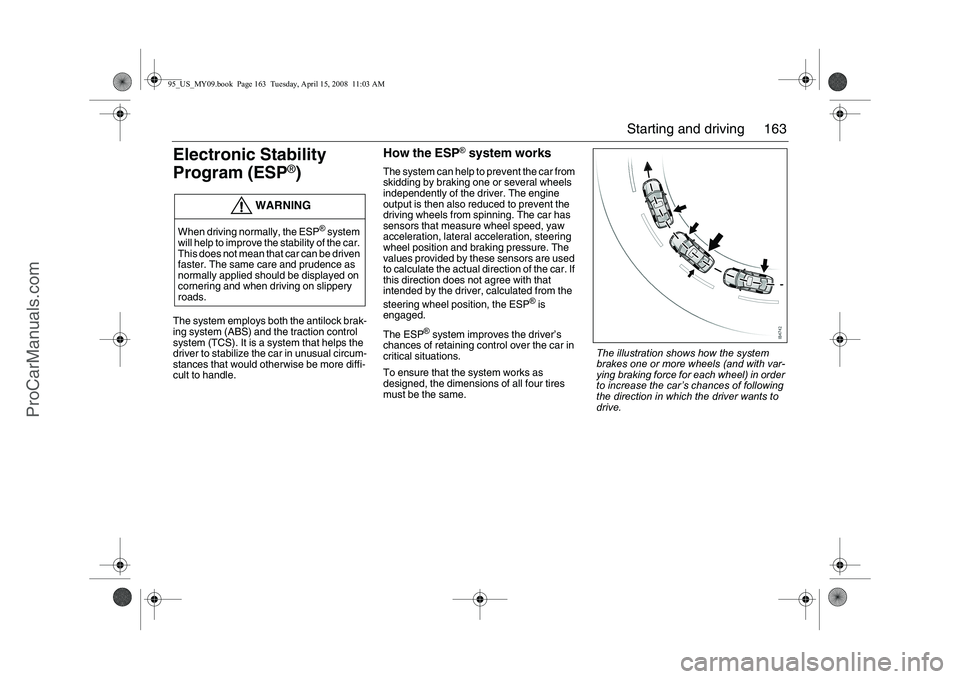
The illustration shows how the system
brakes one or more wheels (and with var-
ying braking force for each wheel) in order
to increase the car’s chances of following
the direction in which the driver wants to
drive.
95_US_MY09.book Page 163 Tuesday, April 15, 2008 11:03 AM
ProCarManuals.com
Page 191 of 272
191 Car care and technical information
Saab Trionic engine
management systemThe Saab Trionic engine management
system is a unique Saab development that
combines sequential multiport fuel injection,
electronic distributorless ignition and turbo-
charger boost pressure control into one sys-
tem.
The Trionic engine control module (ECM)
monitors many different engine parameters
such as:
Intake manifold pressure
Intake air temperature
Crankshaft position
Engine coolant temperature
Throttle position and
The oxygen content of the exhaust gases.
The ECM receives information regarding
engine knocking from a sophisticated feed-
back function in the ignition discharge unit.
By processing all of this information, the Tri-
onic system can control fuel injector open-
ing duration, ignition timing and turbo-
charger boost pressure to provide excellent
engine performance while maintaining low
emissions and fuel consumption.
ORVR (Onboard Refueling Vapor
Recovery)Hydrocarbon vapors formed when refueling
will be recovered by the car and not
released into the atmosphere. The hydro-
carbons are absorbed in a evaporative
emission canister. When the engine is sub-
sequently started, the evaporative emission
canister is gradually purged as air is sucked
into it through a shut-off valve. The hydro-
carbon/air mixture passes through the evap
canister purge valve and into the engine
where it is burned.
When refueling, make sure you screw the
filler cap on and keep turning until it has
clicked at least 3 times. Otherwise, it is pos-
sible for the CHECK ENGINE light to illumi-
nate.
Refueling, see page 146.
NOTICEThe Trionic engine management system
continuously monitors the operation of
these systems and has on-board diag-
nostic capabilities (OBD II).
If the ”Service Engine Light also known as
CHECK ENGINE” lamp in the main
instrument illuminates, this indicates that
the Trionic ECM has detected a problem.
The car will continue to operate, but per-
formance may be diminished. You should
have your car checked by a Saab dealer
as soon as possible.
95_US_MY09.book Page 191 Tuesday, April 15, 2008 11:03 AM
ProCarManuals.com
Page 194 of 272
194 Car care and technical informationThe cooling system is charged at the factory
with coolant containing a 45 % concentra-
tion of a combined antifreeze and corrosion
inhibitor. A weaker mixture will result in
reduced anticorrosion protection. For
protection against freezing in very cold
weather, a stronger concentration will be
needed.
A 60 % concentration of antifreeze will pro-
vide protection at temperatures down to
–58°F (–50°C).
The coolant does not normally have to be
changed during the service life of the car.
The type of coolant used has a reddish color
and should not be mixed with other types of
coolant. Saab Original coolant should be
used all year round. Only use coolant
approved by Saab.
Note:
If incorrect coolant is used or added, the
life-time properties will be affected. Even if
the coolant is flushed from the system and
replaced with life-time coolant, life-time
properties are no longer retained and the
coolant must then be drained and replaced
at regular intervals.
Brake and clutch fluid Checking the fluid level The combined brake and clutch-fluid reser-
voir is transparent to facilitate checking of
the fluid level.
The level should be between the MAX and
MIN marks. Top up, as necessary, with
DOT 4 fluid. Do not use DOT 5 brake fluid.
NOTICEAlways mix the antifreeze with the
appropriate volume of water before
adding it to the cooling system.
If pure antifreeze is added, the engine
could still freeze and be damaged. This is
because the antifreeze will not mix
properly with the coolant before the
thermostat has opened to allow full
circulation.
WARNING
Brake fluid deteriorates as it becomes
old. Because it is hygroscopic, it absorbs
water from the air and, in time, could allow
vapor to form in the brake system, thus
reducing its performance. It is therefore
important that brake fluid be changed reg-
ularly, as specified in the service pro-
gram.
95_US_MY09.book Page 194 Tuesday, April 15, 2008 11:03 AM
ProCarManuals.com
Page 217 of 272
217 Car care and technical information
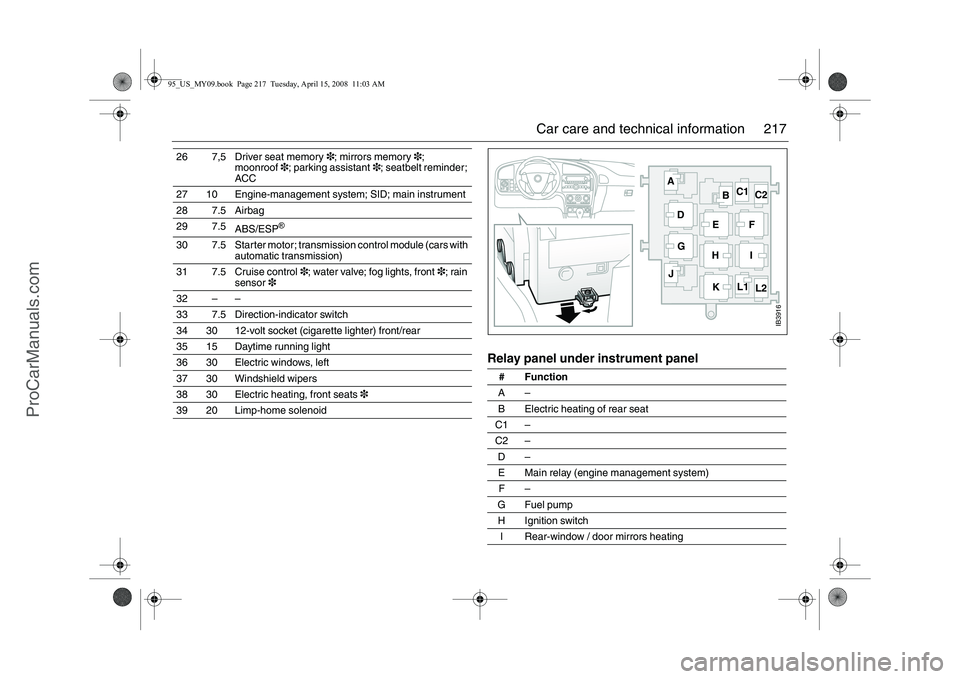
Relay panel under instrument panel
26 7,5 Driver seat memory3; mirrors memory3;
moonroof3; parking assistant3; seatbelt reminder;
ACC
27 10 Engine-management system; SID; main instrument
28 7.5 Airbag
29 7.5
ABS/ESP
®
30 7.5 Starter motor; transmission control module (cars with
automatic transmission)
31 7.5 Cruise control3; water valve; fog lights, front3; rain
sensor3
32 – –
33 7.5 Direction-indicator switch
34 30 12-volt socket (cigarette lighter) front/rear
35 15 Daytime running light
36 30 Electric windows, left
37 30 Windshield wipers
38 30 Electric heating, front seats3
39 20 Limp-home solenoid
# Function
A –
B Electric heating of rear seat
C1 –
C2 –
D–
E Main relay (engine management system)
F–
GFuel pump
H Ignition switch
I Rear-window / door mirrors heating
IB3916
A
BC1
C2
L2 L1 D
GE
F
H
I
K J
95_US_MY09.book Page 217 Tuesday, April 15, 2008 11:03 AM
ProCarManuals.com
Page 218 of 272
218 Car care and technical information
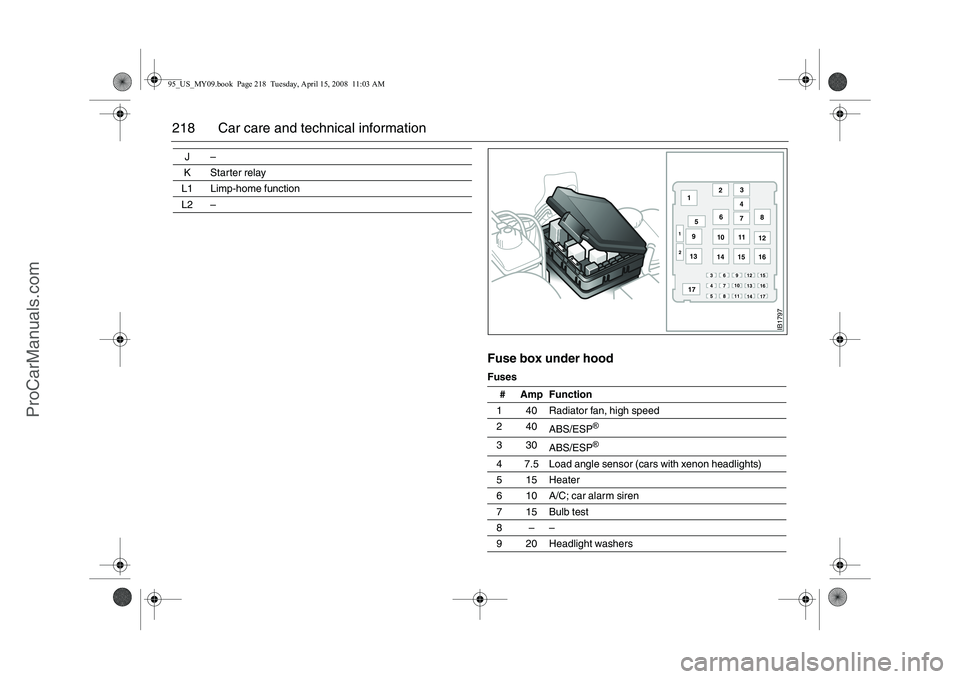
Fuse box under hoodFuses J–
KStarter relay
L1 Limp-home function
L2 –
# Amp Function
1 40 Radiator fan, high speed
240
ABS/ESP
®
330
ABS/ESP
®
4 7.5 Load angle sensor (cars with xenon headlights)
515Heater
6 10 A/C; car alarm siren
715Bulb test
8––
9 20 Headlight washers
43
2
IB1797
2 1
14 1312 7 6
5 1
15 168
11
10 9
178 5
17 14 11 7 4
16 13 69
10 3
15 12
95_US_MY09.book Page 218 Tuesday, April 15, 2008 11:03 AM
ProCarManuals.com
Page 223 of 272
223 Car care and technical information
Buying New TiresTo find out what kind and size of tires you
need, look at the Tire-Loading Information
label.
Before changing to wheels/tires of another
size, we recommend that you contact an
authorized Saab workshop regarding
acceptable options. See also page 261
Wheels/tires combinations that are not
approved by the vehicle manufacturer can
negatively affect the car’s directional stabil-
ity, steering and braking in both wet and dry
conditions.
The wheels and tires have been carefully
matched to the characteristics of the car and
play a key role in its outstanding roadhold-
ing and handling.
Do not take it for granted that a wheel/tire
combination will work in the best possible
way, just because it can be fitted to the car.
To ensure that the speedometer is as accu-
rate as possible it should be reprogrammed
if wheels of a different dimension are fitted.
Contact a Saab dealer.
Because of front wheel drive, the front tires
tend to wear faster than the rear ones. New
tires should always be fitted in pairs, so that
tires on the same axle have the same
amount of tread.
Store wheels lying flat or hanging – never
standing upright.
NOTICEWide wheels and tires with sidewalls that
are too low can:
be damaged in potholes etc.
cause springs, shock absorbers and
wheel bearings and body mountings
can be overloaded.
cause the wheels to come into contact
with chassis and body components.
can affect the function of the Elec-
tronic Stability Program (ESP
®).
The speed and load limits for the tires
must not be exceeded; see page 228.
Wheels larger than 17” must not be fitted.
The maximum permissible offset is
49 mm.
WARNING
Mixing tires could cause you to lose con-
trol while driving. If you mix tires of differ-
ent sizes or types (radial and bias-belted
tires), the vehicle may not handle prop-
erly, and you could have a crash. Using
tires of different sizes may also cause
damage to your vehicle. Be sure to use
the same size and type tires on all wheels.
It’s all right to drive with your compact
spare temporarily, it was developed for
use on your vehicle. See “Compact spare
tire” on page 235.
WARNING
If you use bias-ply tires on your vehicle,
the wheel rim flanges could develop
cracks after many miles of driving. A tire
and/or wheel could fail suddenly, causing
a crash. Use only radial-ply tires with the
wheels on your vehicle.
95_US_MY09.book Page 223 Tuesday, April 15, 2008 11:03 AM
ProCarManuals.com
Page 241 of 272
241 Car care and technical information
Upholstery and trimTo remove lint or hairs from the seat uphol-
stery or headlining, use a moist, lint-free
cloth or a special lint remover (brush or
roller). Remove any dirty marks using a
cloth moistened with lukewarm soapy
water.
When using a stain remover, always work
from the outside towards the center to avoid
leaving a ring. If a soiled ring or spot should
remain, it can usually be removed using
lukewarm soapy water or water alone.
Wet patches left by spilled soft drinks or thin
oil must be wiped off immediately using an
absorbent material, such as a paper towel,
and treated with stain remover.
Alcohol is recommended for removing
grease or oil stains, and a semi-stiff brush
may also be used.
Cleaning and caring for leather
upholsteryThe principal reason for treating leather
upholstery is to maintain its elegant appear-
ance and to provide it with a protective film.
Discoloration caused by dust and wear
mainly affects the lighter shades, although
this is not detrimental to the leather –
indeed, the patina resulting from use is often
considered desirable in leather. But if the
leather is allowed to become too grubby, it
can start to look shabby. Regularly vacuum
the leather with a soft brush to remove loose
dirt and dust.
It is a good idea to clean and recondition the
leather twice a year – in conjunction with a
general spring-cleaning of the car – after the
winter and in the autumn, for instance. In
hot, dry climates, the leather will need to be
treated more frequently. Use conventional
leather care products. Follow the instruc-
tions on the packaging.
Do not use harsh polishing agents, cleaning
agents, sprays, coarse soap or hot water.
Semi-aniline leather only has a thin protec-
tive finish and is therefore more sensitive
than other leathers and therefore need
more care to keep the protection and ageing
properties.
Textile carpetingVacuum clean the carpeting regularly. Car-
pets can also be cleaned using a brush, or
carpet shampoo applied with a sponge. Do
not use vacuum cleaners outdoors unless
they are properly grounded.
95_US_MY09.book Page 241 Tuesday, April 15, 2008 11:03 AM
ProCarManuals.com
Page 260 of 272
260 SpecificationsEngine Fuel Engine oil
Engine variants
Electrical system
Brake system
4-cylinder ________________________ Four cylinders, twin
overhead cam-
shafts, 16 valves
and two balancer
shafts.
Cylinder bores _____________________ 3.54 in (90 mm)
Stroke ___________________________ 3.54 in (90 mm)
Swept volume _____________________ 139.7 cu.in
(2.290 litres)
Idling speed _______________________ 825 rpm (man.)
860 rpm (aut.)
Antifreeze_________________________ Saab-approved
antifreeze
Coolant capacity ___________________ 7.8 qts (7.4 litres)
Fuel-tank capacity __________________ 18.0 gal. (68 litres)
Gasoline Octane
Use regular unleaded gasoline with a posted octane of 87 or
higher.
Although not required, use higher octane fuel for optimum perfor-
mance - 93 octane.
Gasoline with a lower octane rating can be used, although not
lower than 87 octane. However, engine performance will fall
slightly and heavy loading and laboring should be avoided.
For further information on fuel, see page 148.Oil capacity incl. filter (on changing) _____ 4.1 qts (4.0 litres)
2.3 Turbo
Rating, SAE at 5000 rpm ____________ 260 hp (191 kW)
Maximum torque, SAE at 1900 rpm ____ 258.0 ft.lb.
(350 Nm)
Voltage ___________________________ 12 V
Battery capacity ____________________ 70 Ah
Footbrake (ABS) ____________________ Hydraulic, dual-
circuit brake sys-
tem. Diagonally
split circuit with vac-
uum servo unit.
Disc brakes front
and rear. EBD, see
page 160.
Parkingbrake _______________________ Acts on rear wheels
Brake fluid _________________________ DOT 4 95_US_MY09.book Page 260 Tuesday, April 15, 2008 11:03 AM
ProCarManuals.com
Page 267 of 272
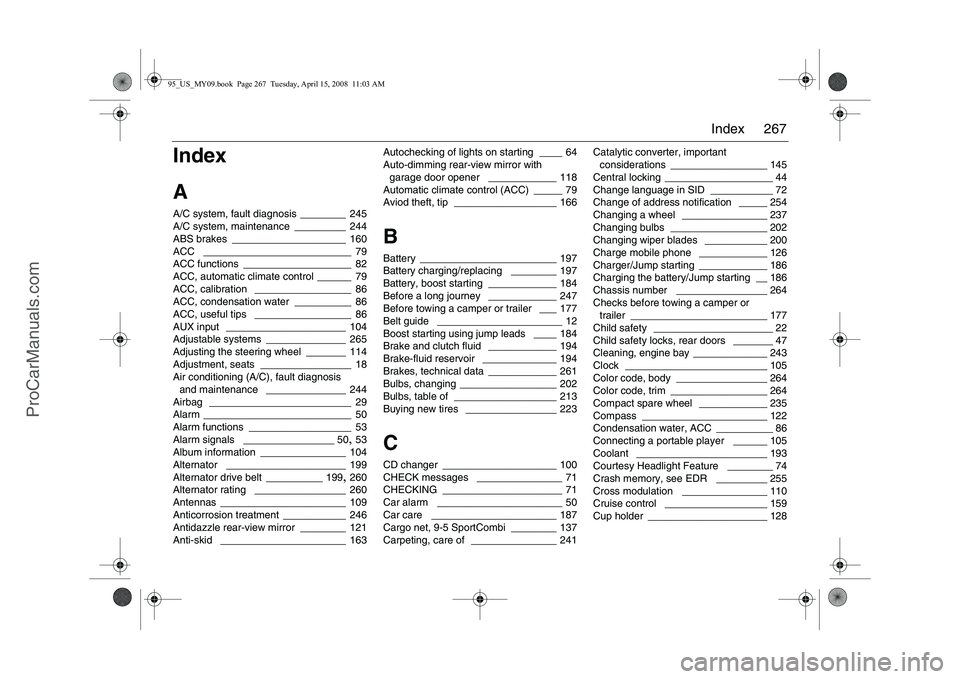
267 Index
Index
AA/C system, fault diagnosis
________ 245
A/C system, maintenance _________ 244
ABS brakes
____________________ 160
ACC
__________________________ 79
ACC functions
___________________ 82
ACC, automatic climate control
______ 79
ACC, calibration
_________________ 86
ACC, condensation water
__________ 86
ACC, useful tips
_________________ 86
AUX input
_____________________ 104
Adjustable systems
______________ 265
Adjusting the steering wheel
_______ 114
Adjustment, seats
________________ 18
Air conditioning (A/C), fault diagnosis
and maintenance ______________ 244
Airbag
_________________________ 29
Alarm __________________________ 50
Alarm functions
__________________ 53
Alarm signals
________________ 50
, 53
Album information
_______________ 104
Alternator
_____________________ 199
Alternator drive belt
__________ 199
, 260
Alternator rating
________________ 260
Antennas
______________________ 109
Anticorrosion treatment
___________ 246
Antidazzle rear-view mirror
________ 121
Anti-skid
______________________ 163Autochecking of lights on starting
____ 64
Auto-dimming rear-view mirror with
garage door opener
____________ 118
Automatic climate control (ACC)
_____ 79
Aviod theft, tip
__________________ 166
BBattery
________________________ 197
Battery charging/replacing
________ 197
Battery, boost starting
____________ 184
Before a long journey ____________ 247
Before towing a camper or trailer
___ 177
Belt guide
______________________ 12
Boost starting using jump leads
____ 184
Brake and clutch fluid
____________ 194
Brake-fluid reservoir
_____________ 194
Brakes, technical data ____________ 261
Bulbs, changing
_________________ 202
Bulbs, table of
__________________ 213
Buying new tires ________________ 223
CCD changer
____________________ 100
CHECK messages
_______________ 71
CHECKING
_____________________ 71
Car alarm
______________________ 50
Car care
______________________ 187
Cargo net, 9-5 SportCombi
________ 137
Carpeting, care of
_______________ 241Catalytic converter, important
considerations
_________________ 145
Central locking ___________________ 44
Change language in SID
___________ 72
Change of address notification
_____ 254
Changing a wheel
_______________ 237
Changing bulbs
_________________ 202
Changing wiper blades
___________ 200
Charge mobile phone
____________ 126
Charger/Jump starting ____________ 186
Charging the battery/Jump starting
__ 186
Chassis number
________________ 264
Checks before towing a camper or
trailer
________________________ 177
Child safety
_____________________ 22
Child safety locks, rear doors
_______ 47
Cleaning, engine bay
_____________ 243
Clock
_________________________ 105
Color code, body
________________ 264
Color code, trim _________________ 264
Compact spare wheel
____________ 235
Compass
______________________ 122
Condensation water, ACC
__________ 86
Connecting a portable player ______ 105
Coolant
_______________________ 193
Courtesy Headlight Feature
________ 74
Crash memory, see EDR
_________ 255
Cross modulation
_______________ 110
Cruise control
__________________ 159
Cup holder
_____________________ 128
95_US_MY09.book Page 267 Tuesday, April 15, 2008 11:03 AM
ProCarManuals.com