battery SAAB 9-5 2009 User Guide
[x] Cancel search | Manufacturer: SAAB, Model Year: 2009, Model line: 9-5, Model: SAAB 9-5 2009Pages: 272, PDF Size: 21.53 MB
Page 59 of 272
59 Instruments and controls
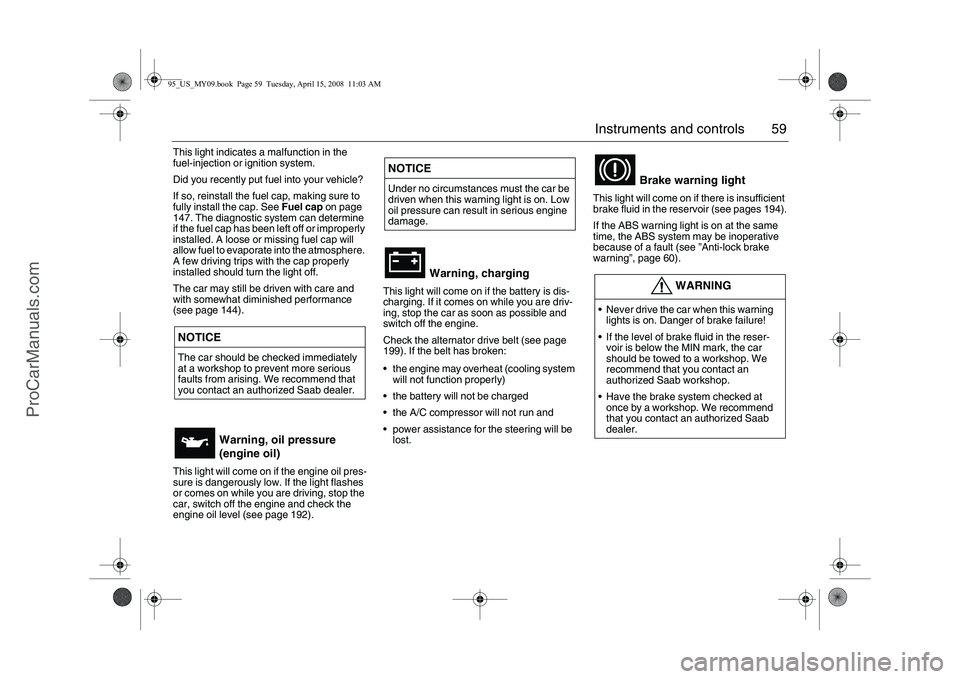
This light indicates a malfunction in the
fuel-injection or ignition system.
Did you recently put fuel into your vehicle?
If so, reinstall the fuel cap, making sure to
fully install the cap. See Fuel cap on page
147. The diagnostic system can determine
if the fuel cap has been left off or improperly
installed. A loose or missing fuel cap will
allow fuel to evaporate into the atmosphere.
A few driving trips with the cap properly
installed should turn the light off.
The car may still be driven with care and
with somewhat diminished performance
(see page 144).
This light will come on if the engine oil pres-
sure is dangerously low. If the light flashes
or comes on while you are driving, stop the
car, switch off the engine and check the
engine oil level (see page 192).
This light will come on if the battery is dis-
charging. If it comes on while you are driv-
ing, stop the car as soon as possible and
switch off the engine.
Check the alternator drive belt (see page
199). If the belt has broken:
the engine may overheat (cooling system
will not function properly)
the battery will not be charged
the A/C compressor will not run and
power assistance for the steering will be
lost.This light will come on if there is insufficient
brake fluid in the reservoir (see pages 194).
If the ABS warning light is on at the same
time, the ABS system may be inoperative
because of a fault (see ”Anti-lock brake
warning”, page 60).
NOTICEThe car should be checked immediately
at a workshop to prevent more serious
faults from arising. We recommend that
you contact an authorized Saab dealer.
Warning, oil pressure
(engine oil)
NOTICEUnder no circumstances must the car be
driven when this warning light is on. Low
oil pressure can result in serious engine
damage.
Warning, charging
Brake warning light
WARNING
Never drive the car when this warning
lights is on. Danger of brake failure!
If the level of brake fluid in the reser-
voir is below the MIN mark, the car
should be towed to a workshop. We
recommend that you contact an
authorized Saab workshop.
Have the brake system checked at
once by a workshop. We recommend
that you contact an authorized Saab
dealer.
95_US_MY09.book Page 59 Tuesday, April 15, 2008 11:03 AM
ProCarManuals.com
Page 71 of 272
71 Instruments and controls
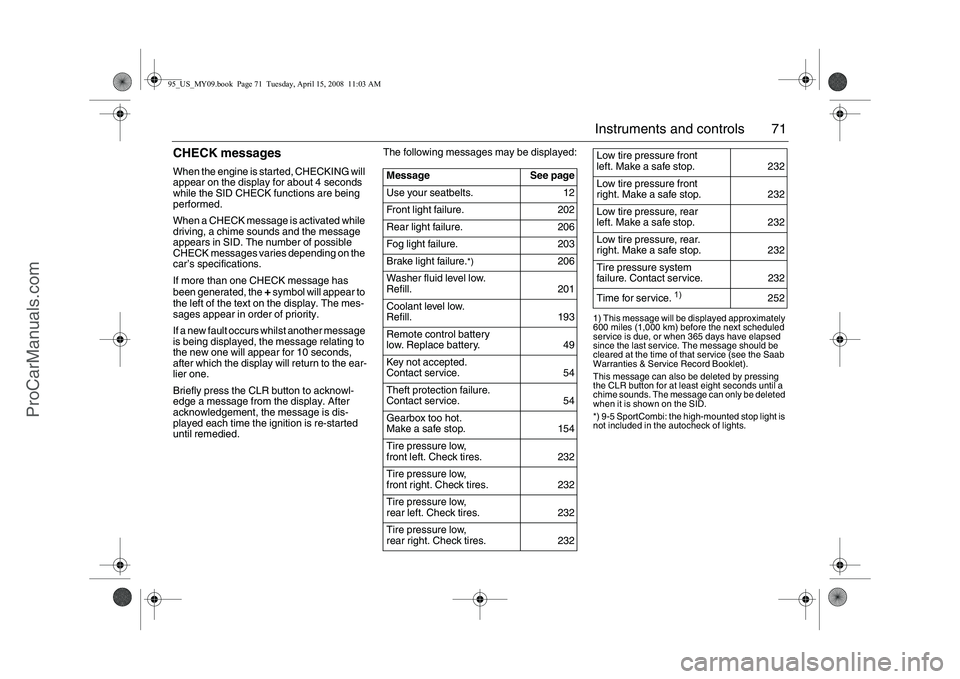
CHECK messages When the engine is started, CHECKING will
appear on the display for about 4 seconds
while the SID CHECK functions are being
performed.
When a CHECK message is activated while
driving, a chime sounds and the message
appears in SID. The number of possible
CHECK messages varies depending on the
car’s specifications.
If more than one CHECK message has
been generated, the
+ symbol will appear to
the left of the text on the display. The mes-
sages appear in order of priority.
If a new fault occurs whilst another message
is being displayed, the message relating to
the new one will appear for 10 seconds,
after which the display will return to the ear-
lier one.
Briefly press the CLR button to acknowl-
edge a message from the display. After
acknowledgement, the message is dis-
played each time the ignition is re-started
until remedied.The following messages may be displayed:
1) This message will be displayed approximately
600 miles (1,000 km) before the next scheduled
service is due, or when 365 days have elapsed
since the last service. The message should be
cleared at the time of that service (see the Saab
Warranties & Service Record Booklet).
This message can also be deleted by pressing
the CLR button for at least eight seconds until a
chime sounds. The message can only be deleted
when it is shown on the SID.
*) 9-5 SportCombi: the high-mounted stop light is
not included in the autocheck of lights.
Message See page
Use your seatbelts. 12
Front light failure. 202
Rear light failure. 206
Fog light failure. 203
Brake light failure.
*)
206
Washer fluid level low.
Refill. 201
Coolant level low.
Refill. 193
Remote control battery
low. Replace battery. 49
Key not accepted.
Contact service. 54
Theft protection failure.
Contact service. 54
Gearbox too hot.
Make a safe stop. 154
Tire pressure low,
front left. Check tires. 232
Tire pressure low,
front right. Check tires. 232
Tire pressure low,
rear left. Check tires. 232
Tire pressure low,
rear right. Check tires. 232
Low tire pressure front
left. Make a safe stop. 232
Low tire pressure front
right. Make a safe stop. 232
Low tire pressure, rear
left. Make a safe stop. 232
Low tire pressure, rear.
right. Make a safe stop. 232
Tire pressure system
failure. Contact service. 232
Time for service.
1)
252
95_US_MY09.book Page 71 Tuesday, April 15, 2008 11:03 AM
ProCarManuals.com
Page 76 of 272
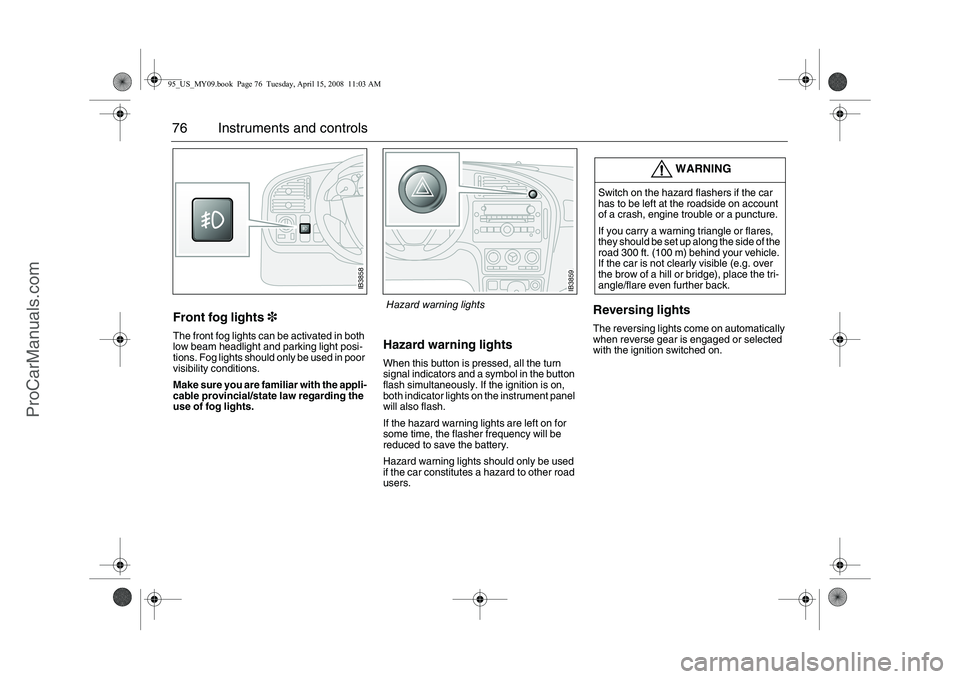
76 Instruments and controlsFront fog lights3The front fog lights can be activated in both
low beam headlight and parking light posi-
tions. Fog lights should only be used in poor
visibility conditions.
Make sure you are familiar with the appli-
cable provincial/state law regarding the
use of fog lights.
Hazard warning lightsWhen this button is pressed, all the turn
signal indicators and a symbol in the button
flash simultaneously. If the ignition is on,
both indicator lights on the instrument panel
will also flash.
If the hazard warning lights are left on for
some time, the flasher frequency will be
reduced to save the battery.
Hazard warning lights should only be used
if the car constitutes a hazard to other road
users.
Reversing lightsThe reversing lights come on automatically
when reverse gear is engaged or selected
with the ignition switched on.
WARNING
Switch on the hazard flashers if the car
has to be left at the roadside on account
of a crash, engine trouble or a puncture.
If you carry a warning triangle or flares,
they should be set up along the side of the
road 300 ft. (100 m) behind your vehicle.
If the car is not clearly visible (e.g. over
the brow of a hill or bridge), place the tri-
angle/flare even further back.
IB3858
IB3859
Hazard warning lights
95_US_MY09.book Page 76 Tuesday, April 15, 2008 11:03 AM
ProCarManuals.com
Page 82 of 272
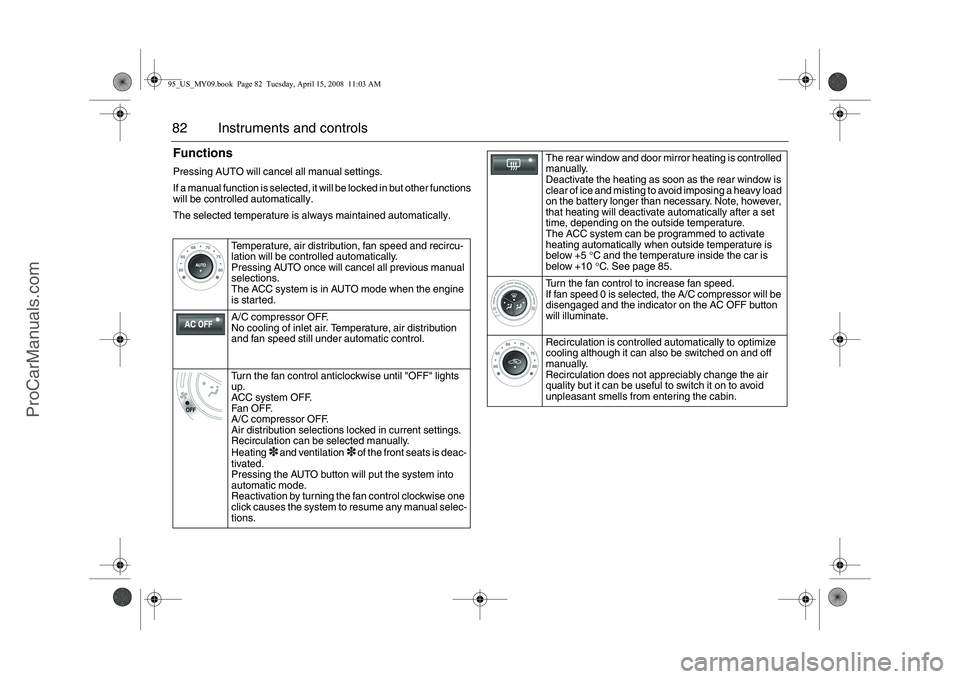
82 Instruments and controlsFunctionsPressing AUTO will cancel all manual settings.
If a manual function is selected, it will be locked in but other functions
will be controlled automatically.
The selected temperature is always maintained automatically.
Temperature, air distribution, fan speed and recircu-
lation will be controlled automatically.
Pressing AUTO once will cancel all previous manual
selections.
The ACC system is in AUTO mode when the engine
is started.
A/C compressor OFF.
No cooling of inlet air. Temperature, air distribution
and fan speed still under automatic control.
Turn the fan control anticlockwise until "OFF" lights
up.
ACC system OFF.
Fa n O F F.
A/C compressor OFF.
Air distribution selections locked in current settings.
Recirculation can be selected manually.
Heating
3 and ventilation
3 of the front seats is deac-
tivated.
Pressing the AUTO button will put the system into
automatic mode.
Reactivation by turning the fan control clockwise one
click causes the system to resume any manual selec-
tions.
The rear window and door mirror heating is controlled
manually.
Deactivate the heating as soon as the rear window is
clear of ice and misting to avoid imposing a heavy load
on the battery longer than necessary. Note, however,
that heating will deactivate automatically after a set
time, depending on the outside temperature.
The ACC system can be programmed to activate
heating automatically when outside temperature is
below +5 °C and the temperature inside the car is
below +10°C. See page 85.
Turn the fan control to increase fan speed.
If fan speed 0 is selected, the A/C compressor will be
disengaged and the indicator on the AC OFF button
will illuminate.
Recirculation is controlled automatically to optimize
cooling although it can also be switched on and off
manually.
Recirculation does not appreciably change the air
quality but it can be useful to switch it on to avoid
unpleasant smells from entering the cabin.
95_US_MY09.book Page 82 Tuesday, April 15, 2008 11:03 AM
ProCarManuals.com
Page 86 of 272
86 Instruments and controlsCalibrationCalibration is carried out automatically after
a certain number of starts if the ignition has
been switched off for more than 2 hours.
If the battery has been disconnected or has
run flat, the system will need to be recali-
brated.
Calibration is started manually as follows:
1 Start the engine.
2 Press and at the same
time.
When manual calibration starts,
”ACC:CALIBR.
STARTED”
appears in SID.
Calibration takes approx. 30 seconds.Useful tips(before taking the car to a workshop. We
recommend that you contact an authorized
Saab workshop.)
If the battery has been disconnected or
has run flat, the system will need to be
recalibrated. See "Calibration" above.
If front seat heating and/or rear window
heating do not function satisfactorily, see
"Adaptation of ACC" on page 85.
Condensation waterWhen the A/C system is running, the intake
air is dehumidified, and the resultant con-
densation is drained off through two outlets
underneath the floor of the car, in the vicinity
of the front doors.
It is therefore perfectly normal for water to
be seen dripping from these outlets when
the car is parked. The warmer the ambient
air and the higher the humidity, the more
condensation water will form.Formation of ice and mist in
extreme weather conditionsIt is only in the most extreme conditions that
icing and misting of window glass are likely
to be a problem, e.g. in torrential rain or
severe cold coupled with high relative
humidity, or when passengers are perspir-
ing heavily or wearing wet clothes.
The following measures are recommended
if such problems should occur:
1 Select AUTO and 21 °C for both temper-
ature zones.
2 Select Defroster.
If this is not enough...
3 Increase the fan speed.
If this is not enough...
4 Select a higher temperature.The following measures are recommended
if the occupants feel that it is cold and
draughty in the car:
1 Make sure that all the air vents are fully
open, including the center rear vent. If
this is not enough...
2 Direct the air flow away from the body. If
this is not enough...
3 Raise the temperature setting a degree
or two. If this is not enough...
4 Lower the fan speed.
Troubleshooting and care, see page 244.
95_US_MY09.book Page 86 Tuesday, April 15, 2008 11:03 AM
ProCarManuals.com
Page 119 of 272
119 Interior equipment and trunk
Preparations for first-time programming
Before programming the garage opener for
the first time, you must delete any factory
codes.
Press and hold the two outer buttons until
the indicator light begins to flash-after
20 seconds. Release both buttons. Do not
hold for longer that 30 seconds. The garage
opener is now in the train (or learning) mode
and can be programmed at any time begin-
ning with "Programming" - step 2.
Programming
The garage opener can record and store the
frequencies of three different remote con-
trols.
The battery in the remote control should be
fairly new for programming to work well.
Do not repeat "Programming" - step two
to train additional devices to a second or
third button. Begin with "Programming" -
step three.
1 Turn the ignition ON.
2 Press and hold the two outer buttons
(buttons one and three) - releasing only
when the indicator light begins to flash
(after 20 seconds). Do not hold the
buttons for longer than 30 seconds and
do not repeat step two to program a
second and/or third hand-held transmit-
ter to the remaining two buttons.
3 Position the end of your hand-held trans-
mitter 1-3 inches (5-14 cm) away from the button you wish to program while
keeping the indicator light in view. The
transmitter should face the mirror from
below or left side of the mirror.
4 Simultaneously press and hold both the
chosen and hand-held transmitter
buttons. Do not release the buttons
until step 5 has been completed.
Note: Some gate operators and garage
door openers may require you to replace
this Programming Step 4 with procedures
noted in the "Gate Operator / Canadian Pro-
gramming" section.
5 After the indicator light changes from a
slow to a rapidly blinking light, release
both the mirror and hand-held transmit-
ter buttons.
6 Press and hold the just-trained button
and observe the indicator light.
If the indicator light stays on
constantly, programming is complete
and your device should activate when
the button is pressed and released.
Note: To program the remaining two but-
tons, begin with "Programming" - step
three. Do not repeat step two.
If the indicator light blinks rapidly for two
seconds and then turns to a constant
light continue with "Programming"
steps 7-9 to complete the programming of
a rolling code equipped device (most com-
monly a garage door opener).7 At the garage door opener receiver
(motor-head unit) in the garage, locate
the "learn" or "smart" button. This can
usually be found where the hanging
antenna wire is attached to the
motor-head unit.
8 Firmly press and release the "learn" or
"smart" button. (The name and color of
the button may vary by manufacturer.)
Note: There are 30 seconds in which to ini-
tiate step nine.
9 Return to the vehicle and firmly press,
hold for two seconds and release the
programmed button. Repeat the
"press/hold/release" sequence a
second time, and, depending on the
brand of the garage door opener (or
other rolling code equipped device),
repeat this sequence a third time to
complete the programming process.
The garage opener should now activate
your rolling code equipped device.
Note: To program the remaining two but-
tons, begin with "Programming" - step
three. Do not repeat step two. 95_US_MY09.book Page 119 Tuesday, April 15, 2008 11:03 AM
ProCarManuals.com
Page 125 of 272
125 Interior equipment and trunk
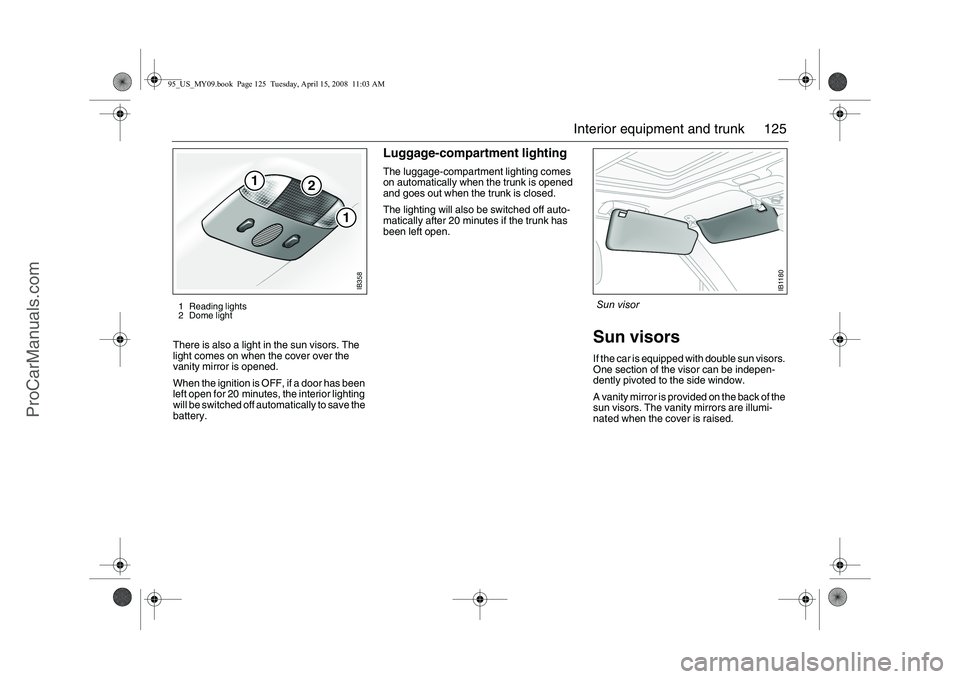
There is also a light in the sun visors. The
light comes on when the cover over the
vanity mirror is opened.
When the ignition is OFF, if a door has been
left open for 20 minutes, the interior lighting
will be switched off automatically to save the
battery.
Luggage-compartment lightingThe luggage-compartment lighting comes
on automatically when the trunk is opened
and goes out when the trunk is closed.
The lighting will also be switched off auto-
matically after 20 minutes if the trunk has
been left open.
Sun visorsIf the car is equipped with double sun visors.
One section of the visor can be indepen-
dently pivoted to the side window.
A vanity mirror is provided on the back of the
sun visors. The vanity mirrors are illumi-
nated when the cover is raised.
1
2
1
IB358
1 Reading lights
2 Dome light
IB1180
Sun visor
95_US_MY09.book Page 125 Tuesday, April 15, 2008 11:03 AM
ProCarManuals.com
Page 142 of 272
142 Starting and drivingIt is possible for air to enter the lubricating
system in conjunction with an oil or oil-filter
change, or if the car has been stored for
some time. This air can cause the hydraulic
cam followers to emit a ticking noise, which
can persist for up to 15 minutes after start-
ing. Although this is quite normal and does
not indicate any malfunction, it is advisable
not to exceed 3,000 rpm before the noise
has disappeared.
The hydraulic cam lifters are completely
service free; the valve clearance is set up at
the factory and will not need any subse-
quent adjustment.
Starting the engineAvoid racing the engine or putting a heavy
load on it before it has warmed up. Drive
away as soon as the oil warning light has
been extinguished to enable the engine to
attain its normal temperature as quickly as
possible.
The engine has an automatic choke and
should be started as follows:
Cars with manual transmission
To start the engine the clutch pedal must
be fully depressed.
1 Depress the clutch pedal fully but do not
touch the accelerator.
2 Start the engine. Let the ignition key
spring back as soon as the engine has
started and is running smoothly – at very
low temperatures, you may need to run
the starter for up to 25 seconds. Wait
20–30 seconds before running the
starter again, to give the battery time to
recover.
Note:
On cars with manual transmission, if the
starter fails to engage when the ignition key
is turned to the start position, make sure the
clutch pedal is full depressed. Misposi-
tioned floor mats or other obstructions
under the clutch pedal may affect starting.Let the engine idle for about 10 seconds.
Do not open the throttle wide for at least
2–3 minutes after starting.
Cars with automatic transmission 3
1 The selector lever must be in the P or N
position.
2 Keep your foot on the brake pedal.
3 Start the engine. Let the ignition key
spring back as soon as the engine has
started and is running smoothly – at very
low temperatures, you may need to run
the starter for up to 25 seconds. Wait
20–30 seconds before running the
starter again, to give the battery time to
recover.
Let the engine idle for about 10 seconds. Do
not open the throttle wide for at least
2–3 minutes after starting. The tail pipe of the exhaust system
can become very hot during driving.
Bear this in mind when loading and
unloading the car.
Do not rest or sleep in the car when
parked with the engine running. There
is a risk of depressing the accelerator
which could lead to engine damage.
There is also the risk that exhaust
gases may enter the cabin.
95_US_MY09.book Page 142 Tuesday, April 15, 2008 11:03 AM
ProCarManuals.com
Page 145 of 272
145 Starting and driving
Important considerations with
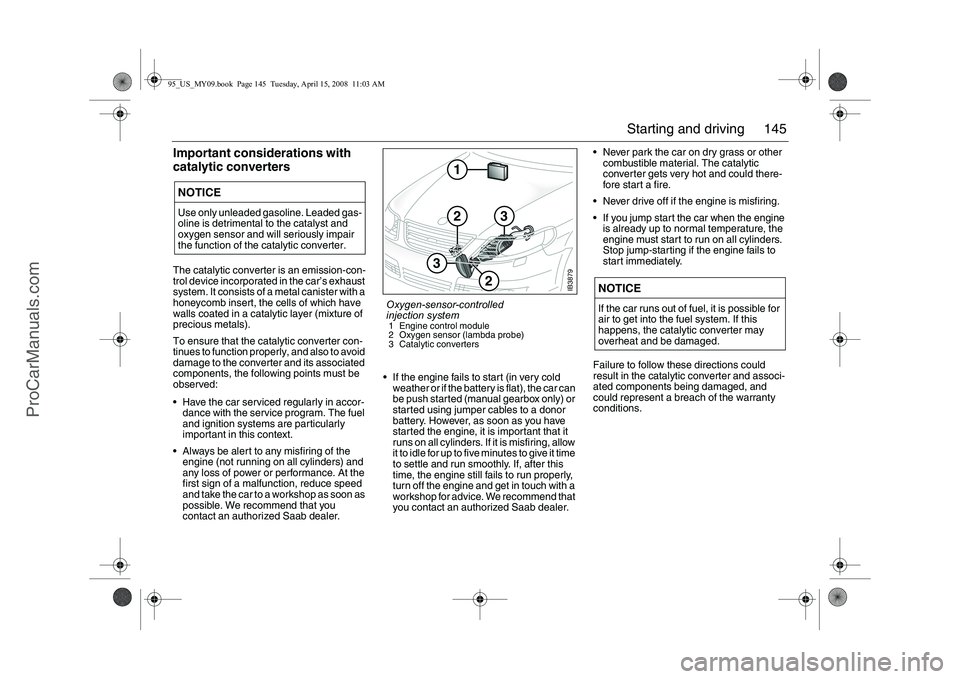
catalytic convertersThe catalytic converter is an emission-con-
trol device incorporated in the car’s exhaust
system. It consists of a metal canister with a
honeycomb insert, the cells of which have
walls coated in a catalytic layer (mixture of
precious metals).
To ensure that the catalytic converter con-
tinues to function properly, and also to avoid
damage to the converter and its associated
components, the following points must be
observed:
Have the car serviced regularly in accor-
dance with the service program. The fuel
and ignition systems are particularly
important in this context.
Always be alert to any misfiring of the
engine (not running on all cylinders) and
any loss of power or performance. At the
first sign of a malfunction, reduce speed
and take the car to a workshop as soon as
possible. We recommend that you
contact an authorized Saab dealer. If the engine fails to start (in very cold
weather or if the battery is flat), the car can
be push started (manual gearbox only) or
started using jumper cables to a donor
battery. However, as soon as you have
started the engine, it is important that it
runs on all cylinders. If it is misfiring, allow
it to idle for up to five minutes to give it time
to settle and run smoothly. If, after this
time, the engine still fails to run properly,
turn off the engine and get in touch with a
workshop for advice. We recommend that
you contact an authorized Saab dealer. Never park the car on dry grass or other
combustible material. The catalytic
converter gets very hot and could there-
fore start a fire.
Never drive off if the engine is misfiring.
If you jump start the car when the engine
is already up to normal temperature, the
engine must start to run on all cylinders.
Stop jump-starting if the engine fails to
start immediately.
Failure to follow these directions could
result in the catalytic converter and associ-
ated components being damaged, and
could represent a breach of the warranty
conditions.
NOTICEUse only unleaded gasoline. Leaded gas-
oline is detrimental to the catalyst and
oxygen sensor and will seriously impair
the function of the catalytic converter.
NOTICEIf the car runs out of fuel, it is possible for
air to get into the fuel system. If this
happens, the catalytic converter may
overheat and be damaged.
IB3879
12
2
3
3
Oxygen-sensor-controlled
injection system1 Engine control module
2 Oxygen sensor (lambda probe)
3 Catalytic converters
95_US_MY09.book Page 145 Tuesday, April 15, 2008 11:03 AM
ProCarManuals.com
Page 153 of 272
153 Starting and driving
Lock-up function The automatic transmission has a lock-up
function, which can render the torque con-
verter inoperative in 3rd, 4th and 5th gears,
thus reducing the engine speed and fuel
consumption.
When the lock-up function comes into oper-
ation, it may give the impression of an over-
drive being engaged.Kick-downWhen the accelerator is pressed down hard,
a change-down to the next gear will be
effected to provide maximum acceleration,
e.g. for overtaking.
Following this, the next higher gear will be
selected at the optimum engine speed for
acceleration or, if you ease off the acceler-
ator, before reaching this.
Park Brake Shift LockThe transmission has a security function
known as Park Brake Shift Lock. To move
the gear selector out of the P position, the
brake pedal must be depressed at the same
time as the gear selector catch (detent) is
pressed in.
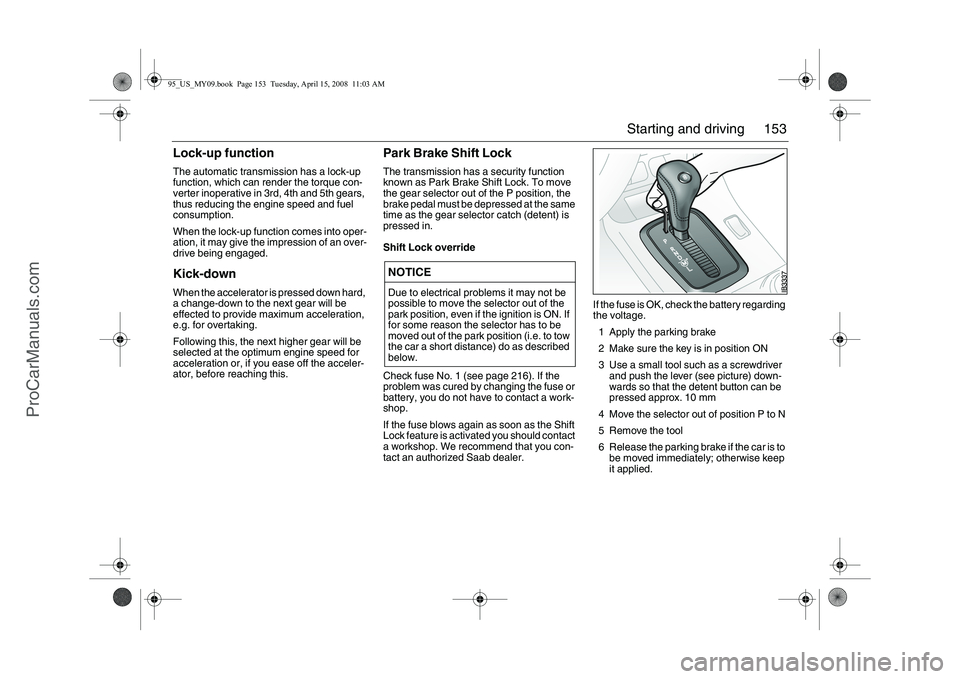
Shift Lock override
Check fuse No. 1 (see page 216). If the
problem was cured by changing the fuse or
battery, you do not have to contact a work-
shop.
If the fuse blows again as soon as the Shift
Lock feature is activated you should contact
a workshop. We recommend that you con-
tact an authorized Saab dealer.If the fuse is OK, check the battery regarding
the voltage.
1 Apply the parking brake
2 Make sure the key is in position ON
3 Use a small tool such as a screwdriver
and push the lever (see picture) down-
wards so that the detent button can be
pressed approx. 10 mm
4 Move the selector out of position P to N
5 Remove the tool
6 Release the parking brake if the car is to
be moved immediately; otherwise keep
it applied.NOTICEDue to electrical problems it may not be
possible to move the selector out of the
park position, even if the ignition is ON. If
for some reason the selector has to be
moved out of the park position (i.e. to tow
the car a short distance) do as described
below.
95_US_MY09.book Page 153 Tuesday, April 15, 2008 11:03 AM
ProCarManuals.com