open hood SAAB 9-5 2009 User Guide
[x] Cancel search | Manufacturer: SAAB, Model Year: 2009, Model line: 9-5, Model: SAAB 9-5 2009Pages: 272, PDF Size: 21.53 MB
Page 172 of 272
172 Starting and drivingEngine block heater3The following are just some of the benefits
to the car and the environment of using an
engine block heater:
Lower fuel consumption.
Exhaust emissions substantially reduced
over short runs.
Reduced wear on the engine.
Inside of car warms up faster.
The engine heater is effective at outside
temperatures up to 58–68°F (+15–20°C).
The warmer it is outside, the shorter the time
the engine heater needs to be connected.
Longer than 1.5 hours is unnecessary.
If the car is equipped with a removable,
electrical cabin heater that is not in use, this
should be stored in the luggage compart-
ment.
Driving in cold weatherBefore starting a journey in cold weather
you should check the following:
That the wiper blades have not become
frozen to the windshield/glass.
Brush any snow away from the air intake
for the heater system (opening between
hood and windshield).
It may be advisable to lubricate the
door-lock cylinder (use molybdenum
disulphide, MoS
2) to prevent its freezing.
If the lock has frozen, take care not to
break the key (or use the remote control)
– heat it first or spray it with de-icer.
Periodically during the winter, add gaso-
line anti-freeze to the fuel to dispel any
condensation in the fuel tank which could
freeze and cause problems in the system.
Keep the tank well filled to reduce the risk
of condensation forming.
If the car is parked outside in freezing
weather, fuel additives (gasoline
anti-freeze) will not do any good as it
cannot remove water that has already
frozen. Park the car in a warm place so
that any ice that may have built up melts,
then add gasoline anti-freeze when filling
up the tank. Condensation is caused by
changes in the outdoor temperature or by
the car being parked alternately in a
garage and outside. It is particularly important when the roads
are slippery that the brakes and tires be in
good condition.
Check the anti-freeze in the engine cool-
ant, see page 193.
The car´s trip computer will warn you when
there is a risk of slippery conditions. For fur-
ther information on this function, see
page 68.
The car is equipped with tires designed to
provide optimum grip on both wet and dry
roads, although this has been achieved at
the expense of somewhat reduced grip on
snow and ice. For regular driving on snow
and ice, we therefore recommend that
winter (snow) tires be fitted.
Winter (snow) tires, particularly studded
tires (where use is legally permitted), gener-
ally make driving safer on snow and ice.
Acquaint yourself with the legal provi-
sions governing the use of different
types of winter tires and snow chains.
Studded tires are not allowed in some
countries.
95_US_MY09.book Page 172 Tuesday, April 15, 2008 11:03 AM
ProCarManuals.com
Page 174 of 272
174 Starting and driving2 Wait until the needle has dropped back
to indicate normal temperature (roughly
midway, in the white zone) before stop-
ping the engine. If the coolant needs
topping up, unscrew the cap on expan-
sion tank carefully.
Top up, as necessary, ideally with a
50/50 mixture of Saab-approved coolant
and water. If only water is available, use
that, but remember to have the coolant
mixture checked as soon as possible. 3 As soon as possible, have the cooling
system checked by a workshop. We
recommend that you contact an autho-
rized Saab dealer.
Towing a trailer3Trailer hitch attachment3Trailer hitch attachments are available as
accessories. These are designed for a max-
imum trailer weight of 3500 lbs. (1588 kg),
see also page 259.
Use only the electrical trailer hitch socket
provided in the trailer hitch kit.3
Saab recommends:
Use a Saab original hitch kit attachment
which is designed and tested by Saab. Consult your Saab dealer regarding the
appropriate hitch kit for your car.
If the car has a 13-pin genuine Saab electri-
cal socket, the trailer/caravan can be
equipped with rear fog lamp and reversing
lamps.
The caravan can also have interior and
exterior lighting when the car’s ignition is off.
Do not put a load on the battery for so
long that it becomes discharged and the
car cannot be started.
There is also access to power in the caravan
during a journey, the caravan battery can be
charged for example.
WARNING
Exercise care when opening the hood
if the engine is overheated. Never
remove the expansion tank cap com-
pletely when the engine is hot.
The cooling system is pressurized -
hot coolant and vapor can escape.
These can cause injury to your eyes
and burns. Open the cap slowly to
release the pressure before
removing it.
WARNING
When towing a trailer, do not attempt
to negotiate a hill having a gradient in
excess of 15 %. The weight distribu-
tion over the front wheels of the car will
be insufficient to prevent wheelspin,
making further progress impossible.
In addition, the parking brake may not
always be able to hold the car and
trailer securely, with the result that the
wheels can start to slide downhill.
Always apply the trailer’s parking-
brake when unhitching it. There is oth-
erwise a risk of personal injury or
damage to the bumper should the
trailer start to roll.
NOTICEOnly use a towbar that has been
approved for your car. We recommend
that you entrust towbar installation to an
authorized Saab workshop, which can
also provide important information such
as trailer weight. Your authorized Saab
workshop has information on how the
towbar is to be installed and whether
other measures must be undertaken that
could affect the cooling system or other
equipment.
We recommend that you consult an
authorized Saab dealer for guidance on
how to connect the trailer hitch electrical
system.
95_US_MY09.book Page 174 Tuesday, April 15, 2008 11:03 AM
ProCarManuals.com
Page 185 of 272
185 Starting and driving
help save both batteries and it could
save your radio.
4 Open the hood and locate the battery.
Find the positive (+) and negative (–) termi-
nals on the battery.5 Check that the jumper cables do not
have loose or missing insulation. If they
do, you could get a shock and also the
vehicles could be damaged.
Before you connect the cables, here are
some basic things you should know.
Positive (+) will go to positive (+) and
negative (–) will go to a major metal
engine part with a good ground. Do not
connect (+) to (–) or you will get a short
that could injure you or would damage
the battery and maybe other parts as
well.
6 Connect the red positive (+) cable to the
positive (+) terminal of the vehicle with
the discharged battery.
7 Do not let the other end touch metal.
Connect it to the positive (+) terminal of
the good battery. Use a remote positive
(+) terminal if the vehicle has one.
8 Now connect the black negative (–)
cable to the good battery’s negative
terminal.NOTICEIf you leave your radio on, it could be
badly damaged. The repairs would not be
covered by your warranty.
WARNING
An electric fan can start up even when the
engine is not running and can injure you.
Keep hands, clothing and tools away from
any underhood electric fan.
WARNING
Using a match or flame of any kind near a
battery can cause battery gas to explode.
You can suffer burns or be blinded. Use a
flashlight if you need more light.
Be sure the battery has enough water.
The battery installed in your new Saab
has filler caps. Be sure the right amount
of water is there. Add distilled or boiled
water if the level is too low. If you don’t,
explosive gas could be present.
Be sure the electrolyte in the battery is not
frozen. Discharged batteries will freeze.
When connecting jumper cables to a
frozen battery, gas from the chemical
reaction inside the battery can build up
under the ice and cause an explosion.
Battery fluid contains acid that can burn
you. Do not get it on you. If you acciden-
tally get it in your eyes or on your skin,
flush the area with water and get medical
help immediately.
95_US_MY09.book Page 185 Tuesday, April 15, 2008 11:03 AM
ProCarManuals.com
Page 188 of 272
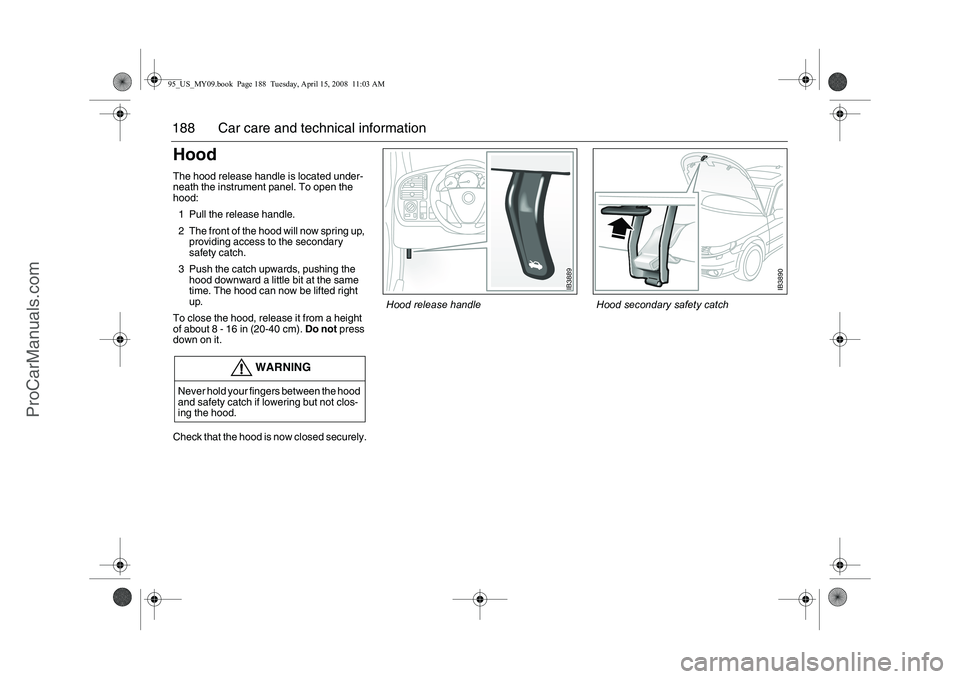
188 Car care and technical informationHood The hood release handle is located under-
neath the instrument panel. To open the
hood:
1 Pull the release handle.
2 The front of the hood will now spring up,
providing access to the secondary
safety catch.
3 Push the catch upwards, pushing the
hood downward a little bit at the same
time. The hood can now be lifted right
up.
To close the hood, release it from a height
of about 8 - 16 in (20-40 cm). Do not press
down on it.
Check that the hood is now closed securely.
WARNING
Never hold your fingers between the hood
and safety catch if lowering but not clos-
ing the hood.
IB3890
IB3889
Hood release handle Hood secondary safety catch
95_US_MY09.book Page 188 Tuesday, April 15, 2008 11:03 AM
ProCarManuals.com
Page 193 of 272
193 Car care and technical information
Transmission fluidManual transmission Check and top up the fluid in accordance
with the service program.Automatic transmissionCheck and top up the fluid in accordance
with the service program.
Coolant There is an overpressure in the cooling sys-
tem. Coolant temperatures can sometimes
exceed 212°F (100 °C).
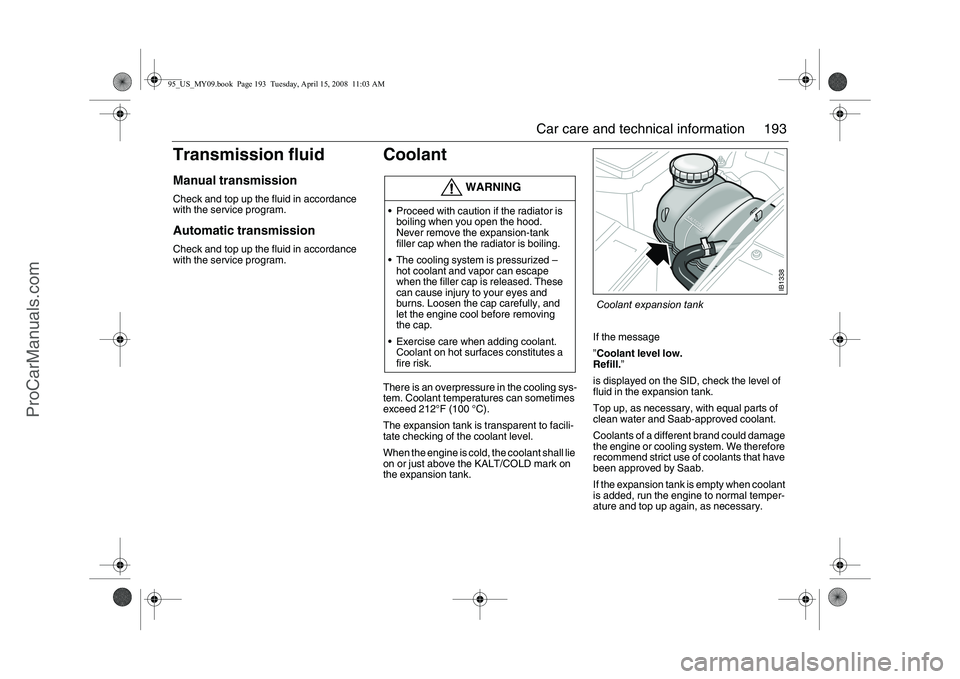
The expansion tank is transparent to facili-
tate checking of the coolant level.
When the engine is cold, the coolant shall lie
on or just above the KALT/COLD mark on
the expansion tank.If the message
”Coolant level low.
Refill.”
is displayed on the SID, check the level of
fluid in the expansion tank.
Top up, as necessary, with equal parts of
clean water and Saab-approved coolant.
Coolants of a different brand could damage
the engine or cooling system. We therefore
recommend strict use of coolants that have
been approved by Saab.
If the expansion tank is empty when coolant
is added, run the engine to normal temper-
ature and top up again, as necessary.
WARNING
Proceed with caution if the radiator is
boiling when you open the hood.
Never remove the expansion-tank
filler cap when the radiator is boiling.
The cooling system is pressurized –
hot coolant and vapor can escape
when the filler cap is released. These
can cause injury to your eyes and
burns. Loosen the cap carefully, and
let the engine cool before removing
the cap.
Exercise care when adding coolant.
Coolant on hot surfaces constitutes a
fire risk.
IB1338
Coolant expansion tank
95_US_MY09.book Page 193 Tuesday, April 15, 2008 11:03 AM
ProCarManuals.com
Page 249 of 272
249 Car care and technical information
The vehicle should be fully assembled
and all other work stopped while headlight
aiming is being done.
The vehicle should not have any snow, ice
or mud attached to it.
Tires should be inflated to the prescribed
pressure.
Close all doors.
Rock the vehicle to stabilize the suspen-
sion.
Headlight aiming is done with the vehicle
low beam lamps. The high beam lamps will
be correctly aimed if the low beam lamps
are aimed properly.
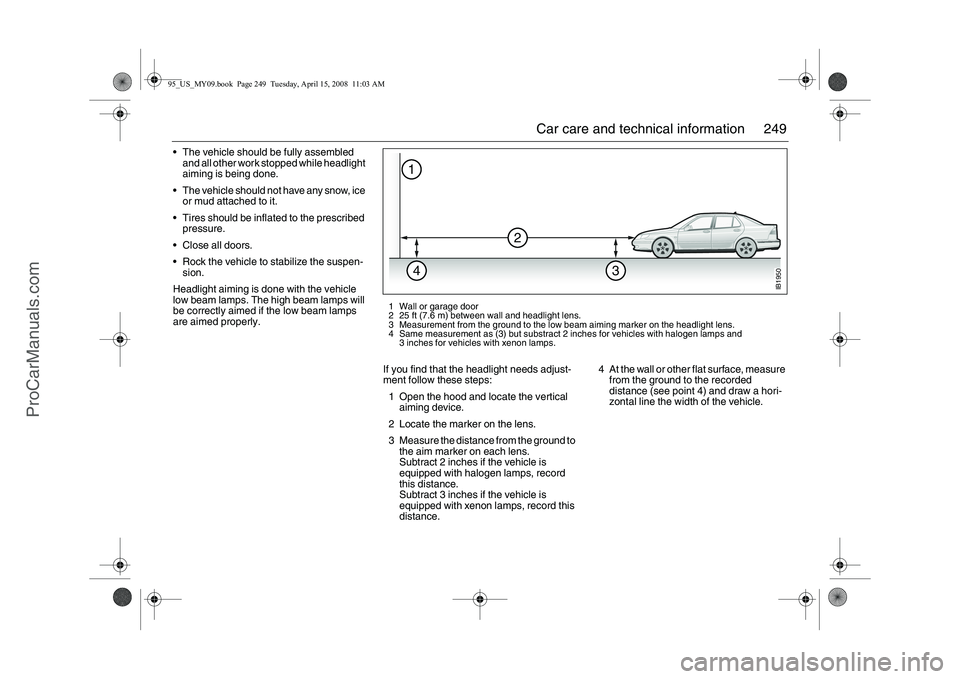
If you find that the headlight needs adjust-
ment follow these steps:
1 Open the hood and locate the vertical
aiming device.
2 Locate the marker on the lens.
3 Measure the distance from the ground to
the aim marker on each lens.
Subtract 2 inches if the vehicle is
equipped with halogen lamps, record
this distance.
Subtract 3 inches if the vehicle is
equipped with xenon lamps, record this
distance.4 At the wall or other flat surface, measure
from the ground to the recorded
distance (see point 4) and draw a hori-
zontal line the width of the vehicle.
IB1950
2
14
3
1 Wall or garage door
2 25 ft (7.6 m) between wall and headlight lens.
3 Measurement from the ground to the low beam aiming marker on the headlight lens.
4 Same measurement as (3) but substract 2 inches for vehicles with halogen lamps and
3 inches for vehicles with xenon lamps.
95_US_MY09.book Page 249 Tuesday, April 15, 2008 11:03 AM
ProCarManuals.com
Page 268 of 272
268 IndexDDICE/TWICE
___________________ 215
Date
_________________________ 105
Date code, tires
_________________ 231
Date display
___________________ 106
Definitions and terminology, tire
____ 229
Determining correct load, tires
_____ 231
Dim-dipped beam
________________ 73
Direction indicators _______________ 75
Diversity antenna
_______________ 109
Door handles
____________________ 44
Door mirrors ___________________ 116
Doors, locks & luggage compartment
_43
Drive belt
______________________ 260
Drive belt, alternator
_____________ 199
Drive belts, length
_______________ 260
Driver’s seat, programmable
________ 20
Driving at night
_________________ 179
Driving in hot weather
____________ 173
Driving with a load
_______________ 179
EEDR (Event Data Recorders)
______ 255
ESP®
________________________ 163
Electric heating of rear seat
________ 87
Electric windows
________________ 115
Electrical system, technical data
____ 260
Electrically retractable door mirrors _117
Electronic Stability Program
_______ 163Electronic starting interlock
_________ 49
Emergency operation of moonroof
__ 124
Emission control systems
_________ 190
Engine bay
____________________ 189
Engine bay, cleaning
_____________ 243
Engine number
_________________ 264
Engine oil, grade ________________ 260
Engine, description ______________ 192
Engine, technical data ____________ 260
Engine, temperature gauge
_________ 66
Engine-oil level, checking
_________ 192
Error codes, Audio System ________ 112
Event Data Recorders (EDR) ______ 255
Expansion tank, coolant
__________ 193
FFilling a portable fuel container
_____ 148
Flat spots, tires
_________________ 222
Fluid level, automatic transmission
__ 193
Foldable door mirrors
____________ 117
Folding the parcel shelf,
9-5 SportCombi
________________ 133
Folding the rear seat, 9-5 Sedan
____ 129
Folding the rear seat, 9-5 SportCombi
132
Frequency band
_________________ 93
Frequently asked questions on airbag
40
Front fog lights
__________________ 76
Frost warning
___________________ 68
Fuel
__________________________ 146
Fuel consumption
________________ 68Fuel container
__________________ 148
Fuel gauge
_____________________ 65
Fuel grade _____________________ 260
Fuel information
_________________ 148
Fuse box under hood
____________ 218
Fuse panel
_____________________ 214
Fuses
_________________________ 214
GGarage door opener
_____________ 118
Gearbox number
________________ 264
Gearbox oil, checking
____________ 193
General functions
_______________ 105
Glove compartment ______________ 126
HHandbrake
_____________________ 165
Hazard warning lights
_____________ 76
Head restraint
___________________ 21
Headlight flasher _________________ 73
Headlights
______________________ 73
Heated front seats
________________ 87
Hood
_________________________ 188
Horn __________________________ 114
IIf a tire goes flat
_________________ 226
Ignition switch
__________________ 140
95_US_MY09.book Page 268 Tuesday, April 15, 2008 11:03 AM
ProCarManuals.com
Page 271 of 272
271 Index
Temperature gauge, engine
________ 66
Temperature zones, ACC
__________ 81
Textile carpeting
________________ 241
Through-load hatch ______________ 131
Tie Downs
_____________________ 131
Tightening torque, wheel studs
_____ 237
Time display
___________________ 106
Tip, driving at night
______________ 179
Tip, to avoid theft
_______________ 166
Tips, ACC
______________________ 86
Tire chains ____________________ 226
Tire date code __________________ 231
Tire direction of rotation
__________ 231
Tire inspection and rotation ________ 221
Tire markings
__________________ 228
Tire pressure ___________________ 180
Tire sidewall labeling
_____________ 227
Tire terminology and definitions
____ 229
Tire, compact spare
_____________ 235
Tires
_____________________ 220
, 261
Tires, winter
___________________ 261
Touching-in the paintwork
_________ 243
Towbar attachment
______________ 174
Towbar load
___________________ 178
Towing the car _________________ 181
Towing, automatics
______________ 181
Traffic programme ________________ 99
Trailer weights
__________________ 259
Treadwear indicators
____________ 222
Trionic
________________________ 190
Trip computer
___________________ 68
Trip meter
______________________ 64Trunk
_________________________ 129
Trunk lid, opening
________________ 47
Tuning
_________________________ 93
Turbo gauge
____________________ 67
Turbo, points to note
_____________ 144
UUnder the hood
_________________ 189
Uniform tire quality grading
________ 224
Upholstery and trim
______________ 241
Upholstery and trim, care of
_______ 241
VVanity mirrors
__________________ 125
Vehicle Data Collection
___________ 255
Ventilated front seats
_____________ 87
Viscosity, engine oil
______________ 260
WWarning labels
___________________ 7
Warning light, AIR BAG
____________ 37
Warning lights
___________________ 58
Washers
______________________ 200
Washers, windshield
_____________ 201
Washing the car
________________ 242
Waxing and polishing
____________ 243
Wear indicators, tires ____________ 222What Will You See After an Airbag
Inflates?
_______________________ 38
Wheel replacement
______________ 225
Wheel, change
_________________ 237
Wheels and tires ________________ 261
Wheels and tires, sizes
___________ 261
When it is time for new tires
_______ 222
Windshield washers
______________ 77
Windshield wipers
________________ 77
Winter tires
________________ 231
, 261
Wiper blades, replacing
___________ 200
Wipers and washers
__________ 77
, 200
XXenon headlight
________________ 202
95_US_MY09.book Page 271 Tuesday, April 15, 2008 11:03 AM
ProCarManuals.com