spare wheel SAAB 9-5 2009 User Guide
[x] Cancel search | Manufacturer: SAAB, Model Year: 2009, Model line: 9-5, Model: SAAB 9-5 2009Pages: 272, PDF Size: 21.53 MB
Page 234 of 272
234 Car care and technical informationMalfunctionsThe above message is shown on the SID if:
a wheel without pressure sensor has
been fitted (e.g. spare wheel)
one or more pressure sensors are broken
or missing
a fault has arisen in the receiver
a system error has arisen.
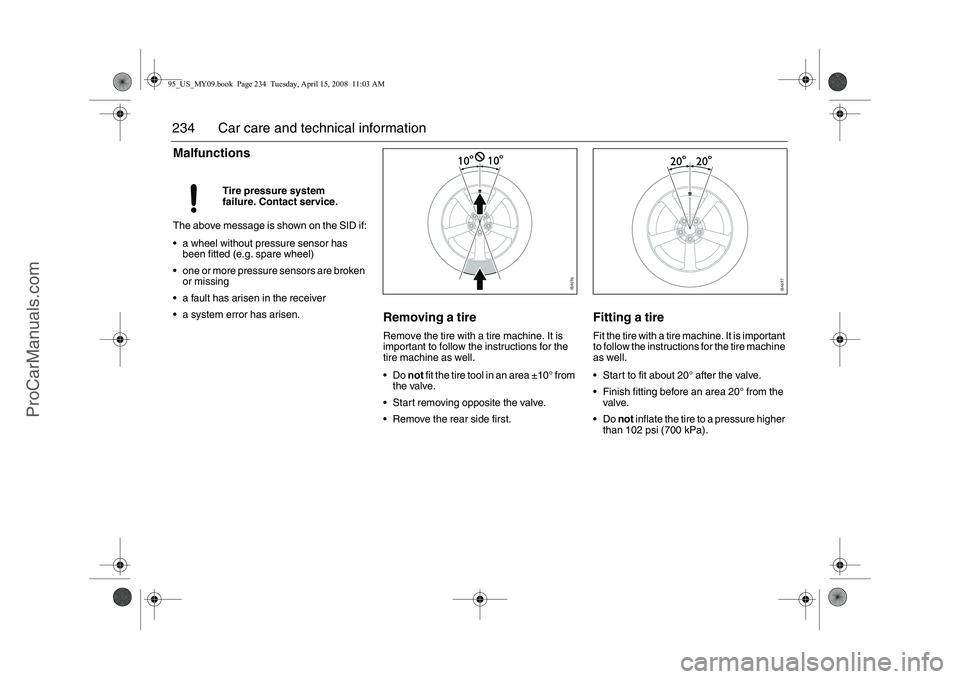
Removing a tireRemove the tire with a tire machine. It is
important to follow the instructions for the
tire machine as well.
Do not fit the tire tool in an area ±10° from
the valve.
Start removing opposite the valve.
Remove the rear side first.
Fitting a tireFit the tire with a tire machine. It is important
to follow the instructions for the tire machine
as well.
Start to fit about 20° after the valve.
Finish fitting before an area 20° from the
valve.
Do not inflate the tire to a pressure higher
than 102 psi (700 kPa). Tire pressure system
failure. Contact service.
95_US_MY09.book Page 234 Tuesday, April 15, 2008 11:03 AM
ProCarManuals.com
Page 235 of 272
235 Car care and technical information
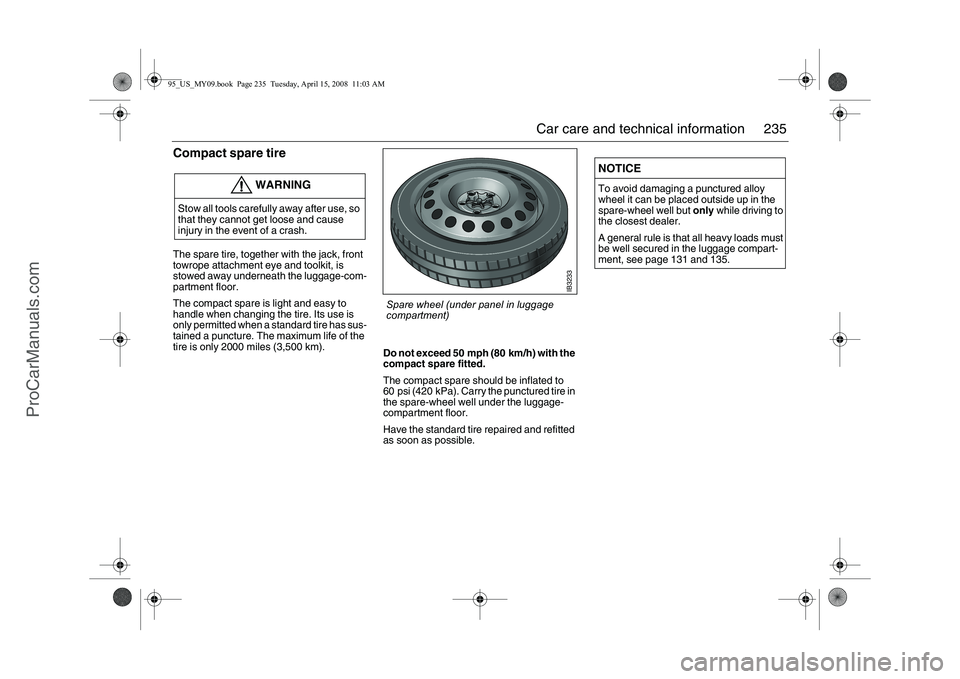
Compact spare tireThe spare tire, together with the jack, front
towrope attachment eye and toolkit, is
stowed away underneath the luggage-com-
partment floor.
The compact spare is light and easy to
handle when changing the tire. Its use is
only permitted when a standard tire has sus-
tained a puncture. The maximum life of the
tire is only 2000 miles (3,500 km).
Do not exceed 50 mph (80 km/h) with the
compact spare fitted.
The compact spare should be inflated to
60 psi (420 kPa). Carry the punctured tire in
the spare-wheel well under the luggage-
compartment floor.
Have the standard tire repaired and refitted
as soon as possible.
WARNING
Stow all tools carefully away after use, so
that they cannot get loose and cause
injury in the event of a crash.
NOTICETo avoid damaging a punctured alloy
wheel it can be placed outside up in the
spare-wheel well but only while driving to
the closest dealer.
A general rule is that all heavy loads must
be well secured in the luggage compart-
ment, see page 131 and 135.
IB3233
Spare wheel (under panel in luggage
compartment)
95_US_MY09.book Page 235 Tuesday, April 15, 2008 11:03 AM
ProCarManuals.com
Page 236 of 272
236 Car care and technical informationDriving considerations with
compact spare wheel/tire fitted
The following should be observed when the
compact spare wheel (T115/70 R16) is
fitted:
The compact spare is light and easy to
handle when changing the wheel.
Do not drive further than necessary with
the compact spare fitted – the maximum
life of the wheel is only just over
2000 miles (3,500 km).
Refit the standard tire as soon as possi-
ble.
Fitting a spare tire/wheel without pressure
sensor will trigger a malfunction
message, see page 234.
Important considerations when driving with
a compact spare tire:
The car’s ground clearance is reduced.
The car must not be driven with more than
one compact tire at a time.
Avoid driving against a curb.
Do not use snow chains.
Do not fit the wheel cover - this would
conceal the warning text.
WARNING
Do not exceed 50 mph (80 km/h) as
the tire can overheat and adversely
affect the handling of the car.
Tire pressure: refer to page 263.
The spare wheel or punctured tire
must be stowed under the trunk floor,
and secured in place with the retaining
nut.
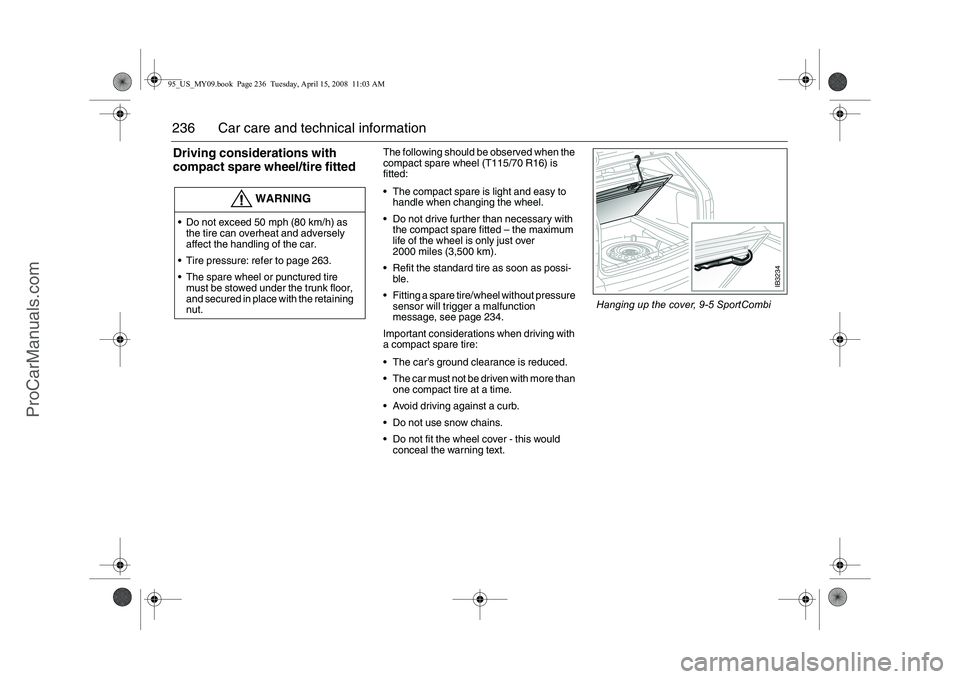
IB3234
Hanging up the cover, 9-5 SportCombi
95_US_MY09.book Page 236 Tuesday, April 15, 2008 11:03 AM
ProCarManuals.com
Page 237 of 272
237 Car care and technical information
Changing a wheel
WARNING
Lifting a vehicle and getting under it to do
maintenance or repairs is dangerous
without the appropriate safety equipment
and training. The jack provided with your
vehicle is designed only for changing a
flat tire. If it is used for anything else, you
or others could be badly injured or killed if
the vehicle slips off the jack. Use the jack
provided with your vehicle only for chang-
ing a flat tire.
Changing a tire can be dangerous. The
vehicle can slip off the jack and roll over
or fall on you or other people. You and
they could be badly injured or even killed.
Find a level place to change your tire. To
help prevent the vehicle from moving:
1 Set the parking brake firmly.
2 If you have an automatic transmis-
sion, put the shift lever in PARK (P).
For a manual transmission, leave the
car in gear (1st or REVERSE (R)).
3 Turn off the engine and do not restart
while the vehicle is raised.
4 Do not allow passengers to remain in
the vehicle.
To be even more certain the vehicle won't
move, you should put blocks at the front
and rear of the tire farthest away from the
one being changed. That would be the
tire, on the other side, at the opposite end
of the vehicle.
The car jack is designed solely for use
in changing a wheel or fitting snow
chains. It must not be used to sup-
port the car during repair work or
servicing.
Never crawl under a car that is
supported only by a jack.
Raising your vehicle too high or with
the jack improperly positioned can
damage the vehicle and even make
the vehicle fall. To help avoid personal
injury and vehicle damage, be sure to
fit the jack lift head into the proper
location before raising the vehicle, and
raise the vehicle only far enough off
the ground so there is enough room
for the spare tire to fit (no more than
25 mm or 1 inch clearance between
the ground and the bottom of the tire).
Switch on the hazard warning lights if
the car is on a road.
The jack should be stored correctly
under the carpeting in the trunk. If it
lies loose in the car, it could thrown for-
ward and cause personal injury in the
event of a crash or if the car rolls over.
Grit, salt and rust can clog the inner
threads of the wheel bolts if the car has
been driven for several years exclu-
sively with alloy wheels.
If steel wheels are being installed, the
bolt hole threads in the brake hubs
should be cleaned before the thinner
steel wheels are fitted. It may other-
wise not be possible to achieve the
correct clamping force, despite tight-
ening the wheel bolts to the correct
torque.
95_US_MY09.book Page 237 Tuesday, April 15, 2008 11:03 AM
ProCarManuals.com
Page 247 of 272
247 Car care and technical information
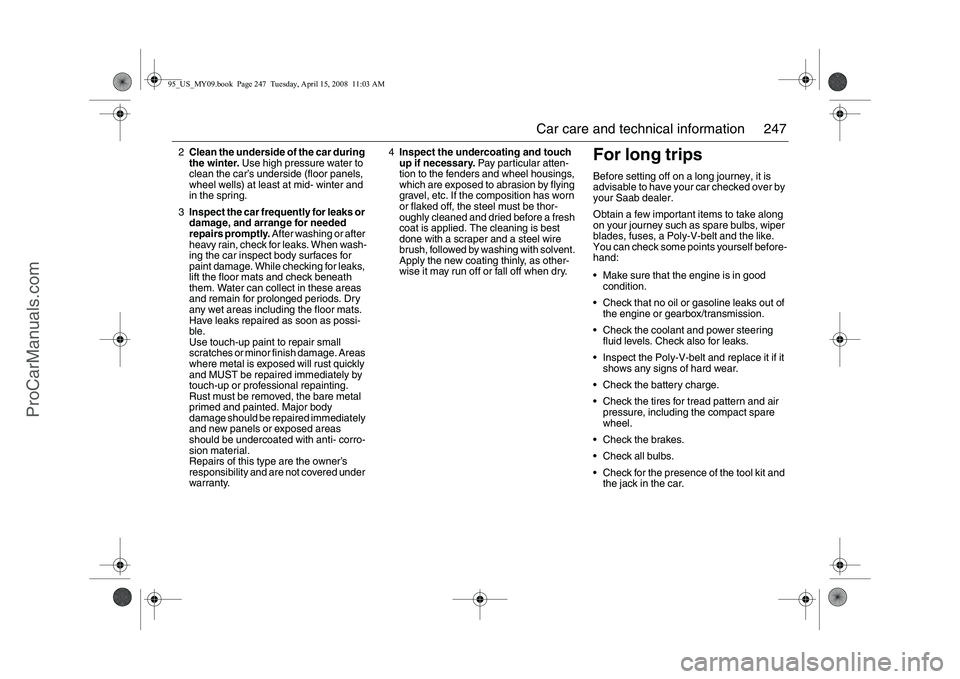
2Clean the underside of the car during
the winter. Use high pressure water to
clean the car’s underside (floor panels,
wheel wells) at least at mid- winter and
in the spring.
3Inspect the car frequently for leaks or
damage, and arrange for needed
repairs promptly. After washing or after
heavy rain, check for leaks. When wash-
ing the car inspect body surfaces for
paint damage. While checking for leaks,
lift the floor mats and check beneath
them. Water can collect in these areas
and remain for prolonged periods. Dry
any wet areas including the floor mats.
Have leaks repaired as soon as possi-
ble.
Use touch-up paint to repair small
scratches or minor finish damage. Areas
where metal is exposed will rust quickly
and MUST be repaired immediately by
touch-up or professional repainting.
Rust must be removed, the bare metal
primed and painted. Major body
damage should be repaired immediately
and new panels or exposed areas
should be undercoated with anti- corro-
sion material.
Repairs of this type are the owner’s
responsibility and are not covered under
warranty.4Inspect the undercoating and touch
up if necessary. Pay particular atten-
tion to the fenders and wheel housings,
which are exposed to abrasion by flying
gravel, etc. If the composition has worn
or flaked off, the steel must be thor-
oughly cleaned and dried before a fresh
coat is applied. The cleaning is best
done with a scraper and a steel wire
brush, followed by washing with solvent.
Apply the new coating thinly, as other-
wise it may run off or fall off when dry.
For long tripsBefore setting off on a long journey, it is
advisable to have your car checked over by
your Saab dealer.
Obtain a few important items to take along
on your journey such as spare bulbs, wiper
blades, fuses, a Poly-V-belt and the like.
You can check some points yourself before-
hand:
Make sure that the engine is in good
condition.
Check that no oil or gasoline leaks out of
the engine or gearbox/transmission.
Check the coolant and power steering
fluid levels. Check also for leaks.
Inspect the Poly-V-belt and replace it if it
shows any signs of hard wear.
Check the battery charge.
Check the tires for tread pattern and air
pressure, including the compact spare
wheel.
Check the brakes.
Check all bulbs.
Check for the presence of the tool kit and
the jack in the car.
95_US_MY09.book Page 247 Tuesday, April 15, 2008 11:03 AM
ProCarManuals.com
Page 258 of 272
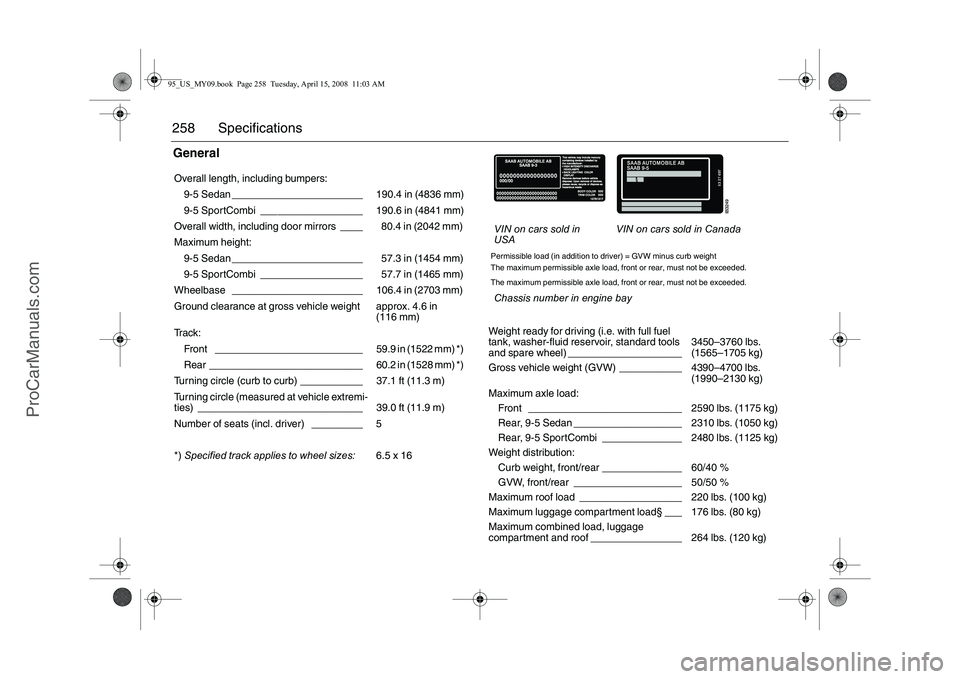
258 SpecificationsGeneral Overall length, including bumpers:
9-5 Sedan _______________________ 190.4 in (4836 mm)
9-5 SportCombi __________________ 190.6 in (4841 mm)
Overall width, including door mirrors ____ 80.4 in (2042 mm)
Maximum height:
9-5 Sedan _______________________ 57.3 in (1454 mm)
9-5 SportCombi __________________ 57.7 in (1465 mm)
Wheelbase _______________________ 106.4 in (2703 mm)
Ground clearance at gross vehicle weight approx. 4.6 in
(116 mm)
Tr a c k :
Front __________________________ 59.9 in (1522 mm) *)
Rear ___________________________ 60.2 in (1528 mm) *)
Turning circle (curb to curb) ___________ 37.1 ft (11.3 m)
Turning circle (measured at vehicle extremi-
ties) _____________________________ 39.0 ft (11.9 m)
Number of seats (incl. driver) _________ 5
*) Specified track applies to wheel sizes: 6.5 x 16
VIN on cars sold in
USAVIN on cars sold in CanadaPermissible load (in addition to driver) = GVW minus curb weight
The maximum permissible axle load, front or rear, must not be exceeded.
The maximum permissible axle load, front or rear, must not be exceeded. Chassis number in engine bay
Weight ready for driving (i.e. with full fuel
tank, washer-fluid reservoir, standard tools
and spare wheel) ____________________ 3450–3760 lbs.
(1565–1705 kg)
Gross vehicle weight (GVW) ___________ 4390–4700 lbs.
(1990–2130 kg)
Maximum axle load:
Front ___________________________ 2590 lbs. (1175 kg)
Rear, 9-5 Sedan ___________________ 2310 lbs. (1050 kg)
Rear, 9-5 SportCombi ______________ 2480 lbs. (1125 kg)
Weight distribution:
Curb weight, front/rear ______________ 60/40 %
GVW, front/rear ___________________ 50/50 %
Maximum roof load __________________ 220 lbs. (100 kg)
Maximum luggage compartment load§ ___ 176 lbs. (80 kg)
Maximum combined load, luggage
compartment and roof ________________ 264 lbs. (120 kg)
95_US_MY09.book Page 258 Tuesday, April 15, 2008 11:03 AM
ProCarManuals.com
Page 261 of 272
261 Specifications
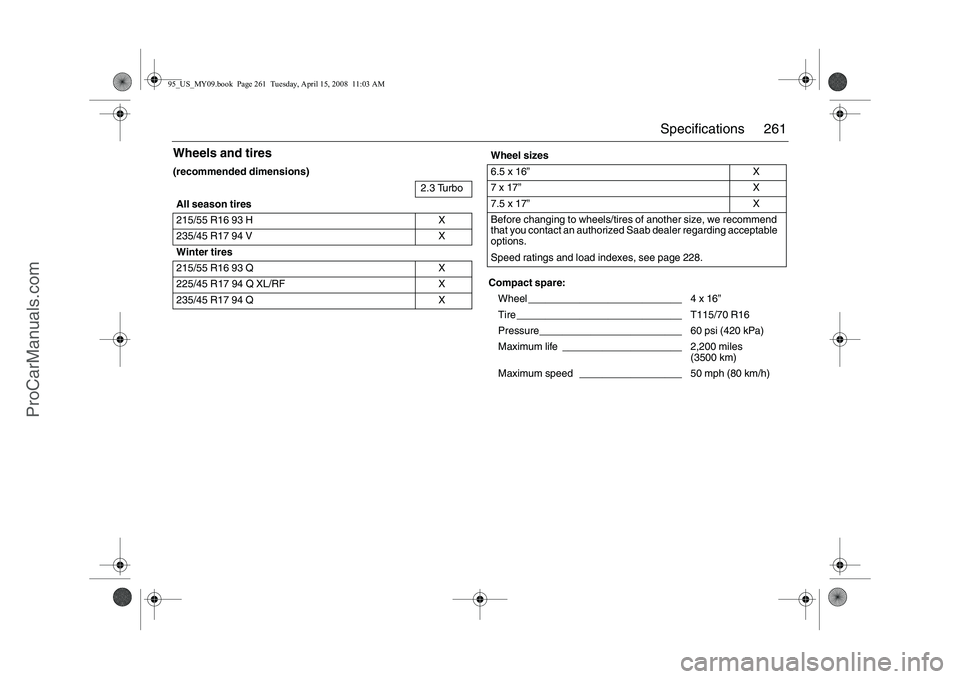
Wheels and tires(recommended dimensions)
2.3 Turbo
All season tires
215/55 R16 93 H X
235/45 R17 94 V X
Winter tires
215/55 R16 93 Q X
225/45 R17 94 Q XL/RF X
235/45 R17 94 Q X
Wheel sizes
6.5 x 16” X
7 x 17” X
7.5 x 17” X
Before changing to wheels/tires of another size, we recommend
that you contact an authorized Saab dealer regarding acceptable
options.
Speed ratings and load indexes, see page 228.
Compact spare:
Wheel ___________________________ 4 x 16”
Tire _____________________________ T115/70 R16
Pressure_________________________ 60 psi (420 kPa)
Maximum life _____________________ 2,200 miles
(3500 km)
Maximum speed __________________ 50 mph (80 km/h)
95_US_MY09.book Page 261 Tuesday, April 15, 2008 11:03 AM
ProCarManuals.com
Page 263 of 272
263 Specifications
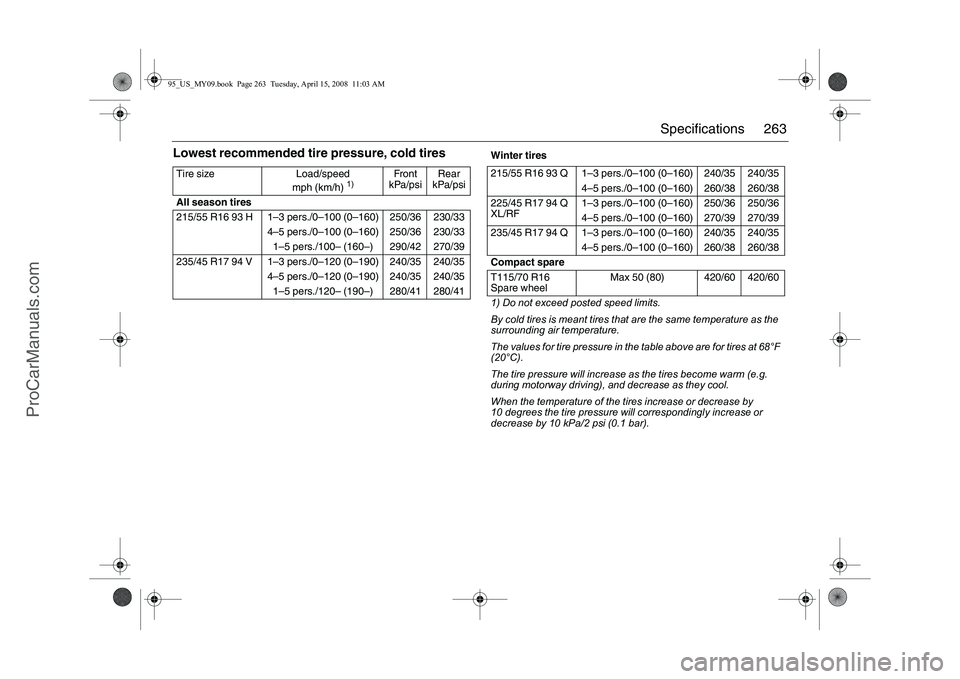
Lowest recommended tire pressure, cold tiresTire size Load/speed
mph (km/h)
1)
Front
kPa/psiRear
kPa/psi
All season tires
215/55 R16 93 H 1–3 pers./0–100 (0–160) 250/36 230/33
4–5 pers./0–100 (0–160) 250/36 230/33
1–5 pers./100– (160–) 290/42 270/39
235/45 R17 94 V 1–3 pers./0–120 (0–190) 240/35 240/35
4–5 pers./0–120 (0–190) 240/35 240/35
1–5 pers./120– (190–) 280/41 280/41
Winter tires
215/55 R16 93 Q 1–3 pers./0–100 (0–160) 240/35 240/35
4–5 pers./0–100 (0–160) 260/38 260/38
225/45 R17 94 Q
XL/RF1–3 pers./0–100 (0–160) 250/36 250/36
4–5 pers./0–100 (0–160) 270/39 270/39
235/45 R17 94 Q 1–3 pers./0–100 (0–160) 240/35 240/35
4–5 pers./0–100 (0–160) 260/38 260/38
Compact spare
T115/70 R16
Spare wheelMax 50 (80) 420/60 420/60
1) Do not exceed posted speed limits.
By cold tires is meant tires that are the same temperature as the
surrounding air temperature.
The values for tire pressure in the table above are for tires at 68°F
(20°C).
The tire pressure will increase as the tires become warm (e.g.
during motorway driving), and decrease as they cool.
When the temperature of the tires increase or decrease by
10 degrees the tire pressure will correspondingly increase or
decrease by 10 kPa/2 psi (0.1 bar).
95_US_MY09.book Page 263 Tuesday, April 15, 2008 11:03 AM
ProCarManuals.com
Page 267 of 272
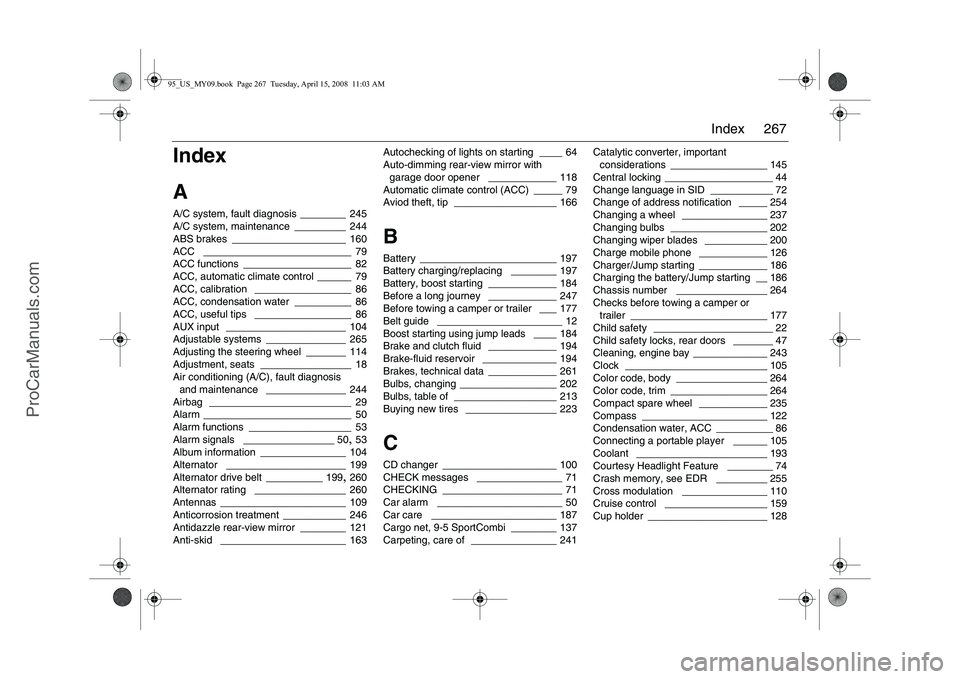
267 Index
Index
AA/C system, fault diagnosis
________ 245
A/C system, maintenance _________ 244
ABS brakes
____________________ 160
ACC
__________________________ 79
ACC functions
___________________ 82
ACC, automatic climate control
______ 79
ACC, calibration
_________________ 86
ACC, condensation water
__________ 86
ACC, useful tips
_________________ 86
AUX input
_____________________ 104
Adjustable systems
______________ 265
Adjusting the steering wheel
_______ 114
Adjustment, seats
________________ 18
Air conditioning (A/C), fault diagnosis
and maintenance ______________ 244
Airbag
_________________________ 29
Alarm __________________________ 50
Alarm functions
__________________ 53
Alarm signals
________________ 50
, 53
Album information
_______________ 104
Alternator
_____________________ 199
Alternator drive belt
__________ 199
, 260
Alternator rating
________________ 260
Antennas
______________________ 109
Anticorrosion treatment
___________ 246
Antidazzle rear-view mirror
________ 121
Anti-skid
______________________ 163Autochecking of lights on starting
____ 64
Auto-dimming rear-view mirror with
garage door opener
____________ 118
Automatic climate control (ACC)
_____ 79
Aviod theft, tip
__________________ 166
BBattery
________________________ 197
Battery charging/replacing
________ 197
Battery, boost starting
____________ 184
Before a long journey ____________ 247
Before towing a camper or trailer
___ 177
Belt guide
______________________ 12
Boost starting using jump leads
____ 184
Brake and clutch fluid
____________ 194
Brake-fluid reservoir
_____________ 194
Brakes, technical data ____________ 261
Bulbs, changing
_________________ 202
Bulbs, table of
__________________ 213
Buying new tires ________________ 223
CCD changer
____________________ 100
CHECK messages
_______________ 71
CHECKING
_____________________ 71
Car alarm
______________________ 50
Car care
______________________ 187
Cargo net, 9-5 SportCombi
________ 137
Carpeting, care of
_______________ 241Catalytic converter, important
considerations
_________________ 145
Central locking ___________________ 44
Change language in SID
___________ 72
Change of address notification
_____ 254
Changing a wheel
_______________ 237
Changing bulbs
_________________ 202
Changing wiper blades
___________ 200
Charge mobile phone
____________ 126
Charger/Jump starting ____________ 186
Charging the battery/Jump starting
__ 186
Chassis number
________________ 264
Checks before towing a camper or
trailer
________________________ 177
Child safety
_____________________ 22
Child safety locks, rear doors
_______ 47
Cleaning, engine bay
_____________ 243
Clock
_________________________ 105
Color code, body
________________ 264
Color code, trim _________________ 264
Compact spare wheel
____________ 235
Compass
______________________ 122
Condensation water, ACC
__________ 86
Connecting a portable player ______ 105
Coolant
_______________________ 193
Courtesy Headlight Feature
________ 74
Crash memory, see EDR
_________ 255
Cross modulation
_______________ 110
Cruise control
__________________ 159
Cup holder
_____________________ 128
95_US_MY09.book Page 267 Tuesday, April 15, 2008 11:03 AM
ProCarManuals.com
Page 270 of 272
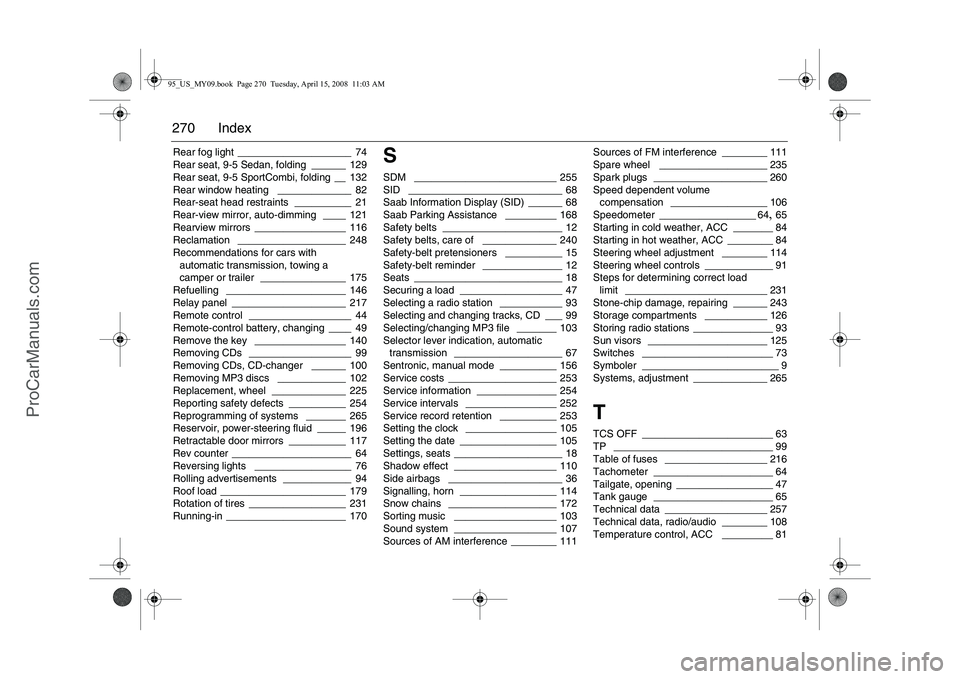
270 IndexRear fog light
____________________ 74
Rear seat, 9-5 Sedan, folding
______ 129
Rear seat, 9-5 SportCombi, folding
__ 132
Rear window heating
_____________ 82
Rear-seat head restraints __________ 21
Rear-view mirror, auto-dimming
____ 121
Rearview mirrors
________________ 116
Reclamation
___________________ 248
Recommendations for cars with
automatic transmission, towing a
camper or trailer
_______________ 175
Refuelling
_____________________ 146
Relay panel ____________________ 217
Remote control __________________ 44
Remote-control battery, changing
____ 49
Remove the key
________________ 140
Removing CDs
__________________ 99
Removing CDs, CD-changer
______ 100
Removing MP3 discs
____________ 102
Replacement, wheel
_____________ 225
Reporting safety defects
__________ 254
Reprogramming of systems _______ 265
Reservoir, power-steering fluid _____ 196
Retractable door mirrors
__________ 117
Rev counter
_____________________ 64
Reversing lights
_________________ 76
Rolling advertisements
____________ 94
Roof load
______________________ 179
Rotation of tires
_________________ 231
Running-in
_____________________ 170
SSDM
_________________________ 255
SID
___________________________ 68
Saab Information Display (SID)
______ 68
Saab Parking Assistance
_________ 168
Safety belts
_____________________ 12
Safety belts, care of
_____________ 240
Safety-belt pretensioners
__________ 15
Safety-belt reminder
______________ 12
Seats
__________________________ 18
Securing a load
__________________ 47
Selecting a radio station
___________ 93
Selecting and changing tracks, CD
___ 99
Selecting/changing MP3 file
_______ 103
Selector lever indication, automatic
transmission
___________________ 67
Sentronic, manual mode
__________ 156
Service costs
___________________ 253
Service information
______________ 254
Service intervals
________________ 252
Service record retention
__________ 253
Setting the clock
________________ 105
Setting the date _________________ 105
Settings, seats ___________________ 18
Shadow effect __________________ 110
Side airbags
____________________ 36
Signalling, horn _________________ 114
Snow chains
___________________ 172
Sorting music __________________ 103
Sound system __________________ 107
Sources of AM interference
________ 111Sources of FM interference
________ 111
Spare wheel
___________________ 235
Spark plugs
____________________ 260
Speed dependent volume
compensation _________________ 106
Speedometer
_________________ 64
, 65
Starting in cold weather, ACC
_______ 84
Starting in hot weather, ACC ________ 84
Steering wheel adjustment
________ 114
Steering wheel controls
____________ 91
Steps for determining correct load
limit
_________________________ 231
Stone-chip damage, repairing
______ 243
Storage compartments
___________ 126
Storing radio stations
______________ 93
Sun visors
_____________________ 125
Switches
_______________________ 73
Symboler ________________________ 9
Systems, adjustment
_____________ 265
TTCS OFF
_______________________ 63
TP
____________________________ 99
Table of fuses
__________________ 216
Tachometer
_____________________ 64
Tailgate, opening
_________________ 47
Tank gauge
_____________________ 65
Technical data __________________ 257
Technical data, radio/audio
________ 108
Temperature control, ACC _________ 81
95_US_MY09.book Page 270 Tuesday, April 15, 2008 11:03 AM
ProCarManuals.com