wash SAAB 9-5 2009 User Guide
[x] Cancel search | Manufacturer: SAAB, Model Year: 2009, Model line: 9-5, Model: SAAB 9-5 2009Pages: 272, PDF Size: 21.53 MB
Page 117 of 272
117 Interior equipment and trunk
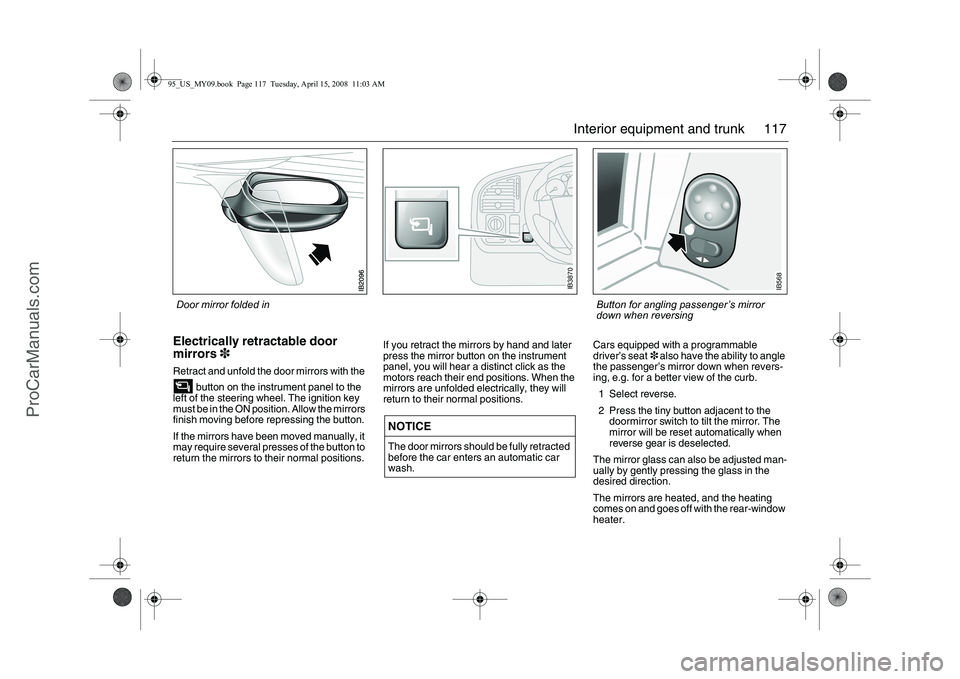
Electrically retractable door
mirrors3Retract and unfold the door mirrors with the
button on the instrument panel to the
left of the steering wheel. The ignition key
must be in the ON position. Allow the mirrors
finish moving before repressing the button.
If the mirrors have been moved manually, it
may require several presses of the button to
return the mirrors to their normal positions. If you retract the mirrors by hand and later
press the mirror button on the instrument
panel, you will hear a distinct click as the
motors reach their end positions. When the
mirrors are unfolded electrically, they will
return to their normal positions.Cars equipped with a programmable
driver’s seat3 also have the ability to angle
the passenger’s mirror down when revers-
ing, e.g. for a better view of the curb.
1 Select reverse.
2 Press the tiny button adjacent to the
doormirror switch to tilt the mirror. The
mirror will be reset automatically when
reverse gear is deselected.
The mirror glass can also be adjusted man-
ually by gently pressing the glass in the
desired direction.
The mirrors are heated, and the heating
comes on and goes off with the rear-window
heater.
NOTICEThe door mirrors should be fully retracted
before the car enters an automatic car
wash.
IB3870
Door mirror folded in
IB568
Button for angling passenger’s mirror
down when reversing
95_US_MY09.book Page 117 Tuesday, April 15, 2008 11:03 AM
ProCarManuals.com
Page 123 of 272
123 Interior equipment and trunk
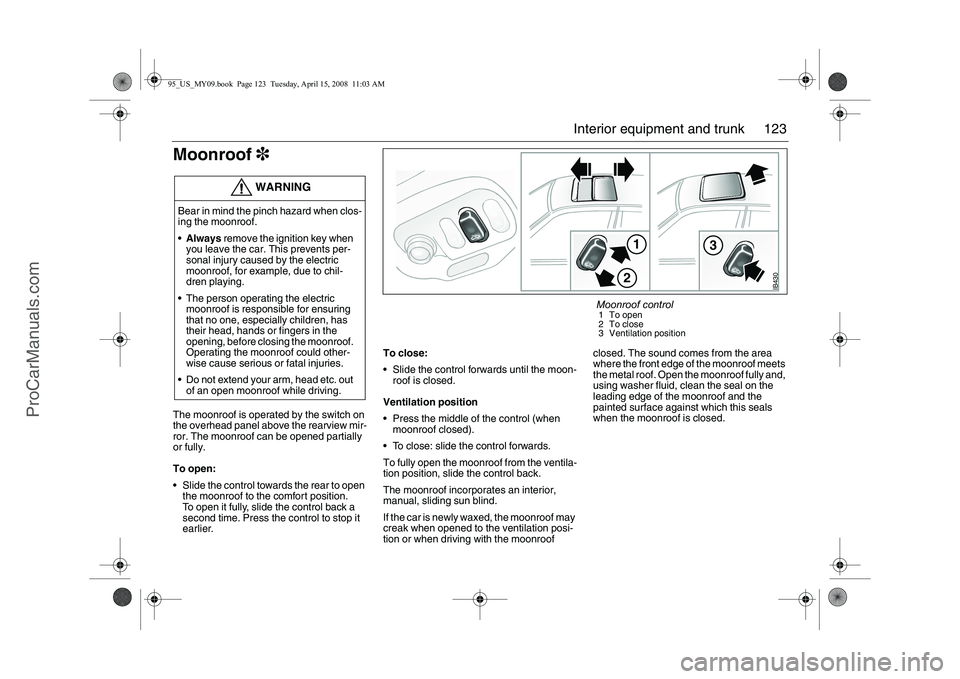
Moonroof3 The moonroof is operated by the switch on
the overhead panel above the rearview mir-
ror. The moonroof can be opened partially
or fully.
To open:
Slide the control towards the rear to open
the moonroof to the comfort position.
To open it fully, slide the control back a
second time. Press the control to stop it
earlier. To close:
Slide the control forwards until the moon-
roof is closed.
Ventilation position
Press the middle of the control (when
moonroof closed).
To close: slide the control forwards.
To fully open the moonroof from the ventila-
tion position, slide the control back.
The moonroof incorporates an interior,
manual, sliding sun blind.
If the car is newly waxed, the moonroof may
creak when opened to the ventilation posi-
tion or when driving with the moonroof closed. The sound comes from the area
where the front edge of the moonroof meets
the metal roof. Open the moonroof fully and,
using washer fluid, clean the seal on the
leading edge of the moonroof and the
painted surface against which this seals
when the moonroof is closed.
WARNING
Bear in mind the pinch hazard when clos-
ing the moonroof.
Always remove the ignition key when
you leave the car. This prevents per-
sonal injury caused by the electric
moonroof, for example, due to chil-
dren playing.
The person operating the electric
moonroof is responsible for ensuring
that no one, especially children, has
their head, hands or fingers in the
opening, before closing the moonroof.
Operating the moonroof could other-
wise cause serious or fatal injuries.
Do not extend your arm, head etc. out
of an open moonroof while driving.
IB430
1
3
2
Moonroof control 1 To open
2 To close
3 Ventilation position
95_US_MY09.book Page 123 Tuesday, April 15, 2008 11:03 AM
ProCarManuals.com
Page 161 of 272
161 Starting and driving
ABS brakes
ABS (antilock braking system) modulates
the brake pressure to the respective
wheels. Wheel sensors detect if a wheel is
about to lock, and the control module
reduces the pressure to that wheel and then
increases it once more until the tendency is
detected again.
The brake system is equipped with an Elec-
tronic Brake-force Distribution device
(EBD), which distributes the brake pressure
between the front and rear wheels, in such
a way as to achieve optimum braking perfor-
mance irrespective of the car’s speed and
load.
WARNING
It is prudent to try your brakes from
time to time, especially when driving in
heavy rain, through water collected on
the road, in snow, on a wet road sur-
face or in salty slush. In such condi-
tions, the brakes may take longer than
normal to take effect. To rectify this,
touch the brake pedal periodically to
dry the brakes out.
The same applies after the car has
been washed or when the weather is
very humid.
Avoid parking the car with wet brakes.
Before parking, and if the traffic condi-
tions allow, brake quite heavily so that
the brake discs and pads warm up and
dry.
The brakes are power assisted and it
should be kept in mind that the servo
unit only provides the power assis-
tance when the engine is running.
The brake pressure required when the
engine is off,(e.g. when the car is
being towed) is roughly four times the
normal pedal force required. The
pedal also feels hard and unre-
sponsive.
WARNING
The additional safety afforded by the
ABS system is not designed to allow
drivers to drive faster but to make
normal driving safer.
To stop as quickly as possible, without
loss of directional stability, whether
the road surface is dry, wet or slippery,
press the brake pedal down hard-
without letting up (do not pump the
pedal), declutching simulta-
neously, and steer the car to safety.
95_US_MY09.book Page 161 Tuesday, April 15, 2008 11:03 AM
ProCarManuals.com
Page 167 of 272
167 Starting and driving
Long-term parkingIf the car is not going to be used for some
time, e.g. 3–4 months, the following steps
are recommended:
Run the engine to normal temperature
before long-term parking.
Drain the washer-fluid reservoir and
hoses.
Wash and wax the car. Clean the rubber
seals on the hood, luggage compartment
lid and doors, and lubricate them with
glycerol (glycerin).
After washing the car, dry the brake discs
by taking the car out on the road and
applying the brakes a few times. Fill the fuel tank with fuel to prevent
condensation forming in it.
Top up the coolant and check the anti-
freeze before the onset of winter.
Park the car in a dry, covered and
well-ventilated building. Leave the park-
ing brake OFF!
Disconnect the negative (–) battery lead.
If frost is likely to occur during the
long-term parking, remove the battery
and store it away from the frost.
Ideally, the car should be put up on
blocks, with the wheels off the ground. If
this is not possible, inflate the tires to
about 43 psi (300 kPa).
Leave all the windows open a crack and
cover the car with a fabric tarpaulin – not
one made of plastic.95_US_MY09.book Page 167 Tuesday, April 15, 2008 11:03 AM
ProCarManuals.com
Page 169 of 272
169 Starting and driving
When an object is approximately 3 feet
(90 cm) from the car, the sound pulses
change character markedly. A distance of
about 3 feet (90 cm) is suitable if you wish
to load or unload the luggage compartment.
If the distance between an object and the
corner sensors does not change for three
seconds, e.g. if you are reversing alongside
a wall, the system will switch to monitoring
straight back. The system indicates if the
distance to the wall decreases again.
The system can be disengaged for when
driving with a trailer. Press and hold the CLR
button on the steering wheel when the dis-
play shows "PARK ASSIST", until the dis-
play shows "PARK ASSIST OFF". The
system is re-engaged in the same way. The
system is also always activated when the
ignition key is turned to ON. Pressing a steering wheel button briefly will
not disengage the system, the display will
simply show the previously selected func-
tion.
Ice, snow and dirt can affect the sensitivity
of the sensors. In such cases a continuous
tone will sound warning the driver that the
system cannot measure the distance to an
object. You can turn the system off by press-
ing and holding the CLR button for
1.5 seconds.
If the text "PARK ASSIST FAILURE" is dis-
played on the SID, have the system
checked by a workshop. We recommend
that you contact an authorized Saab dealer.NOTICEReverse slowly so that you have time to
stop the car when the continuous tone is
heard at approx. 12 in. (30 cm).
NOTICETo function well, the sensors must be kept
clean. Ice snow and dirt can affect their
sensitivity.
Do not spray the sensors or closer than
8 in. (20 cm) to the sensors with a pres-
sure washer, as this could damage them.
95_US_MY09.book Page 169 Tuesday, April 15, 2008 11:03 AM
ProCarManuals.com
Page 184 of 272
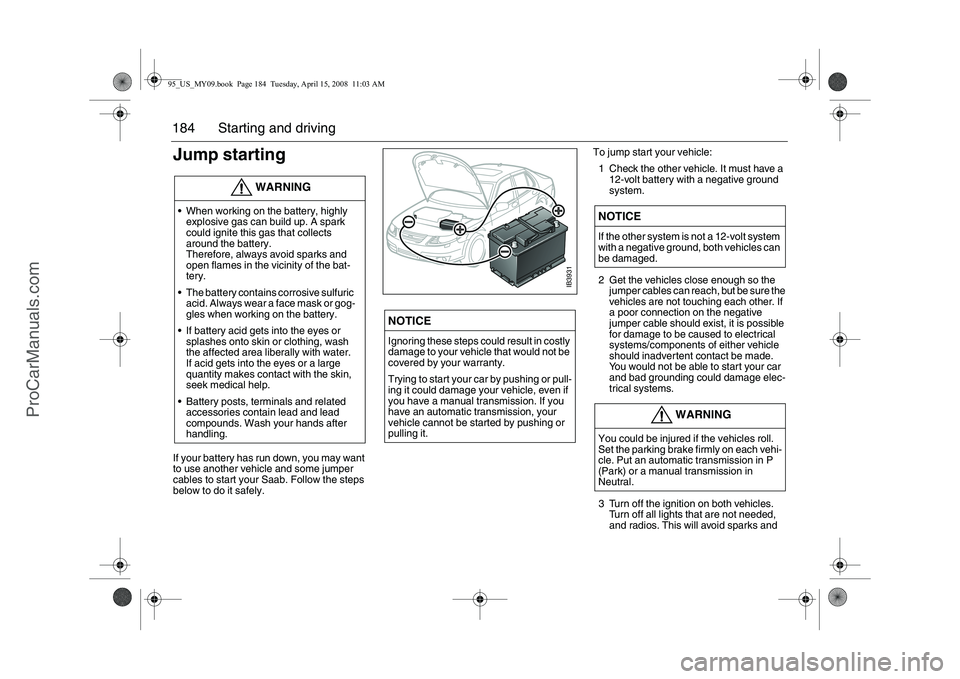
184 Starting and drivingJump startingIf your battery has run down, you may want
to use another vehicle and some jumper
cables to start your Saab. Follow the steps
below to do it safely.To jump start your vehicle:
1 Check the other vehicle. It must have a
12-volt battery with a negative ground
system.
2 Get the vehicles close enough so the
jumper cables can reach, but be sure the
vehicles are not touching each other. If
a poor connection on the negative
jumper cable should exist, it is possible
for damage to be caused to electrical
systems/components of either vehicle
should inadvertent contact be made.
You would not be able to start your car
and bad grounding could damage elec-
trical systems.
3 Turn off the ignition on both vehicles.
Turn off all lights that are not needed,
and radios. This will avoid sparks and
WARNING
When working on the battery, highly
explosive gas can build up. A spark
could ignite this gas that collects
around the battery.
Therefore, always avoid sparks and
open flames in the vicinity of the bat-
tery.
The battery contains corrosive sulfuric
acid. Always wear a face mask or gog-
gles when working on the battery.
If battery acid gets into the eyes or
splashes onto skin or clothing, wash
the affected area liberally with water.
If acid gets into the eyes or a large
quantity makes contact with the skin,
seek medical help.
Battery posts, terminals and related
accessories contain lead and lead
compounds. Wash your hands after
handling.
NOTICEIgnoring these steps could result in costly
damage to your vehicle that would not be
covered by your warranty.
Trying to start your car by pushing or pull-
ing it could damage your vehicle, even if
you have a manual transmission. If you
have an automatic transmission, your
vehicle cannot be started by pushing or
pulling it.
NOTICEIf the other system is not a 12-volt system
with a negative ground, both vehicles can
be damaged.
WARNING
You could be injured if the vehicles roll.
Set the parking brake firmly on each vehi-
cle. Put an automatic transmission in P
(Park) or a manual transmission in
Neutral.
IB3931
95_US_MY09.book Page 184 Tuesday, April 15, 2008 11:03 AM
ProCarManuals.com
Page 187 of 272
187 Car care and technical information
IB3888
Hood ________________ 188
Engine compartment __ 189
Emission control
systems ____________ 190
Engine ______________ 192
Engine oil ____________ 192
Transmission fluid ____ 193
Coolant ______________ 193
Brake and clutch fluid__ 194
Power steering fluid ___ 196
Air filter _____________ 196
Battery ______________ 197
Drive belts ___________ 199
Wipers and washers ___ 200
Changing bulbs _______ 202
Fuses _______________ 214 Tires ________________ 220
Automatic tire pressure
monitoring system ___ 232
Compact spare tire ____ 235
Safety belts __________ 240
Upholstery and trim ___ 241
Textile carpeting ______ 241
Washing the car ______ 242
Waxing and polishing __ 243
Engine compartment __ 243
Touching up the paint _ 243
Air conditioning (ACC) _ 244
Anti-corrosion treatment 246
For long trips _________ 247
Recovery and/or
recycling of automotive
materials ___________ 248
Headlight aiming ______ 248
Car care and technical information
3 Asterisk means: equipment not fitted in all cars
(can depend on model variant, engine variant,
market specification, options or accessories).95_US_MY09.book Page 187 Tuesday, April 15, 2008 11:03 AM
ProCarManuals.com
Page 189 of 272
189 Car care and technical information
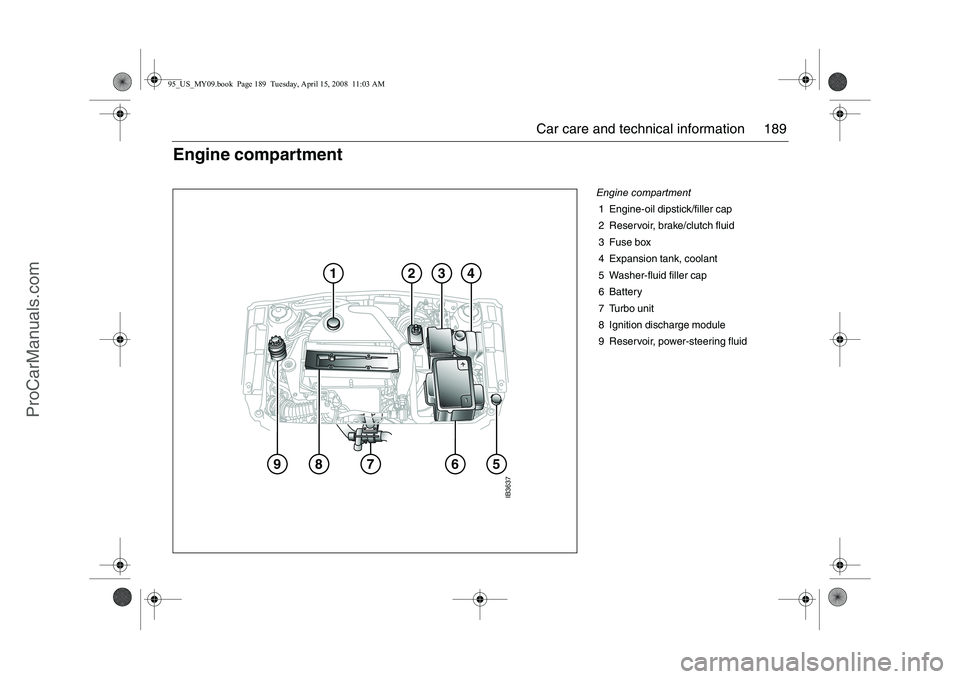
Engine compartment
9
6
8
1
2
4
3
5
7
IB3637
Engine compartment
1 Engine-oil dipstick/filler cap
2 Reservoir, brake/clutch fluid
3 Fuse box
4 Expansion tank, coolant
5 Washer-fluid filler cap
6Battery
7 Turbo unit
8 Ignition discharge module
9 Reservoir, power-steering fluid
95_US_MY09.book Page 189 Tuesday, April 15, 2008 11:03 AM
ProCarManuals.com
Page 197 of 272
197 Car care and technical information
Battery
The battery is provided with a cover to
protect it from radiated heat. If the battery is
exposed to high temperatures, its life will be
shortened. To remove the cover, release
the two clips along its long sides.
The cover fits the standard battery installed
in the car. If a new battery is to be fitted,
make sure that its dimensions are the same
as the standard one.
The battery is maintenance free.
If frequent short journeys are made, the bat-
tery may need to be given a booster charge.
This can be done either using a battery
charger or by taking the car for a long run.
A car with a standard equipment specifica-
tion and a fully charged battery can be left
for up to 40 days and still have a sufficient
charge for starting. If extra equipment is fit-
ted, such as a car phone, the charge may
only be sufficient for about 15 days.
Charging/replacing the battery Connect the positive lead to the positive (+)
battery terminal (red), and the negative lead
to a good ground point, e.g. the lifting lug at
the front of the engine.
To remove the battery, always disconnect
the negative (black) lead first and reconnect
it last when fitting the new battery.
The battery size must comply with DIN
53735 MFI 230/2.16.
WARNING
Work on the battery may entail an
explosion hazard, since the battery
gives off hydrogen which forms an
explosive mixture with the oxygen in
the air.
For this reason, always avoid sparks
or open flames when working near the
battery.
The battery contains corrosive sulfuric
acid. Always wear a face mask or
goggles when working on the battery.
If battery acid gets into the eyes or
splashes the skin or clothing, wash the
affected area liberally with water.
If acid gets into the eyes or a large
quantity makes contact with the skin,
seek medical help.
Battery posts, terminals and related
accessories contain lead and lead
compounds. Wash your hands after
handling.
NOTICEA discharged battery can freeze and frac-
ture. Batteries should therefore always be
stored away from frost.
NOTICETo avert the danger of short-circuiting
between the positive (+) terminal on the
battery and the inlet manifold on the
engine, always disconnect the negative
(–) battery lead first and reconnect it last.
95_US_MY09.book Page 197 Tuesday, April 15, 2008 11:03 AM
ProCarManuals.com
Page 200 of 272
200 Car care and technical informationWipers and washersCheck and clean all wiper blades regularly.
If poor wiper performance is experienced,
clean the windshield with a quality glass
cleaner. This is particularly important if the
car has been through an automatic car
wash, as these sometimes leave a wax
coating on the windshield.
If wiper performance is still unsatisfactory,
fit new blades.
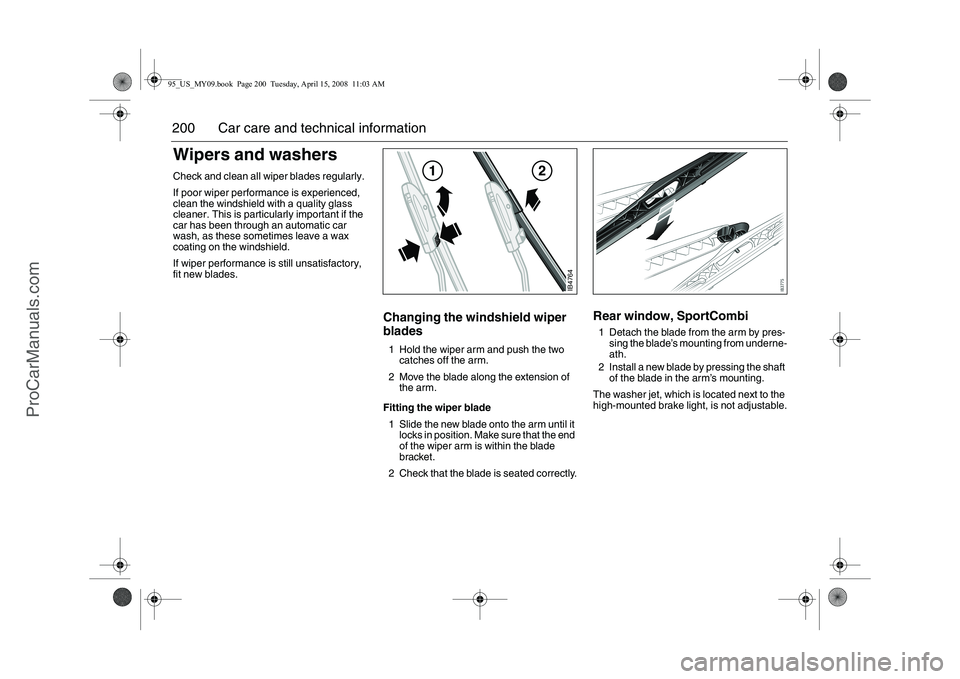
Changing the windshield wiper
blades1 Hold the wiper arm and push the two
catches off the arm.
2 Move the blade along the extension of
the arm.
Fitting the wiper blade
1 Slide the new blade onto the arm until it
locks in position. Make sure that the end
of the wiper arm is within the blade
bracket.
2 Check that the blade is seated correctly.
Rear window, SportCombi1 Detach the blade from the arm by pres-
sing the blade’s mounting from underne-
ath.
2 Install a new blade by pressing the shaft
of the blade in the arm’s mounting.
The washer jet, which is located next to the
high-mounted brake light, is not adjustable.
IB4764
95_US_MY09.book Page 200 Tuesday, April 15, 2008 11:03 AM
ProCarManuals.com