child seat SAAB 9-5 2009 Owner's Manual
[x] Cancel search | Manufacturer: SAAB, Model Year: 2009, Model line: 9-5, Model: SAAB 9-5 2009Pages: 272, PDF Size: 21.53 MB
Page 40 of 272
40 SafetyFrequently asked questions on
function of airbagsDo you still need to wear a safety belt if air-
bags are fitted?
Yes, always! The airbag merely supple-
ments the car’s normal safety system.
Moreover, the airbag will only be actuated in
a moderate to severe frontal, or near-frontal
crash, which means, of course, that it pro-
vides no protection in minor frontal crashes,
major rear-end or side-on crashes or if the
car rolls over.
The safety belts help reduce the chance of
the car occupants from being thrown around
and injured or killed inside the car.
But they also ensure that, if a crash occurs
in which the airbags are inflated, the airbag
will make the optimum contact with the
occupant, i.e. square on from the front. If the
occupant meets the airbag in an offset posi-
tion, the protection afforded will be reduced.
In addition, airbags provide no protection
against a secondary impact occurring in the
same incident. So there is no doubt about
the benefit of wearing safety belts at all
times.
Do not sit too close to the airbag: it needs
room to inflate.
The airbag inflates very quickly and power-
fully in order to protect an adult person,
before they are thrown forward, in a serious
frontal crash.How do I position the seat to leave room for
the airbag to inflate?
Don’t have your seat too far forward.
Recline the seat back to increase the dis-
tance between you and the airbag. For short
drivers, special accessory pedal extensions
are available through your Saab dealer.
Airbags inflate extremely rapidly and with
great force – to be fast enough to protect an
adult in the seat.
When do the front airbags inflate?
The airbag will only be inflated under certain
predetermined conditions in a moderate to
severe frontal, or near-frontal crash,
depending on such factors as the force and
angle of the impact, the speed of the car on
impact, and the resistance to deformation of
the impacting object.
The airbag can only be activated once in the
same incident.
Do not attempt to drive the car after an
airbag has been inflated, even if it is
possible.
What won’t trigger the front airbags?
The airbag will not be activated in all
front-end crashes. For instance, if the car
has hit something relatively soft and yielding
(e.g. a snow drift or a hedge) or a solid object at a low impact speed, the airbag will
not necessarily be triggered.
How loud is the inflation?
The noise of the inflation is certainly loud,
but it is very short-lived and will not damage
your hearing. For a short time afterwards
you could experience a buzzing noise in
your ears.
Most people who have experienced it
cannot remember the noise of the inflation
at all – all they remember is the noise of the
crash.
Can you still use a child seat in the front if a
passenger airbag is installed?
Definitely not!
Children can be killed or seriously injured
by the airbag
The BACK SEAT is the SAFEST place for
children 12 and under or shorter than
55 inches (140 cm)
ALWAYS use SAFETY BELTS and
CHILD RESTRAINTS
NEVER put a rear-facing child seat in the
front
Sit as far back as possible from the airbag95_US_MY09.book Page 40 Tuesday, April 15, 2008 11:03 AM
ProCarManuals.com
Page 47 of 272
47 Security
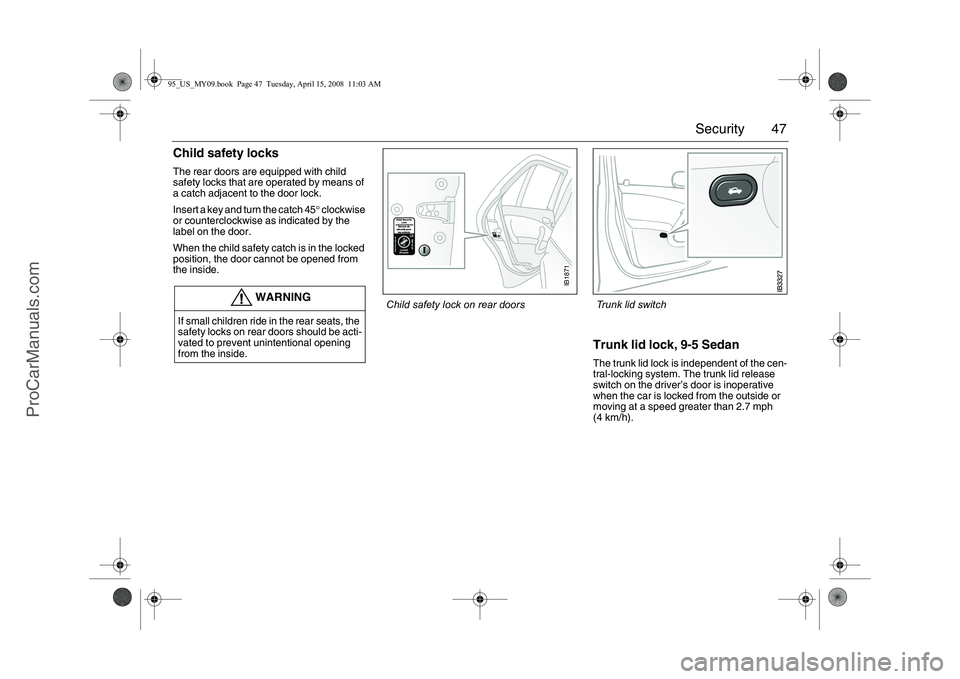
Child safety locksThe rear doors are equipped with child
safety locks that are operated by means of
a catch adjacent to the door lock.
Insert a key and turn the catch 45° clockwise
or counterclockwise as indicated by the
label on the door.
When the child safety catch is in the locked
position, the door cannot be opened from
the inside.
Trunk lid lock, 9-5 SedanThe trunk lid lock is independent of the cen-
tral-locking system. The trunk lid release
switch on the driver’s door is inoperative
when the car is locked from the outside or
moving at a speed greater than 2.7 mph
(4 km/h).
WARNING
If small children ride in the rear seats, the
safety locks on rear doors should be acti-
vated to prevent unintentional opening
from the inside.
IB1871
Child safety lock on rear doors
Trunk lid switch
95_US_MY09.book Page 47 Tuesday, April 15, 2008 11:03 AM
ProCarManuals.com
Page 116 of 272
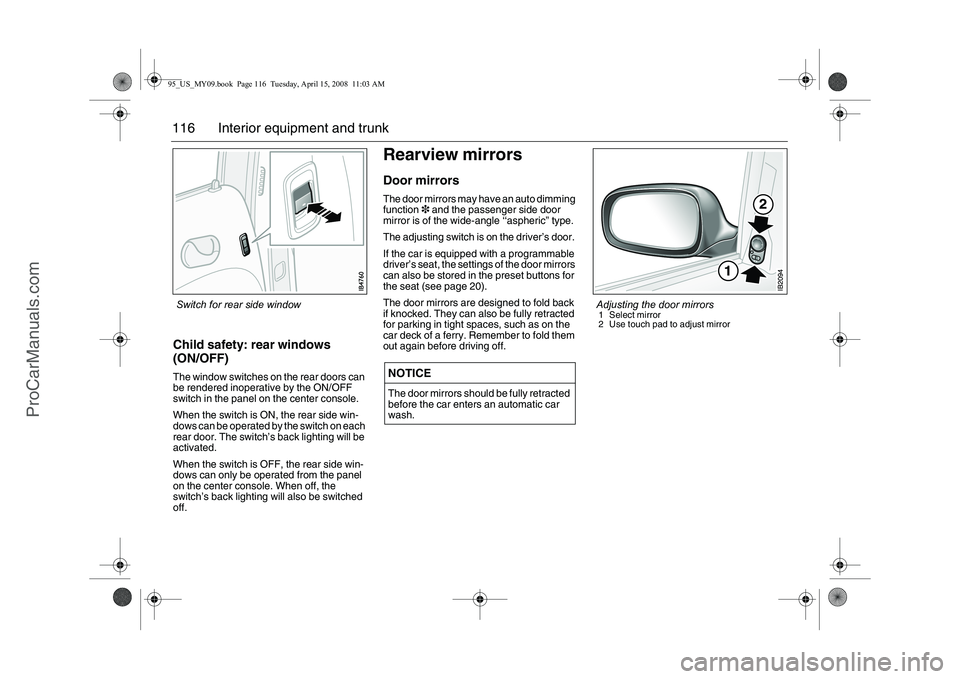
116 Interior equipment and trunkChild safety: rear windows
(ON/OFF)The window switches on the rear doors can
be rendered inoperative by the ON/OFF
switch in the panel on the center console.
When the switch is ON, the rear side win-
dows can be operated by the switch on each
rear door. The switch’s back lighting will be
activated.
When the switch is OFF, the rear side win-
dows can only be operated from the panel
on the center console. When off, the
switch’s back lighting will also be switched
off.
Rearview mirrorsDoor mirrorsThe door mirrors may have an auto dimming
function3 and the passenger side door
mirror is of the wide-angle ‘‘aspheric” type.
The adjusting switch is on the driver’s door.
If the car is equipped with a programmable
driver’s seat, the settings of the door mirrors
can also be stored in the preset buttons for
the seat (see page 20).
The door mirrors are designed to fold back
if knocked. They can also be fully retracted
for parking in tight spaces, such as on the
car deck of a ferry. Remember to fold them
out again before driving off.NOTICEThe door mirrors should be fully retracted
before the car enters an automatic car
wash.
Switch for rear side window
Adjusting the door mirrors 1 Select mirror
2 Use touch pad to adjust mirror
95_US_MY09.book Page 116 Tuesday, April 15, 2008 11:03 AM
ProCarManuals.com
Page 129 of 272
129 Interior equipment and trunk
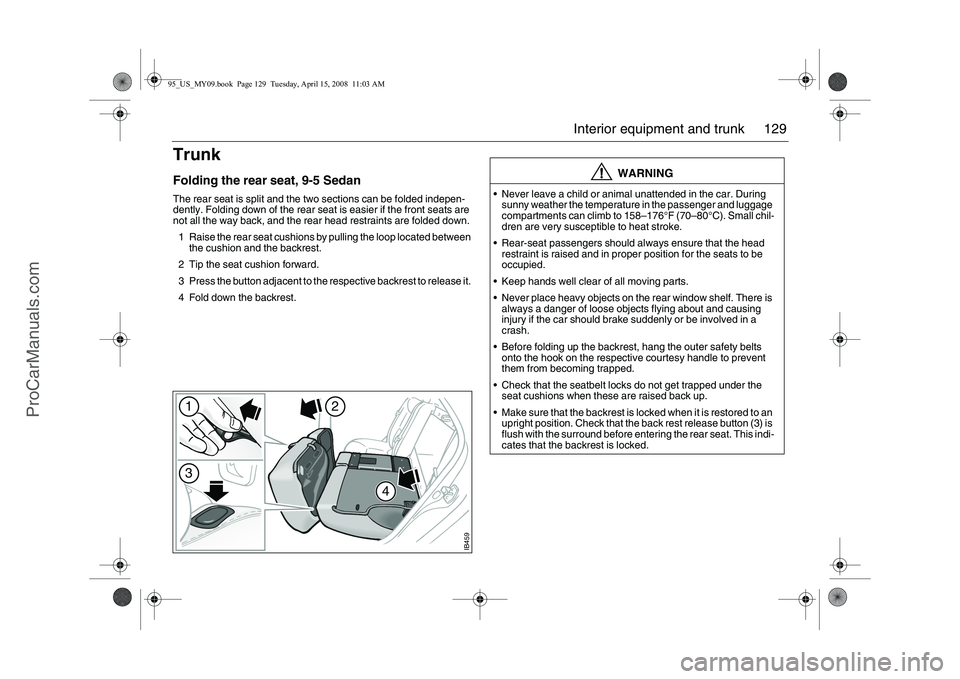
TrunkFolding the rear seat, 9-5 SedanThe rear seat is split and the two sections can be folded indepen-
dently. Folding down of the rear seat is easier if the front seats are
not all the way back, and the rear head restraints are folded down.
1 Raise the rear seat cushions by pulling the loop located between
the cushion and the backrest.
2 Tip the seat cushion forward.
3 Press the button adjacent to the respective backrest to release it.
4 Fold down the backrest.
WARNING
Never leave a child or animal unattended in the car. During
sunny weather the temperature in the passenger and luggage
compartments can climb to 158–176°F (70–80°C). Small chil-
dren are very susceptible to heat stroke.
Rear-seat passengers should always ensure that the head
restraint is raised and in proper position for the seats to be
occupied.
Keep hands well clear of all moving parts.
Never place heavy objects on the rear window shelf. There is
always a danger of loose objects flying about and causing
injury if the car should brake suddenly or be involved in a
crash.
Before folding up the backrest, hang the outer safety belts
onto the hook on the respective courtesy handle to prevent
them from becoming trapped.
Check that the seatbelt locks do not get trapped under the
seat cushions when these are raised back up.
Make sure that the backrest is locked when it is restored to an
upright position. Check that the back rest release button (3) is
flush with the surround before entering the rear seat. This indi-
cates that the backrest is locked.
IB459
1
2
4
3
95_US_MY09.book Page 129 Tuesday, April 15, 2008 11:03 AM
ProCarManuals.com
Page 130 of 272
130 Interior equipment and trunk
WARNING
Place heavy items closest to the backrest and stow smaller
and lighter items on top.
Never overload the cargo net3. If the elastic breaks this may
cause personal injury. Do not use a cargo net that shows signs
of wear.
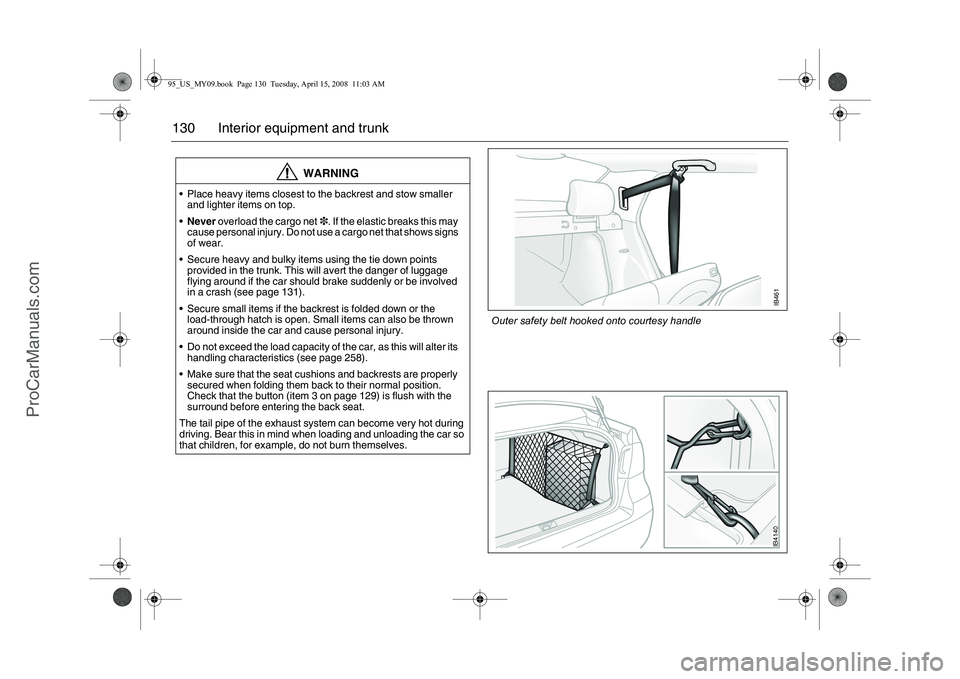
Secure heavy and bulky items using the tie down points
provided in the trunk. This will avert the danger of luggage
flying around if the car should brake suddenly or be involved
in a crash (see page 131).
Secure small items if the backrest is folded down or the
load-through hatch is open. Small items can also be thrown
around inside the car and cause personal injury.
Do not exceed the load capacity of the car, as this will alter its
handling characteristics (see page 258).
Make sure that the seat cushions and backrests are properly
secured when folding them back to their normal position.
Check that the button (item 3 on page 129) is flush with the
surround before entering the back seat.
The tail pipe of the exhaust system can become very hot during
driving. Bear this in mind when loading and unloading the car so
that children, for example, do not burn themselves.
IB4140IB461
Outer safety belt hooked onto courtesy handle
95_US_MY09.book Page 130 Tuesday, April 15, 2008 11:03 AM
ProCarManuals.com
Page 133 of 272
133 Interior equipment and trunk
Parcel shelf, 9-5 SportCombiFold the parcel shelf as follows:
1 Press the rear edge of the shelf downwards and forwards.
2 Continue pressing the folded section forward until it is folded over
the front section.
Extend the parcel shelf as follows:
1 Hold the rear edge of the shelf and pull it back.
2 The shelf rests on a track located beneath the rear side windows.
Make sure that the rear corner fits in the recess. Otherwise it will
not lie flat.
Alternative location of the parcel shelf if this is removed:
Folded up on the floor at the rear of the luggage compartment.
On its end on the floor behind the front seat backrest.
WARNING
Do not travel in the back seat without ensuring that the head
restraint is set at a suitable height for the seats to be occupied.
Never allow anyone to sit on a folded backrest.
Always be aware of the risk of pinching when handling moving
parts of the seating.
Never place heavy objects on the parcel shelf. There is always
a danger of loose objects flying about and causing injury if the
car should brake suddenly or be involved in a crash.
Make sure that the backrests are locked when they are folded
back upright. Check that the two red warning-indication flags
are fully down. This indicates that the backrests are locked.
Check that the safety belt lock is not trapped under the seat
cushions when these are raised back up.
Never leave a child or animal unattended in the car. During
sunny weather the temperature in the passenger and luggage
compartments can climb to 158–176°F (70–80°C). Small chil-
dren are very susceptible to heat stroke.
The tail pipe of the exhaust system can become very hot during
driving. Bear this in mind when loading and unloading the car so
that children, for example, do not burn themselves.95_US_MY09.book Page 133 Tuesday, April 15, 2008 11:03 AM
ProCarManuals.com
Page 165 of 272
165 Starting and driving
Parking brake
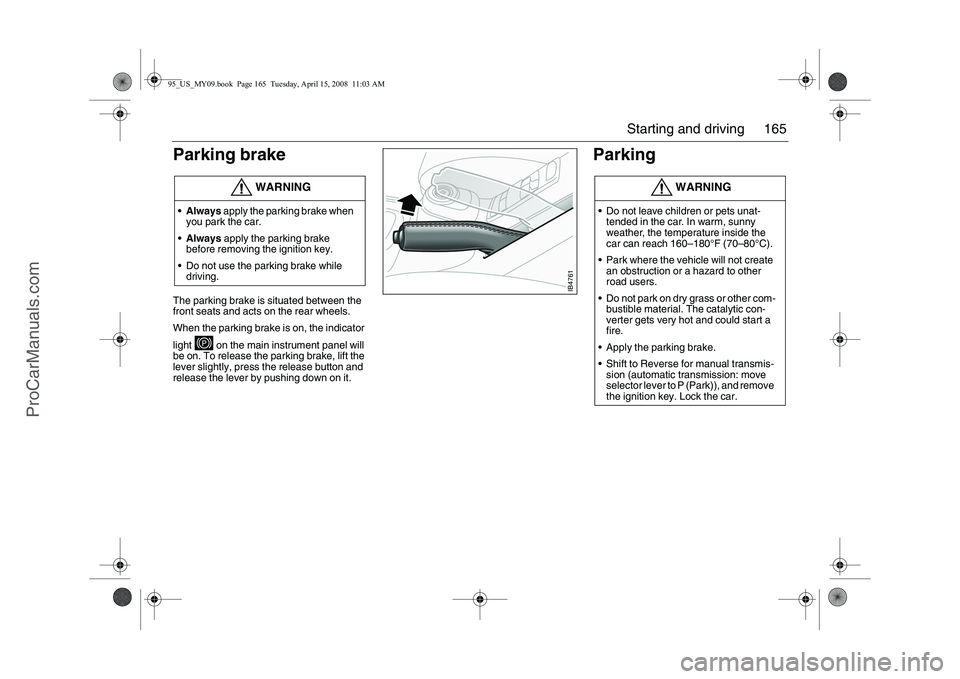
The parking brake is situated between the
front seats and acts on the rear wheels.
When the parking brake is on, the indicator
light on the main instrument panel will
be on. To release the parking brake, lift the
lever slightly, press the release button and
release the lever by pushing down on it.
Parking
WARNING
Always apply the parking brake when
you park the car.
Always apply the parking brake
before removing the ignition key.
Do not use the parking brake while
driving.
WARNING
Do not leave children or pets unat-
tended in the car. In warm, sunny
weather, the temperature inside the
car can reach 160–180°F (70–80°C).
Park where the vehicle will not create
an obstruction or a hazard to other
road users.
Do not park on dry grass or other com-
bustible material. The catalytic con-
verter gets very hot and could start a
fire.
Apply the parking brake.
Shift to Reverse for manual transmis-
sion (automatic transmission: move
selector lever to P (Park)), and remove
the ignition key. Lock the car.
IB4761
95_US_MY09.book Page 165 Tuesday, April 15, 2008 11:03 AM
ProCarManuals.com
Page 267 of 272
267 Index
Index
AA/C system, fault diagnosis
________ 245
A/C system, maintenance _________ 244
ABS brakes
____________________ 160
ACC
__________________________ 79
ACC functions
___________________ 82
ACC, automatic climate control
______ 79
ACC, calibration
_________________ 86
ACC, condensation water
__________ 86
ACC, useful tips
_________________ 86
AUX input
_____________________ 104
Adjustable systems
______________ 265
Adjusting the steering wheel
_______ 114
Adjustment, seats
________________ 18
Air conditioning (A/C), fault diagnosis
and maintenance ______________ 244
Airbag
_________________________ 29
Alarm __________________________ 50
Alarm functions
__________________ 53
Alarm signals
________________ 50
, 53
Album information
_______________ 104
Alternator
_____________________ 199
Alternator drive belt
__________ 199
, 260
Alternator rating
________________ 260
Antennas
______________________ 109
Anticorrosion treatment
___________ 246
Antidazzle rear-view mirror
________ 121
Anti-skid
______________________ 163Autochecking of lights on starting
____ 64
Auto-dimming rear-view mirror with
garage door opener
____________ 118
Automatic climate control (ACC)
_____ 79
Aviod theft, tip
__________________ 166
BBattery
________________________ 197
Battery charging/replacing
________ 197
Battery, boost starting
____________ 184
Before a long journey ____________ 247
Before towing a camper or trailer
___ 177
Belt guide
______________________ 12
Boost starting using jump leads
____ 184
Brake and clutch fluid
____________ 194
Brake-fluid reservoir
_____________ 194
Brakes, technical data ____________ 261
Bulbs, changing
_________________ 202
Bulbs, table of
__________________ 213
Buying new tires ________________ 223
CCD changer
____________________ 100
CHECK messages
_______________ 71
CHECKING
_____________________ 71
Car alarm
______________________ 50
Car care
______________________ 187
Cargo net, 9-5 SportCombi
________ 137
Carpeting, care of
_______________ 241Catalytic converter, important
considerations
_________________ 145
Central locking ___________________ 44
Change language in SID
___________ 72
Change of address notification
_____ 254
Changing a wheel
_______________ 237
Changing bulbs
_________________ 202
Changing wiper blades
___________ 200
Charge mobile phone
____________ 126
Charger/Jump starting ____________ 186
Charging the battery/Jump starting
__ 186
Chassis number
________________ 264
Checks before towing a camper or
trailer
________________________ 177
Child safety
_____________________ 22
Child safety locks, rear doors
_______ 47
Cleaning, engine bay
_____________ 243
Clock
_________________________ 105
Color code, body
________________ 264
Color code, trim _________________ 264
Compact spare wheel
____________ 235
Compass
______________________ 122
Condensation water, ACC
__________ 86
Connecting a portable player ______ 105
Coolant
_______________________ 193
Courtesy Headlight Feature
________ 74
Crash memory, see EDR
_________ 255
Cross modulation
_______________ 110
Cruise control
__________________ 159
Cup holder
_____________________ 128
95_US_MY09.book Page 267 Tuesday, April 15, 2008 11:03 AM
ProCarManuals.com