oil SAAB 9-5 2009 Owner's Manual
[x] Cancel search | Manufacturer: SAAB, Model Year: 2009, Model line: 9-5, Model: SAAB 9-5 2009Pages: 272, PDF Size: 21.53 MB
Page 219 of 272

219 Car care and technical information
Relays
10 15 High beam headlight, left
11 15 Low beam headlight left
12 15 High beam headlight, right
13 15 Low beam headlight, right
14 30 Radiator fan, high speed
15 15 Fog lights (front spoiler)
16 20 Wiper, rear
17 15 Horn
18 – –
# Function
1 Bulb test; head light; high beam flasher
2 Headlight washer
3 Front fog lights
4 Wiper, rear (9-5 SportCombi)
5–
6–
7 Rain sensor
8 Radiator fan, low speed
9 Radiator fan, high speed
10 A/C-compressor
11 Radiator fan, high speed, right fan
12 Horn
13 Extra lights (accessory)
14 High beam headlight
15 Low beam headlight
16 –
17 Windshield wipers
95_US_MY09.book Page 219 Tuesday, April 15, 2008 11:03 AM
ProCarManuals.com
Page 229 of 272
229 Car care and technical information
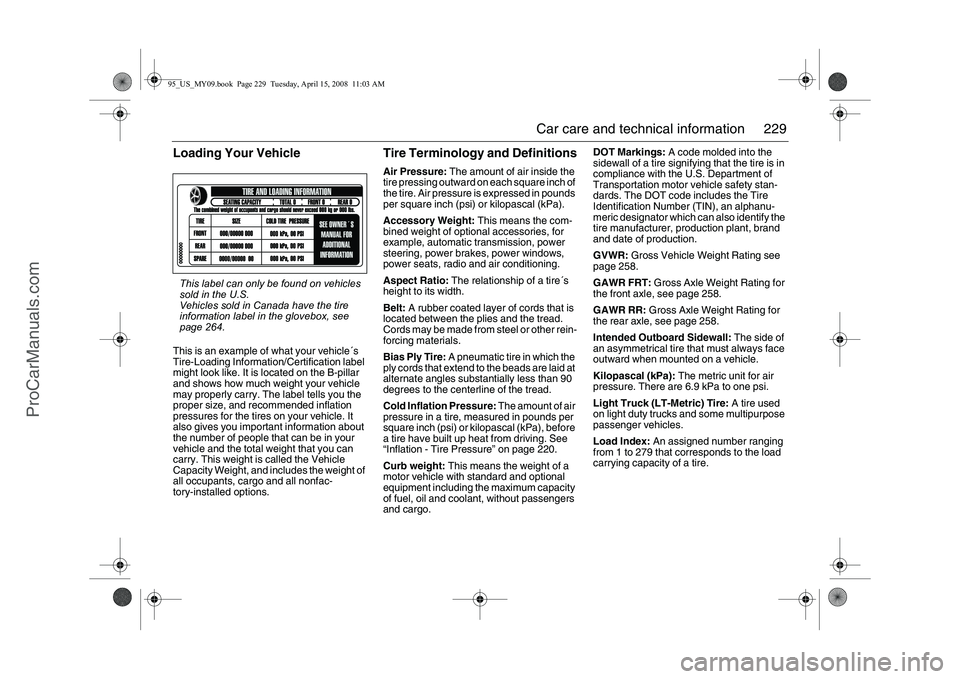
Loading Your VehicleThis is an example of what your vehicle´s
Tire-Loading Information/Certification label
might look like. It is located on the B-pillar
and shows how much weight your vehicle
may properly carry. The label tells you the
proper size, and recommended inflation
pressures for the tires on your vehicle. It
also gives you important information about
the number of people that can be in your
vehicle and the total weight that you can
carry. This weight is called the Vehicle
Capacity Weight, and includes the weight of
all occupants, cargo and all nonfac-
tory-installed options.
Tire Terminology and DefinitionsAir Pressure: The amount of air inside the
tire pressing outward on each square inch of
the tire. Air pressure is expressed in pounds
per square inch (psi) or kilopascal (kPa).
Accessory Weight: This means the com-
bined weight of optional accessories, for
example, automatic transmission, power
steering, power brakes, power windows,
power seats, radio and air conditioning.
Aspect Ratio: The relationship of a tire´s
height to its width.
Belt: A rubber coated layer of cords that is
located between the plies and the tread.
Cords may be made from steel or other rein-
forcing materials.
Bias Ply Tire: A pneumatic tire in which the
ply cords that extend to the beads are laid at
alternate angles substantially less than 90
degrees to the centerline of the tread.
Cold Inflation Pressure: The amount of air
pressure in a tire, measured in pounds per
square inch (psi) or kilopascal (kPa), before
a tire have built up heat from driving. See
“Inflation - Tire Pressure” on page 220.
Curb weight: This means the weight of a
motor vehicle with standard and optional
equipment including the maximum capacity
of fuel, oil and coolant, without passengers
and cargo.DOT Markings: A code molded into the
sidewall of a tire signifying that the tire is in
compliance with the U.S. Department of
Transportation motor vehicle safety stan-
dards. The DOT code includes the Tire
Identification Number (TIN), an alphanu-
meric designator which can also identify the
tire manufacturer, production plant, brand
and date of production.
GVWR: Gross Vehicle Weight Rating see
page 258.
GAWR FRT: Gross Axle Weight Rating for
the front axle, see page 258.
GAWR RR: Gross Axle Weight Rating for
the rear axle, see page 258.
Intended Outboard Sidewall: The side of
an asymmetrical tire that must always face
outward when mounted on a vehicle.
Kilopascal (kPa): The metric unit for air
pressure. There are 6.9 kPa to one psi.
Light Truck (LT-Metric) Tire: A tire used
on light duty trucks and some multipurpose
passenger vehicles.
Load Index: An assigned number ranging
from 1 to 279 that corresponds to the load
carrying capacity of a tire. This label can only be found on vehicles
sold in the U.S.
Vehicles sold in Canada have the tire
information label in the glovebox, see
page 264.
95_US_MY09.book Page 229 Tuesday, April 15, 2008 11:03 AM
ProCarManuals.com
Page 240 of 272

240 Car care and technical information8 Check-tighten the wheel bolts after a few
miles.
Tightening torque
Light-alloy wheels: 80 ft.lbs. (110 Nm)
Steel wheels: 80 ft.lbs. (110 Nm)
Safety beltsRegularly check the function of the safety
belts as follows:
Hold the diagonal strap and pull it sharply.
The safety belt should lock and it should
not be possible to withdraw it further.
Check the anchorage points in the floor.
They must not have suffered rust damage.
There must be no frayed threads in the web-
bing.
Safety belts must not come into contact with
substances such as polishes, oils or other
chemicals. If the straps are dirty, wash them
with warm water and a detergent or have
them replaced.
WARNING
If the car is involved in a crash, the safety
belts, belt pretensioners and other com-
ponents must be inspected by a work-
shop. We recommend that you contact an
authorized Saab dealer.
Never make any alterations or repairs to
the safety belt yourself.
IB1800IB1800
Removing the wheel cover
IB539
Tightening sequence, wheel bolts
95_US_MY09.book Page 240 Tuesday, April 15, 2008 11:03 AM
ProCarManuals.com
Page 241 of 272
241 Car care and technical information
Upholstery and trimTo remove lint or hairs from the seat uphol-
stery or headlining, use a moist, lint-free
cloth or a special lint remover (brush or
roller). Remove any dirty marks using a
cloth moistened with lukewarm soapy
water.
When using a stain remover, always work
from the outside towards the center to avoid
leaving a ring. If a soiled ring or spot should
remain, it can usually be removed using
lukewarm soapy water or water alone.
Wet patches left by spilled soft drinks or thin
oil must be wiped off immediately using an
absorbent material, such as a paper towel,
and treated with stain remover.
Alcohol is recommended for removing
grease or oil stains, and a semi-stiff brush
may also be used.
Cleaning and caring for leather
upholsteryThe principal reason for treating leather
upholstery is to maintain its elegant appear-
ance and to provide it with a protective film.
Discoloration caused by dust and wear
mainly affects the lighter shades, although
this is not detrimental to the leather –
indeed, the patina resulting from use is often
considered desirable in leather. But if the
leather is allowed to become too grubby, it
can start to look shabby. Regularly vacuum
the leather with a soft brush to remove loose
dirt and dust.
It is a good idea to clean and recondition the
leather twice a year – in conjunction with a
general spring-cleaning of the car – after the
winter and in the autumn, for instance. In
hot, dry climates, the leather will need to be
treated more frequently. Use conventional
leather care products. Follow the instruc-
tions on the packaging.
Do not use harsh polishing agents, cleaning
agents, sprays, coarse soap or hot water.
Semi-aniline leather only has a thin protec-
tive finish and is therefore more sensitive
than other leathers and therefore need
more care to keep the protection and ageing
properties.
Textile carpetingVacuum clean the carpeting regularly. Car-
pets can also be cleaned using a brush, or
carpet shampoo applied with a sponge. Do
not use vacuum cleaners outdoors unless
they are properly grounded.
95_US_MY09.book Page 241 Tuesday, April 15, 2008 11:03 AM
ProCarManuals.com
Page 246 of 272
246 Car care and technical informationAnti-corrosion
treatmentThe entire car is corrosion-protected at the
factory in different stages by an electrolytic
immersion coating and a PVC-based pro-
tective coating to protect against corrosion
caused by stones flung up by the wheels. A
thin penetrating anti-rust oil is also applied
in cavities and body members.
In addition to conventional anti-corrosion
treatment like painting, underbody treat-
ment and cavity treatment, most of the body
panel surfaces are galvanized. These
include the hood, the doors and the under-
body.
The anti-corrosion treatment on the under-
side of the car and inside the wheel arches
is particularly exposed to constant wear and
possible damage, the degree of which will
obviously depend on driving conditions.
What causes rust?Steel body panels of automobiles are sub-
ject to rusting whenever air and moisture
manage to penetrate the protective finish,
and body panels may rust through if the pro-
cess is unchecked. Rusting can occur wher-
ever water is trapped or where the car’s
panels are continuously damp. Damage to
paint and undercoating by stones, gravel
and minor crashes immediately exposes
metal to air and moisture. Road salts used
for de-icing will collect on the bottom of the
car and promote rusting. Areas of the coun-
try with high humidity have great potential
for rust problems, especially where salt is
used on roads or there is moist sea air.
Industrial pollution (fallout) may also
damage paint and promote rusting.
Preventive maintenanceThe following procedures are necessary to
help protect against rusting. Refer also to
the terms and conditions of the Sheet Metal
Coverage described in the warranty book-
let.
1Wash the car frequently, and wax at
least twice a year. Under adverse
conditions, where there is a rapid
buildup of dirt, sand or road salt, wash
your car at least once a week. After
extreme exposure to salted snow or
slush, evidenced by a white film on the
car, wash the car immediately. Frequent
washing will prevent paint damage from
acid rain and other airborne contami-
nants such as tree sap and bird drop-
pings. If any of these contaminants are
noticed on the car the finish should be
washed immediately.
Begin washing by rinsing the entire car
with water to loosen and flush off heavy
concentrations of dirt (include the
underbody).
Sponge the car with a solution of either
a good quality car soap or mild general
purpose (dish washing) detergent and
water.
Rinse car thoroughly with clean water.
After washing, check and clear all
drains in doors and body panels.
Wipe the car dry, preferably using a
chamois.
95_US_MY09.book Page 246 Tuesday, April 15, 2008 11:03 AM
ProCarManuals.com
Page 247 of 272
247 Car care and technical information
2Clean the underside of the car during
the winter. Use high pressure water to
clean the car’s underside (floor panels,
wheel wells) at least at mid- winter and
in the spring.
3Inspect the car frequently for leaks or
damage, and arrange for needed
repairs promptly. After washing or after
heavy rain, check for leaks. When wash-
ing the car inspect body surfaces for
paint damage. While checking for leaks,
lift the floor mats and check beneath
them. Water can collect in these areas
and remain for prolonged periods. Dry
any wet areas including the floor mats.
Have leaks repaired as soon as possi-
ble.
Use touch-up paint to repair small
scratches or minor finish damage. Areas
where metal is exposed will rust quickly
and MUST be repaired immediately by
touch-up or professional repainting.
Rust must be removed, the bare metal
primed and painted. Major body
damage should be repaired immediately
and new panels or exposed areas
should be undercoated with anti- corro-
sion material.
Repairs of this type are the owner’s
responsibility and are not covered under
warranty.4Inspect the undercoating and touch
up if necessary. Pay particular atten-
tion to the fenders and wheel housings,
which are exposed to abrasion by flying
gravel, etc. If the composition has worn
or flaked off, the steel must be thor-
oughly cleaned and dried before a fresh
coat is applied. The cleaning is best
done with a scraper and a steel wire
brush, followed by washing with solvent.
Apply the new coating thinly, as other-
wise it may run off or fall off when dry.
For long tripsBefore setting off on a long journey, it is
advisable to have your car checked over by
your Saab dealer.
Obtain a few important items to take along
on your journey such as spare bulbs, wiper
blades, fuses, a Poly-V-belt and the like.
You can check some points yourself before-
hand:
Make sure that the engine is in good
condition.
Check that no oil or gasoline leaks out of
the engine or gearbox/transmission.
Check the coolant and power steering
fluid levels. Check also for leaks.
Inspect the Poly-V-belt and replace it if it
shows any signs of hard wear.
Check the battery charge.
Check the tires for tread pattern and air
pressure, including the compact spare
wheel.
Check the brakes.
Check all bulbs.
Check for the presence of the tool kit and
the jack in the car.
95_US_MY09.book Page 247 Tuesday, April 15, 2008 11:03 AM
ProCarManuals.com
Page 252 of 272
252 Customer Assistance and InformationMaintenance scheduleThe Maintenance Schedule prescribes a
service program to the purchaser/operator
of a Saab that is reasonable and necessary
to ensure the proper emission control sys-
tems function, safety and reliability of the
Saab automobile in normal use. Additional
maintenance is recommended for specific
components when the car is operated under
certain severe conditions. Proper mainte-
nance is always good advice!
Authorized Saab dealers are equipped and
trained to meet your Saab’s service needs.
They regularly receive up-to-date Saab
service manuals and parts and technical
service bulletins from Saab and are able,
through their franchise agreement, to attend
Saab service schools, obtain Saab special
tools and technical assistance and pur-
chase original equipment service and
replacement parts.
Today’s complex automobiles should only
be entrusted to the most knowledgeable
service professionals. A Saab dealer is your
best choice.
Service intervalsA time for service message will illuminate on
the Saab Instrument Display (SID) when the
car is due for regular maintenance.
Engine oil and filter changesChanging the engine oil and filter is required
at every service point. Use only a Saab
approved long-life oil filter and engine oils
stated in the Specification section of this
Owner’s Manual. The use of extra additives
in the oil is not necessary and is not recom-
mended, and may be harmful to turbo-
chargers.
More frequent oil changes are recom-
mended if your vehicle is operated under
the following conditions:
Most trips are less than 5 to 10 miles (8 to
16 km). This is particularly important
when outside temperatures are below
freezing.
Most trips include extensive idling (such
as frequent stop-and-go driving).
Most trips are through dusty areas.
You frequently tow a trailer or use a carrier
on top of your vehicle.
If the vehicle is used for delivery service,
police, taxi or other commercial applica-
tions.
If your driving habits match this description,
have the engine oil and filter changed in-
between normal services at 5,000 mile
(8,000 km) intervals. The Saab Warranty
and Service Record Booklet has provisions
to record extra oil changes.
95_US_MY09.book Page 252 Tuesday, April 15, 2008 11:03 AM
ProCarManuals.com
Page 253 of 272
253 Customer Assistance and Information
Service record retentionIt is the owner´s responsibility to retain ser-
vice records. If possible, you should keep
copies of all shop work orders for all service
and repairs, whenever performed. As indi-
cated in the new car and emission control
system warranties, it is important to docu-
ment that all necessary maintenance has
been done.HOW THE SERVICE RECORD IS
ORGANIZEDThe service record is comprised of a series
of coupons on which to record services as
they are performed. There are additional
coupons for documenting extra engine oil
and filter changes, extra automatic trans-
mission fluid services necessary for severe
service conditions, and brake fluid changes.HOW TO USE THE SERVICE
RECORD COUPONSWhen the car is brought to a Saab dealer for
scheduled maintenance, present the Saab
Warranty and Service Record Booklet to the
service manager. When the technician has
completed the service, the technician will
sign the maintenance record. The person
responsible for quality assurance at the
dealership will also sign and stamp the
record with the dealer identification stamp.
Service costsDealer pricing practices and labor for ser-
vice work vary. Saab’s recommended ser-
vice times for each service point do not
include the labor required to replace wear
items, such as wiper blades, brake pads or
tires. Nor is labor to perform other service or
repairs found to be necessary as a result of
the inspections included in these times.
Additional labor and parts will be charged
for such work when necessary, except as
covered under an applicable Saab warranty
or any optional extended service contract.
Transmission fluid changes or suspension
alignment, when necessary, are also addi-
tional.
Dealer charges for general shop material,
regulated hazardous waste removal, recy-
cling expenses or other operation costs may
also be applied to service and repair
invoices and are apt to vary by dealer and
location.
Owner assistanceWarranties and service problem
assistanceFor complete information about all applica-
ble warranties, including the New Car War-
ranty, Perforation Warranty, Vehicle Emis-
sion Warranty and Emission Perforation
Warranty, consult the Warranties and Ser-
vice Record Booklet which accompanies
this Owner’s Manual. It also contains owner
assistance information including Saab
Roadside Assistance. If the booklet is lost or
misplaced, a new one may be ordered
through a Saab dealer or by contacting
Saab.
In the U.S. there is a national Customer
Assistance Center at Saab Automobile
USA, Inc. The toll-free number to call from
all 50 states is 1-800-955-9007.
In Canada, please call the Saab Customer
Assistance Center at 1-800-263-1999.
A list of authorized Saab sales and service
dealers is available for those planning to
travel in the United States and Canada.
Canadian or U.S. travelers may call the
Customer Assistance Center in the country
in which they are traveling.
95_US_MY09.book Page 253 Tuesday, April 15, 2008 11:03 AM
ProCarManuals.com
Page 257 of 272
257 Specifications
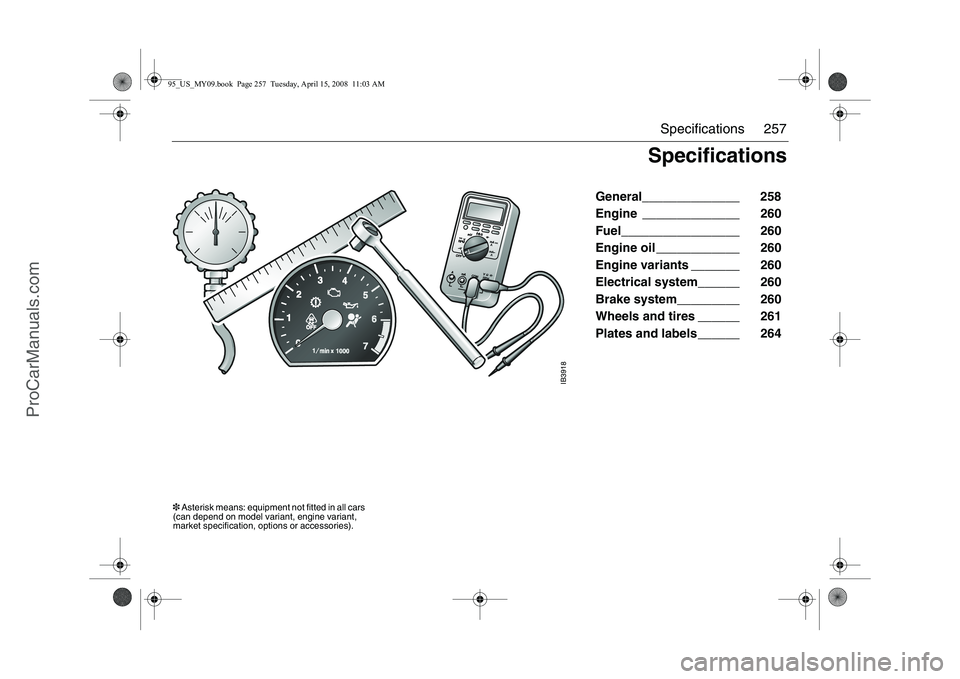
General______________ 258
Engine ______________ 260
Fuel_________________ 260
Engine oil ____________ 260
Engine variants _______ 260
Electrical system______ 260
Brake system_________ 260
Wheels and tires ______ 261
Plates and labels ______ 264
IB3918
Specifications
3 Asterisk means: equipment not fitted in all cars
(can depend on model variant, engine variant,
market specification, options or accessories).95_US_MY09.book Page 257 Tuesday, April 15, 2008 11:03 AM
ProCarManuals.com
Page 260 of 272
260 SpecificationsEngine Fuel Engine oil
Engine variants
Electrical system
Brake system
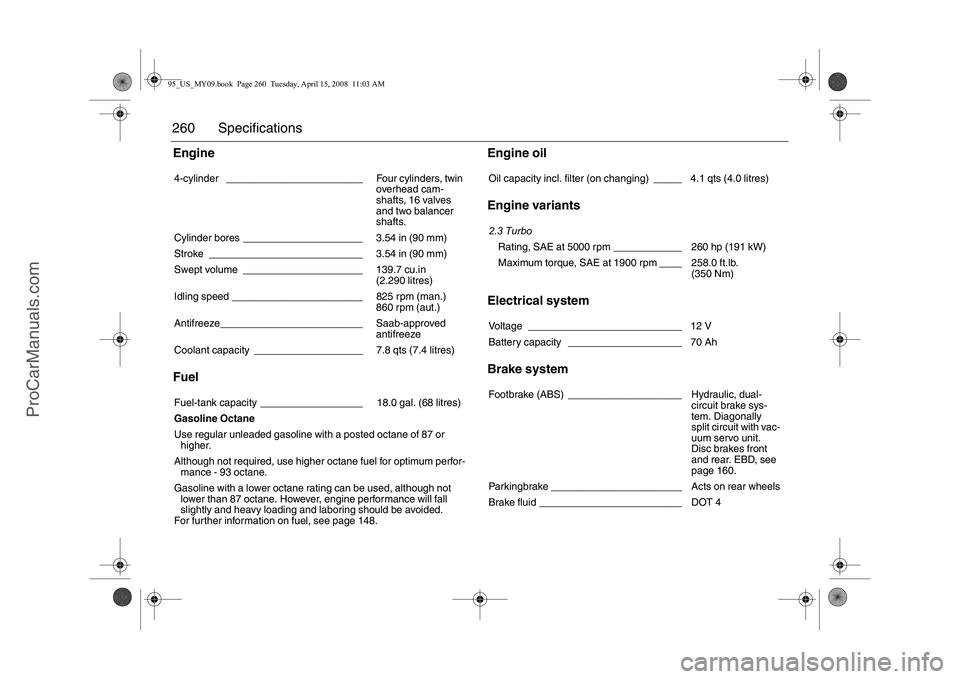
4-cylinder ________________________ Four cylinders, twin
overhead cam-
shafts, 16 valves
and two balancer
shafts.
Cylinder bores _____________________ 3.54 in (90 mm)
Stroke ___________________________ 3.54 in (90 mm)
Swept volume _____________________ 139.7 cu.in
(2.290 litres)
Idling speed _______________________ 825 rpm (man.)
860 rpm (aut.)
Antifreeze_________________________ Saab-approved
antifreeze
Coolant capacity ___________________ 7.8 qts (7.4 litres)
Fuel-tank capacity __________________ 18.0 gal. (68 litres)
Gasoline Octane
Use regular unleaded gasoline with a posted octane of 87 or
higher.
Although not required, use higher octane fuel for optimum perfor-
mance - 93 octane.
Gasoline with a lower octane rating can be used, although not
lower than 87 octane. However, engine performance will fall
slightly and heavy loading and laboring should be avoided.
For further information on fuel, see page 148.Oil capacity incl. filter (on changing) _____ 4.1 qts (4.0 litres)
2.3 Turbo
Rating, SAE at 5000 rpm ____________ 260 hp (191 kW)
Maximum torque, SAE at 1900 rpm ____ 258.0 ft.lb.
(350 Nm)
Voltage ___________________________ 12 V
Battery capacity ____________________ 70 Ah
Footbrake (ABS) ____________________ Hydraulic, dual-
circuit brake sys-
tem. Diagonally
split circuit with vac-
uum servo unit.
Disc brakes front
and rear. EBD, see
page 160.
Parkingbrake _______________________ Acts on rear wheels
Brake fluid _________________________ DOT 4 95_US_MY09.book Page 260 Tuesday, April 15, 2008 11:03 AM
ProCarManuals.com