oil change SAAB 9-5 2009 Owners Manual
[x] Cancel search | Manufacturer: SAAB, Model Year: 2009, Model line: 9-5, Model: SAAB 9-5 2009Pages: 272, PDF Size: 21.53 MB
Page 142 of 272
142 Starting and drivingIt is possible for air to enter the lubricating
system in conjunction with an oil or oil-filter
change, or if the car has been stored for
some time. This air can cause the hydraulic
cam followers to emit a ticking noise, which
can persist for up to 15 minutes after start-
ing. Although this is quite normal and does
not indicate any malfunction, it is advisable
not to exceed 3,000 rpm before the noise
has disappeared.
The hydraulic cam lifters are completely
service free; the valve clearance is set up at
the factory and will not need any subse-
quent adjustment.
Starting the engineAvoid racing the engine or putting a heavy
load on it before it has warmed up. Drive
away as soon as the oil warning light has
been extinguished to enable the engine to
attain its normal temperature as quickly as
possible.
The engine has an automatic choke and
should be started as follows:
Cars with manual transmission
To start the engine the clutch pedal must
be fully depressed.
1 Depress the clutch pedal fully but do not
touch the accelerator.
2 Start the engine. Let the ignition key
spring back as soon as the engine has
started and is running smoothly – at very
low temperatures, you may need to run
the starter for up to 25 seconds. Wait
20–30 seconds before running the
starter again, to give the battery time to
recover.
Note:
On cars with manual transmission, if the
starter fails to engage when the ignition key
is turned to the start position, make sure the
clutch pedal is full depressed. Misposi-
tioned floor mats or other obstructions
under the clutch pedal may affect starting.Let the engine idle for about 10 seconds.
Do not open the throttle wide for at least
2–3 minutes after starting.
Cars with automatic transmission 3
1 The selector lever must be in the P or N
position.
2 Keep your foot on the brake pedal.
3 Start the engine. Let the ignition key
spring back as soon as the engine has
started and is running smoothly – at very
low temperatures, you may need to run
the starter for up to 25 seconds. Wait
20–30 seconds before running the
starter again, to give the battery time to
recover.
Let the engine idle for about 10 seconds. Do
not open the throttle wide for at least
2–3 minutes after starting. The tail pipe of the exhaust system
can become very hot during driving.
Bear this in mind when loading and
unloading the car.
Do not rest or sleep in the car when
parked with the engine running. There
is a risk of depressing the accelerator
which could lead to engine damage.
There is also the risk that exhaust
gases may enter the cabin.
95_US_MY09.book Page 142 Tuesday, April 15, 2008 11:03 AM
ProCarManuals.com
Page 154 of 272
154 Starting and drivingIf ”Automatic transmission3, fault indicator”
light appears on the main instrument panel,
the system has detected a fault in the auto-
matic transmission or its control module
(see page 62).
This also means that the Limp-home mode
has been selected, to guard against further
damage being done to the transmission. In
this mode, the automatic transmission
starts in 5th gear, and gear changes (if nec-
essary) will have to be made manually.
Stop the car in a safe place. Switch off then
restart the engine. If the fault is intermittent,
the transmission will operate as normal
despite the fault indicator being on. Have
the car checked at a workshop. We recom-
mend that you contact an authorized Saab
dealer.
It is not possible to select the SPORT or
Sentronic mode when the Limp-home mode
is active.
Gear changes must be made manually.
The following gears will be engaged in the
respective selector positions when the auto-
matic transmission is in Limp-home mode:
Overheated transmission fluid If the automatic-transmission fluid should
overheat, the following message will appear
on the SID:
”Gearbox too hot.
Make a safe stop.”
In this event, stop the car in a suitable place,
switch off the engine and open the hood.
Wait for several minutes then turn on the
ignition to check that the message has gone
out. When driving subsequent to the trans-
mission fluid overheating, select a gear in
which the engine speed is about 3,000 rpm.
Overheating of the automatic-transmission
fluid can occur when the car is towing a
heavy load, such as a camping trailer in hilly
country. High ambient temperatures can
also increase the temperature of the trans-
mission fluid or the oil cooler may be faulty.
Contact a workshop. We recommend that
you contact an authorized Saab dealer (see
also page 174).
Automatic transmission3,
fault indicator
Position R D M L
Gear Reverse 5th 5th 2nd
NOTICEIf the control module has actuated the
Limp-home function for the automatic
transmission, the car will remain in 5th
gear when D is selected, making it very
sluggish.
Select position L to prevent unnecessary
wear on the transmission. The transmis-
sion then starts in 2nd gear. Once the car
is moving you can select position D.
When the indicator light is on, the car
must not be driven with a caravan or
trailer attached.
95_US_MY09.book Page 154 Tuesday, April 15, 2008 11:03 AM
ProCarManuals.com
Page 155 of 272
155 Starting and driving
Driving on hilly roads with a
heavy loadThe transmission fluid can overheat when
the gearbox is strained, for example, when
driving with a trailer on hilly roads. To avoid
the transmission fluid overheating, always
drive in Normal mode. The adaptive gear
change patterns are then active.
High air temperatures or a faulty oil cooler
can also cause the transmission fluid to
overheat. Overheating reduces the service
life of the fluid. Contact an authorized Saab
dealer (see also page 174).
Towing Towing of cars with automatic transmission,
see page 181.
Descending hillsIf the speed of the car increases while
descending a steep hill, despite the acceler-
ator being released, the control module will
change down a gear when you brake. If you
desire more powerful engine braking, man-
ually select a lower gear.
WARNING
Remember to use engine-braking (selec-
tor position D or L) to spare the brakes
when you are driving on a long or steep
downhill slope.
Brake failure can result from overheated
brakes!
95_US_MY09.book Page 155 Tuesday, April 15, 2008 11:03 AM
ProCarManuals.com
Page 158 of 272
158 Starting and drivingIf you move the selector lever from D to L, down shifts will follow a
set pattern to avoid damaging the engine or transmission.
Manual gear-changing is not recommended on slippery roads.
If one of the drive wheels spins excessively, the engine torque will
be reduced to avoid damaging the transmission.Adaptive gear-change patternsAdaptive gear-change patterns are selected automatically depend-
ing on the engine load and the present temperature of the transmis-
sion. The function is available in Normal and Sport modes.
The changes occur at a higher engine speed and the car remains in
the same gear for longer, if the transmission control module senses
that the load has not decreased. These gear-change patterns pre-
vent unnecessary changing up and down, when for example driving
up or down long slopes with a trailer or caravan, and to prevent over-
heating the transmission oil. The adaptive gear-change function is
also selected automatically when the transmission oil becomes too
hot, to protect the transmission itself from damage and to lower the
oil temperature.
The adaptive gear-change pattern function is deselected when:
The engine is switched off.
The load is reduced so much that the function is no longer
required.
”Automatic transmission3, fault indicator” appears on main
instrument panel, see page 154.
SPORT modes
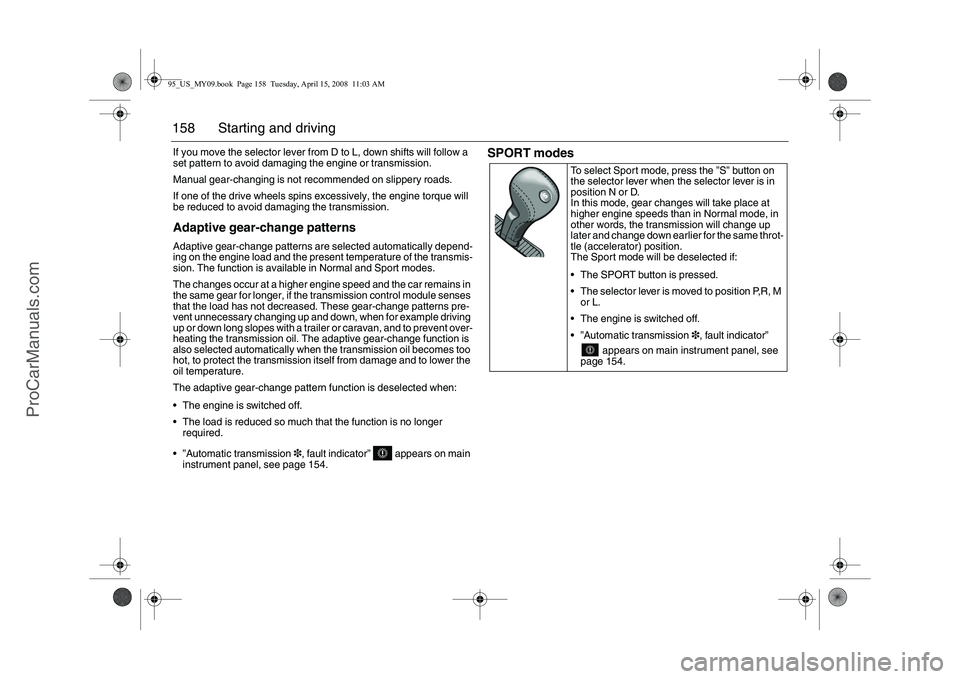
To select Sport mode, press the ”S” button on
the selector lever when the selector lever is in
position N or D.
In this mode, gear changes will take place at
higher engine speeds than in Normal mode, in
other words, the transmission will change up
later and change down earlier for the same throt-
tle (accelerator) position.
The Sport mode will be deselected if:
The SPORT button is pressed.
The selector lever is moved to position P,R, M
or L.
The engine is switched off.
”Automatic transmission3, fault indicator”
appears on main instrument panel, see
page 154.
95_US_MY09.book Page 158 Tuesday, April 15, 2008 11:03 AM
ProCarManuals.com
Page 192 of 272
192 Car care and technical informationEngineThe 2.3-liter model is a transverse, 4-cylin-
der in-line engine with twin overhead cam-
shafts and 4 valves per cylinder.
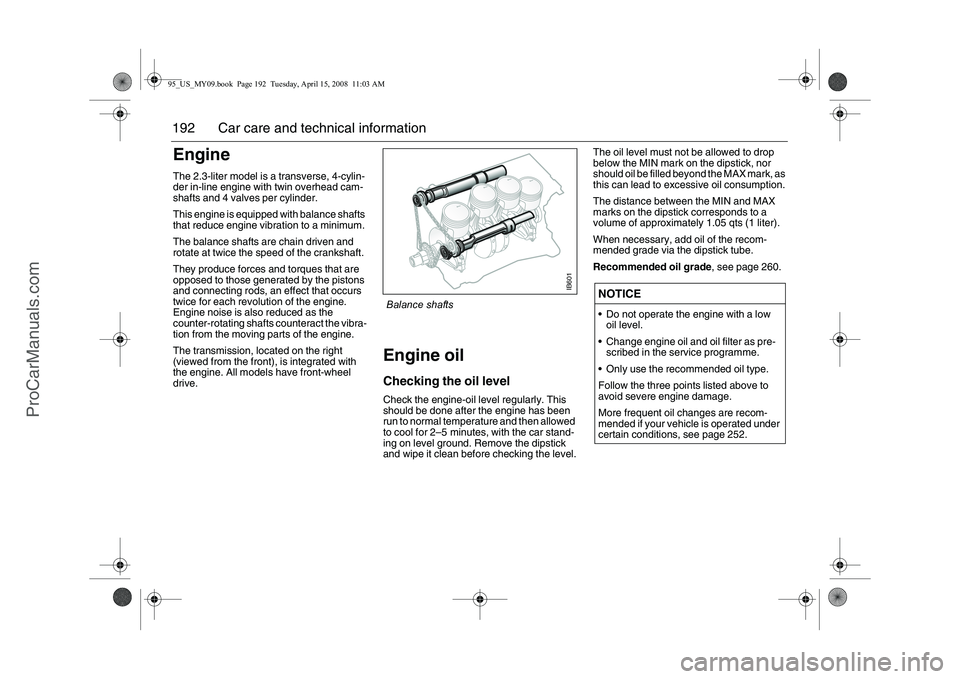
This engine is equipped with balance shafts
that reduce engine vibration to a minimum.
The balance shafts are chain driven and
rotate at twice the speed of the crankshaft.
They produce forces and torques that are
opposed to those generated by the pistons
and connecting rods, an effect that occurs
twice for each revolution of the engine.
Engine noise is also reduced as the
counter-rotating shafts counteract the vibra-
tion from the moving parts of the engine.
The transmission, located on the right
(viewed from the front), is integrated with
the engine. All models have front-wheel
drive.
Engine oilChecking the oil level Check the engine-oil level regularly. This
should be done after the engine has been
run to normal temperature and then allowed
to cool for 2–5 minutes, with the car stand-
ing on level ground. Remove the dipstick
and wipe it clean before checking the level.The oil level must not be allowed to drop
below the MIN mark on the dipstick, nor
should oil be filled beyond the MAX mark, as
this can lead to excessive oil consumption.
The distance between the MIN and MAX
marks on the dipstick corresponds to a
volume of approximately 1.05 qts (1 liter).
When necessary, add oil of the recom-
mended grade via the dipstick tube.
Recommended oil grade, see page 260.
NOTICE Do not operate the engine with a low
oil level.
Change engine oil and oil filter as pre-
scribed in the service programme.
Only use the recommended oil type.
Follow the three points listed above to
avoid severe engine damage.
More frequent oil changes are recom-
mended if your vehicle is operated under
certain conditions, see page 252.
IB601
Balance shafts
95_US_MY09.book Page 192 Tuesday, April 15, 2008 11:03 AM
ProCarManuals.com
Page 202 of 272
202 Car care and technical informationChanging bulbs
Check that the new bulb is working when
finished.
Use only "Long Life" bulbs.
Headlight aiming, see page 248.
Xenon headlight3Xenon headlights produce roughly twice as
much light as halogen bulbs and have a sig-
nificantly longer service life.
The lamp units consist of a gas discharge
lamp containing xenon. When the lights are
switched on a very high voltage activates
the xenon gas. The lamps soon reach full
intensity.
Cars with xenon headlights have automatic
levelling. The levelling system comprises
two sensors, one on the front axle, one on
the rear axle and a control unit under each
of the two headlight housings. Headlight
alignment is regulated automatically to pre-
vent dazzling oncoming traffic. Alignment is
also adjusted during braking.
WARNING
Before changing a bulb in the engine bay,
switch off the engine to avoid danger of
fingers and hands being injured by
moving parts.
The radiator fan can start up even when
the engine is switched off.
Xenon headlights3 are high voltage
and must therefore be changed at a
workshop. We recommend that you
contact an authorized Saab work-
shop. Work involving high-voltage
components is potentially lethal.NOTICE Since the headlight lenses are made
of plastic, rinse dried-on dirt with
water and allow it time to soften up
before cleaning the lenses. Avoid
rubbing the lenses when dry and
never use solvents.
Use de-icer spray instead of scraping
the ice off.
NOTICE Do not fit bulbs with a higher rating
than 55 W, since the headlight reflec-
tor and the wiring of the car are not
designed for a higher wattage.
Switch off the ignition before chang-
ing a bulb, to avoid possible short-cir-
cuiting.
Do not touch the glass of the bulbs
with your fingers. The oil on your skin
can shorten the life of the bulb.
95_US_MY09.book Page 202 Tuesday, April 15, 2008 11:03 AM
ProCarManuals.com
Page 252 of 272
252 Customer Assistance and InformationMaintenance scheduleThe Maintenance Schedule prescribes a
service program to the purchaser/operator
of a Saab that is reasonable and necessary
to ensure the proper emission control sys-
tems function, safety and reliability of the
Saab automobile in normal use. Additional
maintenance is recommended for specific
components when the car is operated under
certain severe conditions. Proper mainte-
nance is always good advice!
Authorized Saab dealers are equipped and
trained to meet your Saab’s service needs.
They regularly receive up-to-date Saab
service manuals and parts and technical
service bulletins from Saab and are able,
through their franchise agreement, to attend
Saab service schools, obtain Saab special
tools and technical assistance and pur-
chase original equipment service and
replacement parts.
Today’s complex automobiles should only
be entrusted to the most knowledgeable
service professionals. A Saab dealer is your
best choice.
Service intervalsA time for service message will illuminate on
the Saab Instrument Display (SID) when the
car is due for regular maintenance.
Engine oil and filter changesChanging the engine oil and filter is required
at every service point. Use only a Saab
approved long-life oil filter and engine oils
stated in the Specification section of this
Owner’s Manual. The use of extra additives
in the oil is not necessary and is not recom-
mended, and may be harmful to turbo-
chargers.
More frequent oil changes are recom-
mended if your vehicle is operated under
the following conditions:
Most trips are less than 5 to 10 miles (8 to
16 km). This is particularly important
when outside temperatures are below
freezing.
Most trips include extensive idling (such
as frequent stop-and-go driving).
Most trips are through dusty areas.
You frequently tow a trailer or use a carrier
on top of your vehicle.
If the vehicle is used for delivery service,
police, taxi or other commercial applica-
tions.
If your driving habits match this description,
have the engine oil and filter changed in-
between normal services at 5,000 mile
(8,000 km) intervals. The Saab Warranty
and Service Record Booklet has provisions
to record extra oil changes.
95_US_MY09.book Page 252 Tuesday, April 15, 2008 11:03 AM
ProCarManuals.com
Page 253 of 272
253 Customer Assistance and Information
Service record retentionIt is the owner´s responsibility to retain ser-
vice records. If possible, you should keep
copies of all shop work orders for all service
and repairs, whenever performed. As indi-
cated in the new car and emission control
system warranties, it is important to docu-
ment that all necessary maintenance has
been done.HOW THE SERVICE RECORD IS
ORGANIZEDThe service record is comprised of a series
of coupons on which to record services as
they are performed. There are additional
coupons for documenting extra engine oil
and filter changes, extra automatic trans-
mission fluid services necessary for severe
service conditions, and brake fluid changes.HOW TO USE THE SERVICE
RECORD COUPONSWhen the car is brought to a Saab dealer for
scheduled maintenance, present the Saab
Warranty and Service Record Booklet to the
service manager. When the technician has
completed the service, the technician will
sign the maintenance record. The person
responsible for quality assurance at the
dealership will also sign and stamp the
record with the dealer identification stamp.
Service costsDealer pricing practices and labor for ser-
vice work vary. Saab’s recommended ser-
vice times for each service point do not
include the labor required to replace wear
items, such as wiper blades, brake pads or
tires. Nor is labor to perform other service or
repairs found to be necessary as a result of
the inspections included in these times.
Additional labor and parts will be charged
for such work when necessary, except as
covered under an applicable Saab warranty
or any optional extended service contract.
Transmission fluid changes or suspension
alignment, when necessary, are also addi-
tional.
Dealer charges for general shop material,
regulated hazardous waste removal, recy-
cling expenses or other operation costs may
also be applied to service and repair
invoices and are apt to vary by dealer and
location.
Owner assistanceWarranties and service problem
assistanceFor complete information about all applica-
ble warranties, including the New Car War-
ranty, Perforation Warranty, Vehicle Emis-
sion Warranty and Emission Perforation
Warranty, consult the Warranties and Ser-
vice Record Booklet which accompanies
this Owner’s Manual. It also contains owner
assistance information including Saab
Roadside Assistance. If the booklet is lost or
misplaced, a new one may be ordered
through a Saab dealer or by contacting
Saab.
In the U.S. there is a national Customer
Assistance Center at Saab Automobile
USA, Inc. The toll-free number to call from
all 50 states is 1-800-955-9007.
In Canada, please call the Saab Customer
Assistance Center at 1-800-263-1999.
A list of authorized Saab sales and service
dealers is available for those planning to
travel in the United States and Canada.
Canadian or U.S. travelers may call the
Customer Assistance Center in the country
in which they are traveling.
95_US_MY09.book Page 253 Tuesday, April 15, 2008 11:03 AM
ProCarManuals.com
Page 269 of 272

269 Index
Immobilizer
_____________________ 49
Indicator and warning lights
________ 58
Indicator lights
___________________ 58
Information about fuel
____________ 148
Instrument illumination ____________ 75
Instruments and controls ___________ 57
Interior equipment
_______________ 113
Interior lighting
_________________ 124
Interior rearview mirror
___________ 116
JJack
__________________________ 238
KKey
___________________________ 44
Key, remove
___________________ 140
LLATCH (child safety)
______________ 23
Labeling, tire sidewall ____________ 227
Labels
__________________________ 7
Leather upholstery, care of
________ 241
Light horn
______________________ 73
Light switches ___________________ 73
Loading MP3 discs
______________ 102
Loading your vehicle _____________ 229
Luggage-compartment lighting
_____ 125
MMP3 player
____________________ 102
Main instrument panel
_____________ 58
Main/dipped beam
________________ 73
Maintenance schedule
___________ 252
Maintenance, A/C-system _________ 244
Maxi fuses
_____________________ 215
Milometer ______________________ 64
Moonroof ______________________ 123
Motoring abroad
________________ 247
Multipath propagation
____________ 109
NNIGHT
_________________________ 72
New tires, buying
________________ 223
Night Panel
_____________________ 72
OOdometer
______________________ 64
Oil capacity, engine
______________ 260
Oil specification
_________________ 260
Outdoor temperature
______________ 68
Owner assistance
_______________ 253
PPaintwork, touching-in
____________ 243
Parcel shelf, folding
______________ 133Parking Assistance
______________ 168
Parking lights
____________________ 73
Plates and labels
________________ 264
Poly-V-belt
_____________________ 199
Portable fuel container
___________ 148
Portable player
_________________ 104
Power outlet
___________________ 126
Power steering _________________ 196
Power-steering fluid
______________ 196
Pressure gauge
__________________ 67
Prestige
_______________________ 107
Programme type ALARM
__________ 99
QQuality grading, tires
_____________ 224
Questions on function of airbag
______ 40
RRDS time
______________________ 106
Radiator fan ____________________ 199
Radio
__________________________ 93
Radio Data System (RDS)
_________ 94
Radio text
______________________ 94
Radio waves ___________________ 110
Rain sensor _____________________ 77
Random playback of MP3 files, CD
__ 103
Random playback, CD
____________ 99
Random playback, CD changer
____ 101
Rapid playing an MP3 file
_________ 103
95_US_MY09.book Page 269 Tuesday, April 15, 2008 11:03 AM
ProCarManuals.com
Page 271 of 272
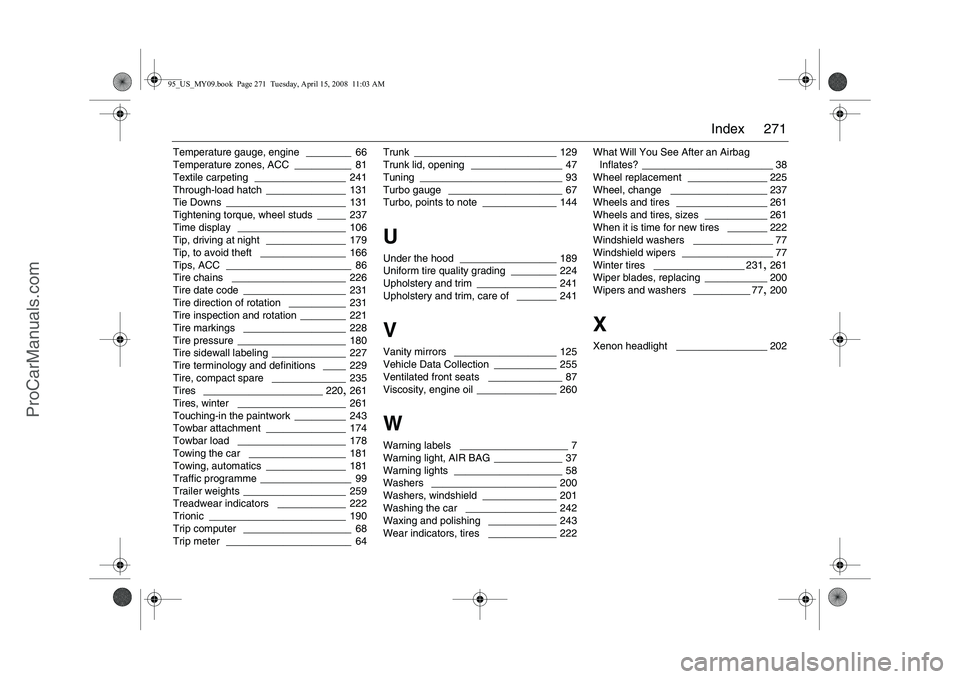
271 Index
Temperature gauge, engine
________ 66
Temperature zones, ACC
__________ 81
Textile carpeting
________________ 241
Through-load hatch ______________ 131
Tie Downs
_____________________ 131
Tightening torque, wheel studs
_____ 237
Time display
___________________ 106
Tip, driving at night
______________ 179
Tip, to avoid theft
_______________ 166
Tips, ACC
______________________ 86
Tire chains ____________________ 226
Tire date code __________________ 231
Tire direction of rotation
__________ 231
Tire inspection and rotation ________ 221
Tire markings
__________________ 228
Tire pressure ___________________ 180
Tire sidewall labeling
_____________ 227
Tire terminology and definitions
____ 229
Tire, compact spare
_____________ 235
Tires
_____________________ 220
, 261
Tires, winter
___________________ 261
Touching-in the paintwork
_________ 243
Towbar attachment
______________ 174
Towbar load
___________________ 178
Towing the car _________________ 181
Towing, automatics
______________ 181
Traffic programme ________________ 99
Trailer weights
__________________ 259
Treadwear indicators
____________ 222
Trionic
________________________ 190
Trip computer
___________________ 68
Trip meter
______________________ 64Trunk
_________________________ 129
Trunk lid, opening
________________ 47
Tuning
_________________________ 93
Turbo gauge
____________________ 67
Turbo, points to note
_____________ 144
UUnder the hood
_________________ 189
Uniform tire quality grading
________ 224
Upholstery and trim
______________ 241
Upholstery and trim, care of
_______ 241
VVanity mirrors
__________________ 125
Vehicle Data Collection
___________ 255
Ventilated front seats
_____________ 87
Viscosity, engine oil
______________ 260
WWarning labels
___________________ 7
Warning light, AIR BAG
____________ 37
Warning lights
___________________ 58
Washers
______________________ 200
Washers, windshield
_____________ 201
Washing the car
________________ 242
Waxing and polishing
____________ 243
Wear indicators, tires ____________ 222What Will You See After an Airbag
Inflates?
_______________________ 38
Wheel replacement
______________ 225
Wheel, change
_________________ 237
Wheels and tires ________________ 261
Wheels and tires, sizes
___________ 261
When it is time for new tires
_______ 222
Windshield washers
______________ 77
Windshield wipers
________________ 77
Winter tires
________________ 231
, 261
Wiper blades, replacing
___________ 200
Wipers and washers
__________ 77
, 200
XXenon headlight
________________ 202
95_US_MY09.book Page 271 Tuesday, April 15, 2008 11:03 AM
ProCarManuals.com