phone SAAB 9-5 2009 Owners Manual
[x] Cancel search | Manufacturer: SAAB, Model Year: 2009, Model line: 9-5, Model: SAAB 9-5 2009Pages: 272, PDF Size: 21.53 MB
Page 41 of 272
41 Safety
Are the smoke and fumes given off when the
airbag operates at all harmful?
Most people who have remained in a car
with little or no ventilation for several min-
utes complained only of minor irritation of
the throat and eyes. Avoid as far as possible
getting dust on your skin as there is a risk of
skin irritation.
If you suffer from asthma, the incident may
bring on an attack, in which case you should
follow the normal procedure advised by
your doctor. It is advisable to consult a
doctor afterwards.
What should I do if the AIRBAG warning
light comes on?
If the warning light is on, it means that a fault
has been detected in the system. The
airbag cannot be relied on to operate as
intended and it might even be activated
erroneously. You should therefore take the
car to an authorized Saab dealer as soon as
possible.
Adding Equipment to Your
Airbag-Equipped VehicleIs there anything I might add to the front or
sides of the vehicle that could keep the air-
bags from working properly?
Yes. If you add things that change your vehi-
cle’s frame, bumper system, front end or
side sheet metal or height, they may keep
the airbag system from working properly.
Also, the airbag system may not work prop-
erly if you relocate any of the airbag sen-
sors. If you have any questions about this,
you should contact Saab Customer Assis-
tance before you modify your vehicle.
The phone numbers and addresses for
Customer Assistance can be found on
page 253.Because I have a disability, I have to get my
vehicle modified. How can I find out whether
this will affect my advanced airbag system?
Changing or moving any parts of the front
seats, safety belts, the airbag sensing and
diagnostic module or the inside rearview
mirror can affect the operation of the
advanced airbag system. If you have ques-
tions, call Customer Assistance. The phone
numbers and addresses for Customer
Assistance can be found on page 253.
95_US_MY09.book Page 41 Tuesday, April 15, 2008 11:03 AM
ProCarManuals.com
Page 122 of 272
122 Interior equipment and trunkCompass The compass is integrated in the rearview
mirror. The compass bearing is displayed in
the top right-hand corner of the mirror and is
updated every other second. The compass
displays the car’s direction of travel: N, NE,
E, etc.
Switch the compass display on and off by
pressing button 5 for 3 seconds.
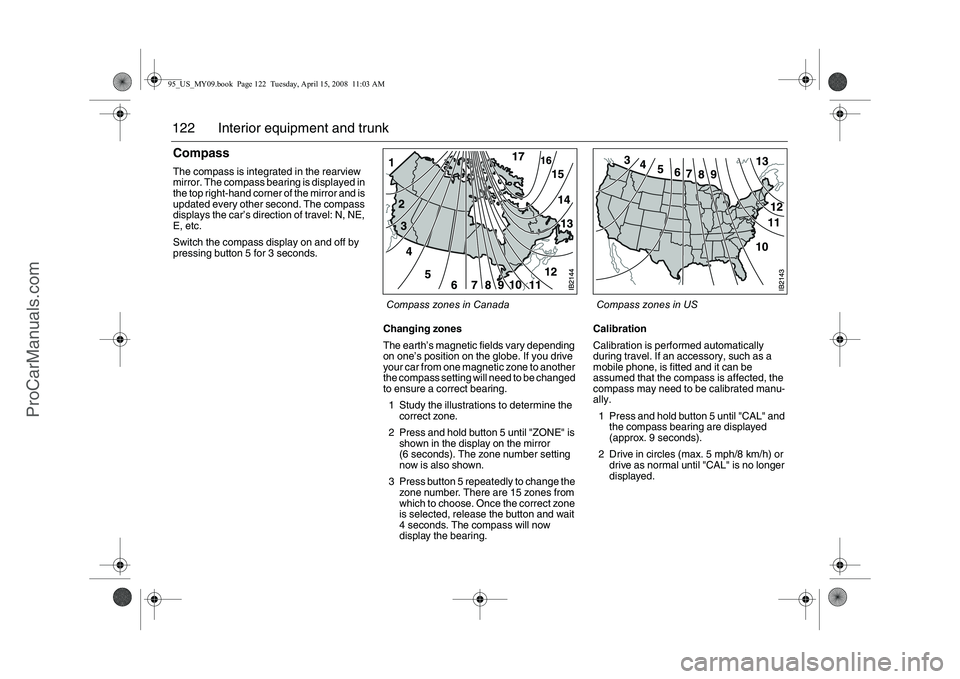
Changing zones
The earth’s magnetic fields vary depending
on one’s position on the globe. If you drive
your car from one magnetic zone to another
the compass setting will need to be changed
to ensure a correct bearing.
1 Study the illustrations to determine the
correct zone.
2 Press and hold button 5 until "ZONE" is
shown in the display on the mirror
(6 seconds). The zone number setting
now is also shown.
3 Press button 5 repeatedly to change the
zone number. There are 15 zones from
which to choose. Once the correct zone
is selected, release the button and wait
4 seconds. The compass will now
display the bearing.Calibration
Calibration is performed automatically
during travel. If an accessory, such as a
mobile phone, is fitted and it can be
assumed that the compass is affected, the
compass may need to be calibrated manu-
ally.
1 Press and hold button 5 until "CAL" and
the compass bearing are displayed
(approx. 9 seconds).
2 Drive in circles (max. 5 mph/8 km/h) or
drive as normal until "CAL" is no longer
displayed.
Compass zones in US Compass zones in Canada
95_US_MY09.book Page 122 Tuesday, April 15, 2008 11:03 AM
ProCarManuals.com
Page 126 of 272
126 Interior equipment and trunkPower Outlet3You can use the electrical socket to charge
a mobile phone, for example.
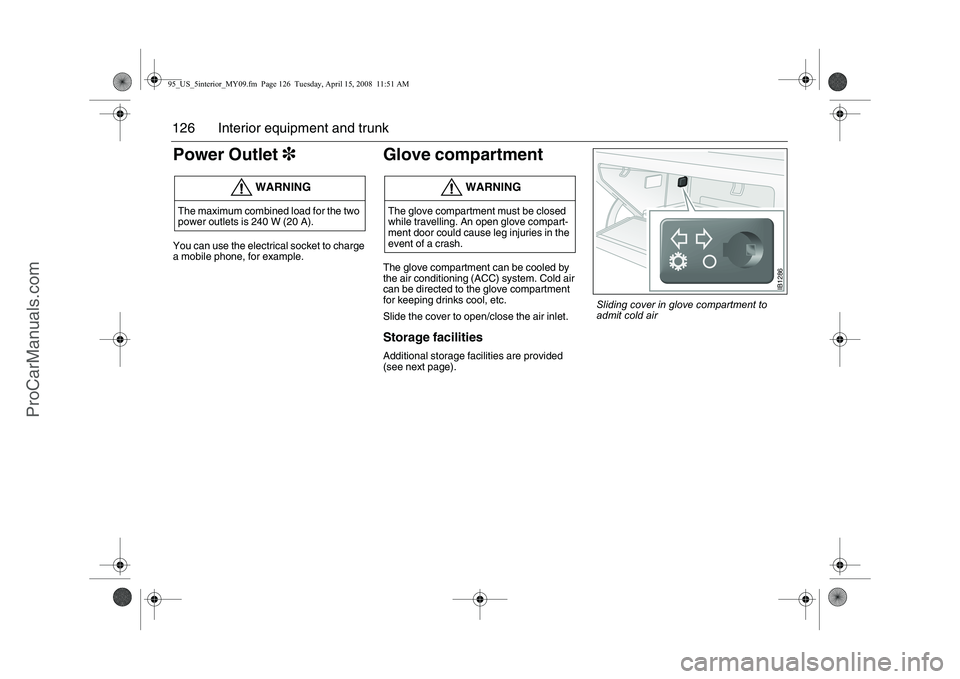
Glove compartment The glove compartment can be cooled by
the air conditioning (A CC) system. Cold air
can be directed to the glove compartment
for keeping drinks cool, etc.
Slide the cover to open/close the air inlet. Storage facilitiesAdditional storage facilities are provided
(see next page).
WARNING
The maximum combined load for the two
power outlets is 240 W (20 A).
WARNING
The glove compartment must be closed
while travelling. An open glove compart-
ment door could cause leg injuries in the
event of a crash.
IB1286
Sliding cover in glove compartment to
admit cold air
95_US_5interior_MY09.fm Page 126 Tuesday, April 15, 2008 11:51 AM
ProCarManuals.com
Page 141 of 272
141 Starting and driving
If the car does not startIf the text
”Key not accepted.
Contact service.”
is shown on the SID, after a failed start
attempt, the cause could be a fault in the
transmitter in the key, or in the receiver in
the ignition lock. The following should be
done:
Turn the key back to the LOCK position.
Turn the key to ON.
Press one of the buttons on the remote
control (the LED stops blinking).
Start the engine.
Try another key. If this works, then the fault
is in the first key.
We recommend that you contact an autho-
rized Saab dealer for checking and rectifica-
tion.
Note:
Certain electronic items, such as cellular
phones, may affect the starting produce-
dure. Be sure that all devices are clear of the
key/ignition switch area.
Starting the engine
NOTICETake care not to spill drinks or to drop
crumbs over the ignition switch. If dirt or
liquid gets into it, the switch may not
operate properly.
WARNING
Always remove the key before leaving
the car.
Always apply the parking brake before
removing the ignition key.
WARNING
When starting the engine:
– Sit down in the driver’s seat.
– Depress the clutch pedal fully. If the
gear lever is not in the neutral posi-
tion, the clutch pedal must be fully
depressed or the car will jump for-
wards or backwards, which may
cause a crash.
– Never start the car from outside the
vehicle, e.g. through a wound down
window. This could lead to serious
personal injury.
Engage reverse (R) (position P for
automatic transmission) to remove the
ignition key. The key can only be
removed in this gear position.
Carbon monoxide (CO) is a colorless,
odorless, poisonous gas. Be alert to
the danger of CO – always open the
garage doors before starting the
engine in the garage.
There is also a danger of CO poison-
ing if the exhaust system is leaking.
95_US_MY09.book Page 141 Tuesday, April 15, 2008 11:03 AM
ProCarManuals.com
Page 146 of 272
146 Starting and drivingRefueling
WARNING
If you spill fuel and then something ignites
it, you could be badly burned. Fuel can
spray out on you if you open the fuel cap
too quickly. This spray can happen if your
tank is nearly full, and is more likely in hot
weather. Open the fuel cap slowly and
wait for any “hiss” noise to stop. Then
unscrew the cap all the way.
Gasoline fumes are highly explosive.
Therefore:
never smoke while refueling
never use gasoline for any purpose
other than as engine fuel
gasoline is extremely flammable and
can cause severe burns. No open or
exposed flames near gasoline
do not use a mobile phone at the
same time as refueling.
NOTICE Do not overfill. Fuel should not come
right up the filler pipe as room for
expansion is needed for when the
temperature rises.
The use of fuel with too low an octane
rating can cause serious engine
damage.
Clean fuel from painted surfaces as
soon as possible.
Do not use additives with E85-fuel.
NOTICEThe engine control module (ECM) mon-
itoring the engine parameters also
stores fault codes.
Under certain circumstances, this may
cause constant illumination of the ”Ser-
vice Engine Light also known as CHECK
ENGINE” indicator light , thus indi-
cating a fault that must be checked by
your Saab dealer, see page 58.
NOTE: always observe the following two
measures:
Make sure that the fuel filler cap is
screwed on correctly before the
engine is started. Screw on the fuel
filler cap until you hear 3 clicks.
Avoid driving with the fuel low level
indicator illuminated. The symbol
illuminates when less than approxi-
mately 2 gallons (8 litres) of fuel
remains in the tank.
95_US_MY09.book Page 146 Tuesday, April 15, 2008 11:03 AM
ProCarManuals.com
Page 166 of 272
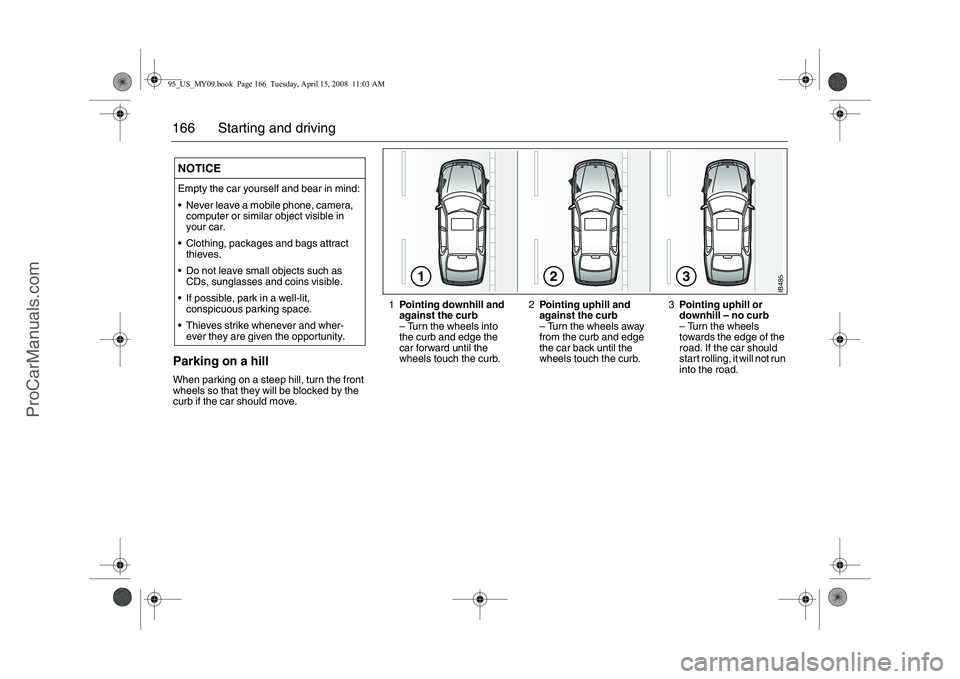
166 Starting and drivingParking on a hillWhen parking on a steep hill, turn the front
wheels so that they will be blocked by the
curb if the car should move. NOTICEEmpty the car yourself and bear in mind:
Never leave a mobile phone, camera,
computer or similar object visible in
your car.
Clothing, packages and bags attract
thieves.
Do not leave small objects such as
CDs, sunglasses and coins visible.
If possible, park in a well-lit,
conspicuous parking space.
Thieves strike whenever and wher-
ever they are given the opportunity.
123
IB485
1Pointing downhill and
against the curb
– Turn the wheels into
the curb and edge the
car forward until the
wheels touch the curb.2Pointing uphill and
against the curb
– Turn the wheels away
from the curb and edge
the car back until the
wheels touch the curb.3Pointing uphill or
downhill – no curb
– Turn the wheels
towards the edge of the
road. If the car should
start rolling, it will not run
into the road.
95_US_MY09.book Page 166 Tuesday, April 15, 2008 11:03 AM
ProCarManuals.com
Page 197 of 272
197 Car care and technical information
Battery
The battery is provided with a cover to
protect it from radiated heat. If the battery is
exposed to high temperatures, its life will be
shortened. To remove the cover, release
the two clips along its long sides.
The cover fits the standard battery installed
in the car. If a new battery is to be fitted,
make sure that its dimensions are the same
as the standard one.
The battery is maintenance free.
If frequent short journeys are made, the bat-
tery may need to be given a booster charge.
This can be done either using a battery
charger or by taking the car for a long run.
A car with a standard equipment specifica-
tion and a fully charged battery can be left
for up to 40 days and still have a sufficient
charge for starting. If extra equipment is fit-
ted, such as a car phone, the charge may
only be sufficient for about 15 days.
Charging/replacing the battery Connect the positive lead to the positive (+)
battery terminal (red), and the negative lead
to a good ground point, e.g. the lifting lug at
the front of the engine.
To remove the battery, always disconnect
the negative (black) lead first and reconnect
it last when fitting the new battery.
The battery size must comply with DIN
53735 MFI 230/2.16.
WARNING
Work on the battery may entail an
explosion hazard, since the battery
gives off hydrogen which forms an
explosive mixture with the oxygen in
the air.
For this reason, always avoid sparks
or open flames when working near the
battery.
The battery contains corrosive sulfuric
acid. Always wear a face mask or
goggles when working on the battery.
If battery acid gets into the eyes or
splashes the skin or clothing, wash the
affected area liberally with water.
If acid gets into the eyes or a large
quantity makes contact with the skin,
seek medical help.
Battery posts, terminals and related
accessories contain lead and lead
compounds. Wash your hands after
handling.
NOTICEA discharged battery can freeze and frac-
ture. Batteries should therefore always be
stored away from frost.
NOTICETo avert the danger of short-circuiting
between the positive (+) terminal on the
battery and the inlet manifold on the
engine, always disconnect the negative
(–) battery lead first and reconnect it last.
95_US_MY09.book Page 197 Tuesday, April 15, 2008 11:03 AM
ProCarManuals.com
Page 242 of 272
242 Car care and technical informationWashing the carWash your car frequently. To facilitate
cleaning, a suitable detergent can be added
to the water, which should be lukewarm.
Saab offers a full line of car care products,
including car wash, for the care of your vehi-
cle. See your dealer for available products
or visit www.saabcatalog.com (U.S. resi-
dents only).
Do not use a pressure washer at close
range on stone chip damage, scratches or
other damage to the paintwork. The paint
can otherwise start to flake.
Remove any bird droppings without delay,
as these can discolor the paintwork and
prove difficult to polish out.
Use a soft cloth moistened with methyl alco-
hol to remove splashes of tar or asphalt. Do
not use strong cleaners, as these can dry
out the paintwork.
The underside of the car also needs wash-
ing regularly, and this should be done extra
thoroughly at the end of winter. Clean the
underside of the car by hand if the car is
usually washed in an automatic car wash
without special facilities for underbody
cleaning.
Never wash or leave the car to dry in the
sun, but wipe it dry with a chamois leather
immediately after washing to avoid smears
and streaks.
Clean the window glass inside and out using
a high quality window cleaner. This is partic-
ularly important when the car is new, as
upholstery and trim have a tendency to
sweat a little at first.
Keep the glass well cleaned, as this helps to
prevent misting.
NOTICEOnly use liquid detergent when cleaning
the plastic lenses of the front and rear
lights. Do not use mechanical cleaning.
Rinse off the detergent immediately, oth-
erwise cracks may form in the plastic
lenses.
NOTICE The door mirrors must be fully
retracted before the car enters an
automatic car wash.
Remove fixed antennas, e.g. for
mobile phone, before putting car
through an automatic car wash.
Try your brakes on leaving a car wash.
Wet brake discs may reduce the per-
formance of the brakes.
Cars with Saab Parking Assistance:
Do not spray the sensors or closer
than 8 in. (20 cm) to the sensors with
a pressure washer, as this can
damage them.
95_US_MY09.book Page 242 Tuesday, April 15, 2008 11:03 AM
ProCarManuals.com
Page 267 of 272
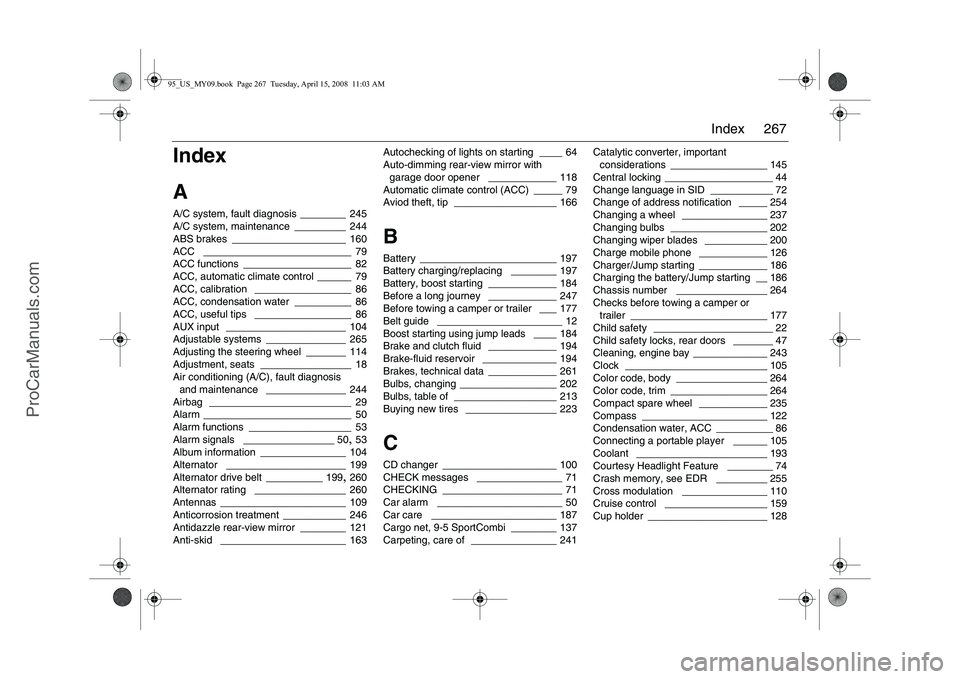
267 Index
Index
AA/C system, fault diagnosis
________ 245
A/C system, maintenance _________ 244
ABS brakes
____________________ 160
ACC
__________________________ 79
ACC functions
___________________ 82
ACC, automatic climate control
______ 79
ACC, calibration
_________________ 86
ACC, condensation water
__________ 86
ACC, useful tips
_________________ 86
AUX input
_____________________ 104
Adjustable systems
______________ 265
Adjusting the steering wheel
_______ 114
Adjustment, seats
________________ 18
Air conditioning (A/C), fault diagnosis
and maintenance ______________ 244
Airbag
_________________________ 29
Alarm __________________________ 50
Alarm functions
__________________ 53
Alarm signals
________________ 50
, 53
Album information
_______________ 104
Alternator
_____________________ 199
Alternator drive belt
__________ 199
, 260
Alternator rating
________________ 260
Antennas
______________________ 109
Anticorrosion treatment
___________ 246
Antidazzle rear-view mirror
________ 121
Anti-skid
______________________ 163Autochecking of lights on starting
____ 64
Auto-dimming rear-view mirror with
garage door opener
____________ 118
Automatic climate control (ACC)
_____ 79
Aviod theft, tip
__________________ 166
BBattery
________________________ 197
Battery charging/replacing
________ 197
Battery, boost starting
____________ 184
Before a long journey ____________ 247
Before towing a camper or trailer
___ 177
Belt guide
______________________ 12
Boost starting using jump leads
____ 184
Brake and clutch fluid
____________ 194
Brake-fluid reservoir
_____________ 194
Brakes, technical data ____________ 261
Bulbs, changing
_________________ 202
Bulbs, table of
__________________ 213
Buying new tires ________________ 223
CCD changer
____________________ 100
CHECK messages
_______________ 71
CHECKING
_____________________ 71
Car alarm
______________________ 50
Car care
______________________ 187
Cargo net, 9-5 SportCombi
________ 137
Carpeting, care of
_______________ 241Catalytic converter, important
considerations
_________________ 145
Central locking ___________________ 44
Change language in SID
___________ 72
Change of address notification
_____ 254
Changing a wheel
_______________ 237
Changing bulbs
_________________ 202
Changing wiper blades
___________ 200
Charge mobile phone
____________ 126
Charger/Jump starting ____________ 186
Charging the battery/Jump starting
__ 186
Chassis number
________________ 264
Checks before towing a camper or
trailer
________________________ 177
Child safety
_____________________ 22
Child safety locks, rear doors
_______ 47
Cleaning, engine bay
_____________ 243
Clock
_________________________ 105
Color code, body
________________ 264
Color code, trim _________________ 264
Compact spare wheel
____________ 235
Compass
______________________ 122
Condensation water, ACC
__________ 86
Connecting a portable player ______ 105
Coolant
_______________________ 193
Courtesy Headlight Feature
________ 74
Crash memory, see EDR
_________ 255
Cross modulation
_______________ 110
Cruise control
__________________ 159
Cup holder
_____________________ 128
95_US_MY09.book Page 267 Tuesday, April 15, 2008 11:03 AM
ProCarManuals.com