tires SAAB 9-5 2009 Owners Manual
[x] Cancel search | Manufacturer: SAAB, Model Year: 2009, Model line: 9-5, Model: SAAB 9-5 2009Pages: 272, PDF Size: 21.53 MB
Page 4 of 272
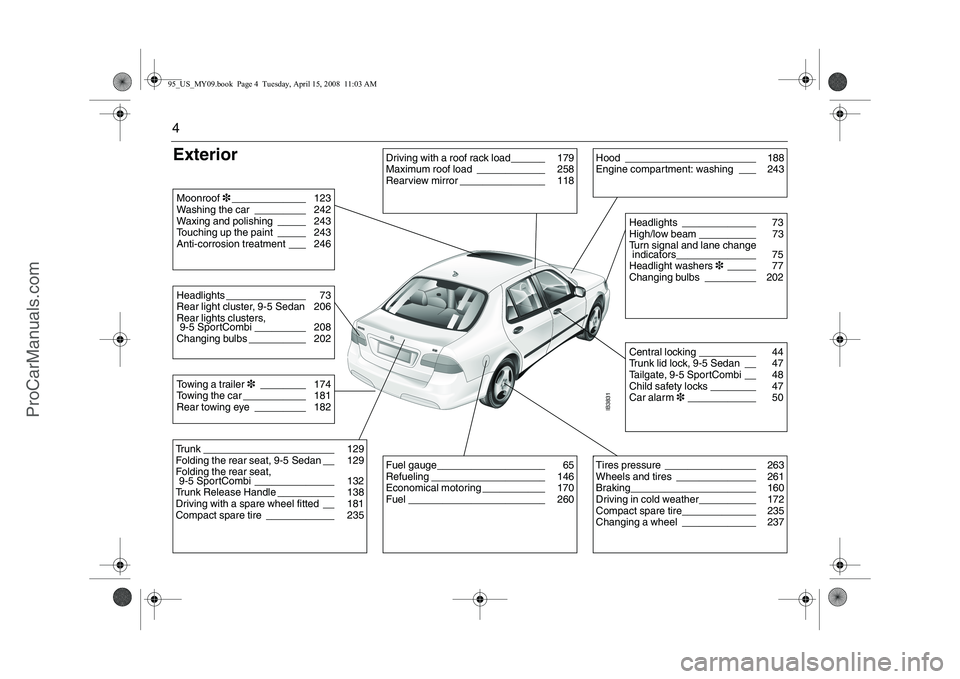
4Exterior
IB3831
Driving with a roof rack load______ 179
Maximum roof load ____________ 258
Rearview mirror _______________ 118
Hood _______________________ 188
Engine compartment: washing ___ 243
Central locking __________ 44
Trunk lid lock, 9-5 Sedan __ 47
Tailgate, 9-5 SportCombi __ 48
Child safety locks ________ 47
Car alarm3____________ 50Headlights _____________ 73
High/low beam __________ 73
Turn signal and lane change
indicators______________ 75
Headlight washers3_____ 77
Changing bulbs _________ 202
Fuel gauge___________________ 65
Refueling ____________________ 146
Economical motoring ___________ 170
Fuel ________________________ 260
b Tires pressure ________________ 263
Wheels and tires ______________ 261
Braking______________________ 160
Driving in cold weather__________ 172
Compact spare tire_____________ 235
Changing a wheel _____________ 237
Trunk _______________________ 129
Folding the rear seat, 9-5 Sedan __ 129
Folding the rear seat,
9-5 SportCombi ______________ 132
Trunk Release Handle __________ 138
Driving with a spare wheel fitted __ 181
Compact spare tire ____________ 235Towing a trailer3________ 174
Towing the car ___________ 181
Rear towing eye _________ 182Headlights ______________ 73
Rear light cluster, 9-5 Sedan 206
Rear lights clusters,
9-5 SportCombi _________ 208
Changing bulbs __________ 202Moonroof3_____________ 123
Washing the car _________ 242
Waxing and polishing _____ 243
Touching up the paint _____ 243
Anti-corrosion treatment ___ 24695_US_MY09.book Page 4 Tuesday, April 15, 2008 11:03 AM
ProCarManuals.com
Page 63 of 272
63 Instruments and controls
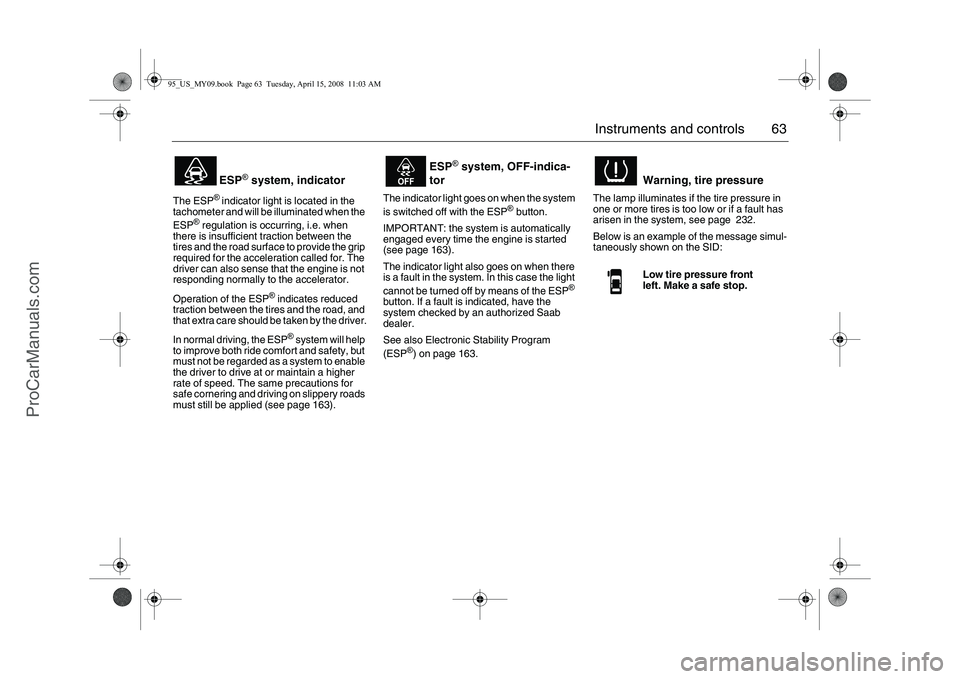
The ESP
® indicator light is located in the
tachometer and will be illuminated when the
ESP
® regulation is occurring, i.e. when
there is insufficient traction between the
tires and the road surface to provide the grip
required for the acceleration called for. The
driver can also sense that the engine is not
responding normally to the accelerator.
Operation of the ESP
® indicates reduced
traction between the tires and the road, and
that extra care should be taken by the driver.
In normal driving, the ESP
® system will help
to improve both ride comfort and safety, but
must not be regarded as a system to enable
the driver to drive at or maintain a higher
rate of speed. The same precautions for
safe cornering and driving on slippery roads
must still be applied (see page 163).The indicator light goes on when the system
is switched off with the ESP
® button.
IMPORTANT: the system is automatically
engaged every time the engine is started
(see page 163).
The indicator light also goes on when there
is a fault in the system. In this case the light
cannot be turned off by means of the ESP
®
button. If a fault is indicated, have the
system checked by an authorized Saab
dealer.
See also Electronic Stability Program
(ESP
®) on page 163.The lamp illuminates if the tire pressure in
one or more tires is too low or if a fault has
arisen in the system, see page 232.
Below is an example of the message simul-
taneously shown on the SID:
ESP
® system, indicator
ESP
® system, OFF-indica-
tor
Warning, tire pressureLow tire pressure front
left. Make a safe stop.
95_US_MY09.book Page 63 Tuesday, April 15, 2008 11:03 AM
ProCarManuals.com
Page 71 of 272
71 Instruments and controls
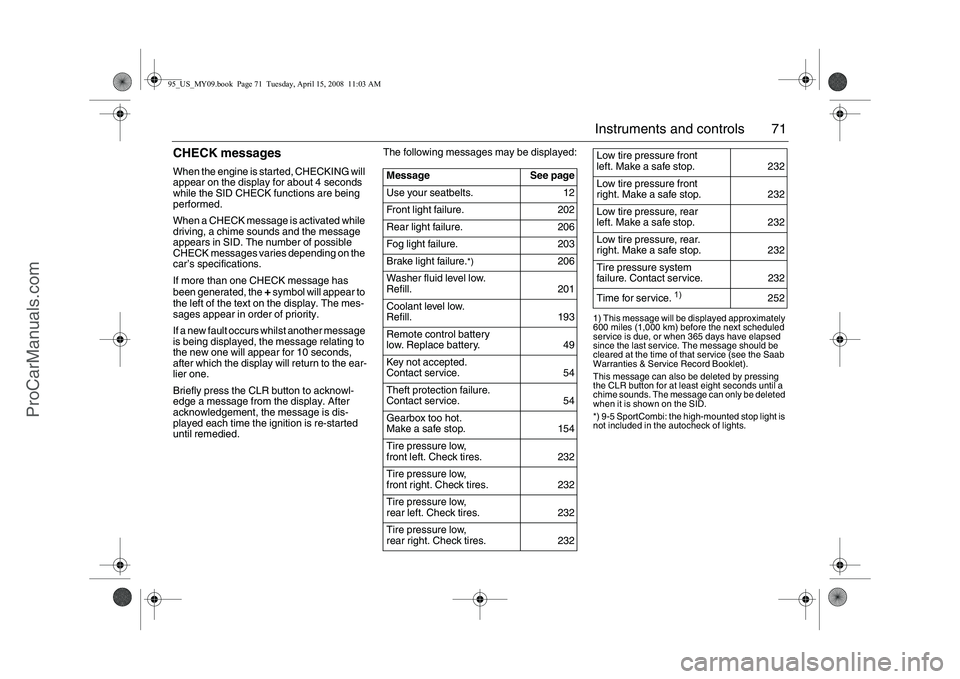
CHECK messages When the engine is started, CHECKING will
appear on the display for about 4 seconds
while the SID CHECK functions are being
performed.
When a CHECK message is activated while
driving, a chime sounds and the message
appears in SID. The number of possible
CHECK messages varies depending on the
car’s specifications.
If more than one CHECK message has
been generated, the
+ symbol will appear to
the left of the text on the display. The mes-
sages appear in order of priority.
If a new fault occurs whilst another message
is being displayed, the message relating to
the new one will appear for 10 seconds,
after which the display will return to the ear-
lier one.
Briefly press the CLR button to acknowl-
edge a message from the display. After
acknowledgement, the message is dis-
played each time the ignition is re-started
until remedied.The following messages may be displayed:
1) This message will be displayed approximately
600 miles (1,000 km) before the next scheduled
service is due, or when 365 days have elapsed
since the last service. The message should be
cleared at the time of that service (see the Saab
Warranties & Service Record Booklet).
This message can also be deleted by pressing
the CLR button for at least eight seconds until a
chime sounds. The message can only be deleted
when it is shown on the SID.
*) 9-5 SportCombi: the high-mounted stop light is
not included in the autocheck of lights.
Message See page
Use your seatbelts. 12
Front light failure. 202
Rear light failure. 206
Fog light failure. 203
Brake light failure.
*)
206
Washer fluid level low.
Refill. 201
Coolant level low.
Refill. 193
Remote control battery
low. Replace battery. 49
Key not accepted.
Contact service. 54
Theft protection failure.
Contact service. 54
Gearbox too hot.
Make a safe stop. 154
Tire pressure low,
front left. Check tires. 232
Tire pressure low,
front right. Check tires. 232
Tire pressure low,
rear left. Check tires. 232
Tire pressure low,
rear right. Check tires. 232
Low tire pressure front
left. Make a safe stop. 232
Low tire pressure front
right. Make a safe stop. 232
Low tire pressure, rear
left. Make a safe stop. 232
Low tire pressure, rear.
right. Make a safe stop. 232
Tire pressure system
failure. Contact service. 232
Time for service.
1)
252
95_US_MY09.book Page 71 Tuesday, April 15, 2008 11:03 AM
ProCarManuals.com
Page 163 of 272
163 Starting and driving
Electronic Stability
Program (ESP
®)
The system employs both the antilock brak-
ing system (ABS) and the traction control
system (TCS). It is a system that helps the
driver to stabilize the car in unusual circum-
stances that would otherwise be more diffi-
cult to handle.
How the ESP
® system works
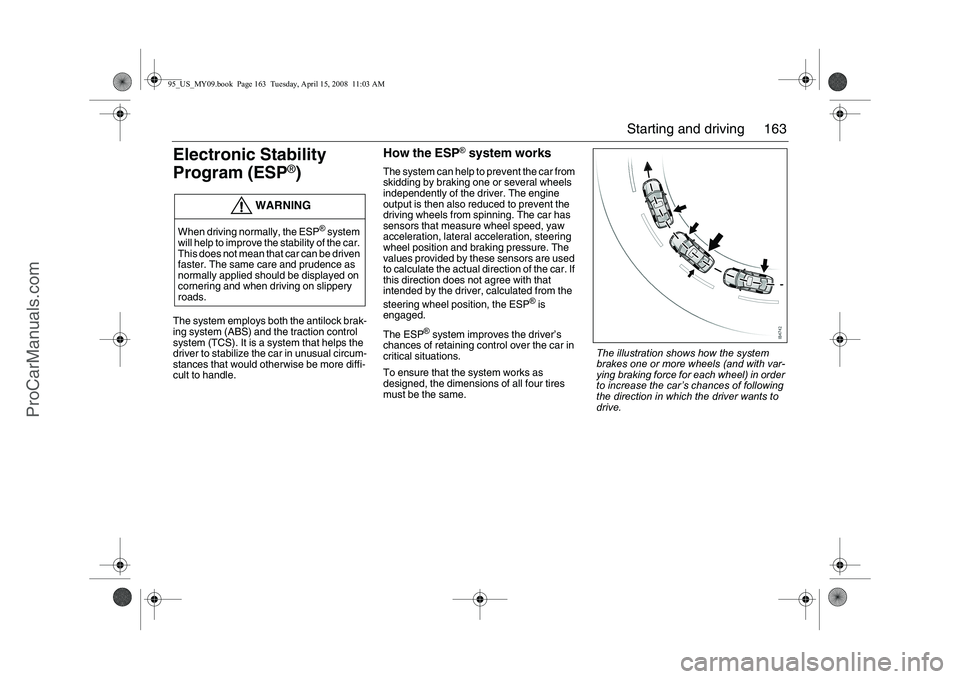
The system can help to prevent the car from
skidding by braking one or several wheels
independently of the driver. The engine
output is then also reduced to prevent the
driving wheels from spinning. The car has
sensors that measure wheel speed, yaw
acceleration, lateral acceleration, steering
wheel position and braking pressure. The
values provided by these sensors are used
to calculate the actual direction of the car. If
this direction does not agree with that
intended by the driver, calculated from the
steering wheel position, the ESP
® is
engaged.
The ESP
® system improves the driver’s
chances of retaining control over the car in
critical situations.
To ensure that the system works as
designed, the dimensions of all four tires
must be the same.
WARNING
When driving normally, the ESP
® system
will help to improve the stability of the car.
This does not mean that car can be driven
faster. The same care and prudence as
normally applied should be displayed on
cornering and when driving on slippery
roads.
The illustration shows how the system
brakes one or more wheels (and with var-
ying braking force for each wheel) in order
to increase the car’s chances of following
the direction in which the driver wants to
drive.
95_US_MY09.book Page 163 Tuesday, April 15, 2008 11:03 AM
ProCarManuals.com
Page 164 of 272
164 Starting and drivingThe ESP
® indicator light
The indicator light on the main instru-
ment comes on for a short period of time
when the ESP
® system is operative.
Operation of the ESP
® system indicates
reduced cohesion between the tires and the
road, and that extra care should be taken by
the driver.
The ESP
® OFF-indicator light
The light on the main instrument comes
on if:
A fault has been detected and the system
has therefore been switched off.
The system has been switched off manu-
ally.
When the ignition key is turned to the ON
position, the lamp is lit for about four sec-
onds while the system undergoes a
self-test.
Temporarily turning the ESP
®
system off
The system can be turned off manually with
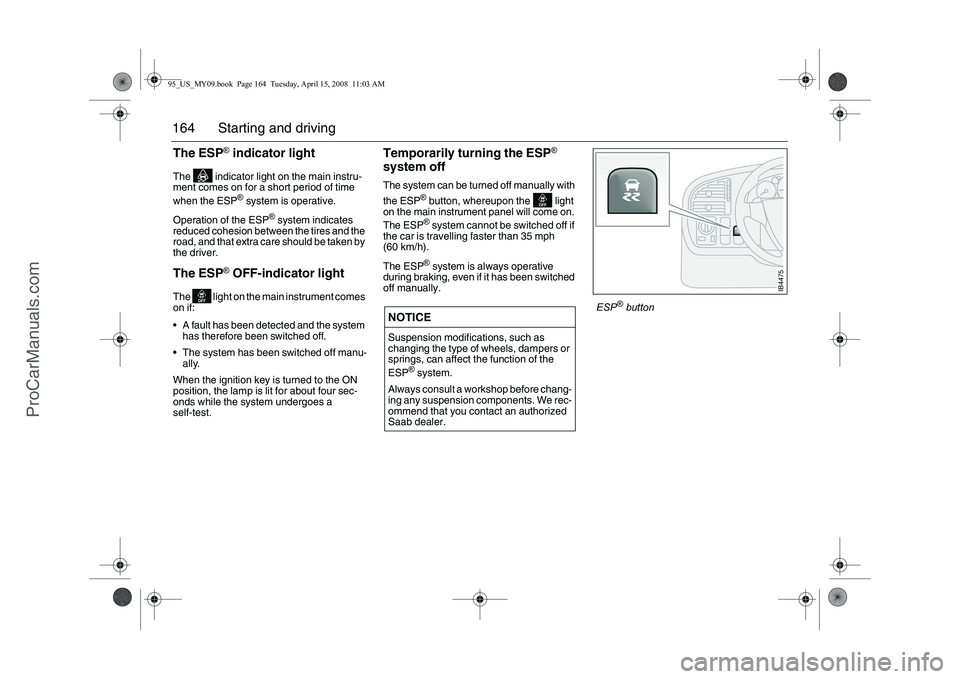
the ESP
® button, whereupon the light
on the main instrument panel will come on.
The ESP® system cannot be switched off if
the car is travelling faster than 35 mph
(60 km/h).
The ESP® system is always operative
during braking, even if it has been switched
off manually.
NOTICESuspension modifications, such as
changing the type of wheels, dampers or
springs, can affect the function of the
ESP
® system.
Always consult a workshop before chang-
ing any suspension components. We rec-
ommend that you contact an authorized
Saab dealer.
IB4475
ESP
® button
95_US_MY09.book Page 164 Tuesday, April 15, 2008 11:03 AM
ProCarManuals.com
Page 167 of 272
167 Starting and driving
Long-term parkingIf the car is not going to be used for some
time, e.g. 3–4 months, the following steps
are recommended:
Run the engine to normal temperature
before long-term parking.
Drain the washer-fluid reservoir and
hoses.
Wash and wax the car. Clean the rubber
seals on the hood, luggage compartment
lid and doors, and lubricate them with
glycerol (glycerin).
After washing the car, dry the brake discs
by taking the car out on the road and
applying the brakes a few times. Fill the fuel tank with fuel to prevent
condensation forming in it.
Top up the coolant and check the anti-
freeze before the onset of winter.
Park the car in a dry, covered and
well-ventilated building. Leave the park-
ing brake OFF!
Disconnect the negative (–) battery lead.
If frost is likely to occur during the
long-term parking, remove the battery
and store it away from the frost.
Ideally, the car should be put up on
blocks, with the wheels off the ground. If
this is not possible, inflate the tires to
about 43 psi (300 kPa).
Leave all the windows open a crack and
cover the car with a fabric tarpaulin – not
one made of plastic.95_US_MY09.book Page 167 Tuesday, April 15, 2008 11:03 AM
ProCarManuals.com
Page 171 of 272
171 Starting and driving
Driving technique To obtain the best running economy, not
only regarding fuel consumption but
general wear also, regular service is
required.
High speed, unnecessary acceleration,
heavy braking and much low gear work all
gives rise to higher fuel consumption.
Frequent gear changing in traffic, starting
in cold weather, the use of studded tires
and roof racks, and towing a trailer all
increase fuel consumption.
Do not run the engine when the car is
stationary.
If idling, it will take much longer before the
engine becomes hot. Engine wear is
greatest during this warming-up phase.
Therefore drive away as soon as possible
after the engine is started and avoid high
revving. Driving in a low gear results in higher fuel
consumption than in a high gear because
of the higher engine speed for a given
road speed. Always change up to a higher
gear as soon as traffic conditions allow
and use the highest gear as much as
possible.
Check the air pressure in the tires once a
month. Incorrect pressures increase tire
wear. It is better to have slightly higher
pressure than lower.
Check fuel consumption regularly.
Increased consumption can indicate that
something is wrong and that the car
needs to be checked by a workshop. We
recommend that you contact an autho-
rized Saab dealer.
Practical trials on the roads have demon-
strated that substantial savings in fuel con-
sumption can be made if the above advice
is heeded.
Road conditionsWet roads increase fuel consumption, as do
unpaved roads and driving in hilly country
(the amount of fuel saved driving downhill is
less than the additional amount required to
climb the hill).
WARNING
Never switch the engine off while driving
as the effect of the brakes and power
steering will be greatly reduced.
95_US_MY09.book Page 171 Tuesday, April 15, 2008 11:03 AM
ProCarManuals.com
Page 172 of 272
172 Starting and drivingEngine block heater3The following are just some of the benefits
to the car and the environment of using an
engine block heater:
Lower fuel consumption.
Exhaust emissions substantially reduced
over short runs.
Reduced wear on the engine.
Inside of car warms up faster.
The engine heater is effective at outside
temperatures up to 58–68°F (+15–20°C).
The warmer it is outside, the shorter the time
the engine heater needs to be connected.
Longer than 1.5 hours is unnecessary.
If the car is equipped with a removable,
electrical cabin heater that is not in use, this
should be stored in the luggage compart-
ment.
Driving in cold weatherBefore starting a journey in cold weather
you should check the following:
That the wiper blades have not become
frozen to the windshield/glass.
Brush any snow away from the air intake
for the heater system (opening between
hood and windshield).
It may be advisable to lubricate the
door-lock cylinder (use molybdenum
disulphide, MoS
2) to prevent its freezing.
If the lock has frozen, take care not to
break the key (or use the remote control)
– heat it first or spray it with de-icer.
Periodically during the winter, add gaso-
line anti-freeze to the fuel to dispel any
condensation in the fuel tank which could
freeze and cause problems in the system.
Keep the tank well filled to reduce the risk
of condensation forming.
If the car is parked outside in freezing
weather, fuel additives (gasoline
anti-freeze) will not do any good as it
cannot remove water that has already
frozen. Park the car in a warm place so
that any ice that may have built up melts,
then add gasoline anti-freeze when filling
up the tank. Condensation is caused by
changes in the outdoor temperature or by
the car being parked alternately in a
garage and outside. It is particularly important when the roads
are slippery that the brakes and tires be in
good condition.
Check the anti-freeze in the engine cool-
ant, see page 193.
The car´s trip computer will warn you when
there is a risk of slippery conditions. For fur-
ther information on this function, see
page 68.
The car is equipped with tires designed to
provide optimum grip on both wet and dry
roads, although this has been achieved at
the expense of somewhat reduced grip on
snow and ice. For regular driving on snow
and ice, we therefore recommend that
winter (snow) tires be fitted.
Winter (snow) tires, particularly studded
tires (where use is legally permitted), gener-
ally make driving safer on snow and ice.
Acquaint yourself with the legal provi-
sions governing the use of different
types of winter tires and snow chains.
Studded tires are not allowed in some
countries.
95_US_MY09.book Page 172 Tuesday, April 15, 2008 11:03 AM
ProCarManuals.com
Page 173 of 272
173 Starting and driving
If winter tires are fitted, the same type must
be fitted on all wheels. Your Saab dealer will
be pleased to advise you on the best tires for
your car.
Remember that tires age. It may therefore
be necessary to change them before they
reach the legal wear limit, as they gradually
lose their friction properties.
The best response if the car gets into a
front-wheel skid is to freewheel (manual
gearbox only), i.e. disengage the clutch (so
that the wheels are neither driven or
retarded by the engine.
If the car has automatic transmission, ease
up on the accelerator and steer carefully in
the desired direction.
In a rear-wheel skid, steer in the same direc-
tion that the rear of the car is moving.
Tire chains3If you want to fit tire chains (where legally
permitted) they should only be fitted to the
tires recommended under ”Specifications”
(see page 261).
Consult your Saab dealer for details of
approved tire chains.
Driving in hot weatherAlways check the coolant level before start-
ing a journey. When the engine is cold, the
coolant shall lie on or just above the
KALT/COLD mark on the expansion tank..
At the end of a journey, if the engine has
worked hard, allow it to idle for two or three
minutes before switching it off.
If the needle on the temperature gauge
enters the red zone:
1 Bring the car to a standstill but leave the
engine running. Do not remove the cap
on the expansion tank even if the tank is
empty. If the needle on the temperature
gauge continues to rise while the engine
is idling, switch off the engine.
WARNING
Do not exceed 30 mph (50 km/h)
when tire chains are fitted.
Tire chains can reduce the directional
stability of the car.
Tire chains must not be used on the
rear wheels. NOTICE Check the links frequently for wear.
Check that the chains do not contact
the wheel-arch liner at full lock.
See section ”Specifications”,
page 261, for information on allowable
wheel dimensions for the fitting of tire
chains.
95_US_MY09.book Page 173 Tuesday, April 15, 2008 11:03 AM
ProCarManuals.com
Page 179 of 272
179 Starting and driving
Driving with a roof rack
loadThe maximum permissible roof load is
220 lbs. (100 kg).
Note that the roof load is included in the
car’s maximum permissible load (see
page 258).
Strong, sturdy roof carriers3 designed spe-
cially for the car are available from your
Saab dealer. Always secure the roof load
safely.
Driving with a loadThe driving characteristics of the car are
affected by the way it is loaded.
Place heavy loads as far forward and as
low as possible in the trunk.
Secure the load to the tie downs, see
page 131.
The load should be such that the car´s
total weight or axle weight are not
exceeded, see page 258.
Heavy loads mean that the car’s center of
gravity is further back. As a result, the car
will sway more during evasive steering.
Never exceed the permissible load in the
roof box3, even if there is room for more.
Ensure that the tire pressure is correct –
slight overinflation is preferable to under-
inflation.
The braking distance of a loaded car is
always greater. Keep your distance from
the vehicle in front.
Roof loads can negatively affect tele-
communication.
Tire pressure, see page 263.
Additional information on tires, see page
220.
WARNING
A roof load will affect the car’s center
of gravity and aerodynamics. Be
aware of this when cornering and driv-
ing in crosswinds.
Suit your speed to the prevailing con-
ditions.
Due to higher aerodynamic drag, fuel
economy may suffer when driving with
a roof rack.95_US_MY09.book Page 179 Tuesday, April 15, 2008 11:03 AM
ProCarManuals.com