tow SAAB 9-7X 2005 Owners Manual
[x] Cancel search | Manufacturer: SAAB, Model Year: 2005, Model line: 9-7X, Model: SAAB 9-7X 2005Pages: 398, PDF Size: 2.42 MB
Page 1 of 398
Seats and Restraint Systems........................... 1-1
Front Seats
............................................... 1-2
Rear Seats
............................................... 1-5
Safety Belts
.............................................. 1-7
Child Restraints
.......................................1-25
Airbag System
.........................................1-45
Restraint System Check
............................1-59
Features and Controls..................................... 2-1
Keys
........................................................ 2-3
Doors and Locks
....................................... 2-8
Windows
.................................................2-14
Theft-Deterrent Systems
............................2-16
Starting and Operating Your Vehicle
...........2-19
Mirrors
....................................................2-31
OnStar
®System
......................................2-34
HomeLink®Wireless Control System
...........2-36
Storage Areas
.........................................2-41
Sunroof
..................................................2-45
Vehicle Personalization
.............................2-45
Instrument Panel............................................. 3-1
Instrument Panel Overview
.......................... 3-4
Climate Controls
......................................3-20
Warning Lights, Gages, and Indicators
........3-25
Driver Information Center (DIC)
..................3-43
Audio System(s)
.......................................3-56Driving Your Vehicle....................................... 4-1
Your Driving, the Road, and Your Vehicle
..... 4-2
Towing
...................................................4-34
Service and Appearance Care.......................... 5-1
Service
..................................................... 5-3
Fuel
......................................................... 5-4
Checking Things Under the Hood
................. 5-8
All-Wheel Drive
........................................5-44
Rear Axle
...............................................5-45
Front Axle
...............................................5-46
Headlamp Aiming
.....................................5-47
Bulb Replacement
....................................5-47
Windshield Replacement
...........................5-51
Windshield Wiper Blade Replacement
.........5-51
Tires
......................................................5-54
Appearance Care
.....................................5-85
Vehicle Identication
.................................5-94
Electrical System
......................................5-94
Capacities and Specications
...................5-106
Maintenance Schedule..................................... 6-1
Maintenance Schedule
................................ 6-2
Customer Assistance and Information.............. 7-1
Customer Assistance and Information
........... 7-2
Reporting Safety Defects
............................ 7-6
Index................................................................ 1
2005 Saab 9-7X Owner ManualM
2005 - Saab 9-7X Owner Manual
ProCarManuals.com
Page 12 of 398
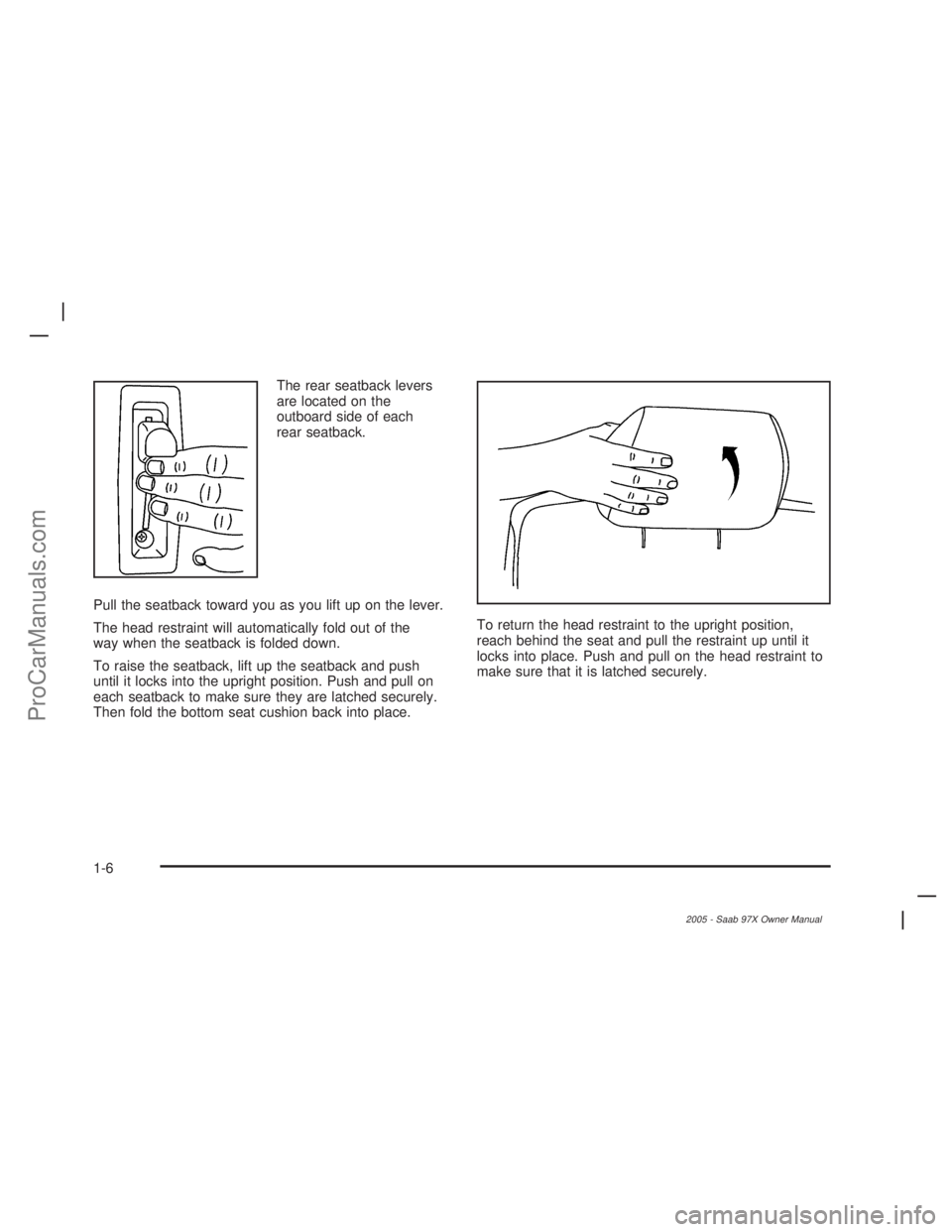
The rear seatback levers
are located on the
outboard side of each
rear seatback.
Pull the seatback toward you as you lift up on the lever.
The head restraint will automatically fold out of the
way when the seatback is folded down.
To raise the seatback, lift up the seatback and push
until it locks into the upright position. Push and pull on
each seatback to make sure they are latched securely.
Then fold the bottom seat cushion back into place.To return the head restraint to the upright position,
reach behind the seat and pull the restraint up until it
locks into place. Push and pull on the head restraint to
make sure that it is latched securely.
1-6
2005 - Saab 97X Owner Manual
ProCarManuals.com
Page 32 of 398
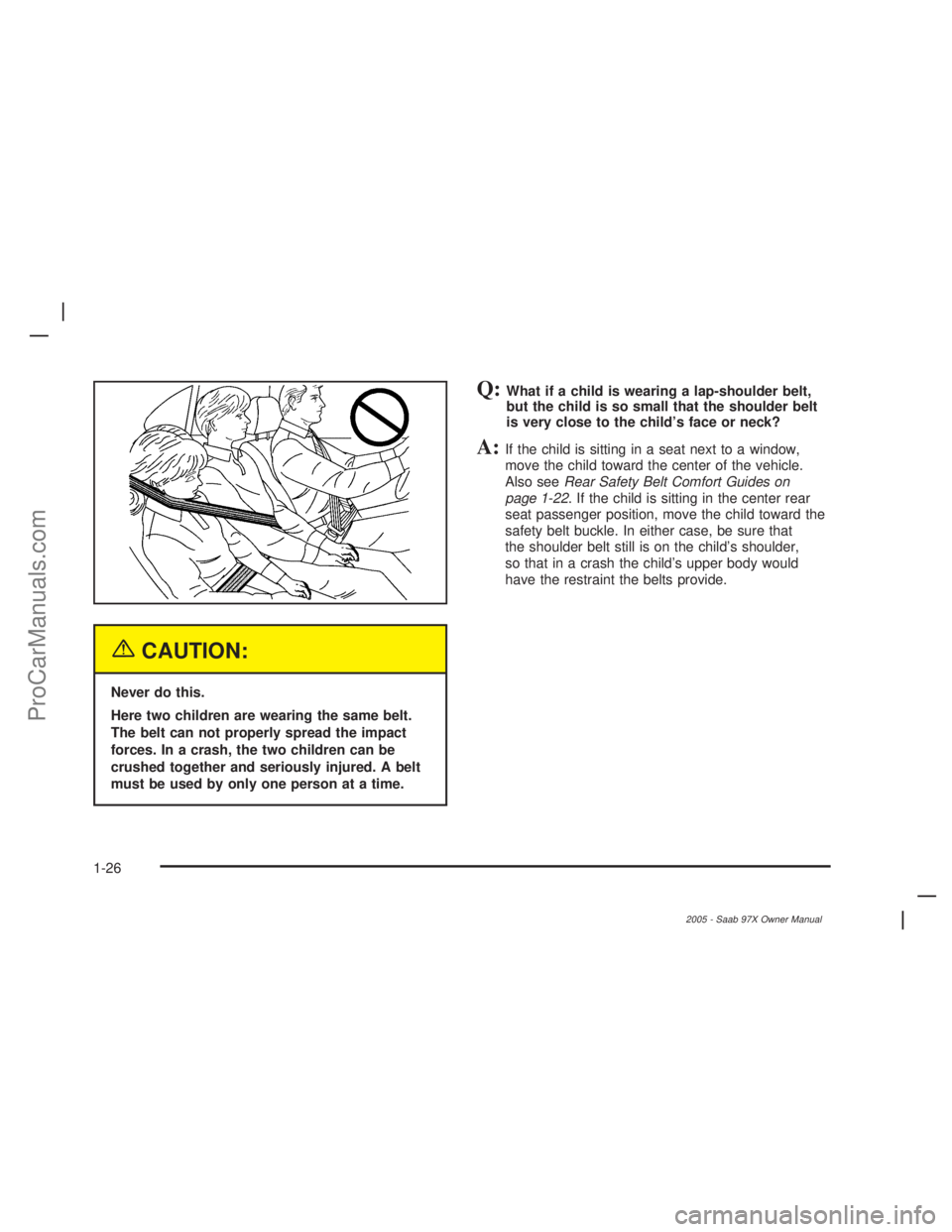
{CAUTION:
Never do this.
Here two children are wearing the same belt.
The belt can not properly spread the impact
forces. In a crash, the two children can be
crushed together and seriously injured. A belt
must be used by only one person at a time.
Q:What if a child is wearing a lap-shoulder belt,
but the child is so small that the shoulder belt
is very close to the child’s face or neck?
A:If the child is sitting in a seat next to a window,
move the child toward the center of the vehicle.
Also seeRear Safety Belt Comfort Guides on
page 1-22. If the child is sitting in the center rear
seat passenger position, move the child toward the
safety belt buckle. In either case, be sure that
the shoulder belt still is on the child’s shoulder,
so that in a crash the child’s upper body would
have the restraint the belts provide.
1-26
2005 - Saab 97X Owner Manual
ProCarManuals.com
Page 37 of 398
{CAUTION:
The body structure of a young child is quite
unlike that of an adult or older child, for whom
the safety belts are designed. A young child’s
hip bones are still so small that the vehicle’s
regular safety belt may not remain low on the
hip bones, as it should. Instead, it may settle
up around the child’s abdomen. In a crash, the
belt would apply force on a body area that is
unprotected by any bony structure. This alone
could cause serious or fatal injuries. Young
children always should be secured in
appropriate child restraints.
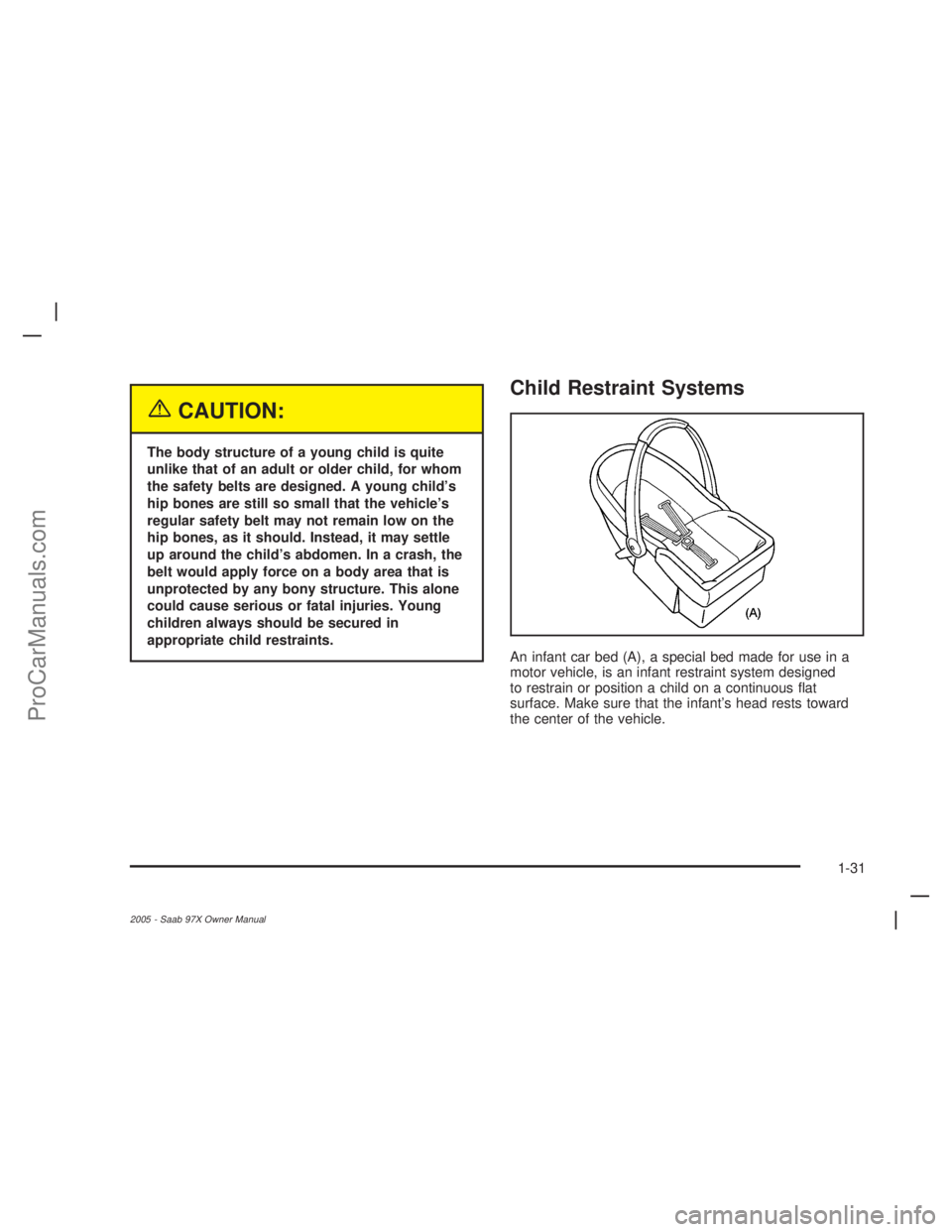
Child Restraint Systems
An infant car bed (A), a special bed made for use in a
motor vehicle, is an infant restraint system designed
to restrain or position a child on a continuous at
surface. Make sure that the infant’s head rests toward
the center of the vehicle.
1-31
2005 - Saab 97X Owner Manual
ProCarManuals.com
Page 58 of 398
How Does an Airbag Restrain?
In moderate to severe frontal or near frontal collisions,
even belted occupants can contact the steering wheel or
the instrument panel. In moderate to severe side
collisions, even belted occupants can contact the inside
of the vehicle. The airbag supplements the protection
provided by safety belts. Airbags distribute the force of
the impact more evenly over the occupant’s upper
body, stopping the occupant more gradually. But the
frontal airbags would not help you in many types
of collisions, including rollovers, rear impacts, and many
side impacts, primarily because an occupant’s motion
is not toward the airbag. Roof-mounted side impact
airbags would not help you in many types of collisions,
including many frontal or near frontal collisions, and
rear impacts, primarily because an occupant’s motion is
not toward those airbags. Airbags should never be
regarded as anything more than a supplement to safety
belts, and then only in moderate to severe frontal or
near-frontal collisions for the driver’s and right front
passenger’s frontal airbags, and only in moderate to
severe side collisions or rollovers for the roof-mounted
side impact airbags.
What Will You See After an Airbag
Inates?
After an airbag inates, it quickly deates, so quickly
that some people may not even realize the airbag
inated. Some components of the airbag module — the
steering wheel hub for the driver’s airbag, the
instrument panel for the right front passenger’s bag or
the ceiling of your vehicle near the side windows — will
be hot for a short time. The parts of the bag that
come into contact with you may be warm, but not too
hot to touch. There will be some smoke and dust coming
from the vents in the deated airbags. Airbag ination
does not prevent the driver from seeing or being able to
steer the vehicle, nor does it stop people from leaving
the vehicle.
1-52
2005 - Saab 97X Owner Manual
ProCarManuals.com
Page 63 of 398
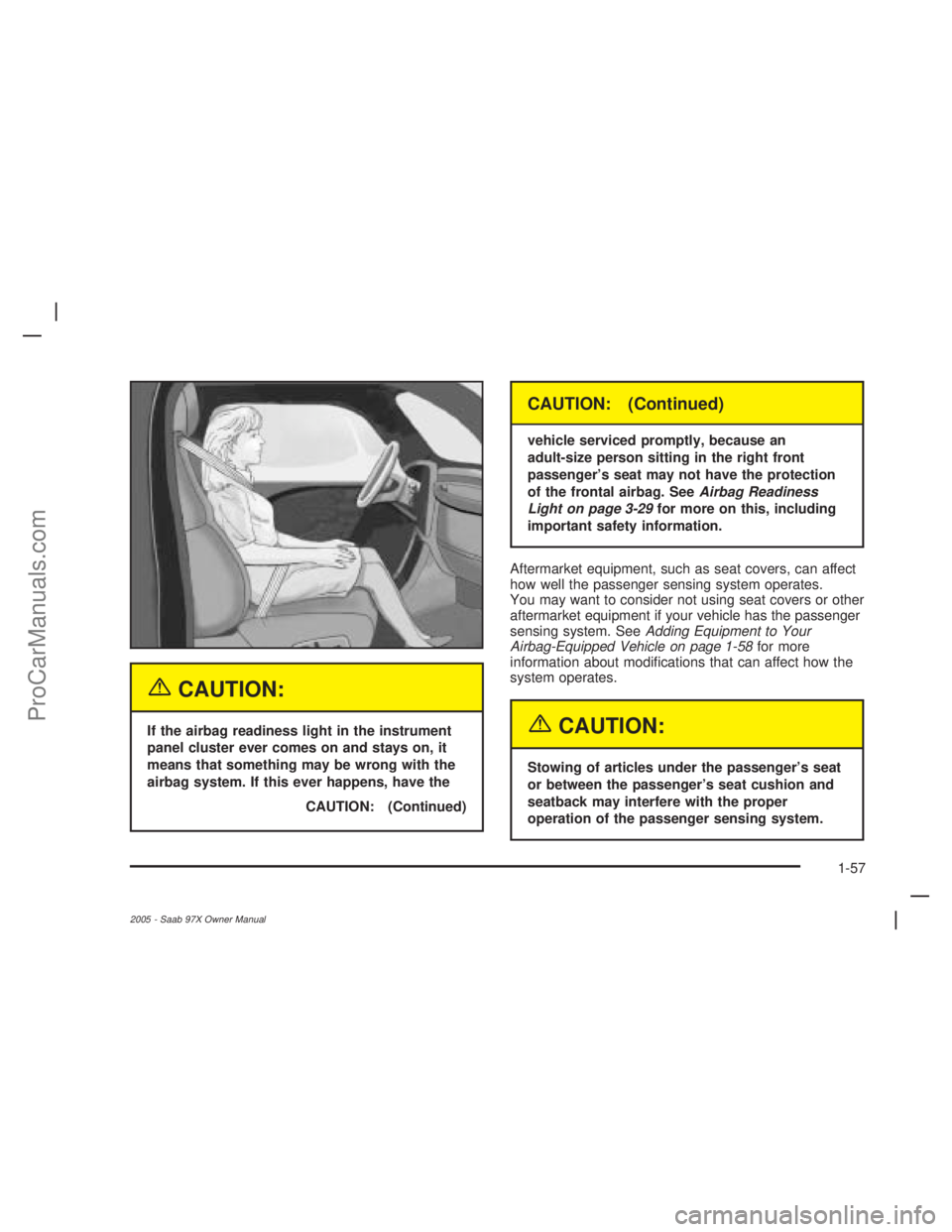
{CAUTION:
If the airbag readiness light in the instrument
panel cluster ever comes on and stays on, it
means that something may be wrong with the
airbag system. If this ever happens, have the
CAUTION: (Continued)
CAUTION: (Continued)
vehicle serviced promptly, because an
adult-size person sitting in the right front
passenger’s seat may not have the protection
of the frontal airbag. SeeAirbag Readiness
Light on page 3-29for more on this, including
important safety information.
Aftermarket equipment, such as seat covers, can affect
how well the passenger sensing system operates.
You may want to consider not using seat covers or other
aftermarket equipment if your vehicle has the passenger
sensing system. SeeAdding Equipment to Your
Airbag-Equipped Vehicle on page 1-58for more
information about modications that can affect how the
system operates.
{CAUTION:
Stowing of articles under the passenger’s seat
or between the passenger’s seat cushion and
seatback may interfere with the proper
operation of the passenger sensing system.
1-57
2005 - Saab 97X Owner Manual
ProCarManuals.com
Page 76 of 398
Programming Delayed Locking
To turn the delayed locking feature on or off, do the
following:
1. Press and hold the power door lock switch on the
driver’s door in the lock position.
2. Press the remote keyless entry transmitter unlock
button twice.
If the delayed locking feature was on, it will now be off.
If the feature was off, it will now be on.
Programmable Automatic
Door Locks
Your vehicle is equipped with an automatic lock/unlock
feature which enables you to program your vehicle’s
power door locks. You can program this feature through
the Driver Information Center (DIC), or by the following
method. SeeDIC Vehicle Customization on page 3-50.
Programmable Locking Feature
Following are the two locking modes that can be
programmed:
Mode 1:All doors lock when the transmission is shifted
out of PARK (P).
Mode 2:All doors lock when the vehicle speed is greater
than 8 mph (13 km/h).The automatic door locks were pre-programmed at the
factory to lock all the doors when the transmission
is shifted into gear. The following instructions detail how
to program your door locks differently than the factory
setting. Choose one of the two programming options
listed previously before entering the program mode.
To enter the program mode, do the following:
1. Begin with the ignition off. Then pull the turn
signal/multifunction lever toward you and hold
it there while you perform the next step.
2. Turn the key to RUN and LOCK twice. Then, with the
key in LOCK, release the turn signal/multifunction
lever. Once you do this, you will hear the lock switch
lock and unlock, the horn will chirp twice, and a
30-second program timer will begin.
3. You are now ready to program the automatic door
locks. Select one of the two programming options
listed previously, and press the lock side of
the power door lock switch to cycle through the
lock options. You will have 30 seconds to
begin programming. If you exceed the 30-second
limit, the locks will automatically lock and
unlock and the horn will chirp twice to indicate
that you have left the program mode. If this
occurs, repeat the procedure beginning with
Step 1 to re-enter the programming mode.
2-10
2005 - Saab 97X Owner Manual
ProCarManuals.com
Page 77 of 398
You can exit the program mode any time by turning the
ignition to RUN. The locks will automatically lock and
unlock and the horn will chirp twice to indicate that you
are leaving the program mode. If the lock/unlock switches
are not pressed while in the programming mode, the
current auto lock/unlock setting will not be modied.
See your dealer for more information.
Programmable Unlocking Feature
The following is the list of available programming options:
Mode 1:All doors unlock when the transmission is
shifted into PARK (P).
Mode 2:Driver’s door unlocks when the transmission is
shifted into PARK (P).
Mode 3:All doors unlock when the key is removed
from the ignition.
Mode 4:No automatic door unlock.
The automatic door locks were pre-programmed at the
factory to unlock all doors once the transmission is shifted
to PARK (P). The following instructions detail how to
program your door locks differently than the factory
setting. Choose one of the four programming options
listed previously before entering the program mode.To enter the program mode you need to do the following:
1. Begin with the ignition off. Then pull the turn
signal/multifunction lever toward you and hold
it there while you perform the next step.
2. Turn the key to RUN and LOCK twice. Then, with the
key in LOCK, release the turn signal/multifunction
lever. Once you do this, you will hear the lock switch
lock and unlock, the horn will chirp twice, and a
30-second program timer will begin.
3. You are now ready to program the automatic door
locks. Select one of the four programming options
listed above, and press the unlock side of the power
door lock switch to cycle through the unlocking
options. You will have 30 seconds to begin
programming. If you exceed the 30-second limit,
the locks will automatically lock and unlock and the
horn will chirp twice to indicate that you have left
the program mode. If this occurs, repeat the
procedure beginning with Step 1 to re-enter the
programming mode.
You can exit the program mode any time by turning the
ignition to RUN. The locks will automatically lock and
unlock and the horn will chirp twice to indicate that you
are leaving the program mode. If the lock/unlock switches
are not pressed while in the programming mode, the
current auto lock/unlock setting will not be modied.
See your dealer for more information.
2-11
2005 - Saab 97X Owner Manual
ProCarManuals.com
Page 85 of 398
To program the new key, do the following:
1. Verify that the new key has PK3 stamped on it.
2. Insert the current driver’s key in the ignition
and start the engine. If the engine will not start,
see your dealer for service.
3. After the engine has started, turn the key to OFF,
and remove the key.
4. Insert the key to be programmed and turn it to ON
within 10 seconds of removing the previous key.
5. The SECURITY light will turn off once the key has
been programmed. It may not be apparent that the
SECURITY light went on due to how quickly the
key is programmed.
6. Repeat Steps 1 through 4 if additional keys are to
be programmed.
If you are ever driving and the SECURITY light comes on
and stays on, you will be able to restart your engine if you
turn it off. Your PASS-Key
®III system, however, is not
working properly and must be serviced by your dealer.
Your vehicle is not protected by the PASS-Key
®III
system at this time.
If you lose or damage a PASS-Key
®III key, see your
dealer to have a new key made.
Starting and Operating Your
Vehicle
New Vehicle Break-In
Notice:Your vehicle does not need an elaborate
break-in. But it will perform better in the long run
if you follow these guidelines:
Keep your speed at 55 mph (88 km/h) or less for
the rst 500 miles (805 km).
Do not drive at any one speed, fast or slow,
for the rst 500 miles (805 km). Do not make
full-throttle starts.
Avoid making hard stops for the rst 200 miles
(322 km) or so. During this time your new brake
linings are not yet broken in. Hard stops with new
linings can mean premature wear and earlier
replacement. Follow this breaking-in guideline
every time you get new brake linings.
Do not tow a trailer during break-in. SeeTowing a
Trailer on page 4-35for more information.
2-19
2005 - Saab 97X Owner Manual
ProCarManuals.com
Page 90 of 398
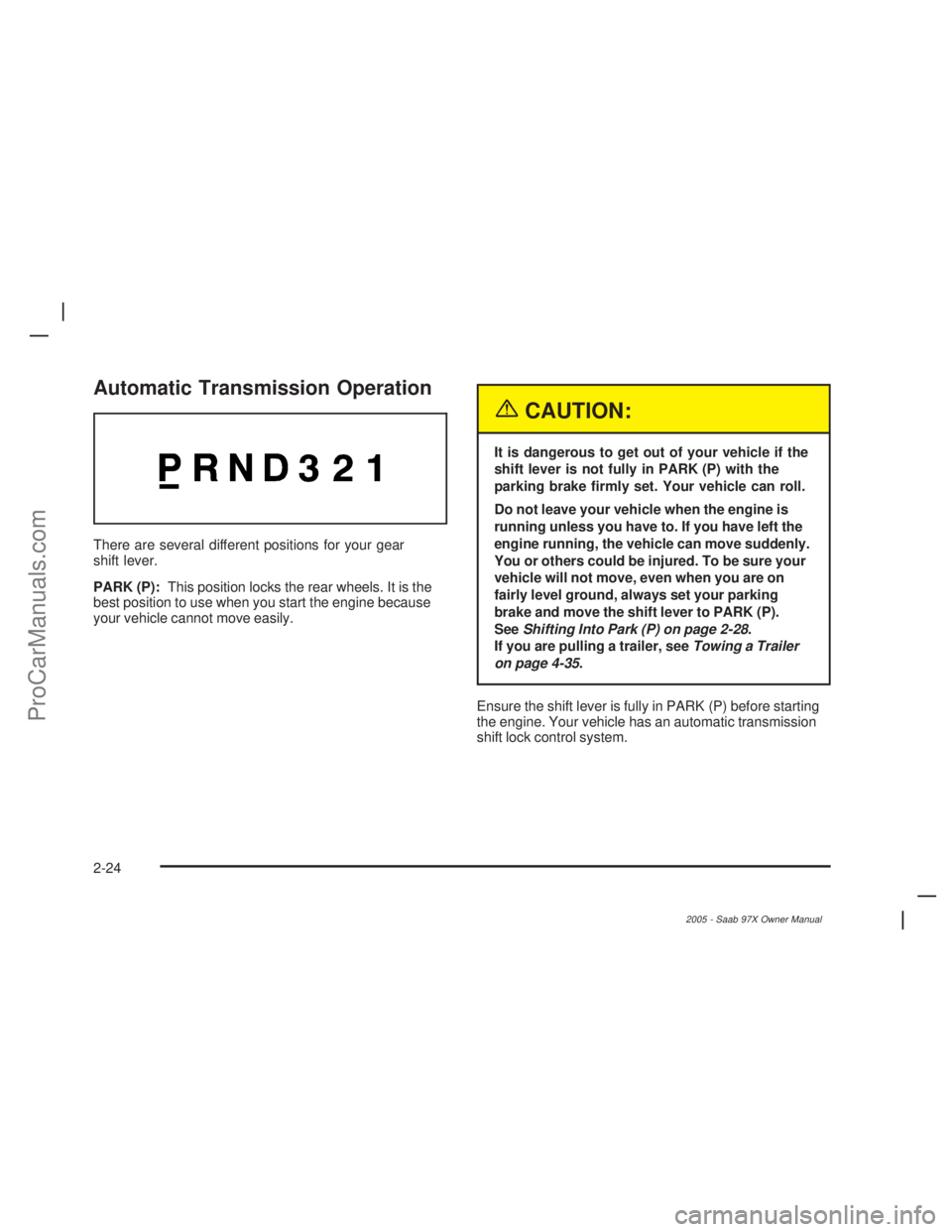
Automatic Transmission Operation
There are several different positions for your gear
shift lever.
PARK (P):This position locks the rear wheels. It is the
best position to use when you start the engine because
your vehicle cannot move easily.
{CAUTION:
It is dangerous to get out of your vehicle if the
shift lever is not fully in PARK (P) with the
parking brake rmly set. Your vehicle can roll.
Do not leave your vehicle when the engine is
running unless you have to. If you have left the
engine running, the vehicle can move suddenly.
You or others could be injured. To be sure your
vehicle will not move, even when you are on
fairly level ground, always set your parking
brake and move the shift lever to PARK (P).
SeeShifting Into Park (P) on page 2-28.
If you are pulling a trailer, seeTowing a Trailer
on page 4-35.
Ensure the shift lever is fully in PARK (P) before starting
the engine. Your vehicle has an automatic transmission
shift lock control system.
2-24
2005 - Saab 97X Owner Manual
ProCarManuals.com