seats SAAB 9-7X 2007 User Guide
[x] Cancel search | Manufacturer: SAAB, Model Year: 2007, Model line: 9-7X, Model: SAAB 9-7X 2007Pages: 498, PDF Size: 3.13 MB
Page 24 of 498
Driver Position
Lap-Shoulder Belt
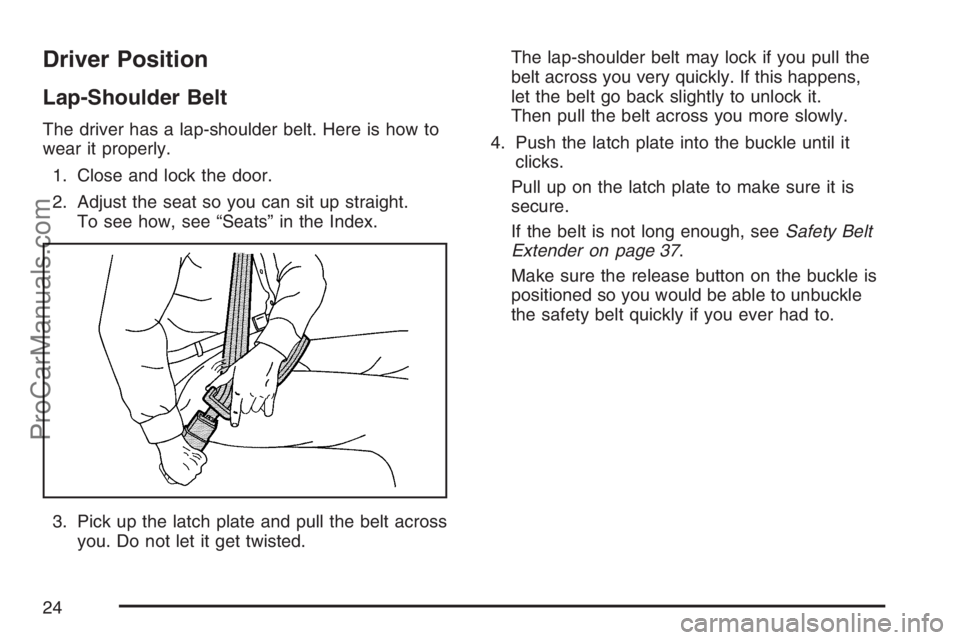
The driver has a lap-shoulder belt. Here is how to
wear it properly.
1. Close and lock the door.
2. Adjust the seat so you can sit up straight.
To see how, see “Seats” in the Index.
3. Pick up the latch plate and pull the belt across
you. Do not let it get twisted.The lap-shoulder belt may lock if you pull the
belt across you very quickly. If this happens,
let the belt go back slightly to unlock it.
Then pull the belt across you more slowly.
4. Push the latch plate into the buckle until it
clicks.
Pull up on the latch plate to make sure it is
secure.
If the belt is not long enough, seeSafety Belt
Extender on page 37.
Make sure the release button on the buckle is
positioned so you would be able to unbuckle
the safety belt quickly if you ever had to.
24
ProCarManuals.com
Page 35 of 498
Rear Safety Belt Comfort Guides
Rear shoulder belt comfort guides may provide
added safety belt comfort for older children
who have outgrown booster seats and for some
adults. When installed on a shoulder belt, the
comfort guide positions the belt away from
the neck and head.
There is one guide for each outside passenger
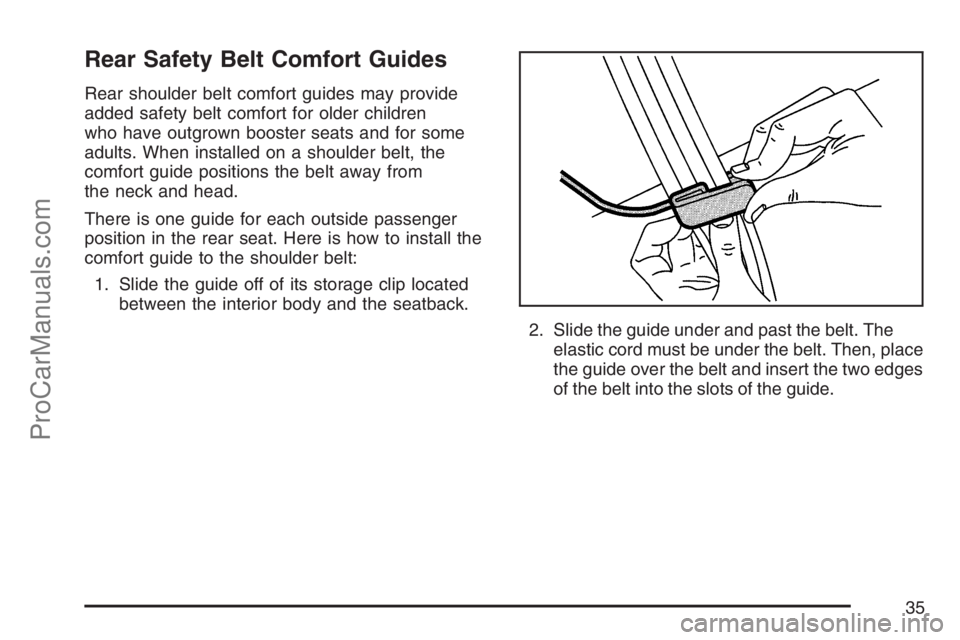
position in the rear seat. Here is how to install the
comfort guide to the shoulder belt:
1. Slide the guide off of its storage clip located
between the interior body and the seatback.
2. Slide the guide under and past the belt. The
elastic cord must be under the belt. Then, place
the guide over the belt and insert the two edges
of the belt into the slots of the guide.
35
ProCarManuals.com
Page 37 of 498
To remove and store the comfort guide, squeeze
the belt edges together so that you can take them
out of the guide. Slide the guide back onto its
storage clip located between the interior body
and the seatback.
Safety Belt Pretensioners
Your vehicle has safety belt pretensioners for the
driver and right front passenger. Although you
cannot see them, they are part of the safety belt
assembly. They help tighten the safety belts during
the early stages of a moderate to severe frontal,
near frontal or side crash or a rollover if the
threshold conditions for pretensioner activation
are met.
Pretensioners work only once. If they activate in a
crash, you will need to get new ones, and probably
other new parts for your safety belt system. See
Replacing Restraint System Parts After a Crash on
page 83.
Safety Belt Extender
If the vehicle’s safety belt will fasten around you,
you should use it.
But if a safety belt is not long enough, your dealer
will order you an extender. When you go in to order
it, take the heaviest coat you will wear, so the
extender will be long enough for you. To help avoid
personal injury, do not let someone else use it, and
use it only for the seat it is made to t. The extender
has been designed for adults. Never use it for
securing child seats. To wear it, just attach it to the
regular safety belt. For more information see the
instruction sheet that comes with the extender.
37
ProCarManuals.com
Page 38 of 498
Child Restraints
Older Children
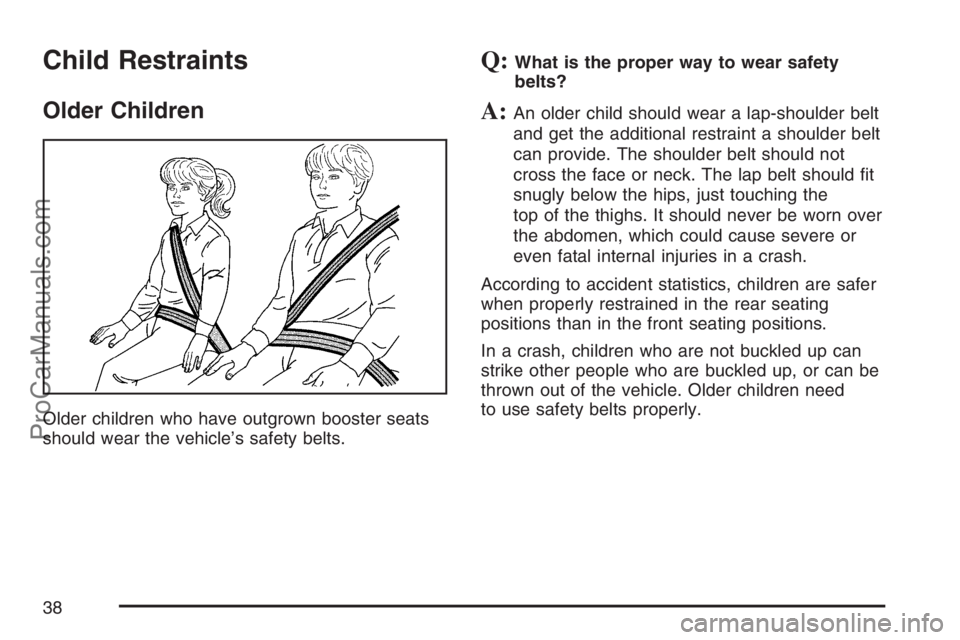
Older children who have outgrown booster seats
should wear the vehicle’s safety belts.
Q:What is the proper way to wear safety
belts?
A:An older child should wear a lap-shoulder belt
and get the additional restraint a shoulder belt
can provide. The shoulder belt should not
cross the face or neck. The lap belt should t
snugly below the hips, just touching the
top of the thighs. It should never be worn over
the abdomen, which could cause severe or
even fatal internal injuries in a crash.
According to accident statistics, children are safer
when properly restrained in the rear seating
positions than in the front seating positions.
In a crash, children who are not buckled up can
strike other people who are buckled up, or can be
thrown out of the vehicle. Older children need
to use safety belts properly.
38
ProCarManuals.com
Page 45 of 498
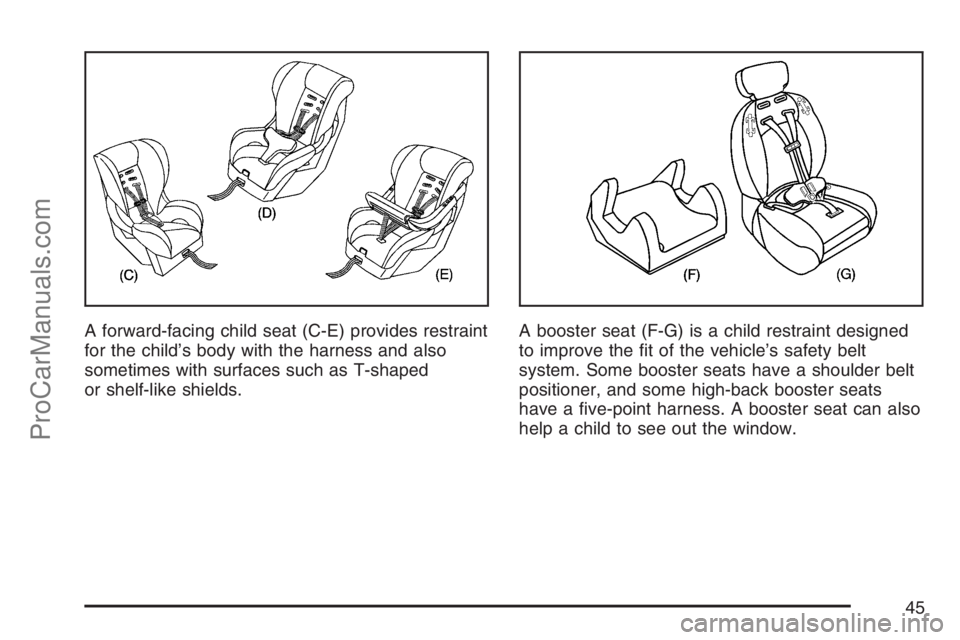
A forward-facing child seat (C-E) provides restraint
for the child’s body with the harness and also
sometimes with surfaces such as T-shaped
or shelf-like shields.A booster seat (F-G) is a child restraint designed
to improve the t of the vehicle’s safety belt
system. Some booster seats have a shoulder belt
positioner, and some high-back booster seats
have a ve-point harness. A booster seat can also
help a child to see out the window.
45
ProCarManuals.com
Page 46 of 498
Q:How Should I Use a Child Restraint?
A:A child restraint system is any device designed
for use in a motor vehicle to restrain, seat,
or position children. A built-in child restraint
system is a permanent part of the motor
vehicle. An add-on child restraint system
is a portable one, which is purchased by the
vehicle’s owner. To help reduce injuries, an
add-on child restraint must be secured in the
vehicle. With built-in or add-on child restraints,
the child has to be secured within the child
restraint.
When choosing an add-on child restraint, be
sure the child restraint is designed to be used in
a vehicle. If it is, it will have a label saying that it
meets federal motor vehicle safety standards.
Then follow the instructions for the restraint.
You may nd these instructions on the restraint
itself or in a booklet, or both.
Securing an Add-on Child Restraint in
the Vehicle
{CAUTION:
A child can be seriously injured or killed in
a crash if the child restraint is not properly
secured in the vehicle. Make sure the child
restraint is properly installed in the vehicle
using the vehicle’s safety belt or LATCH
system, following the instructions that
came with that restraint, and also the
instructions in this manual.
To help reduce the chance of injury, the child
restraint must be secured in the vehicle. Child
restraint systems must be secured in vehicle seats
by lap belts or the lap belt portion of a lap-shoulder
belt, or by the LATCH system. SeeLower Anchors
and Tethers for Children (LATCH) on page 50for
more information. A child can be endangered in a
crash if the child restraint is not properly secured in
the vehicle.
46
ProCarManuals.com
Page 61 of 498
CAUTION: (Continued)
If you need to secure a forward-facing
child restraint in the right front seat,
always move the front passenger seat as
far back as it will go. It is better to secure
the child restraint in a rear seat.
If you need to secure a forward-facing child restraint
in the right front seat position, move the seat as far
back as it will go before securing the forward-facing
child restraint. SeePower Seats on page 9.
If your child restraint has the LATCH system, see
Lower Anchors and Tethers for Children (LATCH)
on page 50.
There is no top tether anchor at the right front
seating position. Do not secure a child seat in this
position if a national or local law requires that
the top tether be anchored or if the instructions
that come with the child restraint say that the top
tether must be anchored. SeeLower Anchors
and Tethers for Children (LATCH) on page 50if
the child restraint has a top tether.You will be using the lap-shoulder belt to secure
the child restraint in this position. Be sure to follow
the instructions that came with the child restraint.
Secure the child in the child restraint when and as
the instructions say.
1. Your vehicle has a right front passenger’s
frontal airbag. SeePassenger Sensing System
on page 74. We recommend that rear-facing
child restraints be secured in a rear seat, even
if the airbag is off. If your child restraint is
forward-facing, move the seat as far back as it
will go before securing the child restraint in this
seat. SeePower Seats on page 9.
When the passenger sensing system has
turned off the right front passenger’s frontal
airbag, the off indicator in the passenger airbag
status indicator should light and stay lit when
you turn the ignition to RUN or START. See
Passenger Airbag Status Indicator on
page 179.
2. Put the child restraint on the seat.
3. Pick up the latch plate, and run the lap and
shoulder portions of the vehicle’s safety belt
through or around the restraint. The child
restraint instructions will show you how.
61
ProCarManuals.com
Page 82 of 498
Q:Because I have a disability, I have to get
my vehicle modied. How can I nd out
whether this will affect my airbag system?
A:Changing or moving any parts of the
front seats, safety belts, the airbag sensing
and diagnostic module, steering wheel,
instrument panel, the inside review mirror,
ceiling headliner, ceiling and pillar garnish trim,
roof-mounted airbag modules, or airbag
wiring can affect the operation of the airbag
system. If you have questions, call Customer
Assistance. The phone numbers and
addresses for Customer Assistance are in
Step Two of the Customer Satisfaction
Procedure in this manual. SeeCustomer
Satisfaction Procedure on page 466.
Restraint System Check
Checking the Restraint Systems
Now and then, make sure the safety belt reminder
light and all your belts, buckles, latch plates,
retractors and anchorages are working properly.
Look for any other loose or damaged safety belt
system parts. If you see anything that might keep
a safety belt system from doing its job, have it
repaired. Keep safety belts clean and dry. SeeCare
of Safety Belts on page 427for more information.
Torn or frayed safety belts may not protect you in a
crash. They can rip apart under impact forces. If
a belt is torn or frayed, get a new one right away.
Also look for any opened or broken airbag
covers, and have them repaired or replaced. The
airbag system does not need regular maintenance.
82
ProCarManuals.com
Page 116 of 498
Parking Brake
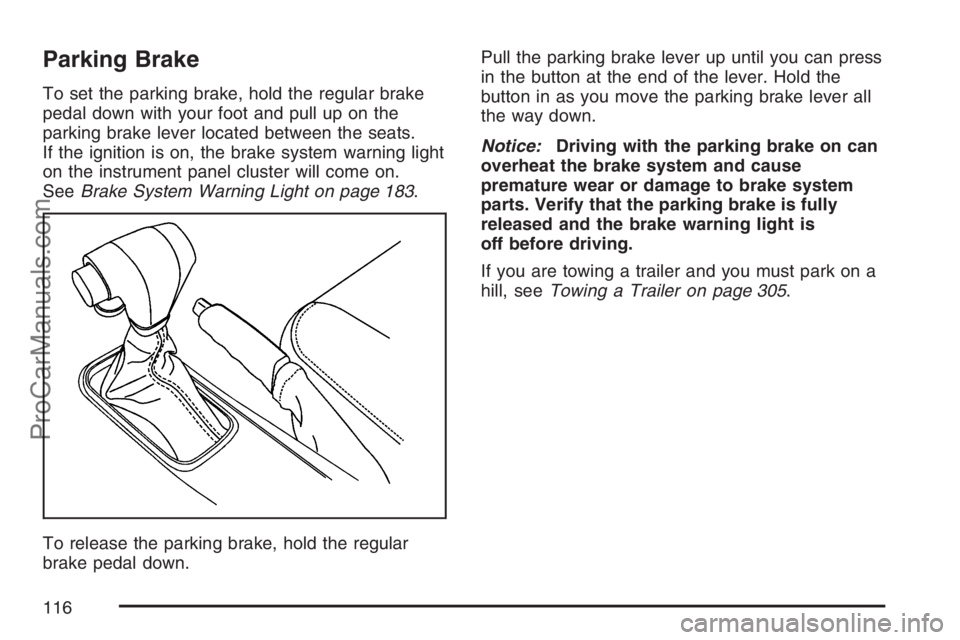
To set the parking brake, hold the regular brake
pedal down with your foot and pull up on the
parking brake lever located between the seats.
If the ignition is on, the brake system warning light
on the instrument panel cluster will come on.
SeeBrake System Warning Light on page 183.
To release the parking brake, hold the regular
brake pedal down.Pull the parking brake lever up until you can press
in the button at the end of the lever. Hold the
button in as you move the parking brake lever all
the way down.
Notice:Driving with the parking brake on can
overheat the brake system and cause
premature wear or damage to brake system
parts. Verify that the parking brake is fully
released and the brake warning light is
off before driving.
If you are towing a trailer and you must park on a
hill, seeTowing a Trailer on page 305.
116
ProCarManuals.com
Page 165 of 498
A high electrical load occurs when several of the
following loads are on: headlamps, high beams,
fog lamps, rear window defogger, climate
control fan at high speed, heated seats, engine
cooling fans, trailer loads, and loads plugged into
accessory power outlets.
EPM works to prevent excessive discharge of the
battery. It does this by balancing the generator’s
output and the vehicle’s electrical needs. It
can increase engine idle speed to generate more
power, whenever needed. It can temporarily
reduce the power demands of some accessories.
Normally, these actions occur in steps or levels,
without being noticeable. In rare cases at the
highest levels of corrective action, this action may
be noticeable to the driver. If so, a Driver
Information Center (DIC) message might be
displayed, such as Battery Saver Active or Service
Battery Charging System. If this message is
displayed, it is recommended that the driver
reduce the electrical loads as much as possible.
SeeDIC Warnings and Messages on page 199.Battery Run-Down Protection
This feature shuts off the dome, courtesy, and
vanity lamps if they are left on for more than
20 minutes when the ignition is off. This will keep
the battery from running down.
If the battery run-down protection shuts off the
interior lamps, it may be necessary to do one of
the following to return to normal operation:
Shut off all lamps and close all doors.
Turn the ignition key to RUN.
This feature will also turn off the parking lamps
and headlamps under most circumstances, if they
are left on. If you would like to turn them back
on, turn the exterior lamps knob.
165
ProCarManuals.com