brake SAAB 9-7X 2007 Owner's Manual
[x] Cancel search | Manufacturer: SAAB, Model Year: 2007, Model line: 9-7X, Model: SAAB 9-7X 2007Pages: 498, PDF Size: 3.13 MB
Page 204 of 498

SERVICE TIRE MONITOR
This message displays if a part on the Tire
Pressure Monitor (TPM) system is not working
properly. If you drive your vehicle while any of the
four sensors are missing or inoperable, the
warning comes on in about 20 minutes. A sensor
would be missing, for example, if you put
different wheels on your vehicle without
transferring the sensors. If the warning comes on
and stays on, there may be a problem with the
TPM. See your dealer.
STABILITRAK ACTIVE
This message displays anytime the StabiliTrak®
system activates to maintain vehicle stability.
Any combination of engine speed management,
brake traction control, and stability control displays
this message.
STABILITRAK NOT READY
This message may display if driving conditions
delay StabiliTrak®system initialization. This
is normal. Once the system initializes, this
message will no longer be displayed on the DIC.
STABILITRAK OFF
This message displays when you press the
StabiliTrak®button for more than ve seconds or
when stability control has been automatically
disabled. The StabiliTrak
®button is located on the
transmission shift handle. To limit wheel spin
and realize the full benets of the stability
enhancement system, you should normally leave
StabiliTrak
®on. However, you should turn
StabiliTrak®off if your vehicle gets stuck in sand,
mud, ice, or snow and you want to rock your
vehicle to attempt to free it, or if you are driving in
extreme off-road conditions and require more
wheel spin. SeeIf Your Vehicle is Stuck in Sand,
Mud, Ice, or Snow on page 295. To turn the
StabiliTrak
®system back on, press the
StabiliTrak®button again.
The message may display if the brake system
warning light is on. SeeBrake System Warning
Light on page 183.
The message turns off as soon as the conditions
that caused the message to be displayed are
no longer present.
204
ProCarManuals.com
Page 205 of 498
TIGHTEN FUEL CAP
This message may display and a chime may sound
if the vehicle’s fuel cap is not tightened properly.
Fully reinstall the fuel cap. SeeFilling the Tank on
page 326. The diagnostic system can determine if
the fuel cap has been left off or improperly installed.
A loose or missing fuel cap allows fuel to evaporate
into the atmosphere. This message remains on until
it is acknowledged and cleared from the DIC display
by pressing any of the DIC buttons or the trip stem.
The DIC message is also cancelled if the ignition is
turned off.
The DIC message and the Service Engine Soon
light may come on again during a second trip if
the fuel cap is still not tightened properly. See
Malfunction Indicator Lamp on page 187for
more information.
TRACTION CONTROL OFF
This message displays when you momentarily
press the StabiliTrak®button located on the
transmission shift handle. In this mode, stability
control and the brake-traction control are
functional. Engine speed management will be
modied and the driven wheels can spin more
freely. For more details on this mode, see
StabiliTrak
®System on page 271.
TURN SIGNAL ON
This message displays and a chime sounds if a
turn signal is left on for 3/4 of a mile (1.2 km).
Move the turn signal/multifunction lever to the off
position. Press any of the DIC buttons, or the
trip stem, to acknowledge this message and clear
it from the DIC display.
DIC Vehicle Customization
Your vehicle may have customization capabilities
that allow you to program some features to
one setting based on your preference. All of the
customizable options listed may not be available
on your vehicle. Only the options available display
on the Driver Information Center (DIC).
The default settings for the customization features
were set when your vehicle left the factory, but
may have been changed from their default
state since then.
To change feature preferences, make sure the
ignition is on and the vehicle is in PARK (P).
To avoid excessive drain on the battery, it is
recommended that the headlamps are turned off.
205
ProCarManuals.com
Page 263 of 498
Your Driving, the Road, and Your Vehicle.... 264
Defensive Driving...................................... 264
Drunken Driving........................................ 265
Control of a Vehicle.................................. 268
Braking...................................................... 268
Anti-Lock Brake System (ABS).................. 269
Braking in Emergencies............................. 271
Limited-Slip Rear Axle............................... 271
StabiliTrak
®System................................... 271
All-Wheel Drive (AWD) System.................. 275
Steering.................................................... 276
Off-Road Recovery.................................... 278
Passing..................................................... 278
Loss of Control.......................................... 280
Off-Road Driving........................................ 281
Driving at Night......................................... 281
Driving in Rain and on Wet Roads............ 282City Driving............................................... 285
Freeway Driving........................................ 286
Before Leaving on a Long Trip.................. 287
Highway Hypnosis..................................... 288
Hill and Mountain Roads........................... 288
Winter Driving........................................... 291
If Your Vehicle is Stuck in Sand,
Mud, Ice, or Snow ................................. 295
Rocking Your Vehicle to Get It Out........... 296
Loading Your Vehicle................................ 296
Towing........................................................ 302
Towing Your Vehicle ................................. 302
Recreational Vehicle Towing...................... 302
Electronically Controlled Air
Suspension System................................ 303
Towing a Trailer........................................ 305
Section 4 Driving Your Vehicle
263
ProCarManuals.com
Page 268 of 498
Control of a Vehicle
You have three systems that make your
vehicle go where you want it to go. They are the
brakes, the steering, and the accelerator. All
three systems have to do their work at the places
where the tires meet the road.
Sometimes, as when you are driving on snow or
ice, it is easy to ask more of those control systems
than the tires and road can provide. That means
you can lose control of your vehicle.
Adding non-Saab accessories can affect your
vehicle’s performance. SeeAccessories and
Modications on page 322.
Braking
SeeBrake System Warning Light on page 183.
Braking action involves perception time and
reaction time.
First, you have to decide to push on the brake
pedal. That is perception time. Then you have to
bring up your foot and do it. That is reaction time.
Average reaction time is about three-fourths of a
second. But that is only an average. It might be less
with one driver and as long as two or three seconds
or more with another. Age, physical condition,
alertness, coordination, and eyesight all play a part.
So do alcohol, drugs, and frustration. But even in
three-fourths of a second, a vehicle moving at
60 mph (100 km/h) travels 66 feet (20 m). That
could be a lot of distance in an emergency, so
keeping enough space between your vehicle and
others is important.
And, of course, actual stopping distances vary
greatly with the surface of the road, whether it is
pavement or gravel; the condition of the road,
whether it is wet, dry, or icy; tire tread; the
condition of the brakes; the weight of the vehicle;
and the amount of brake force applied.
268
ProCarManuals.com
Page 269 of 498
Avoid needless heavy braking. Some people drive
in spurts — heavy acceleration followed by
heavy braking — rather than keeping pace with
traffic. This is a mistake. The brakes may not have
time to cool between hard stops. The brakes
will wear out much faster if you do a lot of heavy
braking. If you keep pace with the traffic and
allow realistic following distances, you will
eliminate a lot of unnecessary braking. That means
better braking and longer brake life.
If your vehicle’s engine ever stops while you are
driving, brake normally but do not pump the
brakes. If you do, the pedal may get harder to
push down. If the engine stops, you will still have
some power brake assist. But you will use it
when you brake. Once the power assist is used
up, it may take longer to stop and the brake pedal
will be harder to push.
Adding non-Saab accessories can affect your
vehicle’s performance. SeeAccessories and
Modications on page 322.Anti-Lock Brake System (ABS)
Your vehicle has the Anti-Lock Brake System
(ABS), an advanced electronic braking system
that will help prevent a braking skid.
When you start your engine and begin to drive
away, ABS will check itself. You may hear a
momentary motor or clicking noise while this test
is going on. This is normal.
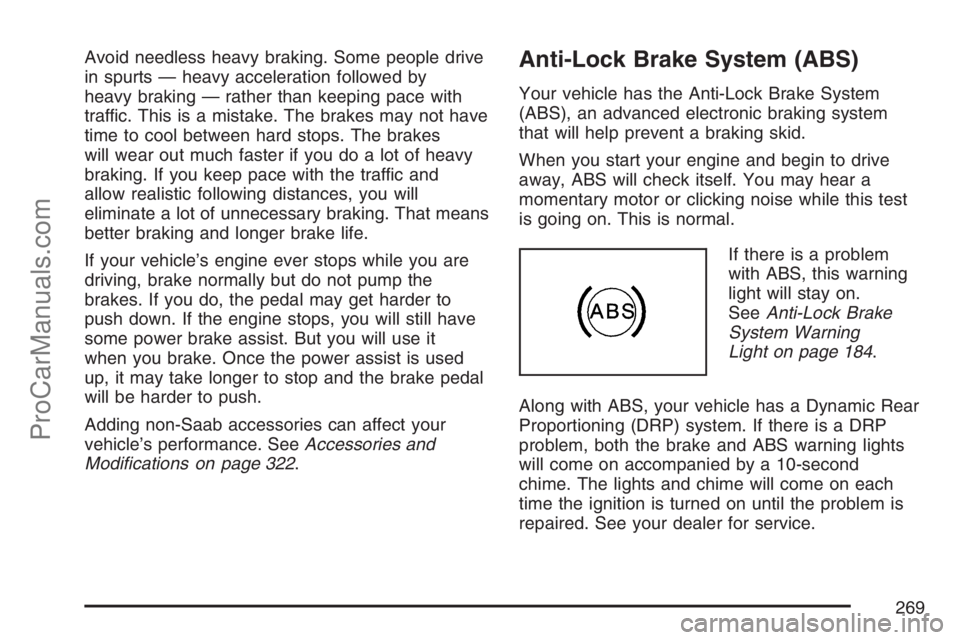
If there is a problem
with ABS, this warning
light will stay on.
SeeAnti-Lock Brake
System Warning
Light on page 184.
Along with ABS, your vehicle has a Dynamic Rear
Proportioning (DRP) system. If there is a DRP
problem, both the brake and ABS warning lights
will come on accompanied by a 10-second
chime. The lights and chime will come on each
time the ignition is turned on until the problem is
repaired. See your dealer for service.
269
ProCarManuals.com
Page 270 of 498
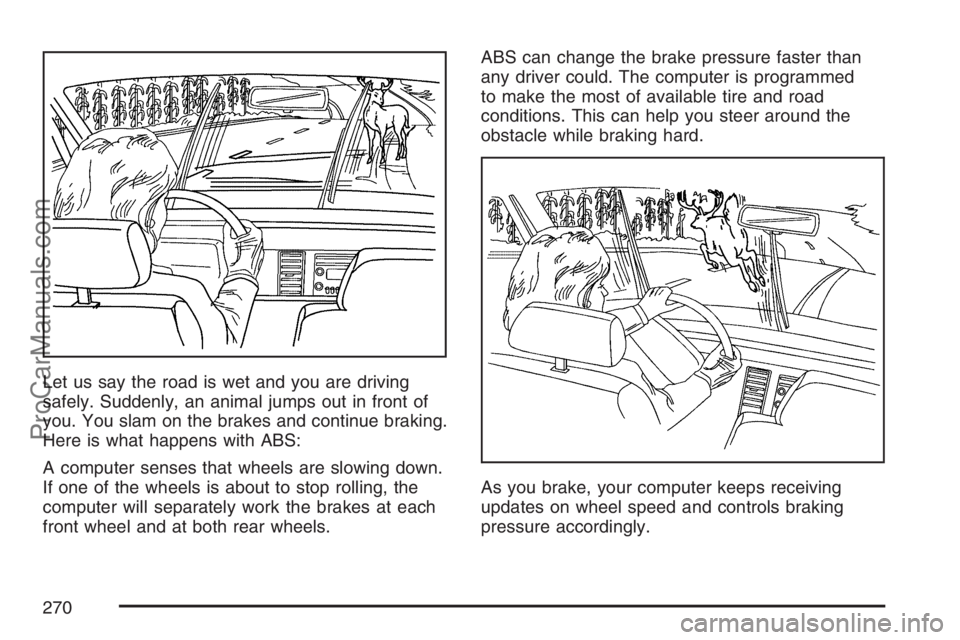
Let us say the road is wet and you are driving
safely. Suddenly, an animal jumps out in front of
you. You slam on the brakes and continue braking.
Here is what happens with ABS:
A computer senses that wheels are slowing down.
If one of the wheels is about to stop rolling, the
computer will separately work the brakes at each
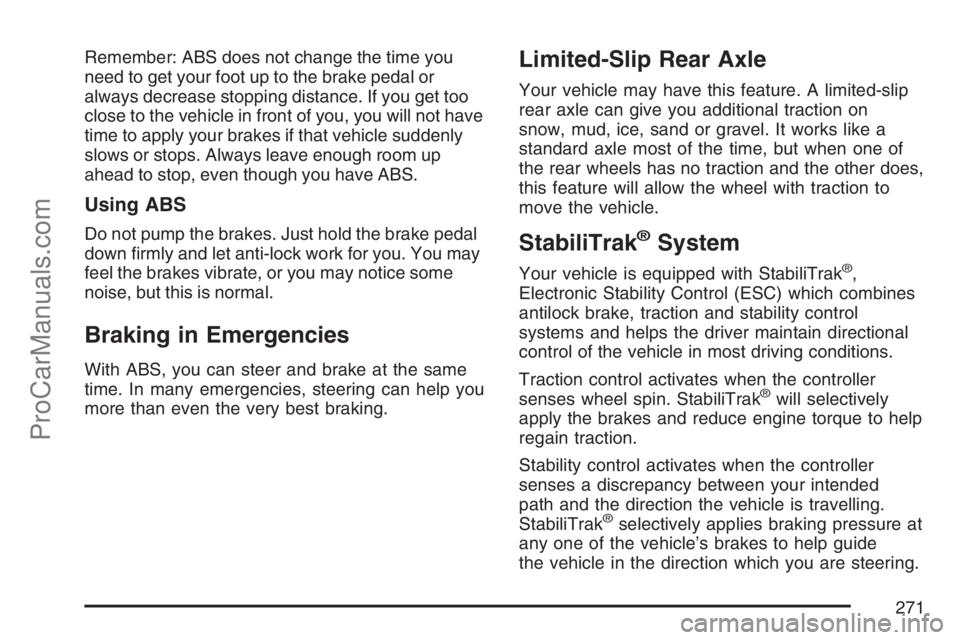
front wheel and at both rear wheels.ABS can change the brake pressure faster than
any driver could. The computer is programmed
to make the most of available tire and road
conditions. This can help you steer around the
obstacle while braking hard.
As you brake, your computer keeps receiving
updates on wheel speed and controls braking
pressure accordingly.
270
ProCarManuals.com
Page 271 of 498
Remember: ABS does not change the time you
need to get your foot up to the brake pedal or
always decrease stopping distance. If you get too
close to the vehicle in front of you, you will not have
time to apply your brakes if that vehicle suddenly
slows or stops. Always leave enough room up
ahead to stop, even though you have ABS.
Using ABS
Do not pump the brakes. Just hold the brake pedal
down rmly and let anti-lock work for you. You may
feel the brakes vibrate, or you may notice some
noise, but this is normal.
Braking in Emergencies
With ABS, you can steer and brake at the same
time. In many emergencies, steering can help you
more than even the very best braking.
Limited-Slip Rear Axle
Your vehicle may have this feature. A limited-slip
rear axle can give you additional traction on
snow, mud, ice, sand or gravel. It works like a
standard axle most of the time, but when one of
the rear wheels has no traction and the other does,
this feature will allow the wheel with traction to
move the vehicle.
StabiliTrak®System
Your vehicle is equipped with StabiliTrak®,
Electronic Stability Control (ESC) which combines
antilock brake, traction and stability control
systems and helps the driver maintain directional
control of the vehicle in most driving conditions.
Traction control activates when the controller
senses wheel spin. StabiliTrak
®will selectively
apply the brakes and reduce engine torque to help
regain traction.
Stability control activates when the controller
senses a discrepancy between your intended
path and the direction the vehicle is travelling.
StabiliTrak
®selectively applies braking pressure at
any one of the vehicle’s brakes to help guide
the vehicle in the direction which you are steering.
271
ProCarManuals.com
Page 273 of 498
STABILITRAK OFF — The driver can turn off
StabiliTrak®by pressing the StabiliTrak®button for
more than ve seconds. The StabiliTrak®light
will come on and STABILITRAK OFF will be
displayed. For vehicles without a DIC, the
StabiliTrak
®indicator light will come on.
Momentarily pressing the StabiliTrak®button again
will return the system to the STABILITRAK ON
mode. See StabiliTrak
®Off below for more
information.
Traction Control Off
In this mode, stability control and brake-traction
control are functional. Engine speed management
will be modied and the driven wheels can spin
more freely. This can cause the brake-traction
control to activate more frequently. If the controller
detects excessive wheel spin in this mode, the
StabiliTrak
®indicator light may blink and the
STABILITRAK ACTIVE message may be displayed
to warn the driver that damage may occur to the
transfer case.
StabiliTrak®Off
In this mode, both stability control and part of the
traction control system are disabled. Your vehicle
will still have brake-traction control, but will not
be able to use the engine speed management
system. You may still hear system noises
as a result of the brake-traction control coming on.
If the controller detects excessive wheel spin in
this mode, the StabiliTrak
®indicator light may blink
and the STABILITRAK ACTIVE message may
be displayed to warn the driver that damage may
occur to the transfer case.
It is recommended to leave the system on for
normal driving conditions, but it may be necessary
to turn the system off if your vehicle is stuck in
sand, mud, ice or snow, and you may want
to “rock” your vehicle in an attempt to free it. It may
also be necessary to turn off the system when
driving in extreme off-road conditions where high
wheel spin is required. SeeIf Your Vehicle is
Stuck in Sand, Mud, Ice, or Snow on page 295for
more information.
273
ProCarManuals.com
Page 274 of 498
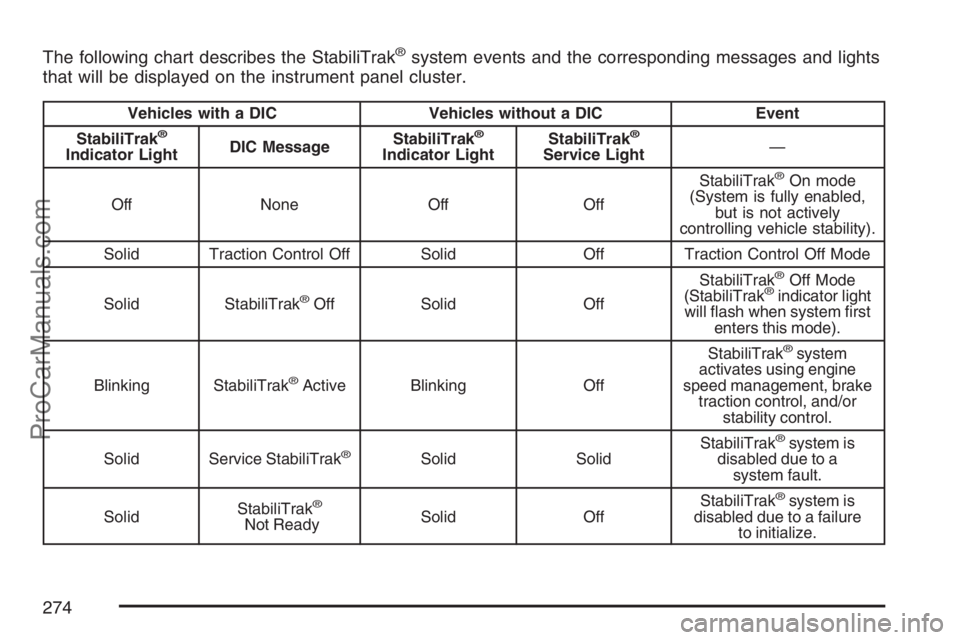
The following chart describes the StabiliTrak®system events and the corresponding messages and lights
that will be displayed on the instrument panel cluster.
Vehicles with a DIC Vehicles without a DIC Event
StabiliTrak
®
Indicator LightDIC MessageStabiliTrak
®
Indicator LightStabiliTrak
®
Service Light—
Off None Off OffStabiliTrak
®On mode
(System is fully enabled,
but is not actively
controlling vehicle stability).
Solid Traction Control Off Solid Off Traction Control Off Mode
Solid StabiliTrak
®Off Solid OffStabiliTrak
®Off Mode
(StabiliTrak®indicator light
will ash when system rst
enters this mode).
Blinking StabiliTrak
®Active Blinking OffStabiliTrak
®system
activates using engine
speed management, brake
traction control, and/or
stability control.
Solid Service StabiliTrak
®Solid SolidStabiliTrak
®system is
disabled due to a
system fault.
SolidStabiliTrak
®
Not ReadySolid OffStabiliTrak
®system is
disabled due to a failure
to initialize.
274
ProCarManuals.com
Page 275 of 498
Notice:If the StabiliTrak®light comes on due
to heavy braking and/or because the traction
control system has been continuously active,
do not allow the wheel(s) of one axle to spin
excessively. If you do, you may be causing
damage to the transfer case. This could lead to
costly repairs not covered by your warranty.
Notice:If you allow the wheel(s) of one axle to
spin excessively while the StabiliTrak
®, ABS
and brake warning lights and the SERVICE
STABILITRAK message are displayed, you
could damage the transfer case. The repairs
would not be covered by your warranty. Reduce
engine power and do not spin the wheel(s)
excessively while these lights and this message
are displayed.
StabiliTrak
®may activate on dry or rough roads or
under conditions such as heavy acceleration
while turning or abrupt upshifts/downshifts of the
transmission. When this happens, you may
notice a reduction in acceleration, or may hear a
noise or vibration. This is normal.
If your vehicle is in cruise control when the system
activates, the StabiliTrak
®light will blink, and
the cruise control will automatically disengage.When road conditions allow, you may re-engage
the cruise control. SeeCruise Control on page 156.
StabiliTrak
®will turn off automatically if a problem
is detected in the system. The StabiliTrak®
light will come on and SERVICE STABILITRAK
will be displayed on the DIC. For vehicles without a
DIC, the StabiliTrak
®light and the StabiliTrak®
service light will both come on. If the SERVICE
STABILITRAK message (or StabiliTrak®service
light) does not clear itself after restarting the
vehicle, you should see your dealer for service.
Adding non-GM accessories can affect your
vehicle’s performance. SeeAccessories and
Modications on page 322for more information.
All-Wheel Drive (AWD) System
Your vehicle has this feature. There is no lever or
switch to engage or disengage the front axle. It
is fully automatic and adjusts as needed for
road conditions. Your vehicle has an active
transfer case allowing two-wheel-drive operation
on dry roads. The transfer case will shift
automatically into all-wheel drive on slippery
surfaces. You may feel an extra shift when the
all-wheel drive engages.
275
ProCarManuals.com