wheel SAAB 9-7X 2007 Owner's Manual
[x] Cancel search | Manufacturer: SAAB, Model Year: 2007, Model line: 9-7X, Model: SAAB 9-7X 2007Pages: 498, PDF Size: 3.13 MB
Page 204 of 498

SERVICE TIRE MONITOR
This message displays if a part on the Tire
Pressure Monitor (TPM) system is not working
properly. If you drive your vehicle while any of the
four sensors are missing or inoperable, the
warning comes on in about 20 minutes. A sensor
would be missing, for example, if you put
different wheels on your vehicle without
transferring the sensors. If the warning comes on
and stays on, there may be a problem with the
TPM. See your dealer.
STABILITRAK ACTIVE
This message displays anytime the StabiliTrak®
system activates to maintain vehicle stability.
Any combination of engine speed management,
brake traction control, and stability control displays
this message.
STABILITRAK NOT READY
This message may display if driving conditions
delay StabiliTrak®system initialization. This
is normal. Once the system initializes, this
message will no longer be displayed on the DIC.
STABILITRAK OFF
This message displays when you press the
StabiliTrak®button for more than ve seconds or
when stability control has been automatically
disabled. The StabiliTrak
®button is located on the
transmission shift handle. To limit wheel spin
and realize the full benets of the stability
enhancement system, you should normally leave
StabiliTrak
®on. However, you should turn
StabiliTrak®off if your vehicle gets stuck in sand,
mud, ice, or snow and you want to rock your
vehicle to attempt to free it, or if you are driving in
extreme off-road conditions and require more
wheel spin. SeeIf Your Vehicle is Stuck in Sand,
Mud, Ice, or Snow on page 295. To turn the
StabiliTrak
®system back on, press the
StabiliTrak®button again.
The message may display if the brake system
warning light is on. SeeBrake System Warning
Light on page 183.
The message turns off as soon as the conditions
that caused the message to be displayed are
no longer present.
204
ProCarManuals.com
Page 205 of 498
TIGHTEN FUEL CAP
This message may display and a chime may sound
if the vehicle’s fuel cap is not tightened properly.
Fully reinstall the fuel cap. SeeFilling the Tank on
page 326. The diagnostic system can determine if
the fuel cap has been left off or improperly installed.
A loose or missing fuel cap allows fuel to evaporate
into the atmosphere. This message remains on until
it is acknowledged and cleared from the DIC display
by pressing any of the DIC buttons or the trip stem.
The DIC message is also cancelled if the ignition is
turned off.
The DIC message and the Service Engine Soon
light may come on again during a second trip if
the fuel cap is still not tightened properly. See
Malfunction Indicator Lamp on page 187for
more information.
TRACTION CONTROL OFF
This message displays when you momentarily
press the StabiliTrak®button located on the
transmission shift handle. In this mode, stability
control and the brake-traction control are
functional. Engine speed management will be
modied and the driven wheels can spin more
freely. For more details on this mode, see
StabiliTrak
®System on page 271.
TURN SIGNAL ON
This message displays and a chime sounds if a
turn signal is left on for 3/4 of a mile (1.2 km).
Move the turn signal/multifunction lever to the off
position. Press any of the DIC buttons, or the
trip stem, to acknowledge this message and clear
it from the DIC display.
DIC Vehicle Customization
Your vehicle may have customization capabilities
that allow you to program some features to
one setting based on your preference. All of the
customizable options listed may not be available
on your vehicle. Only the options available display
on the Driver Information Center (DIC).
The default settings for the customization features
were set when your vehicle left the factory, but
may have been changed from their default
state since then.
To change feature preferences, make sure the
ignition is on and the vehicle is in PARK (P).
To avoid excessive drain on the battery, it is
recommended that the headlamps are turned off.
205
ProCarManuals.com
Page 212 of 498
If U.S. (ENGLISH) is chosen, all information will
be displayed in English units. For example,
distance will be displayed in miles (mi) and fuel
economy in miles per gallon (MPG). If METRIC
(km/L) is chosen, all information will be displayed
in metric units. For example, distance will be
displayed in kilometers (km) and fuel economy in
kilometers per liter (km/L). If METRIC (L/100 km)
is chosen, all information will be displayed in metric
units. For example, distance will be displayed in
kilometers (km) and fuel economy in liters per
100 kilometers (L/100 km).
Choose one of the available options and press the
customization button while it is displayed on the
DIC to select it and exit out of the customizable
options.
Audio System(s)
Determine which radio your vehicle has and then
read the pages following to familiarize yourself
with its features.
Driving without distraction is a necessity for a
safer driving experience. SeeDefensive Driving on
page 264. By taking a few moments to read this
manual and get familiar with your vehicle’saudio system, you can use it with less effort, as
well as take advantage of its features. While your
vehicle is parked, set up your audio system by
presetting your favorite radio stations, setting the
tone and adjusting the speakers. Then, when
driving conditions permit, you can tune to
your favorite stations using the presets and
steering wheel controls if the vehicle has them.
{CAUTION:
This system provides you with a far greater
access to audio stations and song listings.
Giving extended attention to entertainment
tasks while driving can cause a crash and
you or others can be injured or killed.
Always keep your eyes on the road and
your mind on the drive — avoid engaging
in extended searching while driving.
Keeping your mind on the drive is important for
safe driving. For more information, seeDefensive
Driving on page 264.
212
ProCarManuals.com
Page 213 of 498
Here are some ways in which you can help avoid
distraction while driving.
While your vehicle is parked:
Familiarize yourself with all of its controls.
Familiarize yourself with its operation.
Set up your audio system by presetting your
favorite radio stations, setting the tone, and
adjusting the speakers. Then, when driving
conditions permit, you can tune to your favorite
radio stations using the presets and steering
wheel controls if the vehicle has them.
Notice:Before adding any sound equipment to
your vehicle, such as an audio system, CD
player, CB radio, mobile telephone, or two-way
radio, make sure that it can be added by
checking with your dealer. Also, check federal
rules covering mobile radio and telephone
units. If sound equipment can be added, it is
very important to do it properly. Added sound
equipment may interfere with the operation of
your vehicle’s engine, radio, or other systems,
and even damage them. Your vehicle’s systems
may interfere with the operation of sound
equipment that has been added.Your vehicle has a feature called Retained
Accessory Power (RAP). With RAP, the audio
system can be played even after the ignition is
turned off. SeeRetained Accessory Power (RAP)
on page 108for more information.Setting the Time
Press and hold H until the correct hour appears on
the display. AM or PM will appear on the display
(Radio with CD (UpLevel, MP3, and Six-Disc CD)).
Press and hold M until the correct minute
appears on the display. The time can be set with
the ignition on or off.
213
ProCarManuals.com
Page 259 of 498
Audio Steering Wheel Controls
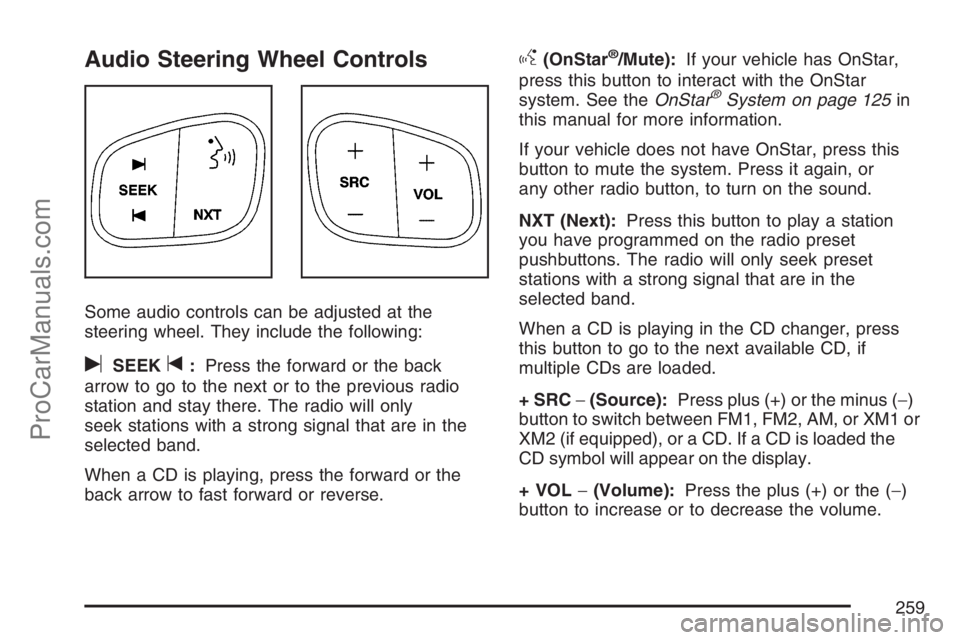
Some audio controls can be adjusted at the
steering wheel. They include the following:
uSEEKt:Press the forward or the back
arrow to go to the next or to the previous radio
station and stay there. The radio will only
seek stations with a strong signal that are in the
selected band.
When a CD is playing, press the forward or the
back arrow to fast forward or reverse.
g(OnStar®/Mute):If your vehicle has OnStar,
press this button to interact with the OnStar
system. See theOnStar
®System on page 125in
this manual for more information.
If your vehicle does not have OnStar, press this
button to mute the system. Press it again, or
any other radio button, to turn on the sound.
NXT (Next):Press this button to play a station
you have programmed on the radio preset
pushbuttons. The radio will only seek preset
stations with a strong signal that are in the
selected band.
When a CD is playing in the CD changer, press
this button to go to the next available CD, if
multiple CDs are loaded.
+ SRC−(Source):Press plus (+) or the minus (−)
button to switch between FM1, FM2, AM, or XM1 or
XM2 (if equipped), or a CD. If a CD is loaded the
CD symbol will appear on the display.
+ VOL−(Volume):Press the plus (+) or the (−)
button to increase or to decrease the volume.
259
ProCarManuals.com
Page 263 of 498
Your Driving, the Road, and Your Vehicle.... 264
Defensive Driving...................................... 264
Drunken Driving........................................ 265
Control of a Vehicle.................................. 268
Braking...................................................... 268
Anti-Lock Brake System (ABS).................. 269
Braking in Emergencies............................. 271
Limited-Slip Rear Axle............................... 271
StabiliTrak
®System................................... 271
All-Wheel Drive (AWD) System.................. 275
Steering.................................................... 276
Off-Road Recovery.................................... 278
Passing..................................................... 278
Loss of Control.......................................... 280
Off-Road Driving........................................ 281
Driving at Night......................................... 281
Driving in Rain and on Wet Roads............ 282City Driving............................................... 285
Freeway Driving........................................ 286
Before Leaving on a Long Trip.................. 287
Highway Hypnosis..................................... 288
Hill and Mountain Roads........................... 288
Winter Driving........................................... 291
If Your Vehicle is Stuck in Sand,
Mud, Ice, or Snow ................................. 295
Rocking Your Vehicle to Get It Out........... 296
Loading Your Vehicle................................ 296
Towing........................................................ 302
Towing Your Vehicle ................................. 302
Recreational Vehicle Towing...................... 302
Electronically Controlled Air
Suspension System................................ 303
Towing a Trailer........................................ 305
Section 4 Driving Your Vehicle
263
ProCarManuals.com
Page 270 of 498
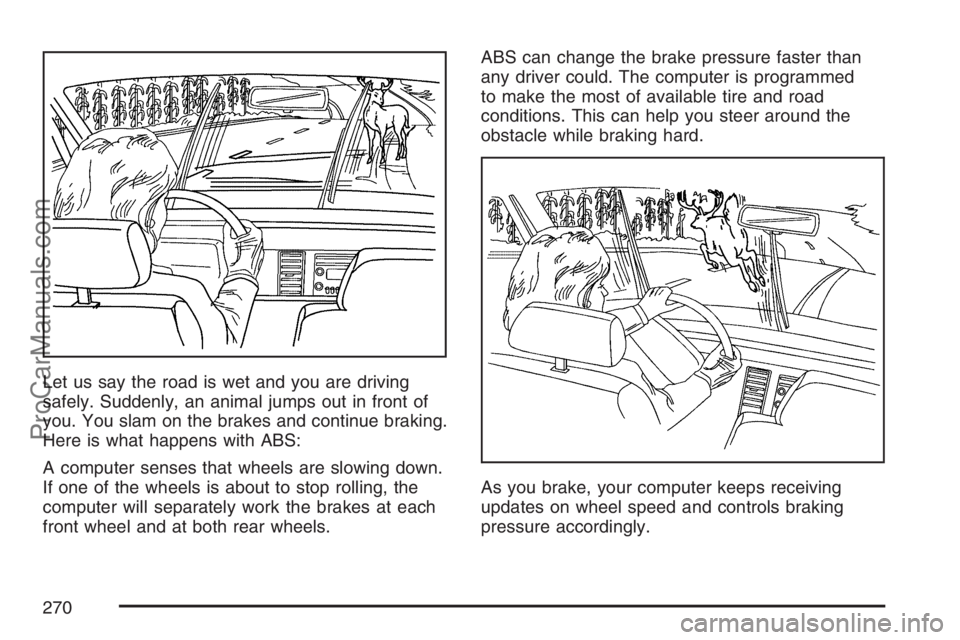
Let us say the road is wet and you are driving
safely. Suddenly, an animal jumps out in front of
you. You slam on the brakes and continue braking.
Here is what happens with ABS:
A computer senses that wheels are slowing down.
If one of the wheels is about to stop rolling, the
computer will separately work the brakes at each
front wheel and at both rear wheels.ABS can change the brake pressure faster than
any driver could. The computer is programmed
to make the most of available tire and road
conditions. This can help you steer around the
obstacle while braking hard.
As you brake, your computer keeps receiving
updates on wheel speed and controls braking
pressure accordingly.
270
ProCarManuals.com
Page 271 of 498
Remember: ABS does not change the time you
need to get your foot up to the brake pedal or
always decrease stopping distance. If you get too
close to the vehicle in front of you, you will not have
time to apply your brakes if that vehicle suddenly
slows or stops. Always leave enough room up
ahead to stop, even though you have ABS.
Using ABS
Do not pump the brakes. Just hold the brake pedal
down rmly and let anti-lock work for you. You may
feel the brakes vibrate, or you may notice some
noise, but this is normal.
Braking in Emergencies
With ABS, you can steer and brake at the same
time. In many emergencies, steering can help you
more than even the very best braking.
Limited-Slip Rear Axle
Your vehicle may have this feature. A limited-slip
rear axle can give you additional traction on
snow, mud, ice, sand or gravel. It works like a
standard axle most of the time, but when one of
the rear wheels has no traction and the other does,
this feature will allow the wheel with traction to
move the vehicle.
StabiliTrak®System
Your vehicle is equipped with StabiliTrak®,
Electronic Stability Control (ESC) which combines
antilock brake, traction and stability control
systems and helps the driver maintain directional
control of the vehicle in most driving conditions.
Traction control activates when the controller
senses wheel spin. StabiliTrak
®will selectively
apply the brakes and reduce engine torque to help
regain traction.
Stability control activates when the controller
senses a discrepancy between your intended
path and the direction the vehicle is travelling.
StabiliTrak
®selectively applies braking pressure at
any one of the vehicle’s brakes to help guide
the vehicle in the direction which you are steering.
271
ProCarManuals.com
Page 273 of 498
STABILITRAK OFF — The driver can turn off
StabiliTrak®by pressing the StabiliTrak®button for
more than ve seconds. The StabiliTrak®light
will come on and STABILITRAK OFF will be
displayed. For vehicles without a DIC, the
StabiliTrak
®indicator light will come on.
Momentarily pressing the StabiliTrak®button again
will return the system to the STABILITRAK ON
mode. See StabiliTrak
®Off below for more
information.
Traction Control Off
In this mode, stability control and brake-traction
control are functional. Engine speed management
will be modied and the driven wheels can spin
more freely. This can cause the brake-traction
control to activate more frequently. If the controller
detects excessive wheel spin in this mode, the
StabiliTrak
®indicator light may blink and the
STABILITRAK ACTIVE message may be displayed
to warn the driver that damage may occur to the
transfer case.
StabiliTrak®Off
In this mode, both stability control and part of the
traction control system are disabled. Your vehicle
will still have brake-traction control, but will not
be able to use the engine speed management
system. You may still hear system noises
as a result of the brake-traction control coming on.
If the controller detects excessive wheel spin in
this mode, the StabiliTrak
®indicator light may blink
and the STABILITRAK ACTIVE message may
be displayed to warn the driver that damage may
occur to the transfer case.
It is recommended to leave the system on for
normal driving conditions, but it may be necessary
to turn the system off if your vehicle is stuck in
sand, mud, ice or snow, and you may want
to “rock” your vehicle in an attempt to free it. It may
also be necessary to turn off the system when
driving in extreme off-road conditions where high
wheel spin is required. SeeIf Your Vehicle is
Stuck in Sand, Mud, Ice, or Snow on page 295for
more information.
273
ProCarManuals.com
Page 275 of 498
Notice:If the StabiliTrak®light comes on due
to heavy braking and/or because the traction
control system has been continuously active,
do not allow the wheel(s) of one axle to spin
excessively. If you do, you may be causing
damage to the transfer case. This could lead to
costly repairs not covered by your warranty.
Notice:If you allow the wheel(s) of one axle to
spin excessively while the StabiliTrak
®, ABS
and brake warning lights and the SERVICE
STABILITRAK message are displayed, you
could damage the transfer case. The repairs
would not be covered by your warranty. Reduce
engine power and do not spin the wheel(s)
excessively while these lights and this message
are displayed.
StabiliTrak
®may activate on dry or rough roads or
under conditions such as heavy acceleration
while turning or abrupt upshifts/downshifts of the
transmission. When this happens, you may
notice a reduction in acceleration, or may hear a
noise or vibration. This is normal.
If your vehicle is in cruise control when the system
activates, the StabiliTrak
®light will blink, and
the cruise control will automatically disengage.When road conditions allow, you may re-engage
the cruise control. SeeCruise Control on page 156.
StabiliTrak
®will turn off automatically if a problem
is detected in the system. The StabiliTrak®
light will come on and SERVICE STABILITRAK
will be displayed on the DIC. For vehicles without a
DIC, the StabiliTrak
®light and the StabiliTrak®
service light will both come on. If the SERVICE
STABILITRAK message (or StabiliTrak®service
light) does not clear itself after restarting the
vehicle, you should see your dealer for service.
Adding non-GM accessories can affect your
vehicle’s performance. SeeAccessories and
Modications on page 322for more information.
All-Wheel Drive (AWD) System
Your vehicle has this feature. There is no lever or
switch to engage or disengage the front axle. It
is fully automatic and adjusts as needed for
road conditions. Your vehicle has an active
transfer case allowing two-wheel-drive operation
on dry roads. The transfer case will shift
automatically into all-wheel drive on slippery
surfaces. You may feel an extra shift when the
all-wheel drive engages.
275
ProCarManuals.com