ECU SAAB 9-7X 2007 Owner's Guide
[x] Cancel search | Manufacturer: SAAB, Model Year: 2007, Model line: 9-7X, Model: SAAB 9-7X 2007Pages: 498, PDF Size: 3.13 MB
Page 85 of 498
Keys.............................................................. 87
Remote Keyless Entry (RKE) System.......... 89
Remote Keyless Entry (RKE)
System Operation.................................... 90
Doors and Locks.......................................... 92
Door Locks................................................. 92
Power Door Locks....................................... 93
Delayed Locking.......................................... 94
Programmable Automatic Door Locks.......... 94
Rear Door Security Locks........................... 97
Lockout Protection....................................... 97
Liftgate/Liftglass........................................... 98
Windows....................................................... 99
Power Windows........................................ 100
Sun Visors................................................ 101
Theft-Deterrent Systems............................. 101
Content Theft-Deterrent............................. 102
PASS-Key
®III ........................................... 103
PASS-Key®III Operation........................... 104Starting and Operating Your Vehicle......... 106
New Vehicle Break-In................................ 106
Ignition Positions....................................... 107
Retained Accessory Power (RAP)............. 108
Starting the Engine.................................... 108
Adjustable Throttle and Brake Pedal.......... 110
Engine Coolant Heater.............................. 110
Automatic Transmission Operation............. 112
Parking Brake........................................... 116
Shifting Into Park (P) ................................. 117
Shifting Out of Park (P)............................. 118
Parking Over Things That Burn................. 118
Engine Exhaust......................................... 119
Running the Engine While Parked............. 120
Mirrors......................................................... 121
Automatic Dimming Rearview Mirror
with OnStar
®and Compass................... 121
Automatic Dimming Rearview Mirror
with Compass........................................ 123
Outside Power Mirror................................ 123
Section 2 Features and Controls
85
ProCarManuals.com
Page 97 of 498
Rear Door Security Locks
Your vehicle may have this feature. You can lock
the rear doors so they cannot be opened from
the inside by passengers. To use one of
these locks do the following:
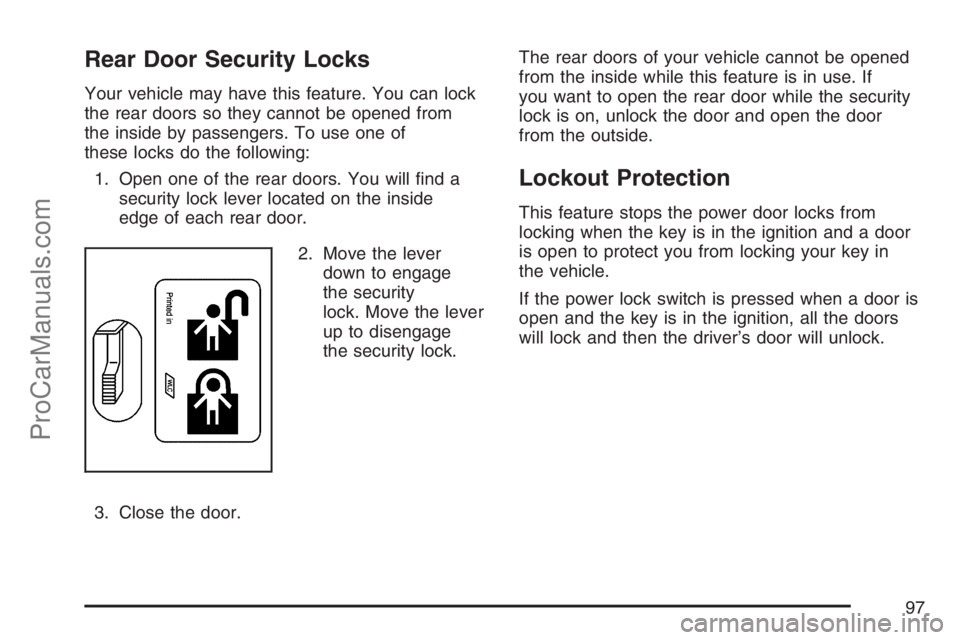
1. Open one of the rear doors. You will nd a
security lock lever located on the inside
edge of each rear door.
2. Move the lever
down to engage
the security
lock. Move the lever
up to disengage
the security lock.
3. Close the door.The rear doors of your vehicle cannot be opened
from the inside while this feature is in use. If
you want to open the rear door while the security
lock is on, unlock the door and open the door
from the outside.
Lockout Protection
This feature stops the power door locks from
locking when the key is in the ignition and a door
is open to protect you from locking your key in
the vehicle.
If the power lock switch is pressed when a door is
open and the key is in the ignition, all the doors
will lock and then the driver’s door will unlock.
97
ProCarManuals.com
Page 102 of 498
Content Theft-Deterrent
Your vehicle is equipped
with a content
theft-deterrent alarm
system.
Here is how to operate the system:
1. Open the door.
2. Lock the door with the power door lock switch
or the remote keyless entry transmitter. The
security light should ash.
3. Close all doors. The security light should turn
off after approximately 30 seconds. The alarm
is not armed until the security light turns off.
If a locked door is opened without the key or the
remote keyless entry transmitter, the alarm will go
off. The headlamps and parking lamps will ash
for two minutes, and the horn will sound for
30 seconds, then will turn off to save the
battery power.Remember, the theft-deterrent system will not
activate if you lock the doors with a key or use the
manual door lock. It activates only if you use a
power door lock switch with the door open, or with
the remote keyless entry transmitter. You should
also remember that you can start your vehicle with
the correct ignition key if the alarm has been set off.
Here is how to avoid setting off the alarm by
accident:
If you do not want to activate the
theft-deterrent system, the vehicle should be
locked with the door keyafterthe doors
are closed.
Always unlock a door with a key, or use the
remote keyless entry transmitter. Unlocking
a door any other way will set off the alarm.
If you set off the alarm by accident, unlock any
door with the key. You can also turn off the alarm
by pressing unlock on the remote keyless entry
transmitter. The alarm will not stop if you try
to unlock a door any other way.
102
ProCarManuals.com
Page 103 of 498
Testing the Alarm
The alarm can be tested by following these steps:
1. From inside the vehicle, lower the driver’s
window and open the driver’s door.
2. Activate the system by locking the doors with
the power door lock switch while the door is
open, or with the remote keyless entry
transmitter.
3. Get out of the vehicle, close the door and wait
for the security light to go out.
4. Then reach in through the window, unlock the
door with the manual door lock and open the
door. This should set off the alarm.
When the alarm is set the power door unlock
switch is not operational.
If the alarm does not sound when it should but the
headlamps ash, check to see if the horn works.
The horn fuse may be blown. To replace the fuse,
seeFuses and Circuit Breakers on page 435.
If the alarm does not sound or the headlamps do
not ash, the vehicle should be serviced by
your dealer.
PASS-Key®III
Your PASS-Key®III system operates on a radio
frequency subject to Federal Communications
Commission (FCC) Rules and with Industry
Canada.
This device complies with Part 15 of the FCC
Rules. Operation is subject to the following
two conditions:
1. This device may not cause harmful
interference.
2. This device must accept any interference
received, including interference that may
cause undesired operation.
This device complies with RSS-210 of Industry
Canada. Operation is subject to the following
two conditions:
1. This device may not cause interference.
2. This device must accept any interference
received, including interference that may
cause undesired operation of the device.
Changes or modications to this system by other
than an authorized service facility could void
authorization to use this equipment.
PASS-Key
®III uses a radio frequency transponder
in the key that matches a decoder in your vehicle.
103
ProCarManuals.com
Page 104 of 498
PASS-Key®III Operation
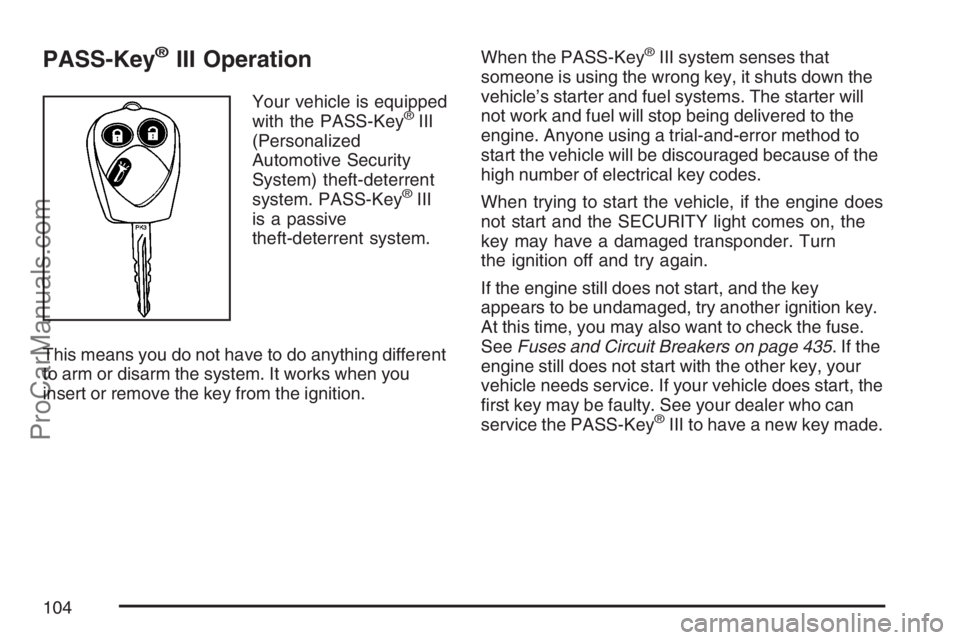
Your vehicle is equipped
with the PASS-Key®III
(Personalized
Automotive Security
System) theft-deterrent
system. PASS-Key
®III
is a passive
theft-deterrent system.
This means you do not have to do anything different
to arm or disarm the system. It works when you
insert or remove the key from the ignition.When the PASS-Key
®III system senses that
someone is using the wrong key, it shuts down the
vehicle’s starter and fuel systems. The starter will
not work and fuel will stop being delivered to the
engine. Anyone using a trial-and-error method to
start the vehicle will be discouraged because of the
high number of electrical key codes.
When trying to start the vehicle, if the engine does
not start and the SECURITY light comes on, the
key may have a damaged transponder. Turn
the ignition off and try again.
If the engine still does not start, and the key
appears to be undamaged, try another ignition key.
At this time, you may also want to check the fuse.
SeeFuses and Circuit Breakers on page 435.Ifthe
engine still does not start with the other key, your
vehicle needs service. If your vehicle does start, the
rst key may be faulty. See your dealer who can
service the PASS-Key
®III to have a new key made.
104
ProCarManuals.com
Page 105 of 498
It is possible for the PASS-Key®III decoder to
learn the transponder value of a new or
replacement key. Up to 10 keys may be
programmed for the vehicle. This procedure
is for programming additional keys only.
Canadian Owners:If you lose or damage your
keys, only a GM dealer can service PASS-Key
®III
to have new keys made. To program additional
keys you will require two current driver’s keys. You
must add a step to the following procedure.
After Step 2 repeat Steps 1 and 2 with the second
current driver’s key. Then continue with Step 3.
To program the new key, do the following:
1. Verify that the new key has PK3 stamped on it.
2. Insert the current driver’s key in the ignition
and start the engine. If the engine will not
start, see your dealer for service.
3. After the engine has started, turn the key to
LOCK, and remove the key.4. Insert the key to be programmed and turn it to
ON within 10 seconds of removing the
previous key.
5. The SECURITY light will turn off once the key
has been programmed. It may not be apparent
that the SECURITY light went on due to
how quickly the key is programmed.
6. Repeat Steps 1 through 4 if additional keys
are to be programmed.
If you are ever driving and the SECURITY light
comes on and stays on, you will be able to restart
your engine if you turn it off. Your PASS-Key
®III
system, however, is not working properly and must
be serviced by your dealer. Your vehicle is not
protected by the PASS-Key
®III system at this time.
If you lose or damage a PASS-Key
®III key, see
your dealer to have a new key made.
105
ProCarManuals.com
Page 125 of 498
OnStar®System
OnStar®uses several innovative technologies and
live advisors to provide you with a wide range
of safety, security, information, and convenience
services. If your airbags deploy, the system is
designed to make an automatic call to OnStar
®
Emergency advisors who can request emergency
services be sent to your location. If you lock
your keys in the vehicle, call OnStar
®at
1-888-4-ONSTAR and they can send a signal to
unlock your doors. If you need roadside
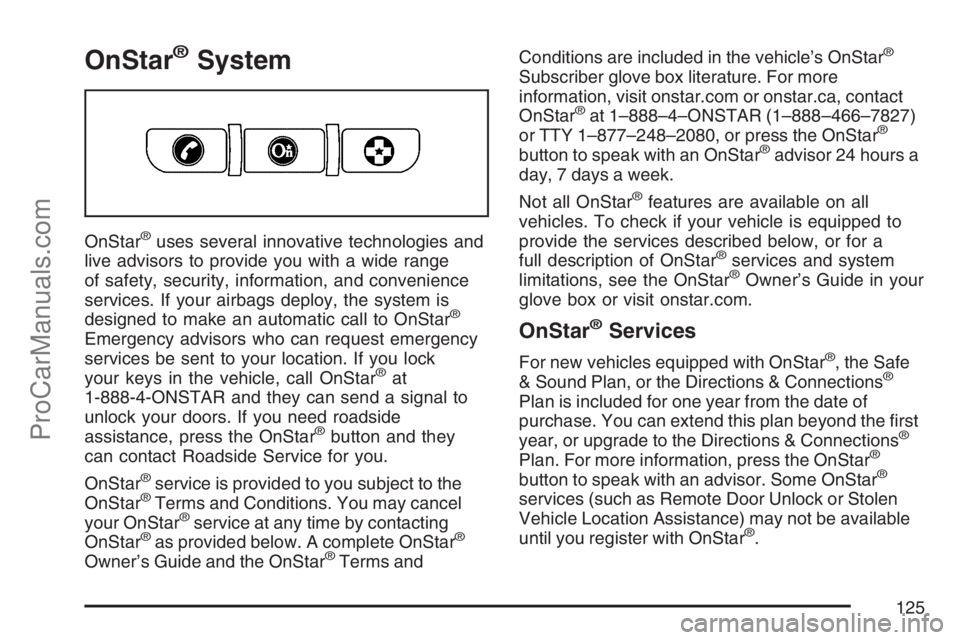
assistance, press the OnStar
®button and they
can contact Roadside Service for you.
OnStar
®service is provided to you subject to the
OnStar®Terms and Conditions. You may cancel
your OnStar®service at any time by contacting
OnStar®as provided below. A complete OnStar®
Owner’s Guide and the OnStar®Terms andConditions are included in the vehicle’s OnStar
®
Subscriber glove box literature. For more
information, visit onstar.com or onstar.ca, contact
OnStar
®at 1–888–4–ONSTAR (1–888–466–7827)
or TTY 1–877–248–2080, or press the OnStar®
button to speak with an OnStar®advisor 24 hours a
day, 7 days a week.
Not all OnStar
®features are available on all
vehicles. To check if your vehicle is equipped to
provide the services described below, or for a
full description of OnStar
®services and system
limitations, see the OnStar®Owner’s Guide in your
glove box or visit onstar.com.
OnStar®Services
For new vehicles equipped with OnStar®, the Safe
& Sound Plan, or the Directions & Connections®
Plan is included for one year from the date of
purchase. You can extend this plan beyond the rst
year, or upgrade to the Directions & Connections
®
Plan. For more information, press the OnStar®
button to speak with an advisor. Some OnStar®
services (such as Remote Door Unlock or Stolen
Vehicle Location Assistance) may not be available
until you register with OnStar
®.
125
ProCarManuals.com
Page 128 of 498
OnStar®service that involves location information
about your vehicle cannot work unless GPS
satellite signals are unobstructed and available in
that place as well.
Your vehicle must have a working electrical
system (including adequate battery power) for the
OnStar
®equipment to operate. There are other
problems OnStar®cannot control that may prevent
OnStar®from providing OnStar®service to you
at any particular time or place. Some examples are
damage to important parts of your vehicle in an
accident, hills, tall buildings, tunnels, weather
or wireless phone network congestion.
Your Responsibility
You may need to increase the volume of your
radio to hear the OnStar®advisor. If the light next
to the OnStar®buttons is red, this means that
your system is not functioning properly and should
be checked by a dealer. If the light appears
clear (no light is appearing), your OnStar
®
subscription has expired. You can always press
the blue OnStar®button to conrm that your
OnStar®equipment is active.
Universal Home Remote
System
Universal Home Remote System
(With Three Round LED)
The Universal Home Remote System provides a
way to replace up to three hand-held
Radio-Frequency (RF) transmitters used to
activate devices such as garage door openers,
security systems, and home lighting.
This device complies with Part 15 of the FCC
Rules. Operation is subject to the following
two conditions:
1. This device may not cause harmful
interference.
2. This device must accept any interference
received, including interference that may
cause undesired operation.
The FCC Grant of Equipment Authorization
Certicate number is KOBGTE05A.
128
ProCarManuals.com
Page 129 of 498
This device complies with RSS-210 of Industry
Canada. Operation is subject to the following
two conditions:
1. This device may not cause interference.
2. This device must accept any interference
received, including interference that may
cause undesired operation of the device.
The Canadian Registration ID number is
3521A-GTE05A.
Changes or modications to this system by other
than an authorized service facility could void
authorization to use this equipment.
Universal Home Remote System
(With One Triangular LED)
The Universal Home Remote System provides a
way to replace up to three hand-held
radio-frequency (RF) transmitters used to activate
devices such as garage door openers, security
systems, and home lighting.This device complies with Part 15 of the FCC
Rules. Operation is subject to the following
two conditions:
1. This device may not cause harmful
interference.
2. This device must accept any interference
received, including interference that may
cause undesired operation.
The FCC Grant of Equipment Authorization
Certicate number is CB2SAHL3.
This device complies with RSS-210 of Industry
Canada. Operation is subject to the following
two conditions:
1. This device may not cause interference.
2. This device must accept any interference
received, including interference that may
cause undesired operation of the device.
The Canadian Registration ID number is
2791021849A.
Changes or modications to this system by other
than an authorized service facility could void
authorization to use this equipment.
129
ProCarManuals.com
Page 130 of 498
Universal Home Remote System
Operation (With Three Round LED)
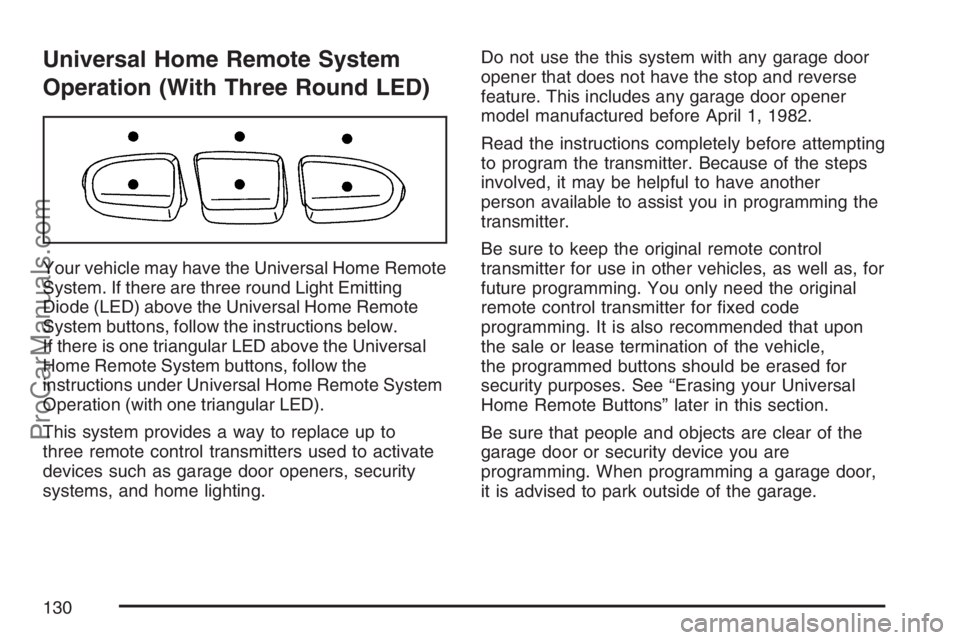
Your vehicle may have the Universal Home Remote
System. If there are three round Light Emitting
Diode (LED) above the Universal Home Remote
System buttons, follow the instructions below.
If there is one triangular LED above the Universal
Home Remote System buttons, follow the
instructions under Universal Home Remote System
Operation (with one triangular LED).
This system provides a way to replace up to
three remote control transmitters used to activate
devices such as garage door openers, security
systems, and home lighting.Do not use the this system with any garage door
opener that does not have the stop and reverse
feature. This includes any garage door opener
model manufactured before April 1, 1982.
Read the instructions completely before attempting
to program the transmitter. Because of the steps
involved, it may be helpful to have another
person available to assist you in programming the
transmitter.
Be sure to keep the original remote control
transmitter for use in other vehicles, as well as, for
future programming. You only need the original
remote control transmitter for xed code
programming. It is also recommended that upon
the sale or lease termination of the vehicle,
the programmed buttons should be erased for
security purposes. See “Erasing your Universal
Home Remote Buttons” later in this section.
Be sure that people and objects are clear of the
garage door or security device you are
programming. When programming a garage door,
it is advised to park outside of the garage.
130
ProCarManuals.com