ecu SAAB 9-7X 2007 Repair Manual
[x] Cancel search | Manufacturer: SAAB, Model Year: 2007, Model line: 9-7X, Model: SAAB 9-7X 2007Pages: 498, PDF Size: 3.13 MB
Page 347 of 498
{CAUTION:
You can be burned if you spill coolant on
hot engine parts. Coolant contains
ethylene glycol, and it will burn if the
engine parts are hot enough. Do not spill
coolant on a hot engine.
Occasionally check the coolant level in the
radiator. For information on how to add coolant to
the radiator, seeCooling System on page 349.
Radiator Pressure Cap
Notice:If the pressure cap is not tightly
installed, coolant loss and possible engine
damage may occur. Be sure the cap is properly
and tightly secured.
SeeEngine Compartment Overview on page 330
for information on location.
Engine Overheating
You will nd a coolant temperature gage on your
vehicle’s instrument panel. SeeEngine Coolant
Temperature Gage on page 186for more
information.
If your vehicle has a Driver Information Center
(DIC), the display will show an Engine Coolant
Hot/Engine Overheated message. SeeDIC
Warnings and Messages on page 199for more
information.
347
ProCarManuals.com
Page 373 of 498
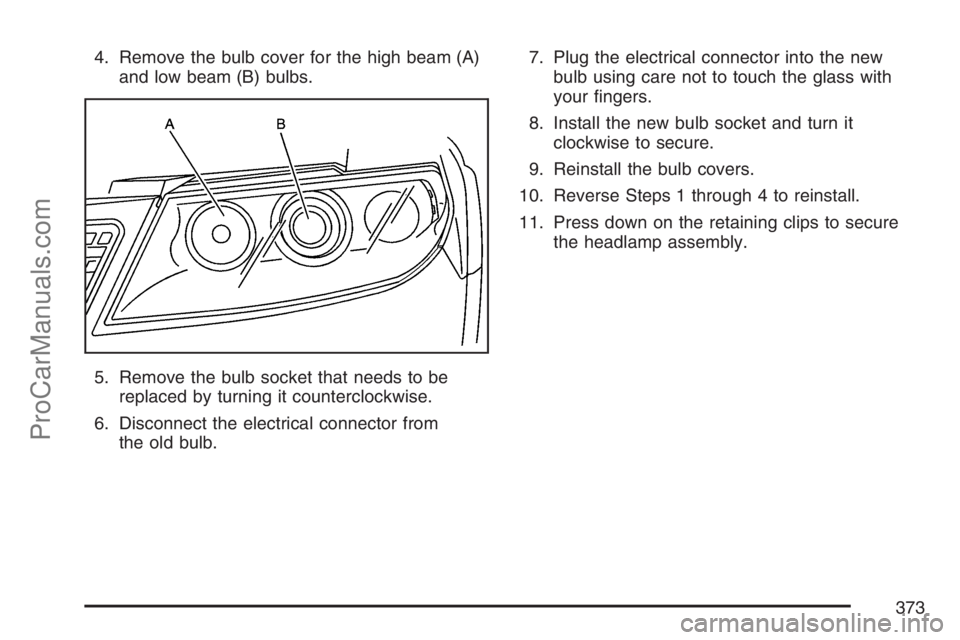
4. Remove the bulb cover for the high beam (A)
and low beam (B) bulbs.
5. Remove the bulb socket that needs to be
replaced by turning it counterclockwise.
6. Disconnect the electrical connector from
the old bulb.7. Plug the electrical connector into the new
bulb using care not to touch the glass with
your ngers.
8. Install the new bulb socket and turn it
clockwise to secure.
9. Reinstall the bulb covers.
10. Reverse Steps 1 through 4 to reinstall.
11. Press down on the retaining clips to secure
the headlamp assembly.
373
ProCarManuals.com
Page 374 of 498
Front Turn Signal, Sidemarker and
Parking Lamps
To replace one of these bulbs, do the following:
1. Follow Steps 1 through 3 underHeadlamps on
page 372to access the front turn signal,
sidemarker or parking lamp.
2. Turn the bulb socket counterclockwise and
remove it from the lamp assembly.
3. Holding the socket, pull the old bulb to
release it from the socket.
4. Push the new bulb into the socket until it
clicks.
5. Insert the bulb socket into the lamp assembly
and turn it clockwise to secure.
6. Reinstall the headlamp assembly by lining up
the headlamp assembly with the slots in the
headlamp retaining clips.
7. Press down on the headlamp retaining clips to
secure the headlamp assembly.
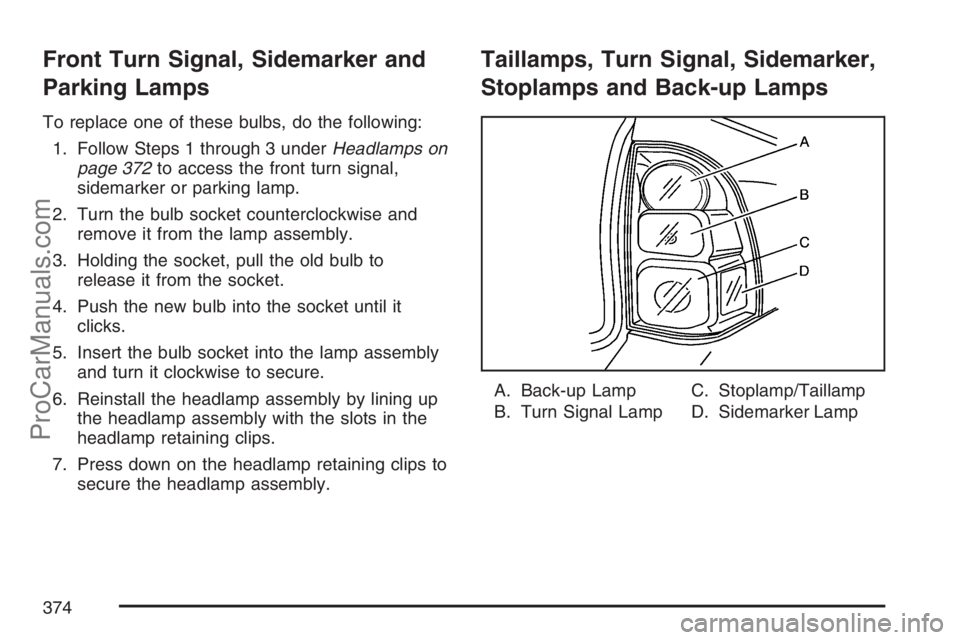
Taillamps, Turn Signal, Sidemarker,
Stoplamps and Back-up Lamps
A. Back-up Lamp
B. Turn Signal LampC. Stoplamp/Taillamp
D. Sidemarker Lamp
374
ProCarManuals.com
Page 375 of 498
To replace one of these bulbs, do the following:
1. Open the liftgate. SeeLiftgate/Liftglass
on page 98for more information.
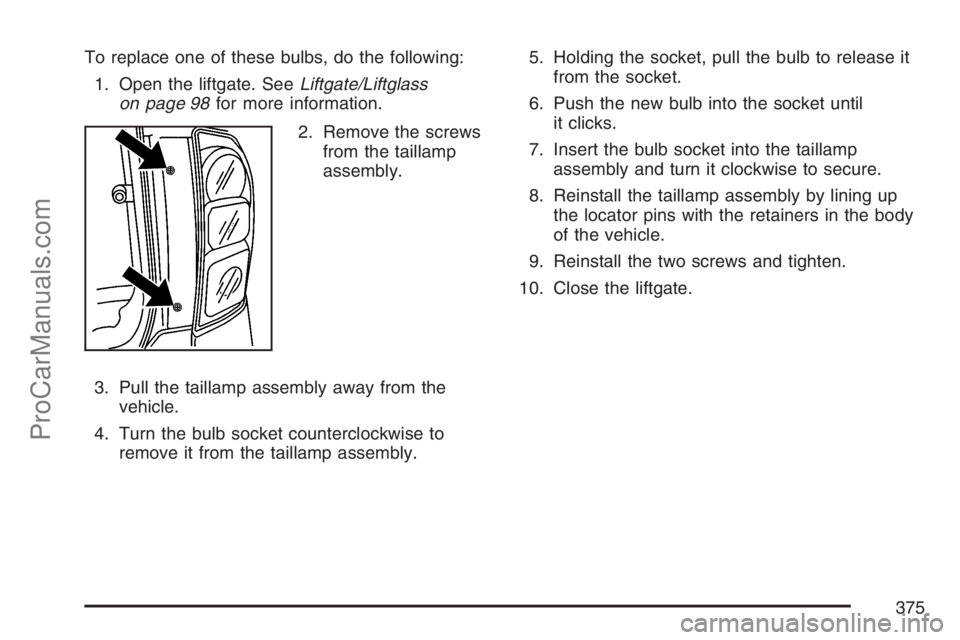
2. Remove the screws
from the taillamp
assembly.
3. Pull the taillamp assembly away from the
vehicle.
4. Turn the bulb socket counterclockwise to
remove it from the taillamp assembly.5. Holding the socket, pull the bulb to release it
from the socket.
6. Push the new bulb into the socket until
it clicks.
7. Insert the bulb socket into the taillamp
assembly and turn it clockwise to secure.
8. Reinstall the taillamp assembly by lining up
the locator pins with the retainers in the body
of the vehicle.
9. Reinstall the two screws and tighten.
10. Close the liftgate.
375
ProCarManuals.com
Page 396 of 498
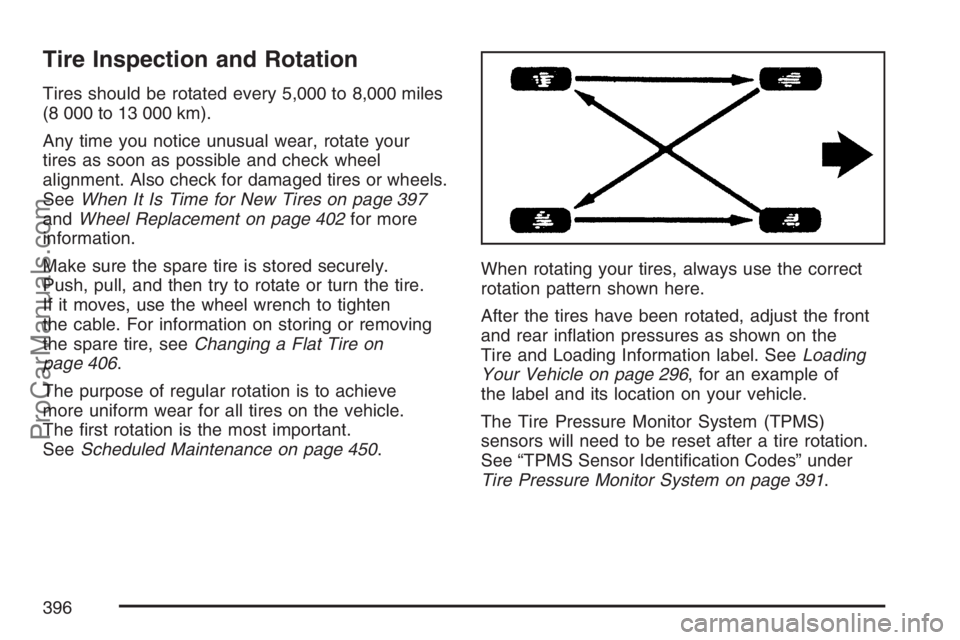
Tire Inspection and Rotation
Tires should be rotated every 5,000 to 8,000 miles
(8 000 to 13 000 km).
Any time you notice unusual wear, rotate your
tires as soon as possible and check wheel
alignment. Also check for damaged tires or wheels.
SeeWhen It Is Time for New Tires on page 397
andWheel Replacement on page 402for more
information.
Make sure the spare tire is stored securely.
Push, pull, and then try to rotate or turn the tire.
If it moves, use the wheel wrench to tighten
the cable. For information on storing or removing
the spare tire, seeChanging a Flat Tire on
page 406.
The purpose of regular rotation is to achieve
more uniform wear for all tires on the vehicle.
The rst rotation is the most important.
SeeScheduled Maintenance on page 450.When rotating your tires, always use the correct
rotation pattern shown here.
After the tires have been rotated, adjust the front
and rear ination pressures as shown on the
Tire and Loading Information label. SeeLoading
Your Vehicle on page 296, for an example of
the label and its location on your vehicle.
The Tire Pressure Monitor System (TPMS)
sensors will need to be reset after a tire rotation.
See “TPMS Sensor Identication Codes” under
Tire Pressure Monitor System on page 391.
396
ProCarManuals.com
Page 421 of 498
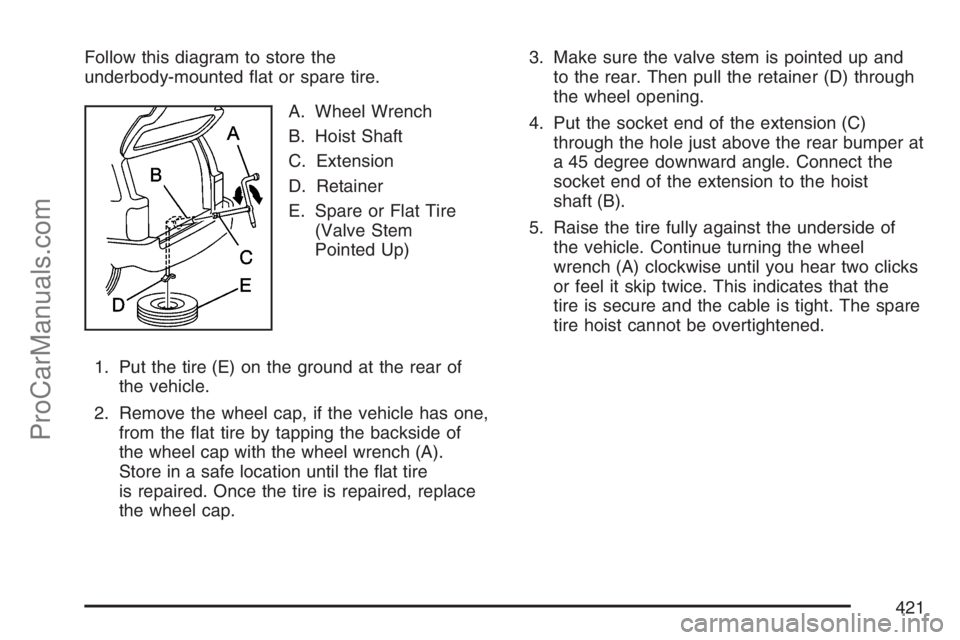
Follow this diagram to store the
underbody-mounted at or spare tire.
A. Wheel Wrench
B. Hoist Shaft
C. Extension
D. Retainer
E. Spare or Flat Tire
(Valve Stem
Pointed Up)
1. Put the tire (E) on the ground at the rear of
the vehicle.
2. Remove the wheel cap, if the vehicle has one,
from the at tire by tapping the backside of
the wheel cap with the wheel wrench (A).
Store in a safe location until the at tire
is repaired. Once the tire is repaired, replace
the wheel cap.3. Make sure the valve stem is pointed up and
to the rear. Then pull the retainer (D) through
the wheel opening.
4. Put the socket end of the extension (C)
through the hole just above the rear bumper at
a 45 degree downward angle. Connect the
socket end of the extension to the hoist
shaft (B).
5. Raise the tire fully against the underside of
the vehicle. Continue turning the wheel
wrench (A) clockwise until you hear two clicks
or feel it skip twice. This indicates that the
tire is secure and the cable is tight. The spare
tire hoist cannot be overtightened.
421
ProCarManuals.com
Page 422 of 498
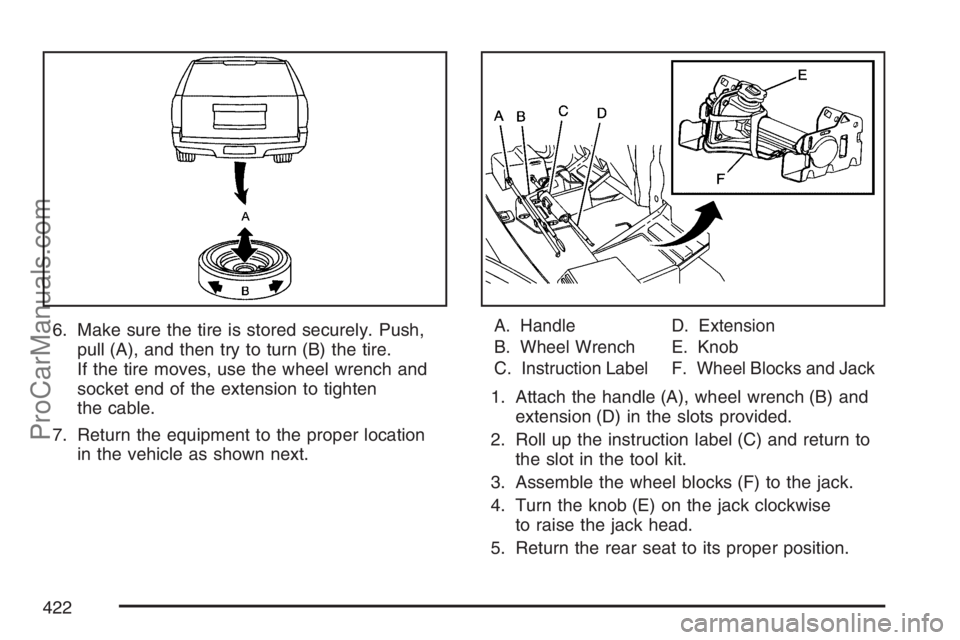
6. Make sure the tire is stored securely. Push,
pull (A), and then try to turn (B) the tire.
If the tire moves, use the wheel wrench and
socket end of the extension to tighten
the cable.
7. Return the equipment to the proper location
in the vehicle as shown next.A. Handle
B. Wheel Wrench
C. Instruction LabelD. Extension
E. Knob
F. Wheel Blocks and Jack
1. Attach the handle (A), wheel wrench (B) and
extension (D) in the slots provided.
2. Roll up the instruction label (C) and return to
the slot in the tool kit.
3. Assemble the wheel blocks (F) to the jack.
4. Turn the knob (E) on the jack clockwise
to raise the jack head.
5. Return the rear seat to its proper position.
422
ProCarManuals.com
Page 455 of 498
Owner Checks and Services
These owner checks and services should be
performed at the intervals specied to help ensure
the safety, dependability, and emission control
performance of your vehicle. Your dealer can
assist you with these checks and services.
Be sure any necessary repairs are completed at
once. Whenever any uids or lubricants are added
to your vehicle, make sure they are the proper
ones, as shown inRecommended Fluids and
Lubricants on page 458.
At Each Fuel Fill
It is important to perform these underhood checks
at each fuel ll.
Engine Oil Level Check
Check the engine oil level and add the proper oil if
necessary. SeeEngine Oil on page 334for
further details.
Notice:It is important to check your oil
regularly and keep it at the proper level. Failure
to keep your engine oil at the proper level can
cause damage to your engine not covered by
your warranty.
Engine Coolant Level Check
Check the engine coolant level and add
DEX-COOL®coolant mixture if necessary. See
Engine Coolant on page 344for further details.
Windshield Washer Fluid Level Check
Check the windshield washer uid level in
the windshield washer uid reservoir and add the
proper uid if necessary.
At Least Once a Month
Tire Ination Check
Visually inspect your vehicle’s tires and make sure
they are inated to the correct pressures. Do not
forget to check the spare tire. SeeInation - Tire
Pressure on page 388. Check to make sure the
spare tire is stored securely. SeeChanging a Flat
Tire on page 406.
Tire Wear Inspection
Tire rotation may be required for high mileage
highway drivers prior to the Engine Oil Life System
service notication. Check the tires for wear
and, if necessary, rotate the tires. SeeTire
Inspection and Rotation on page 396.
455
ProCarManuals.com
Page 470 of 498
The following services are provided in the U.S.
during the Bumper-to-Bumper warranty period and,
in Canada, during the Base Warranty coverage
period of the New Vehicle Limited Warranty,
up to a maximum coverage of $100.
Fuel Delivery:Delivery of enough fuel for the
customer to get to the nearest service station
(approximately $5 in the U.S. and 10 litres
in Canada). Service to provide diesel may be
restricted. For safety reasons, propane
and other alternative fuels will not be provided
through this service.
Lock-out Service:To ensure security, the
driver must present the vehicle registration and
personal ID before lock-out service is provided.
Lock-out service will be covered at no charge if
you are unable to gain entry into your vehicle.
In the U.S., replacement keys made at the
customer’s expense will be covered within
10 miles (16 km).
Flat Tire Change:If your vehicle has a spare
tire, installation of the tire in good condition will
be covered at no charge. The customer is
responsible for the repair or replacement of the
tire if not covered by a warrantable failure.
Jump Start:No-start occurrences which
require a battery jump start will be covered at
no charge.
Emergency Tow From a Public Roadway or
Highway:Tow to the nearest dealership for
warranty service or in the event of a
vehicle-disabling accident. Winch-out
assistance when the vehicle is mired in sand,
mud, or snow. If your vehicle will not start,
Roadside Assistance will arrange to have your
vehicle towed to the nearest authorized
dealership.
Alternative ServiceThere may be times, when
Roadside Assistance cannot provide timely
assistance, your advisor may authorize you to
secure local emergency road service, and you
will be reimbursed up to $100 upon submission
of the original receipt to Roadside Assistance.
470
ProCarManuals.com
Page 472 of 498
Calling for Assistance
For prompt and efficient assistance when calling,
please provide the following to the Roadside
Assistance Representative:
Your name, home address, and home
telephone number.
Telephone number of your location.
Location of the vehicle.
Model, year, color, and license plate number
of the vehicle.
Odometer reading, Vehicle Identication
Number (VIN), and delivery date of the vehicle.
Description of the problem.
While we hope you never have the occasion to
use our service, it is added security while traveling
for you and your family. Remember, we are only
a phone call away. Saab and General Motors
of Canada Limited reserve the right to make any
changes or discontinue the Roadside Assistance
program at any time without notication.Roadside Assistance is not part of or included in
the coverage provided by the New Vehicle Limited
Warranty. Saab and General Motors of Canada
Limited reserve the right to make any changes or
discontinue the Roadside Assistance program
at any time without notication.
Towing and Road Service Exclusions
Specically excluded from Roadside Assistance
coverage are towing or services for vehicles
operated on a non-public roadway or highway,
nes, impound towing caused by a violation
of local, Municipal, State, Provincial, or Federal
law, and mounting, dismounting or changing
of snow tires, chains, or other traction devices.
472
ProCarManuals.com