light SAAB 9-7X 2009 User Guide
[x] Cancel search | Manufacturer: SAAB, Model Year: 2009, Model line: 9-7X, Model: SAAB 9-7X 2009Pages: 424, PDF Size: 2.75 MB
Page 77 of 424

If there is a decrease in the RKE operating range,
try this:
Check the distance. The transmitter may be too
far from the vehicle. Stand closer during rainy
or snowy weather.
Check the location. Other vehicles or objects may
be blocking the signal. Take a few steps to the
left or right, hold the transmitter higher, and
try again.
Check the transmitter’s battery. See “Battery
Replacement” later in this section.
If the transmitter is still not working correctly,
see your dealer/retailer or a qualied technician
for service.
Remote Keyless Entry (RKE)
System Operation
The Remote Keyless Entry (RKE) transmitter functions
work up to 30 feet (9 m) away from the vehicle.
The RKE transmitter buttons do not operate when the key
is in the ignition.
Q(Lock):Press to lock all
the doors. Press
Qagain
within three seconds
and the horn may chirp.
K(Unlock):Press once to unlock the driver door.
The parking lamps may ash and the interior lights
come on. Press
Kagain and all remaining doors unlock.
To program different feedback settings through the
Driver Information Center (DIC), seeDriver Information
Center (DIC) on page 3-42.
L(Panic Alarm):Press to sound the horn.
The headlamps and taillamps ash for up to 30 seconds.
To turn the alarm off, press
Lagain, or wait 30 seconds,
or start the vehicle.
2-5
ProCarManuals.com
Page 87 of 424

Express-Down Window
AUTO (Express-down):The driver’s and front
passenger’s window switches have an express-down
feature that allows you to lower the window without
holding the switch down. Press down briey on the
driver’s or front passenger’s window switch labeled
AUTO to activate the express-down feature. Lightly tap
the switch to open the window slightly. The express-down
feature can be interrupted at any time by pressing the top
of the switch.
Window Lockout
o
(Lockout):Your vehicle has a lockout feature to
prevent passengers from operating the power windows.
The lockout switch is located in front of the window
switches on the driver’s door. A light in the lockout
switch will come on to show that the switch has been
activated. Press the lockout switch again to return
to normal operation.
Sun Visors
Sun Visors with Slide Rod
Your vehicle may have this feature. Pull the sun visor
down to block glare. Detach the sun visor from the center
mount and slide it along the rod from side-to-side to cover
the driver or passenger side of the front window. Swing
the sun visor to the side to cover the side window. It can
also be moved along the rod from side-to-side in this
position.
Sun Visors with Fixed Rod and Pull-out
Extension
Your vehicle may have this feature. Pull the sun visor
down to block glare. Pull the sun visor extender out
for additional coverage. Detach the sun visor from the
center mount and swing it to the side to cover the
side window.
Lighted Visor Vanity Mirror
Pull the sun visor down and lift the mirror cover to turn
on the lamps. The lamps will turn off when the cover
is closed.
2-15
ProCarManuals.com
Page 88 of 424

Theft-Deterrent Systems
Vehicle theft is big business, especially in some cities.
This vehicle has theft-deterrent features, however,
they do not make it impossible to steal.
Content Theft-Deterrent
Your vehicle is
equipped with a
content theft-deterrent
alarm system.
Here is how to operate the system:
1. Open the door.
2. Lock the door with the power door lock switch or
the remote keyless entry transmitter. The security
light should ash.
3. Close all doors. The security light should turn off
after approximately 30 seconds. The alarm is not
armed until the security light turns off.If a locked door is opened without the key or the
remote keyless entry transmitter, the alarm will go off.
The headlamps and parking lamps will ash for
two minutes, and the horn will sound for 30 seconds,
then will turn off to save the battery power.
Remember, the theft-deterrent system will not activate
if you lock the doors with a key or use the manual door
lock. It activates only if you use a power door lock switch
with the door open, or with the remote keyless entry
transmitter. You should also remember that you can start
your vehicle with the correct ignition key if the alarm has
been set off.
Here is how to avoid setting off the alarm by accident:
If you do not want to activate the theft-deterrent
system, the vehicle should be locked with the
door keyafterthe doors are closed.
Always unlock a door with a key, or use the remote
keyless entry transmitter. Unlocking a door any
other way will set off the alarm.
If you set off the alarm by accident, unlock any door
with the key. You can also turn off the alarm by pressing
unlock on the remote keyless entry transmitter. The alarm
will not stop if you try to unlock a door any other way.
2-16
ProCarManuals.com
Page 89 of 424

Testing the Alarm
The alarm can be tested by following these steps:
1. From inside the vehicle, lower the driver’s window
and open the driver’s door.
2. Activate the system by locking the doors with the
power door lock switch while the door is open, or
with the remote keyless entry transmitter.
3. Get out of the vehicle, close the door and wait for
the security light to go out.
4. Then reach in through the window, unlock the door
with the manual door lock and open the door.
This should set off the alarm.
When the alarm is set the power door unlock switch is
not operational.
If the alarm does not sound when it should but the
headlamps ash, check to see if the horn works.
The horn fuse may be blown. To replace the fuse,
seeFuses and Circuit Breakers on page 5-107.
If the alarm does not sound or the headlamps do not
ash, the vehicle should be serviced by your dealer.
PASS-Key®III Electronic
Immobilizer
Your PASS-Key III system operates on a radio
frequency subject to Federal Communications
Commission (FCC) Rules and with Industry Canada.
This device complies with Part 15 of the FCC Rules.
Operation is subject to the following two conditions:
1. This device may not cause harmful interference.
2. This device must accept any interference received,
including interference that may cause undesired
operation.
This device complies with RSS-210 of Industry Canada.
Operation is subject to the following two conditions:
1. This device may not cause interference.
2. This device must accept any interference received,
including interference that may cause undesired
operation of the device.
Changes or modications to this system by other than
an authorized service facility could void authorization to
use this equipment.
PASS-Key III uses a radio frequency transponder in the
key that matches a decoder in your vehicle.
2-17
ProCarManuals.com
Page 90 of 424
PASS-Key®III Electronic
Immobilizer Operation
Your vehicle is equipped with the PASS-Key III
(Personalized Automotive Security System)
theft-deterrent system. PASS-Key III is a
passive theft-deterrent system.
The system is automatically armed when the key is
removed from the ignition.
You do not have to manually arm or disarm the system.
The security light will come on if there is a problem
with arming or disarming the theft-deterrent system.
When the PASS-Key III system senses that someone
is using the wrong key, it shuts down the vehicle’s starter
and fuel systems. The starter will not work and fuel will
stop being delivered to the engine. Anyone using a
trial-and-error method to start the vehicle will be
discouraged because of the high number of electrical
key codes.When trying to start the vehicle, if the engine does
not start and the SECURITY light comes on, there
may be a problem with your theft-deterrent system.
Turn the ignition off and try again.
If the engine still does not start, and the key appears to
be undamaged, try another ignition key. At this time, you
may also want to check the fuse. SeeFuses and Circuit
Breakers on page 5-107. If the engine still does not start
with the other key, your vehicle needs service. If your
vehicle does start, the rst key may be faulty. See your
dealer/retailer who can service the PASS-Key III to have
a new key made.
It is possible for the PASS-Key III decoder to learn the
transponder value of a new or replacement key. Up to
10 keys may be programmed for the vehicle. This
procedure is for programming additional keys only.
Canadian Owners:If you lose or damage your keys,
only a dealer/retailer can service PASS-Key III to
have new keys made. To program additional keys you
will require two current driver’s keys. You must add
a step to the following procedure. After Step 2 repeat
Steps 1 and 2 with the second current driver’s key.
Then continue with Step 3.
2-18
ProCarManuals.com
Page 91 of 424
To program the new key:
1. Verify that the new key has PK3 stamped on it.
2. Insert the current driver’s key in the ignition
and start the engine. If the engine will not start,
see your dealer/retailer for service.
3. After the engine has started, turn the key to
LOCK/OFF, and remove the key.
4. Insert the key to be programmed and turn it to
ON/RUN within 10 seconds of removing the
previous key.
5. The SECURITY light will turn off once the key has
been programmed. It may not be apparent that the
SECURITY light went on due to how quickly the
key is programmed.
6. Repeat Steps 1 through 4 if additional keys are to
be programmed.
If you are ever driving and the SECURITY light comes
on and stays on, you will be able to restart your engine if
you turn it off. Your PASS-Key III system, however, is not
working properly and must be serviced by your dealer/
retailer. Your vehicle is not protected by the PASS-Key III
system at this time.
If you lose or damage a PASS-Key III key, see your
dealer/retailer to have a new key made.
Do not leave the key or device that disarms or
deactivates the theft deterrent system in the vehicle.Starting and Operating
Your Vehicle
New Vehicle Break-In
Notice:The vehicle does not need an elaborate
break-in. But it will perform better in the long run if
you follow these guidelines:
Keep your speed at 55 mph (88 km/h) or less for
the rst 500 miles (805 km).
Do not drive at any one constant speed, fast or
slow, for the rst 500 miles (805 km). Do not
make full-throttle starts. Avoid downshifting
to brake or slow the vehicle.
Avoid making hard stops for the rst 200 miles
(322 km) or so. During this time the new brake
linings are not yet broken in. Hard stops
with new linings can mean premature wear and
earlier replacement. Follow this breaking-in
guideline every time you get new brake linings.
Do not tow a trailer during break-in. SeeTowing
a Trailer on page 4-29for the trailer towing
capabilities of the vehicle and more information.
Following break-in, engine speed and load can
be gradually increased.
2-19
ProCarManuals.com
Page 92 of 424
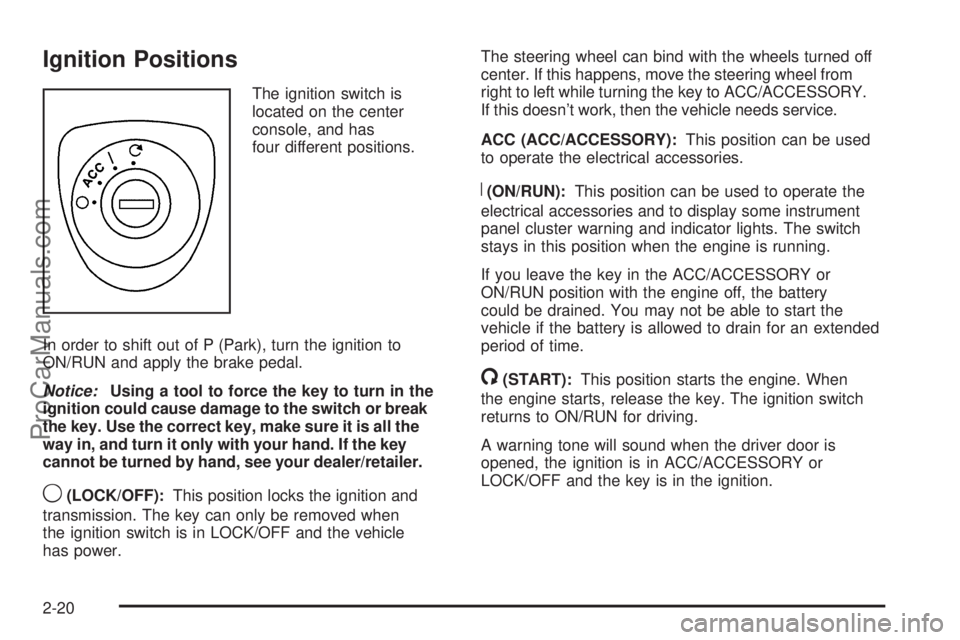
Ignition Positions
The ignition switch is
located on the center
console, and has
four different positions.
In order to shift out of P (Park), turn the ignition to
ON/RUN and apply the brake pedal.
Notice:Using a tool to force the key to turn in the
ignition could cause damage to the switch or break
the key. Use the correct key, make sure it is all the
way in, and turn it only with your hand. If the key
cannot be turned by hand, see your dealer/retailer.
9(LOCK/OFF):This position locks the ignition and
transmission. The key can only be removed when
the ignition switch is in LOCK/OFF and the vehicle
has power.The steering wheel can bind with the wheels turned off
center. If this happens, move the steering wheel from
right to left while turning the key to ACC/ACCESSORY.
If this doesn’t work, then the vehicle needs service.
ACC (ACC/ACCESSORY):This position can be used
to operate the electrical accessories.
R(ON/RUN):This position can be used to operate the
electrical accessories and to display some instrument
panel cluster warning and indicator lights. The switch
stays in this position when the engine is running.
If you leave the key in the ACC/ACCESSORY or
ON/RUN position with the engine off, the battery
could be drained. You may not be able to start the
vehicle if the battery is allowed to drain for an extended
period of time.
/(START):This position starts the engine. When
the engine starts, release the key. The ignition switch
returns to ON/RUN for driving.
A warning tone will sound when the driver door is
opened, the ignition is in ACC/ACCESSORY or
LOCK/OFF and the key is in the ignition.
2-20
ProCarManuals.com
Page 99 of 424
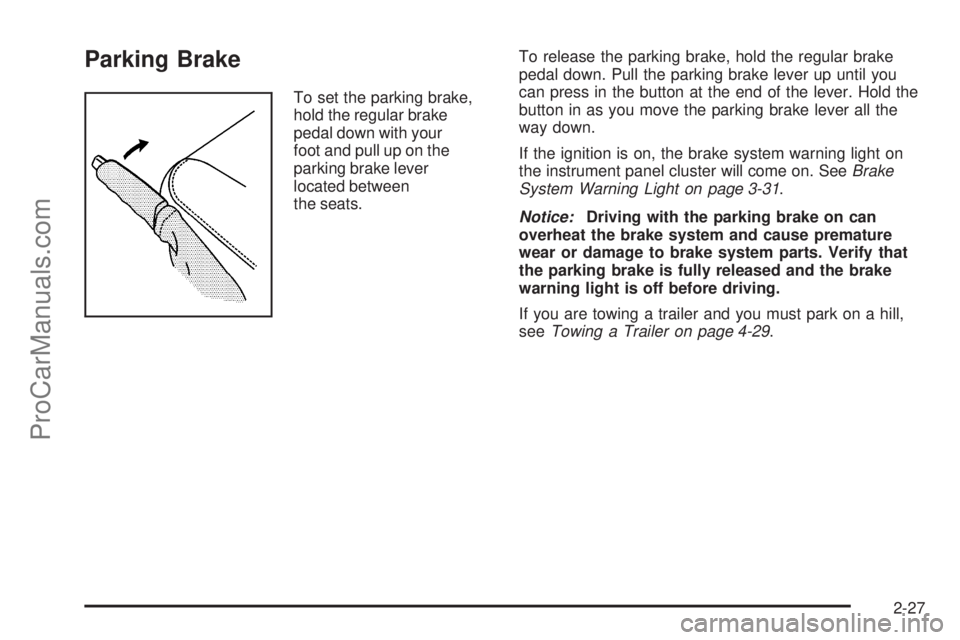
Parking Brake
To set the parking brake,
hold the regular brake
pedal down with your
foot and pull up on the
parking brake lever
located between
the seats.To release the parking brake, hold the regular brake
pedal down. Pull the parking brake lever up until you
can press in the button at the end of the lever. Hold the
button in as you move the parking brake lever all the
way down.
If the ignition is on, the brake system warning light on
the instrument panel cluster will come on. SeeBrake
System Warning Light on page 3-31.
Notice:Driving with the parking brake on can
overheat the brake system and cause premature
wear or damage to brake system parts. Verify that
the parking brake is fully released and the brake
warning light is off before driving.
If you are towing a trailer and you must park on a hill,
seeTowing a Trailer on page 4-29.
2-27
ProCarManuals.com
Page 104 of 424
Mirrors
Automatic Dimming Rearview Mirror
The vehicle may have an automatic dimming rearview
mirror with a compass display.
O(On/Off):Press to turn the dimming feature
on or off.
Automatic Dimming Mirror Operation
Automatic dimming reduces the glare of lights from
behind the vehicle. The dimming feature comes on
and the indicator light illuminates each time the vehicle
is started.
Cleaning the Mirror
Do not spray glass cleaner directly on the mirror.
Use a soft towel dampened with water.
Compass
Compass Operation
There is a compass display on the upper right corner of
the mirror.
Press
Oto turn the compass display on or off.
Compass Calibration
Press and holdOto activate the compass calibration
mode. CAL displays in the compass window on the
mirror.
The compass can be calibrated by driving the vehicle
in circles at 5 mph (8 km/h) or less until the display
reads a direction.
If after a few seconds the display does not show a
compass direction, (N for North for example), there may
be a strong magnetic eld interfering with the compass.
Interference can be caused by a magnetic antenna
mount, note pad holder, or similar object. If CAL appears
in the compass window, the compass may need to be
reset or calibrated.
2-32
ProCarManuals.com
Page 110 of 424
Location information about the vehicle is only available
if the GPS satellite signals are unobstructed and
available.
The vehicle must have a working electrical system,
including adequate battery power, for the OnStar
equipment to operate. There are other problems OnStar
cannot control that may prevent OnStar from providing
OnStar service at any particular time or place. Some
examples are damage to important parts of the vehicle
in a crash, hills, tall buildings, tunnels, weather or
wireless phone network congestion.
Your Responsibility
Increase the volume of the radio if the OnStar advisor
cannot be heard. If the light next to the OnStar buttons
is red, the system may not be functioning properly.
Press the OnStar button and request a vehicle
diagnostic. If the light appears clear (no light is
appearing), your OnStar subscription has expired and
all services have been deactivated. Press the OnStar
button to conrm that the OnStar equipment is active.
Universal Home Remote
System
The Universal Home Remote System provides a way to
replace up to three hand-held Radio-Frequency (RF)
transmitters used to activate devices such as garage
door openers, security systems, and home lighting.
This device complies with Part 15 of the FCC Rules.
Operation is subject to the following two conditions:
1. This device may not cause harmful interference.
2. This device must accept any interference received,
including interference that may cause undesired
operation.
This device complies with RSS-210 of Industry Canada.
Operation is subject to the following two conditions:
1. This device may not cause interference.
2. This device must accept any interference received,
including interference that may cause undesired
operation of the device.
Changes or modications to this system by other than
an authorized service facility could void authorization to
use this equipment.
2-38
ProCarManuals.com