towing SAAB 9-7X 2009 Owner's Manual
[x] Cancel search | Manufacturer: SAAB, Model Year: 2009, Model line: 9-7X, Model: SAAB 9-7X 2009Pages: 424, PDF Size: 2.75 MB
Page 257 of 424
Following Distance
Stay at least twice as far behind the vehicle ahead as
you would when driving the vehicle without a trailer. This
can help to avoid situations that require heavy braking
and sudden turns.
Passing
More passing distance is needed when towing a trailer.
Because the rig is longer, it is necessary to go much
farther beyond the passed vehicle before returning to
the lane.
Backing Up
Hold the bottom of the steering wheel with one hand.
Then, to move the trailer to the left, move that hand
to the left. To move the trailer to the right, move your
hand to the right. Always back up slowly and, if possible,
have someone guide you.
Making Turns
Notice:Making very sharp turns while trailering
could cause the trailer to come in contact with the
vehicle. The vehicle could be damaged. Avoid
making very sharp turns while trailering.
When turning with a trailer, make wider turns than
normal. Do this so the trailer will not strike soft shoulders,
curbs, road signs, trees or other objects. Avoid jerky or
sudden maneuvers. Signal well in advance.
Turn Signals When Towing a Trailer
The arrows on the instrument panel ash whenever
signaling a turn or lane change. Properly hooked up, the
trailer lamps also ash, telling other drivers the vehicle
is turning, changing lanes or stopping.
When towing a trailer, the arrows on the instrument panel
ash for turns even if the bulbs on the trailer are burned
out. For this reason you may think other drivers are
seeing the signal when they are not. It is important to
check occasionally to be sure the trailer bulbs are still
working.
4-37
ProCarManuals.com
Page 258 of 424
Driving On Grades
Reduce speed and shift to a lower gearbeforestarting
down a long or steep downgrade. If the transmission is
not shifted down, the brakes might have to be used so
much that they would get hot and no longer work well.
Vehicles can tow in D (Drive). Shift the transmission to
a lower gear if the transmission shifts too often under
heavy loads and/or hilly conditions.
When towing at high altitude on steep uphill grades,
consider the following: Engine coolant will boil at a lower
temperature than at normal altitudes. If the engine is
turned off immediately after towing at high altitude on
steep uphill grades, the vehicle may show signs similar to
engine overheating. To avoid this, let the engine run while
parked, preferably on level ground, with the automatic
transmission in P (Park) for a few minutes before turning
the engine off. For vehicles with manual transmissions,
let the engine run while parked, preferably on level
ground, with the transmission out of gear and the parking
brake applied, for a few minutes before turning the engine
off. If the overheat warning comes on, seeEngine
Overheating on page 5-34.
Parking on Hills
{CAUTION:
Parking the vehicle on a hill with the trailer
attached can be dangerous. If something goes
wrong, the rig could start to move. People can be
injured, and both the vehicle and the trailer can be
damaged. When possible, always park the rig on a
at surface.
If parking the rig on a hill:
1. Press the brake pedal, but do not shift into P (Park)
yet. Turn the wheels into the curb if facing downhill
or into traffic if facing uphill.
2. Have someone place chocks under the trailer
wheels.
3. When the wheel chocks are in place, release the
brake pedal until the chocks absorb the load.
4. Reapply the brake pedal. Then apply the parking
brake and shift into P (Park).
5. Release the brake pedal.
4-38
ProCarManuals.com
Page 259 of 424
Leaving After Parking on a Hill
1. Apply and hold the brake pedal while you:
start the engine,
shift into a gear, and
release the parking brake.
2. Let up on the brake pedal.
3. Drive slowly until the trailer is clear of the chocks.
4. Stop and have someone pick up and store the
chocks.
Maintenance When Trailer Towing
The vehicle needs service more often when pulling a
trailer. See this manual’s Maintenance Schedule
or Index for more information. Things that are especially
important in trailer operation are automatic transmission
uid, engine oil, axle lubricant, belts, cooling system
and brake system. It is a good idea to inspect
these before and during the trip.
Check periodically to see that all hitch nuts and bolts
are tight.
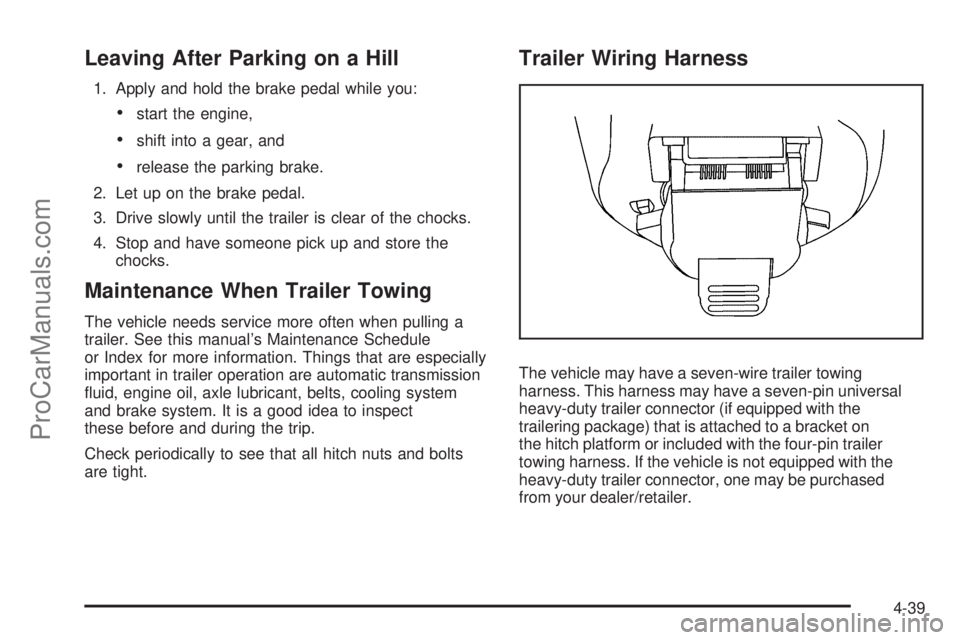
Trailer Wiring Harness
The vehicle may have a seven-wire trailer towing
harness. This harness may have a seven-pin universal
heavy-duty trailer connector (if equipped with the
trailering package) that is attached to a bracket on
the hitch platform or included with the four-pin trailer
towing harness. If the vehicle is not equipped with the
heavy-duty trailer connector, one may be purchased
from your dealer/retailer.
4-39
ProCarManuals.com
Page 260 of 424
The seven-wire harness contains the following trailer
circuits:
Yellow: Left Stop/Turn Signal
Dark Green: Right Stop/Turn Signal
Brown: Running Lamps
White: Ground
Light Green: Back-up Lamps
Dark Blue: Electric Brakes
Red: Battery Feed (The chassis wiring ring terminal
must be fastened to a stud on the underhood
electrical center before the trailer feed will become
active.)
If towing a light-duty trailer with a standard four-way
round pin connector, an adapter connector is available
from your dealer/retailer.
If charging a remote (non-vehicle) battery, turn on the
headlamps to boost the vehicle system voltage and
properly charge the battery.
The vehicle is also equipped with wiring for an electric
trailer brake controller. These wires are located inside the
vehicle on the driver’s side under the instrument panel.
These wires should be connected to an electric trailer
brake controller by your dealer/retailer or a qualied
service center.The vehicle may be equipped with a four-pin trailer
towing harness. This harness has a four-pin trailer
connector that contains the following trailer circuits:
Yellow: Left Stop/Turn Signal
Dark Green: Right Stop/Turn Signal
Brown: Running Lamps
White: Ground
This harness also contains the following trailer circuits
that are not connected to the four-pin trailer connector:
Light Green: Back-Up Lamps
Dark Blue: Electric Brakes
Red: Battery Feed
If the vehicle is a 9–7X Aero, a trailer wiring harness
extension, and instructions for installing this extension,
were provided when the vehicle was delivered.
This extension will allow the vehicle’s trailer wiring
harness to be more easily accessible. There is a
four-way connector on the harness. A seven-way
adapter plug is also included if the trailer requires it.
4-40
ProCarManuals.com
Page 296 of 424
If No Steam Is Coming From The
Engine Compartment
If an engine overheat warning is displayed but no steam
can be seen or heard, the problem may not be too
serious. Sometimes the engine can get a little too hot
when the vehicle:
Climbs a long hill on a hot day.
Stops after high-speed driving.
Idles for long periods in traffic.
Tows a trailer.
If the overheat warning is displayed with no sign of steam:
1. Turn the air conditioning off.
2. Turn the heater on to the highest temperature and
to the highest fan speed. Open the windows as
necessary.
3. In heavy traffic, let the engine idle in N (Neutral) while
stopped. If it is safe to do so, pull off the road, shift to
P (Park) or N (Neutral) and let the engine idle.
If the temperature overheat gage is no longer in the
overheat zone or an overheat warning no longer
displays, the vehicle can be driven. Continue to drive
the vehicle slow for about 10 minutes. Keep a safe
vehicle distance from the car in front of you. If the
warning does not come back on, continue to drive
normally.If the warning continues, pull over, stop, and park the
vehicle right away.
If there is no sign of steam, idle the engine for
three minutes while parked. If the warning is still
displayed, turn off the engine until it cools down.
Engine Fan Noise
The vehicle has a clutched engine cooling fan. When the
clutch is engaged, the fan spins faster to provide more air
to cool the engine. In most everyday driving conditions
the clutch is not engaged. This improves fuel economy
and reduces fan noise. Under heavy vehicle loading,
trailer towing, and/or high outside temperatures, the fan
speed increases when the clutch engages so you may
hear an increase in fan noise. This is normal and should
not be mistaken as the transmission slipping or making
extra shifts. It is merely the cooling system functioning
properly. The fan will slow down when additional cooling
is not required and the clutch disengages.
You may also hear this fan noise when the engine is
started. The sound will go away as the fan clutch
disengages.
5-36
ProCarManuals.com
Page 382 of 424
(e)Make sure the safety belt reminder light and safety
belt assemblies are working properly. Look for any other
loose or damaged safety belt system parts. If you see
anything that might keep a safety belt system from doing
its job, have it repaired. Have any torn or frayed safety
belts replaced. Also see Checking the Restraint Systems
on page 1-66.
(f)Lubricate all key lock cylinders, hood latch assembly,
secondary latch, pivots, spring anchor, release pawl,
rear compartment hinges, outer liftgate handle pivot
points, rear door detent link, roller mechanism, liftgate
handle pivot points, latch bolt, fuel door hinge, cargo
door hinge, locks, and folding seat hardware. More
frequent lubrication may be required when exposed to a
corrosive environment. Applying silicone grease on
weatherstrips with a clean cloth will make them
last longer, seal better, and not stick or squeak.
(g)Inspect hoses for cracks, chafing, leaks, kinks, and
proper installation.
(h)Change automatic transmission fluid and filter if the
vehicle is mainly driven under one or more of these
conditions:
In heavy city traffic where the outside temperature
regularly reaches 90°F (32°C) or higher.
In hilly or mountainous terrain.
When doing frequent trailer towing.
Uses such as found in taxi, police, or delivery
service.(i)Drain, flush, and refill cooling system. This service can
be complex; you should have your dealer/retailer perform
this service. See Engine Coolant on page 5-30 for what to
use. Inspect hoses. Clean radiator, condenser, pressure
cap, and filler neck. Pressure test the cooling system and
pressure cap.
(j)A fluid loss in any vehicle system could indicate a
problem. Have the system inspected and repaired and
the fluid level checked. Add fluid if needed.
(k)If driving regularly under dusty conditions, inspect
the filter at each engine oil change.
(l)Visually inspect belt for fraying, excessive cracks, or
obvious damage. Replace belt if necessary.
Owner Checks and Services
These owner checks and services should be performed
at the intervals specied to help ensure vehicle safety,
dependability, and emission control performance. Your
dealer/retailer can assist with these checks and services.
Be sure any necessary repairs are completed at once.
Whenever any uids or lubricants are added to the
vehicle, make sure they are the proper ones, as shown
inRecommended Fluids and Lubricants on page 6-12.
6-8
ProCarManuals.com
Page 400 of 424
Services Not Included in Roadside
Assistance
Impound towing caused by violation of any laws.
Legal nes.
Mounting, dismounting or changing of snow tires,
chains, or other traction devices.
Towing or services for vehicles driven on a
non-public road or highway.
Services Specic to Canadian
Purchased Vehicles
Fuel delivery:Reimbursement is approximately
$5 Canadian. Diesel fuel delivery may be restricted.
Propane and other fuels are not provided through
this service.
Lock-Out Service:Vehicle registration is required.
Trip Routing Service:Limit of six requests per year.
Trip Interruption Benets and Assistance:Must
be over 250 kilometres from where your trip was
started to qualify. General Motors of Canada Limited
requires pre-authorization, original detailed receipts,
and a copy of the repair orders. Once authorization
has been received, the Roadside Assistance advisor
will help you make arrangements and explain how to
receive payment.
Alternative Service:If assistance cannot be
provided right away, the Roadside Assistance
advisor may give you permission to get local
emergency road service. You will receive payment,
up to $100, after sending the original receipt to
Roadside Assistance. Mechanical failures may be
covered, however any cost for parts and labor for
repairs not covered by the warranty are the owner
responsibility.
Scheduling Service Appointments
When your vehicle requires warranty service, contact
your dealer/retailer and request an appointment.
By scheduling a service appointment and advising your
service consultant of your transportation needs, your
dealer/retailer can help minimize your inconvenience.
If your vehicle cannot be scheduled into the service
department immediately, keep driving it until it can be
scheduled for service, unless, of course, the problem is
safety-related. If it is, please call your dealership/retailer,
let them know this, and ask for instructions.
If the dealer/retailer requests you to bring the vehicle for
service, you are urged to do so as early in the work
day as possible to allow for the same day repair.
7-8
ProCarManuals.com
Page 404 of 424
If a Crash Occurs
Here is what to do if you are involved in a crash.
Try to relax and then check to make sure you are all
right. If you are uninjured, make sure that no one else
in your vehicle, or the other vehicle, is injured.
If there has been an injury, call emergency services
for help. Do not leave the scene of a crash until all
matters have been taken care of. Move your vehicle
only if its position puts you in danger or you are
instructed to move it by a police officer.
Give only the necessary and requested information
to police and other parties involved in the crash.
Do not discuss your personal condition, mental
frame of mind, or anything unrelated to the crash.
This will help guard against post-crash legal action.
If you need roadside assistance, call Saab Roadside
Assistance. SeeRoadside Assistance Program on
page 7-6for more information.
If your vehicle cannot be driven, know where the
towing service will be taking it. Get a card from the
tow truck operator or write down the driver’s name,
the service’s name, and the phone number.
Remove any valuables from your vehicle before it is
towed away. Make sure this includes your insurance
information and registration if you keep these items
in your vehicle.
Gather the important information you will need from
the other driver. Things like name, address, phone
number, driver’s license number, vehicle license
plate, vehicle make, model and model year, Vehicle
Identication Number (VIN), insurance company and
policy number, and a general description of the
damage to the other vehicle.
If possible, call your insurance company from the
scene of the crash. They will walk you through the
information they will need. If they ask for a police
report, phone or go to the police department
headquarters the next day and you can get a copy of
the report for a nominal fee. In some states/provinces
with “no fault” insurance laws, a report may not be
necessary. This is especially true if there are no
injuries and both vehicles are driveable.
Choose a reputable collision repair facility for your
vehicle. Whether you select a Saab dealer or a
private collision repair facility to x the damage,
make sure you are comfortable with them.
Remember, you will have to feel comfortable
with their work for a long time.
Once you have an estimate, read it carefully and
make sure you understand what work will be
performed on your vehicle. If you have a question,
ask for an explanation. Reputable shops welcome
this opportunity.
7-12
ProCarManuals.com
Page 420 of 424
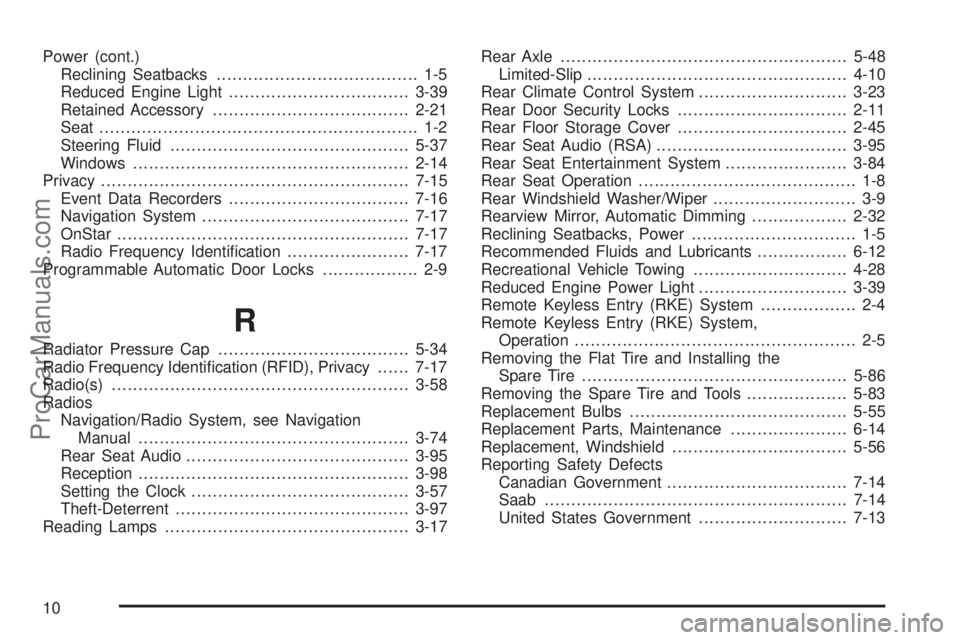
Power (cont.)
Reclining Seatbacks...................................... 1-5
Reduced Engine Light..................................3-39
Retained Accessory.....................................2-21
Seat ............................................................ 1-2
Steering Fluid.............................................5-37
Windows....................................................2-14
Privacy..........................................................7-15
Event Data Recorders..................................7-16
Navigation System.......................................7-17
OnStar .......................................................7-17
Radio Frequency Identication.......................7-17
Programmable Automatic Door Locks.................. 2-9
R
Radiator Pressure Cap....................................5-34
Radio Frequency Identication (RFID), Privacy......7-17
Radio(s)........................................................3-58
Radios
Navigation/Radio System, see Navigation
Manual...................................................3-74
Rear Seat Audio..........................................3-95
Reception...................................................3-98
Setting the Clock.........................................3-57
Theft-Deterrent............................................3-97
Reading Lamps..............................................3-17Rear Axle......................................................5-48
Limited-Slip.................................................4-10
Rear Climate Control System............................3-23
Rear Door Security Locks................................2-11
Rear Floor Storage Cover................................2-45
Rear Seat Audio (RSA)....................................3-95
Rear Seat Entertainment System.......................3-84
Rear Seat Operation......................................... 1-8
Rear Windshield Washer/Wiper........................... 3-9
Rearview Mirror, Automatic Dimming..................2-32
Reclining Seatbacks, Power............................... 1-5
Recommended Fluids and Lubricants.................6-12
Recreational Vehicle Towing.............................4-28
Reduced Engine Power Light............................3-39
Remote Keyless Entry (RKE) System.................. 2-4
Remote Keyless Entry (RKE) System,
Operation..................................................... 2-5
Removing the Flat Tire and Installing the
Spare Tire..................................................5-86
Removing the Spare Tire and Tools...................5-83
Replacement Bulbs.........................................5-55
Replacement Parts, Maintenance......................6-14
Replacement, Windshield.................................5-56
Reporting Safety Defects
Canadian Government..................................7-14
Saab.........................................................7-14
United States Government............................7-13
10
ProCarManuals.com
Page 423 of 424
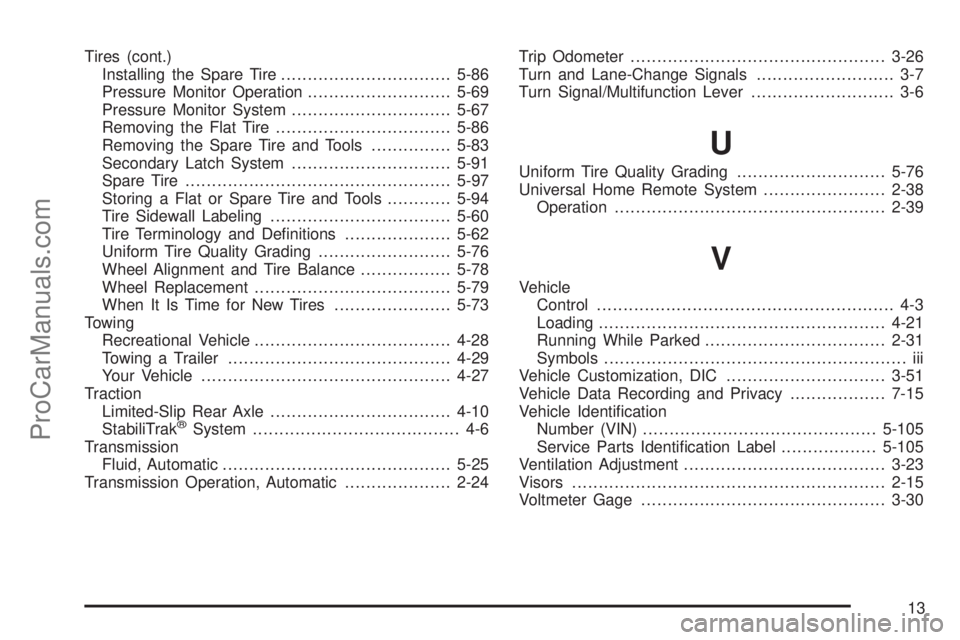
Tires (cont.)
Installing the Spare Tire................................5-86
Pressure Monitor Operation...........................5-69
Pressure Monitor System..............................5-67
Removing the Flat Tire.................................5-86
Removing the Spare Tire and Tools...............5-83
Secondary Latch System..............................5-91
Spare Tire..................................................5-97
Storing a Flat or Spare Tire and Tools............5-94
Tire Sidewall Labeling..................................5-60
Tire Terminology and Denitions....................5-62
Uniform Tire Quality Grading.........................5-76
Wheel Alignment and Tire Balance.................5-78
Wheel Replacement.....................................5-79
When It Is Time for New Tires......................5-73
Towing
Recreational Vehicle.....................................4-28
Towing a Trailer..........................................4-29
Your Vehicle...............................................4-27
Traction
Limited-Slip Rear Axle..................................4-10
StabiliTrak
®System....................................... 4-6
Transmission
Fluid, Automatic...........................................5-25
Transmission Operation, Automatic....................2-24Trip Odometer................................................3-26
Turn and Lane-Change Signals.......................... 3-7
Turn Signal/Multifunction Lever........................... 3-6
U
Uniform Tire Quality Grading............................5-76
Universal Home Remote System.......................2-38
Operation...................................................2-39
V
Vehicle
Control........................................................ 4-3
Loading......................................................4-21
Running While Parked..................................2-31
Symbols......................................................... iii
Vehicle Customization, DIC..............................3-51
Vehicle Data Recording and Privacy..................7-15
Vehicle Identication
Number (VIN)............................................5-105
Service Parts Identication Label..................5-105
Ventilation Adjustment......................................3-23
Visors...........................................................2-15
Voltmeter Gage..............................................3-30
13
ProCarManuals.com