child restraint SATURN ASTRA 2008 User Guide
[x] Cancel search | Manufacturer: SATURN, Model Year: 2008, Model line: ASTRA, Model: SATURN ASTRA 2008Pages: 304, PDF Size: 1.92 MB
Page 37 of 304
If a person of adult-size is sitting
in the right front passenger’s seat,
but the off indicator is lit, it could be
because that person is not sitting
properly in the seat. If this happens,
turn the vehicle off, remove any
additional material from the seat,
such as blankets, cushions, seat
covers, seat heaters or seat
massagers and ask the person
to place the seatback in the fully
upright position, then sit upright
in the seat, centered on the seat
cushion, with the person’s legs
comfortably extended. Restart the
vehicle and have the person remain
in this position for two to three
minutes. This will allow the system
to detect that person and then enable
the right front passenger’s frontal
airbag and seat-mounted side
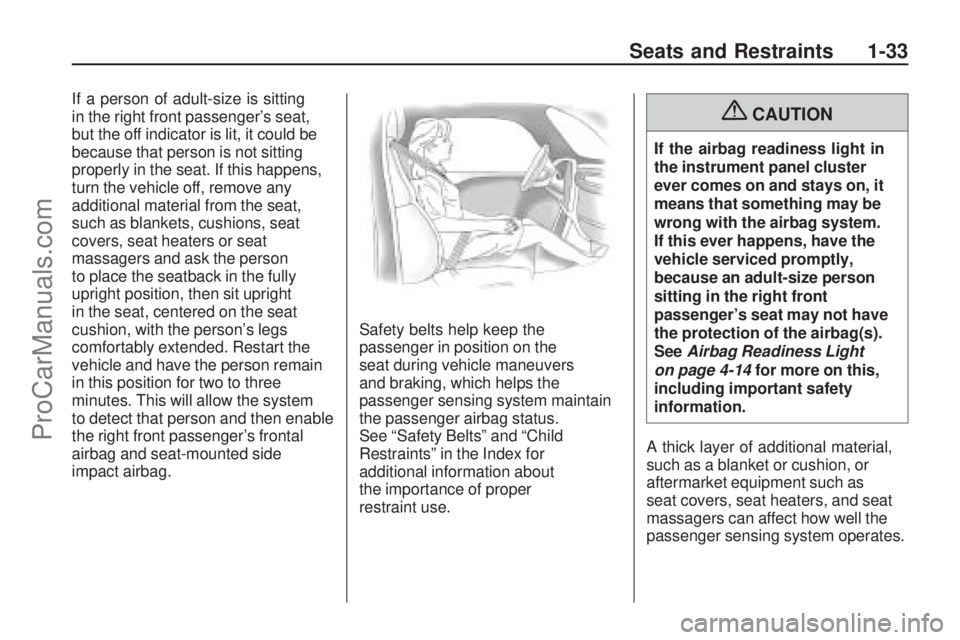
impact airbag.Safety belts help keep the
passenger in position on the
seat during vehicle maneuvers
and braking, which helps the
passenger sensing system maintain
the passenger airbag status.
See “Safety Belts” and “Child
Restraints” in the Index for
additional information about
the importance of proper
restraint use.{CAUTION
If the airbag readiness light in
the instrument panel cluster
ever comes on and stays on, it
means that something may be
wrong with the airbag system.
If this ever happens, have the
vehicle serviced promptly,
because an adult-size person
sitting in the right front
passenger’s seat may not have
the protection of the airbag(s).
SeeAirbag Readiness Light
on page 4-14for more on this,
including important safety
information.
A thick layer of additional material,
such as a blanket or cushion, or
aftermarket equipment such as
seat covers, seat heaters, and seat
massagers can affect how well the
passenger sensing system operates.
Seats and Restraints 1-33
ProCarManuals.com
Page 41 of 304
Child Restraints
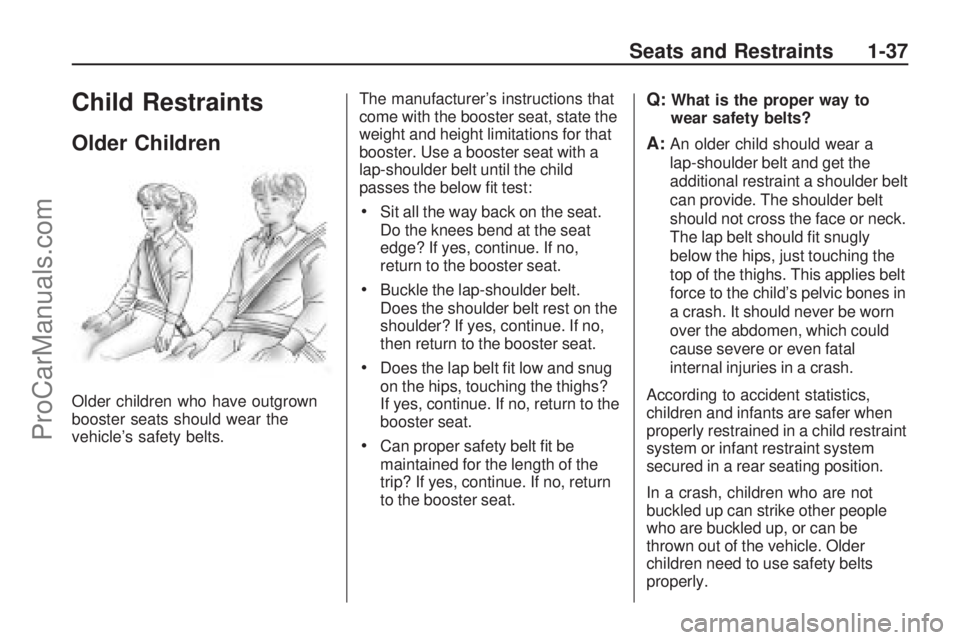
Older Children
Older children who have outgrown
booster seats should wear the
vehicle’s safety belts.The manufacturer’s instructions that
come with the booster seat, state the
weight and height limitations for that
booster. Use a booster seat with a
lap-shoulder belt until the child
passes the below t test:
Sit all the way back on the seat.
Do the knees bend at the seat
edge? If yes, continue. If no,
return to the booster seat.
Buckle the lap-shoulder belt.
Does the shoulder belt rest on the
shoulder? If yes, continue. If no,
then return to the booster seat.
Does the lap belt t low and snug
on the hips, touching the thighs?
If yes, continue. If no, return to the
booster seat.
Can proper safety belt t be
maintained for the length of the
trip? If yes, continue. If no, return
to the booster seat.
Q:What is the proper way to
wear safety belts?
A:An older child should wear a
lap-shoulder belt and get the
additional restraint a shoulder belt
can provide. The shoulder belt
should not cross the face or neck.
The lap belt should t snugly
below the hips, just touching the
top of the thighs. This applies belt
force to the child’s pelvic bones in
a crash. It should never be worn
over the abdomen, which could
cause severe or even fatal
internal injuries in a crash.
According to accident statistics,
children and infants are safer when
properly restrained in a child restraint
system or infant restraint system
secured in a rear seating position.
In a crash, children who are not
buckled up can strike other people
who are buckled up, or can be
thrown out of the vehicle. Older
children need to use safety belts
properly.
Seats and Restraints 1-37
ProCarManuals.com
Page 42 of 304
{CAUTION
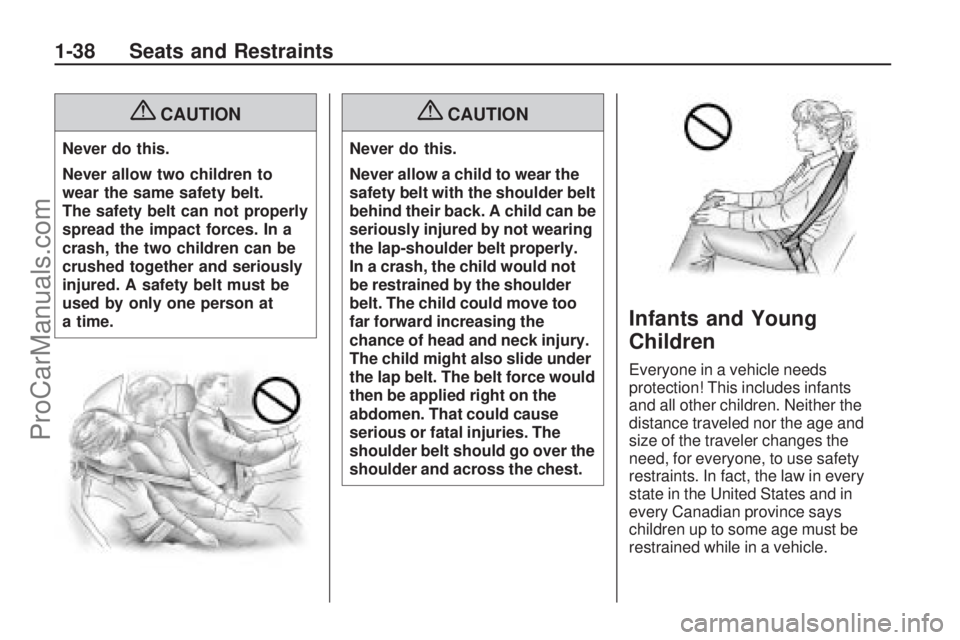
Never do this.
Never allow two children to
wear the same safety belt.
The safety belt can not properly
spread the impact forces. In a
crash, the two children can be
crushed together and seriously
injured. A safety belt must be
used by only one person at
a time.
{CAUTION
Never do this.
Never allow a child to wear the
safety belt with the shoulder belt
behind their back. A child can be
seriously injured by not wearing
the lap-shoulder belt properly.
In a crash, the child would not
be restrained by the shoulder
belt. The child could move too
far forward increasing the
chance of head and neck injury.
The child might also slide under
the lap belt. The belt force would
then be applied right on the
abdomen. That could cause
serious or fatal injuries. The
shoulder belt should go over the
shoulder and across the chest.
Infants and Young
Children
Everyone in a vehicle needs
protection! This includes infants
and all other children. Neither the
distance traveled nor the age and
size of the traveler changes the
need, for everyone, to use safety
restraints. In fact, the law in every
state in the United States and in
every Canadian province says
children up to some age must be
restrained while in a vehicle.
1-38 Seats and Restraints
ProCarManuals.com
Page 43 of 304
{CAUTION
Children can be seriously
injured or strangled if a
shoulder belt is wrapped around
their neck and the safety belt
continues to tighten. Never
leave children unattended in a
vehicle and never allow children
to play with the safety belts.
Every time infants and young
children ride in vehicles, they should
have the protection provided by
appropriate restraints. Children who
are not restrained properly can strike
other people, or can be thrown out
of the vehicle. In addition, young
children should not use the vehicle’s
adult safety belts alone; they need
to use a child restraint.
{CAUTION
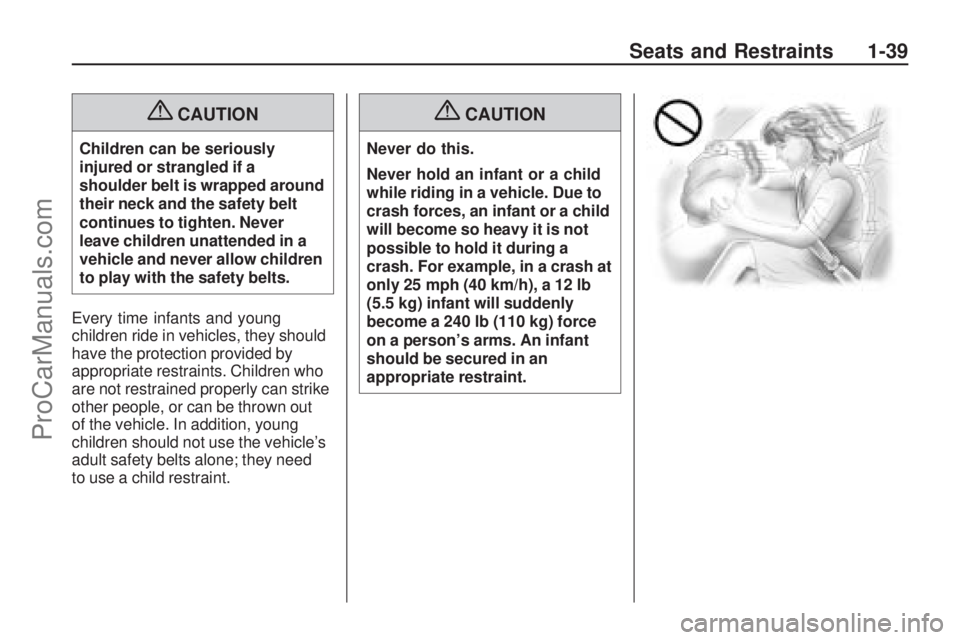
Never do this.
Never hold an infant or a child
while riding in a vehicle. Due to
crash forces, an infant or a child
will become so heavy it is not
possible to hold it during a
crash. For example, in a crash at
only 25 mph (40 km/h), a 12 lb
(5.5 kg) infant will suddenly
become a 240 lb (110 kg) force
on a person’s arms. An infant
should be secured in an
appropriate restraint.
Seats and Restraints 1-39
ProCarManuals.com
Page 44 of 304
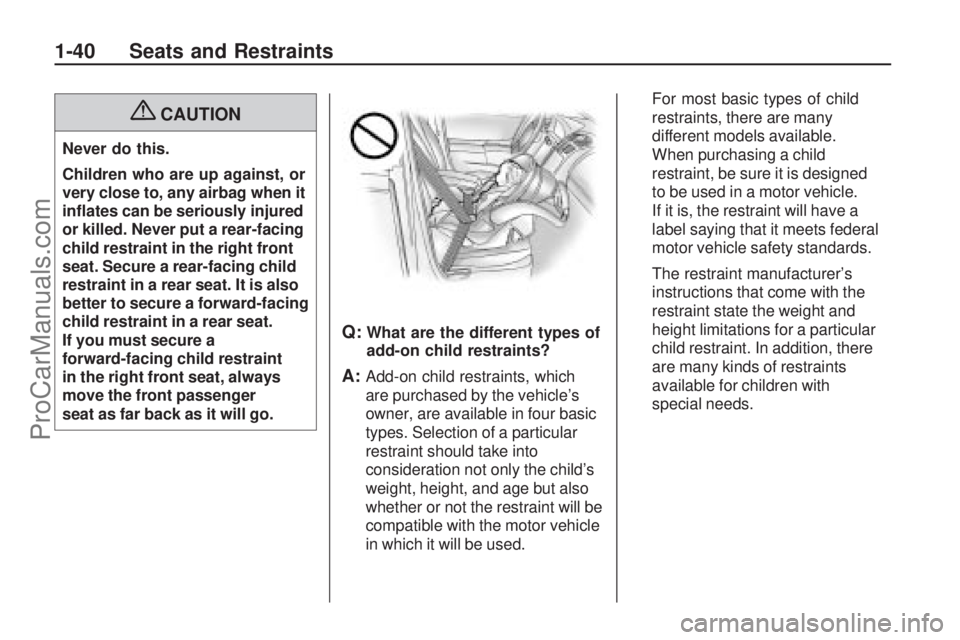
{CAUTION
Never do this.
Children who are up against, or
very close to, any airbag when it
inates can be seriously injured
or killed. Never put a rear-facing
child restraint in the right front
seat. Secure a rear-facing child
restraint in a rear seat. It is also
better to secure a forward-facing
child restraint in a rear seat.
If you must secure a
forward-facing child restraint
in the right front seat, always
move the front passenger
seat as far back as it will go.
Q:What are the different types of
add-on child restraints?
A:Add-on child restraints, which
are purchased by the vehicle’s
owner, are available in four basic
types. Selection of a particular
restraint should take into
consideration not only the child’s
weight, height, and age but also
whether or not the restraint will be
compatible with the motor vehicle
in which it will be used.For most basic types of child
restraints, there are many
different models available.
When purchasing a child
restraint, be sure it is designed
to be used in a motor vehicle.
If it is, the restraint will have a
label saying that it meets federal
motor vehicle safety standards.
The restraint manufacturer’s
instructions that come with the
restraint state the weight and
height limitations for a particular
child restraint. In addition, there
are many kinds of restraints
available for children with
special needs.
1-40 Seats and Restraints
ProCarManuals.com
Page 45 of 304
{CAUTION
To reduce the risk of neck and
head injury during a crash,
infants need complete support.
This is because an infant’s neck
is not fully developed and its
head weighs so much compared
with the rest of its body. In a
crash, an infant in a rear-facing
child restraint settles into the
restraint, so the crash forces
can be distributed across the
strongest part of an infant’s
body, the back and shoulders.
Infants should always be
secured in rear-facing child
restraints.
{CAUTION
A young child’s hip bones are
still so small that the vehicle’s
regular safety belt may not
remain low on the hip bones,
as it should. Instead, it may
settle up around the child’s
abdomen. In a crash, the belt
would apply force on a body
area that is unprotected by
any bony structure. This alone
could cause serious or fatal
injuries. To reduce the risk
of serious or fatal injuries
during a crash, young children
should always be secured in
appropriate child restraints.
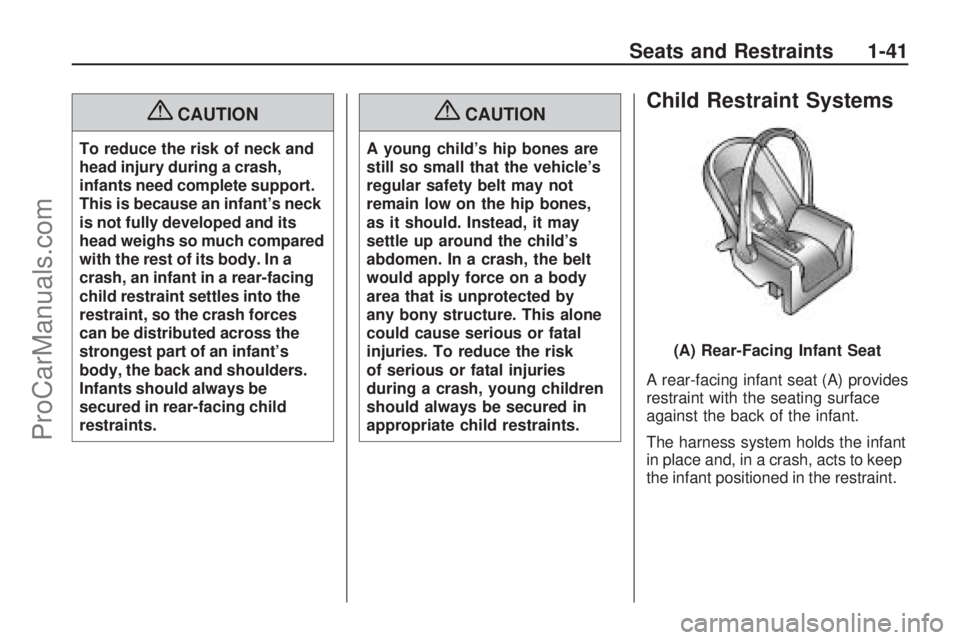
Child Restraint Systems
A rear-facing infant seat (A) provides
restraint with the seating surface
against the back of the infant.
The harness system holds the infant
in place and, in a crash, acts to keep
the infant positioned in the restraint.(A) Rear-Facing Infant Seat
Seats and Restraints 1-41
ProCarManuals.com
Page 46 of 304
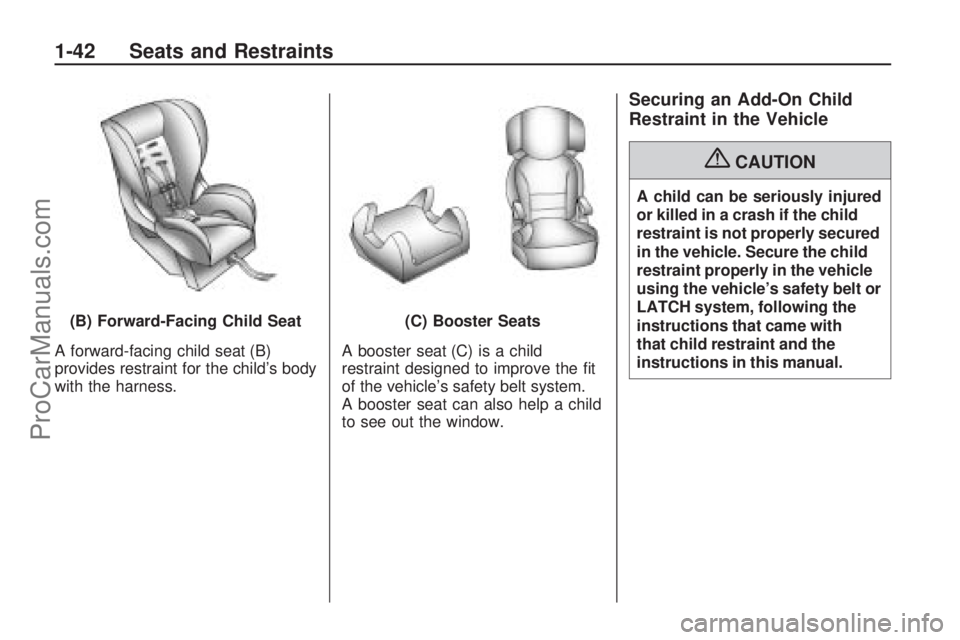
A forward-facing child seat (B)
provides restraint for the child’s body
with the harness.A booster seat (C) is a child
restraint designed to improve the t
of the vehicle’s safety belt system.
A booster seat can also help a child
to see out the window.
Securing an Add-On Child
Restraint in the Vehicle
{CAUTION
A child can be seriously injured
or killed in a crash if the child
restraint is not properly secured
in the vehicle. Secure the child
restraint properly in the vehicle
using the vehicle’s safety belt or
LATCH system, following the
instructions that came with
that child restraint and the
instructions in this manual. (B) Forward-Facing Child Seat
(C) Booster Seats
1-42 Seats and Restraints
ProCarManuals.com
Page 47 of 304
To help reduce the chance of injury,
the child restraint must be secured in
the vehicle. Child restraint systems
must be secured in vehicle seats by
lap belts or the lap belt portion of a
lap-shoulder belt, or by the LATCH
system. SeeLower Anchors and
Tethers for Children (LATCH) on
page 1-45for more information.
A child can be endangered in a
crash if the child restraint is not
properly secured in the vehicle.
When securing an add-on child
restraint, refer to the instructions that
come with the restraint which may be
on the restraint itself or in a booklet,
or both, and to this manual. The child
restraint instructions are important,
so if they are not available, obtain
a replacement copy from the
manufacturer.Keep in mind that an unsecured
child restraint can move around in a
collision or sudden stop and injure
people in the vehicle. Be sure to
properly secure any child restraint
in the vehicle — even when no child
is in it.
Securing the Child Within the
Child Restraint
{CAUTION
A child can be seriously injured
or killed in a crash if the child
is not properly secured in the
child restraint. Secure the
child properly following the
instructions that came with
that child restraint.
Where to Put the
Restraint
According to accident statistics,
children and infants are safer when
properly restrained in a child restraint
system or infant restraint system
secured in a rear seating position.
We recommend that children and
child restraints be secured in a rear
seat, including: an infant or a child
riding in a rear-facing child restraint;
a child riding in a forward-facing child
seat; an older child riding in a booster
seat; and children, who are large
enough, using safety belts.
Seats and Restraints 1-43
ProCarManuals.com
Page 48 of 304
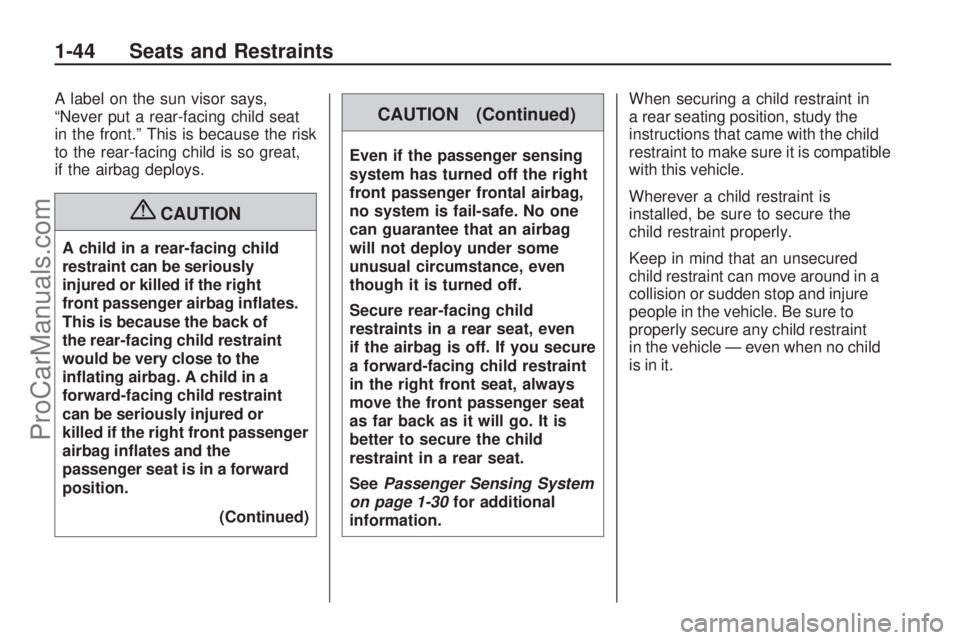
A label on the sun visor says,
“Never put a rear-facing child seat
in the front.” This is because the risk
to the rear-facing child is so great,
if the airbag deploys.
{CAUTION
A child in a rear-facing child
restraint can be seriously
injured or killed if the right
front passenger airbag inates.
This is because the back of
the rear-facing child restraint
would be very close to the
inating airbag. A child in a
forward-facing child restraint
can be seriously injured or
killed if the right front passenger
airbag inates and the
passenger seat is in a forward
position.
(Continued)
CAUTION (Continued)
Even if the passenger sensing
system has turned off the right
front passenger frontal airbag,
no system is fail-safe. No one
can guarantee that an airbag
will not deploy under some
unusual circumstance, even
though it is turned off.
Secure rear-facing child
restraints in a rear seat, even
if the airbag is off. If you secure
a forward-facing child restraint
in the right front seat, always
move the front passenger seat
as far back as it will go. It is
better to secure the child
restraint in a rear seat.
SeePassenger Sensing System
on page 1-30for additional
information.When securing a child restraint in
a rear seating position, study the
instructions that came with the child
restraint to make sure it is compatible
with this vehicle.
Wherever a child restraint is
installed, be sure to secure the
child restraint properly.
Keep in mind that an unsecured
child restraint can move around in a
collision or sudden stop and injure
people in the vehicle. Be sure to
properly secure any child restraint
in the vehicle — even when no child
is in it.
1-44 Seats and Restraints
ProCarManuals.com
Page 49 of 304
Lower Anchors and
Tethers for Children
(LATCH)
The LATCH system holds a child
restraint during driving or in a crash.
This system is designed to make
installation of a child restraint easier.
The LATCH system uses anchors
in the vehicle and attachments
on the child restraint that are made
for use with the LATCH system.
Make sure that a LATCH-compatible
child restraint is properly installed
using the anchors, or use the
vehicle’s safety belts to secure the
restraint, following the instructions
that came with that restraint, and
also the instructions in this manual.When installing a child restraint with
a top tether, you must also use either
the lower anchors or the safety belts
to properly secure the child restraint.
A child restraint must never be
installed using only the top tether
and anchor.
In order to use the LATCH system
in your vehicle, you need a child
restraint that has LATCH
attachments. The child restraint
manufacturer will provide you with
instructions on how to use the child
restraint and its attachments. The
following explains how to attach a
child restraint with these attachments
in your vehicle.
Not all vehicle seating positions
or child restraints have lower
anchors and attachments or top
tether anchors and attachments.
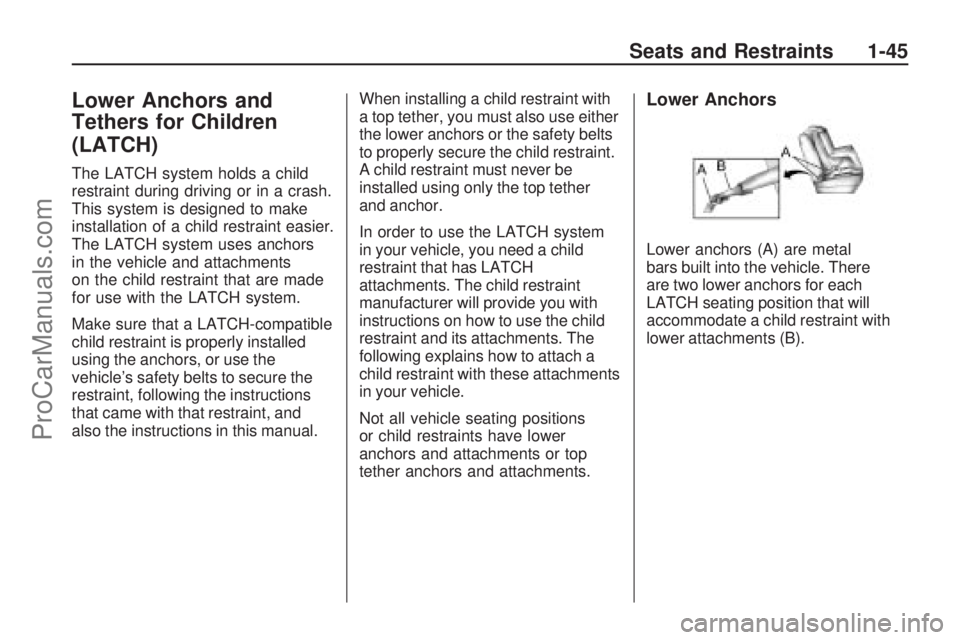
Lower Anchors
Lower anchors (A) are metal
bars built into the vehicle. There
are two lower anchors for each
LATCH seating position that will
accommodate a child restraint with
lower attachments (B).
Seats and Restraints 1-45
ProCarManuals.com