tires SATURN ASTRA 2008 User Guide
[x] Cancel search | Manufacturer: SATURN, Model Year: 2008, Model line: ASTRA, Model: SATURN ASTRA 2008Pages: 304, PDF Size: 1.92 MB
Page 179 of 304

{CAUTION
Coasting downhill in N (Neutral)
or with the ignition off is
dangerous. The brakes will
have to do all the work of
slowing down and they could
get so hot that they would not
work well. You would then have
poor braking or even none
going down a hill. You could
crash. Always have the engine
running and the vehicle in gear
when going downhill.
Stay in your own lane. Do not
swing wide or cut across the
center of the road. Drive at
speeds that let you stay in your
own lane.
Top of hills: Be alert — something
could be in your lane (stalled car,
accident).
Pay attention to special road
signs (falling rocks area, winding
roads, long grades, passing or
no-passing zones) and take
appropriate action.
Winter Driving
Here are some tips for winter
driving:
Have your vehicle in good shape
for winter.
You might want to put winter
emergency supplies in your
vehicle.
Include an ice scraper, a small
brush or broom, a supply of
windshield washer uid, a rag, some
winter outer clothing, a small shovel,
a ashlight, a red cloth, and reective
warning triangles. And, if you will be
driving under severe conditions,
include a small bag of sand, a pieceof old carpet, or a couple of burlap
bags to help provide traction. Be sure
you properly secure these items in
your vehicle.
Also seeTires on page 9-38.
Driving on Snow or Ice
Most of the time, those places
where the tires meet the road
probably have good traction.
However, if there is snow or ice
between the tires and the road, you
can have a very slippery situation.
You have a lot less traction, or grip,
and need to be very careful.
What is the worst time for this? Wet
ice. Very cold snow or ice can be
slick and hard to drive on. But wet ice
can be even more trouble because it
can offer the least traction of all.
Driving and Operating 8-27
ProCarManuals.com
Page 180 of 304

You can get wet ice when it is about
freezing, 32°F (0°C), and freezing
rain begins to fall. Try to avoid driving
on wet ice until salt and sand crews
can get there.
Whatever the condition — smooth
ice, packed, blowing, or loose
snow — drive with caution.
Accelerate gently. Try not to
break the fragile traction. If you
accelerate too fast, the drive wheels
will spin and polish the surface
under the tires even more.
The Antilock Brake System (ABS)
improves your vehicle’s stability
when you make a hard stop
on a slippery road. Even though you
have ABS, begin stopping soonerthan you would on dry pavement.
SeeAntilock Brake System
(ABS) on page 8-18.
Allow greater following distance
on any slippery road.
Watch for slippery spots. The
road might be ne until you hit
a spot that is covered with ice.
On an otherwise clear road, ice
patches can appear in shaded
areas where the sun cannot
reach, such as around clumps of
trees, behind buildings, or under
bridges. Sometimes the surface
of a curve or an overpass can
remain icy when the surrounding
roads are clear. If you see a patch
of ice ahead of you, brake before
you are on it. Try not to brake
while you are actually on the ice,
and avoid sudden steering
maneuvers.
If You Are Caught in a Blizzard
If you are stopped by heavy
snow, you could be in a serious
situation. You should probably
stay with your vehicle unless you
know for sure that you are near
help and you can hike through the
snow. Here are some things to do
to summon help and keep yourself
and your passengers safe:
Turn on the hazard warning
ashers.
Tie a red cloth to your vehicle to
alert police that you have been
stopped by the snow.
Put on extra clothing or wrap a
blanket around you. If you do not
have blankets or extra clothing,
make body insulators from
newspapers, burlap bags, rags,
oor mats — anything you can
wrap around yourself or tuck
under your clothing to keep warm.
You can run the engine to keep
warm, but be careful.
8-28 Driving and Operating
ProCarManuals.com
Page 181 of 304
{CAUTION
Snow can trap exhaust gases
under your vehicle. This can
cause deadly CO (carbon
monoxide) gas to get inside.
CO could overcome you and
kill you. You cannot see it or
smell it, so you might not know
it is in your vehicle. Clear away
snow from around the base of
your vehicle, especially any
that is blocking the exhaust
pipe. And check around again
from time to time to be sure
snow does not collect there.
Open a window just a little on
the side of the vehicle that is
away from the wind. This will
help keep CO out.Run your engine only as long as you
must. This saves fuel. When you run
the engine, make it go a little faster
than just idle. That is, push the
accelerator slightly. This uses less
fuel for the heat that you get and it
keeps the battery charged. You will
need a well-charged battery to
restart the vehicle, and possibly
for signaling later on with the
headlamps. Let the heater run
for a while.
Then, shut the engine off and close
the window almost all the way to
preserve the heat. Start the engine
again and repeat this only when
you feel really uncomfortable from
the cold. But do it as little as
possible. Preserve the fuel as long
as you can. To help keep warm,
you can get out of the vehicle and
do some fairly vigorous exercises
every half hour or so until help
comes.
If Your Vehicle is
Stuck in Sand, Mud, Ice,
or Snow
Slowly and cautiously spin the
wheels to free the vehicle when
stuck in sand, mud, ice, or snow.
SeeRocking Your Vehicle to Get It
Out on page 8-30.
{CAUTION
If you let your vehicle’s tires
spin at high speed, they can
explode, and you or others
could be injured. The vehicle
can overheat, causing an
engine compartment re or
other damage. Spin the wheels
as little as possible and avoid
going above 35 mph (55 km/h)
as shown on the speedometer.
For information about using tire
chains on the vehicle, seeTire
Chains on page 9-59.
Driving and Operating 8-29
ProCarManuals.com
Page 183 of 304

{CAUTION
Do not load the vehicle any
heavier than the Gross
Vehicle Weight Rating
(GVWR), or either the
maximum front or rear
Gross Axle Weight Rating
(GAWR). If you do, parts on
the vehicle can break, and it
can change the way your
vehicle handles. These
could cause you to lose
control and crash. Also,
overloading can shorten
the life of the vehicle.Tire and Loading Information
Label
A vehicle specic Tire and
Loading Information label
is attached to the vehicle’s
center pillar (B-pillar). With the
driver’s door open, you will
nd the label attached below
the door lock post. The Tireand Loading Information label
shows the number of occupant
seating positions (A), and
the maximum vehicle capacity
weight (B) in kilograms and
pounds.
The Tire and Loading
Information label also shows the
tire size of the original equipment
tires (C) and the recommended
cold tire ination pressures (D).
For more information on tires and
ination seeTires on page 9-38
andInflation - Tire Pressure on
page 9-46.
There is also important loading
information on the Certication
label. It tells you the Gross
Vehicle Weight Rating (GVWR)
and the Gross Axle Weight
Rating (GAWR) for the front and
rear axle; see “Certication
Label” later in this section.
Label Example
Driving and Operating 8-31
ProCarManuals.com
Page 191 of 304
Vehicle Service
and Care
Service
Service...............................9-2
Accessories and
Modications.....................9-3
California Proposition 65
Warning............................9-3
California Perchlorate
Materials Requirements.....9-3
Doing Your Own
Service Work....................9-4
Adding Equipment to the
Outside of the Vehicle......9-4
Owner Checks
Owner Checks....................9-5
Hood Release.....................9-5
Engine Compartment
Overview...........................9-6
Engine Oil..........................9-7
Engine Oil Life System.......9-9
Engine Air Cleaner/Filter. . . .9-11
Automatic Transmission
Fluid................................9-12
Manual Transmission
Fluid................................9-12
Hydraulic Clutch................9-12
Engine Coolant.................9-12
Pressure Cap....................9-15
Engine Overheating...........9-15
Cooling System.................9-16
Power Steering Fluid.........9-20
Windshield Washer Fluid. . . .9-20
Windshield Wiper Blade
Replacement...................9-21
Brakes..............................9-22
Battery..............................9-25
Headlamp Aiming
Headlamp Aiming..............9-26
Bulb Replacement
Bulb Replacement.............9-28
Halogen Bulbs..................9-28
Front Turn Signal Lamps. . .9-28
Taillamps
(Five-Door Hatchback).....9-29
Taillamps
(Three-Door Hatchback). . .9-30
License Plate Lamp..........9-32
Replacement Bulbs...........9-33
Electrical System
Add-On Electrical
Equipment.......................9-33
Headlamp Wiring..............9-33
Windshield Wiper Fuses. . . .9-34
Power Windows and
Other Power Options.......9-34
Fuses...............................9-34
Engine Compartment
Fuse Block......................9-34
Rear Compartment
Fuse Block......................9-36
Tires
Tires.................................9-38
Winter Tires......................9-39
Tire Sidewall Labeling.......9-40
Tire Terminology and
Denitions.......................9-43
Ination - Tire Pressure. . . .9-46
High-Speed Operation.......9-47
Tire Pressure Monitor
System............................9-48
Tire Pressure Monitor
Operation........................9-50
Tire Inspection and
Rotation..........................9-51
When It Is Time for
New Tires.......................9-53
Vehicle Service and Care 9-1
ProCarManuals.com
Page 192 of 304
Buying New Tires.............9-54
Different Size Tires
and Wheels.....................9-55
Uniform Tire Quality
Grading...........................9-56
Wheel Alignment and
Tire Balance....................9-58
Wheel Replacement..........9-58
Tire Chains.......................9-59
Tire Changing
If a Tire Goes Flat............9-60
Changing a Flat Tire.........9-60
Removing the Spare
Tire and Tools.................9-61
Removing the Flat Tire
and Installing the
Spare Tire
.......................9-62
Storing a Flat or Spare
Tire and Tools.................9-66
Compact Spare Tire..........9-67
Jump Starting
Jump Starting...................9-68
Towing
Towing Your Vehicle.........9-72
Recreational Vehicle
Towing............................9-72
Towing a Trailer................9-72
Appearance Care
Interior Cleaning................9-72
Exterior Cleaning..............9-75
Sheet Metal Damage........9-78
Finish Damage..................9-79
Underbody Maintenance. . . .9-79
Chemical Paint Spotting. . . .9-79
Vehicle Care/Appearance
Materials.........................9-80
Service
For service and parts needs,
visit your dealer/retailer. You will
receive genuine Saturn parts
and Saturn-trained and supported
service people.
Genuine Saturn parts have one of
these marks.
9-2 Vehicle Service and Care
ProCarManuals.com
Page 214 of 304
Rear disc brake pads do not have
built-in brake pad wear indicators.
Periodic visual inspection of the rear
brake pads is required to determine
when to replace the pads. Visually
inspect the rear brake pads
whenever the rear wheels are
removed such as during tire rotation.
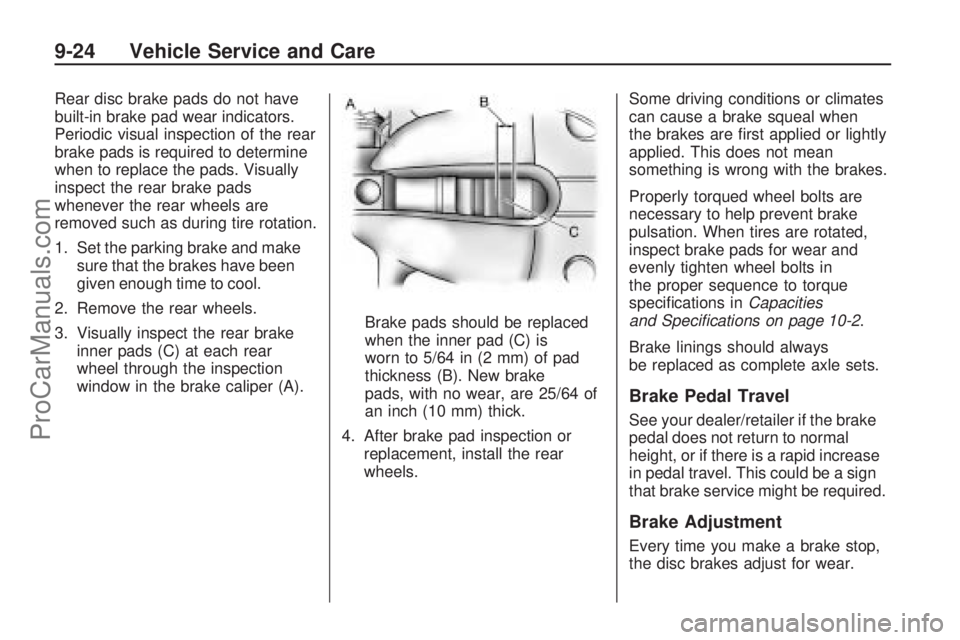
1. Set the parking brake and make
sure that the brakes have been
given enough time to cool.
2. Remove the rear wheels.
3. Visually inspect the rear brake
inner pads (C) at each rear
wheel through the inspection
window in the brake caliper (A).Brake pads should be replaced
when the inner pad (C) is
worn to 5/64 in (2 mm) of pad
thickness (B). New brake
pads, with no wear, are 25/64 of
an inch (10 mm) thick.
4. After brake pad inspection or
replacement, install the rear
wheels.Some driving conditions or climates
can cause a brake squeal when
the brakes are rst applied or lightly
applied. This does not mean
something is wrong with the brakes.
Properly torqued wheel bolts are
necessary to help prevent brake
pulsation. When tires are rotated,
inspect brake pads for wear and
evenly tighten wheel bolts in
the proper sequence to torque
specications inCapacities
and Specifications on page 10-2.
Brake linings should always
be replaced as complete axle sets.
Brake Pedal Travel
See your dealer/retailer if the brake
pedal does not return to normal
height, or if there is a rapid increase
in pedal travel. This could be a sign
that brake service might be required.
Brake Adjustment
Every time you make a brake stop,
the disc brakes adjust for wear.
9-24 Vehicle Service and Care
ProCarManuals.com
Page 216 of 304
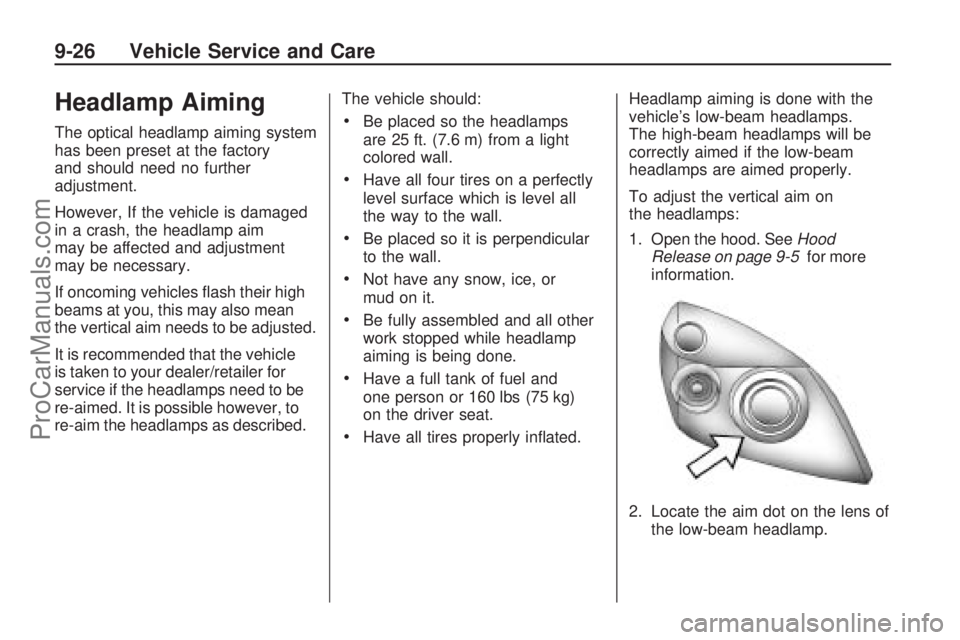
Headlamp Aiming
The optical headlamp aiming system
has been preset at the factory
and should need no further
adjustment.
However, If the vehicle is damaged
in a crash, the headlamp aim
may be affected and adjustment
may be necessary.
If oncoming vehicles ash their high
beams at you, this may also mean
the vertical aim needs to be adjusted.
It is recommended that the vehicle
is taken to your dealer/retailer for
service if the headlamps need to be
re-aimed. It is possible however, to
re-aim the headlamps as described.The vehicle should:Be placed so the headlamps
are 25 ft. (7.6 m) from a light
colored wall.
Have all four tires on a perfectly
level surface which is level all
the way to the wall.
Be placed so it is perpendicular
to the wall.
Not have any snow, ice, or
mudonit.
Be fully assembled and all other
work stopped while headlamp
aiming is being done.
Have a full tank of fuel and
one person or 160 lbs (75 kg)
on the driver seat.
Have all tires properly inated.Headlamp aiming is done with the
vehicle’s low-beam headlamps.
The high-beam headlamps will be
correctly aimed if the low-beam
headlamps are aimed properly.
To adjust the vertical aim on
the headlamps:
1. Open the hood. SeeHood
Release on page 9-5for more
information.
2. Locate the aim dot on the lens of
the low-beam headlamp.
9-26 Vehicle Service and Care
ProCarManuals.com
Page 228 of 304
Fuses Usage
16Front Passenger Seat
Detection Sensor
17Tire Pressure
Monitoring
System (TPMS)/
Rain Sensor/Inside
Rearview Mirror
18 Interior Lights
21 Outside Mirror Heating
22 Sunroof
23 Rear Power Window
24Diagnostic Link
Connector
29Accessory Power
Outlet (APO)
34 Sunroof
38 Door Locks
39 Seat Heating Driver
40Seat Heating Front
PassengerTires
Your new vehicle comes with
high-quality tires made by
a leading tire manufacturer.
If you ever have questions about
the tire warranty and where to
obtain service, see the “Limited
Warranty, Maintenance and
Owner Assistance Information”
manual for details.
{CAUTION
Poorly maintained and
improperly used tires are
dangerous.
Overloading your tires can
cause overheating as a
result of too much exing.
You could have an air-out
and a serious accident.
SeeLoading the Vehicle
on page 8-30.
(Continued)
CAUTION (Continued)
Underinated tires pose
the same danger as
overloaded tires.
The resulting accident
could cause serious
injury. Check all tires
frequently to maintain the
recommended pressure.
Tire pressure should be
checked when your tires
are cold. SeeInflation - Tire
Pressure on page 9-46.
Overinated tires are more
likely to be cut, punctured,
or broken by a sudden
impact — such as when
you hit a pothole. Keep
tires at the recommended
pressure.
(Continued)
9-38 Vehicle Service and Care
ProCarManuals.com
Page 229 of 304

CAUTION (Continued)
Worn, old tires can cause
accidents. If your tread
is badly worn, or if your
tires have been damaged,
replace them.
SeeHigh-Speed Operation
on page 9-47for ination
pressure adjustment for
high speed driving.
Low-Prole Tires
If the vehicle has 225/40ZR18
or 215/45R18 size tires, they
are classied as low-prole
performance tires. These tires
are designed for very responsive
driving on wet or dry pavement.
You may also notice more
road noise with low-prole
performance tires and that they
tend to wear faster.
Notice:If the vehicle has
low-prole tires, they are
more susceptible to damage
from road hazards or curb
impact than standard prole
tires. Tire and/or wheel
assembly damage can occur
when coming into contact with
road hazards like, potholes,
or sharp edged objects,
or when sliding into a curb.
The vehicle warranty does not
cover this type of damage.
Keep tires set to the correct
ination pressure and,
when possible avoid contact
with curbs, potholes, and
other road hazards.Winter Tires
If the vehicle has 225/40ZR18 or
215/45R18 size tires, they are
classied as low-prole performance
tires. These tires are designed for
very responsive driving on wet or dry
pavement. If you expect to drive
on snow or ice covered roads often,
you may want to get winter tires
for your vehicle. All season tires
provide good overall performance on
most surfaces but they may not
offer the traction you would like or
the same level of performance
as winter tires on snow or ice
covered roads.
Winter tires, in general, are
designed for increased traction on
snow and ice covered roads.
With winter tires, there may be
decreased dry road traction,
increased road noise, and shorter
tire tread life. After switching to
winter tires, be alert for changes in
vehicle handling and braking.
Vehicle Service and Care 9-39
ProCarManuals.com