height SATURN ASTRA 2009 User Guide
[x] Cancel search | Manufacturer: SATURN, Model Year: 2009, Model line: ASTRA, Model: SATURN ASTRA 2009Pages: 314, PDF Size: 1.94 MB
Page 226 of 314

Tire Sidewall Labeling
Useful information about a tire
is molded into its sidewall.
The examples below show a
typical passenger vehicle tire and
a compact spare tire sidewall.
(A) Tire Size
:The tire size is
a combination of letters and
numbers used to dene a
particular tire’s width, height,
aspect ratio, construction type,
and service description.See the “Tire Size” illustration
later in this section for more
detail.
(B) TPC Spec (Tire
Performance Criteria
Specication)
:Original
equipment tires designed to
GM’s specic tire performance
criteria have a TPC specication
code molded onto the sidewall.
GM’s TPC specications meet
or exceed all federal safety
guidelines.
(C) DOT (Department of
Transportation)
:The
Department of Transportation
(DOT) code indicates that
the tire is in compliance with
the U.S. Department of
Transportation Motor Vehicle
Safety Standards.
(D) Tire Identication Number
(TIN)
:The letters and numbers
following DOT (Department
of Transportation) code is the
Tire Identication Number (TIN).The TIN shows the manufacturer
and plant code, tire size, and
date the tire was manufactured.
The TIN is molded onto both
sides of the tire, although only
one side may have the date
of manufacture.
(E) Tire Ply Material
:The type
of cord and number of plies in the
sidewall and under the tread.
(F) Uniform Tire Quality
Grading (UTQG)
:Tire
manufacturers are required to
grade tires based on three
performance factors: treadwear,
traction, and temperature
resistance. For more information
seeUniform Tire Quality
Grading on page 9-57.
(G) Maximum Cold Ination
Load Limit
:Maximum load
that can be carried and
the maximum pressure needed
to support that load.
Passenger (P-Metric) Tire
Example
9-42 Vehicle Service and Care
ProCarManuals.com
Page 227 of 314
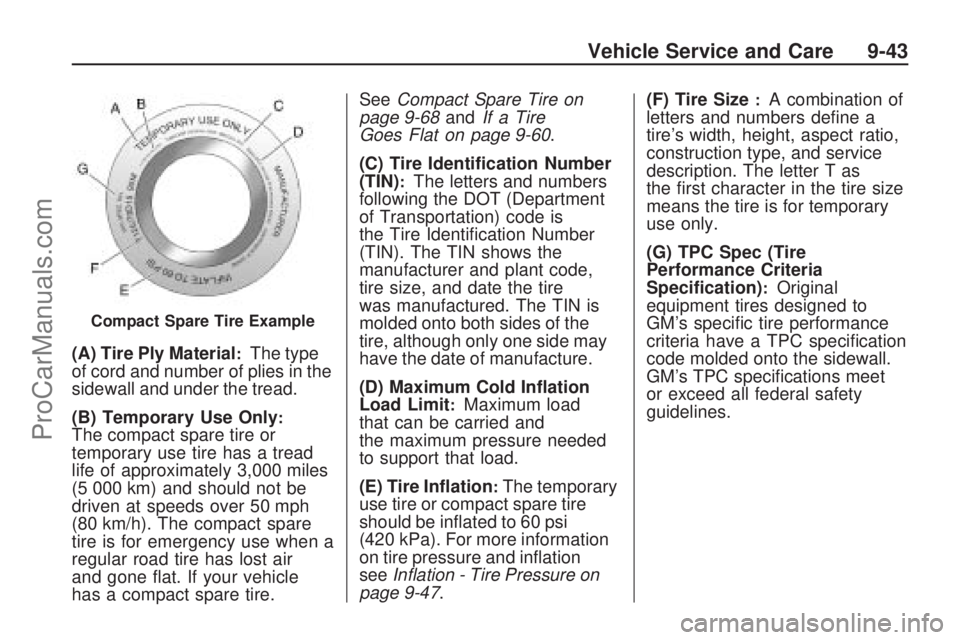
(A) Tire Ply Material:The type
of cord and number of plies in the
sidewall and under the tread.
(B) Temporary Use Only
:The compact spare tire or
temporary use tire has a tread
life of approximately 3,000 miles
(5 000 km) and should not be
driven at speeds over 50 mph
(80 km/h). The compact spare
tire is for emergency use when a
regular road tire has lost air
and gone at. If your vehicle
has a compact spare tire.SeeCompact Spare Tire on
page 9-68andIf a Tire
Goes Flat on page 9-60.
(C) Tire Identication Number
(TIN)
:The letters and numbers
following the DOT (Department
of Transportation) code is
the Tire Identication Number
(TIN). The TIN shows the
manufacturer and plant code,
tire size, and date the tire
was manufactured. The TIN is
molded onto both sides of the
tire, although only one side may
have the date of manufacture.
(D) Maximum Cold Ination
Load Limit
:Maximum load
that can be carried and
the maximum pressure needed
to support that load.
(E) Tire Ination
:The temporary
use tire or compact spare tire
should be inated to 60 psi
(420 kPa). For more information
on tire pressure and ination
seeInflation - Tire Pressure on
page 9-47.(F) Tire Size
:A combination of
letters and numbers dene a
tire’s width, height, aspect ratio,
construction type, and service
description. The letter T as
the rst character in the tire size
means the tire is for temporary
use only.
(G) TPC Spec (Tire
Performance Criteria
Specication)
:Original
equipment tires designed to
GM’s specic tire performance
criteria have a TPC specication
code molded onto the sidewall.
GM’s TPC specications meet
or exceed all federal safety
guidelines.
Compact Spare Tire Example
Vehicle Service and Care 9-43
ProCarManuals.com
Page 228 of 314

Tire Size
The following illustration shows
an example of a typical
passenger vehicle tire size.
(A) Passenger (P-Metric) Tire
:The United States version of
a metric tire sizing system.
The letter P as the rst
character in the tire size
means a passenger vehicle tire
engineered to standards set
by the U.S. Tire and Rim
Association.
(B) Tire Width
:The three-digit
number indicates the tire
section width in millimeters from
sidewall to sidewall.
(C) Aspect Ratio
:A two-digit
number that indicates the tire
height-to-width measurements.For example, if the tire size
aspect ratio is 60, as shown in
item C of the illustration, it would
mean that the tire’s sidewall is
60 percent as high as it is wide.
(D) Construction Code
:A letter
code is used to indicate the
type of ply construction in the
tire. The letter R means radial
ply construction; the letter D
means diagonal or bias ply
construction; and the letter B
means belted-bias ply
construction.
(E) Rim Diameter
:Diameter of
the wheel in inches.
(F) Service Description
:These characters represent the
load index and speed rating
of the tire. The load index
represents the load carry
capacity a tire is certied to
carry. The speed rating is the
maximum speed a tire is certied
to carry a load.
Tire Terminology and
Denitions
Air Pressure:The amount of
air inside the tire pressing
outward on each square inch
of the tire. Air pressure is
expressed in pounds per square
inch (psi) or kilopascal (kPa).
Accessory Weight
:This means
the combined weight of optional
accessories. Some examples
of optional accessories are,
automatic transmission, power
steering, power brakes, power
windows, power seats, and air
conditioning.
Aspect Ratio
:The relationship
of a tire’s height to its width.
Belt
:A rubber coated layer of
cords that is located between the
plies and the tread. Cords may
be made from steel or other
reinforcing materials.
9-44 Vehicle Service and Care
ProCarManuals.com
Page 243 of 314
Wheel Replacement
Replace any wheel that is bent,
cracked or badly rusted or corroded.
If the wheel bolts keep coming
loose, the wheel and wheel bolts
should be replaced. If the wheel
leaks air, replace it (except some
aluminum wheels, which can
sometimes be repaired). See your
dealer/retailer if any of these
conditions exist.
Your dealer/retailer will know the
kind of wheel you need.
Each new wheel should have the
same load-carrying capacity,
diameter, width, offset and be
mounted the same way as the
one it replaces.
If you need to replace any of the
wheels or wheel bolts, replace them
only with new GM original equipment
parts. This way, you will be sure to
have the right wheel and wheel bolts
for the vehicle.{CAUTION
Using the wrong replacement
wheels or wheel bolts on your
vehicle can be dangerous. It could
affect the braking and handling of
the vehicle, make the tires lose air
and make you lose control of
the vehicle. You could have a
collision in which you or others
could be injured. Always use the
correct wheel and wheel bolts for
replacement.
Notice:The wrong wheel can
also cause problems with bearing
life, brake cooling, speedometer
or odometer calibration,
headlamp aim, bumper height,
vehicle ground clearance, and tire
or tire chain clearance to the
body and chassis.
SeeChanging a Flat Tire on
page 9-61for more information.
Used Replacement Wheels
{CAUTION
Putting a used wheel on the
vehicle is dangerous. You cannot
know how it has been used or
how far it has been driven.
It could fail suddenly and cause a
crash. If you have to replace a
wheel, use a new GM original
equipment wheel.
Vehicle Service and Care 9-59
ProCarManuals.com
Page 308 of 314

F
Filter
Engine Air Cleaner............9-11
Final Drive
End Play Measurement....... 5-4
Finish Damage....................9-79
Fixed Mast Antenna.............6-24
Flashers, Hazard Warning....... 4-4
Flash-to-Pass........................ 4-8
Flat Tire..............................9-60
Flat Tire, Changing...............9-61
Flat Tire, Storing..................9-66
Fluid
Automatic Transmission.....9-12
Power Steering.................9-20
Windshield Washer...........9-20
Fog Lamp
Fog .................................. 5-2
Fog Lamp Light...................4-22
Fuel...................................8-34
Additives.........................8-34
California Fuel..................8-34
Driving for Better
Economy......................8-15
Filling a Portable Fuel
Container.....................8-37Fuel (cont.)
Filling the Tank.................8-36
Fuels in Foreign
Countries.....................8-35
Gage ..............................4-24
Gasoline Octane...............8-34
Gasoline Specications......8-34
Low Warning Light............4-24
Fuses.................................9-35
Engine Compartment
Fuse Block...................9-35
Rear Compartment
Fuse Block...................9-37
G
Gage
Fuel................................4-24
Speedometer...................4-13
Tachometer......................4-13
Gasoline
Octane............................8-34
Specications...................8-34
Glove Box............................ 3-1
GM Mobility Reimbursement
Program..........................12-6
H
Hazard Warning Flashers........ 4-4
Head Restraints..................... 1-5
Headlamp
Aiming ............................9-26
Headlamp Wiring.................9-34
Headlamps
Bulb Replacement.............9-28
Daytime Running Lamp....... 5-2
Delayed............................ 5-2
Exterior Lamps................... 5-1
Flash-to-Pass..................... 4-8
Front Turn Signal
Lamps .........................9-28
Halogen Bulbs..................9-28
High/Low Beam Changer..... 4-8
Heater................................. 7-1
Engine.............................. 8-5
Height Adjuster, Seat.............. 1-2
Highbeam On Light..............4-23
High-Speed Operation,
Tires...............................9-48
Highway Hypnosis................8-25
Hill and Mountain Roads.......8-26
Hood
Release............................ 9-5
i-4 INDEX
ProCarManuals.com
Page 312 of 314
S
Safety Belt Reminders..........4-13
Safety Belts.......................... 1-8
Care of ...........................1-23
Check.............................1-22
How to Wear Safety
Belts Properly...............1-12
Lap-Shoulder Belt.............1-18
Replacing Parts After a
Crash..........................1-23
Safety Belt Extender.........1-22
Safety Belt Use During
Pregnancy....................1-22
Scheduled Maintenance........11-3
Seats
Head Restraints................. 1-5
Heated Seats - Rear........... 1-6
Height Adjuster.................. 1-2
Lumbar Adjustment............. 1-3
Rear Seat Operation........... 1-7
Reclining Seatbacks............ 1-3
Securing Child
Restraints................1-51, 1-53Service................................ 9-2
Accessories and
Modications.................. 9-3
Adding Equipment to the
Outside of the Vehicle..... 9-4
California Perchlorate
Materials Requirements.... 9-3
California Proposition 65
Warning......................... 9-3
Doing Your Own Work........ 9-4
Engine Soon Lamp...........4-18
Owner Checks................... 9-4
Publications Ordering
Information.................12-15
Vehicle Soon Light............4-23
Service, Scheduling
Appointments...................12-8
Servicing Your
Airbag-Equipped Vehicle....1-35
Sheet Metal Damage............9-79
Shifting Into Park.................8-11
Shifting Out of Park..............8-12
Signals, Turn and
Lane-Change..................... 4-8Spare Tire
Compact.........................9-68
Installing..........................9-63
Removing........................9-62
Storing............................9-66
Specications, Capacities......10-2
Speedometer.......................4-13
StabiliTrak
®Indicator Light.....4-17
StabiliTrak®System..............8-19
Starting the Engine................ 8-3
Steering..............................8-20
Steering Wheel Controls,
Audio..............................6-23
Steering Wheel, Tilt Wheel...... 4-4
Storage Areas
Cupholders........................ 3-1
Glove Box......................... 3-1
Sunglasses Storage
Compartment.................. 3-1
Stuck in Sand, Mud, Ice, or
Snow..............................8-29
Sun Visors..........................2-11
Sunroof..............................2-12
i-8 INDEX
ProCarManuals.com