air condition SATURN ASTRA 2009 Owner's Manual
[x] Cancel search | Manufacturer: SATURN, Model Year: 2009, Model line: ASTRA, Model: SATURN ASTRA 2009Pages: 314, PDF Size: 1.94 MB
Page 228 of 314

Tire Size
The following illustration shows
an example of a typical
passenger vehicle tire size.
(A) Passenger (P-Metric) Tire
:The United States version of
a metric tire sizing system.
The letter P as the rst
character in the tire size
means a passenger vehicle tire
engineered to standards set
by the U.S. Tire and Rim
Association.
(B) Tire Width
:The three-digit
number indicates the tire
section width in millimeters from
sidewall to sidewall.
(C) Aspect Ratio
:A two-digit
number that indicates the tire
height-to-width measurements.For example, if the tire size
aspect ratio is 60, as shown in
item C of the illustration, it would
mean that the tire’s sidewall is
60 percent as high as it is wide.
(D) Construction Code
:A letter
code is used to indicate the
type of ply construction in the
tire. The letter R means radial
ply construction; the letter D
means diagonal or bias ply
construction; and the letter B
means belted-bias ply
construction.
(E) Rim Diameter
:Diameter of
the wheel in inches.
(F) Service Description
:These characters represent the
load index and speed rating
of the tire. The load index
represents the load carry
capacity a tire is certied to
carry. The speed rating is the
maximum speed a tire is certied
to carry a load.
Tire Terminology and
Denitions
Air Pressure:The amount of
air inside the tire pressing
outward on each square inch
of the tire. Air pressure is
expressed in pounds per square
inch (psi) or kilopascal (kPa).
Accessory Weight
:This means
the combined weight of optional
accessories. Some examples
of optional accessories are,
automatic transmission, power
steering, power brakes, power
windows, power seats, and air
conditioning.
Aspect Ratio
:The relationship
of a tire’s height to its width.
Belt
:A rubber coated layer of
cords that is located between the
plies and the tread. Cords may
be made from steel or other
reinforcing materials.
9-44 Vehicle Service and Care
ProCarManuals.com
Page 232 of 314
When to Check
Check your tires once a month
or more. Do not forget to
check the compact spare tire,
it should be at 60 psi (420 kPa).
For additional information
regarding the compact spare
tire, seeCompact Spare Tire
on page 9-68.
How to Check
Use a good quality pocket-type
gage to check tire pressure.
You cannot tell if your tires are
properly inated simply by
looking at them. Radial tires
may look properly inated even
when they are under-inated.
Check the tire’s ination
pressure when the tires are
cold. Cold means your vehicle
has been sitting for at least
three hours or driven no more
than 1 mile (1.6 km).Remove the valve cap from
the tire valve stem. Press the tire
gage rmly onto the valve to
get a pressure measurement.
If the cold tire ination pressure
matches the recommended
pressure on the Tire and
Loading Information label, no
further adjustment is necessary.
If the ination pressure is low,
add air until you reach the
recommended amount.
If you overll the tire, release air
by pushing on the metal stem
in the center of the tire valve.
Re-check the tire pressure with
the tire gage.
Be sure to put the valve caps
back on the valve stems.
They help prevent leaks by
keeping out dirt and moisture.High-Speed Operation
{CAUTION
Driving at high speeds, 100 mph
(160 km/h) or higher, puts an
additional strain on tires.
Sustained high-speed driving
causes excessive heat build up
and can cause sudden tire failure.
You could have a crash and
you or others could be killed.
Some high-speed rated tires
require ination pressure
adjustment for high speed
operation. When speed limits and
road conditions are such that a
vehicle can be driven at high
speeds, make sure the tires are
rated for high speed operation, in
excellent condition, and set to the
correct cold tire ination pressure
for the vehicle load.
9-48 Vehicle Service and Care
ProCarManuals.com
Page 235 of 314

Tire Pressure Monitor
Operation
This vehicle may have a Tire
Pressure Monitor System (TPMS).
The TPMS is designed to warn
the driver when a low tire pressure
condition exists. TPMS sensors
are mounted onto each tire and
wheel assembly, excluding the
spare tire. The TPMS sensors
monitor the air pressure in the
vehicle’s tires and transmit tire
pressure readings to a receiver
located in the vehicle.
When a low tire pressure condition
is detected, the TPMS illuminates
the low tire pressure warning
light located in the instrument
panel cluster.The low tire pressure warning light
comes on at each ignition cycle
until the tires are inated to
the correct ination pressure.
The low tire pressure warning light
may come on in cool weather
when the vehicle is rst started, and
then turn off as you start to drive.
This could be an early indicator that
the air pressure in the tire(s) are
getting low and need to be inated
to the proper pressure.
You must begin driving before the
TPMS system is operational.
TPMS sensors need to be installed
onto the full-size tire and wheel
assemblies, and the tires adjusted
to the manufacturers’ recommended
tire pressure amount.
A Tire and Load Information label is
attached to the vehicle, and
shows the size of the vehicle’s
original equipment tires and
the correct ination pressure for the
tires when they are cold. See
Loading the Vehicle on page 8-30,
for an example of the Tire andLoad Information label and its
location on the vehicle. Also see
Inflation - Tire Pressure on
page 9-47.
The vehicle’s TPMS can warn you
about a low tire pressure condition
but it does not replace normal
tire maintenance. SeeTire
Inspection and Rotation on
page 9-52andTires on page 9-40.
Notice:Liquid tire sealants
could damage the Tire Pressure
Monitor System (TPMS) sensors.
Sensor damage caused by
using a tire sealant is not covered
by your warranty. Do not use
liquid tire sealants.
Each TPMS sensor has a unique
identication code. Any time
you replace one or more of the
TPMS sensors or rotate the
vehicle’s tires, the identication
codes are automatically learned by
the TPMS. This occurs within a
few moments of driving the vehicle
over 19 mph (31 km/h).
Vehicle Service and Care 9-51
ProCarManuals.com
Page 238 of 314
When It Is Time for
New Tires
Various factors, such as
maintenance, temperatures, driving
speeds, vehicle loading, and
road conditions inuence when you
need new tires.
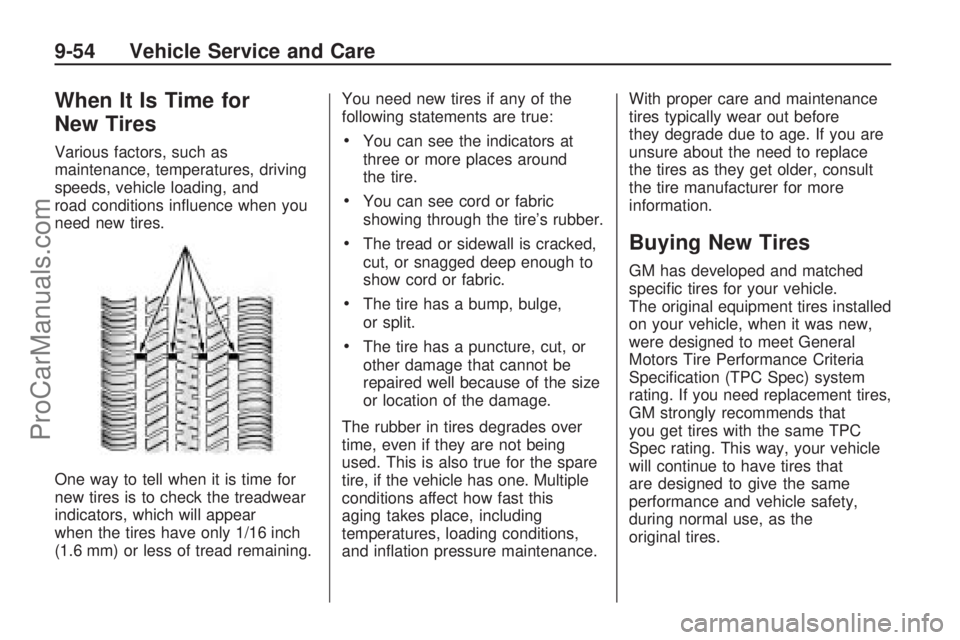
One way to tell when it is time for
new tires is to check the treadwear
indicators, which will appear
when the tires have only 1/16 inch
(1.6 mm) or less of tread remaining.You need new tires if any of the
following statements are true:You can see the indicators at
three or more places around
the tire.
You can see cord or fabric
showing through the tire’s rubber.
The tread or sidewall is cracked,
cut, or snagged deep enough to
show cord or fabric.
The tire has a bump, bulge,
or split.
The tire has a puncture, cut, or
other damage that cannot be
repaired well because of the size
or location of the damage.
The rubber in tires degrades over
time, even if they are not being
used. This is also true for the spare
tire, if the vehicle has one. Multiple
conditions affect how fast this
aging takes place, including
temperatures, loading conditions,
and ination pressure maintenance.With proper care and maintenance
tires typically wear out before
they degrade due to age. If you are
unsure about the need to replace
the tires as they get older, consult
the tire manufacturer for more
information.
Buying New Tires
GM has developed and matched
specic tires for your vehicle.
The original equipment tires installed
on your vehicle, when it was new,
were designed to meet General
Motors Tire Performance Criteria
Specication (TPC Spec) system
rating. If you need replacement tires,
GM strongly recommends that
you get tires with the same TPC
Spec rating. This way, your vehicle
will continue to have tires that
are designed to give the same
performance and vehicle safety,
during normal use, as the
original tires.
9-54 Vehicle Service and Care
ProCarManuals.com
Page 243 of 314
Wheel Replacement
Replace any wheel that is bent,
cracked or badly rusted or corroded.
If the wheel bolts keep coming
loose, the wheel and wheel bolts
should be replaced. If the wheel
leaks air, replace it (except some
aluminum wheels, which can
sometimes be repaired). See your
dealer/retailer if any of these
conditions exist.
Your dealer/retailer will know the
kind of wheel you need.
Each new wheel should have the
same load-carrying capacity,
diameter, width, offset and be
mounted the same way as the
one it replaces.
If you need to replace any of the
wheels or wheel bolts, replace them
only with new GM original equipment
parts. This way, you will be sure to
have the right wheel and wheel bolts
for the vehicle.{CAUTION
Using the wrong replacement
wheels or wheel bolts on your
vehicle can be dangerous. It could
affect the braking and handling of
the vehicle, make the tires lose air
and make you lose control of
the vehicle. You could have a
collision in which you or others
could be injured. Always use the
correct wheel and wheel bolts for
replacement.
Notice:The wrong wheel can
also cause problems with bearing
life, brake cooling, speedometer
or odometer calibration,
headlamp aim, bumper height,
vehicle ground clearance, and tire
or tire chain clearance to the
body and chassis.
SeeChanging a Flat Tire on
page 9-61for more information.
Used Replacement Wheels
{CAUTION
Putting a used wheel on the
vehicle is dangerous. You cannot
know how it has been used or
how far it has been driven.
It could fail suddenly and cause a
crash. If you have to replace a
wheel, use a new GM original
equipment wheel.
Vehicle Service and Care 9-59
ProCarManuals.com
Page 244 of 314
Tire Chains
{CAUTION
Do not use tire chains. There is
not enough clearance. Tire chains
used on a vehicle without the
proper amount of clearance can
cause damage to the brakes,
suspension or other vehicle parts.
The area damaged by the tire
chains could cause you to lose
control of the vehicle and you or
others may be injured in a crash.
Use another type of traction
device only if its manufacturer
recommends it for use on the
vehicle and tire size combination
and road conditions. Follow that
manufacturer’s instructions. To
help avoid damage to the vehicle,
drive slowly, readjust or remove
the device if it is contacting the
vehicle, and do not spin the
vehicle’s wheels. If you do nd
traction devices that will t,
install them on the front tires.
Tire Changing
If a Tire Goes Flat
It is unusual for a tire to blowout
while you are driving, especially if
you maintain your vehicle’s tires
properly. If air goes out of a tire, it is
much more likely to leak out slowly.
But if you should ever have a
blowout, here are a few tips about
what to expect and what to do:
If a front tire fails, the at tire creates
a drag that pulls the vehicle
toward that side. Take your foot off
the accelerator pedal and grip
the steering wheel rmly. Steer to
maintain lane position, and then
gently brake to a stop well out of the
traffic lane.
A rear blowout, particularly on a
curve, acts much like a skid and
may require the same correction you
would use in a skid. In any rear
blowout remove your foot from the
accelerator pedal. Get the vehicle
under control by steering the
way you want the vehicle to go.It may be very bumpy and noisy, but
you can still steer. Gently brake to a
stop, well off the road if possible.{CAUTION
Lifting a vehicle and getting under
it to do maintenance or repairs is
dangerous without the appropriate
safety equipment and training. If a
jack is provided with the vehicle,
it is designed only for changing a
at tire. If it is used for anything
else, you or others could be badly
injured or killed if the vehicle slips
off the jack. If a jack is provided
with the vehicle, only use it for
changing a at tire.
If a tire goes at, the next part
shows how to use the jacking
equipment to change a at tire
safely.
9-60 Vehicle Service and Care
ProCarManuals.com
Page 262 of 314

Rinse the vehicle well, before
washing and after to remove all
cleaning agents completely. If they
are allowed to dry on the surface,
they could stain.
Dry the nish with a soft, clean
chamois or an all-cotton towel to
avoid surface scratches and
water spotting.
High pressure car washes may
cause water to enter the vehicle.
Avoid using high pressure washes
closer than 12 inches (30 cm) to
the surface of the vehicle. Use of
power washers exceeding 1,200 psi
(8 274 kPa) can result in damage
or removal of paint and decals.
Weatherstrips
Silicone grease on weatherstrips
will make them last longer, seal
better, and not stick or squeak.
Apply silicone grease with a clean
cloth. During very cold, damp
weather frequent application
may be required.See “Fluids and Lubricants” in the
Index of the “Maintenance and
Warranty and Owner assistance
Information” manual.
Wheels and Trim — Aluminum
or Chrome
Your vehicle may have either
aluminum or chrome-plated wheels.
Keep the wheels clean using a
soft clean cloth with mild soap and
water. Rinse with clean water.
After rinsing thoroughly, dry with a
soft clean towel. A wax may then
be applied.
Notice:Chrome wheels and
other chrome trim may be
damaged if the vehicle is not
washed after driving on roads
that have been sprayed with
magnesium, calcium or sodium
chloride. These chlorides are
used on roads for conditions
such as ice and dust. Always
wash the vehicle’s chrome with
soap and water after exposure.Notice:Using strong soaps,
chemicals, abrasive polishes,
cleaners, brushes, or cleaners
that contain acid on aluminum or
chrome-plated wheels, could
damage the surface of the
wheel(s). The repairs would not
be covered by the warranty.
Use only approved cleaners on
aluminum or chrome-plated
wheels.
The surface of these wheels is
similar to the painted surface of your
vehicle. Do not use strong soaps,
chemicals, abrasive polishes,
abrasive cleaners, cleaners with
acid, or abrasive cleaning brushes
on them because you could damage
the surface. Do not use chrome
polish on aluminum wheels.
Notice:Using chrome polish on
aluminum wheels could damage
the wheels. The repairs would not
be covered by the warranty.
Use chrome polish on chrome
wheels only.
9-78 Vehicle Service and Care
ProCarManuals.com
Page 263 of 314

Use chrome polish only on
chrome-plated wheels, but avoid
any painted surface of the wheel,
and buff off immediately after
application.
Notice:Driving the vehicle
through an automatic car wash
that has silicone carbide tire
cleaning brushes, could damage
the aluminum or chrome-plated
wheels. The repairs would not be
covered by the warranty. Never
drive a vehicle equipped with
aluminum or chrome-plated
wheels through an automatic car
wash that uses silicone carbide
tire cleaning brushes.
Windshield and Wiper Blades
Clean the outside of the windshield
with glass cleaner.
Clean the rubber blades using a lint
free cloth or paper towel soaked with
windshield washer uid or a mild
detergent. Wash the windshield
thoroughly when cleaning the blades.Bugs, road grime, sap, and a buildup
of vehicle wash/wax treatments may
cause wiper streaking. Replace the
wiper blades if they are worn or
damaged.
Wipers can be damaged by:
Extreme dusty conditions
Sand and salt
Heat and sun
Snow and ice, without proper
removal
Tires
To clean the tires, use a stiff brush
with tire cleaner.
Notice:Using petroleum-based
tire dressing products on the
vehicle may damage the paint
nish and/or tires. When applying
a tire dressing, always wipe off
any overspray from all painted
surfaces on the vehicle.
Sheet Metal Damage
If the vehicle is damaged and
requires sheet metal repair or
replacement, make sure the body
repair shop applies anti-corrosion
material to parts repaired or replaced
to restore corrosion protection.
Original manufacturer replacement
parts will provide the corrosion
protection while maintaining
the vehicle warranty.
Finish Damage
Any stone chips, fractures or deep
scratches in the nish should be
repaired right away. Bare metal will
corrode quickly and may develop into
major repair expense.
Minor chips and scratches can be
repaired with touch-up materials
available from your dealer/retailer.
Larger areas of nish damage can be
corrected in your dealer’s/retailer’s
body and paint shop.
Vehicle Service and Care 9-79
ProCarManuals.com
Page 264 of 314
Underbody Maintenance
Chemicals used for ice and
snow removal and dust control can
collect on the underbody. If these
are not removed, corrosion and rust
can develop on the underbody
parts such as fuel lines, frame,
oor pan, and exhaust system
even though they have corrosion
protection.
At least every spring, ush these
materials from the underbody
with plain water. Clean any areas
where mud and debris can collect.
Dirt packed in close areas of
the frame should be loosened before
being ushed. Your dealer/retailer
or an underbody car washing
system can do this.
Chemical Paint Spotting
Some weather and atmospheric
conditions can create a chemical
fallout. Airborne pollutants can
fall upon and attack painted surfaces
on the vehicle. This damage can
take two forms: blotchy, ring-shaped
discolorations, and small, irregular
dark spots etched into the paint
surface.
Although no defect in the paint job
causes this, we will repair, at no
charge to the owner, the surfaces of
new vehicles damaged by this
fallout condition within 12 months or
12,000 miles (20 000 km) of
purchase, whichever occurs rst.
9-80 Vehicle Service and Care
ProCarManuals.com
Page 266 of 314

Capacities and Specications
The following approximate capacities are given in English and metric conversions. See “Fluids and Lubricants” in
the index of the “Limited Warranty, Maintenance and Owner Assistance Information” manual.
ApplicationCapacities
English Metric
Air Conditioning Refrigerant For the air conditioning system refrigerant charge
amount, see the refrigerant caution label located
under the hood. See your dealer/retailer for more
information.
Cooling System Automatic Transmission 6.2 qt 5.9 L
Manual Transmission 7.3 qt 6.9 L
Engine Oil with Filter 4.8 qt 4.5 L
Fuel Tank 11.9 gal 45.0 L
10-2 Technical Data
ProCarManuals.com